The thought of an interview can be nerve-wracking, but the right preparation can make all the difference. Explore this comprehensive guide to Experience with Irrigation Control Systems interview questions and gain the confidence you need to showcase your abilities and secure the role.
Questions Asked in Experience with Irrigation Control Systems Interview
Q 1. Explain the different types of irrigation controllers.
Irrigation controllers are the brains of your irrigation system, scheduling and controlling water delivery to your landscape. They come in various types, each with its own set of features and capabilities.
- Time-Clock Controllers: These are the most basic type, using a simple timer to activate and deactivate zones at pre-programmed times. Think of it like a kitchen timer for your sprinklers. They’re easy to use and affordable but lack sophisticated features.
- Weather-Based Controllers: These controllers incorporate weather data, usually via a rain sensor or connection to a weather station, to adjust watering schedules based on rainfall. This helps prevent overwatering and water waste.
- Smart Irrigation Controllers: These advanced controllers use sensors, weather data, and even soil moisture readings to optimize watering schedules. Many connect to a smartphone app for remote control and monitoring. They are the most efficient and water-conscious option, although also the most expensive.
- Centralized Controllers: Often used in large-scale irrigation projects, these controllers manage multiple zones and stations, providing comprehensive system oversight and control from a central location.
The best type of controller depends on the size and complexity of your irrigation system and your budget. A small residential lawn might only need a simple time-clock controller, while a large commercial landscape would benefit from a smart controller or a centralized system.
Q 2. Describe the functionality of a rain sensor in an irrigation system.
A rain sensor is a crucial component in water-wise irrigation. Its primary function is to prevent irrigation from running when it’s already raining or the ground is sufficiently moist.
The sensor typically contains a moisture-sensitive element that detects rainfall. When sufficient rainfall is detected, the sensor sends a signal to the irrigation controller, halting the watering cycle. Once the rain stops, the sensor reactivates the system, resuming the pre-programmed schedule. This simple mechanism significantly reduces water waste and protects plants from overwatering.
Think of it as a smart ‘pause’ button for your irrigation system – automatically triggered by nature.
Q 3. What are the benefits of using a smart irrigation system?
Smart irrigation systems offer a plethora of benefits over traditional time-clock systems, primarily focusing on water conservation and efficiency.
- Water Conservation: Smart systems use real-time data (weather, soil moisture, evapotranspiration) to precisely adjust watering schedules, minimizing water waste. This translates to significant savings on water bills.
- Improved Plant Health: By optimizing watering schedules, smart systems ensure plants receive the precise amount of water they need, leading to healthier, more vibrant landscapes.
- Remote Monitoring and Control: Most smart systems offer mobile apps for easy monitoring and control, even when you’re away from home. You can adjust schedules, monitor sensor data, and receive alerts about potential issues, all from your smartphone.
- Data-Driven Optimization: These systems collect data on water usage and weather patterns, allowing you to fine-tune your irrigation strategy over time for optimal efficiency.
- Reduced Maintenance: By preventing overwatering, smart systems can reduce the risk of issues like fungal diseases and soil erosion, ultimately minimizing maintenance needs.
For example, in a drought-prone region, a smart system could automatically reduce watering during dry spells, significantly conserving water resources and preventing unnecessary strain on the municipal water supply.
Q 4. How do you troubleshoot a malfunctioning irrigation valve?
Troubleshooting a malfunctioning irrigation valve requires a systematic approach. Here’s a step-by-step guide:
- Check the Power Supply: Ensure the valve is receiving power. Check the circuit breaker and wiring to the valve. Many valves have a small indicator light to show if they’re receiving power.
- Inspect the Solenoid: The solenoid is the electromagnet that opens the valve. Look for any damage or debris that might be preventing it from operating correctly. Sometimes a gentle tap can help dislodge any obstructions.
- Test the Valve Manually: Many valves have a manual override. Try opening and closing the valve manually to see if it moves freely. If it’s stuck, there could be debris in the valve or a mechanical problem.
- Examine the Water Supply: Ensure adequate water pressure reaches the valve. Check for clogs or leaks in the pipe leading to the valve.
- Verify Controller Signals: Use a multimeter to check the voltage signal sent from the controller to the valve. This will help determine if the problem lies with the controller or the valve itself.
- Check for Leaks: A significant leak near the valve could reduce water pressure or completely prevent the valve from operating.
If the problem persists after these steps, it’s best to call a qualified irrigation technician.
Q 5. What are the common causes of low water pressure in an irrigation system?
Low water pressure in an irrigation system can stem from various sources.
- Clogged Filters or Screens: Debris, sediment, or mineral buildup in the filter or screen can significantly restrict water flow. Regularly cleaning or replacing these filters is crucial.
- Pipe Restrictions: Clogs in pipes, due to sediment buildup or root intrusion, reduce water flow throughout the system. This often requires excavation and pipe repair or replacement.
- Leaking Pipes: Leaks in the piping system reduce the overall water pressure available to the irrigation system. These leaks need to be identified and repaired.
- Problems with the Pump (if applicable): If your system uses a pump, low water pressure can indicate pump malfunction, reduced pump efficiency, or insufficient pump capacity for the system’s demands.
- Main Water Line Issues: Low water pressure might originate from the main water supply line itself. Check your home’s water pressure to determine if the issue lies within your property’s system or with the municipal supply.
Pinpointing the cause requires checking all aspects of the water delivery chain from the main water supply to the individual sprinkler heads.
Q 6. Explain how to program a time-clock irrigation controller.
Programming a time-clock irrigation controller involves setting the days of the week and the start and run times for each zone in your system.
Steps typically include:
- Setting the Clock: Set the correct date and time on the controller.
- Setting the Watering Days: Select the days of the week you want each zone to water (e.g., Mondays, Wednesdays, and Fridays).
- Setting the Start Time: Specify the time each zone should begin watering.
- Setting the Run Time: Determine the duration each zone should water (usually in minutes). This depends on the size of the zone and the water pressure.
- Creating Watering Schedules for Each Zone (Station): Repeat steps 3 and 4 for each zone/station in your irrigation system.
Important Considerations:
- Water Pressure: Adjust run times based on your water pressure. Lower pressure might require longer run times to adequately water the zone.
- Soil Type: Consider your soil type when setting run times. Clay soils retain water longer than sandy soils.
- Weather Conditions: You might need to adjust watering schedules during periods of rain or extreme temperatures.
Most controllers have clear instructions included with the unit. Always refer to your specific controller’s manual for detailed programming steps. Using diagrams or zone maps can greatly help you organize your schedule.
Q 7. Describe your experience with different irrigation system components (e.g., pumps, valves, sensors).
Throughout my career, I’ve worked extensively with a wide range of irrigation system components, gaining hands-on experience with their installation, maintenance, and troubleshooting.
- Pumps: I’ve worked with both centrifugal and submersible pumps, varying in horsepower and pressure capabilities. Experience includes pump selection, installation, maintenance, and troubleshooting problems like cavitation and priming issues.
- Valves: I’m proficient with various valve types, including solenoid valves, diaphragm valves, and ball valves. My expertise covers valve selection, installation, testing, and repair, including resolving issues related to valve leaks or sticking solenoids.
- Sensors: I have experience with various sensors, including rain sensors, soil moisture sensors, and flow meters. This includes understanding sensor technology, installation, calibration, and troubleshooting malfunctioning sensors.
- Controllers: I’ve worked with a variety of controllers ranging from basic time-clock controllers to sophisticated smart controllers. My experience spans controller programming, network configuration (for smart controllers), and troubleshooting controller malfunctions.
- Pipes and Fittings: Proficient in selecting appropriate pipe materials (PVC, polyethylene), understanding pipe sizing and pressure ratings, and carrying out installations that adhere to industry best practices.
I’m adept at identifying compatible components and designing efficient and reliable irrigation systems based on specific site conditions and client requirements. A recent project involved designing a smart irrigation system for a large commercial landscape, integrating various sensors and a centralized controller to optimize water usage and minimize maintenance needs. This project highlighted my skills in system design, component selection, installation, and programming.
Q 8. How do you determine the water requirements for a specific landscape?
Determining water requirements for a landscape involves a multifaceted approach, combining scientific principles with practical considerations. It’s not a simple calculation, but rather a process that balances plant needs with water conservation.
1. Evapotranspiration (ET): This is the key. ET is the combined loss of water from the soil through evaporation and from the plants through transpiration. We use weather data (temperature, humidity, wind speed, solar radiation) and plant type to estimate ET. There are readily available ET calculators and software (like CIMIS in California) that assist in this calculation.
2. Soil Type and Water Holding Capacity: Different soils retain varying amounts of water. Sandy soils drain quickly, requiring more frequent, but smaller, irrigations. Clay soils retain water longer, needing less frequent, but potentially larger, irrigations. A soil test helps determine this.
3. Plant Type and Density: A lush lawn requires significantly more water than a sparsely planted desert garden. The type of plants—their root systems and leaf area—will influence water needs. Mature trees have deeper roots and higher water requirements than young ones.
4. Microclimate: Shade, wind exposure, and slope affect how quickly the soil dries. A south-facing slope in a sunny area will dry out faster than a north-facing slope in a shaded area.
5. Irrigation Efficiency: The type of irrigation system (sprinklers, drip, etc.) and its efficiency factor must be accounted for. A system with high water loss due to wind or runoff will require a higher input to achieve the same plant water needs.
Example: Let’s say we have a lawn area with a particular type of grass, a specific soil type, and a particular climate. We’d use an ET calculator to determine the daily ET. Then, accounting for soil water holding capacity and irrigation system efficiency, we can calculate the amount of water needed per square foot per day. The total water needs are then derived by multiplying this value by the area of the lawn.
Q 9. Explain the principles of water conservation in irrigation systems.
Water conservation in irrigation is crucial for sustainability and cost-effectiveness. The principles revolve around maximizing the amount of water that reaches plant roots while minimizing water waste.
- Efficient Irrigation Techniques: Using drip irrigation, subsurface irrigation, or other low-volume, high-efficiency systems significantly reduces water loss compared to conventional sprinkler systems.
- Smart Controllers: Weather-based irrigation controllers, soil moisture sensors, and evapotranspiration sensors allow for precise irrigation scheduling, adjusting water delivery based on real-time conditions, not just on a set timer.
- Proper System Design and Maintenance: A well-designed irrigation system with properly installed and regularly maintained components minimizes leaks, broken heads, and other sources of water loss.
- Water-Wise Landscaping: Selecting drought-tolerant plants, using mulch to retain soil moisture, and grouping plants based on water requirements dramatically reduces overall water consumption.
- Regular Monitoring and Adjustments: Constantly monitoring the system for leaks, checking soil moisture, and adapting the irrigation schedule as needed optimizes water use.
- Greywater Recycling (Where Applicable): In some cases, reusing non-potable water (from showers or laundry) for irrigation can significantly reduce potable water demand.
Example: A poorly maintained sprinkler system with leaking valves and misaligned sprinkler heads can waste 30% or more of the water being delivered. By addressing these issues through regular maintenance, and by employing a smart controller that adjusts to daily weather conditions, significant water savings can be achieved.
Q 10. What are the different types of irrigation techniques?
Several irrigation techniques exist, each with its own advantages and disadvantages depending on the landscape, soil conditions, and budget.
- Drip Irrigation: Delivers water directly to the roots, minimizing evaporation and runoff. Ideal for individual plants, trees, or rows of crops.
- Sprinkler Irrigation: Uses spray heads to water a larger area. While efficient in some situations, susceptible to evaporation and wind drift, making it less water-efficient than drip.
- Flood Irrigation: Flooding an entire field or area with water. Very inefficient but sometimes used for low-value crops on flat land.
- Subsurface Drip Irrigation (SDI): Water is delivered through a network of pipes placed underground. Minimizes evaporation and weed growth, but is more expensive to install.
- Micro-Sprinklers: Smaller spray heads deliver water more precisely than larger sprinklers, reducing water waste. They are suitable for smaller areas needing more localized watering.
- Soaker Hoses: Perforated hoses that slowly release water into the soil near the plant roots. Easy to install, good for gardens or flower beds.
Example: A homeowner with a small vegetable garden might use drip irrigation for precise water delivery to each plant. A large golf course might use a combination of sprinkler and subsurface drip irrigation, utilizing sprinklers for the fairways and drip for trees and sensitive areas.
Q 11. How do you perform routine maintenance on an irrigation system?
Routine maintenance is paramount for optimal performance and longevity of any irrigation system. Neglecting this can lead to costly repairs and significant water waste.
- Regular Inspections: Weekly walk-throughs to check for leaks, broken sprinkler heads, clogged emitters, or malfunctioning valves.
- Backflow Preventer Testing: Annual testing by a qualified professional to ensure proper functioning and prevent contamination of potable water.
- Valve Operation Check: Periodically check the operation of all valves to ensure they open and close properly.
- Cleaning and Flushing: Periodically flush the lines to remove sediment and debris that can clog emitters and sprinkler heads.
- Sprinkler Head Adjustment: Ensure proper coverage and spray patterns. Adjust heads as needed to prevent overwatering or uneven distribution.
- Winterization (In Cold Climates): Properly drain the system to prevent pipes from freezing and bursting.
- Leak Detection and Repair: Promptly address any leaks to prevent water loss and potential damage.
Example: During a routine inspection, a homeowner notices a sprinkler head spraying water directly into a sidewalk instead of the lawn. By simply adjusting the head, a significant amount of wasted water is immediately saved.
Q 12. What software or programming languages are you proficient in for irrigation control systems?
My proficiency in software and programming languages for irrigation control systems includes:
- Irrigation Control Software: Extensive experience with various commercial irrigation control software packages, such as Rain Bird, Hunter, and Toro, including their programming interfaces for scheduling, weather adjustments, and remote monitoring.
- SCADA Systems: Familiar with Supervisory Control and Data Acquisition (SCADA) systems used for managing large-scale irrigation networks. Experience includes programming and configuring data logging and alarming systems within the SCADA environment.
- Programming Languages: Proficient in Python for data analysis, automation of irrigation control processes, and integration with weather APIs and other data sources. Some experience with C++ and other languages for embedded system programming.
- Databases: Experience working with relational databases (such as MySQL or PostgreSQL) for storing historical irrigation data for analysis and reporting purposes.
Example: I developed a Python script that automatically adjusts irrigation schedules based on real-time weather data from a local weather station, minimizing water waste during periods of rain or high humidity.
Q 13. Describe your experience with hydraulic calculations for irrigation design.
Hydraulic calculations are fundamental to designing efficient and effective irrigation systems. My experience encompasses applying principles of fluid mechanics to determine pipe sizes, pump selection, and pressure requirements.
Pipe Sizing: Using Darcy-Weisbach equation or Hazen-Williams equation to calculate head loss through pipes and determine appropriate pipe diameters to maintain adequate pressure and flow rate across the entire system.
Pump Selection: Using pump curves and system head calculations to select appropriate pumps that meet the required flow rate and pressure while minimizing energy consumption.
Pressure Regulation: Designing and implementing pressure regulating devices (pressure reducing valves, pressure compensating emitters) to maintain uniform pressure throughout the system and optimize water distribution.
Emitter Selection and Spacing: Calculating the appropriate spacing and flow rates of emitters or sprinkler heads to achieve uniform water application based on the plant’s water needs and soil infiltration characteristics.
Example: In a recent project, I used hydraulic modeling software to optimize the pipe network layout for a large agricultural field, reducing the head loss and enabling the use of a smaller, more energy-efficient pump.
Q 14. Explain your experience with different types of irrigation scheduling techniques.
I have experience with various irrigation scheduling techniques, each with its own strengths and weaknesses. The best choice depends on the specific site, plant type, and water resources.
- Fixed Schedule: A simple approach with set irrigation durations and intervals. Least efficient and prone to overwatering.
- Climate-Based Scheduling: Uses weather data such as evapotranspiration (ET) to adjust irrigation schedules. More efficient than fixed schedules but requires access to accurate weather information.
- Soil Moisture-Based Scheduling: Employing soil moisture sensors to monitor soil water content and trigger irrigation only when needed. The most efficient method as it responds directly to plant water needs.
- Crop Coefficient Approach: Uses crop coefficients to adjust the reference evapotranspiration (ETo) to the specific needs of a crop. Allows for a more precise calculation of plant water requirements.
Example: For a high-value landscape, soil moisture sensors would be ideal to ensure the plants receive the precise amount of water needed, preventing both overwatering and underwatering. For a large field of low-value crops, a climate-based scheduling approach might be sufficient and more cost-effective.
Q 15. How do you handle emergencies such as a major water leak?
Handling a major water leak requires immediate action to minimize damage and water waste. My first step is to locate the source of the leak, often using a combination of visual inspection, pressure testing, and potentially employing specialized leak detection equipment. Once identified, I’ll immediately shut off the affected zone’s valves to isolate the leak. This prevents further water loss and damage. Next, I’ll assess the severity of the leak. For minor leaks, repairs might be straightforward. For major breaks in pipes, I may need to call in specialized plumbers or contractors, particularly if it involves excavation or significant pipe replacement. Simultaneously, I’ll notify the appropriate personnel – building management, property owners, or other stakeholders – to keep everyone informed and coordinate repairs. Accurate record-keeping throughout the process – including the time of the leak, location, repair actions, and costs – is crucial for future maintenance and insurance purposes. For instance, in one project, a burst pipe near a main valve caused significant flooding. By quickly isolating the valve and calling emergency services, we minimized the damage, preventing extensive structural issues and significant financial loss.
Career Expert Tips:
- Ace those interviews! Prepare effectively by reviewing the Top 50 Most Common Interview Questions on ResumeGemini.
- Navigate your job search with confidence! Explore a wide range of Career Tips on ResumeGemini. Learn about common challenges and recommendations to overcome them.
- Craft the perfect resume! Master the Art of Resume Writing with ResumeGemini’s guide. Showcase your unique qualifications and achievements effectively.
- Don’t miss out on holiday savings! Build your dream resume with ResumeGemini’s ATS optimized templates.
Q 16. What safety procedures do you follow while working on an irrigation system?
Safety is paramount when working on irrigation systems. Before starting any work, I always conduct a thorough site assessment to identify potential hazards. This includes checking for energized electrical equipment, underground utilities (gas lines, cables), and potential trip hazards. I’ll then implement appropriate safety measures such as using lockout/tagout procedures for electrical equipment, wearing personal protective equipment (PPE) – including safety glasses, gloves, and steel-toed boots – and ensuring adequate ventilation in confined spaces. When working at heights, I use appropriate fall protection equipment. Furthermore, I emphasize communication: I inform others about my location and the work I’m doing, and I clearly mark off work areas to prevent accidents. Before turning systems back on after maintenance or repairs, I conduct a comprehensive system check to ensure proper functionality and prevent further issues. Think of it like this: just as surgeons meticulously follow sterile procedures, we follow strict safety protocols to avoid injuries and system damage.
Q 17. Explain your understanding of water flow and pressure in irrigation pipes.
Understanding water flow and pressure is fundamental to efficient irrigation. Water flow, measured in gallons per minute (GPM) or liters per minute (LPM), describes the volume of water moving through a pipe. Pressure, measured in pounds per square inch (PSI) or kilopascals (kPa), represents the force exerted by the water against the pipe walls. These two factors are interconnected: higher pressure generally leads to higher flow rates, but this relationship isn’t linear, as friction within the pipes, valve restrictions, and elevation changes all affect flow. The system’s design needs to balance these. For example, a large diameter pipe will offer less resistance to flow than a smaller diameter pipe, leading to a higher flow rate at the same pressure. Efficient irrigation requires sufficient pressure to reach the furthest points of the system but not so high as to cause pipe damage or inefficient water usage. We use specialized tools and software to calculate the ideal pressure and flow rates for different sections of the system, ensuring even water distribution throughout the irrigation network. Proper pressure regulation is critical to avoid overwatering some areas while leaving others dry.
Q 18. How do you deal with conflicting priorities in managing multiple irrigation systems?
Managing multiple irrigation systems with conflicting priorities demands a structured approach. I use a scheduling and prioritization system that considers various factors, including water availability, crop needs, weather conditions, and system capacity. I might employ a combination of techniques, such as time-based scheduling where different zones are watered at different times, or using sensors to trigger irrigation based on soil moisture levels. Prioritization might involve giving preference to systems serving high-value crops or areas with higher water stress. Regular monitoring of all systems is vital to track performance, detect anomalies, and adapt the schedule accordingly. For example, a sudden heatwave might require adjusting the schedule to increase watering frequency for sensitive crops. Good communication with stakeholders is essential to ensure everyone understands the priorities and reasons behind scheduling decisions. Using project management software can help track and manage multiple irrigation systems effectively and facilitate communication.
Q 19. What are the limitations of different irrigation control system technologies?
Different irrigation control system technologies have their own limitations. Traditional timer-based systems, while simple and inexpensive, lack flexibility and precision. They don’t consider weather or soil moisture, leading to potential overwatering or underwatering. Sensor-based systems, while more precise and responsive, can be more expensive and require maintenance and calibration. They are also vulnerable to sensor failure. Wireless communication systems offer greater control and monitoring capabilities but are subject to signal interference and security concerns. Cloud-based systems provide extensive data analysis and remote control, but they rely on reliable internet connectivity. Finally, choosing the right technology requires careful consideration of factors such as budget, system size, environmental conditions, and the level of automation desired. Understanding these limitations allows for informed decision-making, ensuring the selection of a technology best suited to the specific application.
Q 20. How do you ensure the accuracy of water usage measurements?
Accurate water usage measurement is essential for optimizing irrigation efficiency and managing water resources. This involves a multi-pronged approach. First, we use flow meters strategically placed at key points in the irrigation system to measure the volume of water passing through each zone. These meters can be mechanical or electronic, providing readings either on-site or remotely transmitted to a central monitoring system. Regular calibration and maintenance of these flow meters are crucial for maintaining accuracy. Secondly, data loggers are used to track weather data like rainfall, temperature, and humidity; this helps in adjusting the irrigation schedule based on environmental changes. Finally, comparing water usage data with crop water requirements, based on factors such as soil type and plant evapotranspiration rates, enables us to verify the accuracy and efficiency of our water application. Any discrepancies between measured water usage and expected water demands would prompt a thorough investigation into potential leaks or inefficiencies in the system.
Q 21. Describe your experience with troubleshooting problems related to soil conditions and irrigation efficiency.
Troubleshooting soil conditions and irrigation efficiency often requires a holistic approach. I begin by assessing soil type and texture to determine its water-holding capacity and drainage characteristics. Poor drainage can lead to overwatering and root rot, while sandy soils require more frequent irrigation. Soil moisture sensors can help me precisely monitor soil moisture levels, which are then compared to optimal levels for the specific crop. If I find areas with consistently high or low moisture despite efficient irrigation, I’ll investigate further. Possible causes could include compacted soil, poorly functioning emitters, or inadequate irrigation system design. I might employ techniques like soil aeration to improve drainage, or adjust the irrigation system’s layout or emitter flow rates to provide more uniform water distribution. In some instances, I might recommend soil amendments to improve water retention or drainage. For example, in one project, we discovered that poor drainage due to compacted soil led to uneven water distribution, causing stress to certain plants. By aerating the soil and making minor adjustments to the sprinkler system, we achieved a more uniform and efficient irrigation pattern.
Q 22. Explain how you would design an irrigation system for a specific site, considering factors like soil type and plant needs.
Designing an irrigation system starts with a thorough site assessment. This involves understanding the specific needs of the plants and the characteristics of the soil. For example, sandy soil drains quickly requiring more frequent, but shorter, irrigation cycles compared to clay soil which retains water longer and needs less frequent, but longer, watering.
Step-by-step design process:
- Site Survey: Mapping the area, identifying plant types and their water requirements, assessing soil type (using a soil test kit or consulting a soil scientist), analyzing sun exposure, and considering slope and drainage.
- Water Source Selection: Determining the available water source (municipal water, well, rainwater harvesting) and its capacity.
- Irrigation Method Selection: Choosing the appropriate irrigation method (drip, sprinkler, micro-sprinkler, subsurface) based on plant type, soil type, and water availability. Drip irrigation is highly efficient for individual plants, while sprinklers are suitable for larger areas with less precise water delivery.
- System Layout: Designing the layout of pipes, valves, emitters, and controllers. This includes calculating the required pipe diameters and pressure based on the flow rate needed for each zone.
- Controller Programming: Setting the irrigation schedule based on the plant’s water needs, soil type, and weather conditions. This could involve utilizing weather sensors to adjust watering based on evapotranspiration rates.
- Testing and Adjustment: Running the system to check for leaks, ensure even water distribution, and making adjustments to optimize performance. Observing plant health after watering to fine-tune the schedule.
Example: In a landscape with a mix of drought-tolerant shrubs and thirsty vegetables, I would use a combination of drip irrigation for the vegetables and a more widely spaced sprinkler system for the shrubs. The drip system would deliver water directly to the roots, maximizing efficiency, while the sprinklers provide adequate coverage for the shrubs.
Q 23. How do you optimize an irrigation system for water conservation?
Optimizing an irrigation system for water conservation focuses on efficient water delivery and smart control. This is achieved through several key strategies:
- Using water-wise irrigation technologies: Employing drip or micro-sprinkler systems delivers water directly to plant roots, minimizing evaporation and runoff. Subsurface drip irrigation can be incredibly effective in reducing water loss.
- Soil moisture sensors: Installing soil moisture sensors provides real-time data on soil water content, preventing overwatering. This allows for irrigation only when needed, avoiding unnecessary water use.
- Weather-based irrigation controllers: Utilizing controllers that incorporate weather data (temperature, rainfall, evapotranspiration) automatically adjust the irrigation schedule based on current conditions. This ensures water is only applied when it is needed.
- Regular system maintenance: Checking for leaks, replacing worn-out emitters, and ensuring proper pressure regulation prevent water loss and maintain system efficiency. A well-maintained system is a water-efficient system.
- Proper system design: Ensuring correct pipe sizing, emitter selection, and pressure regulation prevents overwatering or under-watering.
- Irrigation scheduling optimization: Employing techniques like deficit irrigation (reducing water applied during certain growth stages) can conserve water without significantly impacting plant health. This must be carefully considered for each plant type.
Example: In a large agricultural setting, installing a network of soil moisture sensors and integrating them with a weather-based irrigation controller resulted in a 25% reduction in water usage without compromising crop yields.
Q 24. What is your experience with various types of soil sensors and their applications in irrigation management?
My experience encompasses a range of soil moisture sensors, each with unique applications:
- Tensiometers: Measure soil water tension, providing a direct indication of soil water availability. They are relatively inexpensive and reliable but require regular calibration and are best for monitoring specific areas rather than extensive fields.
- Capacitance sensors: Measure soil dielectric constant, which changes with water content. They are suitable for automated irrigation systems and offer rapid readings. However, they can be affected by soil salinity and temperature variations.
- Neutron probes: Use neutron radiation to measure soil water content. They provide accurate readings over a larger volume of soil, suitable for large fields. They require specialized training and licensing, however.
- Time domain reflectometry (TDR) sensors: Measure soil water content by analyzing the reflection of electromagnetic waves. They are accurate, relatively unaffected by soil type variations, but can be costly.
Application Example: In a vineyard setting, we used capacitance probes integrated into a central irrigation controller. The data from these probes was used to create a zonal irrigation strategy, watering areas only when necessary. This resulted in significant water savings while ensuring healthy grapevine growth.
Q 25. Explain your understanding of different types of irrigation controllers (e.g., central, decentralized, WiFi controlled).
Irrigation controllers manage the operation of irrigation systems, varying in complexity and control methods:
- Central Controllers: Manage the entire irrigation system from a single point. They offer comprehensive control but require more extensive wiring and are less adaptable to changes in zones. Simple time-based programs are common here.
- Decentralized Controllers: Divide the system into smaller, independently controlled zones. This offers greater flexibility and allows for customized scheduling for different plant needs. It is more robust to failures in one zone.
- WiFi-Controlled Controllers: Allow remote monitoring and control through a smartphone app or computer. This provides great flexibility and convenience but requires a reliable internet connection. Many features such as weather integration are enabled here.
Example: A large park might use a decentralized system with multiple controllers managing different areas, while a small residential garden may benefit from a simple, WiFi-enabled controller for ease of management.
Q 26. What are the environmental impacts of inefficient irrigation practices and how can these be mitigated?
Inefficient irrigation practices have significant environmental consequences:
- Water depletion: Overwatering leads to groundwater depletion and reduced water availability for other uses.
- Soil erosion: Runoff from excessive irrigation can cause soil erosion, reducing soil fertility and leading to sedimentation in waterways.
- Salinization: Excessive irrigation in arid and semi-arid regions can lead to salt accumulation in the soil, affecting plant health and land productivity.
- Nutrient runoff: Fertilizers applied with irrigation water can be carried away by runoff, polluting waterways and contributing to algal blooms.
- Increased energy consumption: Inefficient irrigation systems require more energy to pump and distribute water.
Mitigation Strategies:
- Implementing water-efficient irrigation technologies (as discussed in question 2).
- Using soil and weather data to optimize irrigation schedules.
- Promoting water-wise landscaping using drought-tolerant plants.
- Proper nutrient management to reduce fertilizer runoff.
- Regular system maintenance to prevent leaks and ensure optimal efficiency.
- Educating farmers and landowners on best irrigation practices.
Q 27. Describe your experience with data logging and analysis in irrigation systems.
Data logging and analysis are crucial for optimizing irrigation systems. Sensors collect data (soil moisture, weather, etc.), and this information is logged and analyzed to understand system performance and make improvements.
Methods:
- Data acquisition systems: Collect data from various sensors and store it in a central database.
- Data visualization tools: Present data in user-friendly formats (graphs, charts) to identify trends and anomalies.
- Data analysis techniques: Statistical methods are applied to analyze data and identify areas for improvement (e.g., identifying inefficiencies in water application). Machine learning models can be used to predict future water needs.
Example: In a recent project, we used data logging to identify a pattern of overwatering in a specific zone. By analyzing the data, we adjusted the irrigation schedule, resulting in a 15% reduction in water use without impacting crop yield. We also used this data to inform the design of future installations.
Q 28. How do you stay current with the latest technologies and advancements in irrigation control systems?
Staying current with advancements in irrigation control systems involves several strategies:
- Professional development: Attending conferences, workshops, and training sessions focused on irrigation technology and management.
- Industry publications: Reading trade journals, research papers, and technical reports.
- Online resources: Following industry blogs, websites, and online forums.
- Networking with colleagues: Participating in professional organizations and networking events to share knowledge and learn from others’ experiences.
- Manufacturer engagement: Staying informed about the latest products and technologies released by major manufacturers.
Example: I recently completed a certification program in smart irrigation technologies which familiarized me with the latest advances in sensor technology and data-driven irrigation management. This knowledge has been directly applicable in optimizing irrigation systems for clients.
Key Topics to Learn for Experience with Irrigation Control Systems Interview
- System Components & Functionality: Understanding the various components of irrigation control systems (sensors, controllers, actuators, communication networks) and how they interact to automate irrigation processes.
- Programming & Software: Familiarity with programming languages or software used to configure and manage irrigation controllers (e.g., specific software platforms, scripting languages). Demonstrate understanding of scheduling, sensor integration, and data analysis within these systems.
- Water Management Strategies: Discuss different irrigation scheduling techniques (e.g., weather-based, soil moisture-based) and their impact on water conservation and efficiency. Be prepared to discuss the advantages and disadvantages of various approaches.
- Troubleshooting & Maintenance: Describe your experience identifying and resolving common issues in irrigation systems, including sensor malfunctions, communication errors, and pump failures. Highlight your preventative maintenance strategies.
- Data Analysis & Reporting: Explain how you use data collected from irrigation systems (e.g., soil moisture, rainfall, irrigation run times) to optimize irrigation schedules and improve overall efficiency. Show understanding of data interpretation and reporting.
- Hydraulics & Flow Control: Demonstrate understanding of basic hydraulic principles related to water flow, pressure, and pipe sizing within irrigation systems. Be ready to discuss pressure regulation and flow control mechanisms.
- Integration with other Systems: Discuss experience with integrating irrigation systems with other agricultural technologies (e.g., weather stations, soil sensors, GPS systems) or smart home/building management systems.
Next Steps
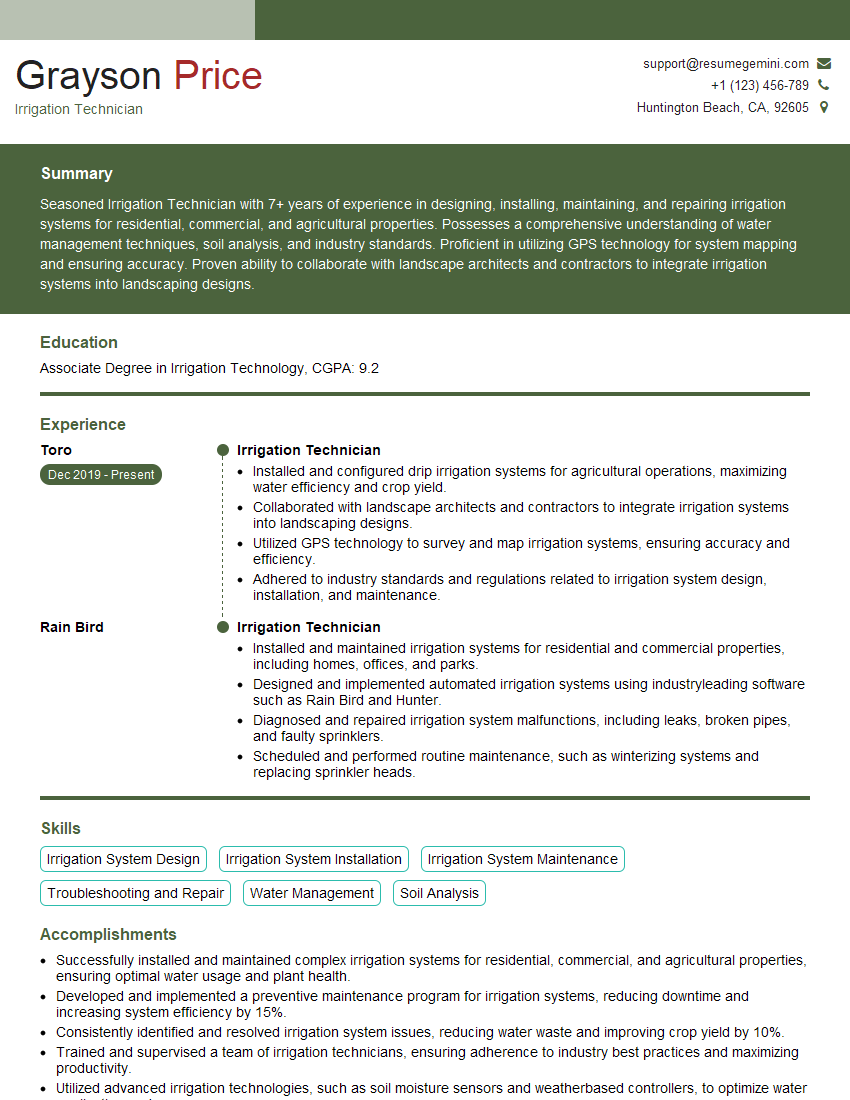
Mastering irrigation control systems knowledge is crucial for advancing your career in agriculture, landscape management, or related fields. A strong understanding of these systems demonstrates valuable technical skills and a commitment to efficient water management. To significantly increase your chances of landing your dream job, crafting an ATS-friendly resume is essential. ResumeGemini is a trusted resource to help you build a professional and impactful resume that highlights your unique skills and experience. We provide examples of resumes tailored to showcasing expertise in Experience with Irrigation Control Systems to help you get started.
Explore more articles
Users Rating of Our Blogs
Share Your Experience
We value your feedback! Please rate our content and share your thoughts (optional).
What Readers Say About Our Blog
Very informative content, great job.
good