Interviews are opportunities to demonstrate your expertise, and this guide is here to help you shine. Explore the essential Experience with network analytics and reporting tools interview questions that employers frequently ask, paired with strategies for crafting responses that set you apart from the competition.
Questions Asked in Experience with network analytics and reporting tools Interview
Q 1. Explain the difference between network monitoring and network analytics.
Network monitoring and network analytics are closely related but distinct processes. Think of it like this: monitoring is like having a dashboard showing you your car’s speed and fuel level in real-time, while analytics is like taking that data and figuring out your average fuel consumption, optimal driving speed for fuel efficiency, or identifying potential mechanical issues based on trends.
Network monitoring focuses on real-time observation of network devices and their performance. It involves collecting data on things like bandwidth usage, CPU utilization, and packet loss. Alerts are triggered when predefined thresholds are exceeded. It’s reactive, primarily concerned with immediate issues.
Network analytics, on the other hand, goes deeper. It involves analyzing historical network data to identify trends, patterns, and anomalies that might indicate performance bottlenecks, security vulnerabilities, or inefficient resource allocation. It’s proactive, helping predict and prevent future problems. It uses techniques like machine learning and statistical analysis to gain valuable insights.
For example, monitoring might alert you to a sudden spike in bandwidth usage, while analytics might reveal that this spike occurs every day at a specific time, indicating a need to optimize application scheduling or upgrade network infrastructure.
Q 2. What network analytics tools are you familiar with? (e.g., SolarWinds, PRTG, Wireshark)
I have extensive experience with several network analytics tools, each with its strengths and weaknesses. My experience includes:
- SolarWinds Network Performance Monitor (NPM): A comprehensive solution offering deep insights into network infrastructure health, including bandwidth monitoring, application performance, and alert management. I’ve used it extensively for capacity planning and troubleshooting.
- PRTG Network Monitor: Known for its ease of use and wide range of sensors, allowing for monitoring of diverse devices and applications. I’ve leveraged its customizable dashboards and reporting features for presenting performance metrics to both technical and non-technical stakeholders.
- Wireshark: An indispensable packet analyzer, invaluable for deep-dive investigations into network traffic. I’ve used Wireshark to pinpoint the source of performance issues, identify security threats (e.g., malicious traffic patterns), and analyze protocol behavior.
- Nagios: A powerful open-source monitoring system offering a flexible architecture. I’ve contributed to building customized Nagios environments for complex network topologies.
My familiarity extends beyond these; I am comfortable learning and adapting to new tools as needed.
Q 3. Describe your experience with network performance monitoring (NPM).
My experience with Network Performance Monitoring (NPM) spans several years and diverse environments. I’ve been involved in the entire lifecycle, from initial setup and configuration to ongoing maintenance and performance optimization. I’ve worked with both commercial and open-source solutions. My tasks include:
- Deployment and Configuration: Setting up NPM tools, configuring sensors, and defining thresholds for alerts.
- Data Analysis and Reporting: Analyzing performance data to identify trends and bottlenecks, generating reports for management and stakeholders.
- Troubleshooting and Remediation: Using NPM data to isolate and resolve network performance issues.
- Capacity Planning: Forecasting future bandwidth and infrastructure needs based on historical trends and projected growth.
- Alert Management: Configuring and managing alerts to ensure timely notification of potential problems.
For instance, in a previous role, I used SolarWinds NPM to identify a recurring bottleneck on a specific network segment during peak hours. This analysis led to the upgrade of network equipment, resulting in a significant improvement in application performance and user satisfaction.
Q 4. How do you identify and troubleshoot network bottlenecks using analytics?
Identifying and troubleshooting network bottlenecks using analytics is a systematic process. It generally involves these steps:
- Data Collection: Gather relevant network data using tools like SolarWinds NPM, PRTG, or Wireshark.
- Data Analysis: Analyze metrics like latency, packet loss, bandwidth utilization, CPU and memory usage on network devices. Look for unusual spikes or trends.
- Bottleneck Identification: Pinpoint the specific location or component causing the bottleneck. This often involves correlating data from multiple sources.
- Root Cause Analysis: Investigate the underlying cause of the bottleneck. Is it due to insufficient bandwidth, faulty hardware, misconfiguration, or application-level issues?
- Remediation: Implement appropriate solutions. This could range from upgrading hardware, optimizing network configurations, improving application performance, or adjusting traffic policies.
- Validation: Monitor network performance after implementing solutions to ensure the bottleneck has been resolved.
For example, if I detect high latency on a specific link, I might use Wireshark to capture packets and analyze their behavior, looking for signs of congestion or packet loss. This may lead to discovering a faulty router or a need to increase bandwidth on that link.
Q 5. What metrics are crucial for assessing network performance and health?
Several key metrics are crucial for assessing network performance and health. These can be broadly categorized as:
- Bandwidth Utilization: The amount of bandwidth being used compared to the available bandwidth. High utilization can indicate a bottleneck.
- Latency: The delay in transmitting data across the network. High latency can impact application performance.
- Packet Loss: The percentage of data packets that are lost during transmission. High packet loss indicates network instability.
- Jitter: The variation in latency. High jitter can lead to poor quality of service (QoS) for real-time applications like VoIP.
- CPU and Memory Utilization on Network Devices: High utilization on routers, switches, or firewalls can indicate overloading and potential performance issues.
- Error Rates: The number of errors occurring during data transmission. High error rates can signal faulty hardware or cabling.
Monitoring these metrics provides a comprehensive picture of network health and helps to proactively identify and address potential problems.
Q 6. Explain your experience with analyzing network traffic data.
Analyzing network traffic data is a cornerstone of my expertise. I’ve analyzed various data types using different tools and techniques. My experience involves:
- Identifying Performance Bottlenecks: Analyzing traffic patterns to pinpoint congested links or devices.
- Security Threat Detection: Identifying malicious activities such as malware communication or intrusion attempts.
- Application Performance Monitoring: Analyzing application traffic to identify performance issues and optimize resource allocation.
- Capacity Planning: Using historical traffic data to forecast future network needs.
- Troubleshooting Network Issues: Correlating traffic data with other network metrics to diagnose and resolve problems.
For example, I once analyzed network traffic data to discover that a specific application was consuming an unexpectedly large amount of bandwidth during peak hours. This led to optimizing the application’s resource usage and improving overall network performance.
Q 7. How do you interpret network flow data?
Network flow data provides a summary of network traffic, showing communication patterns between different network devices. I interpret this data to understand network behavior and identify potential issues. Key aspects of my interpretation include:
- Source and Destination: Identifying the origin and destination of network traffic to pinpoint communication patterns.
- Protocol: Determining the protocol used (e.g., TCP, UDP, HTTP) to understand the type of communication.
- Port Numbers: Analyzing port numbers to identify applications and services involved in the communication.
- Packet Counts and Bytes: Assessing the volume of traffic between different devices. High counts or large byte sizes may indicate bottlenecks or unusual activities.
- Traffic Patterns: Identifying trends and patterns in network traffic to understand typical usage and identify deviations that could signal problems.
I use tools like Wireshark or specialized network flow analyzers to visualize and analyze this data, creating reports and visualizations to communicate findings effectively. For example, consistently high traffic volume between specific servers during particular times might highlight a need for network upgrades or application optimization.
Q 8. How would you use network analytics to improve network security?
Network analytics plays a crucial role in bolstering network security by providing visibility into network traffic patterns and user behavior. By analyzing this data, we can identify anomalies that might indicate malicious activity or vulnerabilities. For example, a sudden spike in failed login attempts from a specific IP address could signal a brute-force attack. Similarly, unusual amounts of data exfiltrating to an external server might indicate a data breach in progress. We can use this information to proactively implement security measures, such as blocking malicious IPs, strengthening authentication protocols, or deploying intrusion detection/prevention systems.
In practice, I’ve used network analytics to pinpoint compromised workstations within a large enterprise network. By analyzing network flow data, I noticed a significant increase in outbound connections to a known command-and-control server from a specific subnet. This led to a quick investigation and isolation of the infected machines, preventing further damage.
Q 9. What are some common network security threats revealed by analytics?
Network analytics reveals a wide range of security threats, including:
- Malware infections: Unusual network communication patterns, such as connections to known malicious domains or a sudden increase in outbound data transfer, often indicate malware activity.
- Data breaches: Large amounts of data being exfiltrated to unauthorized destinations or unusual access patterns from privileged accounts can signify a data breach.
- Denial-of-service (DoS) attacks: A surge in traffic targeting specific servers or ports can indicate a DoS attack aimed at overwhelming the network.
- Insider threats: Analyzing user behavior can reveal suspicious activity, such as unauthorized access attempts or data exfiltration by internal personnel.
- Phishing attacks: Analytics can uncover attempts to redirect users to fraudulent websites or steal credentials through phishing emails.
- Vulnerabilities: Analyzing network traffic can highlight unpatched systems or weaknesses that could be exploited by attackers.
For instance, in a previous role, we discovered a sophisticated malware campaign using DNS tunneling to exfiltrate sensitive data. This was identified by analyzing DNS traffic and unusual query patterns that weren’t consistent with typical network usage.
Q 10. How do you identify and address network anomalies using analytics?
Identifying and addressing network anomalies typically involves a multi-step process. First, I establish a baseline of normal network behavior using historical data. This baseline acts as a benchmark against which we compare current network activity. Then, I employ anomaly detection techniques, often using machine learning algorithms, to identify deviations from this established baseline. These deviations might manifest as unusual traffic patterns, unexpected user behavior, or failed login attempts.
Once an anomaly is identified, I prioritize its investigation based on its severity and potential impact. This might involve correlating the anomaly with other network events, examining logs from security devices, or performing deeper packet inspection. Addressing the anomaly involves taking appropriate action, such as blocking suspicious IP addresses, isolating infected systems, patching vulnerabilities, or implementing stricter security policies.
Think of it like a doctor diagnosing a patient. The baseline is the patient’s normal health, the anomaly is a symptom, and the investigation and remediation are the diagnostic tests and treatment.
Q 11. Describe your experience with creating network reports and dashboards.
I have extensive experience creating network reports and dashboards using various tools, including Splunk, ELK stack (Elasticsearch, Logstash, Kibana), and SolarWinds. My reports typically focus on key performance indicators (KPIs) such as network throughput, latency, error rates, and security events. Dashboards are designed to provide a visual overview of the network’s health and security posture, enabling quick identification of potential problems.
For example, I developed a dashboard that visualized real-time network traffic, highlighting potential bottlenecks and security threats. This dashboard included interactive maps showing geographical locations of users and devices, enabling quick identification of unusual activity or attacks originating from specific regions. Another report I created analyzed the effectiveness of our security measures by tracking the number and type of security events over time, allowing us to identify trends and adjust our security strategy as needed.
Q 12. What visualization tools do you use for presenting network data?
I utilize a variety of visualization tools depending on the specific needs of the report or dashboard. These include:
- Kibana: Excellent for interactive dashboards and visualizations of time-series data, offering various chart types like line charts, bar charts, and maps.
- Grafana: Another powerful dashboarding tool, particularly useful for visualizing metrics and creating custom panels.
- Tableau: A robust tool for data analysis and visualization, ideal for creating insightful reports with complex data sets.
- Power BI: A versatile business intelligence tool suitable for creating dashboards and reports that are easily shared and understood by stakeholders.
The choice of tool depends on factors like data volume, complexity, and the target audience. For instance, I’d choose Kibana for real-time network monitoring dashboards aimed at network engineers, while Tableau might be better suited for generating comprehensive reports for management.
Q 13. How do you ensure the accuracy and reliability of network data?
Ensuring the accuracy and reliability of network data is paramount. This involves several key steps:
- Data validation: Implementing checks to ensure data integrity at the source. This might involve verifying data against known good sources or using checksums to detect corruption.
- Data cleansing: Removing or correcting errors or inconsistencies in the data. This involves handling missing values, outliers, and duplicates.
- Data normalization: Transforming data into a consistent format to ensure accurate analysis and comparisons.
- Regular audits: Periodically reviewing data collection processes and procedures to identify and address any potential issues.
- Calibration: Regularly comparing data from multiple sources to ensure consistency and identify any discrepancies.
For example, I implemented a system to cross-validate network flow data against logs from firewalls and intrusion detection systems, enabling early detection of data inconsistencies and improving the accuracy of our network security reports.
Q 14. Explain your experience with data cleaning and preprocessing in network analytics.
Data cleaning and preprocessing are crucial steps in network analytics. This involves handling various data quality issues to ensure accurate and reliable results.
My experience includes:
- Handling missing values: Imputation techniques like mean/median imputation or using predictive models to fill in missing data points.
- Outlier detection and treatment: Identifying and handling outliers using statistical methods or machine learning algorithms, deciding whether to remove them or replace them with more representative values.
- Data transformation: Converting data into a suitable format for analysis, such as log transformations for skewed data or standardization for improved model performance.
- Data reduction: Applying techniques like dimensionality reduction to reduce the number of variables while retaining important information.
- Noise reduction: Filtering out irrelevant or noisy data to improve the signal-to-noise ratio, enhancing the accuracy of analysis.
For instance, I’ve encountered situations where network flow data contained numerous incomplete records. I used a combination of imputation techniques and data filtering to clean the data, enabling a more accurate representation of network traffic patterns and improving the accuracy of anomaly detection models.
Q 15. How do you handle large datasets in network analytics?
Handling large network datasets effectively requires a multi-pronged approach. Simply loading everything into memory isn’t feasible. Instead, we leverage techniques like distributed computing (using frameworks like Hadoop or Spark) to process the data across multiple machines. This allows us to analyze terabytes or even petabytes of data that would be impossible to manage on a single server. Another crucial aspect is data sampling. If the dataset is truly massive, we can carefully select a representative sample to perform initial analysis and identify trends. This significantly reduces processing time and resource consumption. Finally, data aggregation and summarization are vital. Instead of dealing with every single network flow, we can aggregate data based on time intervals, IP addresses, or other relevant parameters to reduce the volume and focus on high-level insights. We also heavily rely on optimized databases such as InfluxDB or TimescaleDB which are purpose-built for time-series data common in network analytics.
For example, when analyzing network traffic for a large telecommunications company, I’ve successfully used Spark to process network logs distributed across a cluster, aggregating data by geographic region and application type to identify congestion points much faster than traditional methods.
Career Expert Tips:
- Ace those interviews! Prepare effectively by reviewing the Top 50 Most Common Interview Questions on ResumeGemini.
- Navigate your job search with confidence! Explore a wide range of Career Tips on ResumeGemini. Learn about common challenges and recommendations to overcome them.
- Craft the perfect resume! Master the Art of Resume Writing with ResumeGemini’s guide. Showcase your unique qualifications and achievements effectively.
- Don’t miss out on holiday savings! Build your dream resume with ResumeGemini’s ATS optimized templates.
Q 16. What are some common challenges in network analytics, and how do you overcome them?
Common challenges in network analytics include data volume and velocity (dealing with massive and rapidly changing data streams), data quality (inconsistent or incomplete data leading to inaccurate analysis), data security (protecting sensitive network data), and lack of context (understanding the meaning behind the numbers). We overcome these by using various strategies. For data volume and velocity, we utilize tools built for real-time processing, employing techniques such as streaming analytics and data reduction. To address data quality, we implement data validation and cleaning processes, using techniques like outlier detection and data imputation where appropriate. Security is handled through encryption, access control, and anonymization of sensitive data. Finally, adding context often requires collaboration with network engineers and business stakeholders to understand the network architecture, application behavior, and business goals.
A specific example: I once encountered a challenge where network logs were incomplete, missing crucial fields for application identification. By collaborating with the IT team and meticulously examining database schema and application configurations, we identified the root cause of the data incompleteness – a misconfiguration in the logging system. This involved patching up the data based on correlations with other data and implementing changes to the logging system to prevent future occurrences.
Q 17. Describe your experience with using scripting or programming languages for network automation and analytics (e.g., Python, R).
I have extensive experience in using Python and R for network automation and analytics. In Python, I frequently use libraries like pandas for data manipulation and analysis, matplotlib and seaborn for data visualization, and networkx for graph-based network analysis. requests and paramiko are used for network interaction and automation tasks such as querying devices and executing commands remotely. R shines in its statistical modelling capabilities. Packages like ggplot2 provide powerful data visualization tools and algorithms for predictive modelling are readily available.
For instance, I developed a Python script that automatically collected network performance metrics from various network devices (routers, switches, etc.) using SNMP and NetMiko. This script then processed the data, generated visualizations, and flagged potential performance bottlenecks. This automation saved significant time and effort compared to manual data collection and analysis.
# Example Python code snippet for SNMP data collection:
import pysnmp
# ... (SNMP connection and data retrieval code) ...
Q 18. How do you ensure network analytics insights are actionable?
Making network analytics insights actionable requires careful consideration of the audience and their needs. Insights should be presented in a clear, concise, and visually appealing manner, avoiding technical jargon. Prioritizing insights based on their business impact is crucial. Instead of simply presenting a multitude of metrics, focus on a few key performance indicators (KPIs) that directly relate to business goals. Actionable insights also need clear recommendations – what actions should be taken based on the findings? Finally, establishing a feedback loop is essential to track the effectiveness of the implemented actions and iterate on the analytics process.
For example, instead of saying “average latency increased by 15ms,” I would say: “Increased latency on the London-New York link is impacting customer experience for our high-frequency trading clients, resulting in an estimated $X loss per day. We recommend upgrading the link bandwidth and implementing QoS policies.”
Q 19. Explain your understanding of network capacity planning and forecasting using analytics.
Network capacity planning and forecasting leverage historical network data, current trends, and future projections to optimize network infrastructure. Analytics plays a critical role here. We use historical data (bandwidth usage, application traffic patterns, etc.) to identify trends and predict future demands. Statistical models, such as time series analysis and forecasting methods (ARIMA, exponential smoothing), can be applied to predict bandwidth needs, identify potential bottlenecks, and optimize resource allocation. Machine learning techniques can also be used to improve prediction accuracy and incorporate more complex factors influencing network capacity.
For instance, by analyzing past bandwidth usage patterns and projecting future growth based on business plans, I helped a client design a cost-effective upgrade plan for their network, ensuring they had sufficient capacity to support their expansion while avoiding overspending.
Q 20. How do you measure the ROI of network investments using analytics?
Measuring the ROI of network investments using analytics involves quantifying the benefits and costs associated with the investment. The benefits could be improved network performance (reduced latency, higher throughput), enhanced security, increased availability, and improved user experience. We use analytics to measure these improvements (e.g., by comparing metrics before and after the investment). The costs include hardware, software, implementation, and maintenance. By comparing the quantified benefits against the costs, we can calculate the ROI. Key metrics for ROI calculation might include reduced downtime costs, improved user productivity, and increased revenue generated due to better network performance.
For example, by showing a 20% reduction in downtime after implementing a new network monitoring system, coupled with the cost of the system and associated maintenance, we were able to demonstrate a substantial positive ROI, justifying the investment to stakeholders.
Q 21. Describe a time you had to troubleshoot a complex network issue using analytics.
In a previous role, we experienced a significant drop in application performance impacting a critical e-commerce platform. Initial diagnostics pointed to general network congestion, but the root cause was elusive. I utilized network analytics tools to delve deeper. By analyzing network flow data, I discovered unusual spikes in traffic originating from a specific geographic region. Further analysis revealed that a large number of requests were targeting a specific database server, indicating a potential application-level issue rather than a pure network problem. This finding was then relayed to the application development team, who identified a bug in their code causing an inefficient database query. Resolving this application bug eliminated the performance bottleneck, demonstrating the importance of comprehensive network analytics in pinpointing the source of complex issues, even if it lies outside the network infrastructure itself.
Q 22. What is your experience with different network protocols and their impact on performance?
Understanding network protocols is fundamental to network performance analysis. Different protocols have varying overhead and efficiencies. For example, TCP (Transmission Control Protocol) is reliable but slower due to its acknowledgement mechanisms, while UDP (User Datagram Protocol) is faster but less reliable, making it suitable for streaming applications where some packet loss is acceptable. I’ve extensively worked with TCP, UDP, HTTP, HTTPS, DNS, and various routing protocols like BGP and OSPF. In one project, we identified a significant performance bottleneck due to inefficient TCP window sizing in a high-latency WAN environment. By optimizing the TCP settings, we reduced latency by 40% and improved throughput considerably. Another project involved analyzing network traffic to pinpoint applications heavily reliant on UDP; this helped us identify potential points of failure and strategize appropriate mitigation techniques.
My experience includes analyzing packet captures using tools like Wireshark to diagnose protocol-related issues, such as slow DNS resolution or TCP retransmissions. I’ve also utilized network monitoring tools like SolarWinds or PRTG to identify bottlenecks at the protocol level, allowing for efficient troubleshooting and performance optimization.
Q 23. How familiar are you with different network topologies and their analytical implications?
Network topology significantly influences network performance and security. I have hands-on experience with various topologies, including star, mesh, bus, ring, and tree networks, and understand their analytical implications. For instance, a star topology, while simple to manage, presents a single point of failure at the central hub. Analyzing performance data from a star network requires careful monitoring of the hub’s capacity and potential congestion. A mesh topology, though more robust and fault-tolerant, is complex to manage and requires sophisticated routing protocols. Analyzing performance in a mesh network involves analyzing multiple paths and identifying potential bottlenecks across various links.
In a recent project involving a large enterprise network, we used network mapping tools to visualize the network topology and identified several suboptimal connections within a mesh segment. By strategically restructuring that segment into a more efficient topology, we improved network performance and reduced latency significantly. Furthermore, understanding the topology is crucial when analyzing security threats; for example, a compromised node in a star topology could potentially affect the entire network, highlighting the importance of robust security measures at the central point.
Q 24. Describe your experience with network simulation and modeling.
Network simulation and modeling are powerful tools for predicting network behavior and optimizing designs. I’ve used various simulation tools like NS-3 and OPNET to model different network scenarios. This includes simulating the impact of adding new network devices, testing the resilience of the network under heavy load conditions, and evaluating the performance of different Quality of Service (QoS) policies. For example, in one project, we used NS-3 to model a new data center design before its implementation. The simulation helped us identify potential congestion points and optimize bandwidth allocation, ultimately leading to a more efficient and scalable data center. Moreover, network modeling allows for ‘what-if’ analysis, enabling informed decisions on network upgrades or expansions without disrupting existing operations.
In addition to using pre-built tools, I possess a strong understanding of queuing theory and mathematical models used to analyze network performance. This allows me to build custom models tailored to specific scenarios and derive insightful information for network design and optimization.
Q 25. How do you stay up-to-date with the latest trends and technologies in network analytics?
Staying updated in the dynamic field of network analytics requires a multi-pronged approach. I actively participate in industry conferences like NANOG (North American Network Operators’ Group) and attend webinars on emerging network technologies. I regularly follow leading research publications and journals focusing on network performance and security. Additionally, online communities and forums, like Reddit’s r/networking, offer valuable insights and discussions on the latest trends and challenges. I subscribe to newsletters from key technology providers and regularly review industry reports and white papers on network analytics trends.
Furthermore, hands-on experience with new tools and technologies is critical. I regularly experiment with new analytics platforms and software-defined networking (SDN) solutions to maintain a practical understanding of the latest advancements.
Q 26. Explain your experience with using machine learning in network analytics.
Machine learning (ML) has significantly enhanced network analytics. I have experience using ML algorithms for anomaly detection, predictive maintenance, and network optimization. For example, I’ve used supervised learning techniques, such as Support Vector Machines (SVMs) and Random Forests, to identify patterns in network traffic that indicate potential security breaches or performance issues. Unsupervised learning techniques, like clustering algorithms (k-means), helped segment network traffic based on user behavior and application usage. This data then informed strategies for optimizing bandwidth allocation and improving overall network efficiency.
Deep learning models, specifically Recurrent Neural Networks (RNNs), have proven very effective in predicting network failures by analyzing historical performance data. This allows for proactive maintenance and reduces downtime. I am proficient in using tools like TensorFlow and scikit-learn to implement and deploy these ML models for network analytics.
Q 27. How do you prioritize different network issues based on analytics data?
Prioritizing network issues based on analytics data requires a structured approach. I typically use a combination of factors, including the impact of the issue, its urgency, and the cost of resolution. I employ a framework that combines quantitative and qualitative assessments. Quantitative assessment involves analyzing metrics like packet loss, latency, jitter, and throughput. High packet loss, excessive latency, or significant drops in throughput indicate critical issues requiring immediate attention. Qualitative assessment considers factors such as business impact and user experience. A disruption impacting critical business applications receives higher priority than a minor issue affecting less critical services.
For instance, a sudden spike in latency affecting a critical e-commerce platform demands immediate action, whereas a minor increase in packet loss on a less-used internal network can be scheduled for later investigation. I often utilize dashboards and reporting tools to visually represent this prioritized list, allowing for efficient allocation of resources and a clear communication channel to other teams.
Q 28. Describe your experience with collaborating with other teams to leverage network analytics insights.
Collaboration is essential in leveraging network analytics insights. I have a proven track record of working effectively with various teams, including security, development, and operations teams. My approach involves clear communication, data visualization, and collaborative problem-solving. I often create comprehensive reports and dashboards, visualizing key performance indicators (KPIs) and presenting findings in a readily understandable manner. This allows stakeholders to quickly grasp the insights and participate in the decision-making process.
In a recent project involving a security incident, I collaborated closely with the security team by providing network traffic analysis data which helped identify the source of the breach. This collaborative effort resulted in a swift containment of the issue and minimized the impact on the organization. I use collaborative tools like Slack and Microsoft Teams to ensure seamless communication and efficient information sharing across teams.
Key Topics to Learn for Experience with Network Analytics and Reporting Tools Interview
- Network Monitoring Tools: Understanding the functionality and application of various network monitoring tools (e.g., SolarWinds, PRTG, Nagios). Be prepared to discuss your experience with specific tools and their features.
- Data Analysis Techniques: Mastering data analysis techniques like identifying trends, anomalies, and bottlenecks within network data. Practice interpreting graphs, charts, and reports to draw meaningful conclusions.
- Network Performance Metrics: Familiarize yourself with key network performance metrics (e.g., latency, throughput, packet loss) and how to interpret them in the context of network health and troubleshooting.
- Report Generation and Presentation: Develop strong skills in generating clear, concise, and insightful reports based on network data analysis. Practice presenting your findings effectively to both technical and non-technical audiences.
- Troubleshooting Network Issues: Be ready to discuss your approach to identifying and resolving network performance issues using network analytics tools. Highlight your problem-solving skills and ability to use data to support your conclusions.
- Security Analytics: Understanding how network analytics can be used to identify and respond to security threats and vulnerabilities. This includes familiarity with concepts like intrusion detection and prevention.
- Data Visualization: Demonstrate your proficiency in creating effective visualizations of network data using tools like Tableau or Power BI to communicate complex information clearly.
- Log Analysis: Experience with analyzing network logs to identify patterns, troubleshoot issues, and extract meaningful insights is crucial.
Next Steps
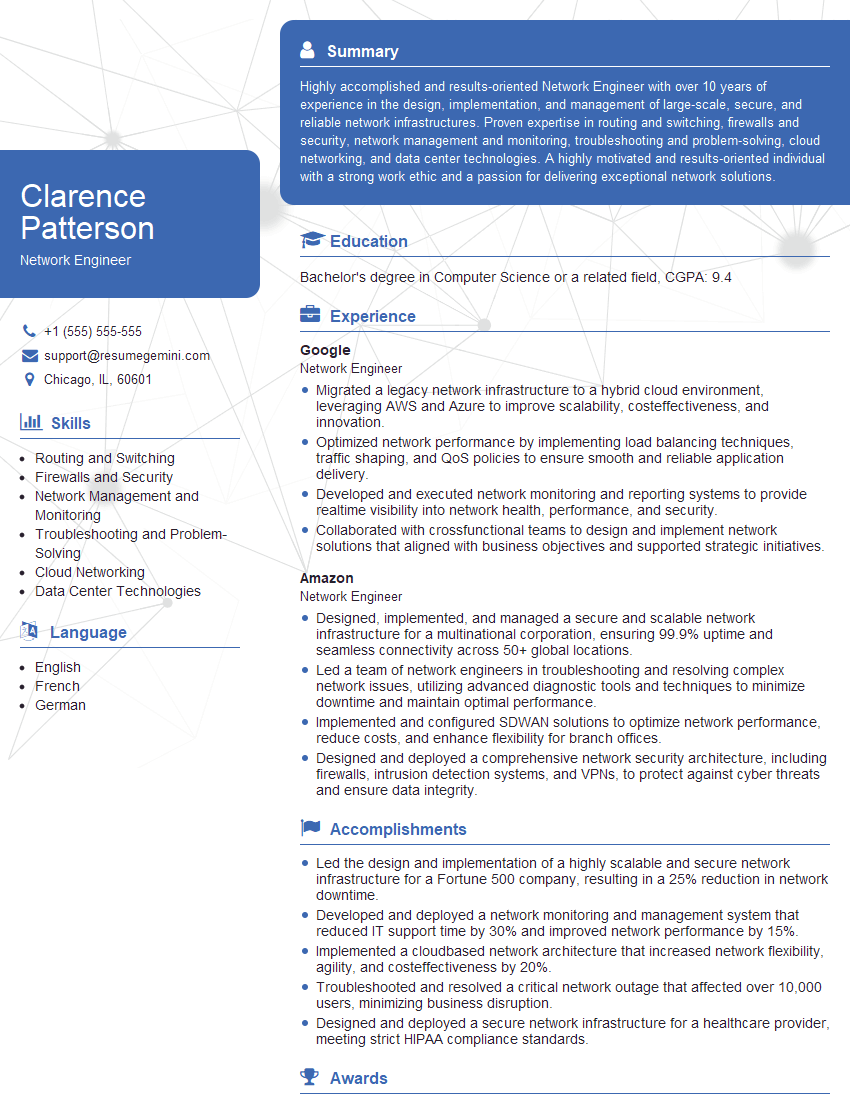
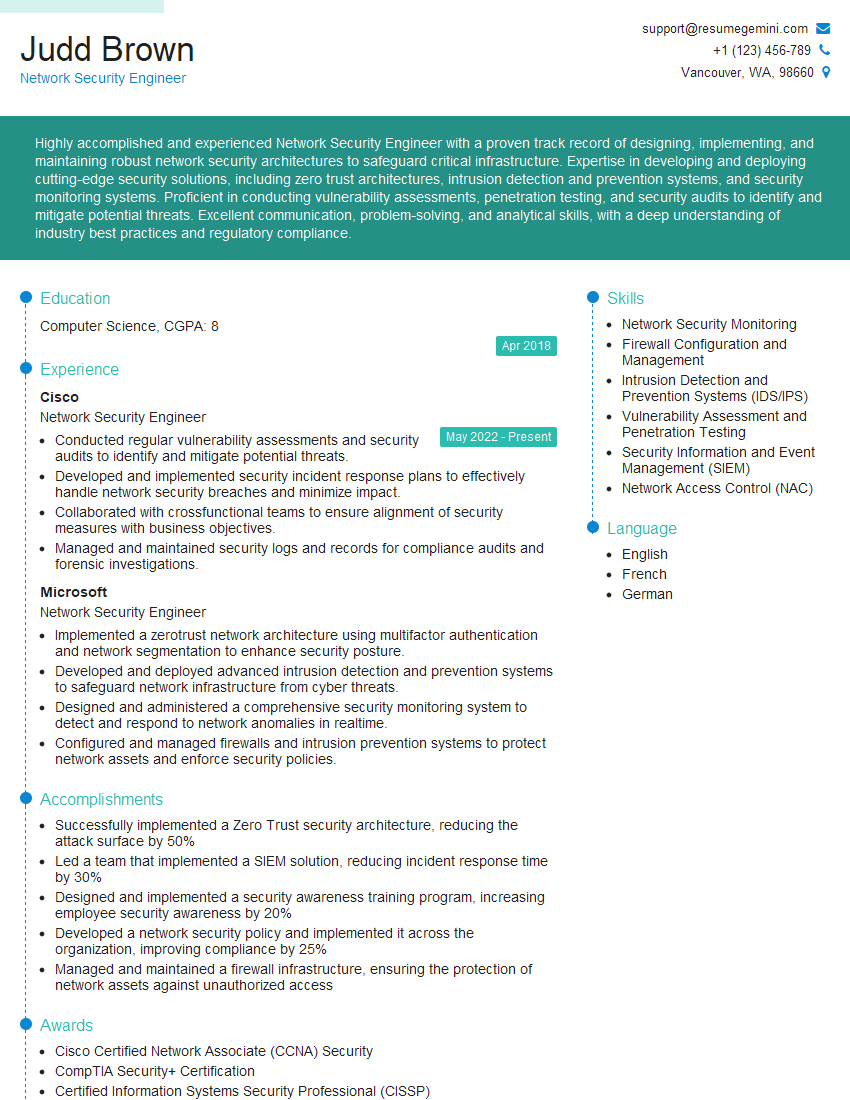
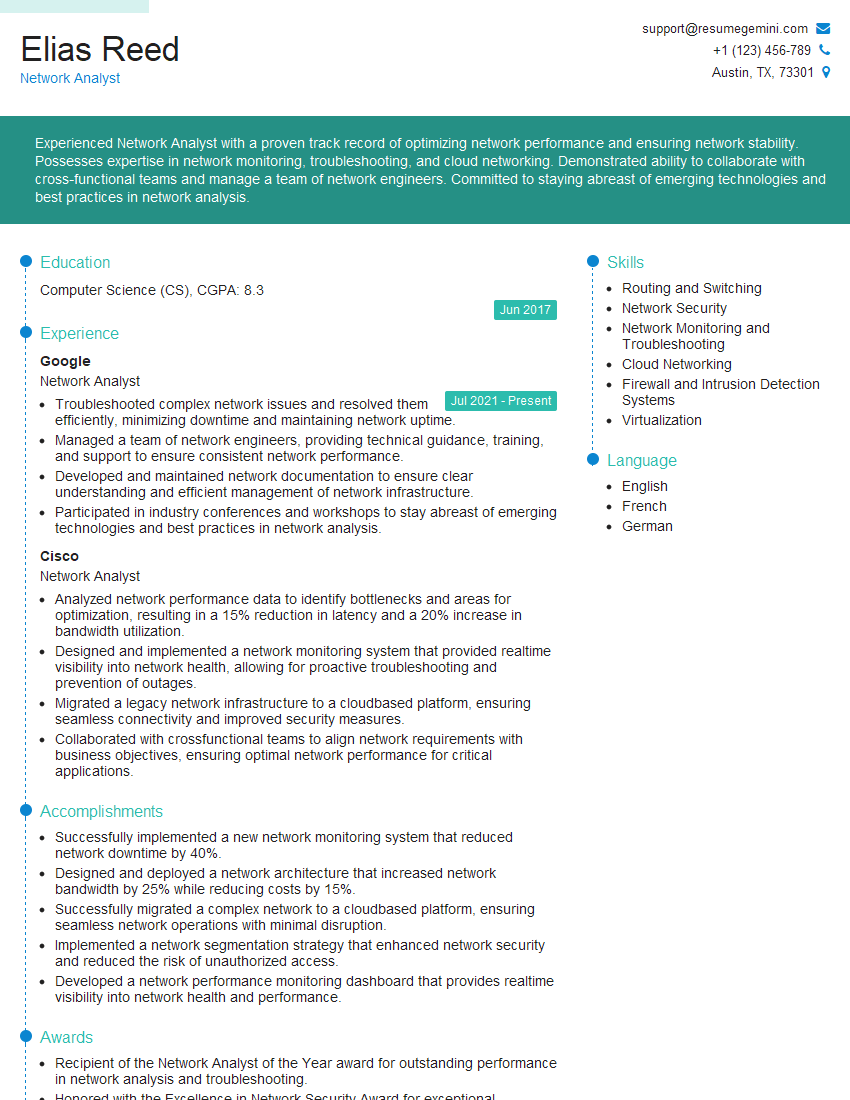
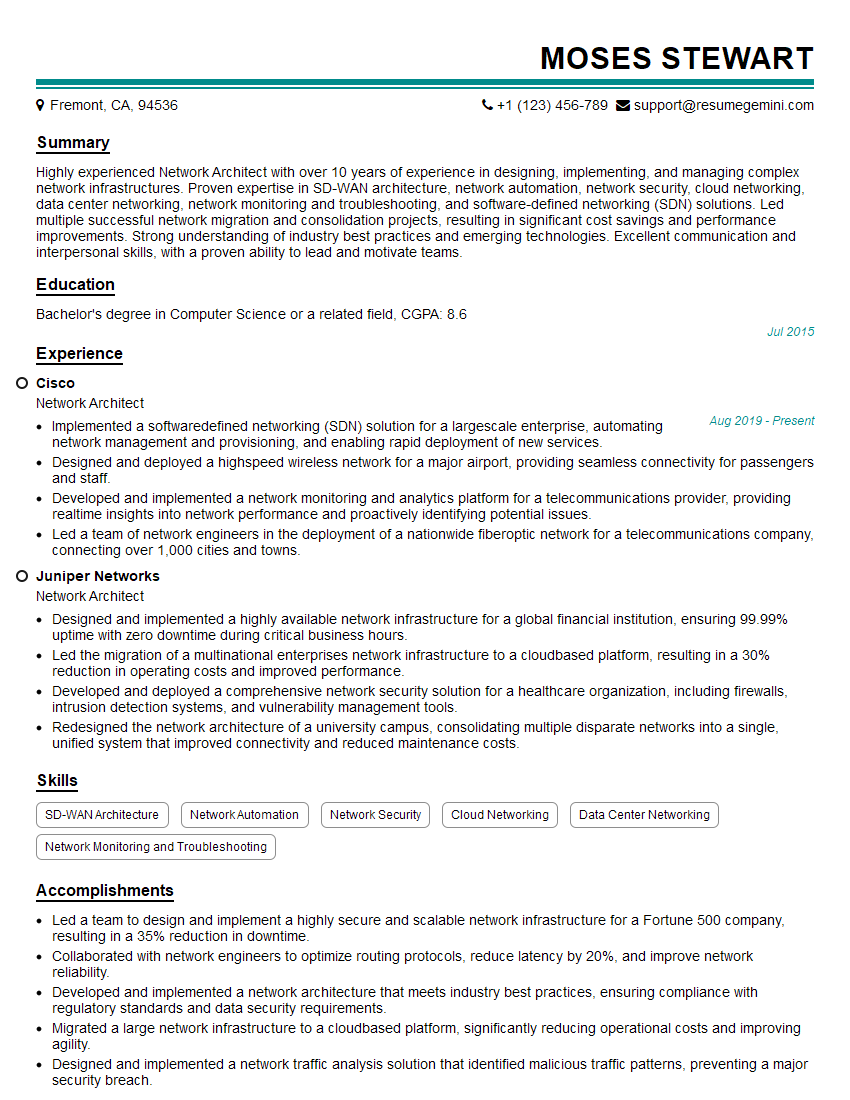
Mastering network analytics and reporting tools is essential for career advancement in today’s technology-driven world. Proficiency in this area opens doors to exciting opportunities and significantly increases your earning potential. To stand out from the competition, create an ATS-friendly resume that effectively showcases your skills and experience. ResumeGemini is a trusted resource to help you build a professional and impactful resume that highlights your expertise. Examples of resumes tailored to experience with network analytics and reporting tools are available to guide you. Take advantage of these resources to make a strong impression on potential employers.


Explore more articles
Users Rating of Our Blogs
Share Your Experience
We value your feedback! Please rate our content and share your thoughts (optional).
What Readers Say About Our Blog
Very informative content, great job.
good