Interviews are opportunities to demonstrate your expertise, and this guide is here to help you shine. Explore the essential Experience with Ticket Sales and Venue Management interview questions that employers frequently ask, paired with strategies for crafting responses that set you apart from the competition.
Questions Asked in Experience with Ticket Sales and Venue Management Interview
Q 1. Describe your experience with different ticketing systems (e.g., Ticketmaster, AXS).
My experience spans several major ticketing platforms, including Ticketmaster, AXS, and Eventbrite. Each system has its own strengths and weaknesses, requiring a nuanced understanding of their functionalities and limitations. For example, Ticketmaster’s extensive reach offers unparalleled access to a large customer base, but its fees can be substantial. AXS excels in its integration with venue management systems, streamlining operations, but might lack the same broad market reach. Eventbrite is particularly strong for smaller-scale events and offers flexible pricing models. I’ve managed everything from configuring event listings and managing inventory to troubleshooting technical issues and analyzing sales data across these platforms. I am proficient in utilizing their respective APIs for data integration and reporting, optimizing workflows, and improving customer experience.
A crucial aspect of my expertise lies in understanding the specific nuances of each platform, like the different reporting functionalities and customer service channels. For example, I know the best strategies for maximizing reach on each platform, accounting for factors such as search engine optimization (SEO) and targeted advertising.
Q 2. How do you handle high-volume ticket sales during peak demand?
Handling high-volume ticket sales requires a multi-pronged approach focused on infrastructure, marketing, and customer service. Firstly, ensuring robust server infrastructure capable of handling peak traffic is crucial. This includes load balancing, distributed systems, and sufficient bandwidth. We often utilize cloud-based solutions to scale resources dynamically during peak demand. Secondly, pre-sale strategies are vital. This might involve tiered pricing, early bird discounts, and VIP packages to distribute demand over time. Finally, a dedicated customer service team equipped to address queries quickly and efficiently is essential to mitigate frustration during high-demand periods. I’ve personally managed several high-profile events with tens of thousands of tickets sold, employing these strategies to ensure a smooth and efficient process for both customers and the venue.
Think of it like managing a rush hour on a highway. You need enough lanes (servers), strategic traffic management (pre-sale strategies), and effective emergency response teams (customer service) to avoid gridlock.
Q 3. Explain your process for resolving customer complaints related to ticket purchases.
My process for resolving customer complaints begins with active listening and empathy. I always aim to understand the customer’s perspective fully before offering solutions. This often involves reviewing the transaction history, confirming the details of the purchase, and examining any potential system errors. Complaints are documented meticulously, with a clear record of the issue, steps taken to resolve it, and the outcome. Simple issues, like incorrect email addresses, are handled immediately. More complex issues, such as fraudulent transactions or disputed orders, require a more thorough investigation, sometimes involving collaboration with the ticketing provider and potentially law enforcement. I always strive for a fair and timely resolution, keeping the customer informed throughout the process. Customer satisfaction is paramount, and even when I cannot fully resolve the complaint, I aim to leave the customer feeling heard and understood.
For instance, a common complaint is regarding duplicate ticket orders. We first verify if it was a genuine mistake, then offer options like a refund for the duplicate or transferring one ticket to another party.
Q 4. What strategies do you employ to maximize ticket sales and revenue?
Maximizing ticket sales and revenue requires a comprehensive strategy that encompasses various aspects of marketing, pricing, and inventory management. Effective marketing campaigns are crucial, utilizing targeted advertising on various channels – social media, email marketing, and even traditional media depending on the event’s profile. Dynamic pricing strategies, adjusting prices based on demand and time remaining, can significantly impact revenue. Offering various ticket types and packages (VIP, family packages, etc.) can also expand the market reach and appeal to different segments. Collaborations and partnerships can help broaden the reach. I regularly analyze sales data to identify trends and optimize our strategies. For example, understanding which marketing channels generate the highest ROI enables us to allocate resources more efficiently.
Imagine it like a restaurant. You need a great menu (diverse ticket options), appealing advertising (marketing campaigns), strategic pricing based on demand (dynamic pricing), and efficient service (customer service) to maximize sales and profits.
Q 5. How do you manage inventory and seating charts effectively?
Efficient inventory and seating chart management are vital for successful ticket sales. We utilize dedicated software that integrates directly with our ticketing system, providing real-time updates on available seats and inventory levels. This allows for accurate tracking of sales and the prevention of overselling. The seating chart software enables us to visually manage seating sections, reserve specific areas for VIPs or sponsors, and even implement dynamic pricing based on seat location. Regular audits are crucial to ensure data accuracy and identify any potential discrepancies. Furthermore, clear labeling and visualization of seating charts on the ticketing website are essential to provide customers with a smooth and user-friendly experience.
Think of it like managing a warehouse inventory. You need a clear system to track what’s available, where it’s located and to avoid stock-outs.
Q 6. Describe your experience with budgeting and financial reporting in a venue setting.
My experience with budgeting and financial reporting in a venue setting is extensive. I’m adept at developing comprehensive budgets encompassing all aspects of event production, including marketing, staffing, security, and operational expenses. I utilize various financial software packages to track income, expenses, and overall profitability. I regularly prepare financial reports for stakeholders, providing clear and concise summaries of revenue streams, cost analysis, and overall financial performance. This involves forecasting future revenue, managing cash flow, and identifying areas for cost optimization. I have a strong understanding of accounting principles and financial regulations, ensuring compliance with all relevant guidelines.
For example, creating a detailed budget for a concert involves forecasting ticket revenue, considering costs for the artist’s fee, venue rental, marketing, security personnel, etc. The actual expenses are then compared to the initial budget to track the profitability of the concert.
Q 7. How do you ensure the security and integrity of ticket sales data?
Ensuring the security and integrity of ticket sales data is paramount. This involves implementing robust security measures throughout the entire ticketing process, from data storage and transmission to access controls. We employ encryption technologies to protect sensitive customer information, such as credit card details and personal data. Secure server environments with regular security audits and penetration testing are crucial to mitigate potential threats. Access controls restrict data access based on roles and responsibilities, preventing unauthorized access and modifications. We comply with all relevant data privacy regulations, such as GDPR and CCPA. Regular monitoring and logging of system activities help to detect and respond to any suspicious activity promptly. In addition, I work closely with IT security professionals to stay abreast of the latest security threats and best practices.
This is akin to safeguarding a bank vault. Multiple layers of security protocols are needed to prevent unauthorized access and data breaches.
Q 8. What is your experience with developing and implementing marketing strategies to increase ticket sales?
Developing and implementing successful marketing strategies for ticket sales requires a multi-faceted approach. It’s not just about selling tickets; it’s about creating demand and building excitement. My strategy begins with a deep understanding of the target audience. Who are we trying to reach? What are their interests and preferences? Once we have a clear picture of our audience, we can tailor our messaging and choose the most effective channels.
- Targeted advertising: Instead of broad campaigns, we use data to target specific demographics on social media, search engines, and email marketing platforms. For example, if we’re promoting a family-friendly concert, we’d focus on parents and families in our marketing efforts.
- Strategic partnerships: Collaborating with complementary businesses or organizations can significantly expand reach. For instance, partnering with local radio stations for contests and giveaways or with hotels for package deals can drive ticket sales.
- Early bird discounts and tiered pricing: Creating a sense of urgency and offering various price points caters to different budgets and encourages early purchases. This also helps forecast demand accurately.
- Content marketing: Creating engaging blog posts, social media content, and videos about the event, the artists, or the venue builds anticipation and excitement. We also leverage influencer marketing when relevant.
- Data analytics: Monitoring key performance indicators (KPIs) like website traffic, conversion rates, and social media engagement allows for continuous optimization of marketing campaigns. We constantly analyze what’s working and what’s not to maximize our return on investment.
For example, in my previous role, we implemented a targeted Facebook ad campaign focusing on young adults interested in indie music. This campaign resulted in a 30% increase in ticket sales for our indie music festival compared to the previous year.
Q 9. How do you handle ticket refunds and exchanges?
Handling ticket refunds and exchanges requires a clear, consistent, and customer-centric approach. Our policy is readily accessible on our website and ticket purchase confirmation. We aim to minimize any inconvenience to the customer. We use a ticketing system that allows for efficient processing of refunds and exchanges.
- Clear refund policy: Our policy outlines the specific circumstances under which refunds or exchanges are granted (e.g., event cancellation, double booking).
- Efficient processing: We have streamlined the process for customers to request refunds or exchanges, either online or via phone. We aim for quick turnaround times.
- Communication: We keep customers informed of the status of their request through email or phone.
- Exception handling: While we have a clear policy, we are prepared to handle exceptional circumstances on a case-by-case basis, demonstrating empathy and understanding.
For instance, if an event is cancelled due to unforeseen circumstances (weather, artist illness), we implement a swift and automated refund process, notifying all ticket holders immediately. In cases of individual requests, we evaluate each situation on its merits, aiming for a fair and customer-focused resolution.
Q 10. Describe your experience with managing relationships with vendors and suppliers.
Managing relationships with vendors and suppliers is crucial for successful event management. It’s built on trust, clear communication, and mutually beneficial partnerships. I prioritize building long-term relationships rather than solely focusing on price.
- Vendor selection: Thorough vetting ensures we choose reliable vendors with a proven track record and a good reputation.
- Clear contracts: Detailed contracts outline expectations, deliverables, timelines, and payment terms, protecting both parties.
- Open communication: Regular communication ensures everyone is on the same page and can address any issues promptly. This involves regular check-ins, meetings, and progress updates.
- Performance evaluation: Following each event, we evaluate vendor performance, identifying areas for improvement and building a record for future collaborations.
- Negotiation: While cost is a factor, we prioritize quality and reliability. We aim for win-win negotiations where both parties feel valued and fairly compensated.
For example, when selecting caterers, we go beyond just comparing prices. We consider factors like menu quality, service standards, and their ability to handle large-scale events. We build relationships with preferred vendors, ensuring consistent quality and service for future events.
Q 11. What is your experience with event planning and logistics?
Event planning and logistics encompass every detail from initial conception to post-event analysis. It’s about creating a seamless and memorable experience for attendees. My approach is methodical and detail-oriented.
- Detailed planning: A comprehensive event plan outlines every aspect, including venue selection, budget allocation, scheduling, staffing, risk assessment, and contingency plans.
- Venue selection: Careful consideration is given to venue capacity, accessibility, location, technical capabilities, and overall suitability for the event.
- Logistics management: This covers transportation, parking, catering, security, equipment rental, and any other necessary services.
- Timeline management: A detailed timeline ensures tasks are completed on schedule and potential bottlenecks are identified and addressed proactively.
- Risk management: Identifying potential risks (e.g., inclement weather, technical failures) and developing contingency plans is critical to ensure a smooth event.
For example, I once managed a large outdoor concert. We developed a detailed weather contingency plan, including alternative indoor venues and strategies for handling potential delays or cancellations. This meticulous planning ensured a successful and enjoyable event, despite the threat of rain.
Q 12. How do you manage staff during high-pressure events?
Managing staff during high-pressure events requires clear communication, strong leadership, and a well-defined structure. Pre-event preparation and training are key to success.
- Clear roles and responsibilities: Each team member understands their role and how it contributes to the overall event’s success.
- Pre-event training: Thorough training ensures staff is prepared to handle various scenarios, including emergencies and unexpected issues.
- Communication protocols: Establishing clear communication channels (e.g., walkie-talkies, designated communication points) allows for swift information sharing during the event.
- Leadership and support: Providing strong leadership and support to staff during stressful situations helps maintain morale and efficiency.
- Post-event debrief: A post-event debrief allows for feedback and identifies areas for improvement in future events.
During a particularly busy festival, we utilized a color-coded system for staff identification and communication, making it easier to identify and direct team members to assist with specific issues. This improved efficiency and communication during peak times.
Q 13. How do you stay updated on industry trends and best practices in ticket sales and venue management?
Staying updated on industry trends and best practices is essential for remaining competitive in ticket sales and venue management. I utilize various methods to ensure I stay informed.
- Industry publications and journals: Reading industry publications and journals keeps me abreast of new technologies, strategies, and regulations.
- Conferences and workshops: Attending industry conferences and workshops provides opportunities to network with peers and learn from experts.
- Online resources and webinars: Accessing online resources, webinars, and industry blogs keeps me informed about the latest developments.
- Networking: Maintaining a strong professional network allows me to exchange ideas and learn from other professionals in the field.
- Data analysis: Analyzing data on ticket sales, customer behavior, and industry trends helps to identify areas for improvement and innovation.
For example, I recently attended a conference on sustainable event management, learning about innovative approaches to reducing environmental impact. This knowledge allowed us to implement eco-friendly practices in our operations, enhancing our brand image and appeal to environmentally conscious customers.
Q 14. Describe your experience with customer relationship management (CRM) systems.
I have extensive experience using CRM systems to manage customer relationships and enhance ticket sales. CRM systems are invaluable for organizing customer data, tracking interactions, and personalizing communication.
- Data management: CRM systems allow for efficient organization and management of customer data, including contact information, purchase history, and communication preferences.
- Marketing automation: CRM systems enable automated marketing campaigns, such as targeted email marketing and personalized promotional offers.
- Sales tracking: Tracking sales data helps identify successful campaigns and areas for improvement.
- Customer service: CRM systems improve customer service by providing a centralized repository of customer information, enabling staff to access relevant details quickly.
- Data analysis: Analyzing data from CRM systems provides insights into customer behavior, helping us tailor marketing efforts and improve overall customer experience.
In a previous role, we used a CRM system to segment our customer base based on purchase history and preferences. This allowed us to send highly targeted email campaigns promoting relevant events, resulting in a significant increase in ticket sales. We also used the system to track customer feedback and resolve issues efficiently.
Q 15. How do you handle unexpected issues or emergencies during an event?
Handling unexpected issues during an event requires a proactive and adaptable approach. Think of it like conducting an orchestra – you need a plan A, B, and even C, and the ability to improvise when necessary.
My strategy involves a multi-faceted approach: Firstly, a robust pre-event checklist minimizes potential problems. This includes thorough venue inspections, confirming vendor readiness, and ensuring all staff are briefed on emergency procedures. Secondly, during the event, a dedicated command center staffed with experienced personnel monitors all aspects of the operation. This team uses real-time data and communication to identify and address issues quickly. For example, if a power outage occurs, the command center immediately activates backup generators and communicates with attendees via announcements and social media to maintain calm and provide updates. Thirdly, post-event debriefs are crucial for identifying weaknesses in our preparedness and refining our emergency response protocols. This ensures continuous improvement and preparedness for future events.
During my time managing the ‘Summer Sounds’ festival, a sudden severe thunderstorm forced us to evacuate attendees. Our pre-planned evacuation procedures, coupled with clear communication, ensured a smooth and safe process, minimizing any panic or injury. The post-event debrief helped us refine our weather monitoring protocols and evacuation strategies, leading to better preparedness in subsequent events.
Career Expert Tips:
- Ace those interviews! Prepare effectively by reviewing the Top 50 Most Common Interview Questions on ResumeGemini.
- Navigate your job search with confidence! Explore a wide range of Career Tips on ResumeGemini. Learn about common challenges and recommendations to overcome them.
- Craft the perfect resume! Master the Art of Resume Writing with ResumeGemini’s guide. Showcase your unique qualifications and achievements effectively.
- Don’t miss out on holiday savings! Build your dream resume with ResumeGemini’s ATS optimized templates.
Q 16. How familiar are you with ADA compliance requirements for venues?
ADA (Americans with Disabilities Act) compliance is paramount for ensuring accessibility and inclusivity. It’s not just about meeting legal requirements; it’s about creating a welcoming environment for all attendees. My familiarity extends to understanding and implementing all aspects, from wheelchair accessibility to appropriate signage, audio-visual aids, and accessible restrooms.
This includes detailed knowledge of the ADA Standards for Accessible Design, focusing on aspects such as ramps, elevators, accessible seating, and appropriate parking. I regularly consult with accessibility experts to ensure our venues meet the highest standards. For instance, during the renovation of our main auditorium, we worked closely with accessibility consultants to ensure every element—from the placement of handrails to the design of the seating layout—adhered to ADA guidelines. We also train our staff to assist attendees with disabilities, ensuring that they are aware of procedures and how to provide support effectively.
Q 17. What are your strategies for attracting new customers and retaining existing ones?
Attracting new customers and retaining existing ones requires a balanced strategy that combines marketing, customer service, and data-driven decision-making. Think of it like building and maintaining strong relationships.
For attracting new customers, we employ targeted marketing campaigns using social media, email marketing, and collaborations with relevant organizations. We also leverage data analytics to identify our target demographics and tailor our messaging accordingly. For example, if we’re hosting a classical music concert, we would focus our marketing on individuals and groups interested in classical music, utilizing targeted ads on relevant platforms.
Retaining existing customers involves building loyalty programs, providing exceptional customer service, and offering exclusive perks such as early bird ticket access or discounts on future events. Personalized email communication, post-event surveys, and gathering feedback allow us to understand their needs and preferences to offer tailored experiences. For example, we send personalized emails based on past attendance history suggesting similar events that might interest them.
Q 18. Describe your experience with data analysis and reporting on ticket sales performance.
Data analysis is the cornerstone of effective ticket sales management. It allows us to understand trends, identify areas for improvement, and make informed decisions. I’m proficient in using various analytics tools to track key performance indicators (KPIs) such as ticket sales volume, conversion rates, average order value, and customer acquisition cost.
I use this data to create comprehensive reports that highlight performance trends and identify areas requiring attention. For example, if we see a low conversion rate on a particular event, I might analyze website traffic data to identify potential bottlenecks or improve the online purchasing experience. This data-driven approach enables informed decisions regarding marketing spend, pricing strategies, and event scheduling. I’m comfortable with using data visualization tools to present this information clearly and effectively to stakeholders, facilitating better understanding and informed decision-making.
For example, using sales data from previous years, I identified that early-bird ticket sales for our annual jazz festival were significantly higher, allowing us to optimize the timing of our marketing campaigns and achieve better sales targets.
Q 19. How do you balance customer satisfaction with operational efficiency?
Balancing customer satisfaction and operational efficiency is a delicate act, like walking a tightrope. It requires a structured approach that prioritizes both aspects without compromising either.
My approach focuses on optimizing processes without sacrificing customer experience. This involves streamlining ticketing processes for speed and simplicity, investing in user-friendly technology, and ensuring efficient customer support channels. At the same time, we proactively gather customer feedback to identify areas for improvement and address issues promptly. For example, implementing a chatbot for quick answers to FAQs reduces wait times and frees up human agents to deal with more complex issues. Furthermore, training staff to handle customer interactions efficiently and with empathy is key. Regular monitoring of customer satisfaction metrics, like Net Promoter Score (NPS), helps us gauge the effectiveness of our efforts and make necessary adjustments.
Q 20. What is your experience with using analytics to optimize ticket pricing strategies?
Using analytics to optimize ticket pricing strategies is crucial for maximizing revenue and minimizing losses. It’s not about arbitrarily setting prices; it’s about data-driven decisions that consider supply, demand, and competitor pricing.
I leverage historical sales data, market research, and competitor analysis to create dynamic pricing models. This allows us to adjust prices based on factors such as the day of the week, time of day, event popularity, and anticipated demand. For example, we might increase prices for highly popular events closer to the event date, while offering discounts for less popular events or during off-peak periods. A/B testing different pricing strategies helps refine these models and maximize revenue. Advanced techniques, such as predictive modeling, can even forecast demand and allow us to set prices more accurately. This ensures that we achieve optimal revenue while maintaining customer satisfaction.
Q 21. How do you ensure the safety and security of attendees at your events?
Ensuring the safety and security of attendees is the highest priority. It’s about creating a secure environment where everyone feels safe and protected. My approach is multi-layered and proactive, not reactive.
This includes collaborating with local law enforcement agencies to develop comprehensive security plans. These plans incorporate measures such as thorough security checks at entry points, the use of surveillance systems, crowd management strategies, and emergency evacuation procedures. Staff training in security protocols and emergency response is crucial, and we regularly conduct drills to ensure everyone is prepared. Moreover, clear communication with attendees about security procedures and emergency protocols is essential. We provide information on our website, at entry points, and via announcements throughout the event. We also use technology such as facial recognition to enhance security and prevent unauthorized access. Regular assessments and audits of our security measures guarantee continual improvement and adaptation to emerging threats.
Q 22. What is your experience with negotiating contracts with artists or performers?
Negotiating artist contracts requires a delicate balance of understanding the performer’s needs and protecting the venue’s interests. It’s not just about the performance fee; it’s a comprehensive agreement covering everything from rider requirements (backstage amenities, technical specifications) to publicity and liability clauses. My approach starts with thorough preparation. I meticulously review the artist’s previous contracts, research their typical demands, and analyze the venue’s capacity and capabilities. This groundwork informs my initial counter-offer, ensuring it’s both competitive and financially sound for the venue. I prioritize open communication, building a rapport with the artist’s management to find mutually acceptable solutions. For example, during negotiations with a rising indie band, they initially requested a substantial amount for backline equipment. By presenting them with our existing high-quality equipment inventory and demonstrating cost savings, we were able to reach an agreement that benefited both parties. Finally, I always ensure the contract is legally reviewed to minimize risks for the venue.
Q 23. Describe your experience with managing marketing budgets.
Managing marketing budgets for a venue involves strategic allocation of resources to maximize ticket sales and brand awareness. I begin with a clear understanding of the overall marketing objectives – be it filling a specific event or raising general profile. Then, I create a detailed budget breakdown that outlines the allocation for different activities: advertising (online, print, radio), social media marketing, public relations, email campaigns, and promotional materials. I prioritize data-driven decision-making, employing analytics tools to track campaign performance and adjust strategies in real-time. For instance, if a social media campaign isn’t generating sufficient engagement, I’ll analyze the data to understand why and reallocate funds to more effective channels, like targeted advertising. Regular reporting ensures transparency and accountability, allowing me to demonstrate the return on investment (ROI) of each marketing initiative. This allows for adjustments and ensures funds are spent effectively throughout the year.
Q 24. What is your experience with developing and implementing emergency evacuation plans?
Developing and implementing effective emergency evacuation plans is crucial for venue safety. My approach involves a thorough risk assessment identifying potential hazards specific to the venue, such as fire, natural disasters, or security threats. This assessment informs the development of detailed evacuation routes, clearly marked signage, and designated assembly points. Regular staff training is essential, including drills to practice evacuation procedures. We also work closely with local emergency services to coordinate response efforts and ensure seamless communication during emergencies. For example, we recently implemented a new system using color-coded maps and emergency lighting to enhance the clarity of evacuation routes during events. We also integrated a real-time communication system so staff can quickly provide updates and guidance during an emergency. Regular reviews and updates to the plan ensure its continued effectiveness and adaptability to changing circumstances.
Q 25. How do you ensure compliance with all relevant health and safety regulations?
Ensuring compliance with health and safety regulations is paramount. This involves staying informed about all applicable local, state, and national laws and standards. We maintain detailed documentation of all inspections, licenses, and certifications. We conduct regular safety inspections of the venue to identify and address potential hazards promptly. Our staff undergoes regular training on health and safety procedures, including first aid, fire safety, and emergency response. We also work proactively with regulatory bodies to maintain open communication and ensure transparency in our compliance efforts. For instance, we’ve implemented a robust system for tracking safety inspections and maintenance records, ensuring all documentation is readily available for audits. We also have a designated safety officer to oversee all compliance efforts.
Q 26. How do you handle disputes between customers and venue staff?
Handling disputes between customers and venue staff requires a calm, empathetic, and professional approach. My strategy centers on active listening – understanding both perspectives to find a mutually acceptable resolution. We empower our staff to handle minor issues independently, utilizing a clear escalation protocol for more complex situations. This involves documenting the incident, gathering relevant information, and involving a supervisor as needed. In cases where a resolution isn’t immediately attainable, I prioritize fair and impartial mediation. For example, if a customer complains about poor service, we’ll offer a sincere apology, investigate the incident, and possibly offer a partial refund or complimentary tickets to a future event. Our goal is to maintain a positive customer experience, turning potential negative situations into opportunities to improve customer service and satisfaction.
Q 27. What is your experience with developing and implementing sponsorship programs?
Developing and implementing sponsorship programs requires identifying brands that align with the venue’s image and target audience. This begins with market research to understand potential sponsors and their marketing objectives. We then create a tiered sponsorship package offering different levels of visibility and benefits, such as branding opportunities, advertising space, and VIP access. We prioritize clear communication and a strong proposal that demonstrates the value proposition for each sponsor. Negotiations focus on achieving a mutually beneficial partnership where the sponsor achieves measurable results and the venue secures crucial funding. For instance, we partnered with a local brewery for a concert series, providing them with prominent branding at the venue, social media promotion, and mentions during the event announcements. This provided them with brand exposure and allowed us to supplement our marketing budget.
Q 28. Describe your experience with building and maintaining positive relationships with local authorities.
Building and maintaining positive relationships with local authorities is essential for smooth venue operations. This involves proactive communication, attending community meetings, and actively addressing any concerns raised by neighbors or local officials. We prioritize transparency by promptly addressing any issues that might arise, such as noise complaints or parking concerns. We also actively seek opportunities for community engagement, collaborating on local initiatives and events that benefit the wider community. For example, we’ve partnered with the local police department to develop efficient traffic management plans for large events, ensuring minimal disruption to the surrounding area. This collaborative approach builds trust and strengthens our standing within the community, facilitating smoother approvals for future events and developments.
Key Topics to Learn for Experience with Ticket Sales and Venue Management Interview
- Ticket Sales Strategies: Understanding various sales channels (online, box office, third-party vendors), implementing effective pricing strategies, and analyzing sales data to optimize performance.
- Customer Relationship Management (CRM): Utilizing CRM systems to manage customer interactions, track sales leads, and personalize communication for improved customer satisfaction and retention.
- Venue Operations & Logistics: Experience in managing event setups, coordinating staffing, handling event day logistics, and ensuring smooth event execution. This includes understanding health and safety regulations.
- Inventory Management & Ticketing Systems: Proficiency in using ticketing software (e.g., Ticketmaster, Eventbrite) to manage ticket inventory, track sales, and handle refunds or exchanges. Understanding the implications of inventory control on revenue and customer satisfaction.
- Marketing & Promotion: Developing and implementing marketing campaigns to promote events, utilizing social media and other digital channels to reach target audiences. Analyzing the effectiveness of marketing strategies.
- Financial Management: Understanding budgeting, revenue tracking, cost analysis, and reporting on financial performance related to ticket sales and venue operations.
- Problem-Solving & Conflict Resolution: Addressing challenges related to ticket sales, venue operations, and customer service in a professional and effective manner. Examples include handling technical glitches, resolving customer disputes, or managing unexpected events.
- Teamwork & Collaboration: Demonstrating experience working effectively within a team, coordinating with various departments (marketing, finance, security), and collaborating with external vendors.
- Data Analysis & Reporting: Analyzing sales data to identify trends, assess the success of marketing campaigns, and make data-driven decisions to improve efficiency and revenue.
Next Steps
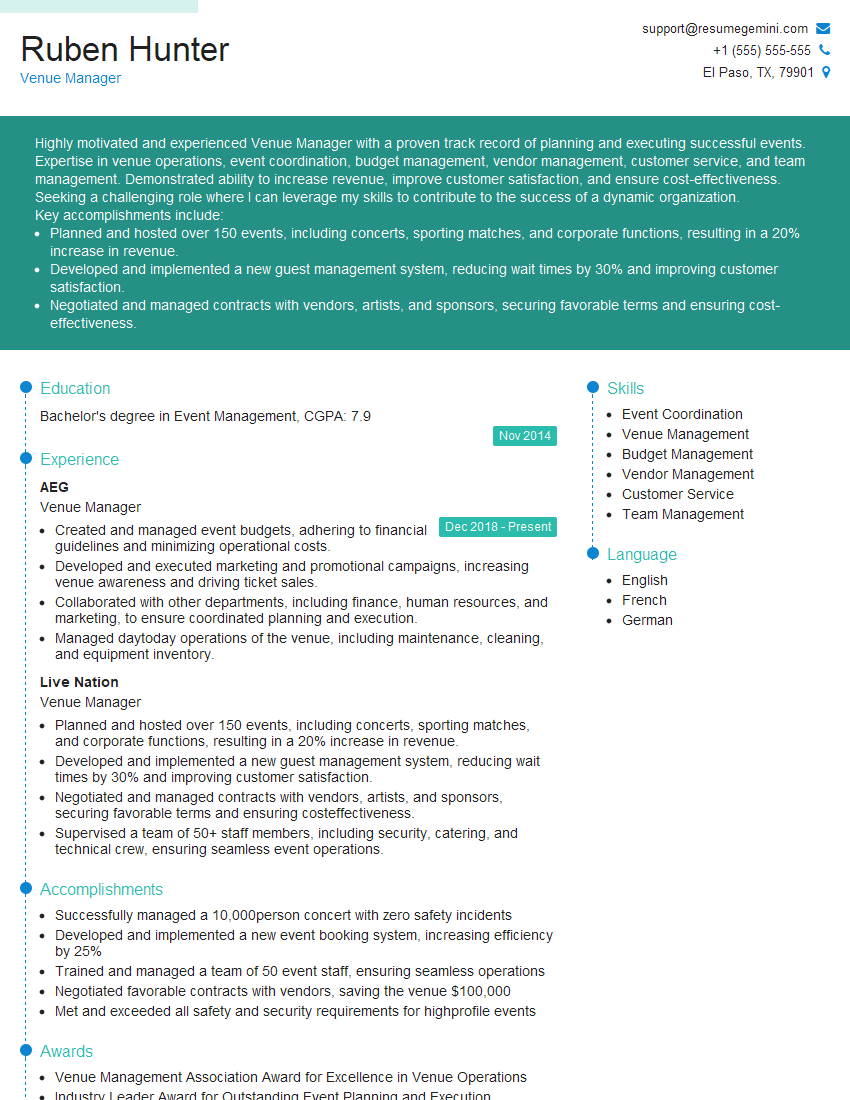
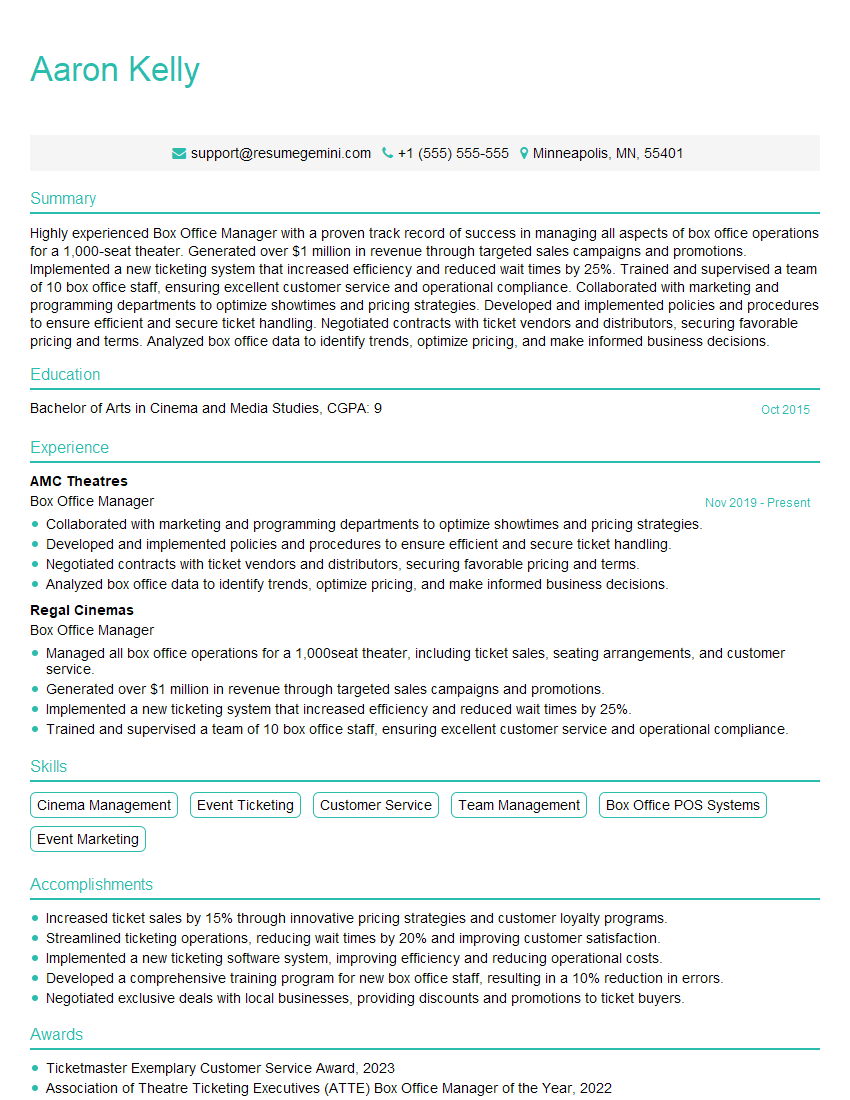
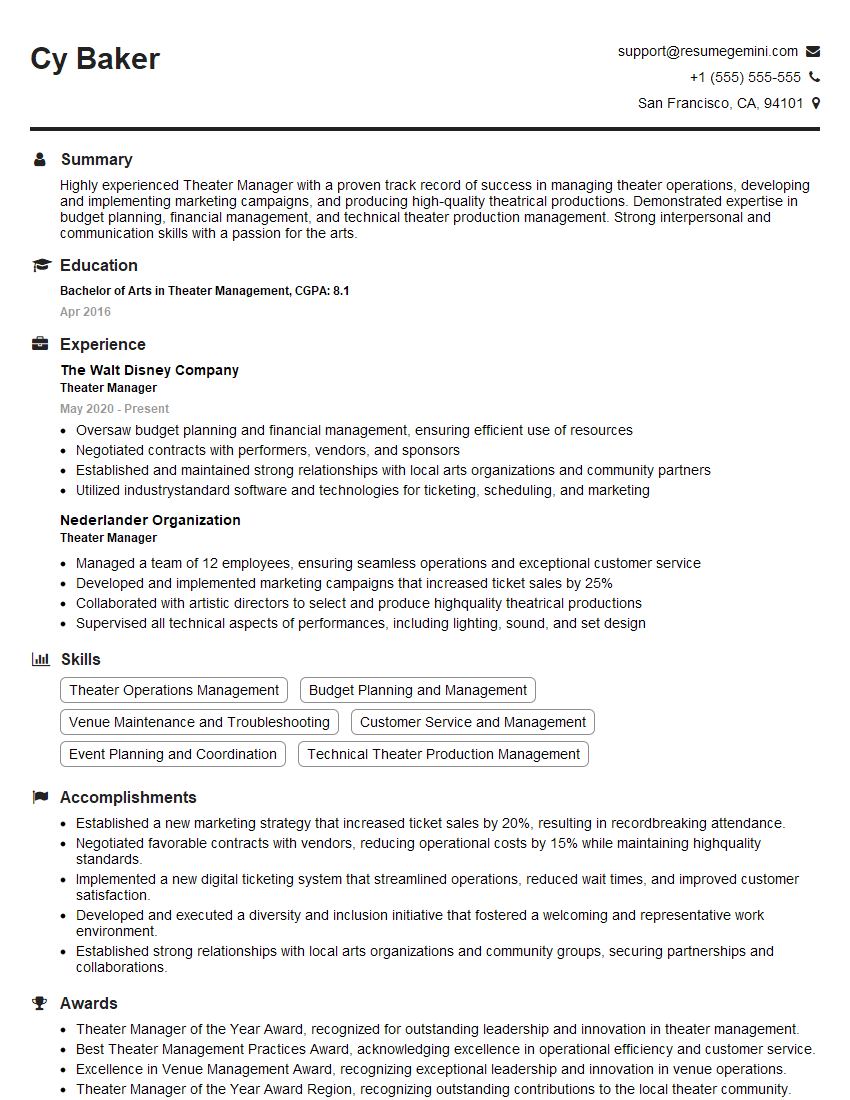
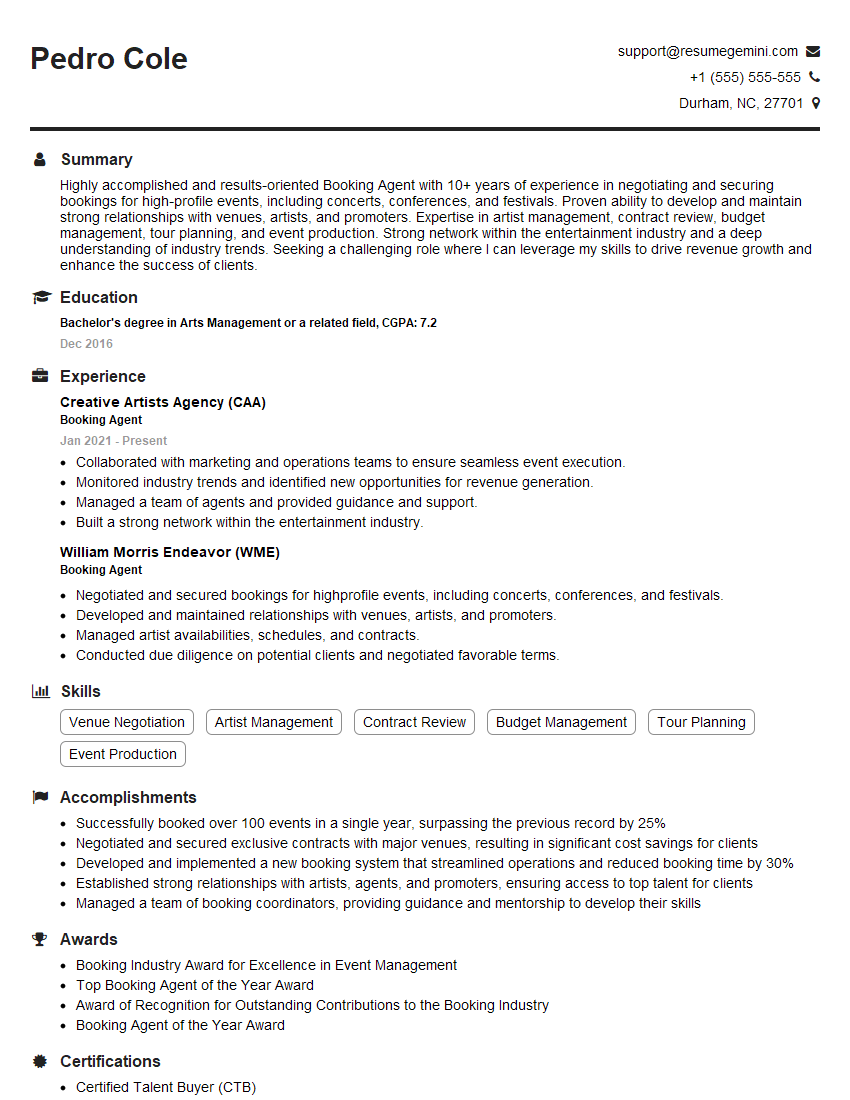
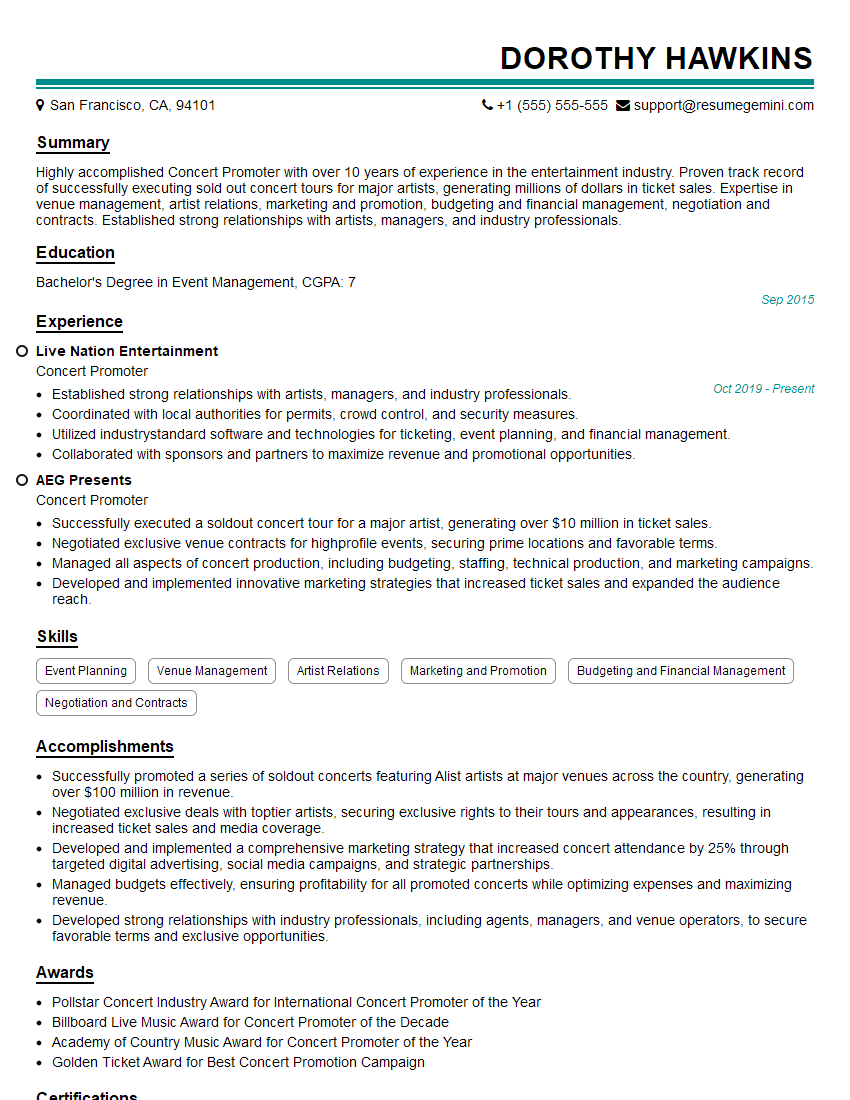
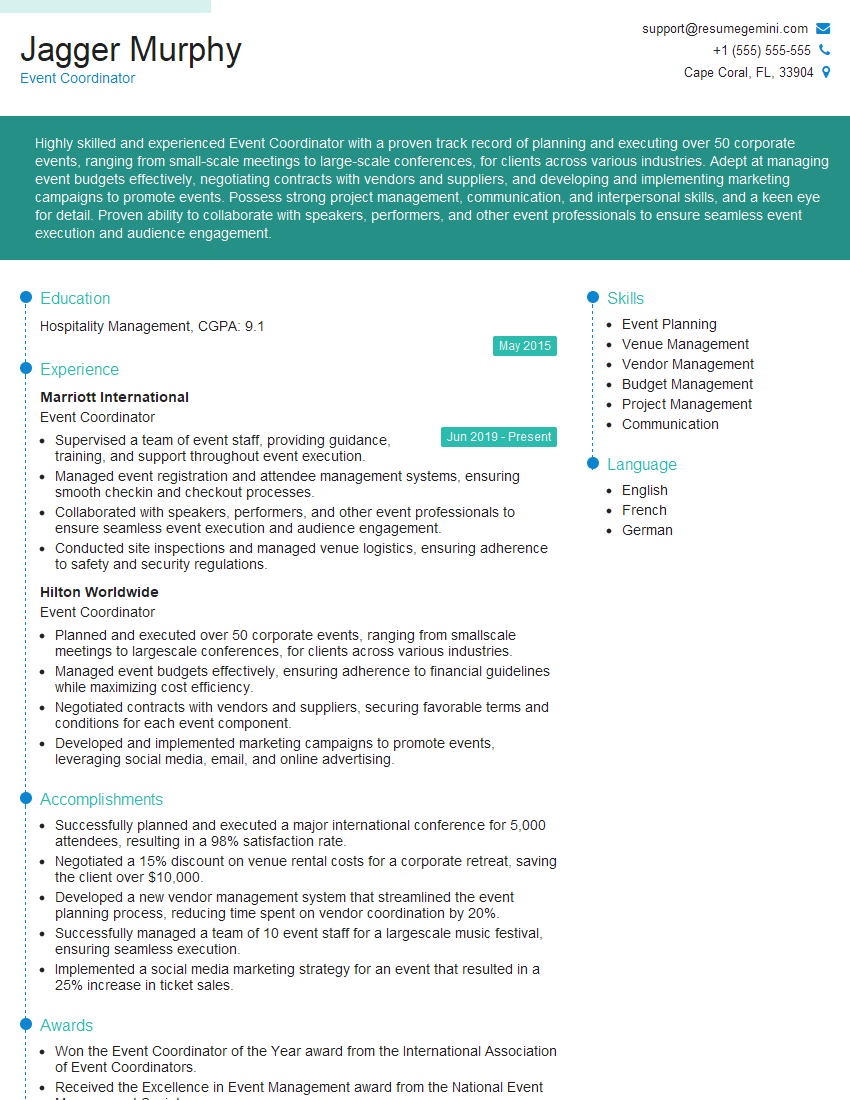
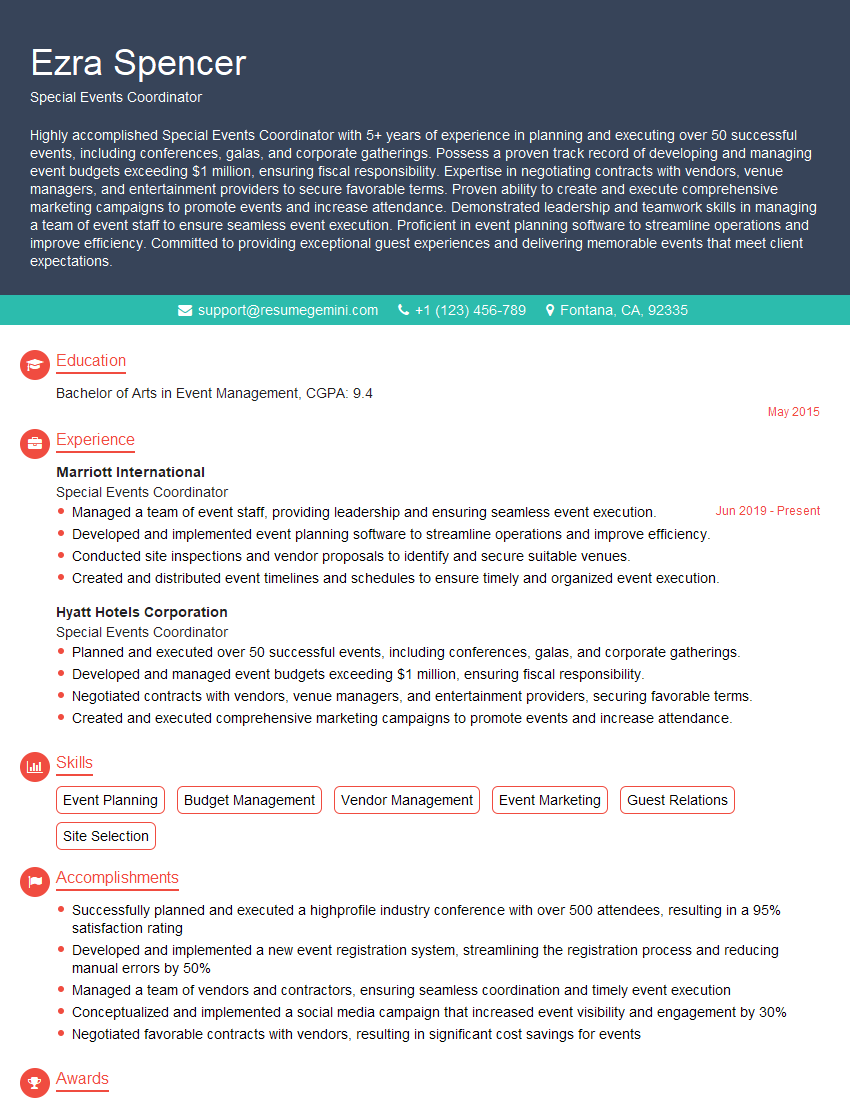
Mastering Experience with Ticket Sales and Venue Management significantly enhances your career prospects within the events industry, opening doors to leadership roles and higher earning potential. A well-crafted, ATS-friendly resume is crucial for showcasing your skills and experience effectively. ResumeGemini is a trusted resource to help you build a professional and impactful resume that highlights your achievements. Examples of resumes tailored to Experience with Ticket Sales and Venue Management are available to guide your resume creation process.
Explore more articles
Users Rating of Our Blogs
Share Your Experience
We value your feedback! Please rate our content and share your thoughts (optional).
What Readers Say About Our Blog
Very informative content, great job.
good