Cracking a skill-specific interview, like one for Felling timber, requires understanding the nuances of the role. In this blog, we present the questions you’re most likely to encounter, along with insights into how to answer them effectively. Let’s ensure you’re ready to make a strong impression.
Questions Asked in Felling timber Interview
Q 1. Describe your experience with different felling techniques.
Felling techniques vary depending on the tree’s size, species, surrounding environment, and the desired outcome. My experience encompasses several key methods:
- Humboldt felling: This is a precise technique, particularly useful for larger trees in confined spaces. It involves making a precise back cut and a controlled felling cut to direct the tree’s fall. I’ve used this extensively in urban forestry projects where accuracy is paramount. Imagine it like carefully guiding a large domino.
- Open felling: This is suitable for trees in open areas where there’s ample space for the tree to fall naturally. The focus is on a quick and efficient cut, prioritizing safety by ensuring clear escape routes. I often use this method during large-scale timber harvesting.
- Directional felling: This technique utilizes specialized cuts to steer the tree’s fall in a pre-determined direction, even if it’s not perfectly straight. It’s essential for navigating obstacles like power lines or other trees. A key part of directional felling involves understanding the tree’s lean and weight distribution.
- Notching and wedging: Sometimes, additional techniques such as notching and wedging are necessary to guide the tree’s fall, particularly with trees that have a strong lean or are prone to splitting. This involves strategic removal of wood to create a hinge, which facilitates control over the direction of the fall.
I constantly adapt my approach to the specific circumstances, prioritizing safety and efficiency above all else.
Q 2. Explain the importance of pre-felling assessments.
Pre-felling assessments are critical for ensuring a safe and efficient operation. They’re like a pre-flight check for a plane; you don’t want to take off without one. These assessments involve a thorough evaluation of:
- Tree condition: Identifying rot, disease, cracks, or other structural weaknesses that could compromise stability during felling.
- Surrounding environment: Assessing the terrain, presence of obstacles (buildings, power lines, other trees), and wind conditions that could affect the tree’s fall path.
- Tree lean and direction of fall: Determining the natural lean of the tree and planning the felling cut to control its fall direction. This includes looking at the tree’s crown weight distribution and root system.
- Escape routes: Planning clear escape routes for the felling team in case of unexpected events.
A proper assessment helps minimize risks and prevents accidents. For instance, ignoring a hidden crack in a tree could lead to unexpected breakage, causing serious injury. I always spend the necessary time thoroughly completing this step, as it is the most important part of safety.
Q 3. How do you identify and mitigate hazards during felling operations?
Hazard identification and mitigation is an ongoing process during felling operations. It starts with the pre-felling assessment but continues throughout the entire process. I follow these steps:
- Identifying hazards: This includes observing any changes in weather conditions (sudden gusts of wind), tree movement, or any unforeseen obstacles that may affect the fall path.
- Risk assessment: Analyzing the likelihood and potential severity of each identified hazard. I consider things such as the size and weight of the tree, potential damage to property or environment, and the proximity of other people.
- Mitigation strategies: Implementing appropriate measures, such as using additional wedges, adjusting the felling direction, or altering escape routes to minimize risk. This might involve clearing the area around the tree or using specialized rigging techniques to control the fall.
- Communication: Constant and clear communication between the felling team is crucial to ensure everyone is aware of potential hazards and safety procedures. A signal system is often used to indicate any issues.
For example, I recently had to adjust the fall path of a tree due to an unexpected change in wind direction. Early detection and mitigation prevented the tree from hitting a nearby power line.
Q 4. What safety equipment is essential for felling timber, and how do you ensure its proper use?
Essential safety equipment is non-negotiable in timber felling. It’s not just about personal safety but also the safety of the team and the environment. This includes:
- Chainsaw: A well-maintained chainsaw that is appropriate for the task at hand is fundamental. Properly sharpened chains and maintained bar oil are crucial.
- Personal Protective Equipment (PPE): This includes chainsaw chaps, safety helmet with face screen, safety gloves, high-visibility clothing, and steel-toe boots. These are the first line of defense against potential injuries.
- Hearing protection: Chainsaws are incredibly loud; hearing protection is mandatory to prevent hearing damage.
- Wedges: Wooden or plastic wedges are used to control the tree’s fall and prevent pinching of the saw bar.
- Helmets with face shields: These are critical to protect the face from flying debris.
Regular inspections of all equipment before, during, and after each operation are mandatory. Ensuring everyone on the crew understands and adheres to safety procedures is just as important as the equipment itself. I always lead by example, modeling safe practices and correcting any lapses in PPE usage immediately.
Q 5. Describe your experience with various chainsaw models and maintenance.
My experience includes working with various chainsaw models from different manufacturers, encompassing various engine sizes and bar lengths. Understanding the strengths and limitations of each model is essential. I’ve used Stihl, Husqvarna, and Echo chainsaws and find that maintaining them regularly extends their life and performance. Proper maintenance includes:
- Regular sharpening and chain lubrication: A dull chain is dangerous and inefficient. Regular sharpening and lubrication ensures optimal performance and reduces the risk of kickback.
- Air filter cleaning: A clean air filter ensures proper engine performance and longevity. I check and clean this regularly.
- Spark plug maintenance: Spark plugs need regular checking and replacing as required. A malfunctioning plug can hinder engine operation.
- Bar and chain oil levels: I always monitor the oil levels to ensure sufficient lubrication to prevent damage to the bar and chain.
I prioritize keeping my chainsaws in top condition. Regular maintenance ensures not only efficiency but also safety. A poorly maintained chainsaw is a dangerous tool.
Q 6. How do you determine the direction of fall for a tree?
Determining the direction of fall is crucial for safety and efficiency. It involves a careful assessment of several factors:
- Tree lean: The most obvious factor; a tree leaning significantly in one direction will naturally fall in that direction.
- Crown weight distribution: A heavier crown on one side will influence the fall direction.
- Wind conditions: Wind can significantly impact a tree’s fall path, potentially altering a planned direction. I always check the wind conditions before beginning the felling process.
- Obstacles: Any obstacles such as other trees, buildings, or power lines need to be carefully considered when determining the safe fall direction.
- Root system: Although less visible, the root system plays a role in a tree’s stability and direction of fall.
I use a combination of visual inspection and sometimes specialized tools to assess these factors. In complex scenarios, I may even use a clinometer to measure the tree’s lean precisely.
Q 7. Explain your understanding of felling angles and hinge cuts.
Felling angles and hinge cuts are fundamental to controlled felling. The felling angle refers to the angle at which the tree falls relative to its original position. The hinge is the portion of the tree left uncut to control the direction of the fall.
- Felling angle: This is determined based on the assessment of the factors mentioned earlier (tree lean, crown weight, wind, obstacles). I aim to create a controlled fall that avoids damaging surroundings.
- Hinge cut: The hinge is created using the face cut and back cut. The face cut is made at a specific angle and depth, leaving a hinge that is strong enough to hold the tree until it’s ready to fall. The back cut is made to sever the wood, and it’s crucial to avoid cutting into the hinge.
Understanding these concepts is critical for controlled felling. For example, making an incorrect hinge cut could cause the tree to split unexpectedly or fall in an uncontrolled manner. It’s a bit like precisely crafting a wooden door to swing smoothly and accurately.
I always take extra care to ensure the correct felling angle and hinge cut are made to ensure a controlled and safe fall, every time.
Q 8. What are the common causes of felling accidents, and how can they be prevented?
Felling accidents are sadly common, often stemming from a combination of factors. The most frequent causes include:
- Improper planning: Failing to assess the tree’s condition, surrounding environment (terrain, obstacles, wind), and escape routes.
- Incorrect felling technique: Using an inappropriate felling method for the tree’s size, lean, or surrounding conditions.
- Equipment failure or misuse: Chainsaw malfunctions, improper sharpening, or lack of maintenance significantly increase risk.
- Environmental factors: Unexpected wind gusts, unstable ground, or hidden obstacles can easily disrupt a felling operation and cause accidents.
- Lack of training and experience: Inexperienced fellers lack the skills and judgment necessary to handle complex situations safely.
Prevention focuses on mitigating these risks. This involves thorough pre-felling planning, which includes a detailed assessment of the tree and its surroundings. Rigorous training and adherence to safe working practices are paramount. Regular chainsaw maintenance and the use of personal protective equipment (PPE) are also critical. Furthermore, establishing clear communication within the felling team prevents accidents.
For example, I once observed a near-miss where an inexperienced feller didn’t account for a hidden rock, causing the tree to fall unpredictably. Thorough ground assessment and the use of a spotter could have prevented this situation.
Q 9. How do you handle unexpected situations during felling, such as wind or unstable ground?
Unexpected situations during felling demand quick thinking and decisive action. If strong winds arise, the safest approach is often to stop the operation immediately. Attempting to fell a tree in high winds increases the risk of the tree falling in an unpredictable manner, potentially endangering life and property. Similarly, if unstable ground is detected, the felling plan must be revised. This might involve using different techniques, such as a directional felling to guide the tree away from the unstable area, or even abandoning the felling entirely if the risk is too high.
In one instance, a sudden downpour caused significant mudslides near a tree I was felling. I immediately stopped the operation and moved a safe distance away, awaiting more stable conditions. This careful approach prioritizes safety above all else, which is essential in this profession.
Q 10. Describe your experience with felling trees in different terrain types.
My experience encompasses diverse terrains. Felling in mountainous regions demands extra caution due to steep slopes and unstable ground. Here, proper rigging and precise felling techniques, potentially incorporating specialized equipment like winches, are essential. Conversely, felling in dense forests requires careful planning to avoid damaging surrounding trees. I’ve also worked in flat, open areas where the primary concern is often ensuring the tree falls clear of any obstacles. Adaptability and a deep understanding of terrain-specific hazards are crucial to safely execute the felling operation across diverse locations.
For instance, felling a large tree on a steep slope necessitates a very different approach than felling a smaller one in a clearing. The slope’s angle will influence the tree’s trajectory, and additional safety measures like utilizing wedges and felling mats would become critical considerations.
Q 11. Explain your knowledge of timber harvesting regulations and best practices.
Timber harvesting regulations and best practices are paramount. These encompass aspects like obtaining necessary permits, complying with environmental regulations (protecting waterways, wildlife habitats), and adhering to workplace safety standards. Best practices include pre-felling assessments, detailed felling plans, utilizing proper techniques and equipment, and maintaining accurate records. Ignoring these leads to legal ramifications and, more importantly, poses significant safety risks.
For example, I am well-versed in the regulations pertaining to buffer zones around waterways, ensuring that no tree debris or pollutants enter sensitive ecological areas during felling and extraction.
Q 12. How do you ensure the safety of yourself and others during felling operations?
Safety is non-negotiable. My approach prioritizes a risk assessment before initiating any felling operation. This includes analyzing the tree, the environment, and identifying potential hazards. This is followed by establishing clear communication protocols with the felling team and utilizing appropriate PPE, which typically includes safety helmets, chainsaw chaps, hearing protection, and safety glasses. I frequently use spotters to monitor the felling area and alert me to unforeseen risks. Finally, maintaining a safe distance from the felling zone after each cut and following emergency protocols are a vital part of my practice.
I always emphasize the importance of everyone being aware of their surroundings and sticking to established safety procedures, preventing injuries and creating a secure workplace.
Q 13. How do you choose the appropriate felling technique for a given tree?
Selecting the appropriate felling technique depends entirely on the specific tree and its environment. Factors considered include the tree’s size, species, lean, the presence of obstructions and the terrain. Techniques like the open-face felling method are employed for trees with minimal lean, whereas the directional felling technique is used when guiding the tree to a specific location is necessary. Humboldt felling is a more specialized technique for trees with extreme leans or difficult situations. I always carefully choose the method that minimizes risk and maximizes control.
For instance, a large tree leaning towards a power line would necessitate the directional felling technique to ensure the tree falls away from the line.
Q 14. What is your experience with using different types of felling tools?
My experience extends to various felling tools, including chainsaws (both petrol and battery-powered), wedges (wood and metal), felling axes, and rigging equipment. I’m proficient in maintaining and safely operating these tools. The choice of tool depends on the job: chainsaws are generally used for larger trees while axes are preferred for smaller ones or for specific tasks like limbing. Rigging equipment such as winches and ropes is employed for safely controlling large trees in complex situations.
Regular maintenance and sharpness checks are critical for ensuring these tools remain effective and safe to use. I am accustomed to keeping a sharp set of tools ready for the various challenges of felling operations.
Q 15. Describe your experience with limbing and bucking operations.
Limbing and bucking are crucial post-felling operations. Limbing involves removing branches from the felled tree, while bucking cuts the trunk into manageable lengths. My experience spans over 15 years, encompassing various tree species and terrain types. I’m proficient in both manual and mechanized limbing techniques, adapting my approach based on the tree’s size, species, and the intended use of the timber. For instance, when dealing with a large Douglas fir, I’d prioritize safety by using a chainsaw with a long bar and employing proper faller’s wedges to manage the weight of the branches. In contrast, smaller trees might be limbed more efficiently using a smaller saw and hand tools. Bucking follows a similar logic, considering factors like log length requirements and ease of transport. I always ensure clean cuts to prevent splitting and maximize timber quality. A precise buck cut prevents damage to the equipment and ensures consistent log lengths for optimal processing.
Career Expert Tips:
- Ace those interviews! Prepare effectively by reviewing the Top 50 Most Common Interview Questions on ResumeGemini.
- Navigate your job search with confidence! Explore a wide range of Career Tips on ResumeGemini. Learn about common challenges and recommendations to overcome them.
- Craft the perfect resume! Master the Art of Resume Writing with ResumeGemini’s guide. Showcase your unique qualifications and achievements effectively.
- Don’t miss out on holiday savings! Build your dream resume with ResumeGemini’s ATS optimized templates.
Q 16. How do you manage the removal of felled trees from the site?
Removing felled trees safely and efficiently requires a well-planned approach. The method depends on factors such as terrain, tree size, and distance to the landing area. For smaller trees on relatively flat ground, manual skidding using a winch or even dragging might suffice. For larger operations or steeper slopes, I’d utilize a forwarder or skidder – specialized forestry machines that effectively extract logs while minimizing ground damage. In challenging terrain, a combination of manual and mechanized methods may be necessary. My experience includes working with various extraction systems, and I’m adept at choosing the most appropriate technique for each situation, always prioritizing safety and minimizing environmental impact. For example, I’ve successfully used a grapple skidder to extract large redwoods from a steep slope, strategically placing the logs to avoid soil erosion.
Q 17. Explain your understanding of tree anatomy and its relevance to felling.
Understanding tree anatomy is fundamental to safe and efficient felling. Knowing the location of the pith (the central core), the heartwood (the older, darker wood), and the sapwood (the younger, lighter wood) is crucial for accurate felling cuts. The grain direction, presence of knots, and the lean of the tree significantly influence how it will fall. For instance, a tree with a pronounced lean requires a felling cut that accounts for its natural fall direction to prevent unwanted swings or ricochets. I also consider the presence of stress cracks or rot, which can weaken the tree and affect the felling process. Identifying these weak points helps me adjust my technique to minimize risks. A thorough understanding of tree anatomy is paramount for precision cutting, predicting the tree’s fall path, and ultimately, maintaining a safe work environment.
Q 18. What is your experience with first aid and emergency response procedures in forestry?
Safety is my top priority. I hold a valid first aid certification and have extensive experience in emergency response procedures specific to forestry. This includes managing chainsaw injuries, dealing with sprains and strains, and responding to potential incidents such as tree falls or equipment malfunctions. I know how to perform CPR and use a defibrillator. I’m also familiar with emergency communication protocols, including calling for assistance and providing accurate information to emergency services. My experience includes managing several minor injuries on site, providing immediate care, and ensuring that injured individuals received proper medical attention. Regular safety training and refresher courses are a crucial part of my professional development.
Q 19. How do you maintain your chainsaw and other equipment?
Proper chainsaw maintenance is essential for safety and operational efficiency. My routine includes daily checks of the chain sharpness, bar lubrication, and fuel/oil mixture levels. I regularly clean and inspect the air filter and spark plug. After each use, I thoroughly clean the chainsaw, removing sawdust and debris. I perform more extensive maintenance, such as chain sharpening and bar cleaning, on a weekly or as-needed basis. I also adhere to a strict schedule for replacing worn parts, such as the chain, bar, and sprockets, ensuring the equipment operates at peak performance and within safety standards. This proactive approach minimizes downtime and prevents potential accidents from malfunctioning equipment. Similar diligence is applied to all other equipment used in felling operations.
Q 20. Describe your experience working in a team environment during felling operations.
Teamwork is fundamental to safe and efficient felling operations. My experience involves extensive collaboration with felling crews of varying sizes. I understand the importance of clear communication, assigned roles, and a shared understanding of safety protocols. Effective teamwork allows us to tackle complex felling situations, such as managing large trees in confined spaces or removing hazardous trees. I’ve always found that mutual respect and trust are essential for a positive and productive work environment. For instance, in a recent project, our team successfully felled a massive oak tree near a power line, employing a coordinated strategy involving designated spotters, fallers, and equipment operators, all working in perfect harmony.
Q 21. How do you handle conflicts or disagreements within a felling team?
Conflicts or disagreements are sometimes inevitable in a team environment. When they arise, I believe in addressing them directly and professionally, focusing on finding a solution that prioritizes safety and project completion. My approach is based on open communication, active listening, and a willingness to compromise. I emphasize the importance of maintaining respect and professional conduct throughout the process. If a resolution can’t be reached within the team, I escalate the issue to the supervisor, ensuring a fair and efficient resolution. My experience shows that proactive communication and a commitment to resolving conflicts constructively contribute significantly to a positive and productive team dynamic.
Q 22. How do you assess the risk of tree failure during felling?
Assessing the risk of tree failure during felling is paramount for safety. It’s a multi-faceted process that combines visual inspection with an understanding of tree biology and environmental factors. I begin by assessing the tree’s overall condition, looking for signs of decay, disease, or structural weakness. This involves examining the trunk for cracks, cavities, leaning, or unusual growth patterns.
Next, I consider the surrounding environment. Wind speed and direction, proximity to other trees or obstacles, and the slope of the ground all influence the fall path and potential hazards. I’ll use specialized tools like a clinometer to measure lean and slope angles. The type of wood also matters; some species are inherently more brittle or prone to failure than others. Finally, I evaluate the intended felling direction to ensure it’s clear of obstructions and minimizes any potential damage.
For example, a seemingly healthy tree might have hidden internal rot that only becomes apparent upon closer inspection. Spotting these hidden dangers requires a keen eye for detail and experience. If the risks are too high, I’ll explore alternative felling techniques or, if necessary, recommend not felling the tree at all.
Q 23. Describe your experience with different types of wood and their properties.
My experience encompasses a wide range of wood types, each with unique properties influencing felling techniques. For example, hardwoods like oak and maple are incredibly dense and strong, requiring more powerful equipment and precise cuts. Their strength can make them difficult to fell, while their density also influences the direction of the fall.
Softwoods like pine and fir, while generally easier to fell due to their lower density, present other challenges. They can be prone to windthrow due to their shallower root systems and are more susceptible to breakage during felling. The type of wood dictates the appropriate cutting techniques, the equipment to use, and the safety measures needed.
I’ve worked extensively with various species, each demanding its unique approach. Understanding these differences allows me to tailor my techniques for optimal safety and efficiency. For instance, the presence of knots in a tree, common in many softwoods, can significantly affect how it falls and must be factored into the felling plan.
Q 24. Explain your knowledge of sustainable forestry practices.
Sustainable forestry is central to my practice. It’s about managing forests responsibly to ensure their long-term health and productivity while minimizing environmental impact. Key aspects include selective logging, which involves removing only mature or diseased trees, allowing the forest to regenerate naturally. This is in contrast to clear-cutting, which removes all trees in an area.
Reforestation and afforestation are equally critical. Reforestation involves planting trees in areas where forests have been previously harvested, while afforestation involves establishing forests where there were none before. Proper forest management plans must account for biodiversity conservation, protecting endangered species and preserving habitats. I also prioritize reducing soil erosion and protecting waterways during operations through responsible planning and careful execution.
Furthermore, sustainable forestry practices often involve using certified wood products, ensuring responsible harvesting and processing. Continuous monitoring of forest health is essential to adapt management strategies and maintain the long-term health of the ecosystem.
Q 25. How do you ensure the environmental impact of felling operations is minimized?
Minimizing the environmental impact of felling operations necessitates careful planning and execution. Before any felling begins, I meticulously assess the site to identify sensitive areas like waterways, wetlands, or endangered species habitats. These areas are then carefully avoided or protected during operations. I utilize specialized equipment, such as directional felling techniques, to control the tree’s fall path and minimize damage to surrounding vegetation.
Following felling, I prioritize minimizing soil erosion and compaction by using appropriate harvesting techniques and equipment. Log extraction routes are planned to reduce disturbance to the surrounding area. If necessary, temporary access roads are carefully constructed and rehabilitated after operations are complete. Post-felling activities may include replanting trees or seeding to enhance regeneration and prevent soil erosion.
I always ensure compliance with all applicable environmental regulations and work collaboratively with environmental agencies to protect sensitive areas. For example, maintaining buffer zones around waterways helps prevent sediment runoff and protects water quality.
Q 26. What is your experience with using GPS and other mapping technologies in forestry?
GPS and mapping technologies have revolutionized forestry, significantly improving efficiency and precision. I routinely use GPS devices to accurately locate trees and plan felling operations. This enables precise measurement of tree dimensions, lean, and fall path, significantly reducing the risk of accidents and damage. I utilize GIS software to create detailed maps of the felling area, identifying obstacles, sensitive habitats, and optimal log extraction routes.
Mapping technologies allow for precise planning, reducing the need for extensive site surveys. This leads to improved safety and efficiency. For instance, I can easily track the location of felled trees to ensure complete inventory and efficient log extraction. Advanced mapping tools provide real-time data on tree locations and surrounding conditions, significantly enhancing safety and overall productivity.
Digital tools allow for better record-keeping and reporting, helping to support sustainable forestry initiatives. Access to high-resolution aerial imagery and LiDAR data further enhances our understanding of the forest’s structure and composition, which informs sustainable management strategies.
Q 27. Describe a time you had to solve a complex problem during a felling operation.
During a large-scale felling operation in a densely forested area, we encountered an unexpected challenge. A large oak tree, marked for felling, had a significant lean towards a power line. A direct fall would have risked serious damage and a power outage. The conventional felling techniques were too risky in this situation.
To solve this, we devised a multi-stage felling plan. First, we carefully removed the surrounding smaller trees to create a safe working zone and to reduce the risk of collateral damage. Second, we used a specialized rigging technique to control the tree’s fall, using multiple ropes and winches to guide the tree away from the power line. Third, we utilized a combination of directional felling cuts and strategic bracing to ensure a controlled and safe fall.
The successful execution of this plan required meticulous planning, precise execution, teamwork, and a good deal of on-the-spot problem-solving. This situation highlighted the importance of adaptability and creative thinking when unexpected challenges arise in felling operations.
Q 28. How do you stay up-to-date with the latest safety regulations and best practices in felling timber?
Staying abreast of the latest safety regulations and best practices is crucial in this profession. I regularly attend industry conferences and workshops to learn about new techniques and technologies. I actively participate in professional organizations like the Society of American Foresters (SAF) to access resources, participate in training, and stay informed about updates to safety regulations.
Subscription to relevant trade publications and online resources keeps me informed about industry advancements and best practices. I also maintain contact with other experienced fellers and safety professionals to share knowledge and discuss current challenges. Regular internal safety training sessions within my team ensure everyone stays updated on safety procedures and best practices.
Continuous professional development is key to ensuring both personal safety and the safety of my team and the environment. Staying current is more than just compliance; it’s about proactively embracing safety innovations to prevent accidents and improve efficiency.
Key Topics to Learn for Felling Timber Interview
- Tree Identification and Assessment: Understanding different tree species, their growth patterns, and assessing their health and stability for safe felling.
- Felling Techniques: Mastering various felling techniques, including directional felling, undercutting, and felling with obstacles, considering factors like wind direction and terrain.
- Safety Procedures and Regulations: Deep understanding of safety protocols, personal protective equipment (PPE) usage, and relevant industry regulations and best practices to prevent accidents.
- Equipment Operation and Maintenance: Proficiency in operating chainsaws, other power tools, and associated equipment, along with knowledge of their maintenance and safe handling.
- Timber Harvesting Planning: Understanding the planning process, including site assessment, harvesting strategies, and environmental considerations.
- Environmental Impact and Sustainability: Knowledge of sustainable forestry practices, minimizing environmental impact, and adherence to environmental regulations.
- Risk Assessment and Mitigation: Ability to identify and assess potential hazards during felling operations and implement appropriate mitigation strategies.
- Emergency Procedures: Familiarity with emergency response plans and procedures in case of accidents or unforeseen circumstances.
- Wood Anatomy and Properties: Basic understanding of wood properties relevant to felling and subsequent timber processing.
Next Steps
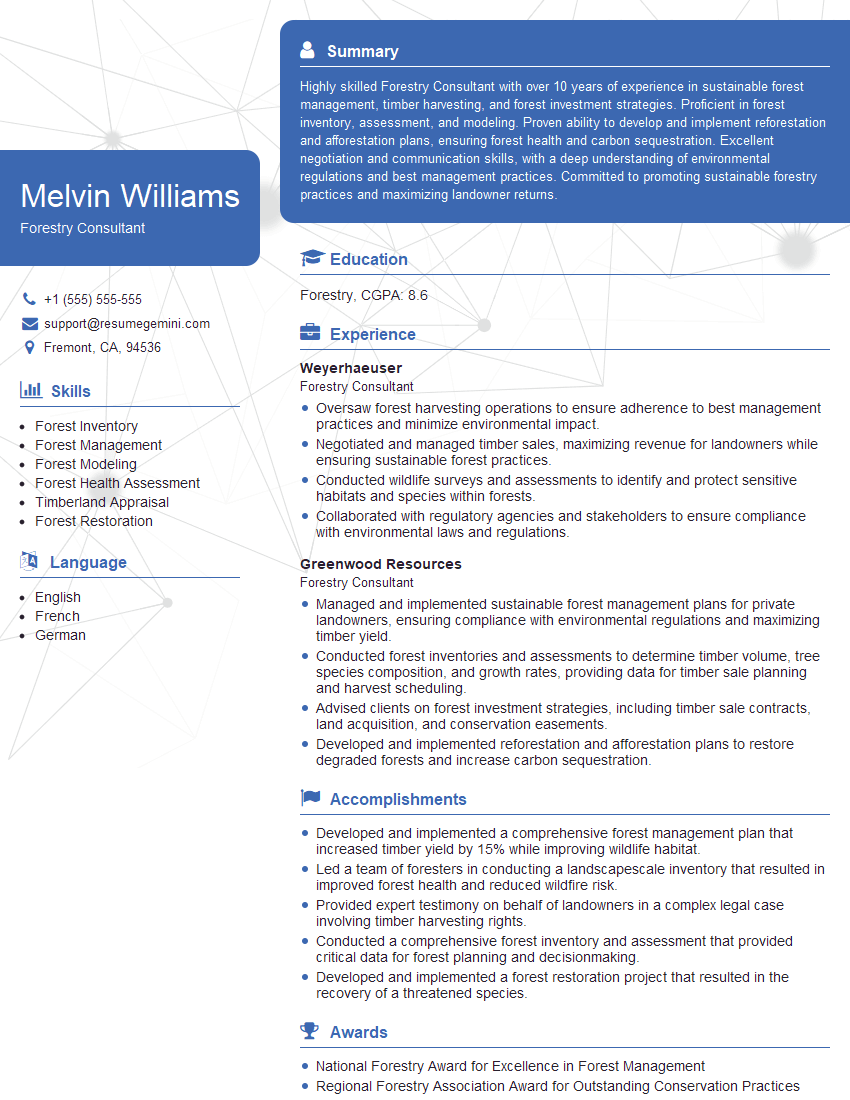
Mastering the art of felling timber opens doors to rewarding careers in forestry, logging, and related industries. A strong understanding of these techniques and safety procedures is crucial for career advancement and securing high-demand positions. To significantly improve your job prospects, creating an ATS-friendly resume is paramount. ResumeGemini is a trusted resource to help you build a professional resume that highlights your skills and experience effectively. We provide examples of resumes tailored to the Felling Timber industry to help guide you. Take the next step towards your dream career today!






Explore more articles
Users Rating of Our Blogs
Share Your Experience
We value your feedback! Please rate our content and share your thoughts (optional).
What Readers Say About Our Blog
Very informative content, great job.
good