Unlock your full potential by mastering the most common Finishing Operations (e.g., Cutting, Binding, Folding) interview questions. This blog offers a deep dive into the critical topics, ensuring you’re not only prepared to answer but to excel. With these insights, you’ll approach your interview with clarity and confidence.
Questions Asked in Finishing Operations (e.g., Cutting, Binding, Folding) Interview
Q 1. What are the different types of binding methods?
Binding methods secure pages together in a finished product. The choice depends on factors like the document’s length, budget, and desired aesthetic. Common methods include:
- Perfect Binding: The edges of the pages are glued together to create a square spine. This is common for paperback books and magazines. Think of your typical paperback novel – that’s perfect binding.
- Saddle Stitch Binding: Pages are folded in half and stapled along the spine. Suitable for brochures, booklets, and magazines with a low page count. It’s like stapling a newsletter.
- Spiral Binding (Coil Binding): A plastic or metal coil is inserted through punched holes along the spine. Often used for reports, calendars, and notebooks. This is the familiar method for many notebooks.
- Wire-O Binding: Similar to spiral binding, but uses double-loop wire for a more professional and durable finish. Frequently used for high-end presentations or calendars.
- Case Binding: Used for hardcover books and high-page-count documents. The sections are sewn together, then glued into covers. It’s the robust method for hardback books you find in libraries.
Q 2. Explain the process of saddle stitching.
Saddle stitching is a simple yet effective binding method ideal for documents with a low page count (generally under 64 pages). The process involves:
- Folding: The sheets of paper are folded in half, creating a signature (a set of folded pages).
- Gathering: The signatures are gathered and collated in the correct order.
- Stacking: The signatures are neatly stacked.
- Stitching: Wire staples are inserted through the folded edge, securing the signatures together. This creates the spine of the document.
- Trimming (optional): The edges might be trimmed to create a neat and even finish.
Think of creating a small booklet – you fold the pages, stack them, and then use a stapler to bind them. That’s saddle stitching in a nutshell.
Q 3. Describe the different types of cutting machines and their applications.
Cutting machines are crucial for achieving precise cuts and trims in finishing operations. Different types cater to various needs:
- Guillotine Cutters: These use a long, sharp blade that descends to cut through a stack of paper. They are highly accurate and efficient for large-volume cutting. Ideal for cutting paper, board and other materials to size. Imagine a large, heavy-duty paper cutter in a print shop – that’s a guillotine cutter.
- Rotary Cutters: These use a rotating cylindrical blade to cut through material. They’re excellent for intricate cuts and curves, but are typically slower than guillotine cutters and suitable for smaller scale projects. Think of a smaller, more versatile cutter, perhaps for cutting intricate shapes or smaller batches.
- Die Cutters: These use a custom-made die to create precise shapes and cuts in paper or cardstock. Often used for creating unique shapes and patterns. Think of creating custom shapes for cards or invitations.
The choice of machine depends on the job’s volume, required precision, and the shape of the finished product.
Q 4. How do you ensure accurate cutting and trimming?
Accurate cutting and trimming are vital for a professional finish. Here’s how to ensure accuracy:
- Regular Maintenance: Sharp blades are essential. Dull blades lead to uneven cuts and can damage the material. Regular sharpening or blade replacement is key.
- Proper Machine Setup: Accurate measurements are critical. Double-check the cutting guides and settings before each cut. Calibrate your machine regularly.
- Consistent Feeding: Ensure the material is fed consistently into the machine to prevent skewed cuts. Use proper feeding techniques.
- Quality Control Checks: Regularly inspect the cuts to identify any inconsistencies. This can include checking for consistent cuts, burrs, and damage.
Imagine baking a cake – you wouldn’t use a dull knife, right? It’s the same principle with cutting machines. Precision starts with well-maintained equipment and careful technique.
Q 5. What are the common issues encountered in folding operations and how do you troubleshoot them?
Folding operations can present challenges. Common issues include:
- Misaligned folds: This can be due to incorrect paper feeding, misaligned rollers, or worn parts.
- Creased or broken folds: Caused by excessive pressure, improper paper type, or damaged rollers.
- Poor fold quality: Can result from incorrect settings, worn-out rollers or improperly adjusted machine components.
Troubleshooting involves:
- Inspecting the machine: Check for worn parts, misalignments, and debris.
- Adjusting machine settings: Correct the pressure, speed, and folding path settings.
- Using the right paper: Choose a paper type suitable for folding, avoiding paper that’s too thick or too thin.
- Testing: Carry out test folds and adjustments before processing a large batch.
Think of folding a shirt – if you don’t do it properly, it will look messy. Similarly, proper techniques and machine maintenance are essential for good quality folds.
Q 6. Explain the importance of quality control in finishing operations.
Quality control in finishing operations is paramount. It ensures the final product meets customer expectations and brand standards. A robust quality control system includes:
- Pre-press checks: Verify that the material and print quality are accurate before commencing finishing.
- In-process inspections: Monitor the finishing process at various stages to identify and correct any defects early on.
- Post-processing checks: A final inspection to ensure all specifications are met. Look for things like binding quality, trim accuracy, and overall presentation.
- Documentation: Maintain thorough records of each process and inspection to track quality trends.
A well-managed quality control process minimizes errors and reworks, saving time and resources. It also safeguards your reputation by ensuring consistent product quality.
Q 7. What are the safety precautions you take while operating finishing machinery?
Safety is paramount when operating finishing machinery. Precautions include:
- Proper Training: Thorough training is crucial before operating any machine. Understand the machine’s controls, safety features, and potential hazards.
- Personal Protective Equipment (PPE): Always wear appropriate PPE, including safety glasses, gloves, and closed-toe shoes. For some machinery, hearing protection may also be necessary.
- Machine Guards: Ensure all safety guards are in place and functioning correctly. Never operate a machine with missing or damaged guards.
- Clear Work Area: Keep the work area free of clutter and obstructions to prevent accidents.
- Emergency Procedures: Familiarize yourself with emergency stop procedures and know the location of safety equipment.
Operating finishing machinery can be hazardous if safety procedures aren’t strictly followed. Safety should be your number one priority.
Q 8. How do you handle large-volume finishing projects efficiently?
Handling large-volume finishing projects efficiently requires a strategic approach combining optimized workflow, automation, and quality control. Think of it like orchestrating a symphony – each instrument (machine and operator) needs to play its part perfectly and in time.
- Process Optimization: We start by analyzing the project’s specifications to identify bottlenecks. For instance, if we’re dealing with a large print run of brochures, we might determine that the folding machine is the limiting factor. We’d then explore solutions such as adding another folding machine or optimizing the existing machine’s settings to improve speed and efficiency.
- Automation: Wherever possible, we integrate automated systems. This includes automated feeders, stackers, and even robotic arms for handling heavier items. Automation reduces manual labor, minimizes errors, and significantly boosts throughput. For example, using a high-speed saddle stitcher for booklet production allows for significantly faster processing than manual stitching.
- Quality Control Checkpoints: We establish regular quality control checkpoints throughout the process, not just at the end. This allows us to catch and rectify errors early on, preventing large-scale rejections and wasted materials. We might implement random sampling at each stage – after cutting, folding, and binding – to ensure consistent quality.
- Staff Training and Expertise: Highly trained operators are crucial. Regular training on equipment maintenance, troubleshooting, and best practices ensures smooth operation and minimizes downtime. For example, training on the nuances of different paper types ensures that the machines are set up correctly for optimal performance.
By meticulously planning and implementing these strategies, we ensure high-volume projects are completed on time and within budget, while maintaining high-quality standards.
Q 9. Describe your experience with different types of paper and their suitability for various finishing techniques.
Paper selection significantly impacts the success of finishing operations. Different papers behave differently under pressure and stress, affecting the quality of cutting, folding, and binding. Imagine trying to fold a crisp sheet of parchment the same way you’d fold a flimsy newspaper – it wouldn’t work!
- Coated Papers: These are often used for high-quality brochures or magazines due to their smooth surface and vibrant color reproduction. However, their smoothness can make them prone to slippage in some finishing machines, so careful machine calibration is essential.
- Uncoated Papers: These offer a more natural texture and are suitable for a wide variety of applications, from books to business cards. Their absorbency needs to be considered for certain binding methods.
- Specialty Papers: We encounter papers with unique characteristics like textured finishes, metallic inks, or unusual weights. These require careful handling and often necessitate adjustments to finishing equipment settings. For example, using a high-quality scoring machine is crucial to prevent cracking or tearing when folding thick, textured cardstock.
My experience spans various paper types and their suitability for specific finishing techniques. I have successfully handled projects involving delicate papers requiring gentle handling and heavy-duty card stock demanding robust machinery. Understanding the paper’s properties is key to choosing the right finishing techniques and machine settings to achieve the best results.
Q 10. How do you maintain and troubleshoot finishing equipment?
Maintaining and troubleshooting finishing equipment is a crucial aspect of my role. It’s like being a car mechanic for a print shop – regular maintenance prevents major breakdowns and ensures optimal performance.
- Preventive Maintenance: Regular cleaning, lubrication, and part replacements according to manufacturer recommendations are essential. This includes checking blades for sharpness, ensuring proper alignment of rollers, and cleaning dust and debris from the machines regularly. We maintain detailed logs of all maintenance activities.
- Troubleshooting: When problems occur, we follow a systematic approach. This typically starts with checking the obvious: paper jams, incorrect settings, and power supply issues. We have detailed troubleshooting guides for all our machines and utilize diagnostic tools as needed. For example, a misaligned cutting blade would manifest as uneven cuts; we’d adjust the blade alignment to resolve this.
- Operator Training: Operators are trained to identify and report potential problems before they become major issues. They are equipped with checklists for daily inspections and empowered to stop the machine if anything seems amiss.
Our proactive maintenance and troubleshooting approach minimizes downtime, ensuring smooth production flow and minimizing the impact of unexpected issues.
Q 11. What are the key performance indicators (KPIs) you track in finishing operations?
Key Performance Indicators (KPIs) in finishing operations help us track efficiency, quality, and overall performance. They are vital in identifying areas for improvement and ensuring we consistently meet targets.
- Throughput (units per hour): This measures the volume of finished products produced within a specific time frame.
- Downtime (percentage): This tracks the percentage of time equipment is not operational due to maintenance, repairs, or breakdowns.
- Waste (percentage): This represents the percentage of materials lost due to errors or defects.
- Defect Rate (percentage): This measures the percentage of finished products with defects requiring rework or rejection.
- Setup Time (minutes): This measures the time taken to set up the machinery for a new job. Reducing setup times significantly increases overall productivity.
By regularly monitoring these KPIs, we can identify trends, pinpoint areas needing improvement, and implement corrective actions to enhance overall efficiency and quality.
Q 12. How do you ensure the alignment and accuracy of folded sheets?
Ensuring accurate alignment and folding is paramount for a professional finish. Think of it as origami on an industrial scale – precision is key.
- Machine Calibration: Regular calibration of folding machines is essential to guarantee accurate folds. This involves checking and adjusting settings such as fold angles, registration marks, and pressure rollers.
- Paper Handling: Proper paper handling from the beginning minimizes misalignments. This includes ensuring the paper is correctly fed into the machine and that there are no wrinkles or creases that could cause misalignment. Using a paper jogger to create a neatly aligned stack is a crucial step.
- Registration Marks: Many projects use registration marks (small printed marks) to help the folding machine align the paper correctly. Checking the accuracy of these marks is a critical step in ensuring perfect folds.
- Quality Control Checks: Regular visual checks throughout the process and random sampling of finished products help identify any misalignments or folding defects early on.
By combining proper machine maintenance, careful paper handling, and quality control checks, we ensure the highest level of alignment and accuracy in folded sheets.
Q 13. Explain the difference between perfect binding and case binding.
Perfect binding and case binding are two common bookbinding methods, each suited for different types of publications. Think of them as two distinct ways to construct a building – one is more suitable for smaller structures, while the other is designed for larger, more elaborate projects.
- Perfect Binding: This method is ideal for softcover books, magazines, or journals with a relatively low page count. The edges of the pages are glued together to create a spine. It’s faster and less expensive than case binding. The spine is relatively flexible and the book lies relatively flat when open.
- Case Binding: This is a more robust and durable method typically used for hardcover books, textbooks, and high-quality publications. The pages are sewn together (or sometimes glued) to form a text block, which is then glued to a separate cover (the case). This creates a stronger, more durable spine that can withstand more wear and tear. The cover is often wrapped in a protective material, providing a professional look and feel. The spine is more rigid, and the book does not lay completely flat.
The choice between perfect binding and case binding depends on factors such as the page count, the desired durability, and the overall budget.
Q 14. What are some common finishing defects and their causes?
Several common finishing defects can occur, each with its own set of causes. Identifying these defects and their root causes is key to preventing them in future projects.
- Misaligned Cuts: This can be caused by dull blades, incorrect machine settings, or improper paper feeding.
- Creased or Wrinkled Pages: These defects often result from improper paper handling, insufficient machine pressure, or overly aggressive folding.
- Poor Binding: This could be due to incorrect glue application, insufficient drying time, or using an inappropriate binding method for the paper type. For example, using the wrong glue type can lead to poor adhesion.
- Page Misregistration: This results in misaligned images or text across different pages. It is caused by poor calibration of the machines or improper paper feeding.
- Incorrect Folding: This can be due to improperly adjusted folding machinery or unsuitable paper type for the selected folding technique.
By carefully monitoring the process and employing preventive measures such as regular equipment maintenance, proper paper handling, and quality checks, we can minimize or eliminate these defects.
Q 15. How do you manage waste and minimize material loss in finishing?
Waste minimization in finishing is crucial for both environmental responsibility and cost-effectiveness. My approach involves a multi-pronged strategy focusing on pre-press planning, efficient machine operation, and meticulous material handling.
Pre-press planning: Careful job estimation and accurate imposition (arranging pages for printing) are critical. Using software like imposition tools to optimize sheet utilization prevents unnecessary material waste from the outset. For example, I once reduced paper waste by 15% on a large magazine project by implementing a more efficient imposition plan.
Efficient machine operation: Regularly maintaining and calibrating cutting, folding, and binding machines ensures precise cuts and folds, minimizing errors that lead to scrap. Operator training is key to understanding optimal machine settings and efficient workflows.
Material handling: Implementing a clear system for storing and retrieving materials, along with proper waste segregation for recycling (paper, cardboard, etc.) and disposal of non-recyclable items, is vital. For instance, implementing a color-coded system for waste stream identification makes recycling easier and more effective.
By combining these strategies, I consistently achieve significant reductions in material waste, translating into lower costs and a smaller environmental footprint.
Career Expert Tips:
- Ace those interviews! Prepare effectively by reviewing the Top 50 Most Common Interview Questions on ResumeGemini.
- Navigate your job search with confidence! Explore a wide range of Career Tips on ResumeGemini. Learn about common challenges and recommendations to overcome them.
- Craft the perfect resume! Master the Art of Resume Writing with ResumeGemini’s guide. Showcase your unique qualifications and achievements effectively.
- Don’t miss out on holiday savings! Build your dream resume with ResumeGemini’s ATS optimized templates.
Q 16. Describe your experience with automated finishing systems.
I have extensive experience with automated finishing systems, including high-speed booklet makers, perfect binders, saddle stitchers, and automated cutting systems. My expertise spans both operation and maintenance.
In a previous role, I oversaw the implementation of a fully automated finishing line for a large-scale printing operation. This involved selecting appropriate machinery, configuring workflows, and training staff on operation and maintenance. This upgrade significantly boosted productivity and improved accuracy, reducing manual handling and its associated errors.
I’m familiar with various control systems, including PLC (Programmable Logic Controller) based systems, and have experience troubleshooting and resolving technical issues on these automated lines. I am also proficient in programming simple adjustments within the automated systems to optimize speed and output based on the job specifications.
Q 17. How do you ensure consistent quality across large print runs?
Ensuring consistent quality across large print runs requires a rigorous approach that begins before the finishing stage.
Pre-flight checks: Thorough inspection of the printed sheets before finishing identifies any defects early, preventing them from propagating through the entire run.
Regular quality control checks: Throughout the finishing process, regular checks using calibrated measuring instruments and visual inspections are crucial. Sampling at consistent intervals ensures that the quality remains consistent. Statistical Process Control (SPC) techniques are very beneficial here.
Machine calibration and maintenance: Maintaining cutting, folding, and binding equipment in top condition is non-negotiable. Regular maintenance ensures that these machines perform consistently and meet the required specifications.
Operator training: Highly trained and skilled operators are essential. Regular refresher training ensures that best practices are followed and that operators are capable of identifying and rectifying inconsistencies.
By implementing these measures, I can ensure that even large print runs maintain the highest quality standards, minimizing rejections and waste.
Q 18. What are your strategies for meeting tight deadlines in finishing operations?
Meeting tight deadlines in finishing requires meticulous planning and efficient execution. My strategy involves:
Prioritization: Using tools like Gantt charts, I prioritize jobs based on urgency and dependencies. This helps ensure that the most time-sensitive projects are completed first.
Efficient workflow: Streamlining workflows by optimizing machine settings, minimizing changeovers between jobs and ensuring good communication between team members is critical.
Resource allocation: Efficiently allocating personnel and equipment to jobs ensures that all resources are utilized optimally.
Contingency planning: Anticipating potential problems and having backup plans allows for swift recovery from unexpected delays. For example, having readily available replacement parts for crucial machinery minimizes downtime.
Overtime or additional resources: In extreme cases, strategically deploying overtime or bringing in additional temporary resources allows for completing tasks on time without compromising quality.
By employing these strategies, I consistently manage to deliver high-quality finished products, even when facing tight deadlines.
Q 19. How do you prioritize tasks and manage your workload in a busy finishing department?
In a busy finishing department, effective task prioritization and workload management are paramount. I utilize a combination of techniques:
Job scheduling software: Employing software that tracks job progress, deadlines, and resource allocation allows for a clear overview of all tasks.
Kanban boards: Visualizing the workflow using Kanban boards allows for easy identification of bottlenecks and facilitates proactive problem-solving.
Regular team meetings: Regular communication amongst the team helps resolve conflicts, shares workload updates and allows for efficient adjustment of task priorities as needed.
Delegation: Effectively delegating tasks to team members based on their skills and experience ensures a balanced workload and maximizes productivity.
My goal is to create a system that balances individual workloads while maintaining a smooth and efficient overall workflow, preventing burnout and maximizing output.
Q 20. Describe your experience with different types of finishing materials (e.g., adhesives, threads).
My experience encompasses a wide range of finishing materials. I’m proficient in handling various types of adhesives, including hot melt, PUR (polyurethane reactive), and cold-set adhesives, each with unique application requirements and properties. Understanding these properties is critical for ensuring proper bonding and adhesion.
Similarly, I am familiar with different types of threads used in different binding techniques, such as those employed in perfect binding, case binding, and saddle stitching. The selection of the appropriate thread type is crucial for the durability and aesthetic appeal of the finished product. I understand the differences in thread strength, colorfastness, and texture, and choose the optimal thread for the job.
I also possess knowledge of various substrates used such as different types of card stock, paper weights, and board stocks. The selection of these materials depends on the desired finished product quality and final application.
Q 21. What software or systems are you familiar with in a finishing environment?
I am proficient in several software and systems commonly used in a finishing environment.
MIS (Management Information Systems): I have experience using various MIS systems to track jobs, manage resources, and generate reports. This helps in efficient job scheduling and resource allocation.
Prepress software: My experience extends to prepress software used for imposition and workflow design, which directly impacts finishing efficiency.
Machine control software: I’m familiar with the software interfaces used to control automated finishing machines, allowing for programming and monitoring of the equipment.
Spreadsheet software (Excel): I’m adept at using spreadsheets for data analysis, reporting, and tracking key performance indicators (KPIs).
My proficiency in these systems significantly enhances my ability to manage finishing operations effectively and analyze performance data.
Q 22. How do you adapt to changes in finishing requirements or specifications?
Adapting to changes in finishing requirements is crucial in this dynamic field. It involves a proactive approach, combining meticulous attention to detail with effective communication. My strategy begins with carefully reviewing the revised specifications, identifying the key differences from the previous ones. This often includes examining changes in paper stock, binding type (e.g., switching from saddle-stitch to perfect binding), trim size, or finishing processes like embossing or foil stamping.
Once the changes are understood, I assess their impact on the production workflow. This might involve adjusting machine settings, re-sequencing operations, or even sourcing new materials. For example, if a project requires a thicker paper stock, I’d adjust the cutting and folding machines accordingly to avoid jams or misfeeds, potentially requiring a change in blade pressure or feed speed.
Communication is key. I’d proactively discuss the changes with the pre-press team to ensure consistency and address any potential challenges early on. This collaborative approach minimizes delays and ensures the final product meets the revised specifications perfectly.
Q 23. What are your skills in problem-solving and troubleshooting in finishing operations?
Problem-solving and troubleshooting are integral to my daily work. My approach is systematic and combines practical experience with a data-driven mindset. I start by carefully identifying the problem, gathering data, and eliminating obvious causes. For example, if a folding machine is malfunctioning, I’d first check for paper jams, ensure the correct settings are applied and examine the machine for any visible damage. I might then systematically check components like rollers, sensors, and belts.
If the issue persists, I use a troubleshooting chart specific to the machine model. This guides me through a series of diagnostic steps to pinpoint the exact source of the problem. I also utilize my knowledge of various finishing techniques and machines to identify potential solutions. For instance, if we’re facing issues with consistent scoring, I might adjust the scoring wheel pressure or examine the paper’s moisture content.
Beyond the technical aspects, I actively investigate the root cause of the problem to prevent its recurrence. This might involve improving machine maintenance procedures, better training for operators or refining the project specifications. Documenting solutions is vital for future reference, creating a valuable knowledge base for the team.
Q 24. Describe a time you had to deal with a major finishing issue. How did you resolve it?
In one project, we encountered significant problems with a large-scale perfect binding job. The client needed 10,000 copies of a high-end book with intricate foil stamping. During the binding process, a high percentage of books were coming off the line with uneven glue application, leading to pages falling out.
Initially, we focused on the obvious – checking glue viscosity, adjusting the glue roller pressure, and cleaning the machine. When these solutions proved ineffective, I investigated the root cause further. I discovered that the uneven pressure on the spine was caused by a slight warp in the feeder tray, creating inconsistent pressure on the book blocks before gluing.
The solution involved temporarily replacing the feeder tray with a spare and meticulously adjusting the pressure settings. We also implemented a more rigorous quality control check at each stage, including a visual inspection of the glue application before further processing. We communicated openly with the client, explaining the issue and the steps taken to rectify it. The project was ultimately completed successfully, though it required extra time and effort. This experience taught me the importance of proactive maintenance and meticulous quality checks throughout the entire finishing process.
Q 25. How do you communicate effectively with other departments (e.g., pre-press, printing)?
Effective communication with other departments is paramount. I believe in a proactive, collaborative approach. I maintain open lines of communication, frequently using emails, instant messaging, and face-to-face meetings to ensure everyone is informed and on the same page. With the pre-press department, this includes confirming color accuracy, checking the final digital proofs for potential finishing issues, ensuring all files are ready, and discussing potential problems that might arise during finishing.
With the printing department, I discuss the print quality, paper stock characteristics (e.g., weight, moisture content), and any potential issues that might impact finishing, such as uneven color or ink bleed. Clear communication prevents misunderstandings, reduces waste, and ensures the smooth flow of work. I emphasize providing constructive feedback and actively listening to their perspectives. This shared understanding leads to better solutions and efficient workflows. I use a project management system, like a shared spreadsheet or dedicated project management software, to track progress, share critical information, and manage any changes in requirements seamlessly.
Q 26. How do you contribute to a team environment in a fast-paced finishing operation?
In a fast-paced environment, teamwork is essential. I actively contribute to a positive and productive team dynamic by prioritizing collaboration and open communication. I’m always willing to assist colleagues, sharing my knowledge and expertise to help them resolve issues or improve their skills. I believe in a supportive team environment, where everyone feels comfortable sharing ideas and offering help.
I’m adept at multitasking and managing time effectively. I prioritize tasks based on urgency and importance, ensuring that deadlines are met without compromising quality. This includes proactively identifying potential bottlenecks and developing contingency plans to mitigate risks. In addition, I readily embrace new technologies and processes to improve efficiency and output. For example, I’ve actively participated in training sessions on using new finishing equipment, improving my skillset and benefiting the team as a whole.
Q 27. What are your career aspirations within the field of Finishing Operations?
My career aspirations involve progressing to a leadership role within finishing operations. I aim to leverage my expertise and experience to mentor and develop other team members, fostering a culture of continuous improvement and high performance. I’m eager to enhance my knowledge of advanced finishing techniques and technologies, and I intend to pursue relevant certifications to enhance my credibility and expertise.
Ultimately, I aspire to be a key contributor to a company’s success by optimizing finishing processes, improving efficiency, reducing costs, and enhancing product quality. I see my future contributions involving the implementation of new technologies, the development of efficient workflow processes, and ultimately, the strategic leadership of a high-performing finishing team.
Q 28. What are your salary expectations?
My salary expectations are commensurate with my experience and expertise in the field of Finishing Operations, aligning with industry standards and the specific requirements of this role. I am open to discussing this further based on a comprehensive review of the job description and responsibilities.
Key Topics to Learn for Finishing Operations (e.g., Cutting, Binding, Folding) Interview
- Cutting Techniques: Understanding different cutting methods (e.g., guillotine, die-cutting), blade types, and their applications for various materials (paper, board, etc.). Consider the impact of blade sharpness and pressure on cut quality and efficiency.
- Binding Methods: Familiarize yourself with various binding techniques (e.g., perfect binding, saddle stitch, spiral binding, wire-o). Know the strengths and weaknesses of each method, and which are best suited for different document types and volumes.
- Folding Techniques: Master different folding patterns (e.g., letter fold, gate fold, parallel fold) and understand the impact of paper type and weight on folding performance. Explore techniques for efficient and accurate folding, including the use of machinery.
- Quality Control: Develop a strong understanding of quality control procedures in finishing operations. This includes identifying common defects (e.g., miscuts, misfolds, binding issues), implementing corrective actions, and maintaining consistent quality standards.
- Safety Procedures: Demonstrate knowledge of safety protocols related to operating machinery and handling materials in a finishing operation environment. This includes proper machine operation, personal protective equipment (PPE) use, and hazard identification.
- Production Efficiency: Understand the principles of optimizing production flow and minimizing waste in finishing operations. This might include understanding workflow optimization, efficient material handling, and troubleshooting production bottlenecks.
- Material Handling and Storage: Be prepared to discuss best practices for handling and storing different paper types and other materials used in finishing operations. This includes considerations for storage conditions, preventing damage, and maintaining material integrity.
- Troubleshooting Common Issues: Practice identifying and resolving common problems encountered in cutting, binding, and folding processes. This involves understanding the root causes of issues and implementing effective solutions.
Next Steps
Mastering Finishing Operations is crucial for career advancement in print production and related fields. A strong understanding of these processes demonstrates technical proficiency and problem-solving skills highly valued by employers. To increase your job prospects, create an ATS-friendly resume that showcases your skills and experience effectively. ResumeGemini is a trusted resource to help you build a professional resume that stands out. Examples of resumes tailored to Finishing Operations are available to guide you.
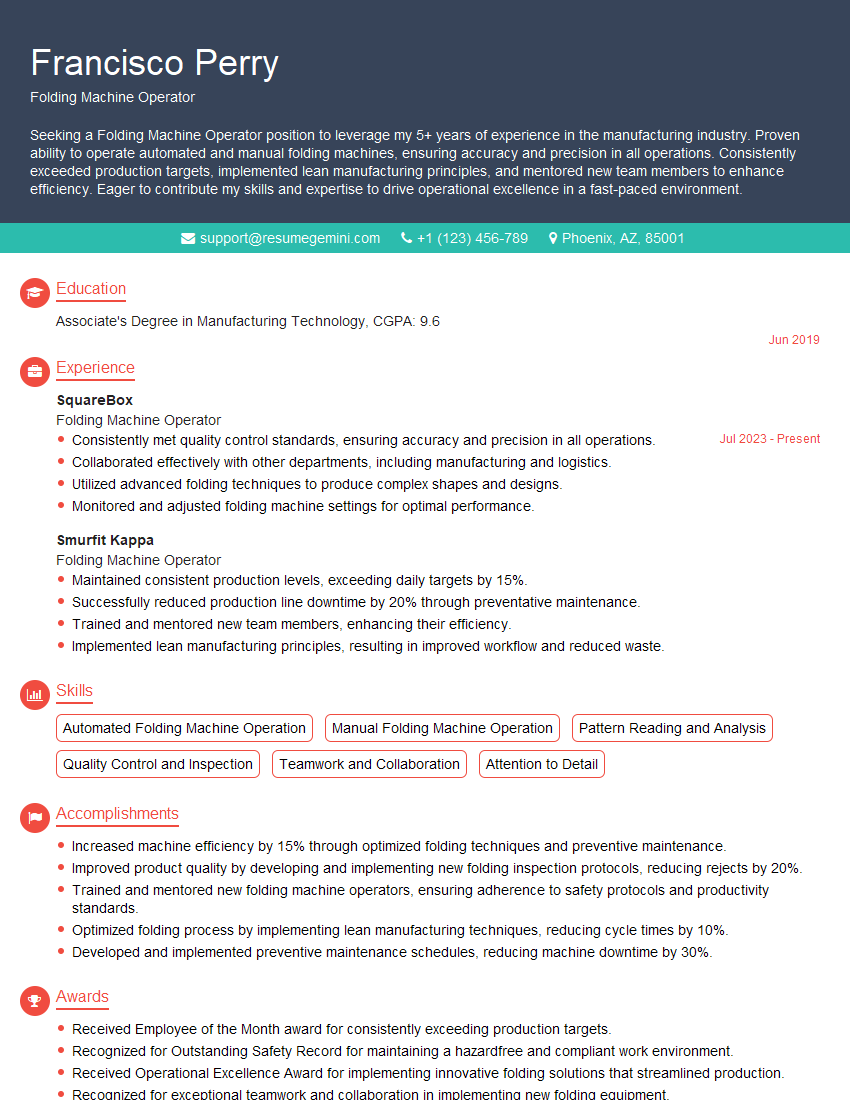
Folding Machine Operator Resume Sample
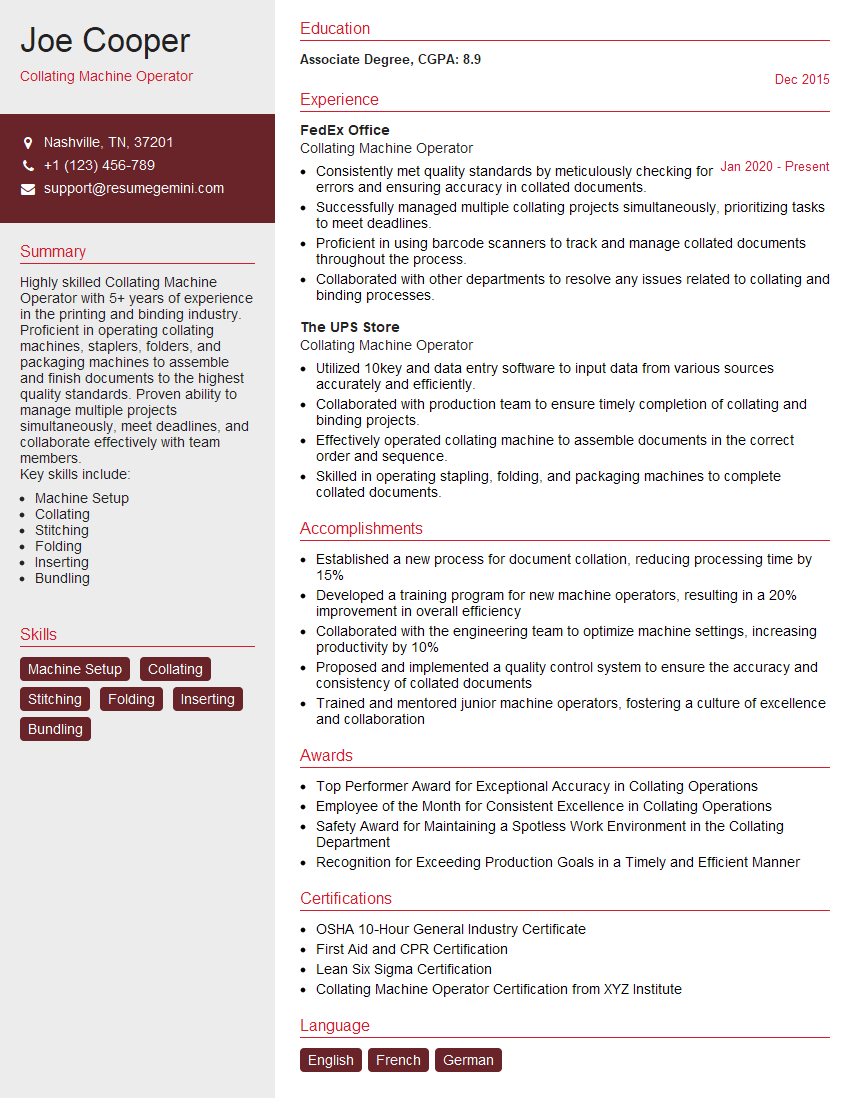
Collating Machine Operator Resume Sample
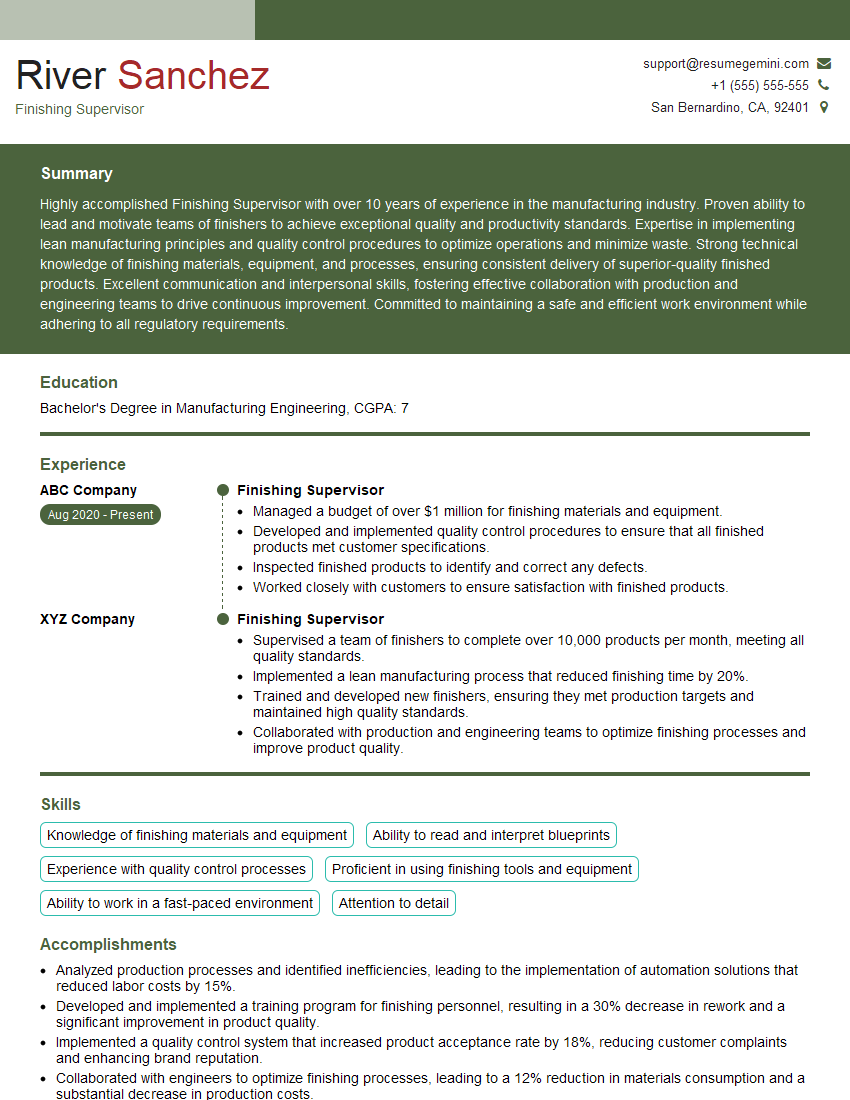
Finishing Supervisor Resume Sample
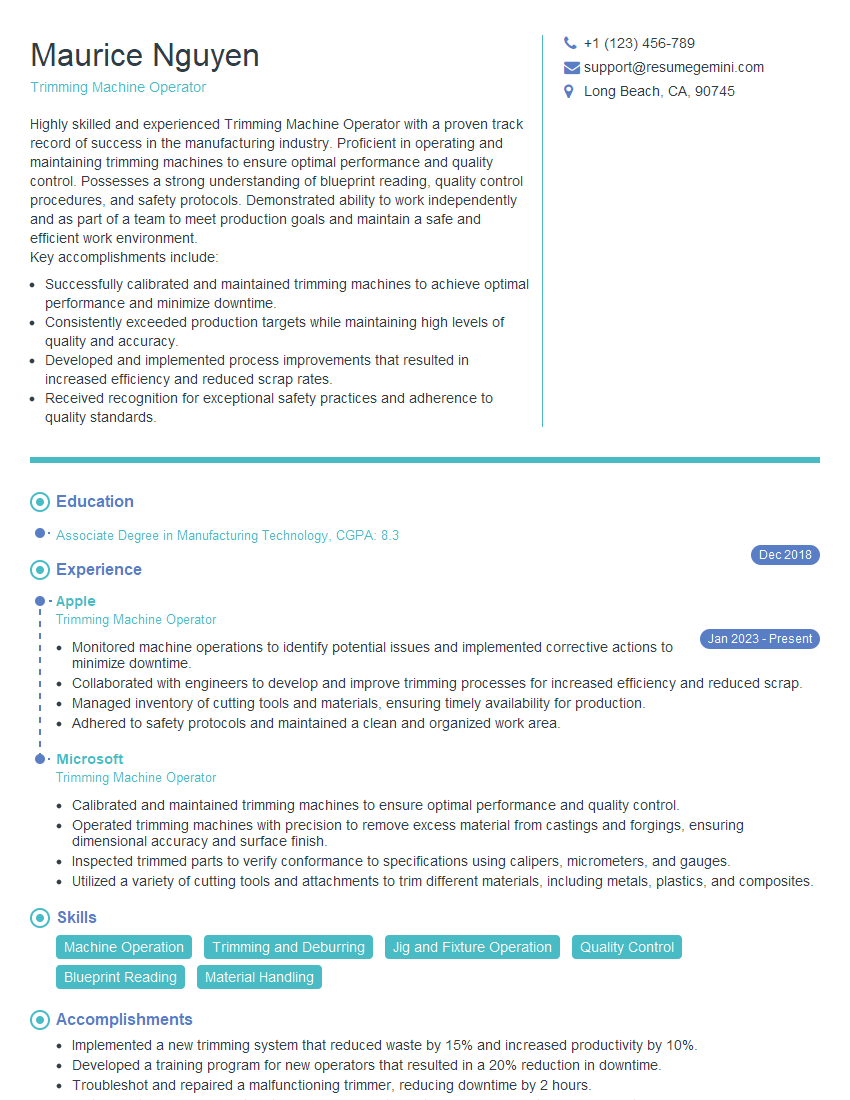
Trimming Machine Operator Resume Sample
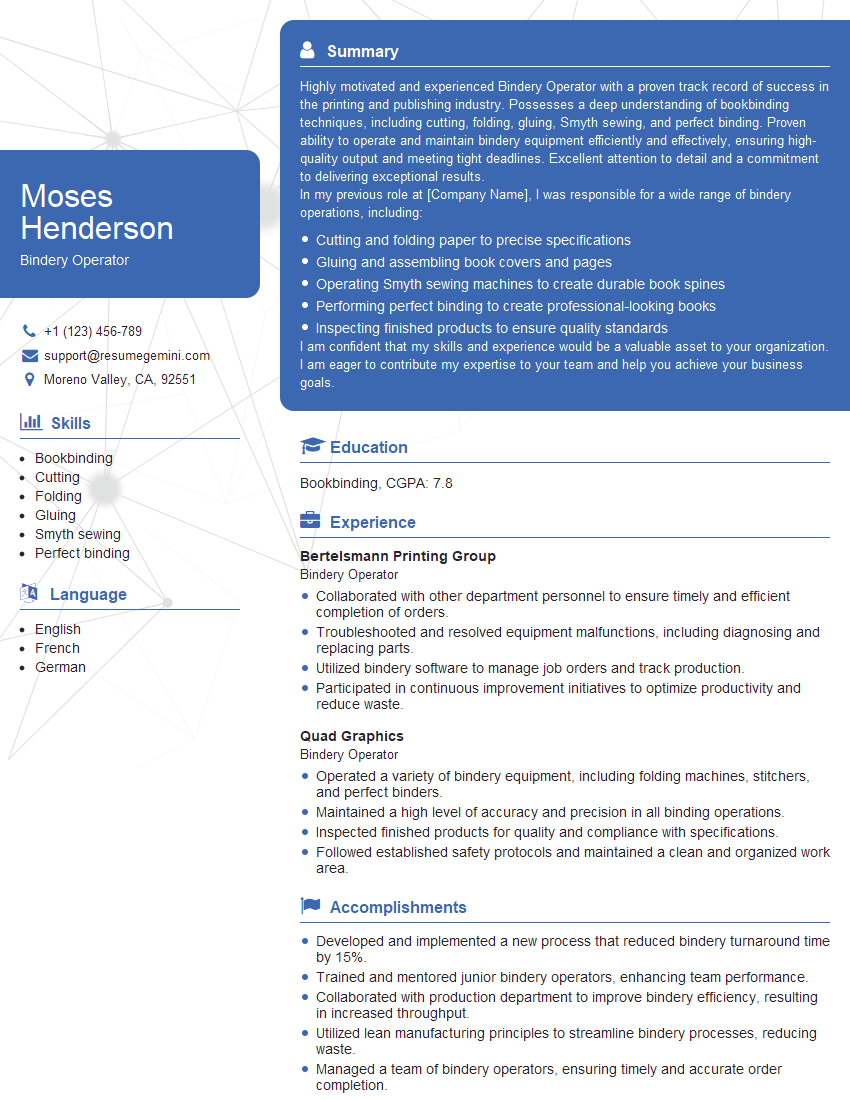
Bindery Operator Resume Sample
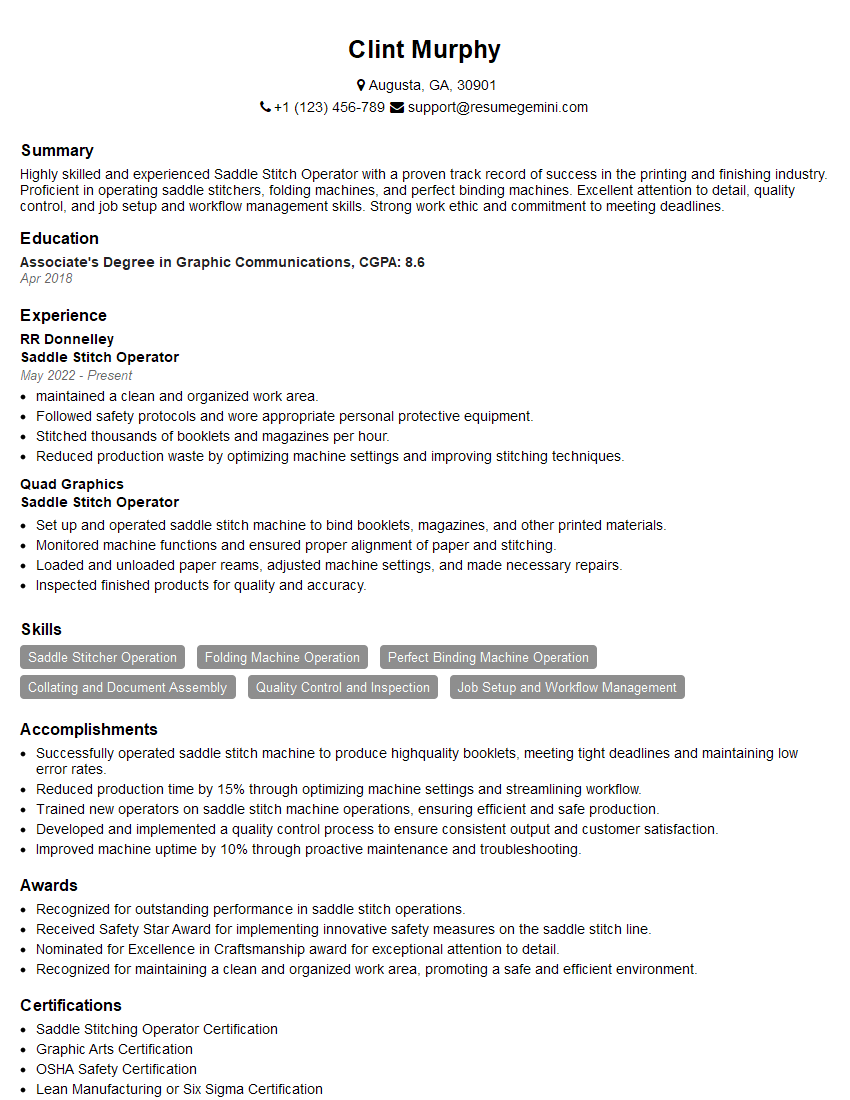
Saddle Stitch Operator Resume Sample
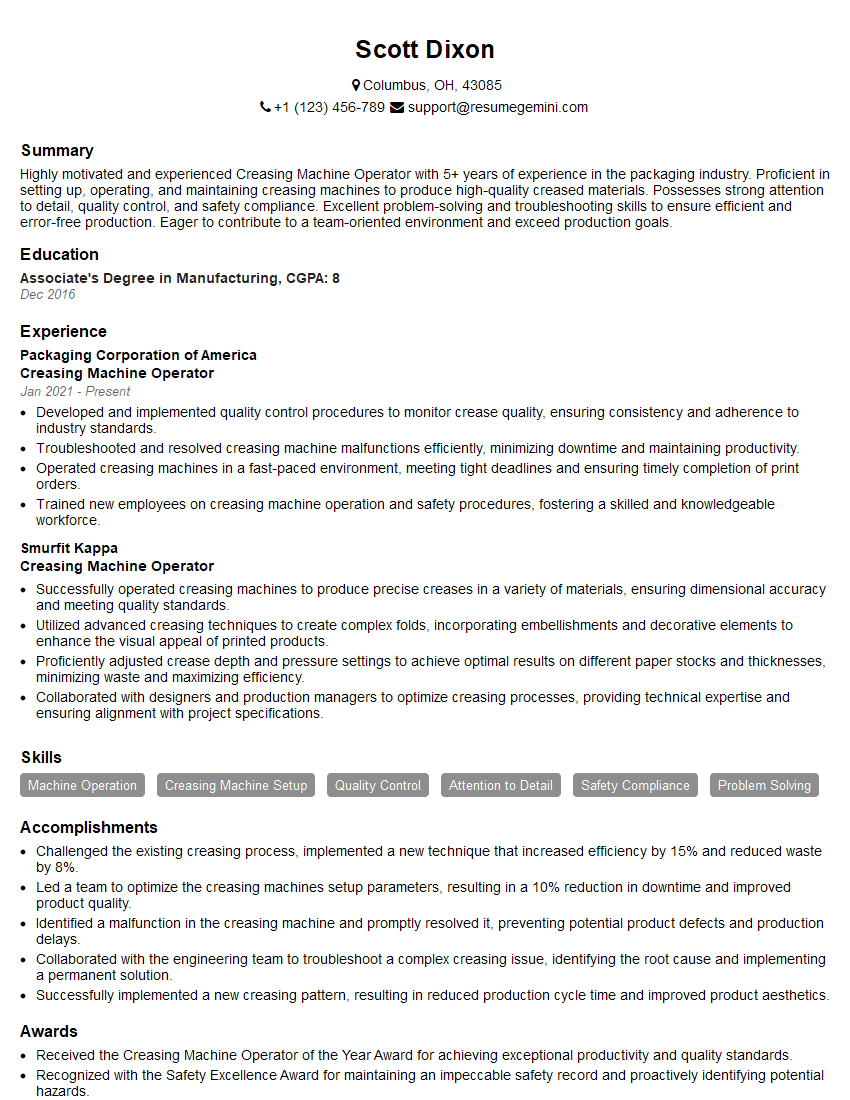
Creasing Machine Operator Resume Sample
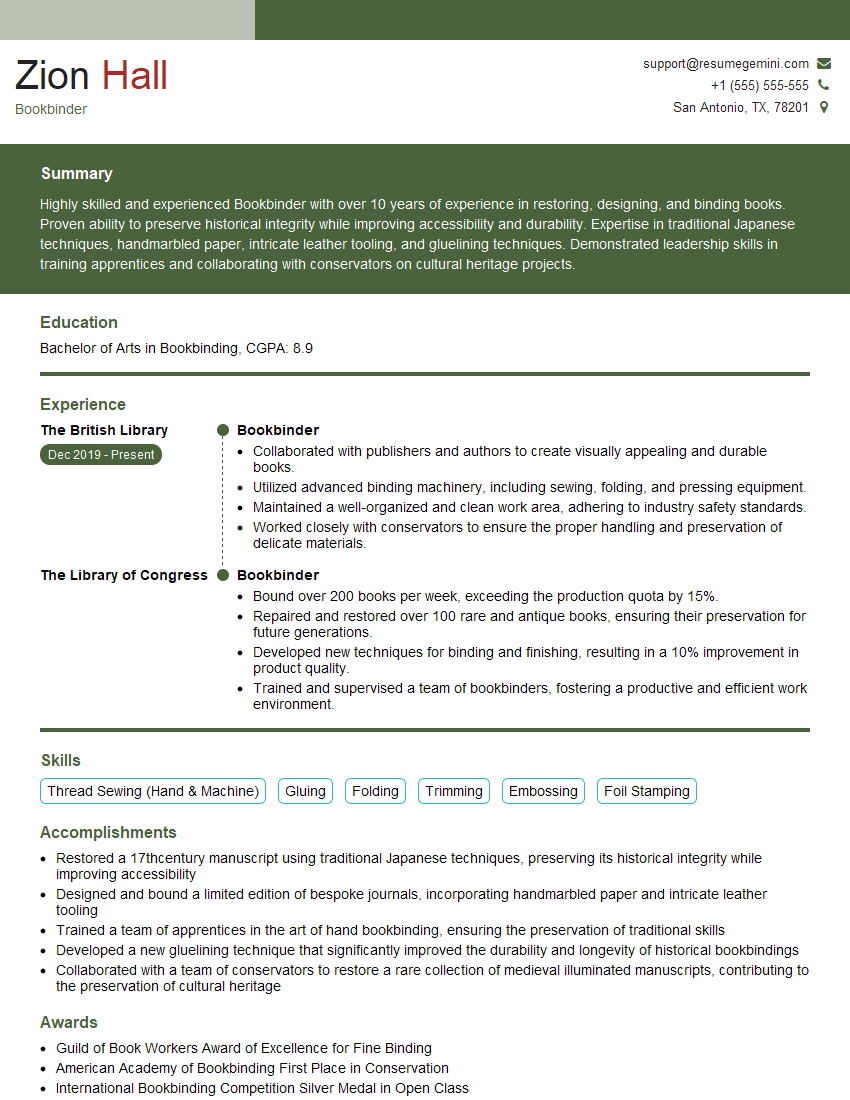
Bookbinder Resume Sample
Explore more articles
Users Rating of Our Blogs
Share Your Experience
We value your feedback! Please rate our content and share your thoughts (optional).
What Readers Say About Our Blog
Very informative content, great job.
good