The thought of an interview can be nerve-wracking, but the right preparation can make all the difference. Explore this comprehensive guide to Fishing Knot Tying interview questions and gain the confidence you need to showcase your abilities and secure the role.
Questions Asked in Fishing Knot Tying Interview
Q 1. What are the five strongest knots for fishing line?
Choosing the strongest knot depends heavily on the type of line and the application. However, five consistently strong and reliable knots for fishing line include the Palomar knot, the improved clinch knot, the blood knot, the Albright knot, and the Uni knot. Each excels in different situations; for instance, the Palomar is excellent for monofilament, while the blood knot shines when joining two lines of different diameters.
Remember, knot strength is always less than the line’s breaking strength, and proper tying technique is paramount.
Q 2. Explain the Palomar knot and its applications.
The Palomar knot is a remarkably strong and simple knot, particularly well-suited for monofilament and fluorocarbon lines. Its loop formation reduces friction, leading to higher breaking strength compared to many other knots. It’s quick to tie and extremely reliable, making it a favorite amongst anglers.
Applications: The Palomar is ideal for attaching lures, swivels, and hooks. Its ease of use and strength make it a versatile choice for almost any fishing situation.
Think of it as a reliable friend you can always count on – easy to work with and consistently delivers.
Q 3. Describe the process of tying a clinch knot.
The clinch knot is a fundamental knot for attaching hooks and lures to your fishing line. While seemingly simple, its effectiveness relies on precise execution. A poorly tied clinch knot is a weak point that can cost you a fish.
- Pass the line through the eye of the hook.
- Wrap the line around the hook shank 5-7 times (more wraps for thicker line).
- Pass the tag end through the loop formed near the hook eye.
- Moisten the knot and snug it tightly against the hook eye.
- Trim the excess tag end.
Crucial Point: Ensure each wrap is tight and lies flat against the shank. A sloppy clinch knot is a recipe for disaster.
Q 4. When would you use a blood knot versus a Albright knot?
Both the blood knot and the Albright knot join two lines of different diameters, but they serve slightly different purposes. The blood knot is excellent for joining lines of similar material (e.g., monofilament to monofilament) while the Albright knot is preferred for joining lines of different materials (e.g., monofilament to braided line).
In essence: Use a Blood knot for lines of similar material and an Albright knot for lines of different materials.
Q 5. What is the importance of proper knot strength in fishing?
Proper knot strength is paramount in fishing because a weak knot is the weakest link in your entire setup. A strong knot ensures you can land the fish without your line breaking at the most crucial moment. A broken line means losing a trophy fish, a valuable lure, or even worse, an injury.
Imagine reeling in a massive tuna; your line holds strong, and then… *snap* at the knot! Your heart sinks, and all that hard work is gone. This highlights the importance of using reliable knots and tying them correctly.
Q 6. How does line diameter affect knot strength?
Line diameter significantly influences knot strength. Thicker lines generally hold knots better than thinner lines. This is because thicker lines distribute stress over a larger area, preventing the knot from being concentrated at a single point. A thinner line has a higher chance of breaking at the knot because there is less material to distribute the force.
Therefore, always consider the diameter of your fishing line when selecting an appropriate knot, and remember that even the strongest knots will weaken with thinner line.
Q 7. Explain how to tie a Uni knot.
The Uni knot is a versatile and strong knot ideal for attaching lures and swivels, especially effective with braided lines. It’s known for its compact size and high strength.
- Pass the line through the eye of the lure or swivel.
- Make 5-7 turns around the main line.
- Pass the tag end back through the first loop near the lure/swivel eye.
- Wet the knot, snug it tight, and trim the tag end.
The Uni knot’s strength and compactness make it particularly valuable in situations where a smaller knot profile is preferred, such as when fishing in tight quarters or using small lures.
Q 8. Describe the advantages and disadvantages of using a perfection loop.
The Perfection Loop is a fantastic knot for creating a loop at the end of your fishing line, primarily used for attaching lures or swivels. Its main advantage lies in its strength and sleek profile, minimizing friction and snags. It’s incredibly versatile and easy to tie, making it a favorite among many anglers. However, a disadvantage is that it can be slightly more challenging to tie perfectly than simpler loops, requiring precise execution to ensure reliable performance. A poorly tied Perfection Loop can weaken significantly, leading to line breakage. Think of it like a perfectly fitted piece of jewelry – beautiful and strong if done right, but potentially flawed if improperly made.
Q 9. How do you prevent line slippage in a knot?
Preventing line slippage is crucial for a secure knot. The key is to ensure the lines are tightly interwoven and the knot is properly cinched down. This often involves wetting the line (especially with braided lines) to reduce friction and allow the fibers to compress more tightly. After tying the knot, firmly pull both lines several times to ensure a snug fit. Using a knot that’s appropriate for your line type and diameter is also vital – a knot too small for your line will slip easily. For added security, consider applying a tiny amount of superglue to the knot’s base (allowing it to dry completely, of course) – but only if you’re confident in your knot tying abilities; otherwise you risk weakening the line itself.
Q 10. What are the signs of a poorly tied knot?
A poorly tied knot shows itself in several ways. Obvious signs include loose sections in the knot, uneven loops, or visibly weak points where the line is not tightly bound. The knot may also appear bulky and unwieldy, suggesting improper tightening. A really alarming sign is when you feel play or looseness when you gently tug on the knot. In the worst-case scenario, the line may break during the casting phase or when fighting a fish, indicative of a catastrophic knot failure.
- Loose sections: Gaps or spaces in the knot structure.
- Uneven loops: Loops of different sizes or shapes within the knot.
- Weak points: Areas where the line appears thin or stressed.
- Bulkiness: A knot that’s significantly larger than it should be.
- Line breakage: The ultimate sign of a poorly tied knot.
Q 11. How do you adjust your knot choice based on the type of fishing line?
Your knot choice hinges directly on the line’s material properties. Braided lines, for instance, are very strong but require knots designed to prevent them from slipping or fraying. Monofilament lines, while less strong, require knots that can securely grip the smooth, round structure. Fluorocarbon lines, being stiff and abrasion-resistant, demand knots that don’t compress too tightly or cause breakage. Choosing the wrong knot can lead to frustrating line failure, lost fish, or lost lures. It’s akin to selecting the right tool for a job; using a hammer for screws doesn’t work.
Q 12. What knots are suitable for braided lines?
Braided lines need knots that grip their fibers tightly to prevent slippage. Excellent choices include the Palomar knot, the improved clinch knot (with multiple wraps), or the FG knot (which is more advanced). The key is to ensure the knot is thoroughly wet before tightening to reduce friction. I often recommend the FG knot for the strength and low profile, but it does take practice to master.
Q 13. What knots are suitable for fluorocarbon lines?
Fluorocarbon lines benefit from knots that don’t over-compress the line, as this can lead to breakage. The improved clinch knot, the Palomar knot, and the blood knot are all good options for fluorocarbon. The blood knot is particularly suitable for joining two fluorocarbon lines of similar diameter.
Q 14. What knots are suitable for monofilament lines?
Monofilament lines are relatively easy to tie, and a wide range of knots work well. The clinch knot is a simple and reliable option, frequently used by beginners. The improved clinch knot offers greater security. The Palomar knot is also very strong and easy to learn, providing excellent abrasion resistance. Remember to always wet the line to aid in tightening the knot.
Q 15. How do you tie a reliable knot for connecting different line diameters?
Connecting lines of different diameters requires a knot that’s both strong and adaptable. The most reliable knot for this is the improved clinch knot, followed by a well-tied Albright knot. The improved clinch is simpler, but the Albright excels with significantly different diameters.
Improved Clinch Knot (Suitable for slight diameter differences): This knot is excellent for attaching a leader to your main line. Imagine you’re using 10lb test main line and a 6lb fluorocarbon leader; the improved clinch works well. It’s relatively simple to tie, and its strength is quite high when properly executed.
Albright Knot (Best for large diameter differences): This knot is your go-to when connecting lines that are substantially different in diameter, such as connecting a heavy braided line to a much thinner monofilament leader. Think 50lb braid to 8lb mono. Its strength comes from the way the thicker line is wrapped around the thinner one, creating a strong, even connection.
Key to Success: Regardless of which knot you choose, meticulously wet your line before tightening, use a snug, but not overly tight initial pull. Overtightening at the start can crimp the line and drastically reduce strength. A final adjustment after wetting is recommended.
Career Expert Tips:
- Ace those interviews! Prepare effectively by reviewing the Top 50 Most Common Interview Questions on ResumeGemini.
- Navigate your job search with confidence! Explore a wide range of Career Tips on ResumeGemini. Learn about common challenges and recommendations to overcome them.
- Craft the perfect resume! Master the Art of Resume Writing with ResumeGemini’s guide. Showcase your unique qualifications and achievements effectively.
- Don’t miss out on holiday savings! Build your dream resume with ResumeGemini’s ATS optimized templates.
Q 16. How do you test the strength of a tied knot?
Testing knot strength isn’t about brute force; it’s about mimicking the stresses a knot will endure during fishing. I always perform two tests:
- Visual Inspection: Check for any imperfections, twists, or loose loops after tying. A poorly tied knot will be readily apparent.
- Controlled Load Test: I use a scale for this. Gently apply load incrementally, slowly increasing the pressure until it breaks. Note the breaking point. A well-tied knot will generally break the line itself, *not* at the knot.
Remember, the actual breaking strength of a knot is always lower than the line’s stated strength. This is why it’s crucial to tie your knots meticulously. This helps to maximize the knot’s strength and minimize the risk of failure on the water.
Q 17. Describe a situation where you had to repair a broken line while fishing.
I once had my main line snap while fighting a particularly large trout. It was mid-cast, and I had a decent amount of line out. The fish was giving an incredible tug-of-war, and the line just went *snap*! Luckily, I always carry a backup spool of line and appropriate tools. I quickly re-spooled a new section using the improved clinch knot, and thankfully reeled it in! I learned that day the importance of carrying extra line, testing knot strength frequently and properly tying a knot is crucial in critical situations such as this.
Q 18. What are some common mistakes people make when tying fishing knots?
Many common mistakes reduce knot strength significantly:
- Insufficient Wraps: Not making enough wraps when tying a knot, especially knots like the improved clinch, weakens the connection and increases the chance of slippage or failure.
- Incorrect Tightening: Pulling too hard initially creates line kinks and weakens the knot. Tightening should be gradual and controlled.
- Uneven Tension: In knots like the Palomar or the Albright, inconsistent tension during the tying process creates weak spots and can lead to failure.
- Ignoring Line Type: Using the same knot for different types of line (braid, mono, fluoro) may not always be ideal. Each line type benefits from certain knots.
- Wetting the Line: Not wetting the line before tightening reduces the knot’s strength due to friction.
Practicing consistently and learning correct technique through various resources is key to avoid these mistakes. Paying close attention to the details of each knot will greatly improve your success rate.
Q 19. Explain the importance of using appropriate tools for knot tying.
The right tools significantly improve knot tying, making it easier and resulting in stronger, more reliable knots.
- Line Cutters/Scissors: Clean cuts prevent frayed ends that weaken the knot.
- Knot Tying Tools: These devices aid in creating even wraps and tightening knots, particularly useful for smaller line diameters.
- Needle-Nose Pliers: These help to create tight, consistent wraps, and allow for precise adjustments.
- Bobbin: A bobbin can be beneficial for helping you to create even wraps, especially for knots requiring many wraps such as the Albright knot.
Investing in quality tools is a small price to pay for increased knot strength and tying efficiency. It’s especially important for lines that are difficult to handle, such as braided lines.
Q 20. How does water temperature and line material impact knot strength?
Both water temperature and line material significantly impact knot strength.
- Water Temperature: Cold water makes most lines stiffer and more brittle. This increases the chance of line breakage at the knot, especially under heavy stress. Warmer water generally makes lines more pliable, leading to better knot performance.
- Line Material: Monofilament is more susceptible to knot slippage in cold water compared to braided line, which generally maintains higher strength across temperature ranges. Fluorocarbon is known for its low stretch and abrasion resistance but behaves differently at varying temperatures, often becoming more brittle in cold conditions. Always remember that the knot itself won’t magically make up for a faulty or poorly suited material choice.
Understanding these factors helps you choose the right line for the conditions and select the appropriate knot for optimal performance.
Q 21. What are some specialized knots for specific fishing techniques?
Certain knots are better suited for specific fishing techniques.
- Palomar Knot: Excellent for general use, particularly strong and easy to tie, making it a good all-around choice for a variety of fishing applications.
- Improved Clinch Knot: Great for attaching lures, swivels, and leaders, particularly suitable for lighter lines and most fishing situations.
- Uni Knot: Ideal for tying strong connections with braided lines and fluorocarbon leaders. Extremely versatile and strong.
- Blood Knot: The best choice when joining two lines of similar diameter. This knot is important for creating a seamless, strong connection between two pieces of line of the same diameter.
- Albright Knot: Specifically designed for joining lines of significantly different diameters and is ideal for joining a thick braided main line with a thin fluorocarbon leader.
Choosing the right knot enhances your success rate and ensures your tackle holds up under pressure. Knowledge and practice are your greatest assets.
Q 22. Explain the impact of knot strength on hook setting.
Knot strength is paramount for successful hook setting. A weak knot will fail under the pressure of a strong fish, resulting in a lost catch. Think of it like this: the knot is the final link in the chain between your rod, line, lure, and the fish. If that link breaks, the entire system fails. A strong knot ensures that when you set the hook, the point penetrates the fish’s mouth effectively, without the line or lure breaking away.
The type of knot significantly impacts strength. A poorly tied Palomar knot, for example, might only achieve 50% of the line’s breaking strength, whereas a correctly tied one can reach close to 90%. This difference is huge when fighting a powerful fish. A stronger knot also minimizes the chance of the line snapping during the fight, leading to a higher catch rate.
Q 23. How do you tie a reliable knot for attaching a swivel?
The best knot for attaching a swivel is the improved clinch knot. It’s simple to tie, reliable, and offers excellent strength. It’s my go-to knot for this purpose, and I recommend it to all anglers, regardless of their experience level.
Here’s how to tie it:
- Pass the main line through the swivel eye.
- Make 5-6 wraps around the main line, keeping the wraps close together and snug.
- Pass the tag end of the line through the loop formed near the swivel.
- Moisten the line and pull the tag end tightly, ensuring that the wraps are snug against the swivel.
- Trim the excess tag end.
The key is to ensure each wrap is tight and that you pass the tag end through the loop correctly. A poorly tied improved clinch knot is weaker, so practice until you can tie it consistently and efficiently.
Q 24. How do you choose the right knot for attaching different lures or baits?
Knot selection for attaching lures and baits depends heavily on the lure/bait type and line diameter. There’s no one-size-fits-all solution.
- Soft plastic lures: I prefer the Palomar knot for its strength and ease of tying. It’s also less likely to damage the soft plastic.
- Hard lures (crankbaits, spinners, etc.): The improved clinch knot is excellent due to its strong connection and ease of use.
- Live bait (worms, minnows, etc.): The clinch knot is a classic choice for its simplicity and reliability; the Palomar is also effective. The size of the hook and line matter in choice here.
- Thick braided line: An Albright knot is ideal as it minimizes line slippage and abrasion. It’s more complex but necessary for the strength of braided line.
- Thin monofilament line: A simple improved clinch knot is often sufficient. The simpler, the less chance for error.
Always consider the line’s strength and the lure’s weight when selecting a knot. If you are fishing with heavier lures, you want a stronger knot to avoid breakage.
Q 25. Describe a time you had to improvise a knot due to limited resources.
I once found myself on a remote lake with only a small piece of paracord and a severely damaged line. My usual knots were out of the question. I had to improvise a makeshift knot to attach my lure to my line. I utilized a variation of a simple overhand knot, repeatedly wrapping the paracord around the remaining line, and then creating a tight overhand knot. It wasn’t ideal, but it held up long enough to catch a few fish before I could replace my line. It highlighted the importance of adaptability and problem-solving when faced with unexpected situations.
This experience reinforced that understanding fundamental knotting principles is more important than memorizing specific knots. Being able to adapt and improvise is a valuable skill for any angler.
Q 26. How do you maintain the strength of your knots during prolonged fishing sessions?
Maintaining knot strength during extended fishing sessions involves careful attention to detail and proactive measures.
- Regular inspection: I routinely check my knots after every few casts, especially in situations involving heavy drag or sharp rocks. Look for any fraying or unusual wear.
- Avoid unnecessary friction: Avoid running the line across sharp objects which can weaken the knot. Keeping your line running smoothly through guides is crucial.
- Proper wetting: Always wet your line before tightening a knot; this reduces friction and maximizes its strength. Avoid extreme temperatures.
- Don’t overtighten: Overtightening can weaken a knot, especially with monofilament lines. Tighten firmly but avoid excessive force.
- Replace worn knots: If a knot shows even slight wear, replace it immediately. It’s better to be safe than sorry, especially when a large fish is on the line.
Proactive maintenance is far better than dealing with a broken line and lost fish.
Q 27. What are some resources you use to learn new fishing knots or improve your technique?
I use a variety of resources to continually improve my knot-tying skills. I started with traditional fishing guides and books; they provide a strong foundational understanding of knot anatomy and functionality.
Online resources, such as YouTube tutorials and detailed knot-tying websites, have become invaluable. These allow me to visualize knot tying in action and compare different techniques. I also frequently attend fishing seminars and workshops where experienced anglers share their expertise.
Ultimately, practice is key. I continually practice various knots until I can tie them accurately and efficiently, even under pressure.
Q 28. How do you determine when a knot is too worn and needs replacing?
Determining when a knot needs replacing requires careful observation and attention to detail.
- Visual inspection: Look for fraying, flattening, or unusual wear patterns on the line near the knot. This indicates weakening and potential failure.
- Feel and texture: A worn knot often feels softer or less firm than a fresh one. This subtle difference can be easily felt with practice.
- Performance: A compromised knot may exhibit reduced strength; for example, your line might feel weaker during the fight. Don’t take unnecessary risks.
When in doubt, always replace the knot. It’s a small price to pay for preventing a lost fish or even a broken rod.
Key Topics to Learn for Fishing Knot Tying Interview
- Knot Selection: Understanding the properties of different knots (e.g., strength, ease of tying, suitability for different line types and applications) and choosing the appropriate knot for a given fishing scenario.
- Tying Techniques: Mastering the precise steps involved in tying various essential fishing knots, including the improved clinch knot, palomar knot, blood knot, and Albright knot. This includes understanding the importance of proper line tension and finishing techniques.
- Line Management: Knowing how to handle different types of fishing line (monofilament, braided, fluorocarbon) and how this impacts knot selection and tying techniques. This includes understanding line diameter and breaking strength.
- Troubleshooting Knot Failures: Identifying common causes of knot failure (e.g., incorrect tying technique, damaged line, inappropriate knot selection) and implementing strategies for prevention and remediation.
- Practical Applications: Demonstrating proficiency in tying knots quickly and efficiently under various conditions (e.g., wet hands, windy conditions). Understanding the implications of knot failure in different fishing contexts (e.g., losing a valuable catch, damaging equipment).
- Advanced Knots: Familiarity with more specialized knots, such as the uni-knot, or specific knots suitable for particular lures or fishing styles. This demonstrates a deeper understanding of the craft.
Next Steps
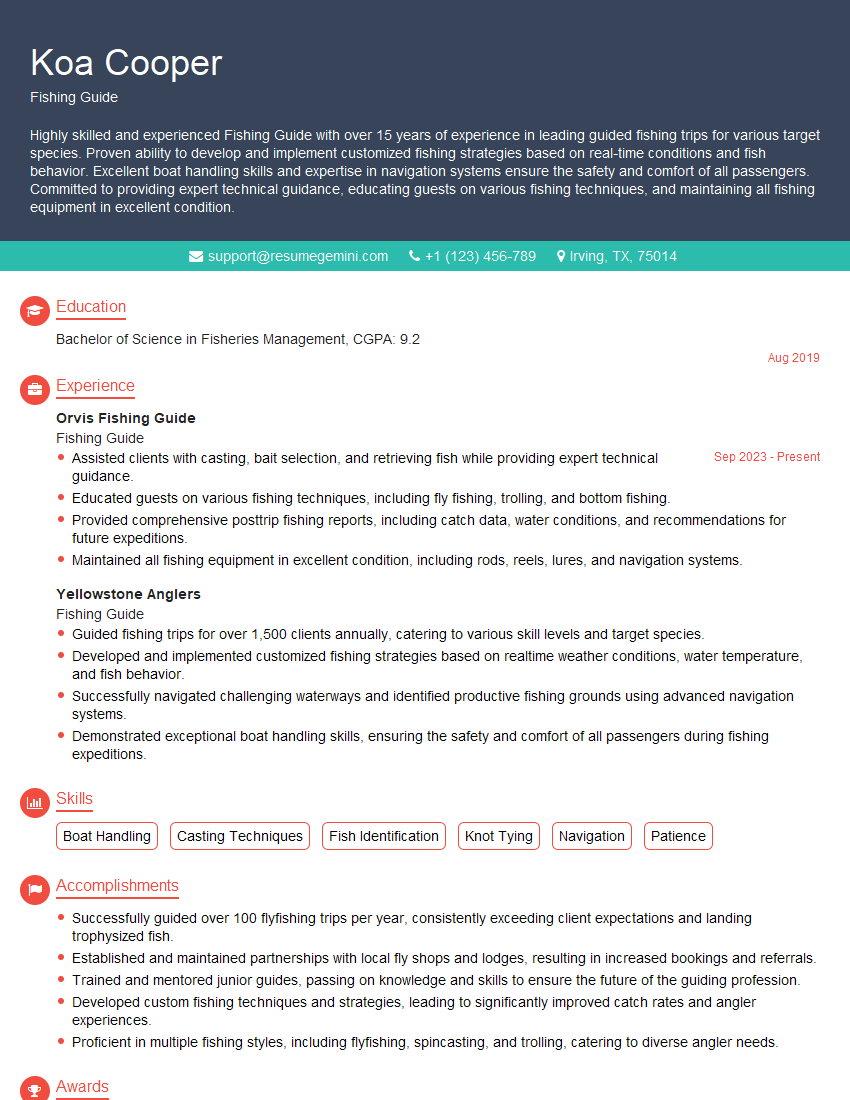
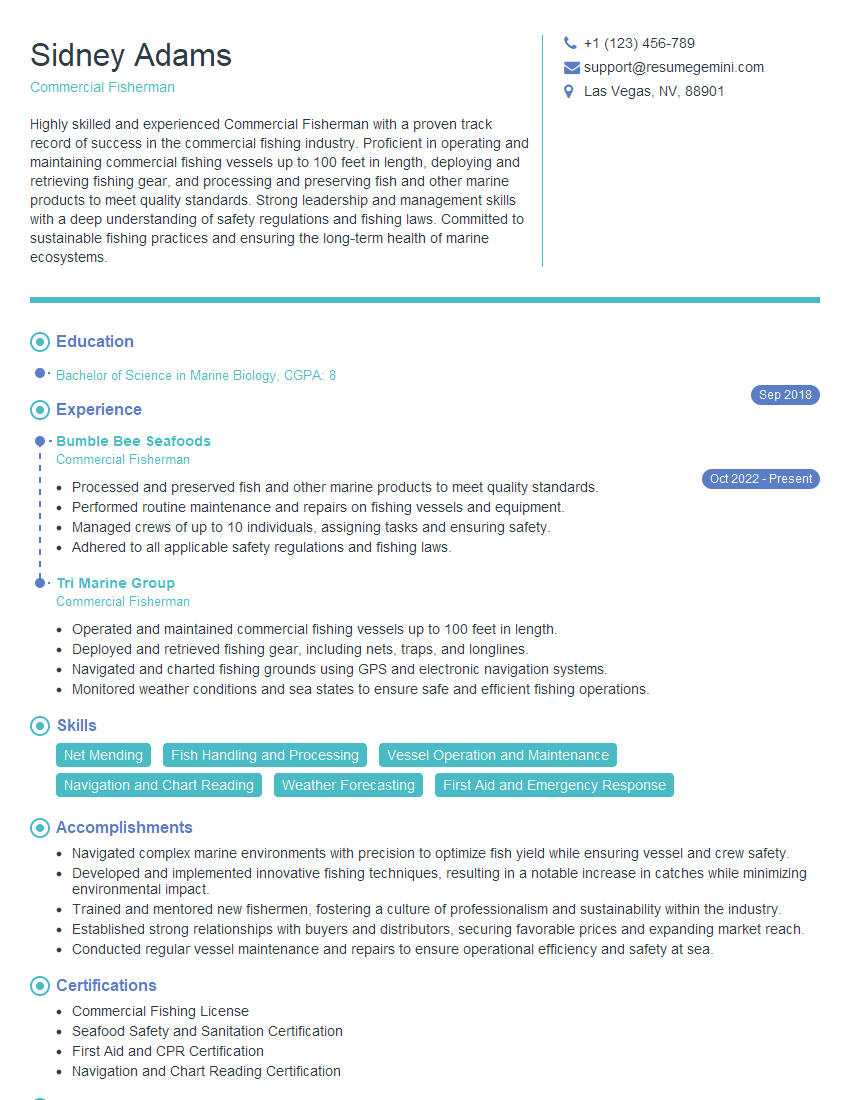
Mastering fishing knot tying is crucial for career advancement in various fishing-related industries, showcasing your practical skills and attention to detail. A strong resume is essential for highlighting these skills to potential employers. Building an ATS-friendly resume increases your chances of getting noticed and securing interviews. ResumeGemini is a trusted resource to help you create a professional and impactful resume, ensuring your qualifications shine. Examples of resumes tailored to fishing knot tying expertise are available to help you get started.
Explore more articles
Users Rating of Our Blogs
Share Your Experience
We value your feedback! Please rate our content and share your thoughts (optional).
What Readers Say About Our Blog
Very informative content, great job.
good