The right preparation can turn an interview into an opportunity to showcase your expertise. This guide to Optical Design for Manufacturing interview questions is your ultimate resource, providing key insights and tips to help you ace your responses and stand out as a top candidate.
Questions Asked in Optical Design for Manufacturing Interview
Q 1. Explain the differences between paraxial and third-order optical design.
Paraxial optics and third-order optics represent different levels of approximation in optical design. Paraxial optics, also known as Gaussian optics, is a simplified model that assumes all rays are near the optical axis (the central axis of the system). This approximation allows for linearization of the ray tracing equations, making calculations significantly easier. It’s useful for initial design and quick estimations of focal length, magnification, and other basic parameters. Think of it like a rough sketch of a system. However, it ignores aberrations – imperfections in the image formed by a lens or mirror.
Third-order optics, on the other hand, is a more accurate model that takes into account the first-order aberrations – spherical aberration, coma, astigmatism, field curvature, and distortion. These aberrations are represented by third-order terms in the ray tracing equations and introduce deviations from the ideal Gaussian image. It provides a more realistic prediction of the system’s performance but still uses approximations. It’s like refining your sketch with more details, adding shading and correcting proportions. Moving beyond third-order involves higher-order aberrations, requiring more complex calculations.
In essence, paraxial optics offers a quick, simple starting point, while third-order optics offers improved accuracy before diving into the complexities of higher-order aberration correction. We often start with paraxial design to get a basic understanding and then progress to higher-order analysis to fine-tune the design.
Q 2. Describe your experience with optical tolerancing and its impact on manufacturing.
Optical tolerancing is critical for manufacturability and achieving the desired performance of an optical system. It involves defining acceptable variations in the manufacturing parameters (like lens radii, thicknesses, surface irregularities, and center thicknesses) to ensure the final system meets its specifications within a certain tolerance range. My experience involves developing tolerance budgets – allocating allowable tolerances to individual components – based on sensitivity analysis.
I use Monte Carlo simulations extensively to assess the impact of these tolerances on the system’s performance. This involves randomly generating variations in the manufacturing parameters within the specified tolerances and simulating the resulting system performance. It helps to identify the most sensitive components to manufacturing errors. For example, I once worked on a high-precision imaging system where the tolerance on a specific lens’ aspheric surface was particularly critical. The Monte Carlo analysis helped us justify the need for a more precise and expensive manufacturing process for that element.
The impact on manufacturing is substantial. Tight tolerances increase the manufacturing cost and complexity, potentially requiring specialized equipment and processes. My goal is to achieve a balance between acceptable performance and manageable manufacturing tolerances. This often involves iterative design optimization where I adjust the design to reduce sensitivity to manufacturing variations.
Q 3. How do you optimize an optical system for manufacturability?
Optimizing an optical system for manufacturability is a crucial aspect of successful optical design. It’s an iterative process involving several key strategies:
- Tolerance Analysis: As mentioned earlier, thorough tolerance analysis using Monte Carlo simulations is essential to identify sensitive parameters and allocate tolerances accordingly.
- Design Simplification: Reducing the number of optical elements and using simpler lens shapes (e.g., spherical instead of aspheric, if feasible) simplifies the manufacturing process and reduces costs.
- Material Selection: Choosing readily available and easy-to-manufacture materials with stable optical properties is crucial. This often involves trade-offs between optical performance and manufacturability.
- Component Standardization: Using standardized components wherever possible reduces manufacturing costs and complexity. For example, employing off-the-shelf lenses reduces the need for custom manufacturing.
- Manufacturing Process Consideration: Throughout the design phase, it’s important to consult with the manufacturing team to incorporate their expertise and constraints. This ensures the design is not only optically sound but also practically feasible to produce.
For example, in a recent project, I was able to reduce the number of aspheric elements by subtly adjusting the design parameters, resulting in significant cost savings and improved manufacturing yield.
Q 4. What software packages are you proficient in for optical design and simulation (e.g., Zemax, Code V, FRED)?
I’m proficient in several optical design and simulation software packages, including Zemax OpticStudio, Code V, and FRED. Zemax OpticStudio is my primary tool, and I’m highly experienced with its various functionalities, including ray tracing, tolerance analysis, optimization, and non-sequential ray tracing. I’ve used Code V for specific projects where its strengths (particularly in its optimization algorithms) were beneficial. FRED’s non-sequential capabilities have proven valuable for simulating complex systems with scattering and diffraction effects. My expertise extends to using the macro language in Zemax to automate repetitive tasks and custom analysis routines. This significantly improves efficiency during complex design iterations.
Q 5. Explain your understanding of different lens types (e.g., singlet, doublet, aspheric).
Different lens types offer varying levels of performance and complexity in manufacturing. A singlet lens is a single element of glass or other transparent material with two curved surfaces. They are simple to manufacture but often suffer from significant aberrations. A doublet lens consists of two singlets cemented together, allowing for improved aberration correction compared to singlets. They offer a good balance between performance and manufacturability. Aspheric lenses have surfaces that are not spherical; they have a freeform shape designed to correct aberrations. Aspherics offer superior image quality, but they’re more challenging and expensive to manufacture compared to spherical lenses, requiring specialized equipment like diamond turning or molding.
The choice of lens type depends on the application’s requirements and budget. For low-cost, low-performance applications, singlets might suffice. For high-performance systems requiring excellent image quality, aspherics might be necessary, even though the manufacturing is more intricate and expensive. Doublets provide a practical middle ground.
Q 6. Describe your experience with different optical fabrication techniques.
My experience encompasses various optical fabrication techniques, including:
- Grinding and Polishing: This traditional method involves progressively shaping and polishing the lens surface using abrasive materials. It’s suitable for a wide range of lens types but can be time-consuming and labor-intensive for complex shapes.
- Diamond Turning: A precision machining technique that uses a diamond tool to create aspheric surfaces with high accuracy. It’s particularly well-suited for creating aspheric and freeform lenses.
- Molding: A cost-effective technique for mass production, particularly for simple lens shapes. It involves injecting molten glass or plastic into a mold to create the desired lens shape.
- Reactive Ion Etching (RIE): Used for micro-optics and creating complex surface structures.
Understanding these techniques is crucial for designing manufacturable optics; for instance, designing a lens with extremely tight tolerances might necessitate using diamond turning, which is accurate but also more expensive.
Q 7. How do you assess the performance of an optical system?
Assessing the performance of an optical system involves a multifaceted approach combining simulation and experimental testing. Simulation, using software like Zemax or Code V, provides predictions of key performance parameters like Modulation Transfer Function (MTF), spot diagrams, wavefront error, and distortion. These simulations help identify design flaws and evaluate the impact of tolerances.
Experimental testing verifies the simulated performance. This involves measuring the actual performance of the manufactured system using instruments such as interferometers (for wavefront measurements), MTF testers, and spot cameras. Comparison between simulation and experimental results is essential to validate the design and manufacturing process. Discrepancies highlight potential issues in the design, manufacturing, or testing procedures.
Beyond these quantitative metrics, qualitative assessment, such as visual inspection of the image quality, is also important. A holistic approach combining simulation and experimental data allows for a complete understanding of the system’s performance and enables identification of areas for improvement.
Q 8. What are the key considerations for designing for mass production?
Designing for mass production in optical design requires a shift from optimizing for perfect performance in a single unit to balancing performance with manufacturability and cost-effectiveness. This involves several key considerations:
- Component Tolerances: Tight tolerances lead to superior performance but increase manufacturing costs and complexity. A crucial part of the design is defining realistic tolerances that minimize performance degradation while remaining achievable within a mass production setting. For example, the center thickness of a lens might be specified with a tolerance of +/- 0.1mm instead of the tighter +/- 0.05mm which would be achievable in smaller batches.
- Material Selection: The choice of optical materials impacts both performance and cost. While exotic materials might offer superior properties, more readily available and less expensive materials are preferred for mass production. We might choose a standard crown glass over a more expensive high-index material if the performance difference is negligible in the context of the application.
- Assembly Considerations: The design must account for efficient and repeatable assembly processes. This includes things like simplifying the number of components, selecting components with robust designs, and ensuring they can be handled by automated equipment. For instance, lenses need to be designed for easy mounting in standardized cells, thus simplifying assembly lines.
- Testing and Quality Control: The design should incorporate simple and efficient testing procedures to ensure consistent quality throughout production. This may involve designing test fixtures and selecting specific metrology methods that can be quickly and reliably applied to a high volume of products. For instance, using a simple go/no-go gauge to check for lens diameter rather than a full interferometric test at every stage.
- Design for Manufacturing (DFM): This methodology encompasses all aspects of the design process aimed at optimizing manufacturing. Close collaboration with manufacturing engineers is key to identifying and mitigating potential issues early in the design process. Examples of DFM include choosing standard lens sizes, minimizing the need for complex machining, and streamlining optical coatings for large scale application.
Q 9. Explain your understanding of optical coatings and their applications.
Optical coatings are thin layers of material deposited onto optical components to modify their interaction with light. They are essential for controlling the transmission, reflection, and polarization of light. Different coating types exist, tailored to specific applications:
- Anti-reflection (AR) coatings: Minimize unwanted reflections, crucial for maximizing throughput in imaging systems and reducing ghosting. These usually consist of multiple layers of materials with varying refractive indices, designed to cause destructive interference of reflected light.
- High-reflection (HR) coatings: Maximize reflection at specific wavelengths, critical for laser cavities and interferometers. They work by employing constructive interference of light waves.
- Dichroic coatings: Selectively transmit or reflect different wavelengths of light, often used in color separation in projection systems or filter specific wavelengths for spectroscopy. They’re created using multilayer interference filters that specifically target different wavelengths.
- Polarizing coatings: Modify the polarization state of light, essential in various applications such as polarimetry and liquid crystal displays. These are often based on materials that exhibit birefringence.
For example, in a high-power laser system, the mirrors need high-reflection coatings to maintain the lasing action, and the output coupler may need a partial-reflection coating to allow some light to escape. In a camera lens, AR coatings are essential to reduce reflections and improve image quality.
Q 10. How do you handle design trade-offs between performance and cost?
Balancing performance and cost is a constant challenge in optical design. The approach involves a systematic process of iterative design and evaluation:
- Defining Performance Requirements: Clearly specifying the minimum acceptable performance levels for the optical system is the first step. These requirements need to be well-defined and justified.
- Initial Design Optimization: Initial designs are created to meet the performance criteria, often prioritizing performance over cost.
- Cost Analysis: This involves identifying the cost drivers in the design. This might involve understanding the cost of different materials, manufacturing processes, and assembly procedures.
- Trade-off Analysis: This is a crucial step, identifying design parameters that can be relaxed without significantly compromising performance while reducing costs. For example, a slightly less accurate lens profile might be acceptable, provided that this can be compensated through other design choices, or the tolerance of a given parameter can be loosened, without affecting final performance below a defined threshold.
- Iterative Refinement: The design is iteratively refined, balancing performance and cost until an optimal solution is achieved. This might involve multiple iterations of design optimization, cost analysis, and trade-off evaluation.
For instance, in designing a consumer-grade camera lens, we might accept a slightly lower resolution or field of view to reduce the complexity of the lens design, potentially through reducing the number of elements or simplifying their shape. This often leads to a cost-effective production process.
Q 11. Describe your experience with optical metrology and testing.
Optical metrology and testing are crucial for verifying the performance of optical systems. My experience encompasses a wide range of techniques:
- Interferometry: Used to measure wavefront errors and surface imperfections with high accuracy. Techniques like Fizeau and Twyman-Green interferometry are frequently used in characterizing lens quality and alignment.
- MTF (Modulation Transfer Function) measurement: Quantifies the ability of an optical system to resolve fine details. This helps assess the imaging performance of a system.
- Autocollimation: Used to measure the surface flatness of mirrors and other optical components. This technique is often used for fast testing and quality control.
- Scatterometry: Measures the surface roughness and texture. This technique is important for characterizing optical components for their impact on light scatter and image quality.
- Spectrophotometry: Measures the transmission and reflection of optical components as a function of wavelength. This is crucial for characterizing the performance of coatings and filters.
I have hands-on experience with various metrology instruments, including interferometers, spectrophotometers, and MTF measurement systems. I can perform both qualitative and quantitative analysis of the test data to assess the quality of optical components and systems. For example, when testing a newly designed objective lens, I would use interferometry to analyze the wavefront error, MTF to assess image quality, and spectrophotometry to confirm that the anti-reflection coating performs as expected.
Q 12. Explain your process for troubleshooting optical system issues.
Troubleshooting optical system issues requires a systematic approach:
- Detailed Problem Definition: Clearly define the problem, including specific symptoms and performance deviations from the expected parameters.
- Review of Design Specifications: Compare the observed performance with the original design specifications to identify potential areas of concern. It might be useful to use modelling software to simulate the observed behavior.
- Systematic Testing: Conduct a series of tests to isolate the source of the problem. This could involve component-level testing to identify any defects.
- Data Analysis: Analyze the collected data to identify trends and correlations that could indicate the source of the issue.
- Corrective Actions: Implement appropriate corrective actions based on the identified source of the problem. This could range from component replacement to redesigning elements of the system.
- Verification: After implementing the corrective actions, retest the system to verify the solution’s effectiveness.
For example, if an imaging system suffers from reduced resolution, I might start by testing each component individually to rule out issues like a misaligned lens or a damaged sensor. If the issue is with a lens, I would check its specifications with regards to its tolerances, and check its alignment to the overall system. If none of the individual elements are at fault, I might suspect issues within the overall optical design, and run a simulation to identify the source of the issue.
Q 13. How familiar are you with different types of optical materials and their properties?
I am very familiar with a wide range of optical materials and their properties. My knowledge encompasses:
- Glasses: Including crown glasses, flint glasses, and specialized glasses like fused silica, offering various refractive indices, Abbe numbers, and transmission characteristics.
- Crystals: Such as calcium fluoride (CaF2), magnesium fluoride (MgF2), and zinc selenide (ZnSe), known for their excellent transmission in the infrared and ultraviolet regions.
- Polymers: Including PMMA (acrylic), polycarbonate, and zeonex, offering cost-effective alternatives with suitable properties in specific applications.
- Metals: Such as aluminum and gold, used for reflective coatings and mirrors.
Understanding the material properties, including refractive index, dispersion, transmission range, thermal expansion coefficient, and mechanical strength, is critical for selecting the appropriate material for a specific application. For example, when designing an infrared imaging system, I would carefully choose materials with low absorption in the infrared wavelength range, such as ZnSe or germanium. In applications requiring high precision, we would typically opt for fused silica due to its low thermal expansion coefficient.
Q 14. Describe your experience with thermal and environmental effects on optical systems.
Thermal and environmental effects significantly influence the performance of optical systems. My experience includes addressing these effects through:
- Thermal Analysis: Using finite element analysis (FEA) software to simulate the temperature distribution within the optical system under various operating conditions.
- Material Selection: Choosing materials with low thermal expansion coefficients to minimize changes in component dimensions and alignment due to temperature variations. This also requires careful consideration of the material’s refractive index change as a function of temperature.
- Compensation Techniques: Incorporating design features like temperature-compensated lenses and kinematic mounts to counteract thermal effects on system performance.
- Environmental Testing: Subjecting the completed optical system to environmental tests such as temperature cycling and humidity exposure to ensure its robustness.
For instance, in designing a space-based telescope, we would use extensive thermal analysis to ensure the system performs accurately within the extreme temperature variations encountered in space. This might involve selecting materials with very low thermal expansion coefficients and using active thermal control mechanisms to maintain a stable operating temperature. In a system designed to operate in harsh environments, specific packaging and materials selection would be crucial, to guarantee that the optics survive external conditions. We might also include environmental sealing to ensure the optics are resistant to humidity and dust.
Q 15. How do you manage optical system alignment during assembly?
Optical system alignment during assembly is crucial for achieving the desired performance. It’s a meticulous process that often involves iterative adjustments. My approach typically involves a combination of techniques, starting with a robust design that incorporates features to simplify alignment. For instance, I might design with self-aligning features or utilize kinematic mounts to minimize degrees of freedom.
During assembly, I employ tools like autocollimators, interferometers, and laser trackers to precisely measure and correct the alignment of individual components. These instruments provide high-precision measurements of angles and distances. I often use iterative alignment procedures, making small adjustments based on feedback from the measurement instruments, until the system meets the specified tolerances. For example, in assembling a complex telescope, I might first align the primary mirror using an autocollimator, then adjust the secondary mirror’s position and tilt using a laser tracker, iterating until the overall system achieves the required pointing accuracy and image quality. Finally, comprehensive testing and validation procedures are followed to confirm that the assembled system performs as designed.
In cases with extremely tight tolerances, I might incorporate active alignment mechanisms which allow for fine adjustments during operation, compensating for environmental factors like temperature changes.
Career Expert Tips:
- Ace those interviews! Prepare effectively by reviewing the Top 50 Most Common Interview Questions on ResumeGemini.
- Navigate your job search with confidence! Explore a wide range of Career Tips on ResumeGemini. Learn about common challenges and recommendations to overcome them.
- Craft the perfect resume! Master the Art of Resume Writing with ResumeGemini’s guide. Showcase your unique qualifications and achievements effectively.
- Don’t miss out on holiday savings! Build your dream resume with ResumeGemini’s ATS optimized templates.
Q 16. What is your experience with optical design for specific applications (e.g., imaging, laser systems, fiber optics)?
My experience spans a broad range of optical design applications. I’ve worked extensively on imaging systems, specifically in the design of high-resolution cameras for both visible and near-infrared wavelengths. This involved optimizing lens designs for various factors including minimizing aberrations, maximizing field of view, and achieving desired depth of field. A key project involved designing a compact, high-resolution camera for use in a minimally invasive surgical procedure, which demanded stringent size and performance constraints.
I also have significant experience in laser systems, focusing on beam delivery and shaping. For example, I designed a system for delivering a tightly focused laser beam to a microscopic target for micromachining applications. This required a deep understanding of Gaussian beam propagation and the design of specialized optical elements like cylindrical lenses and beam expanders to achieve uniform illumination.
In fiber optics, I’ve worked on designing efficient coupling systems between lasers and optical fibers, requiring detailed modeling of the modal properties of the fibers and the optimization of coupling efficiency.
Q 17. Explain the concept of Modulation Transfer Function (MTF) and its importance.
The Modulation Transfer Function (MTF) is a crucial metric in optical design that describes the ability of an optical system to transfer contrast information from the object to the image. It’s essentially a measure of image sharpness and clarity. Specifically, it quantifies the system’s response to various spatial frequencies, illustrating how well it can reproduce fine details. An MTF curve plots contrast (modulation) against spatial frequency, showing the contrast reduction at different frequencies. A higher MTF value at a given spatial frequency indicates better contrast and sharper resolution.
The importance of MTF stems from its ability to directly quantify image quality. It’s used throughout the design process, from initial concept to final testing and validation. During design, the MTF is used to evaluate the performance of different optical configurations and to optimize for desired image quality. In manufacturing, the MTF of a produced system can be measured to verify that it meets the specifications. Deviations from the predicted MTF can help pinpoint problems in the manufacturing process or design itself. A low MTF indicates blurring or loss of detail, highlighting areas that need improvement. For instance, a low MTF at high spatial frequencies implies the system is unable to resolve fine details.
Q 18. Describe your experience with design for six sigma (DFSS) principles in optical design.
Design for Six Sigma (DFSS) is deeply integrated into my optical design workflow. I use DFSS principles to ensure robustness and minimize the variability in the manufacturing process, leading to higher yields and more reliable products. My approach starts with defining critical-to-quality (CTQ) parameters – in optical systems, these might include MTF, wavefront error, or transmission. I then employ statistical modeling techniques to identify the key process parameters (KP) affecting these CTQs. This might involve using simulation software like Zemax or Code V to model the effects of tolerances and variations in manufacturing.
Next, I design experiments (DOE) to quantify the impact of KP variations on CTQs and develop optimized designs that are less sensitive to these variations. This includes considering manufacturing tolerances and environmental factors. For example, I might use tolerance analysis to determine acceptable ranges for lens element thicknesses and curvatures, ensuring the resulting optical performance remains within specifications even with minor manufacturing imperfections. Finally, I incorporate robust design techniques to minimize the impact of these variations, leading to a more resilient product.
Q 19. How do you handle design changes during the manufacturing process?
Handling design changes during manufacturing requires a systematic and collaborative approach. First, a thorough impact assessment is carried out. This involves evaluating the implications of the proposed changes on all aspects of the system, including optical performance, mechanical design, and manufacturing processes. Simulation tools are often employed to predict the effects of changes on key performance indicators like MTF or spot size.
If the changes are deemed necessary, a rigorous change management process is followed. This involves documenting the changes, updating the design specifications, and communicating the updates to all relevant stakeholders, including the manufacturing team and quality control. Testing and verification of the modified design are crucial. This could involve prototyping and testing the modified design to ensure it performs to the updated specifications. Throughout this process, careful documentation ensures traceability and minimizes the risk of errors. Communication is paramount to keep everyone informed and avoid delays. Often, a controlled transition process is implemented to minimize disruption to the production line.
Q 20. Explain your understanding of diffraction and its impact on image quality.
Diffraction is a wave phenomenon where light bends around obstacles or spreads out when passing through an aperture. In optical systems, this affects image quality primarily by limiting resolution. The finite size of optical elements (e.g., lens apertures) acts as a diffracting aperture. Instead of forming a perfectly sharp point image of a point source, diffraction causes the image to spread into a diffraction pattern, often a characteristic Airy disk. The size of this Airy disk determines the ultimate resolution limit of the system. Smaller aperture leads to a larger Airy disk and poorer resolution.
The impact on image quality is that diffraction causes blurring and loss of fine detail. This is especially noticeable when imaging fine structures or high spatial frequencies. The extent of diffraction depends on the wavelength of light and the size of the aperture. Shorter wavelengths and larger apertures generally lead to less diffraction and higher resolution. In optical design, diffraction effects are taken into account to determine the optimal aperture size and balance resolution with other factors, such as depth of field and light gathering power. Software tools can accurately model diffraction effects and help optimize the design for the desired image quality.
Q 21. How do you choose appropriate optical elements for a given application?
Choosing appropriate optical elements is crucial for achieving the desired performance in an optical system. This selection process depends heavily on the specific application requirements. First, a clear understanding of the application’s needs is paramount. This includes factors like wavelength range, required resolution, field of view, tolerance budget, environmental conditions, and cost constraints.
Then, a thorough analysis of available optical elements is necessary, taking into account their properties. For example, for high-resolution imaging in the visible spectrum, high-quality achromatic doublets or more sophisticated lens designs might be chosen to minimize chromatic aberrations. For infrared applications, materials like germanium or zinc selenide are typically favored due to their transmission properties at those wavelengths. In applications requiring high power handling, specific coatings and materials with high damage thresholds are selected. For applications involving extreme precision, special manufacturing techniques and tighter tolerance control are required.
Ultimately, the choice often involves trade-offs. For example, a larger lens diameter might offer better light gathering, but it also increases size, weight, and cost. Advanced lens design software is used to analyze and optimize different combinations of optical elements, considering all relevant factors and ensuring the final choice meets or exceeds the application requirements.
Q 22. Explain your experience with ray tracing techniques.
Ray tracing is the cornerstone of optical design. It’s a computational method that simulates the path of light rays as they interact with optical components like lenses and mirrors. We use it to predict the image formation properties of an optical system. Think of it like drawing a roadmap for each light ray from the object to the image sensor or eye.
My experience encompasses various ray tracing techniques, including:
- Paraxial ray tracing: This approximates ray paths using small-angle assumptions, useful for initial design stages and understanding first-order properties.
- Real ray tracing: This accounts for all ray angles, crucial for precisely modeling aberrations and optimizing performance. This often involves iterative optimization routines.
- Monte Carlo ray tracing: This method simulates a large number of rays randomly sampled from a source, vital for handling complex scenarios like scattering and diffuse reflection.
I’m proficient in using commercial software packages like Zemax and Code V, which implement these techniques, allowing for detailed analysis of spot diagrams, modulation transfer functions (MTFs), and other performance metrics.
For example, in designing a high-resolution camera lens, I’d use real ray tracing to minimize aberrations like coma and spherical aberration to ensure sharp images across the entire field of view. The Monte Carlo method might be employed to model the effects of stray light from reflections inside the lens barrel.
Q 23. What is your experience with different types of optical aberrations and their correction?
Optical aberrations are imperfections in the image formed by an optical system. They deviate from ideal image formation, leading to blurry or distorted images. My experience includes identifying, analyzing, and correcting a wide range of aberrations, including:
- Spherical aberration: Rays from different zones of a lens converge at different points.
- Coma: Off-axis points appear as comet-shaped blur.
- Astigmatism: Two line images are formed instead of one point.
- Field curvature: The image plane is curved instead of flat.
- Distortion: The magnification varies across the field of view.
- Chromatic aberration: Different wavelengths of light focus at different points.
Correction involves strategic lens design, often using multiple lenses of different shapes and materials. We select glasses with different refractive indices and dispersions to balance and compensate for these aberrations. This is an iterative process, refining the design through ray tracing simulations until acceptable performance is achieved. For instance, to reduce chromatic aberration in a telescope objective, I might utilize an achromatic doublet, combining a crown and flint lens to minimize color dispersion. The design process involves careful consideration of manufacturing tolerances to ensure the final product performs as intended.
Q 24. Describe your experience with optical system modeling and simulation.
Optical system modeling and simulation are essential for successful optical design. I’m experienced in using software packages such as Zemax and Code V to build comprehensive models of optical systems, incorporating elements like lenses, mirrors, apertures, and detectors. These models allow me to predict the system’s performance before physical prototyping, saving considerable time and resources.
My work includes:
- Creating 3D models: Precisely defining the geometry and materials of each component.
- Setting up ray tracing simulations: Defining the source, field of view, and other relevant parameters.
- Analyzing performance metrics: Evaluating MTF, spot diagrams, distortion, and other key figures of merit.
- Tolerance analysis: Assessing the sensitivity of the system to manufacturing variations.
For example, when designing a fiber optic connector, I’d use modeling software to simulate light propagation through the fiber and connector to optimize coupling efficiency and minimize signal loss. The model allows for testing different connector designs and material choices without needing to physically build each iteration.
Q 25. How do you ensure the quality and reliability of the optical system?
Ensuring the quality and reliability of an optical system requires a multi-faceted approach.
- Rigorous design process: This starts with clear specifications and performance requirements. The design is iteratively optimized through simulation and analysis to meet these goals.
- Tolerance analysis: This critical step assesses how variations in manufacturing processes impact performance. We aim for designs that are robust against manufacturing tolerances.
- Material selection: Selecting materials with appropriate optical properties, environmental stability, and cost-effectiveness.
- Testing and validation: Prototypes undergo rigorous testing to validate design performance against specifications. This may include interferometry, MTF measurement, and other optical testing techniques.
- Environmental testing: This includes testing for temperature variations, humidity, and vibration to confirm the system’s reliability under different operational conditions.
For instance, in designing a laser rangefinder, we would perform environmental testing to ensure consistent accuracy across a wide range of temperatures. The system must meet stringent performance criteria, and we’d verify this through a series of tests, including those that simulate various harsh conditions.
Q 26. Explain your understanding of the limitations of optical systems.
Optical systems are inherently limited by physical laws and manufacturing constraints. Understanding these limitations is crucial for realistic design goals.
- Diffraction limit: This fundamental limit dictates the smallest detail an optical system can resolve. No matter how perfect the design, diffraction will ultimately limit resolution.
- Aberrations: As discussed previously, these imperfections limit image quality.
- Material limitations: The availability of optical materials with specific properties, such as high refractive index and low dispersion, influences design choices.
- Manufacturing tolerances: Imperfect manufacturing processes introduce errors that affect performance. We must consider these limitations during the design process.
- Cost and size constraints: Design choices are often influenced by cost considerations and the desired size and weight of the system.
For example, when designing a high-power laser system, the thermal properties of the optical components might become a significant constraint. The design must accommodate the heat generated to prevent damage and maintain performance.
Q 27. Describe a challenging optical design problem you solved and how you approached it.
One challenging project involved designing a compact, high-resolution imaging system for a minimally invasive surgical instrument. The key challenge was achieving high image quality and sufficient working distance within a very small form factor.
My approach involved:
- Freeform surface optimization: Using freeform surfaces, which have more design freedom than traditional spherical or aspherical surfaces, allowed for more effective aberration correction within the tight space constraints.
- Advanced optimization algorithms: Employing powerful optimization algorithms in Zemax to efficiently explore the vast design space and find a near-optimal solution.
- Multi-objective optimization: Balancing competing design goals, such as image quality, size, and working distance, using multi-objective optimization techniques.
- Detailed tolerance analysis: Ensuring the final design was robust against manufacturing tolerances.
The result was a system that exceeded initial performance requirements, successfully balancing compactness with high image quality. This project highlighted the importance of applying sophisticated optimization techniques and a deep understanding of the interplay between design parameters and manufacturing realities.
Q 28. What are your strategies for staying current with advancements in optical design and manufacturing?
Staying current in optical design and manufacturing requires a proactive approach.
- Continuous learning: I regularly attend conferences, workshops, and webinars to stay abreast of the latest advancements in optical technologies, software, and manufacturing processes.
- Literature review: I keep up with the latest research by reading journals like Applied Optics and Optics Letters and publications from organizations such as SPIE.
- Software updates and training: I actively participate in software training sessions and utilize the latest versions of optical design and simulation software.
- Collaboration with peers: I actively engage with colleagues and experts in the field through professional networks and collaborations on projects to share knowledge and learn from best practices.
For example, I recently completed an advanced course on freeform optical design, a rapidly evolving area with significant implications for compact and high-performance optical systems. This reflects my commitment to continuous professional development.
Key Topics to Learn for Optical Design for Manufacturing Interview
- Optical System Design Principles: Understanding fundamental concepts like ray tracing, aberration theory (spherical, coma, astigmatism), and diffraction effects is crucial. Consider the practical implications of these theories in real-world designs.
- Tolerancing and Manufacturing Considerations: Learn how manufacturing limitations impact optical performance. Explore topics like surface roughness, material properties, and assembly tolerances, and how to design systems robust to these variations. This involves practical application of statistical analysis and design optimization.
- Lens Design Software Proficiency: Demonstrate familiarity with industry-standard software like Zemax, Code V, or OSLO. Be prepared to discuss your experience with different design methodologies and optimization strategies within these programs.
- Material Selection and Characterization: Understand the optical properties of different lens materials (glass, polymers, crystals) and their suitability for specific applications. Discuss the impact of material choice on manufacturing processes and cost-effectiveness.
- Optical Testing and Metrology: Familiarity with various optical testing methods (interferometry, Shack-Hartmann, etc.) is essential. Understand how to interpret test results and correlate them with design specifications. This is crucial for ensuring quality control in manufacturing.
- Manufacturing Processes: Gain a basic understanding of common optical manufacturing techniques like grinding, polishing, coating, and assembly. This will allow you to design systems that are manufacturable and cost-effective.
- Optimization and Design for Manufacturing (DFM): Explore techniques for optimizing designs for manufacturability, focusing on minimizing cost, improving yield, and reducing lead times. This requires a holistic understanding of the entire design and manufacturing process.
Next Steps
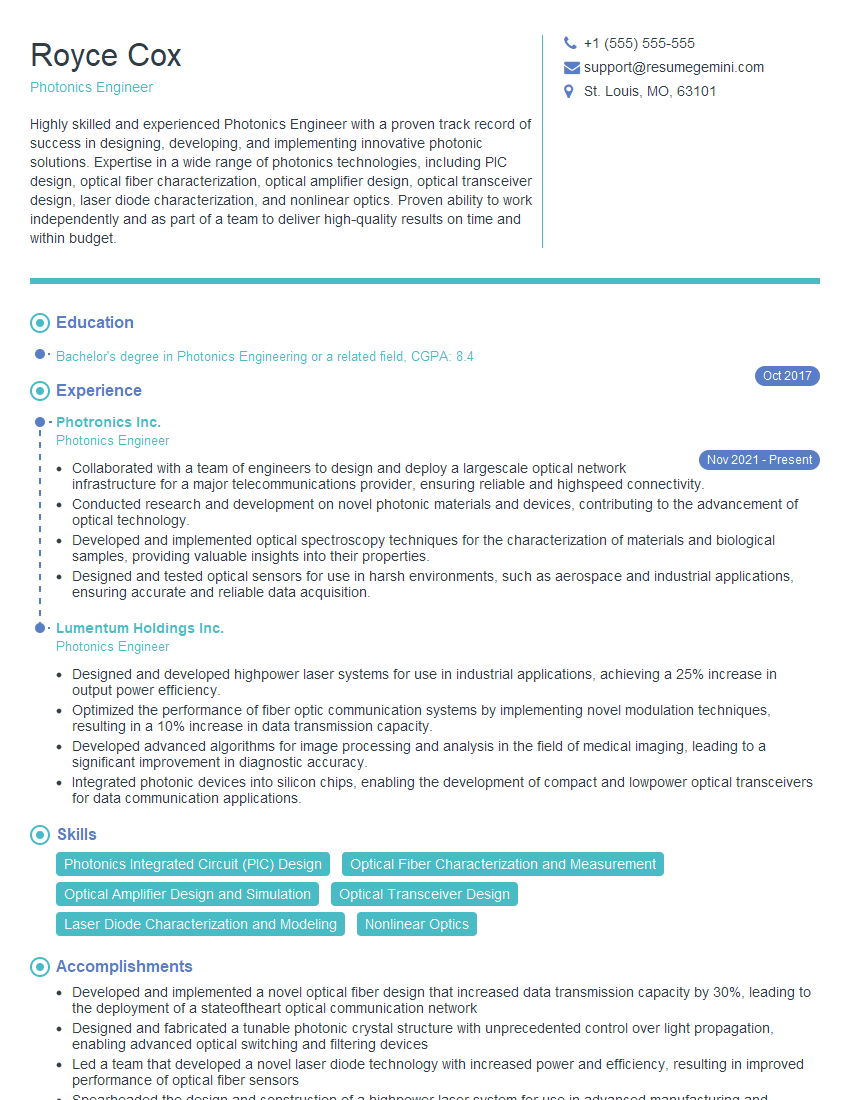
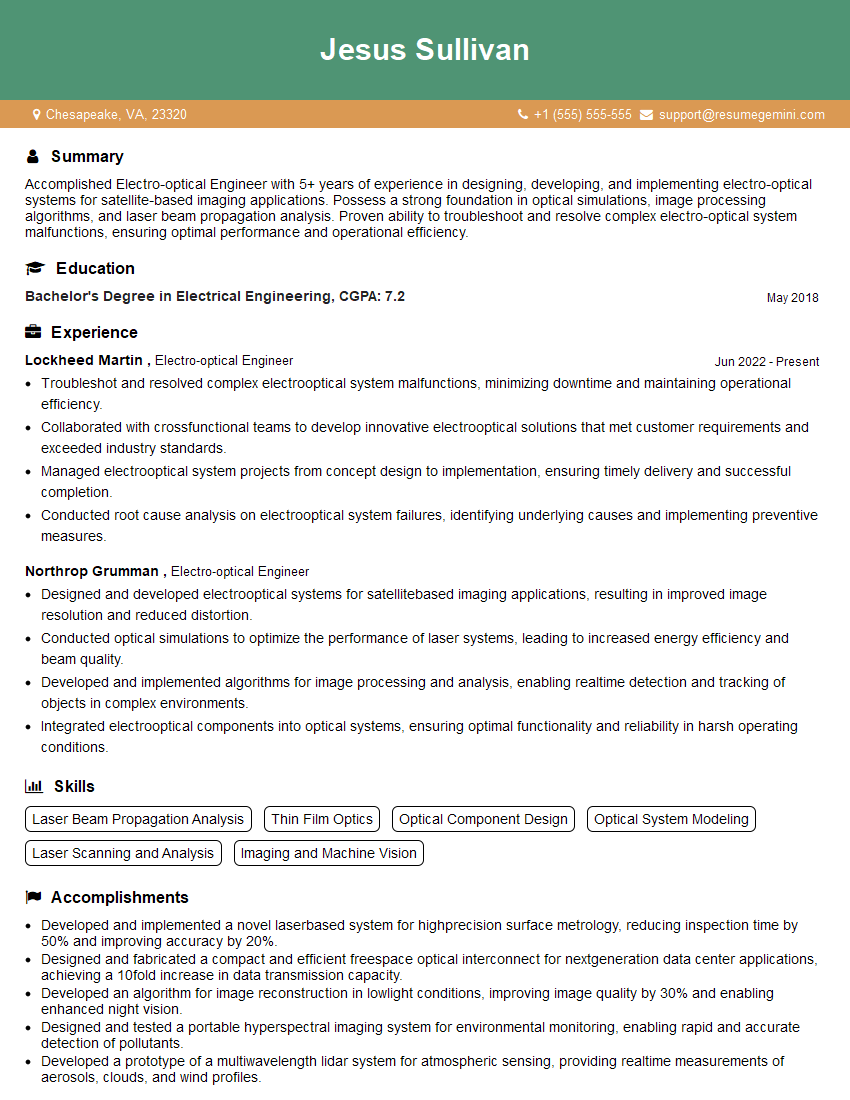
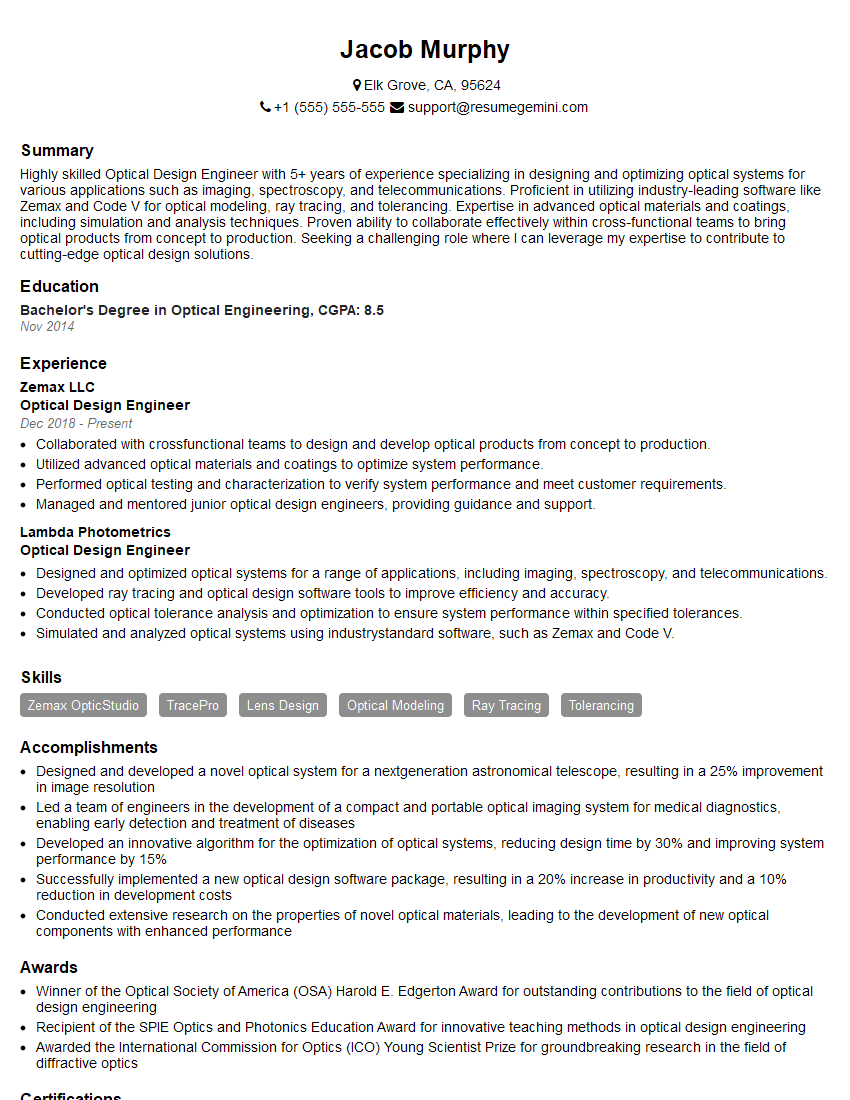
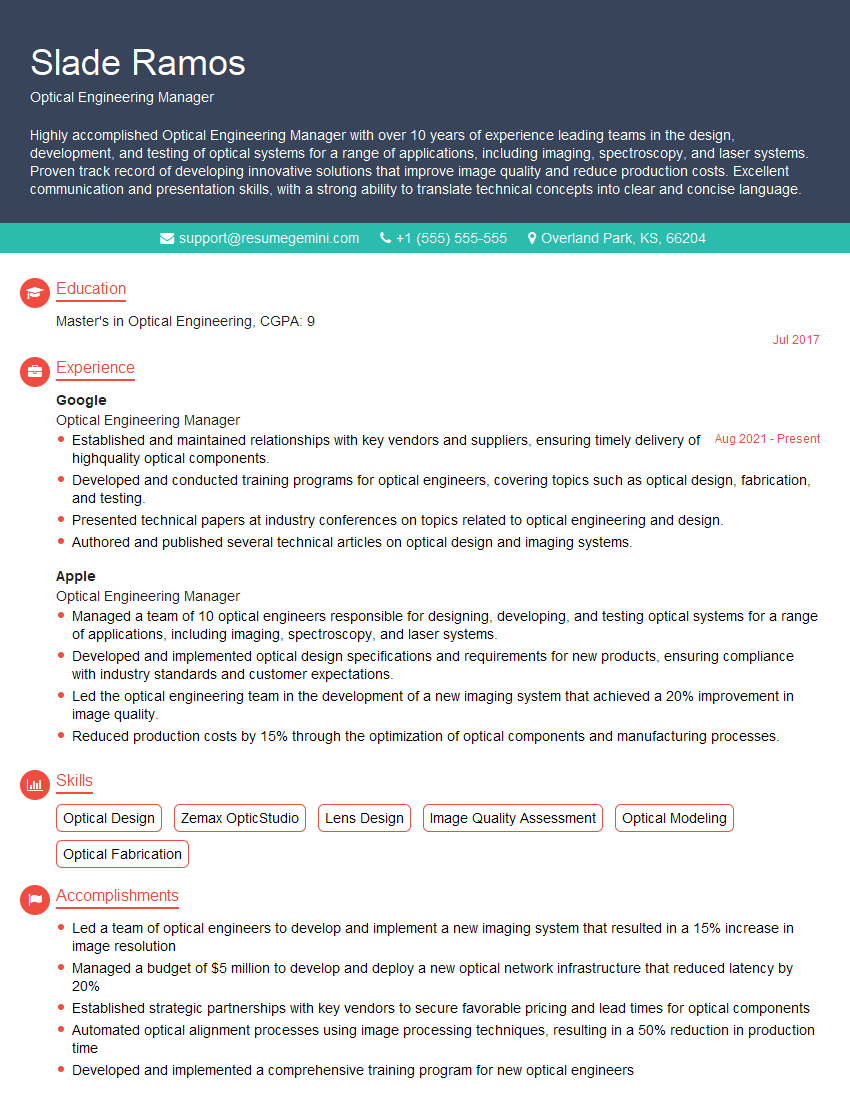
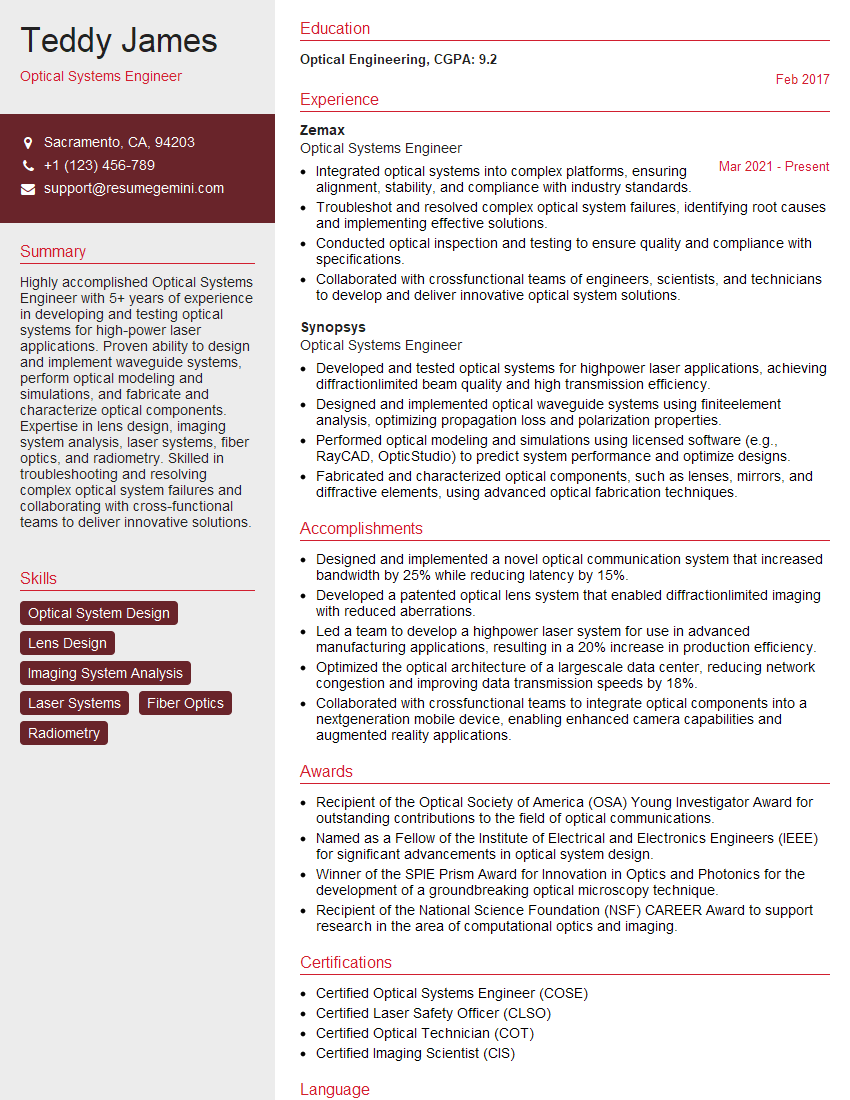
Mastering Optical Design for Manufacturing opens doors to exciting career opportunities in a rapidly growing field. A strong understanding of these principles is highly valued by employers and can significantly enhance your career prospects. To increase your chances of landing your dream job, it’s crucial to create a compelling and ATS-friendly resume that highlights your skills and experience. ResumeGemini is a trusted resource that can help you build a professional and effective resume. Examples of resumes tailored to Optical Design for Manufacturing are available to guide you through the process, ensuring your application stands out.
Explore more articles
Users Rating of Our Blogs
Share Your Experience
We value your feedback! Please rate our content and share your thoughts (optional).
What Readers Say About Our Blog
Very informative content, great job.
good