Interviews are opportunities to demonstrate your expertise, and this guide is here to help you shine. Explore the essential Furniture Tools and Materials interview questions that employers frequently ask, paired with strategies for crafting responses that set you apart from the competition.
Questions Asked in Furniture Tools and Materials Interview
Q 1. What are the key differences between hardwoods and softwoods used in furniture making?
The primary difference between hardwoods and softwoods lies in their cellular structure and resulting properties. Hardwoods come from deciduous trees (those that lose their leaves annually), while softwoods come from coniferous trees (cone-bearing evergreens). This fundamental difference impacts their density, grain patterns, and workability.
- Hardwoods: Typically denser, harder, and more durable. They often exhibit more complex grain patterns, making them ideal for high-end furniture where strength, beauty, and longevity are crucial. Examples include oak, maple, cherry, mahogany, and walnut. They are more challenging to work with, often requiring sharper tools and more careful techniques.
- Softwoods: Generally softer, lighter, and easier to work with. Their grain is typically simpler and more uniform. They are often less expensive than hardwoods and are frequently used for less demanding furniture pieces or as a base for more complex designs. Examples include pine, fir, spruce, and cedar. While softer, certain softwoods, like properly treated pine, can be extremely durable.
Think of it like this: hardwoods are like the sturdy oak tree, strong and long-lasting, while softwoods are like the more flexible pine, readily shaped but perhaps less resistant to wear and tear. The choice depends entirely on the project’s requirements and desired aesthetic.
Q 2. Explain the various types of wood joinery techniques and their applications.
Wood joinery refers to the techniques used to connect pieces of wood together. Strong, durable, and aesthetically pleasing joints are vital for the longevity and visual appeal of any furniture piece. Here are a few common types:
- Mortise and Tenon: A classic joint where a tenon (a projecting piece) fits snugly into a mortise (a hole). Extremely strong and versatile, used in chairs, tables, and casework. Variations include through tenons, blind tenons, and wedged tenons.
- Dovetail: Interlocking finger joints that create incredibly strong and visually appealing connections. Commonly used in drawers and boxes.
- Dado: A groove cut into a piece of wood to receive another piece. Simple to make but can be weakened if not properly sized.
- Rabbet: A shoulder cut into the edge of a board. Used for simple shelf supports or framing.
- Biscuit Joint: Uses small, oval-shaped biscuits of compressed wood to join edges. A faster method than many other joinery types, often used for frames and less-stressed joints.
- Pocket Hole Joinery: Uses angled holes drilled into the edge of one piece to receive screws. Suitable for quick assembly but can be less visually appealing.
The choice of joinery technique depends heavily on factors such as the required strength, the visual appeal desired, the complexity of the project, and the time available. For instance, dovetails are a beautiful choice for a fine heirloom chest of drawers, while pocket hole joinery might suffice for a quick-build bookshelf.
Q 3. Describe the different types of wood finishes and their suitability for various furniture styles.
Wood finishes protect the wood from damage and enhance its appearance. The choice of finish should complement the furniture style and desired aesthetic.
- Oil finishes (e.g., linseed oil, tung oil): Penetrate the wood, enhancing its natural beauty and providing some protection. They’re suitable for rustic or traditional styles where a natural look is desired. They require periodic reapplication.
- Varnish: Forms a hard, durable protective layer. Available in gloss, semi-gloss, and satin finishes. Suitable for many furniture styles and provides good protection against scratches and spills.
- Lacquer: Dries quickly and forms a hard, smooth finish. Often used for durable, high-gloss pieces.
- Shellac: A natural resin-based finish that is easy to apply and produces a warm, amber tone. Suitable for antique or traditional styles.
- Polyurethane: A synthetic finish that is very durable and water-resistant. Available in various sheens and suitable for modern or contemporary furniture.
For example, a rustic farmhouse table might benefit from a simple oil finish, while a sleek modern dining table might be better suited to a clear polyurethane finish. The choice is driven by both the style and the intended use of the piece.
Q 4. What safety precautions should be taken when using power tools in a woodworking shop?
Safety is paramount in any woodworking shop. Here are some key precautions:
- Eye protection: Always wear safety glasses or a face shield to protect your eyes from flying debris.
- Hearing protection: Power tools can be very loud; earplugs or earmuffs are essential.
- Dust collection: Use dust collection systems or a respirator to minimize inhaling wood dust, which can be harmful.
- Proper clothing: Wear close-fitting clothing that won’t get caught in moving parts. Avoid loose sleeves, ties, or jewelry.
- Machine guards: Ensure all safety guards are in place and functioning correctly on power tools.
- Sharp tools: Keep your tools sharp. A dull tool requires more force, increasing the risk of accidents.
- Proper technique: Always follow the manufacturer’s instructions for each tool. Learn the safe operating procedures before using any power tool.
- Clear workspace: Keep your workspace clean and organized to prevent tripping hazards.
Remember, safety is not just a suggestion; it’s a necessity. Always prioritize safety above speed or convenience.
Q 5. How do you select the appropriate wood glue for a particular project?
Choosing the right wood glue is crucial for a strong and lasting bond. Factors to consider include the type of wood, the project’s requirements, and the type of joint.
- Polyvinyl Acetate (PVA) glue: A common, water-based glue that is relatively inexpensive and easy to use. Suitable for most woodworking projects, especially interior applications. It’s ideal for most furniture projects, particularly those using hardwoods.
- Yellow wood glue: Similar to PVA, it offers a slightly stronger bond and is more resistant to moisture. It is a good all-around choice.
- Exterior wood glue: Specifically designed to withstand moisture and temperature changes, suitable for outdoor furniture or projects exposed to the elements.
- Epoxy glue: A two-part adhesive that creates an extremely strong bond. Suitable for projects requiring high strength or gap-filling.
For example, PVA glue would be perfectly suitable for assembling the parts of a chair, whereas epoxy might be a better choice for repairing a broken leg. Always check the manufacturer’s instructions for compatibility with different wood types.
Q 6. What are the advantages and disadvantages of using solid wood versus engineered wood?
Solid wood and engineered wood each have their own set of advantages and disadvantages.
- Solid Wood:
- Advantages: Durability, beauty, repairability, potential to appreciate in value over time.
- Disadvantages: Can be more expensive, susceptible to warping or cracking, requires more maintenance.
- Engineered Wood (e.g., plywood, MDF, particleboard):
- Advantages: More affordable, consistent in size and quality, less prone to warping, often easier to work with.
- Disadvantages: Not as durable as solid wood, less repairable, can be less aesthetically pleasing, might contain harmful chemicals (check certifications).
Imagine building a fine dining table: solid wood would be a premium choice, showcasing its inherent beauty and durability. On the other hand, constructing shelving units for storage might best utilize the cost-effectiveness and consistency of engineered wood like plywood. The best choice is project-dependent.
Q 7. Describe the process of using a router to create different profiles on wood.
A router is a versatile power tool used to create various profiles and shapes on wood. It utilizes a rotating bit to cut away material, allowing for intricate detail work.
The process typically involves:
- Choosing the right bit: Select a router bit that matches the desired profile (e.g., round-over, beading, cove, chamfer). Bits come in a vast array of shapes and sizes.
- Setting up the router: Secure the wood piece firmly to your work surface using clamps. Adjust the router’s depth of cut carefully to avoid damaging the wood.
- Making the cut: Start the router and slowly guide it along the edge of the wood, maintaining consistent speed and pressure. Practice on scrap wood first to get a feel for the tool and bit.
- Finishing: Sand the edges to remove any roughness or imperfections.
Different profiles create different effects: a round-over bit softens edges, a chamfer bit creates a bevel, and a cove bit creates a concave profile. The possibilities are nearly limitless, making the router an invaluable tool for achieving diverse aesthetic results in furniture making.
Q 8. How do you sharpen various woodworking tools, such as chisels and plane blades?
Sharpening woodworking tools like chisels and plane blades requires precision and the right technique. The goal is to create a razor-sharp edge that allows for clean, controlled cuts. Different tools may require slightly different approaches.
For chisels: I typically use a sharpening stone, progressing through grits from coarse to fine (e.g., 100, 400, 800, and then honing on a strop). I hold the chisel at a consistent angle (usually 25-30 degrees) and use a smooth, even motion across the stone. This process involves removing small amounts of metal to refine the bevel. After each grit, I check the sharpness by carefully running my thumb across the bevel – it should feel extremely smooth, without any snagging or roughness. Finally, stropping polishes the edge and creates an incredibly keen sharpness.
For plane blades: Plane blades require similar techniques. I often use a honing guide to ensure consistent bevel angle during sharpening. The process is largely the same as with chisels: progressing through grits on sharpening stones, meticulously checking for sharpness at each stage, and ending with stropping. The honing guide helps maintain the correct angle critical for a plane’s performance. It’s essential to pay close attention to the blade’s camber (the slight curve) as this affects the plane’s cutting action. A slightly convex camber is usually desired.
Safety is paramount. Always wear safety glasses when sharpening tools to protect your eyes from flying debris.
Q 9. Explain the process of applying a stain and varnish to wood furniture.
Applying stain and varnish is a crucial step in protecting and enhancing the beauty of wood furniture. The process involves several steps to ensure a smooth, even finish.
- Preparation: Thoroughly clean and sand the wood to remove any dirt, imperfections, or previous finishes. The smoother the surface, the better the finish will look. The final sanding should be with fine-grit sandpaper (e.g., 220 grit).
- Stain Application: Apply the stain following the manufacturer’s instructions. Usually, this involves using a brush, rag, or spray. Work with the grain of the wood for a more natural look. Allow sufficient drying time.
- Stain Removal: Wipe off excess stain after the recommended time, ensuring an even color distribution. You might need multiple coats for deeper color penetration.
- Varnish Application: Once the stain is completely dry, apply varnish. Several thin coats are better than one thick coat. Each coat should be allowed to dry completely before applying the next. Use light, even strokes, following the wood grain.
- Sanding between coats: Lightly sanding between varnish coats (using very fine sandpaper) can help eliminate imperfections and ensure a flawless finish. This step is particularly important if you see any small imperfections after the varnish has dried.
- Final Finish: After the final varnish coat has dried, you can optionally lightly buff the surface to increase shine and smoothness.
Choosing the right stain and varnish is important and depends on the wood type and desired finish. Experimentation with test pieces is always a good idea.
Q 10. What are the different types of upholstery materials and their properties?
Upholstery materials span a wide range, each with unique properties affecting comfort, durability, and aesthetic appeal. Here are some key types:
- Velvet: Luxurious, soft, and visually appealing, but can be prone to showing wear and requires careful cleaning.
- Chenille: Durable, plush, and relatively easy to maintain. A popular choice for high-traffic areas.
- Leather: Offers a classic look, durability, and is easy to clean, but can be expensive.
- Microfiber: Soft, stain-resistant, and relatively inexpensive, but it may not be as durable as some other materials.
- Cotton: Breathable and comfortable, but can wrinkle and fade more easily than synthetic options.
- Linen: Luxurious and durable, but can wrinkle easily and may require special care.
- Polyester: Highly durable, stain-resistant, and easy to maintain, but may not feel as luxurious as other materials.
The choice of upholstery material depends heavily on the intended use, budget, and desired aesthetic. For example, a family room might benefit from durable, stain-resistant materials like microfiber or chenille, while a formal living room might call for the elegance of velvet or leather.
Q 11. How do you measure and cut fabric for upholstery projects?
Measuring and cutting fabric for upholstery is crucial for a successful project. Accuracy is key to avoid material waste and ensure a proper fit.
I start by carefully measuring the piece of furniture that needs to be upholstered. This usually involves measuring the length, width, and depth of each section needing fabric, adding extra for seams, ease, and pattern matching. Then, I create a pattern on paper, which acts as a template. The pattern accounts for all the necessary pieces, including extra material for seams and pleats. I then lay the pattern pieces on the fabric, ensuring correct grain direction, and carefully cut each piece using sharp fabric shears.
Precise measurements are crucial. A common mistake is forgetting to account for seam allowance (the extra fabric needed to sew the pieces together). Without enough seam allowance, the finished piece won’t fit correctly. Pattern matching – ensuring consistent patterns or designs across seams – also requires careful planning and accurate cutting. It is wise to always have extra fabric on hand to account for potential mistakes or adjustments.
Q 12. Describe the steps involved in reupholstering a chair.
Reupholstering a chair involves a systematic approach, carefully removing old materials and replacing them with new ones. The exact steps may vary depending on the chair’s design, but the general process is:
- Disassembly: Carefully remove the old upholstery, taking note of how the various components are attached. This may involve removing staples, screws, or other fasteners. Photographing the process can be helpful for reassembly.
- Frame Inspection: Inspect the chair frame for any damage and repair any necessary issues before proceeding.
- Pattern Making (If Necessary): If using new fabric, create patterns based on the old upholstery pieces, adding seam allowances.
- Fabric Cutting: Cut new fabric pieces according to the patterns.
- New Upholstery Assembly: Attach the new fabric to the chair frame using appropriate techniques (e.g., stapling, sewing). Ensure tight, even tension to create a professional finish.
- Reassembly: Reassemble the chair carefully, referencing the photographs taken during disassembly.
Tools required might include a staple gun, screwdrivers, pliers, and fabric shears. It’s a project that requires patience and attention to detail. Remember, if you’re unsure about any step, consulting a professional is always an option.
Q 13. What types of fasteners are commonly used in furniture construction?
Furniture construction utilizes a variety of fasteners, each chosen for its specific properties and suitability for the application.
- Screws: Provide strong, reliable joining, often used for assembling frames and attaching legs. Different screw types cater to different wood types and thicknesses.
- Nails: Offer quick joining, particularly for less-visible parts or where rapid assembly is needed. Various types exist – finish nails for minimal visibility, brads for smaller joinery.
- Dowels: Wooden pins used to create strong, invisible joints, often requiring glue for added strength and stability.
- Wood Glue: An essential component in many furniture joints. It provides excellent bonding strength when used correctly.
- Staples: Used primarily in upholstery to secure fabric to the frame. Various sizes and lengths cater to different thicknesses of fabric and padding.
- Cam Locks & Connectors: These are increasingly used in flat-pack furniture for rapid assembly. They are strong, easy to use, and provide a good connection but require precise drilling.
The choice of fastener depends on factors like the type of wood, the stress on the joint, the visibility of the joint, and the required assembly speed. For example, dowels are ideal for hidden, strong joints, whereas screws are good for visible but strong connections.
Q 14. How do you troubleshoot common problems encountered during furniture assembly?
Troubleshooting furniture assembly problems often involves careful observation and systematic investigation. Here are some common issues and solutions:
- Stripped Screw Holes: Use wood glue to fill the stripped hole, then insert a slightly larger screw. Alternatively, use a dowel to reinforce the hole before screwing.
- Parts Don’t Fit: Carefully review the assembly instructions, ensuring correct orientation of all parts. If the problem persists, double-check your measurements and consider using clamps to temporarily align misaligned parts.
- Loose Joints: If joints are loose, ensure adequate glue is used and that parts are properly aligned before tightening fasteners. Consider adding wood glue, or using stronger fasteners.
- Missing Parts: Contact the manufacturer immediately for replacement parts. This is a very common problem with flat-pack furniture.
- Damaged Parts: If you find a damaged part during assembly, contact the manufacturer for a replacement before attempting to assemble it. Trying to force a damaged part into place can lead to further damage and injury.
Always start by checking the instructions carefully, ensuring you are following the assembly steps correctly. If issues persist, contact the manufacturer for support or consult a professional for assistance.
Q 15. What are the different types of sanding techniques and their applications?
Sanding is a crucial step in woodworking, smoothing surfaces and preparing them for finishing. Different techniques cater to various needs and materials.
- Hand Sanding: This involves using sandpaper and a sanding block for precise control, ideal for intricate details and smaller projects. Think of it like sculpting with sandpaper – you’re removing material gradually to achieve the desired shape and smoothness. Different grits (coarseness) are used sequentially, starting rough (e.g., 80 grit) and progressing to fine (e.g., 220 grit) for a polished finish.
- Machine Sanding: Power tools like belt sanders, random orbital sanders, and disc sanders provide faster and more aggressive sanding. Belt sanders are great for shaping and removing significant amounts of material quickly, while random orbital sanders offer smoother finishes with less risk of swirl marks. Disc sanders are excellent for flat surfaces.
- Spindle Sanding: Used for shaping and smoothing curves, spindle sanders utilize a rotating drum with sandpaper. This is particularly effective on chair legs or other curved components.
Choosing the right technique depends on the project’s complexity, the desired finish, and the material’s properties. For instance, hand sanding might be best for delicate inlays, while a belt sander is more suitable for rough shaping of a large tabletop.
Career Expert Tips:
- Ace those interviews! Prepare effectively by reviewing the Top 50 Most Common Interview Questions on ResumeGemini.
- Navigate your job search with confidence! Explore a wide range of Career Tips on ResumeGemini. Learn about common challenges and recommendations to overcome them.
- Craft the perfect resume! Master the Art of Resume Writing with ResumeGemini’s guide. Showcase your unique qualifications and achievements effectively.
- Don’t miss out on holiday savings! Build your dream resume with ResumeGemini’s ATS optimized templates.
Q 16. Describe the process of using a table saw safely and effectively.
Operating a table saw safely and effectively requires attention to detail and adherence to safety protocols. Think of it like driving a car – you need to understand the controls and follow traffic rules to avoid accidents.
- Preparation: Ensure the blade is sharp and properly aligned. Check the workpiece for any loose knots or cracks that could cause kickback. Always use push sticks and featherboards to keep your hands away from the blade.
- Setup: Adjust the blade height and fence position to match your cut. Make sure the workpiece is securely supported and clamped. Remove any loose clothing or jewelry.
- Cutting: Feed the workpiece smoothly and steadily into the blade. Never force the cut. Use both hands to control the workpiece and keep your fingers clear of the blade path.
- Cleanup: After completing your cut, turn off the saw and allow it to come to a complete stop before removing the workpiece. Never reach across the blade.
Ignoring safety precautions can lead to serious injuries. Always wear appropriate safety gear, including eye protection, hearing protection, and dust masks.
Q 17. What are the differences between hand tools and power tools and when would you use each?
Hand tools and power tools offer different levels of precision and speed. The choice depends on the task at hand and your skill level. Imagine hand tools as precise surgical instruments, while power tools are more like heavy machinery.
- Hand Tools: These tools, such as chisels, hand planes, saws, and mallets, rely on manual dexterity and provide a high degree of control and precision. They are essential for fine details and intricate work, and often require more time and skill to master. A hand plane, for example, allows for very fine adjustments to a wood surface.
- Power Tools: These tools, including routers, drills, sanders, and table saws, amplify your strength and speed, allowing for faster material removal and less physical effort. They can be efficient for large-scale projects but require careful handling to avoid damage or injury. A router, for example, enables fast and precise shaping of complex curves.
In practice, a skilled craftsman often uses a combination of both. For example, you might rough-shape a piece with a power tool and then refine it with hand tools for a perfect finish. The overall approach should be about optimizing your efficiency and achieving the highest quality result.
Q 18. How do you read and interpret furniture drawings and blueprints?
Reading furniture drawings and blueprints requires an understanding of common symbols and conventions. It’s like reading a map – you need to understand the symbols to understand the landscape.
Drawings typically show dimensions, materials, joinery details, and assembly instructions. Dimensions are usually presented as fractions or decimals, indicating the length, width, and thickness of different parts. Material specifications indicate the type of wood, such as oak or maple. Joinery details illustrate how the different parts are connected, such as dovetails, mortise and tenon, or dowel joints. Assembly instructions guide you through the steps needed to build the piece of furniture.
Practice and experience are key. Start with simple plans and gradually work your way up to more complex designs. Pay close attention to details, and don’t hesitate to ask for help if needed.
Q 19. Explain the importance of proper wood drying techniques.
Proper wood drying is crucial to prevent warping, cracking, and checking (small cracks) in the finished product. It’s like baking a cake – you need to control the temperature and moisture to avoid a ruined cake. Wood contains moisture, and improper drying can lead to internal stresses that cause the wood to deform.
There are two main drying methods:
- Air Drying (Natural Drying): This slower method involves stacking lumber with spacers for airflow, allowing the wood to dry gradually over several months or even years, depending on the wood’s thickness and species. This method minimizes stress and often produces better quality wood.
- Kiln Drying: This faster method uses a controlled environment (a kiln) to regulate temperature and humidity, speeding up the drying process to days or weeks. While faster, kiln drying can introduce internal stresses if not carefully managed.
Regardless of the method, it’s important to monitor the moisture content throughout the drying process to ensure the wood reaches its equilibrium moisture content (EMC), which prevents the wood from absorbing or releasing too much moisture after it is made into furniture and placed in its final environment.
Q 20. What are some common wood defects and how can they be addressed?
Wood defects can significantly impact the strength and appearance of a piece of furniture. Knowing how to identify and address them is crucial. It’s like inspecting a house before buying it – you want to identify potential problems.
- Knots: These are branches embedded in the wood, creating weaker points. Large, loose knots should be avoided in structural parts.
- Checks: These are small cracks that can run throughout the wood, weakening it. They may be caused by rapid drying.
- Wane: This is the presence of bark on the edge of a board, impacting strength and aesthetics.
- Splits: These are large cracks, often caused by drying stress.
Addressing these defects often involves selecting appropriate wood, orienting the piece strategically in the construction to minimize impact, using wood filler to repair minor damage, or avoiding using the wood with extensive defects altogether.
Q 21. Describe different methods for edge banding.
Edge banding enhances the appearance and durability of furniture edges. It’s like putting a finishing touch on a painting – it improves aesthetics and protection.
- Iron-On Edge Banding: This involves using pre-glued edge banding that is applied using heat and pressure. It’s efficient and relatively easy to use for straight edges.
- PVC Edge Banding: This is a common method using polyvinyl chloride strips, applied with adhesive and trimmed. It’s versatile and available in various colors and finishes.
- Solid Wood Edge Banding: This provides a more luxurious look and feel but requires more skill and precision to apply neatly. It’s best for high-end furniture.
The choice depends on cost, aesthetic preferences, and the desired level of durability. For example, iron-on banding is often used for mass-produced furniture, while solid wood banding might be chosen for custom pieces.
Q 22. How do you maintain and care for woodworking machinery?
Maintaining woodworking machinery is crucial for safety and longevity. Think of it like regularly servicing your car – preventative maintenance saves you from costly repairs down the line. This involves a multi-pronged approach:
- Regular Cleaning: After each use, remove sawdust and debris from all surfaces, especially around moving parts. Compressed air is invaluable here. Ignoring this step can lead to jams and damage.
- Blade Sharpening: Dull blades are dangerous; they require more force, leading to inaccurate cuts and a higher risk of kickback. Sharpen blades according to the manufacturer’s instructions – some require specialized tools.
- Lubrication: Many machines have moving parts that require lubrication. Consult your machine’s manual for specific lubrication points and the type of lubricant to use. Under-lubrication can cause wear and tear, while over-lubrication can attract dust and create a mess.
- Belt and Pulley Checks: Regularly inspect belts for wear and tear, ensuring they’re properly tensioned. Loose or worn belts can slip, causing damage and potential injury.
- Safety Checks: Before each use, inspect safety guards, ensuring they are in place and functioning correctly. Never operate a machine without the appropriate safety guards engaged. This is paramount for preventing accidents.
- Professional Maintenance: For complex machinery, schedule periodic professional maintenance. A qualified technician can identify and address potential problems before they escalate.
For example, I once worked with a planer that hadn’t been cleaned regularly. The build-up of sawdust jammed the rollers, causing a significant delay and requiring a thorough cleaning and adjustment.
Q 23. Explain the process of creating a dovetail joint.
Creating a dovetail joint is a classic woodworking technique that produces a strong and visually appealing joint. It’s like creating interlocking fingers between two pieces of wood. The process involves several steps:
- Marking the Tails: On one piece of wood (the tail piece), mark the layout for the tails using a marking gauge and a pencil. This creates evenly spaced lines for the cuts.
- Cutting the Tails: Use a dovetail saw (or a hand saw) to carefully cut out the angled tails, following the marked lines. Take your time and use a sharp saw to avoid tear-out.
- Marking the Pins: Transfer the tail layout to the other piece of wood (the pin piece) using the tail board itself. This ensures a perfect fit.
- Cutting the Pins: Cut out the pin slots on the pin piece using a chisel or a router. Accurate cuts are crucial for a tight fit.
- Testing and Adjustment: Before gluing, test-fit the joint, making any necessary adjustments to ensure a snug fit. This step is crucial for success.
- Gluing and Clamping: Apply wood glue to the pins and carefully assemble the joint. Use clamps to hold the pieces tightly together while the glue dries.
Think of it like a puzzle. Each tail needs its corresponding pin for a secure connection. Proper planning and precision are key to achieving a strong, beautiful dovetail joint.
Q 24. Describe different types of wood veneer and their application.
Wood veneer is a thin sheet of wood, typically 1/42″ to 1/28″ thick, used to cover a less expensive substrate like plywood or MDF. It’s like applying a beautiful, high-quality ‘skin’ to a more affordable core. Different types exist:
- Rotary Cut Veneer: This is the most common and least expensive type. It’s produced by rotating a log against a knife, creating a continuous sheet. The grain often exhibits a distinctive swirling pattern.
- Sliced Veneer: A log is sliced into thin sheets, resulting in a more uniform grain pattern and better figure. It’s more expensive than rotary cut.
- Quarter-Sliced Veneer: This method produces the highest quality veneer with a distinctive, straight grain pattern. It’s prized for its stability and beauty and commands a premium price.
- Reconstructed Veneer: This type combines smaller pieces of veneer, often with glue, to create larger sheets. This allows for more design flexibility.
Applications: Veneer is widely used in furniture, cabinetry, and decorative panels. It offers a cost-effective way to achieve a luxurious look and feel while using less of the expensive wood. For example, you might find rotary cut veneer used on less visible parts of a cabinet, while quarter-sliced veneer adorns its face.
Q 25. How do you identify different types of wood based on their grain and properties?
Identifying different types of wood involves examining several characteristics:
- Grain Pattern: The arrangement of wood fibers creates a unique grain pattern for each species. Straight grain is common in many woods, while others exhibit more complex patterns like curly, birdseye, or fiddleback figure.
- Color and Tone: Wood species exhibit a wide range of colors, from the light yellow of pine to the dark brown of walnut. The color can also vary based on factors like age and growth conditions.
- Texture: Some woods are smooth and fine-grained (e.g., maple), while others are coarser and more open-grained (e.g., oak). The texture influences the wood’s feel and how it accepts finishes.
- Hardness: The Janka hardness scale measures the force required to embed a steel ball into the wood. This indicates the wood’s durability and resistance to dents.
- Odor: Certain woods possess distinct aromas, such as the characteristic scent of cedar or pine.
For example, the distinct grain pattern of oak, its hardness, and its relatively open pores are readily identifiable features. Practice and familiarity are key to mastering wood identification.
Q 26. What are some common problems encountered with wood finishes and how can they be resolved?
Several problems can arise with wood finishes:
- Sagging or Running: This occurs when the finish is applied too thickly, especially with oil-based finishes. The solution is to apply thinner coats and allow adequate drying time between coats.
- Brush Strokes: Visible brush marks result from improper brushing techniques or using a low-quality brush. Using a good quality brush, applying smooth, even coats, and using a finer grade sandpaper between coats can solve this issue.
- Dust Nibs: These tiny imperfections appear as small bumps in the finish. The best prevention is working in a clean environment, minimizing dust particles, and using a tack cloth before applying subsequent coats.
- Uneven Finish: This is often caused by uneven sanding or improper application. Careful sanding to a smooth surface before applying the finish is vital.
- Bubbling: Bubbles can be caused by trapping air or moisture under the finish, particularly when working in humid conditions. Ensure proper drying time and good ventilation.
A systematic approach to finish application, including thorough surface preparation and the use of quality materials, will minimize the chance of encountering these problems.
Q 27. Describe the different types of wood finishes, their characteristics and applications.
Many wood finishes exist, each with unique characteristics and applications:
- Oil Finishes (Linseed, Tung, etc.): These penetrate the wood, enhancing its natural beauty and providing some protection. They’re easy to apply and repair but offer less durability than other finishes. Ideal for rustic or handcrafted pieces.
- Varnish: A hard, durable finish that provides excellent protection from scratches and moisture. It can be glossy, satin, or matte. Varnish requires careful application to avoid brush strokes.
- Lacquer: A fast-drying finish that offers good durability and a smooth, high-gloss finish. It’s popular for furniture due to its quick drying time.
- Shellac: A natural resin-based finish that is easy to apply and repair. It offers good protection but is less durable than varnish or lacquer.
- Polyurethane: A water-based or oil-based finish offering excellent durability and protection from wear and tear. It’s available in various sheens.
The choice depends on the intended use, desired look, and level of protection required. For example, a kitchen table would benefit from a durable polyurethane finish, whereas a delicate wooden bowl might be better suited to a natural oil finish.
Q 28. Explain the importance of using appropriate personal protective equipment (PPE) when working with woodworking tools and materials.
Using appropriate Personal Protective Equipment (PPE) when working with woodworking tools and materials is paramount for safety. It’s not just about avoiding minor cuts; serious injuries can occur. Essential PPE includes:
- Safety Glasses or Goggles: Protect your eyes from flying debris, wood chips, and dust.
- Hearing Protection: Many woodworking tools, especially power tools, generate significant noise that can damage hearing over time. Earmuffs or earplugs are essential.
- Dust Mask or Respirator: Wood dust can be harmful, especially when inhaling fine particles. Use a dust mask for general protection and a respirator for finer dust or when working with specific wood types known to cause allergic reactions.
- Gloves: Protect your hands from splinters, cuts, and chemicals.
- Apron or Clothing: Protect your clothing from damage and potential burns.
I’ve witnessed firsthand the consequences of not using proper PPE. A colleague once suffered a serious eye injury from a flying wood chip because he wasn’t wearing safety glasses. Remember, PPE is an investment in your health and safety – it’s not optional.
Key Topics to Learn for Furniture Tools and Materials Interview
- Woodworking Hand Tools: Understanding the function and proper use of chisels, hand planes, saws (hand saws, tenon saws, coping saws), measuring tools (tapes, squares), and clamps. Consider practical applications like joint construction and wood shaping.
- Power Tools: Familiarize yourself with the safe and efficient operation of common power tools such as routers, planers, jointers, table saws, and sanders. Practice explaining safety precautions and maintenance procedures.
- Wood Types and Properties: Learn to identify common hardwood and softwood species, understanding their strengths, weaknesses, and suitability for different furniture applications. Be prepared to discuss grain orientation and its impact on project success.
- Joints and Construction Techniques: Master the theory and practical application of various woodworking joints (e.g., mortise and tenon, dovetail, dado, rabbet). Be able to discuss the strengths and weaknesses of each joint type in different contexts.
- Finishes and Coatings: Understand the properties and application methods of various wood finishes, such as stains, lacquers, varnishes, and oils. Discuss the importance of surface preparation and appropriate finish selection for specific projects.
- Materials Beyond Wood: Explore the properties and applications of other materials commonly used in furniture making, such as metal (for hardware and frames), fabrics (for upholstery), and various types of adhesives.
- Blueprint Reading and Design Interpretation: Practice reading and interpreting furniture drawings and plans. Be able to identify dimensions, materials, and construction techniques specified in a design.
- Problem-Solving and Troubleshooting: Prepare examples demonstrating your ability to identify and solve common woodworking problems, such as wood warping, joint misalignment, or finish defects.
Next Steps
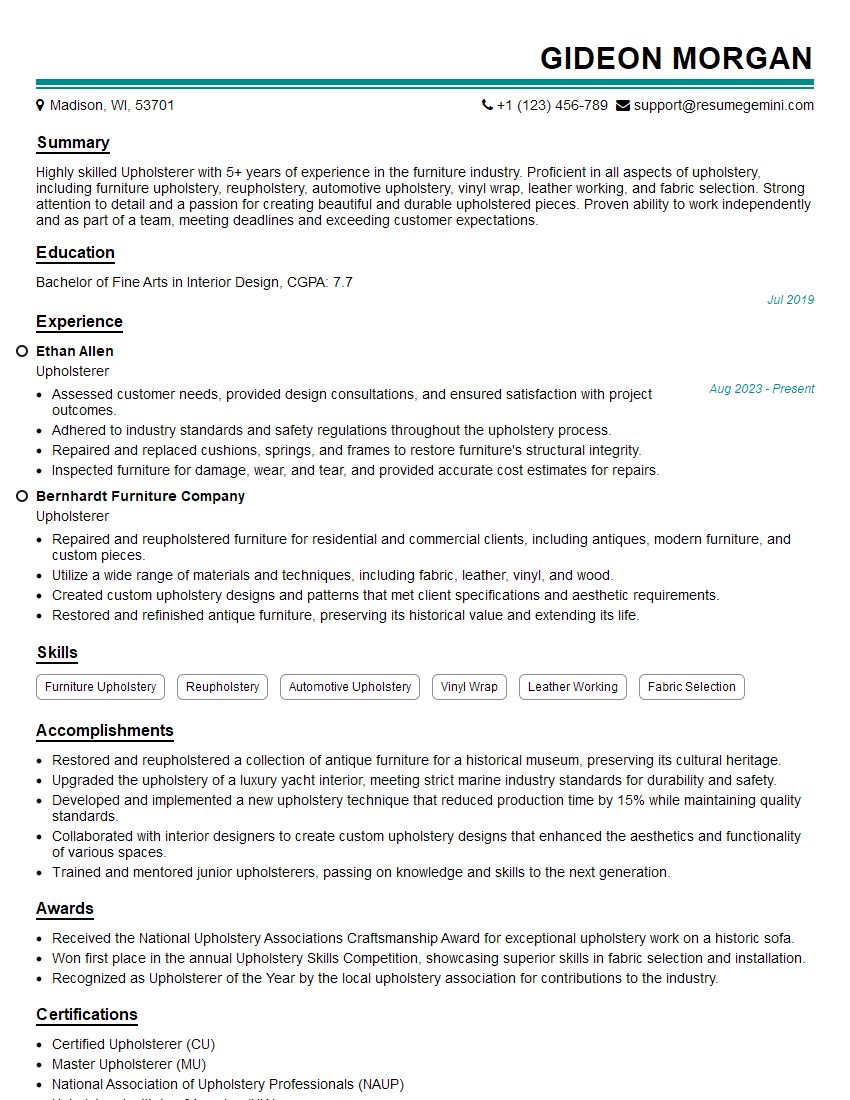
Mastering Furniture Tools and Materials is crucial for career advancement in this field. A strong understanding of these concepts demonstrates practical skills and problem-solving abilities highly valued by employers. To significantly boost your job prospects, creating a well-crafted, ATS-friendly resume is essential. ResumeGemini is a trusted resource to help you build a professional and impactful resume that showcases your skills effectively. Examples of resumes tailored to the Furniture Tools and Materials industry are available to help guide you.







Explore more articles
Users Rating of Our Blogs
Share Your Experience
We value your feedback! Please rate our content and share your thoughts (optional).
What Readers Say About Our Blog
Very informative content, great job.
good