The thought of an interview can be nerve-wracking, but the right preparation can make all the difference. Explore this comprehensive guide to Game Audio Design interview questions and gain the confidence you need to showcase your abilities and secure the role.
Questions Asked in Game Audio Design Interview
Q 1. Explain your process for designing a realistic weapon sound effect.
Creating realistic weapon sounds involves a multi-step process that goes beyond simply recording a real firearm. It’s about capturing the essence of the weapon’s character and integrating it seamlessly into the game world. I begin by researching the weapon’s type – is it a pistol, rifle, shotgun, etc.? This informs my sound design choices.
Next, I gather source material. This might involve recording real-world weapon sounds (carefully and legally, of course!), but I often layer and manipulate existing sound libraries. I then focus on key elements: the impact, the projectile’s flight (if applicable), and the weapon’s mechanical operation. I might record the sound of a hammer striking, a bolt cycling, or a magazine being inserted – these are critical for believability.
In post-production, I use audio editing software like Pro Tools or Reaper to carefully sculpt the sounds. This involves manipulating waveforms, adjusting frequencies, adding reverb and other effects to match the game’s environment. I might even create multiple variations of the weapon sound to reflect different distances, weapon conditions, or ammo types. Finally, I design the sound to fit the game’s aesthetic; a futuristic weapon might have a distinct sci-fi feel, while a historical musket should sound appropriately antiquated.
For example, when designing the sound of a futuristic energy pistol, I might start with a synthesized laser sound and layer in a whooshing effect for the projectile, then add a subtle metallic clang for the weapon’s recoil.
Q 2. Describe your experience with various audio middleware solutions (e.g., Wwise, FMOD).
I have extensive experience with both Wwise and FMOD, two leading audio middleware solutions. My choice often depends on the project’s specific needs and the team’s familiarity with the chosen system. Both are powerful tools for creating and managing in-game audio.
Wwise excels in its robust system for creating complex interactive music and sound systems. Its hierarchical sound design approach and its powerful integration with game engines like Unreal and Unity makes it particularly useful for large-scale projects requiring sophisticated sound design. I’ve found its implementation of positional audio and spatialization very intuitive and effective.
FMOD, on the other hand, is known for its user-friendly interface and ease of implementation, making it ideal for smaller teams or projects where speed and simplicity are prioritized. It’s particularly efficient at handling large numbers of audio events, which is crucial in fast-paced action games. I appreciate FMOD’s ability to handle various audio formats easily and its overall system stability.
Ultimately, both offer excellent features. The best choice hinges on specific project requirements and the team’s preferences.
Q 3. How do you handle audio occlusion and reverberation in a game environment?
Audio occlusion and reverberation are crucial for creating realistic and immersive soundscapes. Occlusion refers to the blocking of sound by objects, while reverberation refers to how sound reflects off surfaces in an environment. Both are handled using the middleware’s spatial audio capabilities, often employing raycasting or other techniques to calculate sound propagation.
In Wwise or FMOD, you’d define the acoustic properties of game objects. A concrete wall will attenuate and reflect sound differently than an open doorway. The middleware uses these properties to dynamically adjust the volume and character of a sound based on the player’s position relative to the source and the intervening objects. For example, a gunshot will sound significantly quieter and more muffled if the player is behind a thick wall compared to if they’re in the open.
Similarly, reverberation is controlled by defining the acoustic properties of the environment itself. A large cathedral will have longer, more pronounced reverberation than a small, sparsely furnished room. The middleware uses algorithms to simulate the reflection of sound waves off surfaces, creating a sense of space and realism. This is often achieved using convolution reverb for complex spaces, or simpler algorithms for faster performance in games.
Q 4. What are your preferred methods for creating and implementing ambient soundscapes?
Creating convincing ambient soundscapes requires a layered approach. It’s not just about adding random background noises; it’s about building a soundscape that enhances the atmosphere and storytelling of the game. I generally start by considering the game’s setting and mood. What is the location? What time of day is it? What kind of mood should the soundscape evoke?
Next, I build layers of sound. The first layer often consists of foundational sounds, such as wind, distant traffic, or birdsong. These establish a sense of place and provide a background hum. The next layer adds more specific sounds that enhance the narrative. This might include distant chatter, the creak of a wooden door, or the rumble of machinery.
The sounds are carefully mixed and balanced to create a cohesive whole. I use spatial audio to place sounds within the game environment, making them feel more realistic and immersive. Additionally, I often use dynamic audio, in which the ambient soundscape changes subtly based on the player’s actions or position. For example, in a forest, the sounds of birds might increase as the player enters a sunlit clearing or diminish as they enter a dark cave.
I frequently use techniques like source layering, sound masking, and spatialization to create a fuller, more immersive sonic environment.
Q 5. Explain your experience with interactive music systems and dynamic music changes.
My experience with interactive music systems encompasses various approaches, from simple trigger-based systems to more complex, dynamic systems that adapt to gameplay events in real-time. I’ve worked extensively with middleware solutions like Wwise and FMOD to implement such systems.
Simpler systems involve triggering specific musical cues based on gameplay events, such as starting a combat encounter or entering a new area. These are effective but lack the fluidity of more sophisticated systems. More complex systems use parameters (such as player health, combat intensity, or game progress) to dynamically adjust musical elements, like tempo, instrumentation, and intensity. This creates a more immersive and responsive soundscape that complements and intensifies the gameplay experience.
For example, in a stealth game, the music might be quiet and tense during stealth sequences, but become more dramatic and intense during combat. In a racing game, the music might dynamically increase in tempo and intensity as the player’s speed increases. I often design custom logic within the middleware to integrate these parameters and create smooth transitions between different musical states. It involves careful consideration of musical structure, tempo variations, and harmonic progressions to ensure seamless transitions.
Q 6. How do you balance sound design with the game’s overall aesthetic and gameplay?
Balancing sound design with a game’s aesthetic and gameplay is paramount. It’s about creating a cohesive auditory experience that enhances rather than detracts from the overall feel of the game. I start by understanding the game’s art style, narrative, and target audience. Is it a realistic shooter, a whimsical cartoon adventure, or a dark fantasy RPG? The style profoundly influences the sonic palette.
For example, a realistic military shooter would require authentic weapon sounds and a gritty soundscape, while a cartoon adventure might use exaggerated and playful sound effects. Gameplay mechanics also dictate sound design choices. In a stealth game, sound cues will be crucial for communicating environmental information to the player and subtly highlighting important game elements.
I also work closely with the game designers, artists, and programmers to ensure consistency and coherence. We discuss the overall vision for the game and how sound can be used to enhance the player’s experience. This collaborative approach ensures the sound design supports the game’s story, characters, and mechanics and contributes to an overall cohesive and memorable experience.
Q 7. Discuss your familiarity with different audio file formats and their compression techniques.
I’m familiar with various audio file formats and their respective compression techniques. The choice of format and compression level depends on factors such as audio quality, file size, and platform constraints.
Common formats include WAV (uncompressed, high quality), MP3 (lossy compression, smaller file sizes), Ogg Vorbis (lossy compression, good balance of quality and size), and WMA (lossy compression, commonly used on Windows). Each has its trade-offs. WAV provides the best audio quality but results in large file sizes; MP3 reduces file size but sacrifices some audio quality. Ogg Vorbis offers a good middle ground.
Compression techniques involve reducing the file size by removing redundant or less perceptible audio data. Lossy compression methods (like MP3 and Ogg Vorbis) permanently discard data, while lossless compression (like FLAC) preserves all data and allows for perfect reconstruction of the original audio. The choice often depends on the priority given to file size versus audio fidelity. In games, a balance is typically struck – maintaining reasonable audio quality while keeping file sizes manageable to optimize performance and reduce loading times.
Q 8. Describe a time you had to solve a complex audio-related problem.
One complex audio challenge involved creating realistic environmental sounds for a vast open-world game. The initial approach, using pre-recorded soundscapes, resulted in noticeable looping and a lack of dynamic variation, breaking immersion. The solution involved a multi-pronged approach. First, we implemented a procedural audio system using Wwise’s sound design tools. This allowed us to generate unique sounds based on the player’s location and environmental factors like time of day and weather. We carefully designed several base sounds (wind, birds, distant traffic) and then used Wwise’s RTPCs (Real-Time Parameters) to dynamically adjust their volume, pitch, and other properties. Secondly, we created a system to blend sounds seamlessly, avoiding abrupt transitions. For example, as the player moved from a forest to a mountain, the bird sounds would gradually fade while mountain wind sounds faded in. Finally, we implemented occlusion and distance attenuation, so sounds faded realistically when behind obstacles or at a distance. This significantly improved realism and immersion without the large storage space of countless pre-recorded sound files.
Q 9. How do you ensure your audio design remains consistent across different platforms?
Consistency across platforms is paramount. I address this by focusing on platform-agnostic design principles, using standardized audio formats (like WAV or Ogg Vorbis) and carefully controlling the audio mixing process. Each platform has different hardware and software capabilities; therefore, a detailed audio specification document outlines the targeted audio quality across platforms, including specifications for bitrate and sample rate. I then rigorously test the game audio on each target platform throughout development. Early and frequent testing is essential to catch inconsistencies or performance issues. For instance, if a particular sound effect sounds muffled on a low-end mobile device, we might need to adjust the EQ or use lower-quality assets, carefully managing trade-offs between audio fidelity and resource usage. Furthermore, using a middleware solution like Wwise or FMOD helps to abstract away platform-specific complexities, enabling a single audio implementation to be easily adapted to multiple platforms.
Q 10. Explain your process for creating and implementing dialogue in a game.
My dialogue implementation process starts with close collaboration with the writers and voice actors. We ensure clear communication about character tone, emotion, and delivery style. Once the voice recordings are obtained, I edit and process them, focusing on removing any background noise and inconsistencies. This often involves careful use of noise reduction, EQ, compression, and sometimes even subtle pitch correction. Next, I implement the dialogue in the game engine using a system that handles lip-sync, voice-over triggers, and potentially voice-over branching based on player actions. For example, I might use markers in the voice-over files to synchronize lip movements with the character’s animation. The dialogue implementation would be linked to gameplay events, ensuring accurate delivery in different game contexts. Finally, extensive playtesting is essential to ensure that the dialogue is integrated seamlessly into the gameplay experience and is easily understood.
Q 11. How do you collaborate effectively with other developers, such as programmers and designers?
Effective collaboration is key. I use various methods to maintain clear communication with programmers and designers. Regular meetings are crucial for discussing design specifications and technical limitations. For instance, I’ll collaborate with the programmers to define the audio API (Application Programming Interface) — the way the game engine interacts with the audio system. This involves defining clear protocols for how audio events are triggered and managed within the game. With designers, I’ll discuss the audio design vision, ensuring that the sound design complements their visual style and gameplay mechanics. Detailed documentation of audio assets, including metadata and usage notes, is essential to promote consistency and mutual understanding. Utilizing collaborative tools like shared project folders and version control systems further strengthens this process.
Q 12. Discuss your experience with audio mixing and mastering techniques.
Mixing and mastering are crucial for creating a polished and cohesive soundscape. Mixing involves balancing and adjusting individual audio elements (music, sound effects, dialogue) within a scene or level. I use EQ, compression, and reverb to shape the sound and create a sense of space and depth. For instance, I might use a high-pass filter on dialogue to reduce muddiness, or add reverb to create a sense of ambience in a cavernous environment. Mastering, on the other hand, is the final stage of post-production where I refine the overall sound, ensuring consistency across the game. It involves adjustments to the volume levels, dynamics, and overall frequency balance to optimize the audio for different playback environments. I typically use professional Digital Audio Workstations (DAWs) like Pro Tools or Reaper for mixing and mastering, leveraging their advanced tools and functionalities. Critical listening in different playback scenarios is key throughout these processes.
Q 13. How do you optimize audio assets for performance and memory usage?
Optimizing audio assets is crucial for performance and memory usage. I start by choosing appropriate audio formats. Ogg Vorbis and MP3 are commonly used for efficient compression. Then, I use tools to reduce the bitrate and sample rate of audio files without significantly impacting quality. For example, I might reduce the sample rate from 48kHz to 44.1kHz, or lower the bitrate from 320kbps to 192kbps. Furthermore, I employ audio streaming techniques to load and unload sound effects as needed. This prevents loading all sounds simultaneously, reducing the game’s initial memory footprint. I also use spatial audio techniques to make the audio system more efficient, rendering only the sounds that are within the player’s listening range. Careful implementation, thorough testing on target devices, and understanding the game engine’s audio capabilities are essential for achieving optimal performance.
Q 14. Describe your workflow for integrating audio into a game engine.
My workflow for audio integration varies based on the game engine, but generally involves a few key steps. First, I prepare the audio assets in the correct format, ensuring compatibility with the engine. Then, I integrate the audio using the engine’s API, creating sound events and linking them to gameplay triggers. I’ll set up parameters for volume, pitch, panning, and other audio properties. I might use a middleware system like FMOD or Wwise to streamline this process. These systems offer features like event scheduling, cue management, and spatial audio implementation. Finally, I thoroughly test the integration in various game scenarios, carefully listening for any issues and fine-tuning the implementation as needed. Debugging and iteration are crucial during this stage to ensure a seamless and high-quality audio experience.
Q 15. What are some common challenges faced in game audio design, and how do you overcome them?
Game audio design presents unique challenges, often stemming from the interactive nature of the medium. One common hurdle is balancing audio clarity with the demands of a dynamic environment. For instance, a crucial dialogue line might be drowned out by intense combat sounds. Another significant challenge is maintaining consistent audio quality across various platforms and hardware configurations. Different devices have varying processing capabilities and speaker setups, requiring careful optimization to ensure a cohesive experience for all players.
- Overcoming these challenges involves employing techniques such as dynamic mixing, where sound levels adjust automatically based on the in-game context. This ensures important sounds remain audible even during chaotic moments. For platform compatibility, I meticulously test audio on multiple target platforms, using different headsets and speakers to identify and resolve inconsistencies. Implementing audio compression and efficient sound file formats also helps to optimize performance across diverse hardware.
- Another challenge is managing large audio assets and workflows. This necessitates using a well-structured asset management system and a robust version control system (such as Perforce or Git LFS) to track changes and collaborate effectively within a team.
For example, in a project I worked on, we utilized a sophisticated dynamic mixing system that prioritized dialogue during crucial plot points, subtly lowering background music and sound effects without creating jarring transitions. We also optimized our sound files significantly, reducing the total game size while maintaining excellent audio quality.
Career Expert Tips:
- Ace those interviews! Prepare effectively by reviewing the Top 50 Most Common Interview Questions on ResumeGemini.
- Navigate your job search with confidence! Explore a wide range of Career Tips on ResumeGemini. Learn about common challenges and recommendations to overcome them.
- Craft the perfect resume! Master the Art of Resume Writing with ResumeGemini’s guide. Showcase your unique qualifications and achievements effectively.
- Don’t miss out on holiday savings! Build your dream resume with ResumeGemini’s ATS optimized templates.
Q 16. What are your experience with spatial audio and 3D sound design?
Spatial audio and 3D sound design are fundamental aspects of immersive game audio. My experience encompasses working with various spatial audio technologies, including binaural audio, Ambisonics, and game engines’ built-in spatialization systems (like Wwise and FMOD). I’m proficient in creating soundscapes that accurately convey the distance, direction, and environment of sound sources within the game world. This involves meticulous placement of sounds within the 3D space, using techniques like panning, reverb, and delay to create realistic sense of depth and realism.
For example, I once designed the soundscape for a horror game, where subtle, directional whispers and distant creaking sounds were crucial to creating a sense of unease and suspense. Accurately placing these sounds in 3D space and carefully manipulating their reverb and other spatial audio parameters was key to the game’s effectiveness. I used Wwise to implement this, leveraging its extensive features for spatial audio authoring.
Q 17. Describe your experience with Foley recording and sound design.
Foley recording is a passion of mine. I have extensive experience in recording and designing Foley effects to enhance the realism and impact of in-game actions. This includes everything from the subtle rustle of fabric to the loud crunch of breaking glass. My process involves carefully studying the animation or gameplay footage, then recreating those sounds using a variety of props and techniques in a controlled recording environment.
For instance, I’ve created realistic footsteps using various surfaces and footwear, simulating different textures and walking styles. I’ve also used creative solutions, like crumpling cellophane to imitate the sound of fire, and recording the impact of fruit against a wall to simulate a punch. My approach is to always seek the most authentic-sounding solution, while also keeping efficiency and project limitations in mind. Post-processing and sound design techniques are then employed to shape and refine the recorded Foley sounds, creating a polished and integrated audio experience.
Q 18. How do you test audio for accessibility and ensure inclusivity?
Accessibility and inclusivity are paramount in game audio design. I test audio for accessibility by incorporating a variety of methods. These include:
- Testing with diverse players: Including individuals with varying hearing abilities in playtesting to gather feedback on clarity, volume levels, and the effectiveness of audio cues for gameplay. Players with hearing impairments, for example, may rely heavily on visual cues and subtitles, so testing should thoroughly assess the clarity of this cross-modal information.
- Providing alternative audio cues: Designing audio cues that are not solely reliant on specific frequencies or subtle sounds, ensuring that players with varying degrees of hearing loss can still benefit from the information conveyed. For example, including visual indicators to accompany sounds for clarity.
- Employing descriptive audio: Using clear and informative narration to aid players who are blind or visually impaired.
- Careful volume balancing: Ensuring that all sounds are within a safe and comfortable listening range to avoid causing discomfort or fatigue.
In a recent project, we collaborated with accessibility consultants to ensure that our game’s audio design met accessibility standards. Their guidance helped us identify and address potential issues before release, resulting in a more inclusive and enjoyable gaming experience for everyone.
Q 19. What are your thoughts on the importance of using audio cues for player feedback and guidance?
Audio cues are absolutely crucial for providing meaningful player feedback and guidance. They provide immediate, intuitive information, enhancing gameplay and immersion. Effective audio cues communicate the consequences of player actions (e.g., a satisfying clang when hitting an object), indicate the presence of enemies or environmental hazards (e.g., ominous music signifying danger), and guide players towards objectives (e.g., a subtle audio trail leading to a hidden item). Well designed audio cues help players understand game mechanics without relying solely on visual cues.
Consider a stealth game; the subtle shift in ambient sounds to indicate the proximity of a guard, or the change in the character’s footstep sounds when moving from grass to concrete are examples of how audio cues enhance the experience and the immersion. These subtle signals are essential for player awareness and enhance the believability and responsiveness of the game world.
Q 20. Explain your understanding of audio mixing consoles and signal flow.
My understanding of audio mixing consoles and signal flow is comprehensive. I’m familiar with both analog and digital consoles and their respective workflows. A mixing console’s primary function is to manage and manipulate multiple audio signals simultaneously. Signal flow refers to the path an audio signal takes from its source to the final output.
Understanding signal flow is crucial for troubleshooting and ensuring audio quality. A typical signal path might be: microphone → preamp → compressor → equalizer → effects processor → mixer → digital audio workstation (DAW) → master bus → output. Each component in the chain has specific functions, and their arrangement dictates the overall sound.
I’m proficient in utilizing various mixing techniques, including equalization (EQ) to shape the frequency balance of sounds, compression to control dynamics, and reverb and delay to create spatial depth and ambience. I use this knowledge to craft clear, balanced mixes that are tailored to the game’s specific needs and artistic vision. I am also well-versed in using digital audio workstations such as Pro Tools, Logic Pro X, and Ableton Live to handle the technical aspects of mixing and mastering game audio.
Q 21. How familiar are you with using version control systems for audio assets?
I’m very familiar with using version control systems for audio assets. This is essential for collaborative projects, preventing conflicts and ensuring that everyone is working with the most up-to-date versions of files. I’ve extensive experience using Git LFS (Large File Storage) which is specifically designed to handle large binary files like audio samples. Using Git LFS allows for efficient tracking of changes and easy collaboration among team members. It lets us rollback to previous versions of files, easily manage different iterations, and track the progression of our audio throughout the development cycle.
Furthermore, a well-defined branching strategy is important for managing multiple versions of game assets for various platforms or different stages of development. Proper version control drastically improves teamwork and reduces the risk of losing or overwriting valuable work.
Q 22. Describe your experience working with sound libraries and sample packs.
Sound libraries and sample packs are invaluable resources for game audio designers. They provide a vast collection of pre-made sounds, saving significant time and effort in production. My experience spans working with both commercial libraries like Sound Ideas and Wwise Sound Bank, and curated collections of personally recorded and processed sounds. I’m adept at selecting appropriate sounds, customizing them to fit the game’s specific needs (applying EQ, compression, reverb, etc.), and creatively layering them to achieve unique sonic textures.
For instance, I once needed the sound of a magical portal opening. Instead of recording it from scratch, I blended sounds from several libraries: a whooshing sound for the energy, crackling embers for the mystical feel, and a low-frequency rumble to enhance the power. This layered approach provided a richer, more evocative result than any single sample could have achieved.
I meticulously organize my libraries and sample packs, often categorizing them by instrument, genre, and emotional impact. This structured approach ensures I can quickly find the ideal sounds, maximizing efficiency in the often-tight deadlines of game development.
Q 23. How do you create effective sound effects for different types of game mechanics?
Creating effective sound effects for game mechanics requires a deep understanding of game design principles and sound design techniques. The goal is to provide clear and satisfying feedback that enhances gameplay. I approach this by first analyzing the mechanic. What action is the player performing? What kind of feedback is appropriate? Should it be subtle and realistic or exaggerated and fantastical?
For example, a light sword clash might use sharp metallic impacts with a subtle echo, whereas a heavy axe swing demands a deep, resonating thud with splintering wood elements. For a stealth mechanic, I might use quiet footsteps that dynamically change based on surface material and player speed. I often use spatial audio to immerse the player further. The sound of a footstep directly behind them sounds different than one further away, significantly enhancing gameplay.
Beyond the core sound, I consider adding variation and randomization to avoid repetitive and monotonous sounds. Slight changes in pitch, volume, or timing keep the audio engaging and avoid predictability. A successful sound effect not only informs the player but also adds to the overall immersion and enjoyment of the game.
Q 24. What methods do you use to ensure high-quality audio production in a fast-paced development environment?
Maintaining high-quality audio production in a fast-paced development environment demands meticulous planning, efficient workflow, and strategic use of tools. First, I establish clear communication with the development team to understand priorities, timelines, and technical limitations. This upfront planning prevents unexpected delays or compromises on sound quality.
I optimize my audio pipeline for efficiency using tools that automate repetitive tasks. This includes employing batch processing for tasks like compression, normalization, and conversion to game-compatible formats. I also leverage version control for all audio assets, enabling easy tracking and collaboration amongst team members. Crucially, I follow a ‘lossless’ workflow until the final game build, ensuring no audio quality is lost during the development process.
Finally, I use efficient methods for previewing and debugging. Utilizing a game-specific audio middleware like Wwise or FMOD allows me to directly implement and test sound effects within the game engine, providing quick feedback and enabling rapid iteration.
Q 25. Discuss your experience with automated audio build processes.
Automated audio build processes are crucial for large-scale game development. My experience includes implementing and managing these processes, significantly reducing manual effort and the risk of errors. I typically utilize scripting (Python is my preference) combined with command-line tools to automate the tasks.
The process usually involves: sound asset gathering, pre-processing (applying compression and EQ), conversion to desired formats (e.g., OGG Vorbis, WAV), sound bank creation (using the game engine’s middleware), and integration into the game build. These steps are orchestrated through custom scripts, ensuring consistency and reproducibility across multiple platforms. This not only saves time but also guarantees quality control. A properly managed automated process ensures the final game includes the correct, optimized audio assets, free from human errors.
For example, a script might automatically detect all audio files in a specified folder, apply a standardized compression setting, and then automatically create a sound bank with appropriate metadata. Then this sound bank is integrated into the game build based on platform-specific configurations.
Q 26. How do you design audio that supports storytelling and emotional impact?
Audio design plays a pivotal role in supporting storytelling and emotional impact. I believe sound is as important as visuals in establishing atmosphere, conveying character emotions, and heightening dramatic moments. My approach involves meticulously studying the game’s narrative and identifying key emotional beats.
For example, a tense scene might feature low, ominous drones and unsettling sound effects, while a joyful celebration could be accompanied by upbeat music and cheering sounds. I consider the use of leitmotifs—recurring musical themes associated with specific characters or events—to enhance emotional connections and provide narrative depth. The dynamic scoring and audio cues need to match the player’s actions and the emotional arc of the game’s narrative.
Furthermore, careful consideration of sound design can greatly enhance player agency and narrative immersion. By dynamically adjusting sound levels or adding specific audio cues based on player actions, the audio design actively participates in the unfolding story, resulting in a more cohesive and engaging game experience.
Q 27. What are your thoughts on the future of game audio technology and trends?
The future of game audio is brimming with exciting possibilities. I foresee continued growth in the use of spatial audio technologies, allowing for even more immersive and realistic soundscapes. We’ll see more sophisticated implementations of AI in audio generation and sound design, potentially assisting in procedural generation of music and sound effects. I’m particularly interested in the intersection of AI and personalized sound experiences, adapting the game’s audio to individual player preferences and playstyles.
Haptic feedback will also play a more significant role, providing another layer of sensory immersion. Imagine feeling the rumble of an explosion in your controller, along with the corresponding audio. Additionally, advancements in virtual and augmented reality will demand creative approaches to sound design, utilizing innovative techniques to create believable and immersive virtual worlds.
However, challenges remain, especially in maintaining balance with increasingly demanding game graphics and ensuring accessibility for diverse player groups. Striking a balance between technological advancement and accessibility will remain a major focus area in the field.
Q 28. Describe your process for creating a compelling and memorable game score.
Creating a compelling and memorable game score is a collaborative process, blending musical composition, sound design, and a deep understanding of the game’s narrative. My process begins with careful analysis of the game’s story, characters, and overall atmosphere. I work closely with the game designers and narrative writers to understand their vision and identify key emotional moments.
I then create a mood board, visually representing the emotions and sonic styles I intend to evoke. This serves as a guide throughout the composition process. I might sketch musical ideas, experiment with different instruments and tempos, and explore various musical styles to find the most suitable approach. I’ll often create short pieces representing key themes, then refine these as development progresses.
Once initial musical ideas are solid, I incorporate the music into the game engine, adapting and refining the score as needed based on gameplay. This iterative process ensures that the music seamlessly complements the action on screen, enhancing the player’s emotional experience without distracting from the core gameplay.
Finally, I work with sound engineers to ensure the music’s quality and mix, using techniques like dynamic scoring and music stemming to allow the music to intelligently react to on-screen events. This contributes to a cohesive, emotionally resonant soundscape.
Key Topics to Learn for Game Audio Design Interview
- Sound Design Fundamentals: Understanding synthesis, sampling, sound manipulation techniques, and audio file formats (WAV, MP3, OGG, etc.). Practical application: Creating realistic and immersive sound effects for various game elements (weapons, footsteps, environmental sounds).
- Music Composition and Implementation: Creating dynamic and engaging music that adapts to gameplay events. Practical application: Designing interactive music systems that respond to player actions and in-game events, understanding the use of middleware like Wwise or FMOD.
- Audio Middleware and Integration: Familiarity with common audio middleware solutions (e.g., FMOD, Wwise) and their integration into game engines (Unity, Unreal Engine). Practical application: Implementing sound effects and music using chosen middleware, optimizing audio performance for different platforms.
- Spatial Audio and 3D Sound: Understanding concepts like panning, reverb, occlusion, and Doppler effect to create immersive 3D soundscapes. Practical application: Designing a believable soundscape that accurately reflects the in-game environment and enhances player immersion.
- Audio Implementation and Optimization: Efficiently managing audio resources, optimizing for performance, and troubleshooting common audio issues. Practical application: Reducing audio memory footprint, preventing audio glitches and pops, and managing audio streaming efficiently within a game.
- Game Audio Workflow and Collaboration: Understanding the audio production pipeline, working effectively with game designers and programmers, and providing timely feedback. Practical application: Participating in a collaborative environment, managing audio assets and version control efficiently.
- Audio for Different Genres: Adapting audio design principles to different game genres (e.g., RPG, FPS, puzzle) and understanding the unique audio requirements of each. Practical application: Designing sound and music that complements the aesthetic and gameplay of the specific game genre.
Next Steps
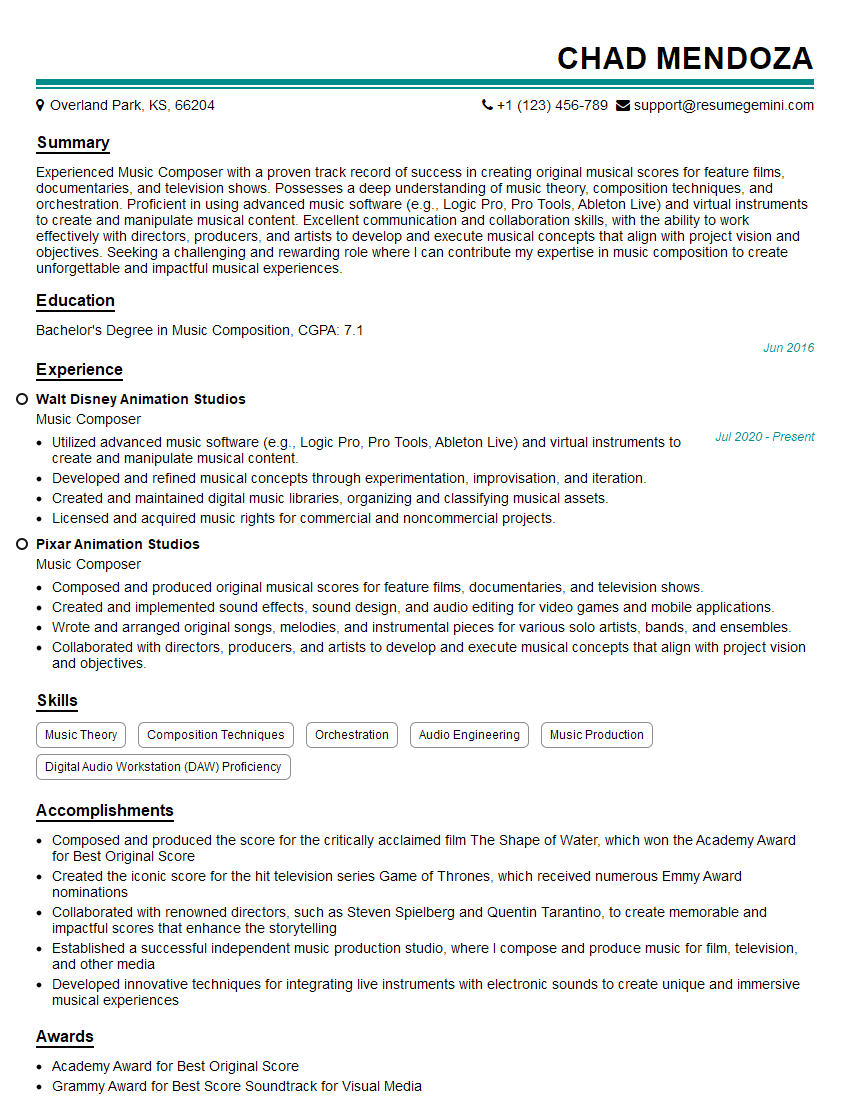
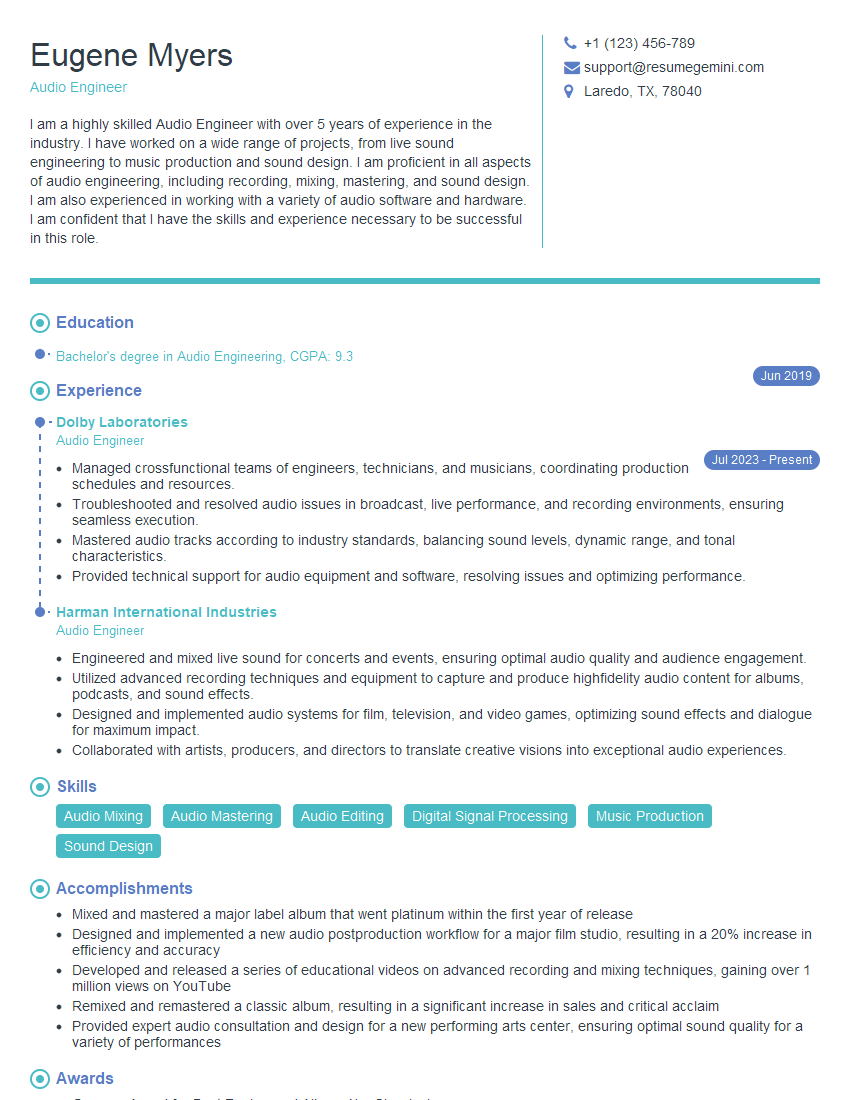
Mastering Game Audio Design opens doors to exciting and rewarding careers in the vibrant gaming industry. To maximize your job prospects, crafting a compelling and ATS-friendly resume is crucial. ResumeGemini is a trusted resource to help you build a professional resume that highlights your skills and experience effectively. Examples of resumes tailored specifically to Game Audio Design are available to help you create a strong application. Take the next step in your career journey and invest in a polished presentation of your talents.
Explore more articles
Users Rating of Our Blogs
Share Your Experience
We value your feedback! Please rate our content and share your thoughts (optional).
What Readers Say About Our Blog
Very informative content, great job.
good