Unlock your full potential by mastering the most common Geometric Optics interview questions. This blog offers a deep dive into the critical topics, ensuring you’re not only prepared to answer but to excel. With these insights, you’ll approach your interview with clarity and confidence.
Questions Asked in Geometric Optics Interview
Q 1. Explain Snell’s Law and its application in optical design.
Snell’s Law is the fundamental principle governing the refraction of light as it passes from one medium to another. It states that the ratio of the sines of the angles of incidence and refraction is equal to the ratio of the refractive indices of the two media. Mathematically, it’s expressed as:
n₁sinθ₁ = n₂sinθ₂
where n₁ and n₂ are the refractive indices of the two media, and θ₁ and θ₂ are the angles of incidence and refraction, respectively, measured with respect to the normal to the interface between the two media.
In optical design, Snell’s Law is crucial for calculating the path of light rays through lenses, prisms, and other optical components. It’s used to design lenses with specific focal lengths and to predict how light will be bent and focused. For instance, in designing a camera lens, Snell’s Law helps determine the appropriate curvature of the lens surfaces to achieve sharp focusing. Without a precise understanding and application of Snell’s Law, designing effective optical systems would be impossible.
Q 2. Describe the difference between real and virtual images formed by lenses and mirrors.
The difference between real and virtual images lies in whether the light rays actually converge at the image location or only appear to converge.
- Real images are formed when light rays from an object converge after passing through a lens or reflecting off a mirror. These images can be projected onto a screen. Think of the image projected onto a movie screen – that’s a real image. They are always inverted.
- Virtual images are formed when light rays appear to originate from a point where they do not actually converge. These images cannot be projected onto a screen. The image you see in a plane mirror is a classic example of a virtual image. Virtual images are always upright.
Lenses can form both real and virtual images depending on the object’s distance from the lens and the lens’s focal length. Concave mirrors always form virtual images, while convex mirrors always form diminished, virtual, upright images. Convex lenses can produce both real and virtual images, while concave lenses always produce virtual, diminished, upright images.
Q 3. How do you calculate the focal length of a thin lens?
For a thin lens, the focal length (f) can be calculated using the lens maker’s equation:
1/f = (n - 1) * (1/R₁ - 1/R₂)
where:
fis the focal lengthnis the refractive index of the lens materialR₁is the radius of curvature of the first lens surfaceR₂is the radius of curvature of the second lens surface
The sign convention is crucial: a convex surface has a positive radius of curvature, while a concave surface has a negative radius of curvature. This equation allows optical designers to determine the necessary curvatures of the lens surfaces to achieve a desired focal length. For example, a shorter focal length requires a stronger curvature.
Q 4. What are the cardinal points of an optical system, and what is their significance?
The cardinal points of an optical system are six points that define the system’s imaging properties. These points are crucial for understanding and analyzing the behavior of complex optical systems. They are:
- First and Second Principal Planes (H₁ and H₂): These planes are located such that a ray entering the system parallel to the optical axis appears to emerge from the second principal plane as if it had refracted at the first principal plane. They simplify ray tracing.
- First and Second Focal Points (F₁ and F₂): A ray passing through the first focal point emerges from the system parallel to the optical axis. Conversely, a ray entering the system parallel to the optical axis appears to have originated from the second focal point.
- First and Second Principal Points (P₁ and P₂): These points are the intersections of the principal planes with the optical axis. They are essential for determining the effective focal length of a system.
The significance of cardinal points is that they simplify ray tracing and allow for the easy calculation of image positions and magnifications even for complex multi-element systems. Knowing these points allows optical designers to predict the system’s behavior and optimize its performance.
Q 5. Explain the concept of paraxial approximation and its limitations.
The paraxial approximation simplifies optical calculations by assuming that all rays are close to the optical axis. This assumption allows us to use small-angle approximations like sin θ ≈ θ and tan θ ≈ θ (where θ is measured in radians). This simplification leads to linear equations, making calculations significantly easier.
However, this approximation has limitations. It is only valid for rays that are very close to the optical axis. As rays move farther from the axis, these approximations become less accurate, leading to significant errors in image formation. This is why real optical systems suffer from aberrations, which are not predicted by paraxial approximations. For instance, paraxial theory predicts that a perfect lens will perfectly focus all parallel rays to a single point, but in reality, this is not the case due to real-world limitations.
Q 6. Describe different types of aberrations in optical systems (e.g., spherical aberration, coma, astigmatism).
Aberrations are imperfections in optical systems that cause light rays to not converge perfectly at a single point, leading to blurred or distorted images. Several types of aberrations exist, including:
- Spherical Aberration: Rays passing through the outer zones of a spherical lens focus closer to the lens than paraxial rays, resulting in a blurry image.
- Coma: Off-axis points appear as comet-shaped images, caused by different magnifications for rays passing through different zones of the lens.
- Astigmatism: Off-axis points are imaged as two line segments oriented perpendicular to each other, resulting from different focal points for tangential and sagittal rays.
- Chromatic Aberration: Different wavelengths of light are refracted differently, leading to color fringing in the image.
- Distortion: Straight lines are imaged as curved lines, caused by varying magnifications across the image field.
These aberrations degrade image quality and limit the performance of optical systems.
Q 7. How can these aberrations be corrected or minimized?
Aberrations can be corrected or minimized using various techniques:
- Aspherical Lenses: Using lenses with non-spherical surfaces can reduce spherical aberration and coma.
- Lens Combinations: Combining lenses of different shapes and refractive indices can compensate for aberrations. For example, a doublet lens uses two lenses to reduce chromatic aberration.
- Aperture Stops: Restricting the light entering the system through an aperture stop reduces the effects of off-axis aberrations. However, this comes at the cost of reduced light throughput.
- Diffractive Optical Elements (DOEs): DOEs use diffraction to manipulate light and correct aberrations.
- Computer-aided design (CAD) and optimization: Sophisticated software can be used to simulate and optimize lens designs to minimize aberrations.
The specific methods chosen depend on the optical system’s requirements, cost constraints, and desired image quality. The goal is always to find a balance between correction and other design factors.
Q 8. Explain the principle of Fermat’s principle of least time.
Fermat’s principle of least time states that light will always travel between two points along the path that takes the least amount of time. This seemingly simple principle has profound implications for understanding how light behaves in various media and under different conditions. Imagine you’re trying to get from point A to point B as quickly as possible, but part of your journey is through a slower medium (like wading through mud). You wouldn’t take a straight line; you’d adjust your path to minimize the time spent in the slower medium. Light does something similar, bending its path to minimize the overall travel time.
Mathematically, this is expressed by considering the optical path length (OPL), which is the product of the geometric distance and the refractive index of the medium. Light minimizes the OPL. In homogeneous media (where the refractive index is constant), the path of least time is simply a straight line. However, in inhomogeneous media or when different media are involved (like air and water), the path becomes curved to satisfy the principle. This principle elegantly explains phenomena such as reflection and refraction.
Q 9. What are the differences between reflection and refraction?
Reflection and refraction are two fundamental ways light interacts with surfaces or boundaries between different media. In reflection, light bounces off a surface. Think of a mirror; the angle of incidence (the angle at which light strikes the surface) equals the angle of reflection (the angle at which light bounces off). The light essentially stays in the same medium.
Refraction, on the other hand, involves light passing from one medium to another (e.g., from air to water). When this happens, the speed of light changes, causing the light to bend. The amount of bending depends on the refractive indices of the two media and the angle of incidence. This bending is governed by Snell’s law: n1 * sin(θ1) = n2 * sin(θ2), where n1 and n2 are the refractive indices of the two media, and θ1 and θ2 are the angles of incidence and refraction, respectively.
In short: reflection involves a change in direction, but the medium remains the same; refraction involves a change in direction and speed as the light changes medium.
Q 10. Describe the process of image formation by a concave mirror.
A concave mirror is a curved mirror that curves inward, like the inside of a sphere. Image formation depends on the position of the object relative to the focal point (F) and the center of curvature (C).
- Object beyond C: A real, inverted, and diminished image is formed between F and C.
- Object at C: A real, inverted, and same-size image is formed at C.
- Object between C and F: A real, inverted, and magnified image is formed beyond C.
- Object at F: No image is formed (rays are parallel after reflection).
- Object between F and the mirror: A virtual, upright, and magnified image is formed behind the mirror.
The process involves tracing rays from the object to the mirror, reflecting them according to the law of reflection, and finding the point where the reflected rays converge (for real images) or appear to diverge from (for virtual images). This point of convergence or divergence defines the location of the image.
Example: A flashlight uses a concave reflector to create a parallel beam of light. The light source is placed at the focal point; thus, after reflection, the rays become parallel, resulting in a concentrated beam.
Q 11. How does the refractive index of a medium affect light propagation?
The refractive index (n) of a medium is a measure of how much light slows down when it passes through that medium. It’s the ratio of the speed of light in a vacuum to the speed of light in the medium: n = c/v, where c is the speed of light in vacuum and v is the speed of light in the medium. A higher refractive index means light travels slower in that medium. This directly impacts light propagation in several ways:
- Bending of Light (Refraction): As discussed earlier with Snell’s law, the refractive index determines the angle of refraction when light passes from one medium to another. A larger difference in refractive indices between two media results in greater bending of light.
- Optical Path Length: The refractive index affects the optical path length, which influences the time light takes to travel through a medium. The OPL is directly proportional to the refractive index.
- Total Internal Reflection: The refractive index plays a crucial role in determining the critical angle for total internal reflection (TIR), a phenomenon where light is completely reflected within a medium, preventing its passage into a less dense medium.
Examples: Optical fibers utilize the high refractive index of the core to achieve total internal reflection, guiding light over long distances. Lenses use variations in refractive index to focus or diverge light.
Q 12. Explain the concept of total internal reflection and its applications.
Total internal reflection (TIR) occurs when light traveling from a denser medium to a less dense medium (e.g., from glass to air) strikes the boundary at an angle greater than the critical angle. At this critical angle, the angle of refraction reaches 90 degrees; any angle larger than this results in complete reflection back into the denser medium. No light escapes into the less dense medium.
The critical angle (θc) is calculated using: sin(θc) = n2/n1, where n1 is the refractive index of the denser medium, and n2 is the refractive index of the less dense medium.
Applications:
- Optical Fibers: TIR is the fundamental principle behind optical fibers. Light is continuously reflected within the fiber core, allowing for efficient transmission over long distances.
- Prisms: Prisms can be used to achieve TIR for purposes such as beam steering or image inversion.
- Medical Imaging: Endoscopes utilize TIR to allow doctors to view internal organs without invasive surgery.
- Decorative applications: Some gems display brilliant sparkle due to TIR.
Q 13. Describe the working principle of a simple magnifying glass.
A simple magnifying glass is a converging lens (a lens that is thicker in the middle than at the edges). It works by creating a magnified virtual image of an object placed closer than the focal length of the lens. When an object is placed within the focal length of a converging lens, the lens refracts the light rays to diverge as if they are coming from a point farther away than the object. This creates a virtual, upright, and magnified image.
The magnification depends on the focal length (f) of the lens and the distance of the object from the lens. A shorter focal length results in higher magnification. The image is virtual, meaning it cannot be projected onto a screen. Instead, it is perceived by the eye.
Q 14. What is the difference between a converging and a diverging lens?
Converging and diverging lenses differ fundamentally in their shape and how they affect light rays:
- Converging lenses (convex lenses): These lenses are thicker in the middle than at the edges. They converge parallel light rays to a single point called the focal point. They form real or virtual images depending on the object’s position relative to the focal point.
- Diverging lenses (concave lenses): These lenses are thinner in the middle than at the edges. They diverge parallel light rays, making them appear to originate from a virtual focal point. They always form virtual, upright, and diminished images.
In essence, converging lenses focus light, while diverging lenses spread light out. This difference leads to their distinct applications in optical systems. Converging lenses are used in magnifying glasses, cameras, and telescopes to focus light and create images; diverging lenses are used to correct nearsightedness (myopia) and in some optical instruments to reduce aberrations.
Q 15. How do you determine the magnification of a lens or mirror system?
Magnification in a lens or mirror system describes how much larger or smaller an image appears compared to the object. It’s determined by the ratio of the image height (hi) to the object height (ho), or equivalently, the ratio of the image distance (di) to the object distance (do).
- For a single lens or mirror: Magnification (M) = hi / ho = -di / do. The negative sign indicates whether the image is inverted (negative M) or upright (positive M).
- For multiple lens systems: The total magnification is the product of the magnification of each individual lens. For example, if you have two lenses with magnifications M1 and M2, the total magnification is Mtotal = M1 * M2.
Example: A converging lens forms an image 10cm tall from a 5cm tall object. The image distance is 20cm. The magnification is M = hi/ho = 10cm/5cm = 2, or M = -di/do = -20cm/do. This implies that the object distance do is 10 cm. Since M is positive, the image is upright and magnified.
Career Expert Tips:
- Ace those interviews! Prepare effectively by reviewing the Top 50 Most Common Interview Questions on ResumeGemini.
- Navigate your job search with confidence! Explore a wide range of Career Tips on ResumeGemini. Learn about common challenges and recommendations to overcome them.
- Craft the perfect resume! Master the Art of Resume Writing with ResumeGemini’s guide. Showcase your unique qualifications and achievements effectively.
- Don’t miss out on holiday savings! Build your dream resume with ResumeGemini’s ATS optimized templates.
Q 16. Describe the concept of optical power and its unit.
Optical power (P) is a measure of a lens or mirror’s ability to converge or diverge light. It’s the reciprocal of the focal length (f), which is the distance between the lens/mirror and its focal point (where parallel rays converge).
Formula: P = 1/f
The unit of optical power is the diopter (D), which is equivalent to inverse meters (m-1). A lens with a focal length of 1 meter has an optical power of 1 diopter. A higher diopter value indicates a stronger converging power (for positive focal lengths) or diverging power (for negative focal lengths).
Example: An eyeglass lens with a focal length of 0.5 meters has an optical power of P = 1/0.5m = 2D. This means it has a strong converging power.
Q 17. Explain how prisms are used to separate light into its constituent colors.
Prisms separate light into its constituent colors (dispersion) due to the phenomenon of refraction. Different wavelengths of light have different refractive indices in a material, meaning they bend at different angles as they pass through the prism’s boundary.
When light enters a prism, it slows down and bends towards the normal (an imaginary line perpendicular to the surface). Since different colors have different wavelengths, they refract at slightly different angles. Violet light, with the shortest wavelength, bends the most, while red light, with the longest wavelength, bends the least. This separation of colors creates a spectrum.
Think of it like a race: Imagine different colored marbles (light waves) rolling down a hill (prism). The smaller marbles (violet) get stuck in the grass (material) more than the larger marbles (red), causing the smaller ones to be slowed down and change direction more significantly.
Q 18. How does the human eye function as an optical system?
The human eye functions as a sophisticated optical system, forming an image on the retina. It consists of several key components:
- Cornea: The transparent outer layer, which refracts light entering the eye.
- Pupil: The adjustable opening that controls the amount of light entering the eye.
- Lens: A flexible structure that further refracts light to focus the image onto the retina. It adjusts its shape (accommodation) to focus on objects at different distances.
- Retina: The light-sensitive layer containing photoreceptor cells (rods and cones) that convert light into electrical signals.
- Optic Nerve: Transmits these signals to the brain for interpretation.
The cornea and lens work together to refract light and focus a real, inverted image onto the retina. The brain then processes this information to produce an upright image.
Myopia (nearsightedness) occurs when the eye is too long or the lens is too strong, causing the image to focus in front of the retina. Hyperopia (farsightedness) happens when the eye is too short or the lens is too weak, causing the image to focus behind the retina.
Q 19. What are the different types of optical fibers and their applications?
Optical fibers are thin, flexible strands of glass or plastic that transmit light signals over long distances with minimal loss. They’re based on the principle of total internal reflection.
- Single-mode fibers: Have a small core diameter, allowing only one mode (path) of light to propagate. This results in low signal dispersion and is ideal for long-distance, high-bandwidth communication like telecommunications.
- Multi-mode fibers: Have a larger core diameter, allowing multiple modes of light to propagate. This leads to higher signal dispersion but is simpler and cheaper to manufacture. They are typically used for shorter-distance applications like local area networks (LANs).
- Plastic optical fibers (POF): Made of plastic, are flexible and cost-effective, but they have higher attenuation (signal loss) compared to glass fibers. They are used in short-range data transmission applications.
Applications include telecommunications, medical imaging (endoscopes), sensing, and illumination.
Q 20. Describe the concept of diffraction and its effect on image formation.
Diffraction refers to the bending of waves (including light) as they pass through an aperture or around an obstacle. This bending causes the light to spread out, blurring the image slightly.
In image formation, diffraction sets a fundamental limit on the resolution of optical systems. The smaller the aperture (like the pupil of an eye or the lens of a camera), the larger the diffraction effect, leading to a less sharp image. This is because the light waves spreading out from the aperture interfere with each other, creating a diffraction pattern instead of a perfectly focused point.
Example: Looking at a distant star through a small telescope aperture will result in a blurry, spread-out image due to the diffraction of starlight.
The amount of diffraction depends on the wavelength of light and the size of the aperture; shorter wavelengths and larger apertures minimize diffraction effects.
Q 21. Explain the principles behind optical interferometry.
Optical interferometry is a technique that uses the interference of light waves to measure extremely small distances or changes in distance with high precision. It relies on the principle of superposition, where two or more waves combine to form a resultant wave.
When two coherent light waves (waves with the same frequency and a constant phase difference) meet, they interfere constructively (bright fringes) where their crests align and destructively (dark fringes) where a crest meets a trough. The pattern of these bright and dark fringes depends on the path difference between the waves.
By analyzing the interference pattern, we can precisely measure the path difference, which can be related to the distance we want to measure or changes in distance due to things like surface irregularities, temperature changes, or vibrations.
Applications: Optical interferometry is used in various fields, including measuring surface roughness, testing optical components, detecting gravitational waves (LIGO), and measuring displacements in metrology.
Q 22. What is the significance of the Abbe number in lens design?
The Abbe number, also known as the V-number, is a crucial measure of a material’s dispersion, indicating how much the refractive index changes with wavelength. It’s vital in lens design because it dictates how well a lens corrects for chromatic aberration – the color fringing seen around images caused by different wavelengths of light focusing at slightly different points. A higher Abbe number signifies lower dispersion, meaning less chromatic aberration.
Think of it like this: imagine shining white light (a mix of colors) through a prism. The prism separates the colors because different colors bend at different angles due to their varying wavelengths. Materials with high Abbe numbers act less like prisms, minimizing this color separation. In lens design, we carefully choose lens materials with appropriate Abbe numbers to minimize or eliminate this undesirable effect. For instance, a lens designed for high-resolution photography might use glasses with high Abbe numbers to reduce chromatic aberration and enhance image sharpness.
Q 23. How do you design a simple optical system to achieve a specific magnification?
Designing an optical system for a specific magnification involves choosing the right lenses and their spacing. For a simple system, a single converging lens (positive focal length) can create a magnified image if the object is placed closer than the focal length. The magnification (M) is given by the ratio of the image distance (v) to the object distance (u): M = -v/u. A negative magnification indicates an inverted image.
To achieve a desired magnification, you’d adjust the object distance (u). If you need a larger magnification, place the object closer to the lens’s focal point. Alternatively, you can use a compound lens system – multiple lenses working together – for higher magnification and better image quality. More complex systems might employ diverging lenses (negative focal length) to correct aberrations or achieve specific image characteristics.
For example, to achieve a magnification of -2, you could use a converging lens with a focal length of 10cm. Let’s assume the desired image distance (v) is 20cm (following our magnification equation). You would place the object at 10cm distance (u = 10cm) from the lens. This arrangement would produce an inverted image twice the size of the object.
Q 24. Describe the different methods for testing optical components.
Testing optical components involves various methods depending on the required accuracy and the specific component’s function. Some common techniques include:
- Interferometry: This high-precision method uses interference patterns of light waves to measure surface irregularities and optical path differences with nanometer accuracy. It’s crucial for testing highly precise lenses and mirrors.
- Autocollimation: This method uses a collimated beam of light reflected back on itself to measure surface flatness and angles.
- Transmission measurements: Using spectrophotometers to measure the transmission of light through a component across various wavelengths, enabling assessment of transmission efficiency and spectral properties.
- Scatterometry: Measuring the angular distribution of scattered light to characterize surface roughness and defects.
- MTF (Modulation Transfer Function) measurements: Assessing the ability of the optical component to transfer spatial frequencies, crucial for image quality evaluation. This often uses specialized test charts and imaging systems.
The choice of method depends on the application and the level of detail required. For instance, a simple magnifying glass might only require transmission measurements, while a high-precision telescope lens needs interferometric testing.
Q 25. Explain the concept of ray tracing and its use in optical design.
Ray tracing is a fundamental technique in optical design. It involves tracing the path of individual light rays as they pass through an optical system. By applying Snell’s law (governing refraction) and the laws of reflection at each surface, we can determine how light rays propagate and where they converge (or diverge) to form an image. This provides valuable information about the system’s imaging properties, aberrations, and overall performance.
Ray tracing is essential for:
- Image formation analysis: Determining the location, size, and orientation of the image.
- Aberration analysis: Identifying and quantifying optical aberrations (e.g., spherical aberration, coma, astigmatism).
- Optical system optimization: Adjusting lens shapes, materials, and spacing to improve image quality and minimize aberrations.
- Field of view determination: Analyzing the extent of the scene that the system can capture.
Sophisticated ray tracing software packages can simulate thousands or millions of rays, providing comprehensive information about the optical system’s behavior. This allows designers to fine-tune their designs and achieve optimal performance before actual manufacturing.
Q 26. What software packages are commonly used for optical design and simulation?
Several software packages are widely used for optical design and simulation. These tools allow for sophisticated ray tracing, aberration analysis, and optimization. Popular choices include:
- Zemax OpticStudio: A widely used commercial software package offering comprehensive capabilities for optical design, analysis, and tolerancing.
- Code V: Another industry-standard commercial software with advanced features for lens design and optimization.
- LightTools: A powerful software package specializing in non-sequential ray tracing, particularly useful for illumination and complex systems.
- OSLO: A versatile commercial software package with a wide range of design and analysis capabilities.
These packages provide powerful tools for designers to create, analyze, and optimize optical systems efficiently, ensuring high-quality performance and cost-effectiveness.
Q 27. Discuss your experience with optical tolerancing and its importance.
Optical tolerancing is the process of defining acceptable variations in the manufacturing parameters of optical components. It’s critical because even slight deviations from the ideal design can significantly impact the system’s performance. Tolerancing determines how much variation in lens curvature, thickness, spacing, and other parameters is acceptable while still meeting the system’s specifications.
The importance of optical tolerancing lies in its impact on manufacturing costs and the system’s final performance. Tight tolerances lead to higher manufacturing costs and potentially longer production times. However, loose tolerances may result in an optical system that does not meet its design specifications and compromises image quality. The goal is to find an optimal balance, balancing cost and performance by using robust design techniques and minimizing the sensitivity to manufacturing variations.
My experience involves using Monte Carlo simulations within optical design software to predict the performance variations resulting from manufacturing tolerances and implementing design changes to improve the system’s robustness to such variations. For example, I’ve optimized the design of a high-power laser system by carefully selecting tolerances for the components, making sure cost and quality requirements were met.
Q 28. Describe a challenging optical design problem you solved and how you approached it.
One challenging project involved designing a compact, high-resolution imaging system for a space-based application. The primary challenge was miniaturization while maintaining excellent image quality and diffraction-limited performance across a wide field of view. This required careful consideration of several factors, including:
- Minimizing aberrations: Using aspheric lenses and sophisticated lens design techniques to correct for aberrations that become more pronounced in compact systems.
- Material selection: Choosing appropriate lens materials with low dispersion and high refractive index to optimize both compactness and chromatic correction.
- Thermal stability: Designing the system to maintain optimal performance across the extreme temperature variations in space.
To solve this, I utilized advanced ray tracing and optimization algorithms in Zemax OpticStudio. I iteratively refined the lens design by modifying lens shapes, materials, and spacings, simulating various manufacturing tolerances and evaluating the impact on the system’s performance. This process involved multiple rounds of design, analysis, and optimization, ultimately leading to a design that met all the performance requirements within the tight size constraints. The solution involved using a freeform lens to achieve exceptional aberration correction and a highly compact design.
Key Topics to Learn for Geometric Optics Interview
- Reflection and Refraction: Understand Snell’s Law, the laws of reflection, and their applications in designing optical systems like lenses and mirrors. Consider the different types of reflection (specular vs. diffuse).
- Lenses and Mirrors: Master the concepts of focal length, image formation (real and virtual images), magnification, and the thin lens equation. Be prepared to analyze simple optical systems involving combinations of lenses and mirrors.
- Ray Tracing: Practice ray tracing techniques to determine image location, size, and orientation for various lens and mirror configurations. This is crucial for visualizing optical systems and solving problems.
- Optical Instruments: Familiarize yourself with the principles behind common optical instruments like telescopes, microscopes, and cameras. Understanding their design and functionality will demonstrate a comprehensive understanding.
- Aberrations: Be prepared to discuss common optical aberrations (spherical, chromatic) and methods for minimizing their effects. This showcases a deeper understanding of the limitations of optical systems.
- Polarization: Understand the concept of polarization of light and its applications in optical systems. This demonstrates advanced knowledge in the field.
- Problem-Solving Approaches: Develop a systematic approach to solving geometric optics problems. This includes identifying the relevant principles, drawing diagrams, and applying appropriate equations.
Next Steps
Mastering Geometric Optics opens doors to exciting careers in fields like optical engineering, photonics, and medical imaging. A strong understanding of these principles is highly valued by employers. To maximize your job prospects, crafting an ATS-friendly resume is essential. ResumeGemini can help you build a professional and impactful resume that highlights your skills and experience effectively. We provide examples of resumes tailored specifically to Geometric Optics roles to help you get started. Invest the time to create a resume that truly showcases your capabilities – it’s a crucial step in landing your dream job.
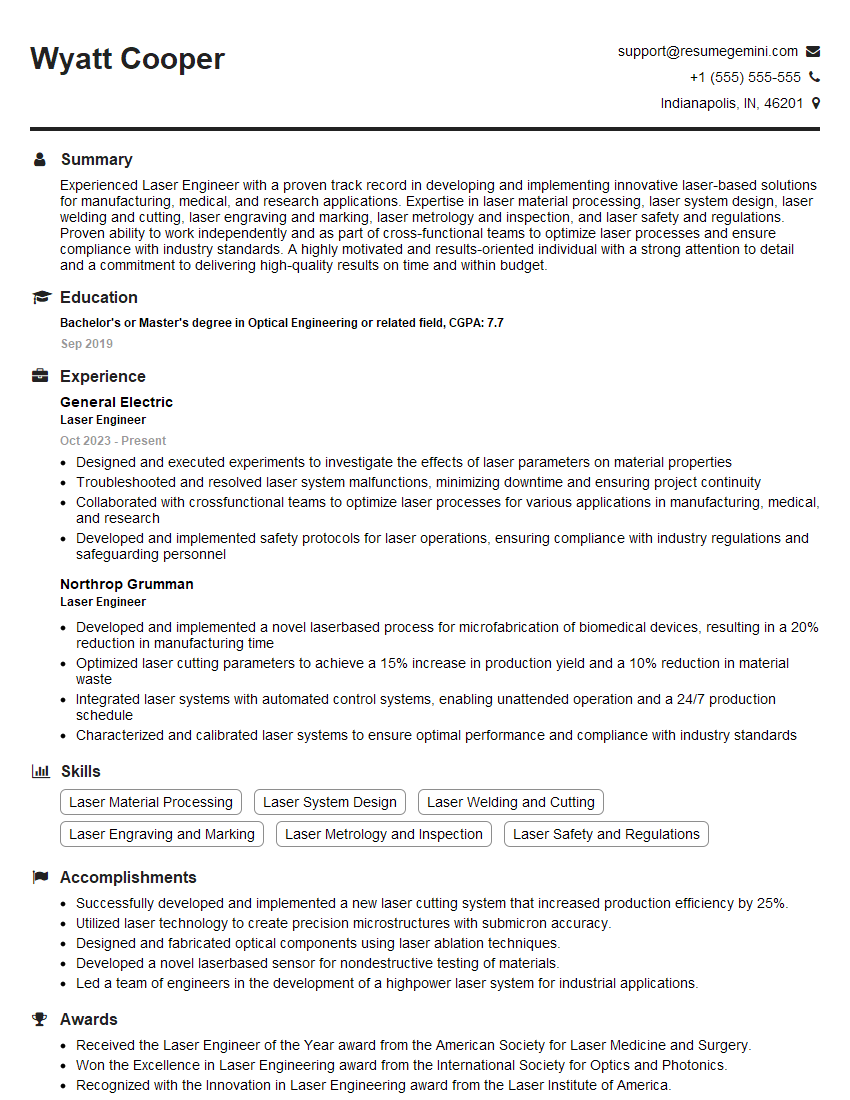
Laser Engineer Resume Sample
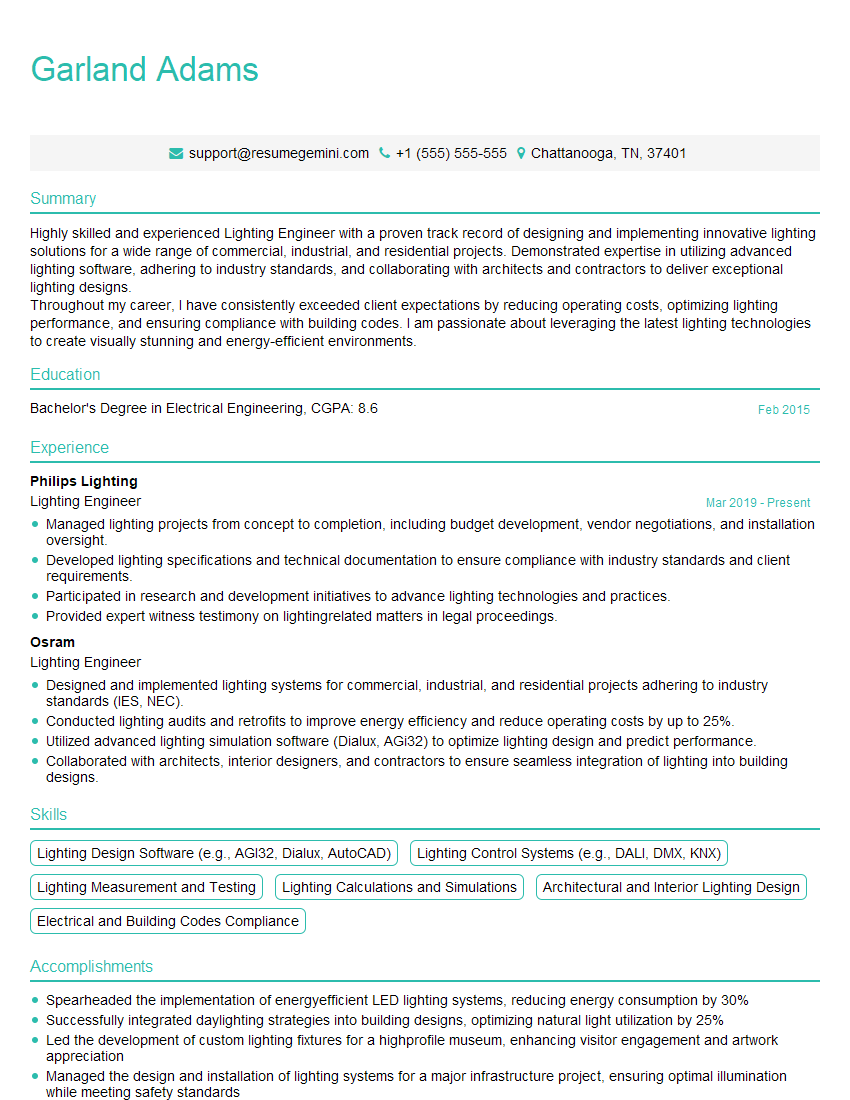
Lighting Engineer Resume Sample
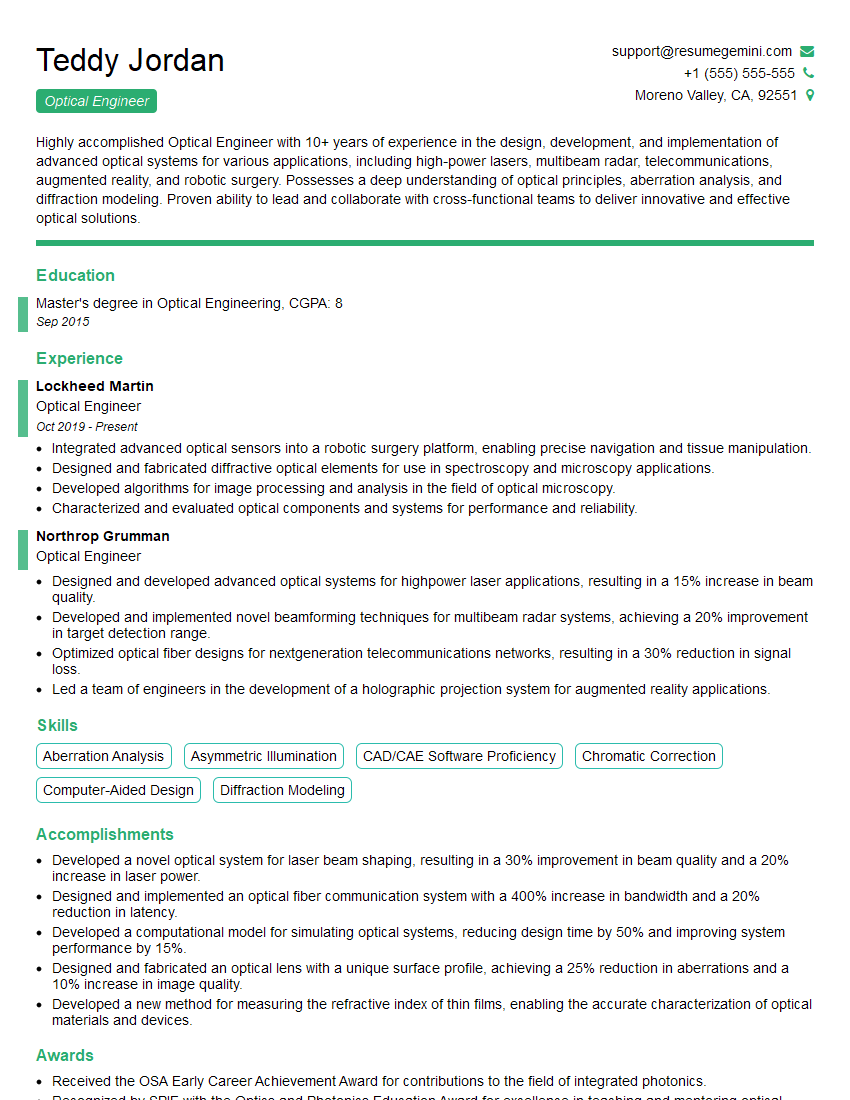
Optical Engineer Resume Sample
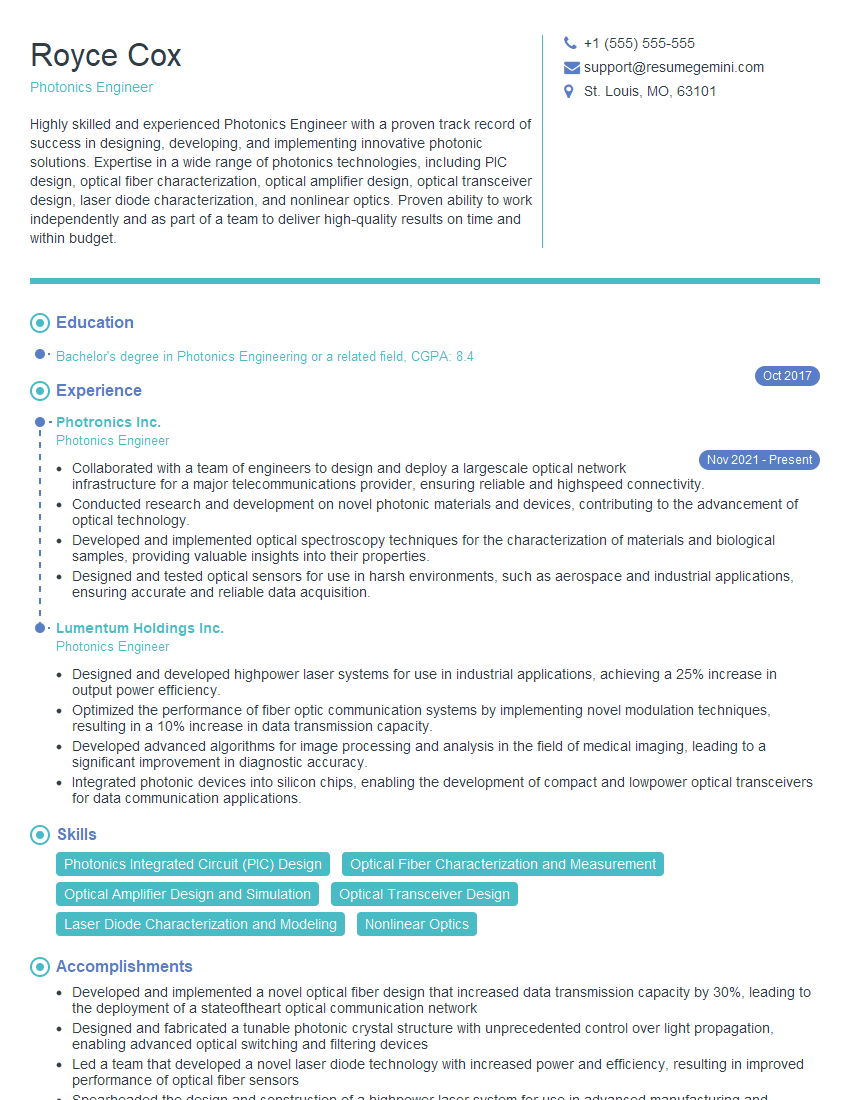
Photonics Engineer Resume Sample
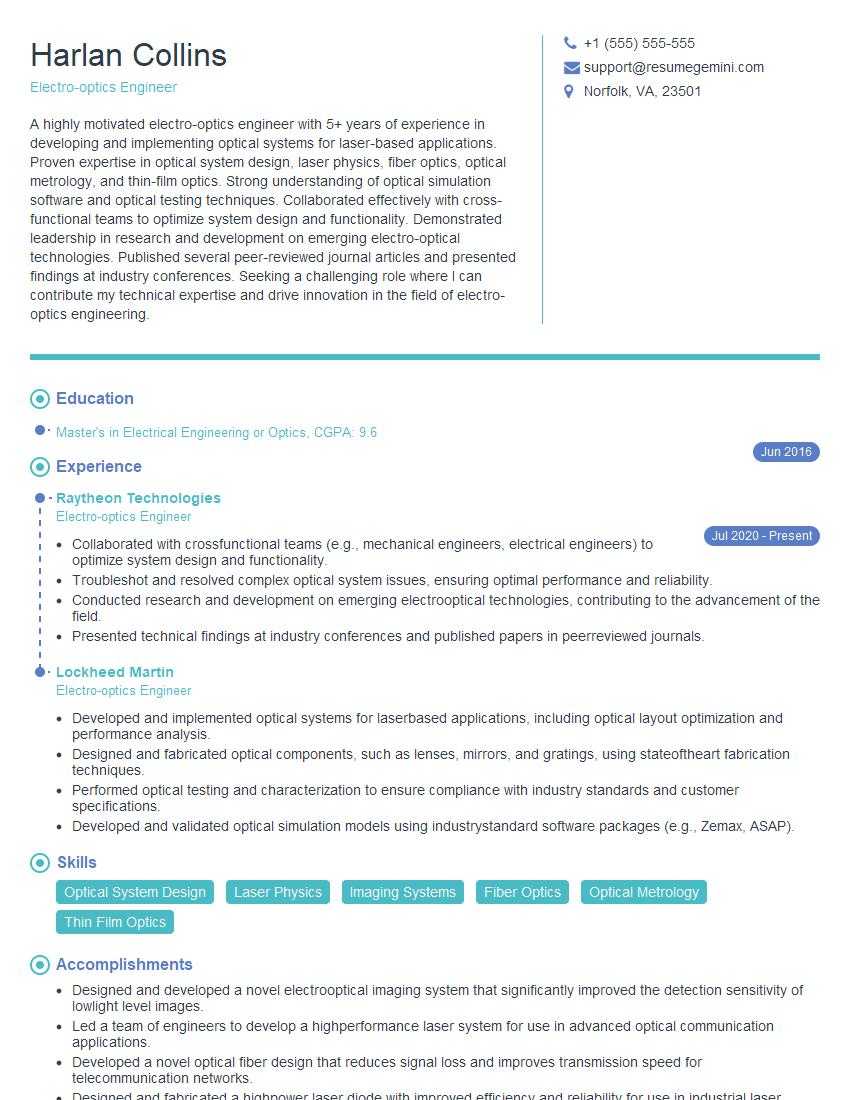
Electro-optics Engineer Resume Sample
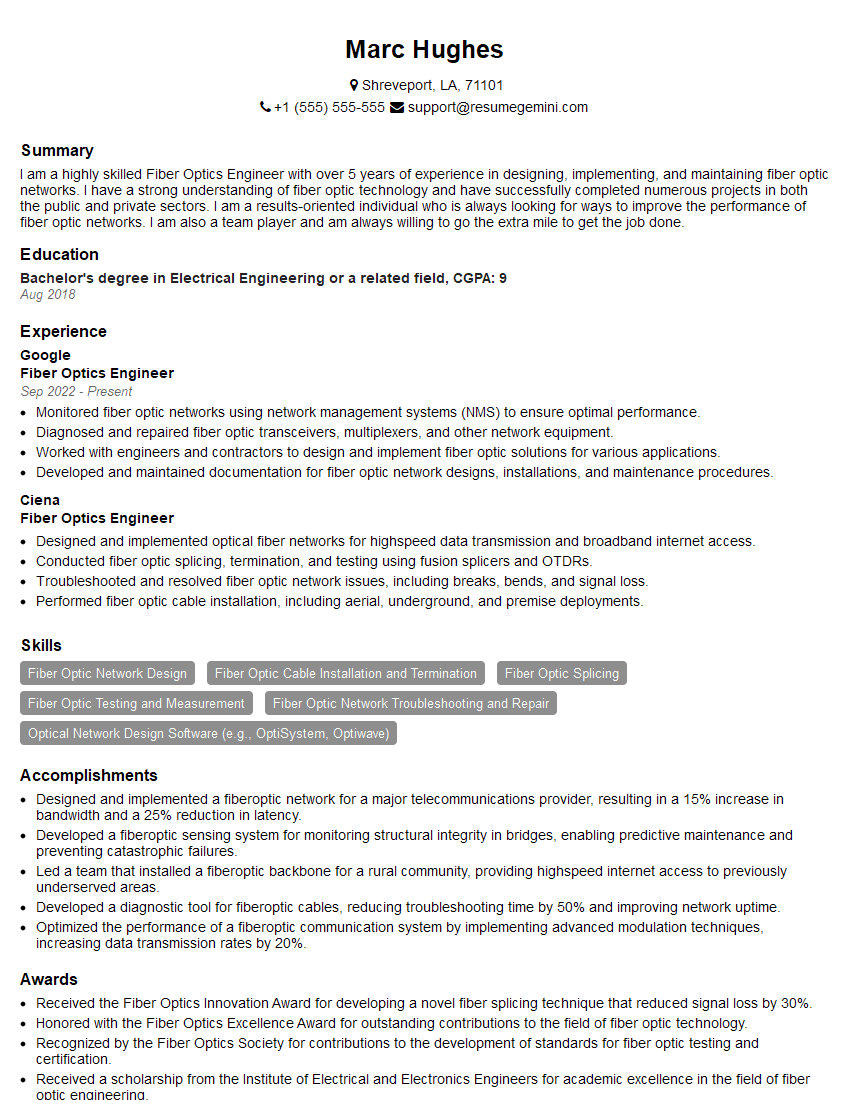
Fiber Optics Engineer Resume Sample
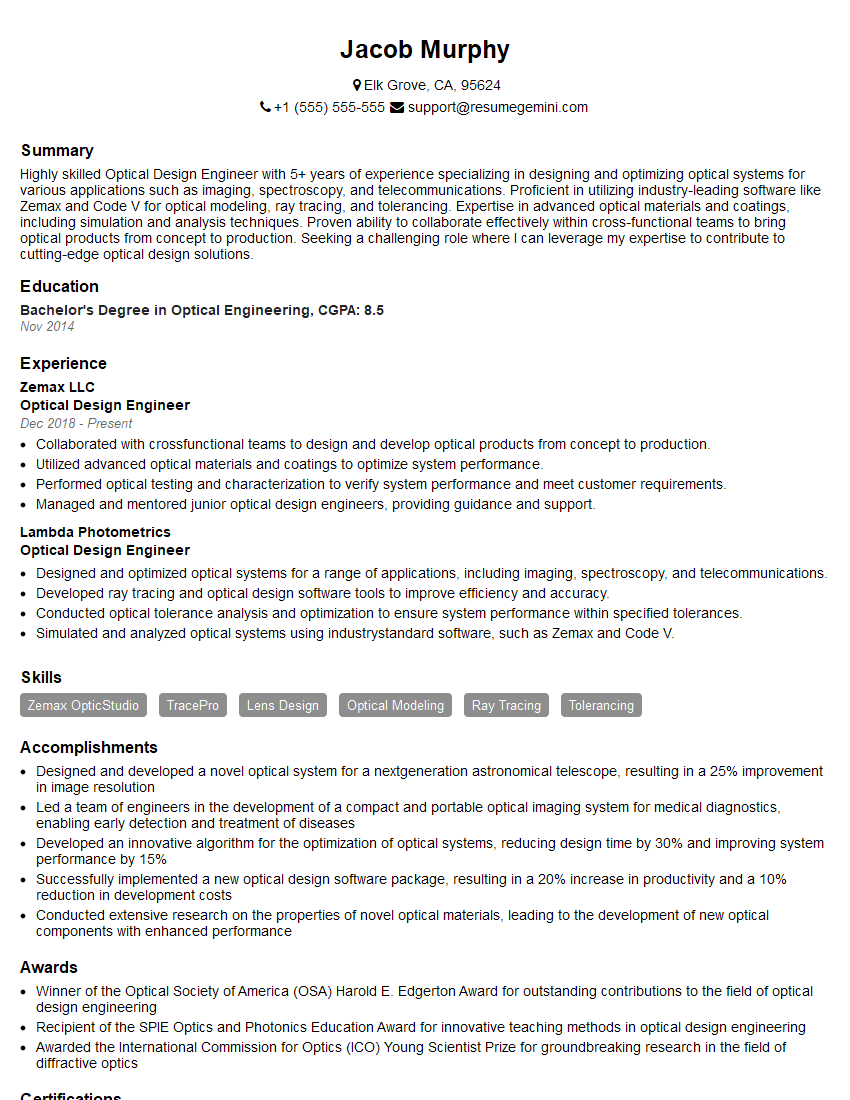
Optical Design Engineer Resume Sample
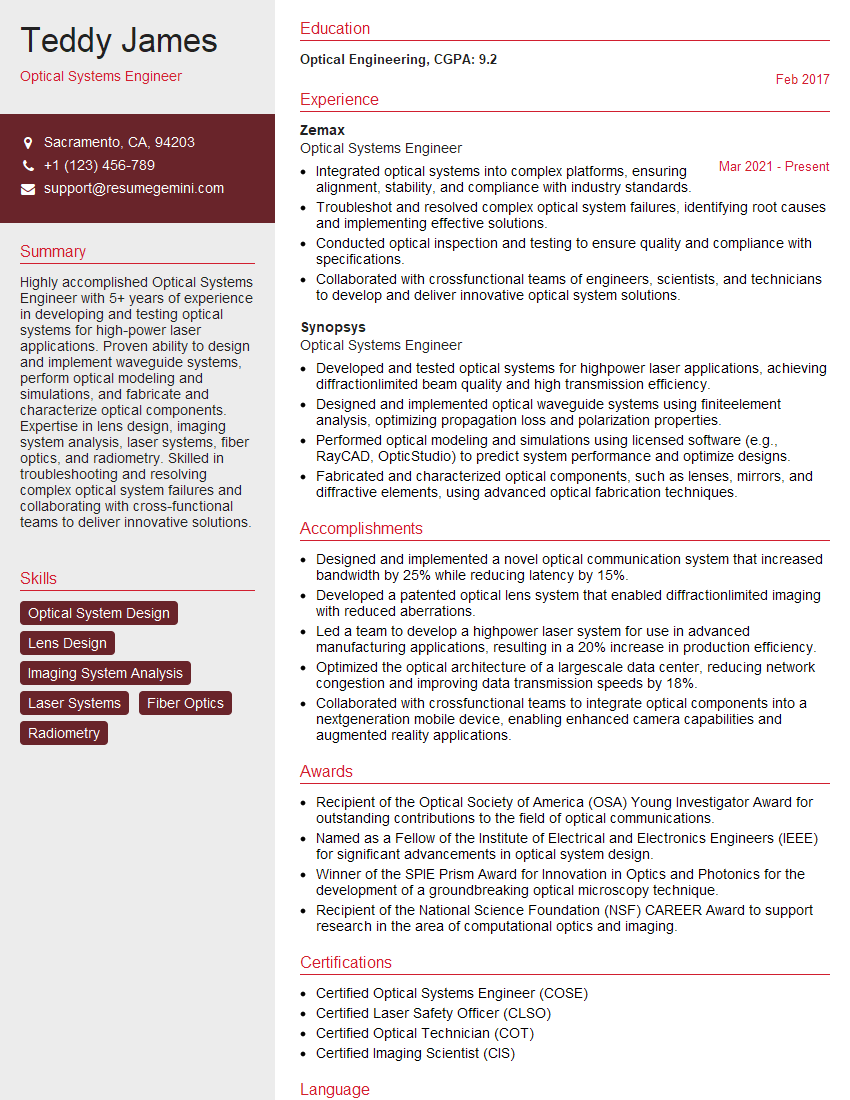
Optical Systems Engineer Resume Sample
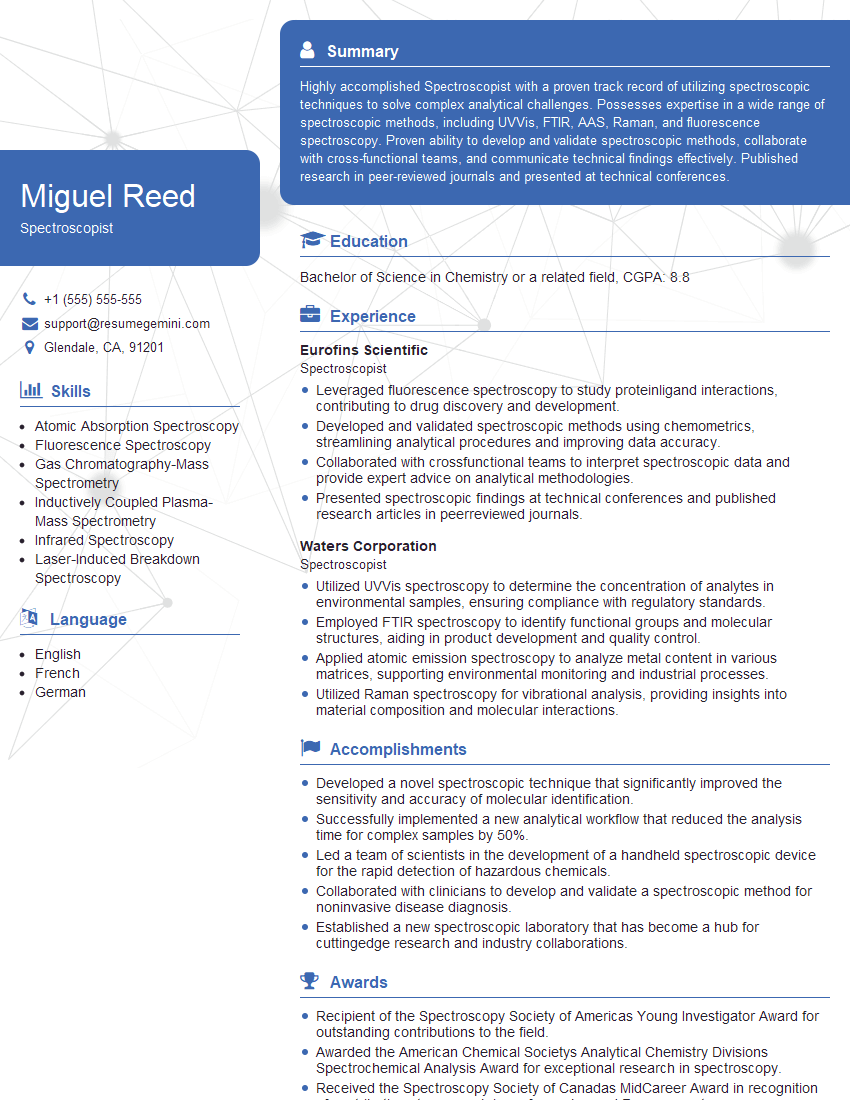
Spectroscopist Resume Sample
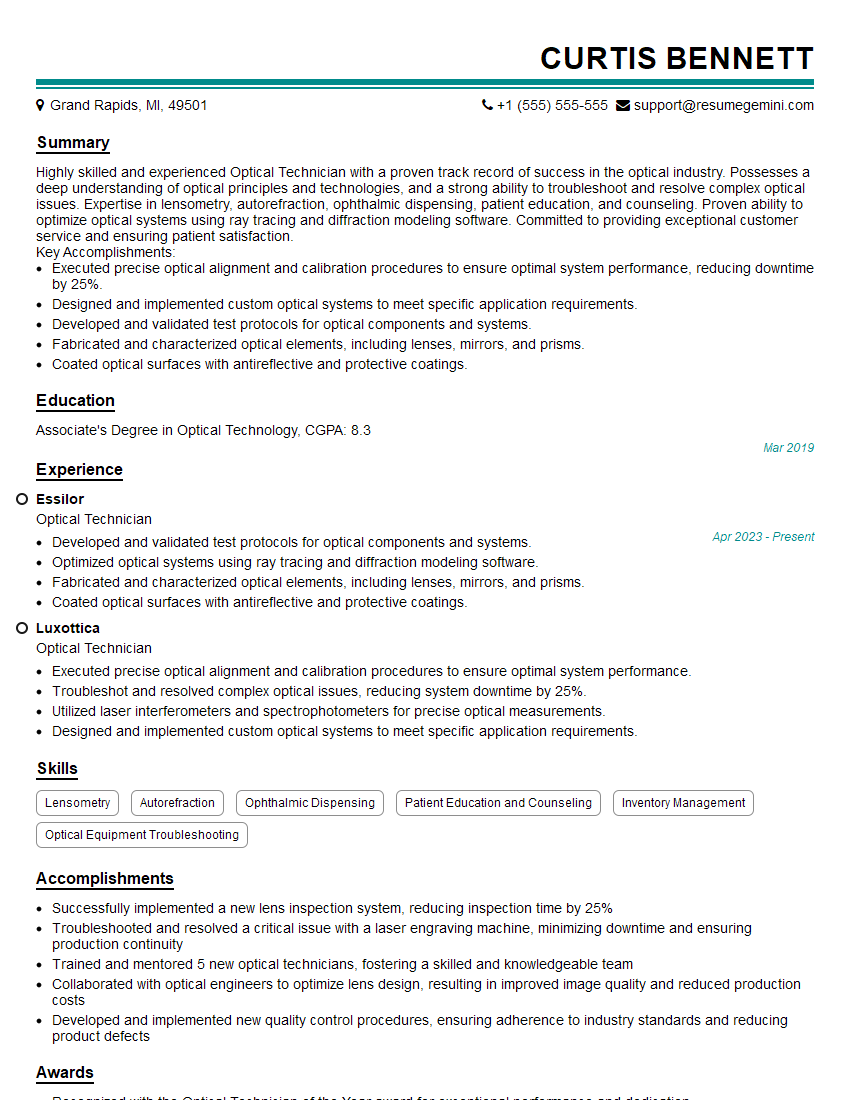
Optical Technician Resume Sample
Explore more articles
Users Rating of Our Blogs
Share Your Experience
We value your feedback! Please rate our content and share your thoughts (optional).
What Readers Say About Our Blog
Very informative content, great job.
good