Cracking a skill-specific interview, like one for Geophysical Report Writing, requires understanding the nuances of the role. In this blog, we present the questions you’re most likely to encounter, along with insights into how to answer them effectively. Let’s ensure you’re ready to make a strong impression.
Questions Asked in Geophysical Report Writing Interview
Q 1. Explain the key elements of a comprehensive geophysical report.
A comprehensive geophysical report is more than just raw data; it’s a compelling narrative that translates complex subsurface information into actionable insights. Key elements include:
- Executive Summary: A concise overview of the project, key findings, and recommendations, accessible to a non-technical audience.
- Introduction: Background information on the project goals, location, and geological context. This sets the stage for the subsequent analysis.
- Methodology: A detailed description of the geophysical methods employed, including survey design, equipment used, data acquisition parameters, and processing steps. Think of this as the ‘recipe’ for your results.
- Data Presentation: This section showcases the processed data through maps, cross-sections, and other visualizations. Clear labeling and legends are crucial for easy understanding. Examples include contour maps of gravity anomalies or seismic velocity sections.
- Interpretation and Analysis: This is the heart of the report, where you interpret the geophysical data to infer subsurface geological structures, properties, and potential resources. This involves integrating geophysical data with geological knowledge and other available information.
- Uncertainty and Error Analysis: A critical section addressing limitations and sources of uncertainty in the data and interpretation. This demonstrates transparency and acknowledges the inherent limitations of geophysical methods.
- Conclusions and Recommendations: Summarizes the key findings and their implications for the project. This often includes recommendations for further investigation or action.
- Appendices: Contains supplementary materials such as raw data files, processing parameters, and detailed technical information.
For example, in a mineral exploration project, the interpretation might identify potential ore bodies based on magnetic or gravity anomalies. The report would then recommend follow-up drilling to confirm the presence of ore.
Q 2. Describe your experience with different types of geophysical data (seismic, gravity, magnetic, etc.).
My experience spans various geophysical methods, each offering unique insights into the subsurface.
- Seismic Reflection/Refraction: I’ve extensively worked with seismic data for subsurface imaging, particularly in hydrocarbon exploration and engineering site investigations. Seismic reflection provides high-resolution images of subsurface layers, while refraction helps determine velocity structures and shallow depths. For example, I’ve used seismic refraction surveys to map bedrock depth for foundation design projects.
- Gravity: Gravity surveys are invaluable for identifying large-scale density variations, often used in mineral exploration and geological mapping. Analyzing Bouguer anomalies, for example, can help delineate buried geological structures or mineral deposits with contrasting densities.
- Magnetic: Magnetic surveys are particularly useful for detecting magnetic minerals like iron ore. I’ve used this technique for both mineral exploration and archaeological surveys. Analyzing magnetic anomalies helps identify subsurface structures associated with mineral deposits or buried artifacts.
- Electromagnetic (EM): EM methods are employed to detect variations in electrical conductivity, useful in groundwater exploration, mineral exploration (detecting conductive sulfide deposits), and environmental studies (locating contaminants).
- Ground Penetrating Radar (GPR): GPR provides high-resolution images of the shallow subsurface, suitable for applications such as utility mapping, archaeological investigations, and pavement evaluations. I’ve utilized GPR extensively for locating buried utilities before construction work.
The choice of method depends on the specific geological problem, depth of investigation, and budget constraints. Often, a combination of techniques provides a more complete understanding.
Q 3. How do you ensure the accuracy and reliability of your geophysical interpretations?
Ensuring accuracy and reliability requires a meticulous approach at every stage, starting from data acquisition to final interpretation.
- Rigorous Quality Control (QC): Implementing QC procedures during data acquisition, processing, and interpretation is paramount. This includes regularly checking data for noise, artifacts, and inconsistencies. For instance, in seismic data processing, I routinely apply filters to remove noise and enhance signal quality.
- Data Validation: Comparing geophysical data with independent data sources (e.g., borehole logs, geological maps) helps validate the interpretation. Discrepancies need to be investigated thoroughly and explained.
- Calibration and Standardization: Using properly calibrated instruments and applying standardized processing workflows helps minimize systematic errors. Regular instrument checks are necessary to ensure accurate measurements.
- Multiple Geophysical Methods: Integrating data from multiple geophysical methods enhances reliability. Using complementary techniques helps corroborate interpretations and reduce uncertainties. For example, combining gravity and magnetic data often provides a more robust interpretation than either method alone.
- Peer Review: Submitting interpretations for peer review ensures a thorough and objective assessment of the results before final reporting. Constructive feedback helps identify any potential biases or overlooked issues.
Consider a scenario where a seismic survey suggests a fault zone. If this is supported by independent evidence like geological mapping or changes in the gravity field, confidence in the interpretation significantly increases.
Q 4. What software packages are you proficient in for geophysical data processing and interpretation?
My proficiency spans several key software packages critical for geophysical data processing and interpretation:
- Seismic Unix (SU): A powerful and versatile open-source suite for seismic data processing. I use it extensively for various tasks like filtering, deconvolution, velocity analysis, and migration.
- Petrel: A commercial software package widely used in the oil and gas industry for seismic interpretation, reservoir modeling, and well planning.
- Geosoft Oasis Montaj: This software is a comprehensive platform for processing and interpreting various geophysical data types, including gravity, magnetic, and electromagnetic data. Its powerful visualization tools are essential for data interpretation.
- ArcGIS: A Geographic Information System (GIS) software that I integrate with geophysical data to create thematic maps and integrate the geophysical results into a geographical context.
- MATLAB: I often use MATLAB for advanced data analysis, algorithm development, and customized data processing routines. It offers flexibility for tackling complex geophysical problems.
The choice of software depends on the specific project needs and the type of data being analyzed. I’m comfortable adapting to new software based on project requirements.
Q 5. Explain your understanding of uncertainty and error analysis in geophysical data.
Understanding uncertainty and error analysis is crucial in geophysical interpretation, as it acknowledges the inherent limitations of the methods and provides a realistic assessment of the results.
Sources of uncertainty can stem from:
- Random errors: These are unpredictable variations in the data due to factors like instrument noise or environmental fluctuations. Statistical methods like standard deviation are used to quantify these errors.
- Systematic errors: These are consistent biases in the data due to factors like instrument calibration issues or incorrect processing parameters. Careful calibration and rigorous QC procedures help minimize systematic errors.
- Model uncertainties: Geological models used for interpretation are often simplified representations of reality. Therefore, interpretations are inherently uncertain. Sensitivity analysis helps assess the impact of model parameters on the results.
Error propagation is essential to understand how uncertainties in the input data affect the final interpretations. Quantifying uncertainty is essential for making informed decisions; for example, when estimating the size and grade of an ore body, stating the associated uncertainty provides a realistic measure of confidence.
I use various techniques to address uncertainty, including:
- Statistical analysis: Calculating confidence intervals and error bars for key parameters.
- Sensitivity analysis: Assessing the impact of different model parameters on the results.
- Monte Carlo simulation: Simulating multiple realizations of the model to assess the range of possible outcomes.
Clearly communicating uncertainty in the final report is vital for responsible interpretation.
Q 6. How do you handle conflicting data from different geophysical methods?
Conflicting data from different geophysical methods is common and requires careful analysis and interpretation. It’s a situation that challenges the geophysicist to be a critical thinker and problem solver.
My approach involves:
- Data Quality Assessment: First, I scrutinize the quality of each dataset. Are there known limitations or processing issues that could be causing discrepancies? This often involves revisiting the acquisition and processing parameters of each survey.
- Independent Validation: I look for independent data (e.g., borehole information, geological maps) to corroborate one dataset or to resolve inconsistencies. Prioritizing data with higher reliability is important.
- Integrated Interpretation: Instead of treating each dataset in isolation, I work to understand the inconsistencies within a broader geological framework. I consider the limitations of each method and how different methods are sensitive to different geological parameters.
- Alternative Models: Sometimes, conflicting data might suggest different geological models are possible. I would investigate and assess the validity and plausibility of each model.
- Uncertainty Analysis: I explicitly highlight the uncertainties and limitations stemming from the conflicting datasets in the final report. Transparency is key. For example, I might present multiple possible interpretations, ranking them based on their probability.
For instance, imagine a gravity survey suggesting a dense body, while a seismic survey shows no significant anomaly in the same location. This could be due to different depths of investigation or that the dense body is not strongly reflective of seismic waves. Further investigation and perhaps other geophysical methods would be necessary to resolve this.
Q 7. Describe your experience with presenting geophysical results to both technical and non-technical audiences.
Effective communication is crucial to ensure the results of geophysical investigations are understood and acted upon. I adapt my communication style to suit the audience.
Technical Audiences:
- I utilize detailed technical language and data visualizations. I emphasize the methodological details, uncertainty estimations, and the scientific basis of the interpretations.
- I focus on the nuances of the data and the subtleties of the interpretations.
- I’m prepared to discuss technical aspects, answer detailed questions, and engage in scientific discourse.
Non-technical Audiences:
- I employ simpler language, avoiding technical jargon. I use clear and concise summaries of the key findings.
- I focus on the implications of the findings for the specific project, avoiding overwhelming the audience with technical details. Visual aids such as maps and diagrams are crucial.
- I emphasize the practical applications and potential outcomes of the findings in a relatable way.
For example, when presenting to a group of geologists, I might delve into the specifics of different seismic processing techniques. However, when presenting to a group of investors, my focus will be on the potential economic value of the identified resources and the associated risk.
In all presentations, I prioritize clear and concise messaging, ensuring the audience can easily grasp the key findings and recommendations.
Q 8. How do you integrate geophysical data with other geological and engineering information?
Integrating geophysical data with other geological and engineering information is crucial for creating a comprehensive understanding of a subsurface environment. It’s like assembling a puzzle – geophysical data provides one piece, but geological and engineering data provide the others needed to see the complete picture.
My approach involves several steps:
- Data Compilation: Gathering all relevant data, including geophysical survey results (seismic, gravity, magnetic, electromagnetic, etc.), geological logs, well test data, bore hole information, geotechnical reports, and any existing maps or subsurface models.
- Data Integration: Using specialized software (e.g., Petrel, Kingdom, ArcGIS) to integrate the different datasets. This might involve overlaying geophysical anomalies on geological maps, correlating seismic reflections with well logs, or incorporating geotechnical data to constrain subsurface models.
- Interpretation and Modeling: Developing an integrated geological model that combines all data sources. This involves interpreting geophysical anomalies in the context of geological formations and engineering parameters, and creating 3D models to visualize subsurface structures and properties.
- Validation and Uncertainty Analysis: Critically evaluating the integrated model, identifying uncertainties and inconsistencies, and refining the interpretation. Sensitivity analysis might be used to understand how uncertainties in individual datasets impact the overall model.
For example, in a groundwater exploration project, seismic reflection data might identify potential aquifer zones. This information would be integrated with borehole data (water level, aquifer properties) and geological maps to determine the extent and characteristics of the aquifer, enabling accurate assessment of water resources.
Q 9. Explain your approach to identifying and mitigating potential risks in geophysical projects.
Identifying and mitigating potential risks in geophysical projects requires a proactive and systematic approach. This involves anticipating potential problems before they arise and having strategies in place to address them.
My approach focuses on:
- Project Planning and Design: Thoroughly assessing project requirements, including defining clear objectives, selecting appropriate geophysical methods, and considering potential environmental and logistical constraints. This often includes conducting thorough site reconnaissance.
- Risk Assessment: Identifying potential risks, such as equipment malfunction, adverse weather conditions, ground instability, regulatory compliance issues, and data interpretation challenges. We assign probabilities and potential impacts to these risks.
- Mitigation Strategies: Developing strategies to mitigate identified risks. For example, using redundant equipment, obtaining necessary permits, developing contingency plans for adverse weather, implementing robust quality control procedures, and employing experienced personnel.
- Monitoring and Contingency Planning: Continuously monitoring project progress, implementing corrective actions as needed, and having contingency plans in place to handle unexpected events. This might involve adjusting survey parameters or employing alternative data acquisition techniques.
- Communication and Reporting: Maintaining open communication with clients and stakeholders throughout the project, promptly reporting any problems or unexpected findings, and providing regular updates on project status and risk management.
For instance, in a marine seismic survey, potential risks include equipment damage from rough seas and potential harm to marine life. Mitigation strategies would involve using specialized vessels equipped for rough weather, employing marine mammal observers, and adhering to strict environmental regulations.
Q 10. Describe your experience with different types of geophysical surveys (land, marine, airborne).
My experience encompasses a wide range of geophysical surveys, including land, marine, and airborne techniques. Each presents unique challenges and advantages.
- Land Surveys: I have extensive experience with various land-based methods, including seismic refraction/reflection, ground penetrating radar (GPR), electrical resistivity tomography (ERT), and magnetic surveys. I’ve used these in various applications such as locating underground utilities, characterizing subsurface geology for construction projects, and exploring for groundwater resources. For example, using GPR to map shallow bedrock depths for a highway construction project.
- Marine Surveys: My experience includes participation in marine seismic surveys, using multichannel reflection systems, and side-scan sonar surveys. These are crucial for offshore oil and gas exploration, seabed mapping, and environmental studies. A specific example includes my role in a survey assessing the extent of seafloor sediment contamination.
- Airborne Surveys: I’ve worked with airborne electromagnetic (AEM) and magnetic surveys, primarily for mineral exploration and geological mapping. These methods are effective for covering large areas efficiently, providing broad-scale subsurface information. For example, using AEM to map conductive zones indicative of potential mineral deposits.
My experience spans various scales, from small-scale site investigations to large regional surveys, giving me a broad understanding of the practical aspects of each technique and its limitations.
Q 11. How do you ensure the clarity and conciseness of your geophysical reports?
Clarity and conciseness are paramount in geophysical report writing. The goal is to communicate complex information effectively to a diverse audience that might include geologists, engineers, clients, and regulators. Think of it like translating technical jargon into plain English.
My approach involves:
- Well-defined Objectives: Beginning with a clear statement of the project objectives and the questions the report aims to answer.
- Logical Structure: Organizing the report logically, using clear headings, subheadings, and bullet points to guide the reader through the information.
- Visual Aids: Using high-quality maps, sections, diagrams, and 3D models to present the data effectively. Charts should be clear and labeled accurately.
- Plain Language: Avoiding technical jargon whenever possible and explaining any necessary technical terms clearly. Using active voice and concise sentences improve readability.
- Data Presentation: Presenting data in a systematic and organized manner, using tables and figures to summarize key findings.
- Summary and Conclusions: Summarizing the key findings and conclusions in a clear and concise manner at the beginning and end of the report. Emphasize the key answers.
- Peer Review: Before final submission, having the report reviewed by a colleague to check for clarity, accuracy, and completeness.
A well-written report should tell a story, presenting the data in a way that is both informative and easily understood. For example, a report presenting findings from a groundwater investigation must clearly indicate the locations of potential aquifers and the implications for water resource management.
Q 12. What are the ethical considerations involved in geophysical report writing?
Ethical considerations are crucial in geophysical report writing. Maintaining integrity and objectivity is paramount to build trust and ensure responsible use of data.
Key ethical considerations include:
- Data Integrity: Ensuring the accuracy, completeness, and reliability of all presented data. This includes proper data acquisition, processing, and interpretation techniques.
- Objectivity: Presenting data and interpretations objectively, avoiding bias or manipulation to support preconceived notions or to favor specific outcomes.
- Transparency: Clearly disclosing any limitations or uncertainties associated with the data or interpretations. This builds credibility and helps prevent misinterpretations.
- Confidentiality: Protecting the confidentiality of client data and proprietary information. Adhering to all relevant data protection regulations.
- Conflict of Interest: Avoiding any conflicts of interest that could compromise the objectivity of the report. Disclosing any potential conflicts.
- Environmental Responsibility: Minimizing the environmental impact of geophysical surveys and adhering to all relevant environmental regulations. This could include waste management or careful consideration of marine ecosystems.
For example, a geophysicist should not exaggerate or misrepresent findings to suit a client’s commercial interests. Transparency about data limitations is critical for responsible decision-making.
Q 13. Explain your understanding of regulatory requirements for geophysical data and reporting.
My understanding of regulatory requirements for geophysical data and reporting is extensive and constantly evolving. The specific regulations vary depending on location, project type, and the nature of the data being collected. However, some general principles apply globally.
Key aspects include:
- Environmental Regulations: Adherence to environmental protection laws and regulations related to land use, water quality, and protection of wildlife (particularly in marine environments). This includes obtaining necessary permits and adhering to best practices for minimizing environmental impact.
- Safety Regulations: Compliance with safety standards for geophysical equipment and operations to protect personnel and the public. This includes proper training, use of safety equipment, and risk assessments.
- Data Management and Reporting: Maintaining proper records of data acquisition, processing, and interpretation, and preparing reports that meet industry standards and regulatory requirements. This often includes specific formatting or data delivery requirements.
- Data Ownership and Confidentiality: Understanding the rules surrounding data ownership and confidentiality, protecting client data, and complying with relevant data protection laws.
- Specific Industry Regulations: For specific industries (e.g., oil and gas, mining), adhering to industry-specific standards and reporting requirements. These are often very detailed and stringent.
Failing to comply with these regulations can result in fines, project delays, or even legal action. Staying updated on the latest regulations is crucial for responsible practice.
Q 14. Describe your experience with quality control and quality assurance in geophysical projects.
Quality control (QC) and quality assurance (QA) are integral to geophysical projects. They ensure the reliability and accuracy of the data and the validity of the interpretations. Think of it as a continuous process that runs throughout the project, from planning to final report.
My experience involves:
- Pre-Survey QC: Checking equipment calibration, ensuring that survey parameters are appropriate, and reviewing proposed survey design for any potential issues before commencing data acquisition.
- Real-time QC: Monitoring data acquisition in real-time, identifying and correcting any problems during the survey, and ensuring data quality is maintained throughout the data acquisition process.
- Post-Survey QC: Processing the data rigorously, applying quality control checks at each processing stage, and reviewing processed data for errors or anomalies.
- QA Procedures: Implementing formal QA procedures, including documentation of all procedures, use of standardized workflows, and independent verification of data and results.
- Data Validation: Comparing processed data with existing information, such as geological maps or well logs, and identifying any discrepancies.
- Uncertainty Analysis: Quantifying the uncertainties associated with the data and interpretations to provide a realistic assessment of the reliability of results.
For example, during a seismic survey, QC checks might involve verifying that the seismic sources are functioning correctly and that the geophones are recording data appropriately. After data processing, QC steps might include identifying and removing noise, analyzing signal-to-noise ratios, and verifying the accuracy of velocity models.
Q 15. How do you manage large datasets in geophysical projects?
Managing large geophysical datasets effectively requires a multi-pronged approach combining efficient data handling techniques with robust data management strategies. Think of it like organizing a massive library – you need a system to find the exact book (data point) you need quickly and efficiently.
Data Format Conversion and Standardization: Initially, I ensure all data is converted to a common, compatible format (e.g., SEG-Y for seismic data). This prevents compatibility issues and streamlines processing.
Database Management Systems (DBMS): I utilize specialized DBMS like PostgreSQL or dedicated geophysical software (e.g., Petrel, Kingdom) to store, manage, and query the datasets. These systems provide efficient data indexing and retrieval, allowing for quick access to specific subsets of the data.
Cloud Computing: For extremely large datasets, cloud-based solutions (like AWS or Azure) offer scalable storage and processing capabilities. This avoids limitations imposed by local hardware.
Data Compression and Subsampling: Techniques such as wavelet compression reduce storage space and processing time without significantly compromising data quality. Subsampling involves strategically reducing the amount of data analyzed while maintaining the essential features.
Parallel Processing: Employing parallel processing algorithms (using tools like Python with libraries like NumPy and Dask) allows for faster processing of large datasets by distributing the computational load across multiple cores or computers.
For example, in a recent project involving 3D seismic data spanning several terabytes, we utilized a cloud-based solution for storage and parallel processing to reduce processing time from weeks to days.
Career Expert Tips:
- Ace those interviews! Prepare effectively by reviewing the Top 50 Most Common Interview Questions on ResumeGemini.
- Navigate your job search with confidence! Explore a wide range of Career Tips on ResumeGemini. Learn about common challenges and recommendations to overcome them.
- Craft the perfect resume! Master the Art of Resume Writing with ResumeGemini’s guide. Showcase your unique qualifications and achievements effectively.
- Don’t miss out on holiday savings! Build your dream resume with ResumeGemini’s ATS optimized templates.
Q 16. Describe your experience with geophysical modeling and inversion techniques.
My experience with geophysical modeling and inversion encompasses a broad range of techniques used to interpret geophysical data and infer subsurface properties. It’s like building a 3D puzzle of the Earth’s interior using clues from the geophysical measurements.
Forward Modeling: I’m proficient in creating synthetic geophysical datasets using various forward modeling codes (e.g., based on finite difference, finite element, or integral equation methods). This helps test the validity of interpretation methods and assess the resolution of different survey parameters.
Inversion Techniques: I have extensive experience with inversion algorithms, including least-squares inversion, damped least-squares, and more advanced techniques like Bayesian inversion and Markov Chain Monte Carlo (MCMC) methods. These algorithms aim to estimate subsurface parameters that best fit the observed geophysical data.
Specific Examples: I’ve worked extensively with gravity and magnetic inversion to delineate subsurface structures, seismic full waveform inversion to build high-resolution velocity models, and electromagnetic inversion for groundwater exploration. Each method has its own set of challenges and requires careful consideration of the data quality and the underlying geological model.
For instance, in a project involving mineral exploration, we used 3D magnetic inversion to identify potential ore bodies. The results provided valuable insights that guided further drilling and exploration efforts.
Q 17. Explain your understanding of different types of geophysical interpretation techniques.
Geophysical interpretation techniques are the methods used to extract meaningful information from geophysical data. Think of it as translating the data’s ‘language’ into a geological understanding.
Qualitative Interpretation: This involves visual inspection of data and maps to identify prominent features like anomalies, trends, and discontinuities. This often involves using specialized software to create maps and cross-sections.
Quantitative Interpretation: This involves applying mathematical and statistical methods to quantify the properties of the subsurface. This includes techniques like spectral analysis, fractal analysis, and various inversion methods.
Integrated Interpretation: This combines multiple geophysical datasets (e.g., seismic, gravity, magnetic, electromagnetic) to create a more comprehensive and reliable subsurface model. It leverages the strengths of each technique to mitigate limitations and uncertainties.
Well Log Integration: Integrating well logs with geophysical data helps calibrate the geophysical interpretations and provides direct ground truth for the subsurface models.
A practical example involves interpreting seismic reflection data to identify stratigraphic units, faults, and potential hydrocarbon reservoirs. This might involve using both qualitative methods (visual analysis of seismic sections) and quantitative methods (horizon tracking and attribute analysis).
Q 18. How do you communicate uncertainty effectively in geophysical reports?
Communicating uncertainty effectively in geophysical reports is crucial for responsible interpretation and decision-making. It’s about presenting the findings honestly and transparently, acknowledging the limitations of the data and methods.
Error Bars and Confidence Intervals: When presenting quantitative results, always include error bars or confidence intervals to show the range of uncertainty associated with the estimates.
Resolution Analysis: Discuss the resolution limitations of the geophysical methods used, explaining how the spatial and temporal resolution affect the interpretation.
Sensitivity Analysis: Conduct sensitivity analysis to evaluate how the interpretations change with variations in input parameters or assumptions.
Probabilistic Interpretation: Employ probabilistic methods (e.g., Monte Carlo simulations) to quantify uncertainty and present the results in terms of probability distributions rather than point estimates.
Clear and Concise Language: Use clear and non-technical language where possible when describing uncertainties to the stakeholders. Avoid using jargon or overly technical terms that may not be easily understood.
For example, instead of stating ‘the depth to the basement is 1000 meters’, a more robust statement might be ‘the depth to the basement is estimated to be 1000 meters, with a 95% confidence interval of 980-1020 meters’.
Q 19. What are the key challenges in geophysical report writing, and how do you address them?
Key challenges in geophysical report writing include ensuring clarity, accuracy, and completeness while catering to diverse audiences with varying levels of technical expertise. Think of it as translating complex scientific information into a language everyone can understand.
Balancing Technical Detail and Accessibility: The report must be technically sound but also understandable for non-experts. This involves carefully selecting the level of detail and using plain language to explain complex concepts.
Data Visualization: Effective data visualization is crucial for clear communication. Using appropriate figures, maps, and cross-sections is essential to convey the information efficiently.
Uncertainty Quantification: Accurately communicating uncertainty is a major challenge, as discussed previously. It requires careful consideration and clear presentation of the limitations of the geophysical methods and data.
Time Management: Writing comprehensive and high-quality reports often requires significant time and effort, especially for large projects.
I address these challenges by using a structured writing process, employing clear visual aids, and thoroughly reviewing the report to ensure accuracy and clarity before submission.
Q 20. Describe your experience with the interpretation of well logs.
Interpretation of well logs involves analyzing measurements taken in boreholes to understand the subsurface geology and properties. It’s like having a detailed ‘profile’ of the Earth at specific locations.
Lithology Identification: I use gamma ray, neutron porosity, and density logs to identify different rock types (e.g., sandstone, shale, limestone). This forms the basis for understanding the geological sequence.
Porosity and Permeability Estimation: Neutron porosity, density porosity, and sonic logs provide crucial information about the porosity and permeability of the rocks, which are key factors for hydrocarbon reservoir evaluation.
Fluid Identification: Resistivity, spontaneous potential (SP), and nuclear magnetic resonance (NMR) logs help identify the type of fluids present in the formations (e.g., water, oil, gas).
Hydrocarbon Saturation Calculation: Various log combinations are used to calculate water saturation, a key parameter for estimating the hydrocarbon reserves.
Well Log Correlation: Comparing well logs from different wells helps to understand the lateral continuity of geological formations and identify any structural features.
In a recent project, well log analysis revealed the presence of a previously unknown high-porosity zone within a known hydrocarbon reservoir. This led to a reassessment of the reserve estimates and influenced the drilling strategy.
Q 21. How do you choose the appropriate geophysical methods for a given project?
Choosing appropriate geophysical methods depends on several factors, and it’s a crucial step to ensure the project’s success. It’s like selecting the right tools for a specific job.
Geological Objectives: The primary objective determines the type of geophysical methods required. For example, exploring for hydrocarbons requires different methods than mapping groundwater resources.
Subsurface Properties of Interest: The properties of interest (e.g., density, magnetic susceptibility, electrical conductivity) dictate the most suitable methods. For instance, mapping subsurface density variations requires gravity or seismic methods.
Depth of Investigation: The depth at which the target is located affects the choice of methods. Shallow targets might be investigated using ground-penetrating radar (GPR), while deeper targets might require seismic reflection surveys.
Cost and Logistics: Budgetary constraints and accessibility to the survey area influence method selection. Some methods (e.g., seismic reflection) are more expensive and complex than others (e.g., electrical resistivity).
Environmental Considerations: The environmental impact of the geophysical methods must also be considered. Some methods may require permits and careful planning to minimize any potential negative impacts.
For instance, in a project investigating a shallow groundwater aquifer, we chose electrical resistivity tomography (ERT) because it’s cost-effective, relatively easy to deploy, and provides high-resolution images of subsurface resistivity variations, which are indicative of aquifer properties.
Q 22. Explain your understanding of the limitations of different geophysical methods.
Understanding the limitations of geophysical methods is crucial for realistic project planning and interpretation. Each method has inherent strengths and weaknesses, depending on the subsurface properties being investigated and the geological context. For example:
- Seismic Reflection: While excellent for imaging subsurface structures at depth, seismic methods struggle with resolving shallow features or areas with complex geology (e.g., heavily fractured zones) and can be affected by noise sources such as surface waves. Resolution can also be limited by the frequency of the seismic source.
- Seismic Refraction: This method is cost-effective for determining the velocity structure of the subsurface, but its resolution is relatively low, and it’s primarily sensitive to major velocity contrasts. It’s less effective in areas with complex layering or low velocity contrasts.
- Gravity and Magnetic Methods: These passive methods are great for large-scale regional surveys but have poor vertical resolution, meaning they can’t precisely pinpoint the location or size of smaller subsurface features. They’re also susceptible to interference from regional geological features and variations in topography.
- Electrical Resistivity: This method is effective in identifying variations in subsurface conductivity but its effectiveness can be limited by near-surface heterogeneity and the presence of conductive materials like clay, which can mask deeper features. The depth of investigation is also limited by the geometry of the survey.
- Electromagnetic Methods: These techniques are useful for locating conductive bodies, such as ore deposits, but their sensitivity and depth of penetration vary considerably depending on the frequency used and the subsurface conductivity. They can be affected by the presence of metallic objects and anthropogenic noise.
Successfully interpreting geophysical data requires a thorough understanding of these limitations and integrating the results from multiple methods to compensate for individual weaknesses.
Q 23. Describe your experience with creating and interpreting seismic sections.
My experience with seismic sections encompasses the entire workflow, from data acquisition and processing to interpretation. I’m proficient in using industry-standard software packages like Petrel and SeisSpace to process and interpret 2D and 3D seismic data.
In one project involving the exploration for hydrocarbon reservoirs, I was involved in pre-processing steps such as noise attenuation (removing unwanted signals), deconvolution (enhancing signal resolution), and velocity analysis (determining the subsurface seismic wave velocities) before creating the seismic sections. The seismic sections clearly showed the presence of several subsurface reflectors, which were indicative of potential reservoir units. The processed data was then interpreted to determine the structural configuration, identify potential hydrocarbon traps, and estimate reservoir thickness and quality. We correlated seismic events to well log data to enhance the accuracy of interpretation. I’m comfortable with a range of interpretation techniques, from basic horizon picking to more advanced techniques like attribute analysis and seismic inversion, which allows for a more quantitative assessment of reservoir properties.
Q 24. How do you assess the economic viability of geophysical projects?
Assessing the economic viability of geophysical projects requires a careful balance of technical feasibility, project costs, and potential returns. It involves a multi-stage process:
- Defining Project Objectives and Scope: Clearly defining the project’s goals (e.g., identifying mineral deposits, locating groundwater resources) and the area of investigation helps determine the appropriate geophysical methods and survey design.
- Cost Estimation: This includes costs related to data acquisition (personnel, equipment, permits), processing, interpretation, and report writing. Factors such as terrain accessibility, environmental conditions, and the complexity of the geology significantly impact costs.
- Risk Assessment: Identifying potential technical challenges (e.g., data quality issues, geological complexities) and financial risks (e.g., unexpected cost overruns, unfavourable geological conditions) is crucial for evaluating overall project risk.
- Return on Investment (ROI) Analysis: This involves estimating the potential economic value of the discovered resources relative to the project’s total cost. This is highly dependent on commodity prices, resource grade, and potential market demand.
- Sensitivity Analysis: Testing the impact of uncertainty in various parameters (e.g., resource quantity, commodity price) on the project’s profitability is vital for robust decision-making.
A thorough economic evaluation is essential to ensure that a geophysical project is both technically sound and financially justified.
Q 25. What are your strategies for time management and prioritization in geophysical projects?
Effective time management in geophysical projects relies on meticulous planning and prioritization. My strategies include:
- Project Breakdown: Dividing the project into smaller, manageable tasks with clearly defined deadlines.
- Task Prioritization: Focusing on critical path activities – those tasks that directly impact the project timeline – while assigning other tasks based on their importance and urgency.
- Regular Monitoring: Tracking progress against the schedule to identify potential delays early and adjust accordingly. This might involve using Gantt charts or project management software.
- Communication: Maintaining clear and consistent communication with team members and stakeholders to ensure everyone is aligned and informed of progress and potential challenges.
- Contingency Planning: Building buffer time into the schedule to account for unexpected delays or complications.
By systematically planning, tracking progress, and adapting to unforeseen events, I can consistently deliver high-quality geophysical results within allocated timeframes.
Q 26. Describe your experience working with multidisciplinary teams in geophysical projects.
My experience working in multidisciplinary teams highlights the importance of collaborative efforts in geophysical projects. I’ve collaborated extensively with geologists, geochemists, engineers, and environmental scientists.
For instance, in a groundwater exploration project, I worked closely with hydrogeologists to interpret the geophysical data in the context of the regional hydrogeology. The hydrogeologists provided valuable insights into the subsurface geology and the likely location of aquifers, which guided my interpretation of the resistivity data. Conversely, the precise locations of high-resistivity zones provided by the geophysical survey guided the hydrogeologists in their drilling decisions. Effective communication and shared understanding of each discipline’s methodology and limitations are key to successful integration.
We regularly held meetings to discuss progress, interpret data, and address any discrepancies. This collaborative process significantly enhanced the quality and efficiency of the project.
Q 27. How do you stay up-to-date with advancements in geophysical technology and techniques?
Staying current in geophysics requires a multifaceted approach:
- Professional Organizations: Active membership in professional societies such as the SEG (Society of Exploration Geophysicists) and EAGE (European Association of Geoscientists and Engineers) provides access to publications, conferences, and networking opportunities.
- Conferences and Workshops: Attending conferences and workshops helps stay abreast of the latest advancements in technology and techniques. These events often feature presentations from leading researchers and industry professionals.
- Peer-Reviewed Journals and Publications: Regularly reading journals like Geophysics and the Journal of Applied Geophysics allows me to keep up with the latest research findings and interpretative techniques.
- Online Resources and Courses: Utilizing online resources, webinars, and online courses provided by various institutions and companies provides convenient access to a wide range of learning materials.
- Industry Collaboration and Networking: Engaging in discussions with other professionals in the field, collaborating on projects, and attending industry events allow for the exchange of ideas and experiences.
Continuous learning is essential to adapt to the evolving landscape of geophysical technology and techniques.
Q 28. Describe a situation where you had to troubleshoot a problem in geophysical data processing or interpretation.
During a seismic data processing project, we encountered significant noise issues that obscured the desired subsurface reflections. The noise appeared to be related to surface waves generated by the seismic source.
Our initial attempts at using standard noise attenuation filters were not entirely effective, leaving residual noise that affected the interpretation. We systematically investigated potential causes, reviewing the acquisition parameters and examining the raw seismic data in detail. We discovered inconsistencies in the coupling of the seismic source to the ground, leading to amplified surface wave generation in certain sections of the survey.
We then implemented a combination of advanced processing techniques: more sophisticated surface wave filtering and a careful application of common midpoint (CMP) stacking to attenuate the noise while preserving the signal. This multi-step approach, coupled with careful review of the data at each stage, significantly improved the quality of the final seismic sections, allowing for a more reliable interpretation of the subsurface structure.
Key Topics to Learn for Geophysical Report Writing Interview
- Data Interpretation and Analysis: Understanding various geophysical datasets (seismic, gravity, magnetic, etc.), applying appropriate interpretation techniques, and effectively communicating findings.
- Report Structure and Organization: Mastering the standard format for geophysical reports, including abstract, introduction, methodology, results, discussion, and conclusions. Understanding the importance of clear and concise writing.
- Visualization and Presentation of Data: Creating effective maps, cross-sections, and other visuals to clearly present complex geophysical data. Choosing appropriate scales and legends for optimal understanding.
- Uncertainty and Error Analysis: Understanding sources of uncertainty in geophysical data and methods, and effectively communicating this uncertainty in reports. Demonstrating proficiency in error propagation and statistical analysis.
- Geological Context and Integration: Connecting geophysical interpretations with geological understanding and models. Demonstrating the ability to integrate geophysical data with other geological data types.
- Software Proficiency: Demonstrating familiarity with relevant software packages used for geophysical data processing, interpretation, and report generation (e.g., Petrel, Kingdom, ArcGIS).
- Communication and Collaboration: Articulating complex technical information clearly and concisely to both technical and non-technical audiences. Highlighting experience in teamwork and collaboration on geophysical projects.
Next Steps
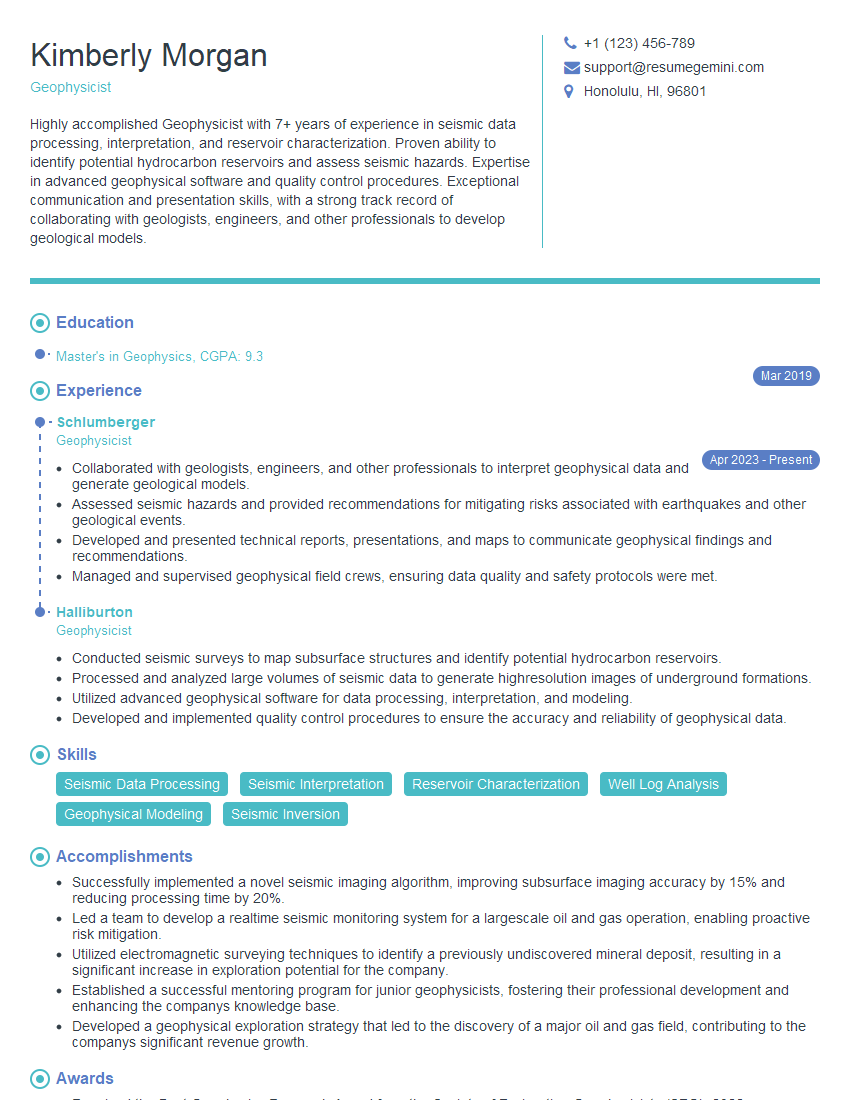
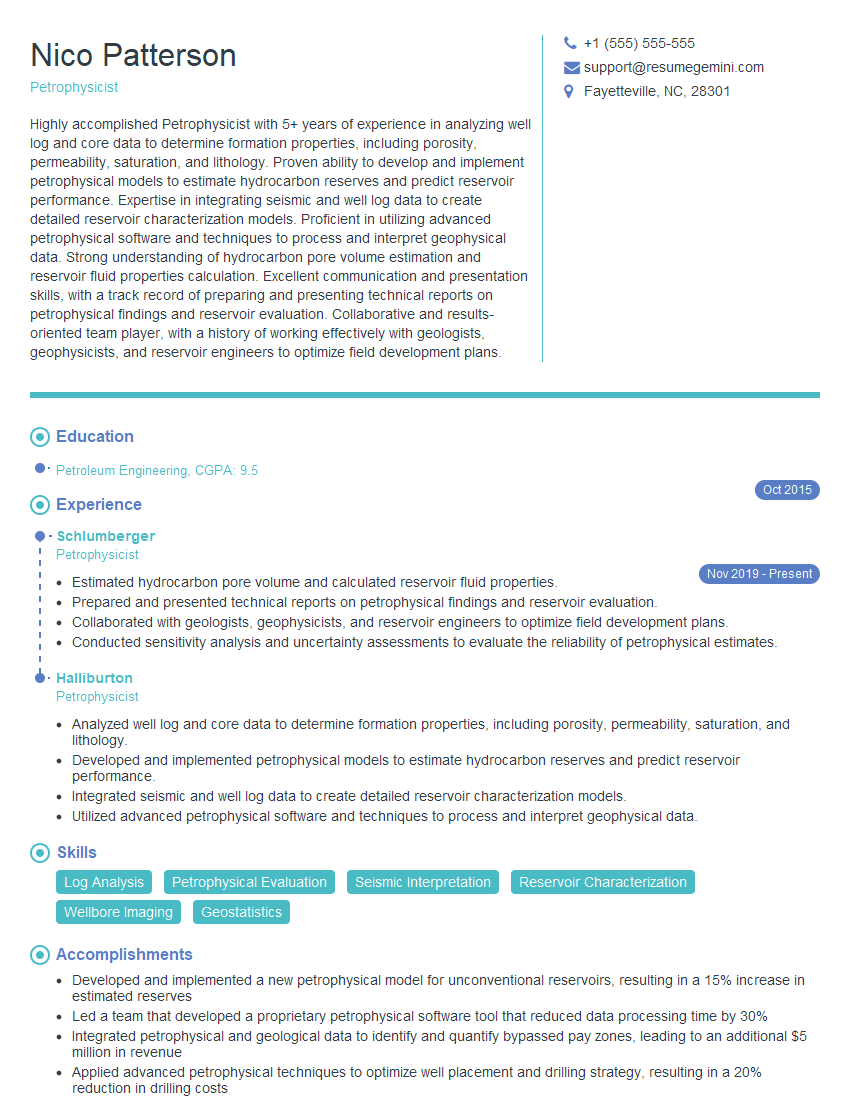
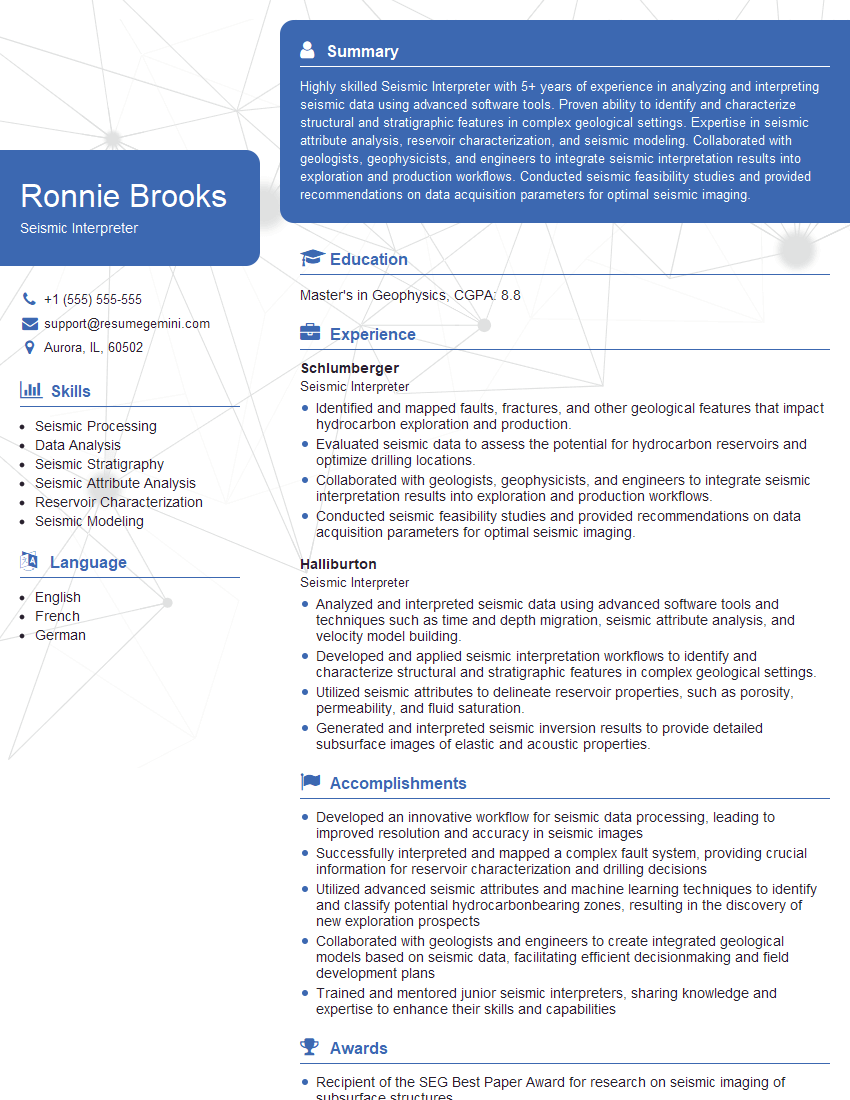
Mastering geophysical report writing is crucial for career advancement in the geosciences. Clear, concise, and well-structured reports are essential for conveying your expertise and influencing decision-making in exploration, production, and environmental projects. To significantly boost your job prospects, create an ATS-friendly resume that effectively showcases your skills and experience. ResumeGemini is a trusted resource to help you build a professional and impactful resume. We provide examples of resumes tailored specifically to Geophysical Report Writing to guide you in crafting your own. Take the next step towards your dream career today!
Explore more articles
Users Rating of Our Blogs
Share Your Experience
We value your feedback! Please rate our content and share your thoughts (optional).
What Readers Say About Our Blog
Very informative content, great job.
good