Feeling uncertain about what to expect in your upcoming interview? We’ve got you covered! This blog highlights the most important High Wire and Trapeze interview questions and provides actionable advice to help you stand out as the ideal candidate. Let’s pave the way for your success.
Questions Asked in High Wire and Trapeze Interview
Q 1. Describe your experience with different high wire techniques.
My high wire experience encompasses a range of techniques, from the fundamental balancing act to more advanced maneuvers. I’ve mastered walking, running, and even turning on the wire, all while maintaining precision and control. One technique I’ve particularly honed is the ‘balance shift,’ which involves subtly shifting my weight to counter unexpected movements or wind gusts. This requires incredibly precise body awareness and refined muscle control. Another crucial skill is the use of a balancing pole, not just for visual appeal, but as a vital tool for maintaining stability, especially during turns or more complex routines. I’ve also practiced various styles of wire walking, such as using different types of poles, walking blindfolded (under controlled and safe conditions), and incorporating acrobatics while maintaining balance. For example, I’ve successfully incorporated slow, controlled squats and handstands while on the wire.
Q 2. Explain the safety procedures you follow during a high wire performance.
Safety is paramount in high wire and trapeze work. My safety procedures begin with meticulous pre-performance checks of all rigging equipment, including the wire itself, the safety lines, and all supporting structures. I use a full body harness connected to multiple redundant safety lines, ensuring that if one fails, the others provide backup. Before each performance, I conduct a thorough inspection of the entire setup, and I always have a spotter present during practice and performance. We establish clear communication signals for any potential issues. Regular maintenance of the equipment and appropriate weather checks are also a non-negotiable part of my safety protocols. These practices aren’t merely checklists; they are deeply ingrained habits born from years of experience and a commitment to safety.
Q 3. How do you maintain balance and stability on a high wire?
Maintaining balance on a high wire is a combination of physical skill and mental focus. It’s about developing a deep sense of proprioception – your body’s awareness of its position in space. This is honed through years of dedicated practice. I use a combination of techniques: Firstly, there’s the proper stance, with feet shoulder-width apart and knees slightly bent to absorb any sudden movements. Secondly, the balancing pole isn’t just for show; it acts as an extension of my body, allowing for subtle adjustments to my center of gravity. Thirdly, and perhaps most importantly, it’s about controlled breathing and focused concentration, maintaining a calm mind even under pressure. Think of it like a tightrope walker’s meditation—total mental clarity is essential for maintaining physical stability. Finally, anticipating and reacting to wind gusts and other external factors is crucial to consistent balance.
Q 4. What are the key elements of a successful trapeze catch?
A successful trapeze catch is a delicate ballet of timing, trust, and precise execution. The key elements include perfect timing between the flyer and the catcher. The flyer must release at the precise moment, initiating a controlled trajectory. The catcher, meanwhile, must be positioned correctly, anticipating the flyer’s momentum and trajectory, ready to meet them in a secure and stable way. This anticipation includes accounting for factors like wind and the flyer’s body position. Trust is crucial; the flyer must trust the catcher’s skill and the catcher must trust the flyer’s execution. Lastly, the grip is critical: a firm yet gentle hold is needed to safely secure the flyer without causing injury. It’s a collaborative act requiring perfect synchronization.
Q 5. Describe your experience with various trapeze maneuvers.
My trapeze repertoire includes a variety of maneuvers, from basic catches and releases to more complex routines. I am proficient in single and double trapeze acts, incorporating elements like swings, twists, and various aerial positions. For instance, I can execute a ‘flyaway,’ which involves a spectacular launch from the trapeze followed by a series of aerial rotations before a catch. I’ve also mastered ‘planches’ and other static holds, demonstrating control and strength in the air. The ‘triple-twist dismount’ is another example of a maneuver requiring considerable strength, precision, and timing. Each maneuver requires specific techniques – strength training, rigorous conditioning, and unwavering focus on safety.
Q 6. How do you handle unexpected situations during a performance?
Handling unexpected situations during a performance relies heavily on years of training and instinctive reactions. For example, if I lose my balance on the high wire, my immediate response is to use my balancing pole and my years of honed instinct to regain control. In case of a missed trapeze catch, we have safety nets and backup systems in place, but it’s also about having pre-planned fallback positions and techniques. Effective communication with fellow performers is crucial; non-verbal cues can prevent accidents. My training emphasizes problem-solving and adaptability. A calm head and the ability to react instantly and creatively are key in overcoming unforeseen challenges while maintaining the appearance of seamless control.
Q 7. Explain your understanding of aerial rigging and safety.
Aerial rigging and safety are foundational to my work. I understand the principles of tension, load distribution, and materials science as they relate to rigging. Knowing the limitations of different ropes, cables, and hardware is crucial. I’m intimately familiar with safety regulations and best practices for rigging aerial apparatuses, such as proper knot tying, load testing, and regular equipment inspection. This includes understanding different types of knots and their strengths, weaknesses and correct applications. Moreover, I’m well-versed in working with different types of rigging hardware – carabiners, shackles, pulleys – and understanding their load ratings. Before every performance, the rigging is inspected by a qualified rigger and myself, and then tested to ensure safety. It’s a continuous process that involves diligent maintenance and pre-performance checks; it’s not just about understanding the mechanics but about developing a thorough understanding of what constitutes safe practice.
Q 8. What are the common safety hazards associated with high wire and trapeze?
High wire and trapeze artistry, while exhilarating, present inherent risks. The most common hazards include falls from significant heights, resulting in severe injuries or fatalities. Equipment failures, such as snapped wires or broken safety nets, pose a substantial threat. Collisions between performers during intricate maneuvers, particularly in trapeze acts involving multiple artists, are another major concern. Adverse weather conditions, such as strong winds or rain, can significantly increase the likelihood of accidents. Finally, human error, including miscalculations, lapses in concentration, or fatigue, contributes significantly to accidents. Even the slightest mistake at such heights can have devastating consequences.
- Falls: The most obvious danger, exacerbated by the height involved.
- Equipment Failure: Regular inspection and maintenance are critical to mitigate this risk.
- Collisions: Careful choreography and precise timing are essential, especially in group acts.
- Weather: Performing in unsuitable conditions should be strictly avoided.
- Human Error: Rigorous training, physical and mental preparedness are crucial.
Q 9. How do you assess and mitigate risks in aerial performances?
Risk assessment in aerial performances is a multi-stage process. It begins with a thorough examination of the venue, including the structural integrity of the rigging points, the condition of the safety nets, and the overall stability of the performance area. Next, a detailed analysis of the act itself is performed, considering the complexity of the maneuvers, the number of performers involved, and the potential for human error. We use a hierarchical risk assessment system, classifying risks from low to extremely high based on likelihood and severity. Mitigation strategies are then developed to reduce the identified risks to an acceptable level. This may include implementing additional safety measures, such as redundant safety lines, modifying the choreography to reduce risk, and providing additional training for the performers. Regular rehearsals and simulations of emergency situations help prepare the team for unforeseen events.
For example, in a high-wire act, we might use multiple safety lines and a redundant net system. In a trapeze act, we may simplify the catching sequence or use cushioned landing pads. Post-performance reviews are crucial to identify areas for improvement and further risk reduction.
Q 10. Describe your experience with various types of safety equipment.
My experience encompasses a wide range of safety equipment, including various types of safety harnesses, specifically designed for aerial work; these harnesses are rigorously tested to meet the highest safety standards. I’m proficient with different types of safety lines, from static ropes to dynamic ropes, each suited for specific purposes. I’m well-versed in the use of safety nets, ensuring their proper placement, securing, and maintenance. Additionally, I have extensive experience with rigging equipment, including shackles, carabiners, and pulleys, understanding their proper selection and usage is paramount. I am also familiar with fall arrest systems and have experience with specialized aerial performance-specific equipment such as safety wires and pulleys with redundant safety systems for high wire acts. We always prioritize equipment that has undergone rigorous testing and certification.
Q 11. How do you maintain your physical fitness for high wire and trapeze?
Maintaining peak physical fitness is non-negotiable for high wire and trapeze artists. My training regimen involves a combination of strength training, cardiovascular exercise, and flexibility exercises. Strength training focuses on building core strength, upper body strength, and grip strength – crucial for maintaining balance and executing aerial maneuvers. Cardiovascular fitness is essential for endurance during long performances and for quick recovery between movements. Regular yoga and Pilates ensure flexibility, range of motion and injury prevention. This holistic approach not only enhances my performance but also significantly reduces the risk of injuries. I also prioritize adequate rest and nutrition to support my training.
Q 12. What are the different types of high wire and trapeze acts?
High wire acts range from solo walks to complex group routines, incorporating daring feats of balance and acrobatics. Some common variations include: walking the wire blindfolded, riding a bicycle or unicycle, juggling or performing other acrobatic feats while walking, incorporating other apparatuses such as ladders or platforms. Trapeze acts are equally diverse, including single, double, and triple trapeze acts, flying trapeze (the most common), and static trapeze. Within these categories, we find acts varying in difficulty and complexity, involving catches, swings, and multiple aerial maneuvers. The artistry lies not just in the technical execution but in the creation of a visually stunning and emotionally engaging narrative.
Q 13. What is your experience with choreography and performance design?
Choreography and performance design are integral to creating a compelling aerial show. My experience includes designing acts from concept to execution, meticulously crafting every movement to ensure both artistic expression and safety. I collaborate closely with fellow artists to integrate individual talents into a cohesive whole, creating a visual narrative through the movements and interactions. The design process involves carefully considering the venue’s constraints, audience demographics, and the overall theme or message of the performance. We extensively storyboard each act, mapping out the sequence of maneuvers, transitions, and dynamic elements to create a seamless flow. Safety is always paramount, and choreography is specifically designed to minimize risk while maximizing the visual impact.
Q 14. How do you adapt your performance to different venues and audiences?
Adaptability is crucial in aerial performance. When adapting to different venues, the primary consideration is the structural integrity and safety of the performance space. The rigging points, the height limitations, and the overall layout of the venue significantly impact the choreography and act design. Audience adaptation involves recognizing the audience’s demographics and expectations, adjusting the performance style and pacing accordingly. A more family-oriented audience might appreciate a show focusing on skill and spectacle, while a more sophisticated audience might prefer a show with an artistic or narrative focus. This adaptability ensures audience engagement and creates a memorable experience regardless of the setting.
Q 15. Describe your problem-solving skills in a high-pressure environment.
In high-wire and trapeze, problem-solving under pressure is paramount. It’s not just about catching a fall; it’s about anticipating potential issues and reacting swiftly and precisely to unexpected events. For instance, during a high-wire walk, a sudden gust of wind could disrupt balance. My immediate response would involve adjusting my center of gravity, using my stabilizing pole effectively, and maintaining focus on my next foothold. I’ve trained extensively to handle such scenarios; this involves rigorous physical conditioning, mental visualization techniques, and constant refinement of my skills. Another example: if a trapeze catch is slightly off, I’ve trained to adjust my body position mid-air, distributing weight effectively to secure the catch and avoid injury. This ability to adapt and solve problems instantly under extreme pressure comes from years of dedicated practice and consistent self-assessment.
Career Expert Tips:
- Ace those interviews! Prepare effectively by reviewing the Top 50 Most Common Interview Questions on ResumeGemini.
- Navigate your job search with confidence! Explore a wide range of Career Tips on ResumeGemini. Learn about common challenges and recommendations to overcome them.
- Craft the perfect resume! Master the Art of Resume Writing with ResumeGemini’s guide. Showcase your unique qualifications and achievements effectively.
- Don’t miss out on holiday savings! Build your dream resume with ResumeGemini’s ATS optimized templates.
Q 16. Explain your experience with audience interaction and engagement.
Audience engagement is crucial in aerial arts. It’s not simply about executing a flawless routine; it’s about connecting with the audience on an emotional level. I achieve this through eye contact, facial expressions, and incorporating elements of storytelling into my performances. For example, in a trapeze act, a pause before a daring move, accompanied by a knowing glance at the audience, creates a sense of anticipation and excitement. I also incorporate audience interaction directly, such as acknowledging applause or responding to visible expressions of awe or concern. This interaction fosters a shared experience, making the performance more impactful and memorable for everyone involved. I regularly gauge audience reactions to adjust my performance slightly, ensuring the experience is engaging and exciting.
Q 17. How do you manage stage fright and maintain composure during a performance?
Stage fright is a natural response, but it can be managed. Years of experience have taught me to channel nervous energy into focused concentration. Before a performance, I employ a combination of techniques: deep breathing exercises to calm my nerves, physical warm-ups to enhance my body awareness, and mental rehearsal of the routine. Visualizing a successful performance helps to build confidence. On stage, I focus on the act itself, connecting with my fellow performers and the audience, shifting my focus away from self-doubt. The adrenaline rush becomes an asset, enhancing my reflexes and performance quality. I’ve learned that a small amount of controlled nervousness can actually be beneficial, sharpening my focus and reflexes. The key is to channel that nervous energy into focused action.
Q 18. Describe your experience working with a team in a collaborative performance setting.
Collaboration is fundamental in high-wire and trapeze. Successful performances rely heavily on trust, precise timing, and clear communication amongst team members. For instance, in a trapeze act involving multiple people, we undergo extensive rehearsal to perfect every movement and transition. This includes detailed discussions about the performance flow, identifying potential risks, and establishing clear verbal and non-verbal communication cues during the act. Open and honest communication about any anxieties or concerns among the team members is also very important. Trust is built through years of shared experience, consistent practice and mutual respect. A successful performance is a testament to our collaborative effort, showcasing the synergy of our individual strengths.
Q 19. What is your understanding of the history of high wire and trapeze arts?
The history of high-wire and trapeze is rich and fascinating! High-wire walking has ancient roots, with evidence suggesting its practice in ancient China and India. The trapeze, as we know it today, emerged in the 19th-century circus. Early performers were often self-taught, developing techniques through trial and error. The evolution of the arts involved progressive refinement of techniques, the development of safety equipment, and the integration of artistic expression. The modern era sees a focus on choreography and storytelling, pushing the boundaries of artistic possibilities while maintaining the highest safety standards. Understanding this history provides context to the evolution of both arts and appreciation for the lineage of skilled practitioners.
Q 20. How do you stay updated on new techniques and safety protocols in aerial arts?
Staying updated on new techniques and safety protocols is crucial. I actively participate in workshops and masterclasses led by renowned aerial artists and safety professionals. I also closely follow industry publications, online forums, and attend relevant conferences to remain informed about advancements in equipment, training methods, and best practices. Regularly reviewing safety guidelines and emergency procedures is a must, ensuring that my skills and knowledge are always current and align with the latest safety standards. Professional development is an ongoing process; continually learning new techniques and safety measures is an integral part of ensuring both successful and safe performances.
Q 21. Explain your understanding of the physical demands of high wire and trapeze.
High-wire and trapeze demand exceptional physical strength, flexibility, balance, and coordination. High-wire walking requires immense core strength and leg power for maintaining balance and stability. Trapeze requires upper body strength, precise timing, and exceptional control over body movements. Both disciplines put significant stress on joints and muscles, requiring rigorous physical training, including strength conditioning, flexibility exercises, and cardiovascular fitness. Mental discipline and focus are also crucial, as both are demanding activities that require sustained concentration and precision. Regular physical therapy and injury prevention measures are key aspects of maintaining optimal health and avoiding injuries.
Q 22. Describe your experience with different types of trapeze apparatus.
My experience encompasses a wide range of trapeze apparatus, from the classic single trapeze to the more complex flying trapeze and triple trapeze. Each apparatus presents unique challenges and opportunities. The single trapeze, for instance, focuses on individual strength, control, and precision. The flying trapeze, on the other hand, emphasizes teamwork, timing, and trust, as it involves catching and swinging between two performers. The triple trapeze adds another layer of complexity, requiring even greater coordination and precision. I’ve also worked with variations like the Russian swing, which utilizes a longer swing and a different catching technique. Each apparatus demands specific skills and techniques, and I’ve dedicated significant time to mastering each one.
- Single Trapeze: Focuses on individual strength, balance, and acrobatic skills.
- Flying Trapeze: Requires teamwork, timing, and precise catching techniques.
- Triple Trapeze: Demands exceptional coordination and spatial awareness.
- Russian Swing: Utilizes a longer swing, resulting in a more dynamic and challenging performance.
Q 23. What are the specific challenges in performing high wire and trapeze acts?
High wire and trapeze acts present a unique set of challenges. On the high wire, maintaining balance at significant heights requires incredible strength, focus, and control. The slightest shift in weight or a gust of wind can have devastating consequences. The constant pressure of the height itself can be mentally taxing. Similarly, trapeze work demands immense upper body strength, precision, and perfect timing. The risk of injury is ever-present, requiring flawless execution of each move. Moreover, both disciplines necessitate intense physical training and mental discipline to manage fear and maintain focus under pressure. A single lapse in concentration can lead to a serious accident.
- High Wire: Balancing at height, managing wind, and maintaining mental focus.
- Trapeze: Upper body strength, precision, timing, and coordination with fellow performers.
Q 24. How do you ensure the safety of yourself and your fellow performers?
Safety is paramount. Before each performance, we conduct thorough equipment checks, ensuring all ropes, wires, and safety nets are in perfect working order. We use specialized safety harnesses and backup systems, which are regularly inspected and maintained by qualified professionals. In trapeze, we emphasize clear communication and precise signals between performers to ensure seamless transitions and catches. For high wire, we use a safety line and regularly check the integrity of the wire itself. Rigorous rehearsal allows us to hone our skills and identify potential hazards, reinforcing safe practices. We also maintain strict adherence to safety protocols set by our organization. One crucial aspect is trusting my partners. Years of experience building rapport and performing together create a level of implicit trust and understanding that significantly enhances safety.
Q 25. How do you maintain the integrity of your equipment?
Equipment maintenance is crucial for safety and performance quality. All equipment undergoes regular inspections by qualified technicians. We visually inspect ropes and wires for fraying or damage before each use. We also adhere to strict cleaning and storage protocols to prevent wear and tear. Ropes are lubricated and treated to maintain flexibility and strength. High wire cables are meticulously inspected for any signs of corrosion or weakening. We keep detailed maintenance logs and replace equipment according to manufacturer recommendations and our own experience-based best practices. It’s not just about functionality, but also longevity and safety. We treat our equipment like an extension of ourselves; maintaining its integrity directly relates to our safety and the success of our act.
Q 26. Describe your experience with pre-show checks and rehearsals.
Pre-show checks and rehearsals are integral to our performance. The pre-show check involves a meticulous inspection of all equipment and a review of the performance plan with my fellow performers. We go through our routine, paying close attention to critical points like handoffs, catches, and transitions. Rehearsals are far more than just running through the movements; it’s about building teamwork, fine-tuning coordination, and reinforcing safety protocols. Rehearsals allow us to identify and address any potential problems before a live audience, enhancing both the quality and safety of our performance. We conduct rehearsals in a controlled environment, mimicking the actual performance space and conditions as closely as possible.
Q 27. How do you handle criticism or setbacks?
Criticism, whether from a coach or self-assessment, is crucial for improvement. I analyze constructive criticism, identifying areas for enhancement in my technique, strength, or coordination. Setbacks are inevitable in this high-risk profession. Instead of letting them discourage me, I use them as learning opportunities, dissecting what went wrong, identifying the root cause, and developing strategies to prevent similar issues in the future. A valuable lesson I’ve learned is that setbacks don’t define success; they refine it. I view setbacks as a challenge to improve my resilience, and a reminder that the pursuit of perfection requires consistent effort and adaptability.
Q 28. What are your career goals in high wire and trapeze performance?
My career goals extend beyond mere technical proficiency. I aim to continue pushing the boundaries of high wire and trapeze performance, developing innovative routines that inspire and captivate audiences. I’m keen to mentor aspiring performers, sharing my expertise and ensuring safety standards remain paramount within the profession. I also aspire to contribute to the growth and evolution of aerial arts through choreography, coaching and possibly even establishing my own performance troupe. The ultimate goal is not just to perform but to make a lasting impact on the world of aerial arts, leaving a legacy of skill, innovation and safety.
Key Topics to Learn for High Wire and Trapeze Interview
Landing your dream role in High Wire and Trapeze requires a blend of technical expertise and strategic thinking. This section outlines key areas to focus your preparation.
- High Wire: Data Analysis & Interpretation: Understanding statistical methods, data visualization techniques, and drawing actionable insights from complex datasets. Consider exploring different statistical modeling approaches and their applications.
- High Wire: Problem-Solving & Critical Thinking: Practicing structured problem-solving methodologies. Develop your ability to break down complex challenges into manageable steps and articulate your thought process clearly.
- High Wire: Communication & Presentation Skills: Mastering the art of effectively communicating technical information to both technical and non-technical audiences. Practice presenting your findings concisely and persuasively.
- Trapeze: Project Management & Execution: Understanding Agile methodologies, project planning, risk management, and effective team collaboration. Consider case studies on successful project delivery.
- Trapeze: Technical Proficiency: Depending on the specific role, this might encompass programming languages, databases, cloud technologies, or specific software applications. Focus on the technologies relevant to the job description.
- Trapeze: Adaptability & Resourcefulness: Demonstrate your ability to navigate ambiguity, learn quickly, and leverage available resources effectively to overcome challenges.
- Common to Both: Behavioral Questions: Prepare examples demonstrating your teamwork, leadership, problem-solving, and resilience in past experiences. The STAR method (Situation, Task, Action, Result) is a valuable framework.
Next Steps
Mastering the skills and concepts related to High Wire and Trapeze significantly enhances your career prospects in the competitive job market. A strong foundation in these areas positions you for success and rapid growth within the organization.
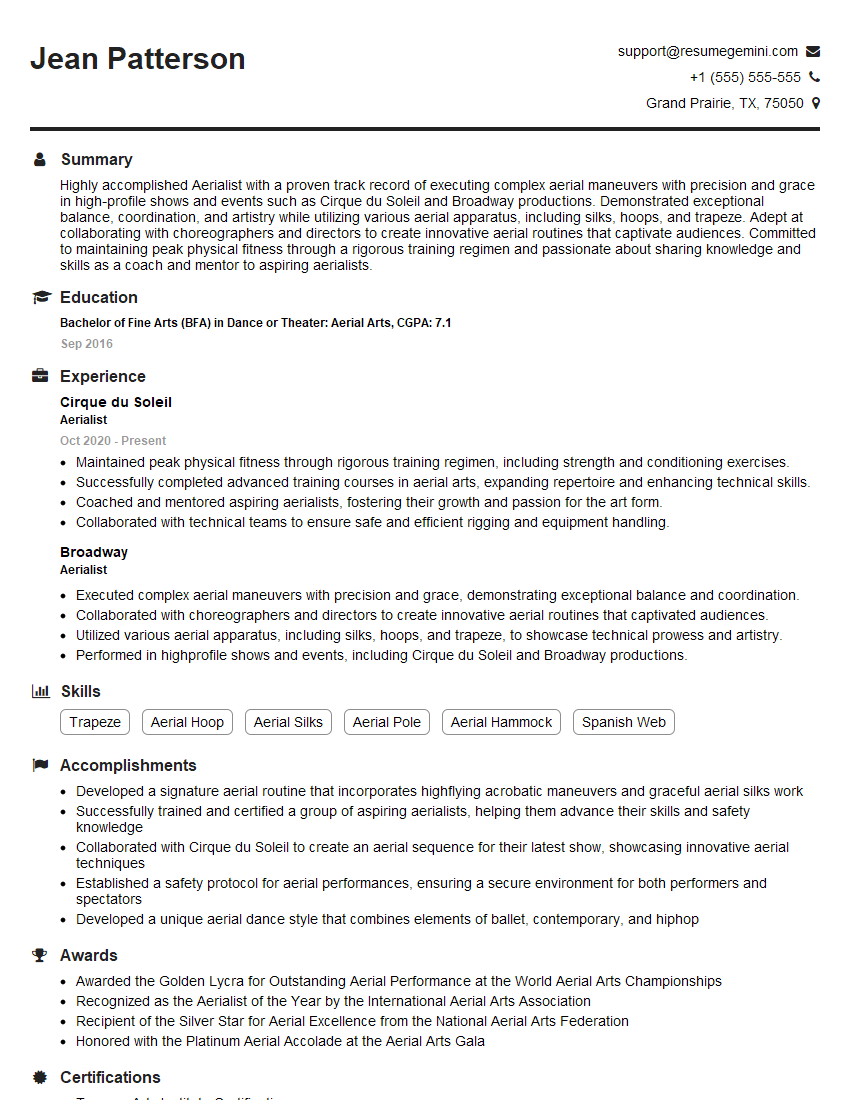
Creating an ATS-friendly resume is crucial for getting your application noticed. An optimized resume ensures your skills and experience are effectively highlighted to Applicant Tracking Systems, significantly increasing your chances of landing an interview. We strongly recommend using ResumeGemini to build a professional and impactful resume that showcases your strengths perfectly.
ResumeGemini provides valuable tools and resources, and we offer examples of resumes tailored specifically to High Wire and Trapeze roles to help guide you. Use these resources to craft a compelling narrative that highlights your qualifications and aspirations.
Explore more articles
Users Rating of Our Blogs
Share Your Experience
We value your feedback! Please rate our content and share your thoughts (optional).
What Readers Say About Our Blog
Very informative content, great job.
good