Preparation is the key to success in any interview. In this post, we’ll explore crucial HVAC and Plumbing Drawings interview questions and equip you with strategies to craft impactful answers. Whether you’re a beginner or a pro, these tips will elevate your preparation.
Questions Asked in HVAC and Plumbing Drawings Interview
Q 1. Explain your experience with different CAD software used in HVAC and plumbing design.
Throughout my career, I’ve become proficient in several CAD software packages crucial for HVAC and plumbing design. My experience spans from the widely used AutoCAD, where I’ve mastered the creation of 2D drawings, including detailed plans, sections, and elevations, to more advanced 3D modeling software. I’m adept at using AutoCAD MEP for its specialized tools in designing complex MEP systems, ensuring accuracy and coordination. I’ve also worked extensively with ArchiCAD, focusing on the BIM (Building Information Modeling) aspects of the design process, allowing for seamless integration with architectural models. My experience also includes using specialized plumbing design software like Pipe-Flow Expert, helping optimize pipe sizing and hydraulic calculations, and various duct design software packages that leverage algorithms for optimizing airflow and pressure drop. Each software brings unique strengths; for instance, AutoCAD excels in precise 2D drafting while Revit emphasizes the collaborative aspects of BIM. I strategically choose the software best suited to the project’s requirements and my clients’ preferences.
For example, on a recent large-scale hospital project, we used Revit for its BIM capabilities, allowing multiple disciplines to work concurrently and avoid clashes. On smaller residential projects, the efficiency of AutoCAD was sufficient and cost-effective.
Q 2. How familiar are you with Revit and its application in HVAC/Plumbing projects?
I’m highly familiar with Revit and its extensive applications in HVAC and plumbing projects. It’s become an industry standard for its BIM capabilities. I’ve leveraged Revit to create comprehensive 3D models of HVAC and plumbing systems, incorporating elements like pipes, ducts, fittings, and equipment. My expertise extends to using Revit’s features for clash detection, ensuring that the various building systems are properly coordinated to avoid costly construction errors. I’m comfortable utilizing Revit’s scheduling and quantification tools to generate accurate material take-offs, vital for budgeting and procurement. Beyond modeling, I can create detailed construction drawings, schedules, and specifications directly from the Revit model, streamlining the entire design and construction process.
For instance, on a recent commercial building project, using Revit’s clash detection feature helped us identify and resolve a conflict between the ductwork and a structural beam early in the design phase. This prevented significant rework during construction and saved considerable time and money.
Q 3. Describe your process for creating accurate and detailed HVAC and plumbing drawings.
Creating accurate and detailed HVAC and plumbing drawings is a meticulous process. It begins with a thorough understanding of the project requirements, including the building’s architectural plans, client needs, and applicable codes. I then develop a detailed design incorporating appropriate equipment selection, pipe and duct sizing, and layout optimization. This includes creating detailed floor plans, sections, elevations, and isometric drawings. I use precise measurements and consistent conventions for symbols and annotations. My process involves iterative review and refinement, utilizing design calculations and simulations (where appropriate) to ensure the system operates efficiently and effectively. For example, for ductwork, I perform airflow calculations to ensure adequate air volume delivery to each space. Similarly, for plumbing, I use hydraulic calculations to ensure proper water pressure and flow rates. Finally, meticulous quality control checks are performed before finalizing the drawings, including peer reviews, to ensure accuracy and completeness.
A recent project involved a complex multi-story building with varying HVAC requirements for each zone. The iterative design process allowed me to refine the ductwork layout, leading to an optimized system that minimized pressure drops and energy consumption.
Q 4. How do you ensure your drawings comply with relevant building codes and standards?
Compliance with building codes and standards is paramount. I ensure this by referring to the relevant codes (e.g., the International Plumbing Code (IPC), International Mechanical Code (IMC), and local building codes) throughout the entire design process. I meticulously check that the system designs meet all requirements for safety, accessibility, energy efficiency, and sustainability. This involves proper sizing of pipes and ducts, appropriate material selection, and adherence to installation standards. I stay updated on code changes and utilize resources like code manuals and online databases to remain current. Furthermore, I incorporate provisions for inspections and testing in the drawings, highlighting critical aspects for easy verification by authorities.
On a recent project, we needed to ensure the plumbing system was compliant with the local code regarding backflow prevention. By understanding and incorporating the necessary devices and design principles, we successfully passed the inspection.
Q 5. Explain your understanding of piping and ductwork design principles.
Understanding piping and ductwork design principles is fundamental to my work. This includes knowledge of fluid dynamics, heat transfer, and pressure drop calculations. For piping, I consider factors like pipe size, material, flow rate, pressure loss, and fitting selection to ensure efficient fluid transport. My design considerations include proper slope for drainage, appropriate valve placement, and adherence to pressure drop criteria to avoid excessive energy consumption. Similarly, ductwork design involves understanding airflow, pressure drop, velocity, and the selection of appropriate duct sizes and materials to ensure proper air distribution. I use specialized software and calculations to optimize duct layouts and minimize energy loss.
For instance, designing a high-rise building’s plumbing system required meticulous calculations to ensure adequate water pressure on upper floors, considering friction losses and elevation changes.
Q 6. How do you handle revisions and updates to HVAC and plumbing drawings?
Handling revisions and updates efficiently is crucial. I use a version control system within my CAD software to track changes and maintain a clear history of revisions. All changes are documented clearly, explaining the reasons for modifications and ensuring that all stakeholders are informed. This often involves generating revised drawings, updating specifications, and notifying relevant parties of the alterations. Clear communication is essential throughout this process to ensure everyone works with the most up-to-date information and to minimize confusion and potential errors. For large projects, I may use cloud-based collaboration tools to facilitate real-time updates and ensure everyone is on the same page.
On a recent project, a client requested a change in the location of a major HVAC unit. Using version control, we seamlessly implemented the change, documented it, and quickly distributed the updated drawings to the entire team.
Q 7. Describe your experience with creating construction documents for HVAC and plumbing systems.
Creating comprehensive construction documents is a key part of my role. This involves producing detailed drawings that provide sufficient information for contractors to accurately install the HVAC and plumbing systems. These documents include plans, sections, elevations, details, specifications, and schedules that fully describe the systems, including equipment specifications, material lists, and installation instructions. I ensure the documents are clear, concise, and easily understood by the construction team. The goal is to minimize ambiguity and prevent costly errors during construction. Furthermore, I create documents that comply with all relevant standards and codes.
I recently prepared construction documents for a large-scale commercial kitchen project that included detailed plumbing plans for the sinks, grease traps, and other equipment. The clear and concise drawings ensured a smooth installation process.
Q 8. How do you collaborate with other disciplines (electrical, structural, etc.) during the design process?
Collaboration with other disciplines is paramount in successful building design. It’s not just about fitting pipes and ducts into a space; it’s about integrating HVAC and plumbing seamlessly into the overall structure and functionality. I approach this through proactive communication and coordination.
- Regular Meetings: I actively participate in integrated design meetings with architects, structural, and electrical engineers. This allows for early identification and resolution of potential clashes.
- Model Coordination: We leverage Building Information Modeling (BIM) software. This allows us to visualize and coordinate all building systems in a 3D environment, identifying conflicts early on, before construction begins. For instance, we can easily spot where a ductwork run might interfere with a structural column or electrical conduit.
- Clear Communication: I ensure that my drawings clearly communicate all relevant information, including dimensions, specifications, and clearances, to other disciplines. This minimizes ambiguity and promotes efficient collaboration.
- Markups and Revisions: We use a streamlined process for reviewing and incorporating feedback from other disciplines. I track all changes meticulously and ensure everyone is working from the most up-to-date drawings.
For example, on a recent project, a proposed structural beam conflicted with a large diameter HVAC duct. By collaborating early, we redesigned the ductwork to avoid the beam, saving both time and money during construction.
Q 9. Explain your knowledge of different types of HVAC and plumbing equipment and their representation in drawings.
My knowledge of HVAC and plumbing equipment encompasses a wide range, from basic components to complex systems. Representing these elements accurately on drawings is crucial for successful construction.
- HVAC Equipment: I’m proficient in detailing various types of air handling units (AHUs), chillers, boilers, cooling towers, fan coil units (FCUs), and variable refrigerant flow (VRF) systems. These are represented using standardized symbols and annotations on drawings, including specifications for capacity, airflow, and electrical requirements.
- Plumbing Equipment: My experience includes detailed representation of pumps, water heaters, toilets, sinks, fixtures, piping systems (including both drainage and supply), and fire sprinkler systems. Plumbing drawings utilize different symbols and notations to represent the size, material, and flow direction of pipes.
- Drawing Representation: Drawings utilize a combination of schematic diagrams (showing the flow of fluids or air) and isometric views (showing the three-dimensional arrangement of equipment). Detailed specifications are typically included in separate schedules and data sheets.
For instance, an AHU would be represented by a symbol indicating its location, size, and air flow capacity, with associated ductwork shown in plan view and possibly detailed in separate sections.
Q 10. How do you ensure the accuracy and completeness of your drawings before submission?
Accuracy and completeness are non-negotiable. My process for ensuring this involves multiple checks and balances.
- Internal Review: Before submission, I conduct a thorough self-review of my drawings, checking for dimensional accuracy, consistency in notation, and adherence to standards. I use checklists to ensure I haven’t missed any key details.
- Peer Review: Another team member independently reviews my work, providing a fresh perspective and catching potential errors I might have overlooked. This helps ensure a higher level of quality control.
- Software Checks: I utilize the built-in checking features of CAD software to identify potential clashes or inconsistencies. This helps detect errors related to dimensions, labeling, and layering.
- Client Review: Before final submission, I provide the drawings to the client for review and feedback. This ensures that the design meets their needs and expectations.
This multi-layered review process significantly reduces the likelihood of errors and omissions, minimizing costly rework during construction.
Q 11. What is your experience with creating shop drawings and submittals?
Creating shop drawings and submittals is a significant part of my role. These documents provide contractors with detailed information needed for fabrication and installation.
- Shop Drawings: These illustrate the specific dimensions, materials, and fabrication details of components for the contractor. I’m proficient in creating shop drawings for HVAC ductwork, piping systems, and other equipment, ensuring that they meet all relevant codes and standards.
- Submittals: Submittals include detailed specifications, manufacturer’s data sheets, and other supporting documents required for approval by the authorities having jurisdiction (AHJ). I prepare submittals that are complete, accurate, and easy to understand, facilitating a smooth review and approval process.
- Coordination: I closely coordinate with fabricators and contractors to ensure that the shop drawings accurately reflect the design intent and address any necessary revisions.
I’ve successfully managed numerous submittal packages, ensuring timely approvals and avoiding delays in the construction schedule. A recent example involved a complex sprinkler system; meticulous shop drawings and submittals ensured a smooth installation without conflicts.
Q 12. Describe your experience with coordinating HVAC and plumbing systems with architectural and structural elements.
Coordinating HVAC and plumbing systems with architectural and structural elements is crucial for a functional and aesthetically pleasing building. This requires meticulous planning and coordination throughout the design process.
- Space Allocation: I work closely with architects to determine the optimal location for HVAC and plumbing equipment, ensuring that they fit within the available space without compromising aesthetics or structural integrity.
- Structural Considerations: I coordinate with structural engineers to ensure that ductwork, piping, and equipment are properly supported and do not create excessive loads on the building’s structure.
- Architectural Integration: I consider architectural features when designing HVAC and plumbing systems, ensuring that the systems are integrated seamlessly into the building’s design.
- MEP Coordination: I ensure that HVAC and plumbing systems don’t conflict with electrical and other building systems through model coordination and careful planning.
For example, on a recent high-rise project, we carefully planned the location of mechanical rooms and equipment to minimize noise and vibration transmission to occupied spaces. Careful coordination of pipe runs within the structural core of the building was critical to the success of the project.
Q 13. How do you manage conflicts and discrepancies in HVAC and plumbing drawings?
Conflicts and discrepancies in drawings are inevitable in complex projects. Addressing them effectively requires a methodical approach.
- Identification: I utilize BIM software to identify conflicts early in the design process through clash detection analysis. This highlights conflicts between different systems, such as ductwork intersecting with structural beams.
- Analysis: Once a conflict is identified, I analyze its cause and determine the best solution. This might involve adjusting the routing of pipes or ducts, modifying the size of equipment, or making changes to the structural design.
- Communication: I communicate with relevant parties to discuss the conflict and agree on a resolution. This ensures that all parties are aware of the changes and that the solution is acceptable to everyone.
- Documentation: I carefully document all changes made to the drawings, ensuring that the revised drawings reflect the agreed-upon solutions.
A recent project involved a conflict between a large duct and a fire sprinkler pipe. By working closely with the sprinkler contractor and adjusting the duct routing, we resolved the conflict without impacting the functionality of either system.
Q 14. Explain your understanding of energy-efficient design principles for HVAC and plumbing systems.
Energy-efficient design is a core principle in modern HVAC and plumbing design. I incorporate various strategies to minimize energy consumption and reduce environmental impact.
- High-Efficiency Equipment: I specify high-efficiency HVAC equipment, such as variable-speed pumps, energy-recovery ventilators, and high-efficiency boilers and chillers. This reduces energy consumption while maintaining comfort.
- Optimized System Design: I optimize the design of HVAC and plumbing systems to minimize energy losses through proper insulation, optimized pipe sizing, and effective airflow management.
- Renewable Energy Integration: Where feasible, I incorporate renewable energy sources such as solar thermal systems for water heating or geothermal energy for heating and cooling.
- Building Envelope Considerations: I work closely with architects to design a building envelope that minimizes heat gain and loss, reducing the load on HVAC systems.
- Smart Building Technologies: I consider incorporating smart building technologies like building automation systems (BAS) to optimize building performance and reduce energy consumption.
For example, on a recent project, we utilized a geothermal heat pump system to significantly reduce the building’s energy consumption for heating and cooling. This resulted in substantial cost savings and a smaller environmental footprint.
Q 15. How do you utilize BIM software for coordination and clash detection in HVAC and plumbing designs?
BIM (Building Information Modeling) software is invaluable for coordinating HVAC and plumbing designs and detecting clashes. Imagine trying to build a house without knowing where all the pipes and ducts will go – you’d end up with a lot of unexpected problems! BIM software allows us to create a 3D model of the entire building, including all the MEP (Mechanical, Electrical, and Plumbing) systems. This allows for proactive clash detection, identifying conflicts between different trades *before* construction begins.
My process involves importing all relevant models – architectural, structural, and MEP – into the BIM software (e.g., Revit, ArchiCAD). Then, I use the software’s built-in clash detection tools to identify conflicts. These clashes could be anything from a duct running through a beam to a pipe intersecting a wall. Once identified, I can then coordinate with other disciplines to resolve these conflicts, often by adjusting the placement of components or rerouting systems.
For instance, in a recent project, BIM software identified a clash between a large HVAC duct and a structural steel column. By reviewing the model in 3D, we quickly realized that slightly altering the duct’s route would solve the problem efficiently and prevent costly rework during construction. This saved significant time and money, preventing delays and rework.
Career Expert Tips:
- Ace those interviews! Prepare effectively by reviewing the Top 50 Most Common Interview Questions on ResumeGemini.
- Navigate your job search with confidence! Explore a wide range of Career Tips on ResumeGemini. Learn about common challenges and recommendations to overcome them.
- Craft the perfect resume! Master the Art of Resume Writing with ResumeGemini’s guide. Showcase your unique qualifications and achievements effectively.
- Don’t miss out on holiday savings! Build your dream resume with ResumeGemini’s ATS optimized templates.
Q 16. Describe your process for creating detailed specifications for HVAC and plumbing components.
Creating detailed specifications for HVAC and plumbing components is crucial for ensuring the project’s success. It’s like providing a detailed recipe to the contractor – it ensures everyone is on the same page and uses the right ingredients (components).
My process starts with understanding the project requirements. This involves reviewing the design documents, understanding the client’s needs, and adhering to relevant building codes and standards. I then create specifications that include:
- Component Details: Manufacturer, model number, capacity, dimensions, material, finishes.
- Performance Requirements: Efficiency ratings (e.g., SEER for air conditioners), pressure drops, flow rates.
- Installation Requirements: Mounting methods, connections, insulation requirements.
- Testing and Commissioning Requirements: Procedures for verifying proper installation and functionality.
For example, when specifying a pump, I wouldn’t just say “a pump.” The specifications would detail the required flow rate, head pressure, motor horsepower, material of construction (e.g., stainless steel for corrosion resistance), and the specific manufacturer and model number. This level of detail eliminates ambiguity and ensures that the correct equipment is procured and installed.
Q 17. How do you incorporate sustainable practices into your HVAC and plumbing designs?
Sustainability is paramount in modern HVAC and plumbing design. It’s about designing systems that minimize environmental impact and reduce operating costs throughout the building’s lifecycle.
I incorporate sustainable practices by:
- Selecting Energy-Efficient Equipment: Specifying high-efficiency HVAC units (heat pumps, boilers, chillers), low-flow plumbing fixtures, and energy-recovery ventilators.
- Optimizing System Design: Designing systems that minimize energy consumption, for instance, using variable-speed drives on pumps and fans to adjust output based on demand.
- Using Sustainable Materials: Choosing recycled or reclaimed materials where appropriate and specifying materials with low embodied carbon.
- Incorporating Renewable Energy Sources: Exploring the feasibility of incorporating solar thermal systems for water heating or geothermal heat pumps for heating and cooling.
- Water Conservation Strategies: Designing systems to minimize water usage, such as using low-flow toilets, showerheads, and faucets.
For example, in a recent project, we incorporated a greywater recycling system to reuse water from showers and sinks for toilet flushing and irrigation, reducing the building’s reliance on potable water.
Q 18. What is your experience with using different drawing standards and conventions?
I have extensive experience with various drawing standards and conventions, including but not limited to ASHRAE, ASME, and AIA standards. Understanding these standards is crucial for clear communication and avoiding misunderstandings. Each standard has its own unique set of symbols, abbreviations, and presentation methods.
My experience includes adapting to different project requirements. For example, a project using ASHRAE standards would have specific requirements for piping and ductwork diagrams, whereas a project following AIA standards might emphasize architectural integration within the drawings. I am proficient in interpreting and applying these standards correctly to create accurate and compliant drawings.
Adaptability is key; I ensure consistent use of symbols, line weights, and annotation methods throughout the drawing set, regardless of the project’s specific standards, resulting in clear and easy-to-understand documents.
Q 19. Explain your understanding of the importance of clear and concise drawing annotations.
Clear and concise drawing annotations are essential; they’re the roadmap for the construction team. Think of them as the narrative guiding the visual elements of the drawings. Without clear annotations, the drawings are just pictures; they lack the information needed for proper installation and operation.
My approach focuses on using consistent terminology, precise measurements, and clear labeling of components. I avoid ambiguity by using specific descriptions and referencing relevant sections of specifications. In short, I make sure that each annotation is meaningful and directly supports the drawing’s purpose.
For instance, instead of simply labeling a pipe “Pipe 1,” I’d use a detailed annotation such as “2” Schedule 40 Steel Pipe, 3″ Dia., Supply Hot Water to Fixture Group A.” This level of detail ensures there’s no doubt about the component’s purpose, material, size, and location.
Q 20. How do you ensure the readability and clarity of your HVAC and plumbing drawings?
Ensuring the readability and clarity of HVAC and plumbing drawings is paramount for effective communication and efficient construction. It’s all about making the information easily digestible for everyone involved.
My strategies include:
- Organization: Using a logical sheet numbering system, consistent scaling, and clear title blocks.
- Layout: Proper arrangement of components and annotations to avoid clutter and improve visual flow.
- Visual Cues: Using different line types and colors to differentiate various systems (e.g., hot water, cold water, air).
- Legends and Schedules: Providing clear legends defining symbols and schedules listing equipment details.
- Revision Control: Implementing a system to track and manage drawing revisions and prevent confusion.
For example, I use consistent line weights to distinguish between main lines and branch lines, making it easier to follow the flow of the system. I also use clearly labeled sections to break down complex systems into manageable parts.
Q 21. Describe your experience with creating and reviewing isometric drawings.
Isometric drawings provide a three-dimensional view of systems, offering a valuable perspective for understanding complex layouts and spatial relationships. They are particularly useful for illustrating piping and ductwork runs.
My experience involves creating isometric drawings using both manual drafting techniques and specialized software (e.g., AutoCAD, Revit). I understand the importance of accuracy in representing angles, dimensions, and component orientations. I also ensure that the drawings are consistently scaled and appropriately annotated. I frequently use isometric drawings to demonstrate complex installations to clients and contractors.
Reviewing isometric drawings involves carefully checking for accuracy in the representation of spatial relationships, adherence to standards, clarity of annotations, and coordination with other disciplines. For example, during the review process, I identify potential conflicts and areas requiring further clarification or adjustment. This reduces potential problems during installation and commissioning.
Q 22. How do you handle changes in design requirements during the project lifecycle?
Handling design changes is crucial in HVAC and plumbing projects. My approach involves a structured process to minimize disruptions and ensure project success. First, I meticulously review the change request, noting its impact on the existing design, budget, and schedule. I then coordinate with the relevant stakeholders – architects, engineers, contractors, and clients – to understand the rationale behind the change and assess its feasibility.
Next, I create updated drawings reflecting the changes, clearly marking revisions and providing detailed notes. This ensures everyone is on the same page. For example, if a client decides to switch from a radiant floor heating system to forced-air, I would redraw the entire HVAC system layout, specify the new equipment, and recalculate the energy loads. I would also prepare a revised budget and schedule, outlining the potential cost and time implications. Finally, I document all changes, maintaining a comprehensive record for future reference. This helps in avoiding future inconsistencies and disputes.
This systematic approach maintains transparency and minimizes misunderstandings, ensuring the final product aligns with the client’s needs while maintaining project integrity.
Q 23. What is your experience with working with different scales and drawing formats?
Experience with various scales and drawing formats is essential. I’m proficient in using different scales, such as 1/4″ = 1′, 1/8″ = 1′, and 1/2″ = 1′, depending on the project’s scope and complexity. I understand the importance of maintaining consistent scale throughout a set of drawings to prevent confusion and errors. I’m also familiar with multiple drawing formats including AutoCAD (DWG, DXF), Revit (RVT), and PDF.
For instance, larger projects may require detailed plans at 1/4″ = 1′ for individual rooms, while overview drawings might use 1/8″ = 1′ or even smaller scales to show the entire building. Conversely, smaller projects or detailed sections might necessitate a larger scale like 1/2″ = 1′ for clarity. My experience extends to converting between formats as needed for compatibility with different software and clients.
Q 24. Explain your knowledge of material selection for HVAC and plumbing systems.
Material selection is critical for ensuring the longevity, efficiency, and safety of HVAC and plumbing systems. My understanding encompasses a range of materials and their properties, considering factors like durability, corrosion resistance, thermal conductivity, and cost-effectiveness. For example, choosing copper piping for plumbing offers excellent durability and resistance to corrosion, but stainless steel or PEX might be preferred in specific circumstances, such as areas prone to freezing or where cost is a significant concern.
Similarly, in HVAC, I consider factors like the refrigerant type, the material of ductwork (galvanized steel, fiberglass, or flexible duct), and the type of insulation. Each choice has implications for energy efficiency, noise levels, and maintenance. I always ensure that material selection complies with relevant building codes and standards, prioritizing sustainability and energy efficiency whenever possible. I factor in the specific climate conditions and the expected lifespan of the system.
Q 25. How do you perform quantity takeoffs from HVAC and plumbing drawings?
Performing quantity takeoffs is a critical step in estimating project costs and material requirements. My process begins with a thorough review of the drawings to identify all necessary components. This involves carefully examining plans, sections, details, and specifications. I then use a combination of manual measurements and specialized software to accurately quantify materials such as pipes, fittings, fixtures, ductwork, insulation, and equipment.
For instance, for plumbing, I’d calculate pipe lengths, the number of fittings, and the quantities of valves. For HVAC, I’d measure ductwork lengths and diameters, and determine the amount of insulation required. Software like Autodesk Quantity Takeoff significantly streamlines this process, providing detailed reports and allowing for efficient adjustments based on design changes. The accuracy of these takeoffs directly impacts the project’s budget and timeline, making it a crucial aspect of my work.
Q 26. Describe your understanding of different types of plumbing fixtures and their specifications.
My understanding of plumbing fixtures encompasses a wide variety, including faucets, sinks, toilets, showers, and bathtubs. I’m familiar with their specifications, including flow rates, water pressure requirements, and ADA compliance. For example, I understand the differences between low-flow and high-flow fixtures and their implications for water conservation. I also consider the durability, style, and maintenance requirements of different materials, such as porcelain, ceramic, stainless steel, and chrome.
When selecting fixtures, I work closely with clients to identify their needs and preferences. We discuss factors such as budget, aesthetic preferences, and accessibility requirements. I provide technical information and recommendations to guide them toward choices that meet both their needs and project specifications. This ensures that chosen fixtures are not only functional but also contribute to the overall design and comfort of the space.
Q 27. How do you ensure the proper sizing and selection of HVAC and plumbing equipment?
Proper sizing and selection of HVAC and plumbing equipment are crucial for system efficiency and performance. I use industry-standard calculation methods and software to determine the appropriate capacities for heating and cooling equipment, pumps, and other components. These calculations consider factors such as building size, occupancy, climate conditions, and desired comfort levels.
For example, I would use Manual J (for HVAC load calculations) and other relevant software to determine the appropriate size of air conditioning units, furnaces, and ductwork. For plumbing, I would calculate pipe sizes based on flow rates and pressure drops. This precise calculation prevents oversizing or undersizing equipment, leading to improved efficiency and cost savings in the long run. I also account for future expansion needs to ensure long-term system viability.
Q 28. Explain your experience with performing site visits and measurements for HVAC and plumbing projects.
Site visits and measurements are fundamental to the success of any HVAC and plumbing project. I conduct thorough on-site assessments to verify existing conditions, gather accurate dimensions, and identify potential challenges. This includes verifying building layouts, locating existing utility lines, and assessing access points for equipment installation.
For example, before designing a new HVAC system, I would visit the site to measure the space, identify existing ductwork (if any), and assess the location of electrical panels. For plumbing, I would verify the location of existing water lines and sewer connections. Detailed field measurements are essential to prevent design errors and ensure the smooth execution of the project. I meticulously document all site observations and measurements, providing a reliable basis for my design work and ensuring a successful project outcome.
Key Topics to Learn for HVAC and Plumbing Drawings Interview
- Blueprint Reading Fundamentals: Understanding symbols, scales, and annotations common to both HVAC and plumbing schematics. Practice interpreting different drawing types (floor plans, elevations, sections).
- HVAC System Components: Identify and explain the function of key components like air handlers, chillers, boilers, pumps, and ductwork on drawings. Understand their representation in different drawing styles.
- Plumbing System Components: Recognize and describe the purpose of fixtures, pipes, valves, fittings, and drainage systems depicted in plumbing drawings. Differentiate between various pipe materials and their representations.
- Pipe Sizing and Calculations: Familiarize yourself with the principles behind pipe sizing for both HVAC and plumbing systems. Understand how to interpret calculations and their impact on system efficiency.
- Equipment Layout and Spatial Relationships: Analyze drawings to understand the spatial arrangement of HVAC and plumbing equipment. Assess potential conflicts and efficient placement strategies.
- Troubleshooting and Problem Solving: Develop your ability to identify potential issues or inefficiencies based on the information provided in the drawings. Practice identifying discrepancies or missing information.
- Building Codes and Regulations: Understand how building codes and regulations influence the design and representation of HVAC and plumbing systems in drawings.
- Energy Efficiency and Sustainability Considerations: Learn how drawings communicate energy-efficient design features in HVAC and plumbing systems.
- Safety Symbols and Procedures: Understand the importance of safety symbols and their implication for installation and maintenance.
Next Steps
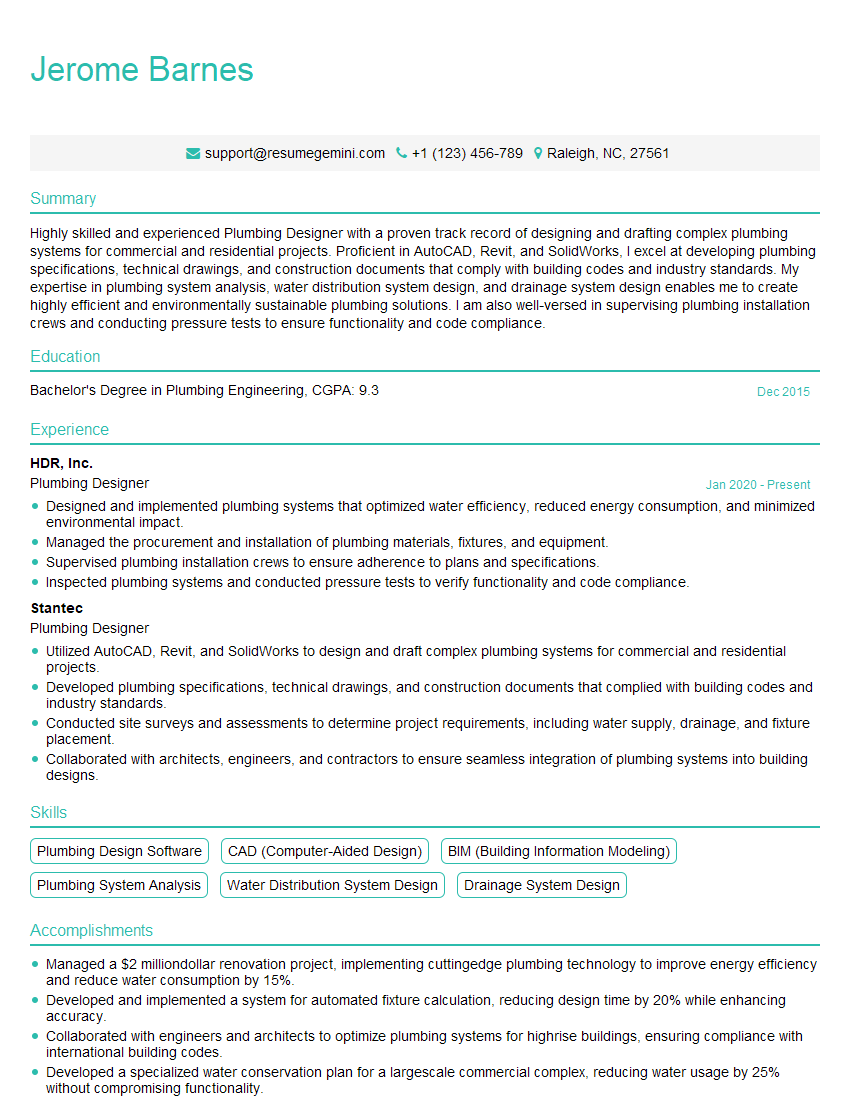
Mastering HVAC and Plumbing drawings is crucial for career advancement in the trades. A strong understanding of these drawings demonstrates technical proficiency and problem-solving abilities, making you a highly valuable asset to any team. To further enhance your job prospects, create a compelling and ATS-friendly resume that highlights your skills and experience. ResumeGemini is a trusted resource to help you build a professional resume that showcases your capabilities effectively. Examples of resumes tailored to HVAC and Plumbing Drawings professionals are available to guide you. Invest the time to craft a resume that truly reflects your expertise and sets you apart from the competition.
Explore more articles
Users Rating of Our Blogs
Share Your Experience
We value your feedback! Please rate our content and share your thoughts (optional).
What Readers Say About Our Blog
Very informative content, great job.
good