The right preparation can turn an interview into an opportunity to showcase your expertise. This guide to Hydrogen Power Plant Design interview questions is your ultimate resource, providing key insights and tips to help you ace your responses and stand out as a top candidate.
Questions Asked in Hydrogen Power Plant Design Interview
Q 1. Explain the different methods of hydrogen production and their relative advantages and disadvantages.
Hydrogen production methods broadly fall into two categories: electrolysis and reforming. Electrolysis uses electricity to split water (H₂O) into hydrogen (H₂) and oxygen (O₂). Reforming uses chemical reactions to extract hydrogen from hydrocarbon sources like natural gas. Let’s explore each further:
- Electrolysis: This is often considered a ‘green’ method if powered by renewable energy sources like solar or wind. There are several types including alkaline electrolysis, proton exchange membrane (PEM) electrolysis, and solid oxide electrolysis (SOEC).
- Alkaline Electrolysis: Mature technology, relatively inexpensive but less efficient than PEM. Think of it like a refined version of a simple battery, using an alkaline solution to facilitate the reaction.
- PEM Electrolysis: More efficient than alkaline, capable of higher current densities and faster response times, but more expensive. This is analogous to a high-performance sports car compared to a reliable family sedan.
- SOEC Electrolysis: High temperature operation leads to high efficiency but requires specialized materials and infrastructure, making it currently a more niche technology.
- Reforming: This involves reacting hydrocarbons with steam (steam methane reforming – SMR being the most common) or partial oxidation to produce hydrogen. While cheaper, it produces significant carbon emissions unless coupled with carbon capture and storage (CCS). Imagine it as extracting hydrogen from existing fuels, a more readily available but less environmentally friendly source. There are variations like autothermal reforming which seeks to balance energy efficiency with reduced emissions.
Advantages and Disadvantages Summary:
- Electrolysis (Advantages): Clean hydrogen production (if powered by renewable energy), scalable, modular.
- Electrolysis (Disadvantages): Higher production costs, energy intensive.
- Reforming (Advantages): Lower initial investment costs, readily available feedstock.
- Reforming (Disadvantages): High CO2 emissions (unless CCS is used), reliance on fossil fuels.
Q 2. Describe the key components of a hydrogen power plant.
A hydrogen power plant, at its core, consists of several key components working in a coordinated manner:
- Hydrogen Storage: This could involve high-pressure tanks, liquid hydrogen storage, or potentially even underground caverns depending on the scale of the plant. Imagine this as the fuel tank of a car.
- Fuel Processing: This stage might involve purifying the hydrogen to remove impurities that could damage the fuel cell. It’s like cleaning the fuel before use to ensure optimal performance.
- Fuel Cell Stack: This is the heart of the power plant where hydrogen reacts with oxygen to produce electricity, heat, and water. This is analogous to the engine of a car.
- Power Conditioning System: This system converts the DC electricity produced by the fuel cell into AC electricity suitable for the grid, a crucial step for distributing the power efficiently.
- Heat Recovery System: Fuel cells generate heat as a byproduct, which can be captured and used for other purposes like heating or cogeneration, optimizing the plant’s overall efficiency.
- Balance of Plant (BOP): This encompasses all the auxiliary systems essential for safe and efficient operation, including safety systems, control systems, and monitoring equipment.
Q 3. What are the safety considerations for handling and storing hydrogen?
Hydrogen safety is paramount due to its flammability and low ignition energy. Key considerations include:
- Leak Detection and Prevention: Regular inspection and maintenance of storage and piping systems are critical. Sophisticated leak detection systems using sensors are essential. Think of it as rigorous safety checks in a gas station.
- Ventilation: Adequate ventilation in storage and processing areas is crucial to prevent the accumulation of hydrogen in flammable concentrations. This prevents the build-up of hydrogen in areas where it could create a hazard.
- Emergency Shut-Down Systems: Systems should be in place to automatically shut down the plant in case of leaks or other emergencies, providing a rapid response to prevent disaster.
- Material Selection: Using appropriate materials for storage and transportation that are compatible with hydrogen and resistant to embrittlement is crucial. This includes selecting materials that resist hydrogen embrittlement which can weaken metal components.
- Training and Procedures: Rigorous training for personnel handling hydrogen is essential to minimize risks. Think of safety protocols similar to those used in nuclear power plants.
Proper handling of hydrogen necessitates adherence to stringent safety protocols and the use of appropriate safety equipment.
Q 4. How does the efficiency of an electrolyzer vary with operating conditions (current density, pressure, temperature)?
Electrolyzer efficiency is complex and depends on several operating parameters:
- Current Density: Increasing current density generally boosts hydrogen production rate, but beyond a certain point, efficiency drops due to increased overpotential (extra voltage needed to drive the reaction). It’s like pushing a car too hard – initial acceleration is good, but sustained high speed reduces fuel efficiency.
- Pressure: Operating at higher pressures increases hydrogen storage density and can improve efficiency by shifting the equilibrium of the water splitting reaction favorably. It’s akin to increasing the pressure in a tire, making it denser and able to hold more air.
- Temperature: Higher temperatures generally improve efficiency in some electrolyzer types (e.g., SOEC), but they also increase energy consumption for heating. This is comparable to a pressure cooker – increased temperature speeds up cooking but requires more energy input.
Optimizing the operating conditions for maximum efficiency requires careful balancing of these parameters. Advanced control systems and modeling are often used to achieve this.
Q 5. Explain different types of fuel cells used in hydrogen power plants.
Several types of fuel cells are used in hydrogen power plants, each with its own strengths and weaknesses:
- Proton Exchange Membrane (PEM) Fuel Cells: These are the most common type for stationary power generation due to their relatively high efficiency, rapid start-up time, and low operating temperature. They are similar to high-performance engines in terms of power and versatility.
- Alkaline Fuel Cells (AFC): These are known for high efficiency and relatively low cost, but are sensitive to CO2 and require careful management of the electrolyte. These can be considered a reliable but somewhat delicate engine.
- Solid Oxide Fuel Cells (SOFC): These operate at high temperatures, leading to very high efficiency and potential for cogeneration (simultaneous production of electricity and heat). However, they have longer start-up times and require robust materials. Think of this as a highly efficient, but demanding, engine.
- Phosphoric Acid Fuel Cells (PAFC): These have a good balance of efficiency, durability, and tolerance to impurities, but operate at lower power densities than PEMFCs. These are like a reliable, workhorse engine.
The choice of fuel cell depends on specific application requirements, including power output, efficiency targets, cost constraints, and environmental considerations.
Q 6. What are the challenges associated with hydrogen storage and transportation?
Hydrogen storage and transportation pose significant challenges:
- Storage Density: Hydrogen has a very low volumetric energy density, meaning it takes up a lot of space for a given amount of energy compared to other fuels. This necessitates either high-pressure tanks or cryogenic (very cold) liquid hydrogen storage.
- Embrittlement: Hydrogen can embrittle certain metals, making material selection for storage tanks and pipelines crucial. This requires careful consideration of material compatibility to ensure structural integrity.
- Transportation Costs: Transporting hydrogen over long distances can be expensive, particularly for liquid hydrogen due to the need for cryogenic transportation. This can affect the overall economic viability of hydrogen as a fuel.
- Infrastructure: A lack of dedicated infrastructure for hydrogen transportation and distribution is a major hurdle. Building the necessary pipelines and refueling stations requires significant investment.
Overcoming these challenges requires innovation in materials science, storage technologies, and infrastructure development.
Q 7. Describe the role of a balance of plant (BOP) in a hydrogen power plant.
The Balance of Plant (BOP) in a hydrogen power plant encompasses all the auxiliary systems that support the core processes. This includes:
- Control Systems: These ensure safe and efficient operation by monitoring and controlling various parameters like temperature, pressure, and flow rates. Think of it as the central nervous system of the plant.
- Safety Systems: These incorporate emergency shut-down systems, leak detection, and fire suppression, crucial for the plant’s safe operation.
- Water Treatment Systems: For electrolysis-based plants, these systems purify the water feedstock to prevent fouling and ensure optimal performance. This is a necessary pre-treatment step to prevent damage to the electrolyzer.
- Power Conditioning Equipment: This converts the DC power produced by the fuel cells into AC power suitable for the grid.
- Heat Exchangers and Cooling Systems: These manage heat generated during fuel cell operation, maximizing efficiency and preventing overheating.
The BOP is critical for ensuring reliability, efficiency, safety, and environmental compliance of the overall hydrogen power plant.
Q 8. How do you ensure the reliability and maintainability of a hydrogen power plant?
Ensuring the reliability and maintainability of a hydrogen power plant is paramount for its safe and efficient operation. It’s a multifaceted approach involving robust design, rigorous testing, and proactive maintenance strategies. Think of it like building a high-performance car – you need quality parts, regular check-ups, and a skilled mechanic.
- Redundancy and Fail-safes: Critical components, such as electrolyzers, fuel cells, and power electronics, should have backup systems to prevent complete plant shutdowns in case of failure. This is like having a spare tire in your car.
- Regular Inspections and Predictive Maintenance: Implementing a comprehensive inspection schedule and employing predictive maintenance techniques using sensors and data analytics allows for early detection of potential problems. This is similar to regularly servicing your car to catch issues before they become major problems.
- High-Quality Materials and Components: Choosing durable and reliable materials and components is crucial for extending the lifespan of the plant. This ensures less downtime and reduces maintenance costs. Consider this like choosing high-quality parts for your car.
- Operator Training and Skill Development: Well-trained operators are essential for safe and efficient operation. Regular training and simulations help prevent human error, a leading cause of plant malfunctions. This is equivalent to driver’s education and responsible driving.
- Modular Design: Employing a modular design simplifies maintenance and repairs as individual components can be replaced or serviced without shutting down the entire plant. This is akin to replacing a part in your car without needing a full engine overhaul.
Q 9. Discuss different hydrogen purification techniques.
Hydrogen purification is crucial as even trace amounts of impurities can significantly affect the performance and longevity of fuel cells. Several techniques are employed, each with its pros and cons:
- Pressure Swing Adsorption (PSA): This method uses pressure changes to selectively adsorb impurities onto a solid adsorbent material, leaving purified hydrogen. It’s widely used for its relatively low cost and simplicity.
- Membrane Separation: This uses special membranes that allow hydrogen to pass through while blocking other gases. It’s energy-efficient but might require multiple stages for high purity levels.
- Cryogenic Distillation: This technique relies on the different boiling points of gases to separate hydrogen. It’s highly effective in achieving ultra-high purity but is energy-intensive and complex.
- Palladium Diffusion: This method uses palladium membranes that selectively allow hydrogen to pass through. It’s highly efficient in producing extremely pure hydrogen, but palladium is expensive and the membranes can be fragile.
The choice of purification technique depends on factors such as the desired purity level, the type of hydrogen source, and cost considerations. For example, a PSA system might be sufficient for a lower-purity application, while cryogenic distillation might be necessary for fuel cells requiring ultra-pure hydrogen.
Q 10. What are the environmental impacts of hydrogen production and utilization?
The environmental impact of hydrogen depends heavily on the production method. ‘Green’ hydrogen, produced using renewable energy sources like solar or wind power to electrolyze water, has minimal environmental impact – only water vapor is released. However, ‘grey’ hydrogen, produced from natural gas, releases significant greenhouse gases like carbon dioxide. ‘Blue’ hydrogen, produced from natural gas with carbon capture and storage (CCS), aims to reduce emissions but still has an environmental footprint due to the energy involved in CCS.
Hydrogen Utilization: When hydrogen is used in fuel cells to generate electricity, the only byproduct is water vapor, making it a clean energy carrier. However, the entire lifecycle needs to be considered – from production to transportation and storage. Leakage of hydrogen can contribute to global warming as hydrogen is a potent greenhouse gas in the upper atmosphere.
Minimizing environmental impact requires focusing on green hydrogen production and efficient utilization to reduce energy losses during production, transportation and distribution.
Q 11. Explain the concept of hydrogen refueling infrastructure.
Hydrogen refueling infrastructure is crucial for widespread adoption of hydrogen fuel cell vehicles. It involves a network of hydrogen production, storage, and dispensing facilities. Think of it as the equivalent of gas stations for hydrogen-powered cars.
- Hydrogen Production Facilities: These facilities produce hydrogen using various methods (electrolysis, steam methane reforming, etc.). They may be centralized or distributed depending on the scale and location.
- Storage and Transportation: Hydrogen can be stored in high-pressure cylinders, liquid form (cryogenic storage), or pipelines. Transportation can be via trucks, pipelines, or specialized ships.
- Refueling Stations: These stations compress and dispense hydrogen at high pressure for vehicle refueling. They require safety systems to handle high-pressure hydrogen.
- Safety Regulations and Standards: Strict safety regulations and industry standards are crucial to ensure safe handling, transportation, and storage of hydrogen.
Developing a comprehensive refueling infrastructure requires substantial investment and careful planning, considering factors like geographical location, demand, and safety protocols. It’s a complex undertaking similar in scale to the development of the early oil and gas infrastructure.
Q 12. What are the different control systems used in a hydrogen power plant?
Hydrogen power plants utilize sophisticated control systems to ensure safe and efficient operation. These systems monitor various parameters and adjust the plant’s operation to maintain optimal performance and prevent malfunctions. These systems are similar to the control systems used in other power plants, but with additional features tailored to hydrogen.
- Supervisory Control and Data Acquisition (SCADA): This system monitors and controls various parameters such as pressure, temperature, flow rates, and gas compositions. It provides a centralized overview of the plant’s status.
- Distributed Control Systems (DCS): These systems control individual components and processes within the plant, such as the electrolyzer, fuel cell stacks, and purification units. They work in conjunction with the SCADA system.
- Safety Instrumented Systems (SIS): These systems are dedicated to safety, detecting and responding to hazardous conditions to prevent accidents. This is crucial given the flammability of hydrogen.
- Power Management Systems (PMS): These systems manage the power flow within the plant, ensuring efficient energy utilization and distribution.
These control systems work in concert, utilizing advanced algorithms and feedback loops to optimize efficiency and safety.
Q 13. Describe the role of power electronics in a hydrogen power plant.
Power electronics play a vital role in hydrogen power plants, primarily in managing the flow of power between different components and converting DC power to AC power for grid integration. They are essential for the efficient and reliable operation of the plant.
- Power Conversion: Electrolyzers typically operate on DC power, while fuel cells produce DC power that often needs to be converted to AC power for grid connection. Power electronics, such as inverters and rectifiers, facilitate these conversions.
- Voltage and Current Control: Power electronics regulate voltage and current levels to optimize the performance of various components and ensure stable operation.
- Grid Integration: Power electronics enable seamless integration of the hydrogen power plant with the electrical grid, allowing it to either generate power or consume power as needed. This involves sophisticated control algorithms to maintain grid stability.
- Protection and Safety: Power electronic devices provide protection against overcurrent, overvoltage, and other faults, ensuring the safety of the plant and the grid.
Advanced power electronics are essential for maximizing efficiency and ensuring the reliable operation of hydrogen power plants, enabling them to function as a flexible and integrated part of the modern power grid.
Q 14. How do you perform a cost analysis for a hydrogen power plant project?
Cost analysis for a hydrogen power plant project is a complex process requiring a detailed breakdown of all expenses throughout the project lifecycle. It’s crucial to conduct a thorough analysis to secure funding and ensure project viability.
- Capital Costs: These include expenses related to land acquisition, plant construction, equipment procurement (electrolyzers, fuel cells, etc.), and infrastructure development.
- Operating Costs: These encompass expenses related to electricity consumption, maintenance, staffing, consumables (catalysts, etc.), and hydrogen feedstock.
- Financing Costs: These include interest payments on loans or other financing options used for project funding.
- Decommissioning Costs: These are expenses associated with the eventual dismantling and disposal of the plant at the end of its operational life.
- Contingency Costs: A buffer for unforeseen expenses or delays is essential.
A comprehensive cost analysis involves detailed estimations, sensitivity analysis (assessing impact of varying parameters like hydrogen price), and comparison with alternative energy sources to evaluate the overall economic feasibility and potential profitability of the project.
Software tools and detailed financial models are frequently used to manage this complex process. Life-cycle costing, which considers all costs over the plant’s entire lifetime, is essential for a realistic assessment of the project’s economic viability.
Q 15. What are the different types of electrolyzers and their working principles?
Electrolyzers are the heart of hydrogen production, splitting water into hydrogen and oxygen using electricity. Several types exist, each with its own strengths and weaknesses.
- Alkaline Electrolyzers: These are the most mature technology, using a potassium hydroxide (KOH) electrolyte solution. They’re robust and relatively inexpensive but operate at lower efficiencies and pressures compared to others. Think of them as the reliable workhorses of the industry.
- Proton Exchange Membrane (PEM) Electrolyzers: PEM electrolyzers employ a solid polymer electrolyte membrane, allowing for higher operating pressures and efficiencies. They’re faster-responding and better suited for dynamic renewable energy integration, like solar or wind power. Imagine them as the sporty, high-performance models.
- Solid Oxide Electrolyzers (SOE): These operate at high temperatures, utilizing a solid ceramic electrolyte. SOEs offer high efficiency and can even be directly integrated with natural gas reforming for hybrid hydrogen production. They are the experimental, potentially groundbreaking option.
- Anion Exchange Membrane (AEM) Electrolyzers: A newer technology using an anion exchange membrane, AEM electrolyzers offer the potential for lower cost and higher performance than PEM electrolyzers by using less-expensive catalysts. They are still under development but hold great promise.
The working principle for all is based on electrolysis: applying an electrical current across electrodes immersed in an electrolyte, causing water molecules to dissociate into hydrogen at the cathode and oxygen at the anode.
Career Expert Tips:
- Ace those interviews! Prepare effectively by reviewing the Top 50 Most Common Interview Questions on ResumeGemini.
- Navigate your job search with confidence! Explore a wide range of Career Tips on ResumeGemini. Learn about common challenges and recommendations to overcome them.
- Craft the perfect resume! Master the Art of Resume Writing with ResumeGemini’s guide. Showcase your unique qualifications and achievements effectively.
- Don’t miss out on holiday savings! Build your dream resume with ResumeGemini’s ATS optimized templates.
Q 16. Discuss the impact of renewable energy sources on hydrogen production.
Renewable energy sources are absolutely crucial for creating ‘green’ hydrogen, meaning hydrogen produced without greenhouse gas emissions. Fossil fuels are traditionally used for hydrogen production through steam methane reforming (SMR), a process that releases significant CO2. Renewable energy sources like solar and wind power, however, provide the clean electricity needed for electrolysis, resulting in a carbon-neutral process.
The intermittency of solar and wind power presents challenges. To address this, energy storage solutions – such as batteries or pumped hydro – are often paired with electrolyzers to ensure a consistent hydrogen production rate, even when renewable energy generation fluctuates. Imagine a solar farm powering an electrolyzer; when the sun isn’t shining, the battery steps in to maintain hydrogen production.
Furthermore, the use of renewable energy in hydrogen production improves the overall environmental impact of the hydrogen economy, reducing our dependence on fossil fuels and promoting a more sustainable energy future. The pairing of renewables and hydrogen production is a key factor in making the hydrogen economy a viable and environmentally sound option.
Q 17. How do you ensure the safety and integrity of hydrogen pipelines?
Ensuring the safety and integrity of hydrogen pipelines requires a multi-faceted approach incorporating stringent design, material selection, and operational practices. Hydrogen’s low density and high diffusivity demand specialized considerations.
- Material Selection: Pipelines must be made from materials highly resistant to hydrogen embrittlement. Steel grades with specific compositions are crucial and must undergo rigorous testing.
- Leak Detection Systems: Advanced leak detection systems are essential to promptly identify and address any leaks, minimizing risks. These systems often employ sensors and sophisticated monitoring software.
- Pipeline Design: The design incorporates features to mitigate the risk of leaks and ruptures. This includes careful consideration of pressure ratings, pipeline diameter, and the overall route selection.
- Regular Inspection and Maintenance: Routine inspections, including non-destructive testing techniques, are crucial for early detection of potential problems. This proactive approach ensures the long-term integrity of the infrastructure.
- Safety Standards and Regulations: Strict adherence to relevant safety standards and regulations is vital for managing the risks associated with hydrogen transportation.
A comprehensive approach that combines robust engineering design with thorough monitoring and maintenance is paramount to the safe and reliable operation of hydrogen pipelines.
Q 18. What are the potential risks associated with hydrogen embrittlement?
Hydrogen embrittlement is a serious concern in hydrogen infrastructure. It occurs when hydrogen atoms diffuse into a metal, weakening its structure and making it more susceptible to cracking and failure. The process can occur gradually over time or be accelerated under pressure.
The risks are significant. Embrittlement can lead to pipeline leaks, equipment failures, and even catastrophic events. The consequences can range from environmental damage to serious safety hazards and economic losses.
Mitigation strategies focus on material selection, surface treatment, and careful design. Choosing materials inherently resistant to hydrogen embrittlement is a primary step. Surface treatments can help limit hydrogen ingress. Design considerations, such as avoiding sharp corners and stress concentrations, also play a key role.
Regular inspections and testing to detect early signs of embrittlement are also vital to preventing catastrophic failures. Understanding the mechanisms of hydrogen embrittlement and employing preventative measures are essential for maintaining the safety and integrity of hydrogen systems.
Q 19. Explain the concept of energy storage systems for hydrogen power plants.
Energy storage systems are crucial for hydrogen power plants, particularly those utilizing intermittent renewable energy sources. They buffer the variability in renewable energy generation, ensuring a consistent hydrogen production rate.
- Compressed Hydrogen Storage: Hydrogen is stored under high pressure in tanks or caverns. This is a common method, but requires significant infrastructure investment.
- Liquefied Hydrogen Storage: Hydrogen is liquefied at -253°C, significantly reducing its volume but requiring energy-intensive cryogenic refrigeration systems.
- Metal Hydride Storage: Hydrogen is stored by absorbing it into specialized metal alloys. This method offers a higher storage density than compressed hydrogen, but material costs can be high.
- Power-to-Gas with Underground Storage: Hydrogen can be injected into depleted natural gas fields or salt caverns for long-term storage. This approach is suitable for large-scale applications.
The choice of energy storage method depends on factors like storage capacity, cost, location, and the specific requirements of the hydrogen power plant. Effective energy storage is key to achieving the reliability and economic viability of hydrogen power generation.
Q 20. What are the key performance indicators (KPIs) for a hydrogen power plant?
Key Performance Indicators (KPIs) for a hydrogen power plant are critical for monitoring its efficiency, reliability, and overall performance. These KPIs can be grouped into several categories:
- Efficiency: Measures the overall energy conversion efficiency, from renewable energy input to hydrogen output. This includes electrolyzer efficiency and any energy losses in compression or storage.
- Capacity Factor: Represents the actual hydrogen production relative to the plant’s maximum capacity. A higher capacity factor indicates greater utilization of the plant.
- Availability Factor: Indicates the plant’s operational uptime. This reflects its reliability and robustness.
- Hydrogen Purity: Measures the purity of the produced hydrogen. High purity is essential for many applications.
- Operating Costs: Track costs associated with electricity consumption, maintenance, and other operational expenses.
- Environmental Impact: Monitors greenhouse gas emissions (ideally, minimizing these) and overall environmental footprint.
By tracking these KPIs, operators can optimize plant performance, identify areas for improvement, and ensure cost-effective and sustainable hydrogen production.
Q 21. Describe your experience with hydrogen plant design software and tools.
Throughout my career, I’ve extensively utilized various hydrogen plant design software and tools. My experience spans from process simulation software like Aspen Plus and HYSYS, which are crucial for modeling the thermodynamic behavior and performance of electrolyzers and the overall plant, to CAD software such as AutoCAD and SolidWorks for detailed engineering design of equipment and layout.
I’m proficient in using specialized hydrogen plant simulation tools that account for specific aspects of hydrogen production, such as the electrochemical behavior of electrolyzers or the dynamics of hydrogen storage and transportation. I also have experience with lifecycle analysis software to assess the environmental impacts of different design choices.
Moreover, I’m familiar with data analytics tools for monitoring and optimizing plant operations based on real-time KPIs, enabling informed decision-making and continuous improvement. This combined skill set allows me to develop efficient, safe, and cost-effective hydrogen power plant designs.
Q 22. Explain your understanding of hydrogen regulations and safety standards.
Hydrogen regulations and safety standards are crucial for mitigating risks associated with hydrogen’s flammability and potential for embrittlement. These regulations cover the entire lifecycle, from production and storage to transportation and utilization. Key aspects include:
- Storage and Handling: Regulations dictate the materials used for storage tanks (often specialized steels or composites) and pressure limitations, emphasizing leak detection and prevention systems. Strict safety protocols, including pressure relief valves and emergency shutdown systems, are mandatory.
- Transportation: Pipelines transporting hydrogen often require specialized coatings and leak detection technologies. Regulations also address the transportation of hydrogen in cylinders and cryogenic tankers, focusing on secure fastening and emergency response procedures.
- Plant Design and Operation: Plant designs must incorporate features to minimize the risk of leaks and explosions, including ventilation systems, hydrogen detection sensors, and fire suppression systems. Operational protocols mandate regular inspections, maintenance, and staff training.
- Environmental Considerations: Regulations may address potential environmental impacts, such as hydrogen emissions, and require environmental impact assessments before plant construction. This includes considerations for potential groundwater contamination.
- International Standards: Organizations like ISO and IEC develop international standards for hydrogen technology, which often influence national regulations. Staying abreast of these standards is essential for compliance.
For example, in a plant design, we’d meticulously specify materials resistant to hydrogen embrittlement and incorporate redundant safety systems like dual pressure sensors and automatic shutoff valves to prevent catastrophic events.
Q 23. Describe your approach to problem-solving in a complex hydrogen plant design scenario.
My approach to problem-solving in complex hydrogen plant design hinges on a structured, iterative process:
- Define the Problem: Clearly articulate the challenge, gathering all relevant data and constraints (e.g., site limitations, budget, regulatory requirements).
- Conceptual Design: Develop multiple preliminary design concepts, exploring various technological options (e.g., different types of electrolyzers, storage methods, turbine designs). This stage involves extensive simulations and modeling.
- Detailed Design: Select the optimal design based on performance, cost, and safety considerations. This involves creating detailed engineering drawings, specifications, and procurement documents.
- Risk Assessment: Conduct a thorough hazard and operability study (HAZOP) to identify potential hazards and develop mitigation strategies. This ensures the plant is safe and reliable.
- Optimization: Use optimization techniques (e.g., simulation software) to fine-tune the design, improving efficiency and reducing costs. This iterative process might involve re-evaluating design choices based on simulation results.
- Validation and Testing: Before implementation, validate the design through simulations, prototype testing, and potentially pilot-scale trials. This reduces the risk of unforeseen issues during construction and operation.
For instance, if facing challenges with integrating renewable energy sources, I would use sophisticated simulation models to explore different energy storage solutions, optimizing the balance between cost, efficiency, and grid stability.
Q 24. How would you address a potential hydrogen leak in a power plant?
Addressing a hydrogen leak requires a multi-faceted, prioritized response:
- Immediate Actions: Evacuate personnel from the immediate vicinity, shutting down affected systems. Activate emergency response procedures as defined in the plant’s safety plan.
- Leak Detection and Isolation: Identify the source and extent of the leak using existing detection systems. Quickly isolate the affected section of the plant using valves and other isolation devices. This prevents further hydrogen release.
- Ventilation: Increase ventilation in the affected area to disperse the hydrogen, minimizing the risk of ignition. This should be done carefully to avoid creating turbulent airflows that can spread the gas.
- Repair: Once the area is safe and the leak isolated, conduct a thorough assessment of the damage and initiate repairs. This usually requires specialized personnel trained in handling high-pressure systems.
- Investigation: After the immediate emergency, a thorough investigation is crucial to identify the root cause of the leak and implement preventive measures to prevent recurrence. This often involves analyzing data from monitoring systems and conducting thorough inspections.
A well-designed plant includes redundant safety systems, leak detection sensors, and robust emergency response plans which form the backbone of a swift and effective response. For example, the use of multiple leak detection technologies allows for rapid localization even in complex plant layouts.
Q 25. What are the economic viability considerations for a hydrogen power plant project?
The economic viability of a hydrogen power plant hinges on several factors:
- Capital Costs: These include the costs associated with land acquisition, plant construction, equipment procurement (electrolyzers, turbines, storage tanks), and initial infrastructure development. These costs can be very significant.
- Operating Costs: This includes energy costs for electrolysis (if using electrolysis for hydrogen production), maintenance, labor, and potential feedstock costs. The efficiency of the plant and the price of electricity heavily influences operating costs.
- Hydrogen Production Costs: The cost of producing hydrogen is a major determinant. This cost depends on the method used (e.g., steam methane reforming, electrolysis) and the price of the feedstock (e.g., natural gas, electricity).
- Revenue Streams: The project’s financial success relies on the price of electricity generated and potential carbon credits, which can significantly impact profitability. Long-term contracts can provide revenue stability.
- Government Incentives and Subsidies: Government policies and financial incentives for renewable energy can make a significant difference in the project’s economic feasibility. Subsidies can offset capital costs and make projects more attractive.
- Lifecycle Costs: A comprehensive analysis needs to consider the entire lifecycle, including decommissioning and environmental remediation costs at the end of the plant’s operational life.
A thorough financial model needs to carefully weigh all these factors and analyze sensitivity to key parameters such as electricity prices and hydrogen demand to assess project viability.
Q 26. Discuss the future trends and innovations in hydrogen power plant technology.
Future trends and innovations in hydrogen power plant technology include:
- Improved Electrolyzer Technology: Research is focused on developing more efficient and cost-effective electrolyzers, potentially using novel materials and designs. This includes solid oxide electrolyzer cells (SOECs) operating at high temperatures, offering higher efficiencies.
- Advanced Hydrogen Storage: Research is exploring better ways to store hydrogen, such as using high-density materials, chemical storage methods, or advanced compressed gas storage.
- Integration with Renewable Energy Sources: The coupling of hydrogen power plants with renewable energy sources like solar and wind will be increasingly important to ensure a sustainable and carbon-neutral energy system.
- Power-to-X (PtX): The concept of using excess renewable energy to produce hydrogen and other synthetic fuels (PtX) is gaining traction, providing a way to store and utilize intermittent renewable energy sources.
- Artificial Intelligence (AI) and Machine Learning (ML): AI and ML are being used to optimize plant operations, improving efficiency, predicting maintenance needs, and enhancing safety.
- High-Temperature Hydrogen Combustion: Developing more efficient high-temperature combustion technologies can increase overall plant efficiency and reduce costs.
For example, the development of highly efficient, low-cost electrolyzers powered by renewable energy will be instrumental in making green hydrogen a cost-competitive alternative to fossil fuels.
Q 27. How do you integrate hydrogen power plants into existing power grids?
Integrating hydrogen power plants into existing power grids requires careful consideration of several factors:
- Grid Compatibility: Hydrogen power plants can be integrated as either baseload or peaking plants, depending on their design and operational characteristics. This requires understanding the grid’s load profile and capacity.
- Power Conversion: Hydrogen needs to be converted back into electricity using fuel cells or gas turbines. These conversion technologies need to be compatible with the grid’s voltage and frequency requirements.
- Grid Stability: Integrating large amounts of intermittent renewable energy coupled with hydrogen storage can impact grid stability. Solutions like advanced grid control systems and energy storage technologies are essential for managing these fluctuations.
- Safety Regulations: Strict safety protocols are needed to address the flammability of hydrogen and prevent potential accidents during integration.
- Infrastructure Development: This might involve upgrading existing transmission lines, constructing new substations, and developing hydrogen pipelines to transport hydrogen to the power plant.
Often, a phased approach is adopted, starting with smaller-scale integration and gradually increasing capacity as experience and confidence grow. Careful planning and coordination with grid operators are crucial for seamless integration.
Q 28. What is your experience with lifecycle assessment (LCA) of hydrogen power plants?
Lifecycle assessment (LCA) of hydrogen power plants is crucial for evaluating their overall environmental impact. My experience includes performing LCAs using established methodologies, considering the entire lifecycle from raw material extraction and manufacturing to operation, decommissioning, and waste disposal. This involves:
- Data Collection: Gathering data on energy consumption, material usage, emissions (e.g., greenhouse gases, pollutants), and waste generation throughout the plant’s lifecycle.
- Impact Assessment: Evaluating the environmental impacts associated with each stage of the lifecycle using various impact categories (e.g., climate change, human toxicity, resource depletion).
- Software Tools: Utilizing specialized LCA software to model and quantify the environmental impacts, comparing different scenarios and design options.
- Sensitivity Analysis: Conducting sensitivity analysis to determine the influence of various parameters on the overall environmental performance.
- Uncertainty Analysis: Acknowledging uncertainties in input data and their potential impact on the results.
For example, in a recent project, we compared the LCA of a hydrogen plant using electrolysis powered by renewable energy with one using steam methane reforming. The LCA highlighted the significantly lower greenhouse gas emissions of the renewable-powered plant, demonstrating the environmental benefits of green hydrogen.
Key Topics to Learn for Hydrogen Power Plant Design Interview
- Electrolysis Technologies: Understand the different methods of hydrogen production via electrolysis (alkaline, PEM, solid oxide), their efficiency, and cost-effectiveness. Consider the practical application of selecting the optimal electrolysis technology for a specific project based on factors like energy source and scale.
- Hydrogen Storage and Transportation: Explore various hydrogen storage methods (compressed gas, liquid hydrogen, metal hydrides) and their implications for plant design and safety. Discuss practical challenges and solutions in transporting hydrogen, including pipeline infrastructure and potential safety concerns.
- Power Generation Systems: Familiarize yourself with different hydrogen power generation technologies (fuel cells, gas turbines, internal combustion engines) and their suitability for different plant sizes and applications. Analyze the practical aspects of integrating these systems into a complete power plant design.
- Plant Integration and Control Systems: Understand the complexities of integrating various components (electrolyzer, storage, power generation) into a cohesive and efficient system. Explore the role of control systems in optimizing plant performance and ensuring safe operation.
- Safety and Environmental Considerations: Discuss the safety protocols and environmental impact assessment crucial for hydrogen plant design. This includes handling hydrogen leaks, emissions control, and minimizing the environmental footprint of the plant’s operation.
- Economic and Lifecycle Analysis: Understand the economic viability of hydrogen power plants, including capital costs, operating expenses, and return on investment. Familiarize yourself with conducting lifecycle assessments to evaluate the long-term environmental and economic sustainability of the plant.
- Renewable Energy Integration: Explore the integration of renewable energy sources (solar, wind) with hydrogen production to create a sustainable and decarbonized energy system. Consider practical applications and challenges in designing a hybrid system.
Next Steps
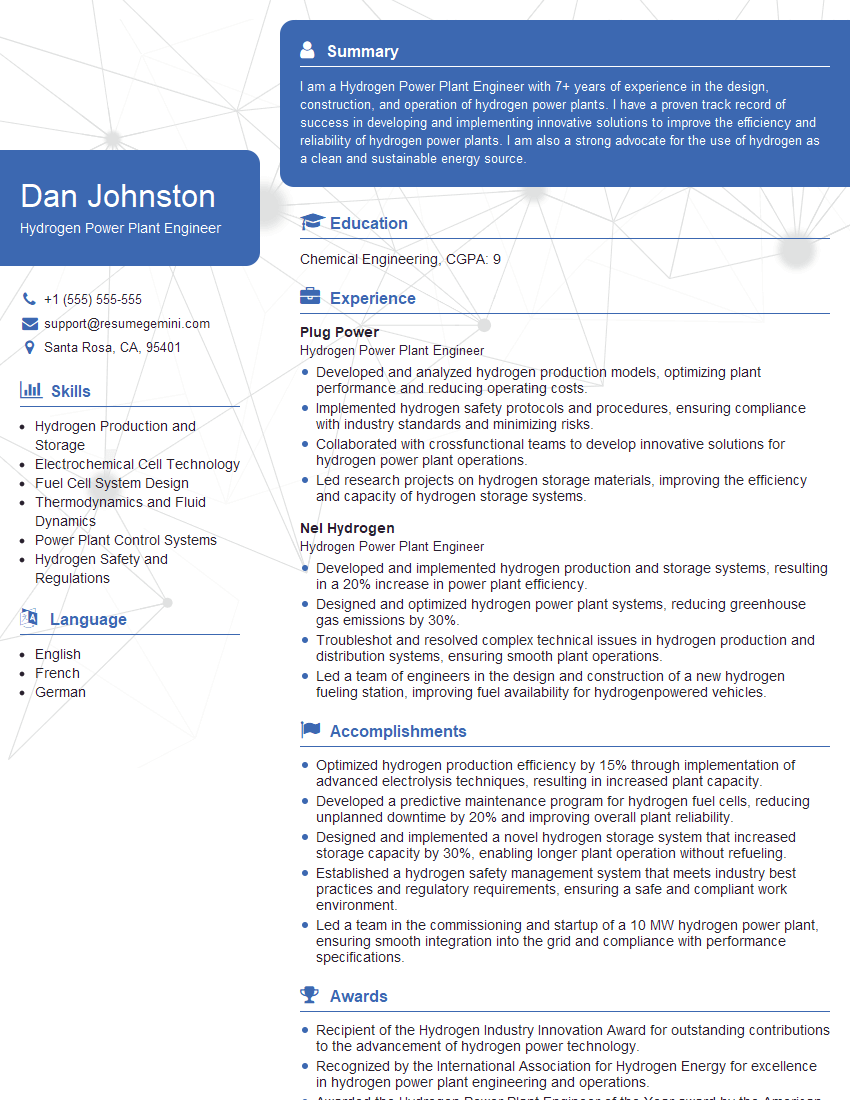
Mastering Hydrogen Power Plant Design opens doors to a rewarding career in a rapidly growing sector. The demand for skilled engineers in this field is high, offering excellent career growth opportunities and the chance to contribute to a sustainable energy future. To maximize your job prospects, create an ATS-friendly resume that highlights your skills and experience effectively. ResumeGemini is a trusted resource that can help you build a professional and impactful resume. We provide examples of resumes tailored to Hydrogen Power Plant Design to give you a head start. Invest time in crafting a strong resume – it’s your first impression on potential employers.
Explore more articles
Users Rating of Our Blogs
Share Your Experience
We value your feedback! Please rate our content and share your thoughts (optional).
What Readers Say About Our Blog
Very informative content, great job.
good