Are you ready to stand out in your next interview? Understanding and preparing for Image Quality Evaluation interview questions is a game-changer. In this blog, we’ve compiled key questions and expert advice to help you showcase your skills with confidence and precision. Let’s get started on your journey to acing the interview.
Questions Asked in Image Quality Evaluation Interview
Q 1. Explain the difference between objective and subjective image quality assessment.
Image quality assessment can be broadly classified into two categories: objective and subjective. Objective assessment uses mathematical metrics to quantify image quality. These metrics analyze the image data directly, comparing it to a reference image, and providing a numerical score. Think of it like using a ruler to measure the length of a table – it’s a direct, quantifiable measurement. Subjective assessment, on the other hand, relies on human perception. Groups of viewers rate the quality of images based on their visual experience, usually on a scale (e.g., 1-5). This is analogous to asking several people to estimate the length of the table; their answers will vary based on individual perception and interpretation.
The key difference lies in the method: objective methods are automated and repeatable, producing consistent numerical results, while subjective methods are based on human judgment and are prone to variability depending on factors like viewer experience and viewing conditions. Both approaches are valuable, and often used in conjunction; objective metrics can be efficient for large-scale testing, while subjective scores provide a more accurate reflection of the actual user experience.
Q 2. Describe various image quality metrics (PSNR, SSIM, VMAF etc.) and their limitations.
Several metrics exist for objective image quality assessment, each with its strengths and weaknesses.
- Peak Signal-to-Noise Ratio (PSNR): PSNR is a widely used metric that calculates the ratio of the maximum possible power of a signal to the power of the noise. A higher PSNR generally indicates better image quality. However, it doesn’t always correlate well with perceived quality, as it’s highly sensitive to small differences in pixel values and doesn’t account for human visual perception. For instance, two images with similar PSNR might differ significantly in perceived quality because PSNR doesn’t capture structural similarity.
- Structural Similarity Index (SSIM): SSIM considers luminance, contrast, and structure to measure the similarity between two images. It more closely aligns with human perception than PSNR. It’s less sensitive to noise than PSNR, making it more appropriate for noisy images. Yet, SSIM still struggles to accurately capture higher-order perceptual aspects.
- Video Multi-method Assessment Fusion (VMAF): VMAF is a perceptually-motivated metric specifically designed for video quality assessment. It combines multiple features related to human visual perception and provides scores that strongly correlate with subjective quality ratings. VMAF is generally considered superior to PSNR and SSIM, particularly for videos.
Limitations generally include the inability to perfectly capture human visual perception, sensitivity to specific types of distortions, and difficulty in handling complex scenes.
Q 3. How would you evaluate the image quality of a high-dynamic-range (HDR) image?
Evaluating the image quality of a High-Dynamic Range (HDR) image presents unique challenges because of its wider color gamut and higher dynamic range than standard dynamic range (SDR) images. Standard metrics like PSNR and SSIM are not directly suitable because they don’t adequately capture the perceptual differences in brightness and color range.
To evaluate HDR image quality, we need metrics that account for the extended range of luminance and color. Specialized metrics like HDR-VDP-2 (HDR Video and Display Perception), which is based on contrast sensitivity and tone mapping, are more appropriate. Additionally, subjective assessments remain crucial, as they capture the overall perceived quality. These assessments should be conducted using HDR-capable displays and under controlled viewing conditions to minimize variations in perceived quality.
Furthermore, it’s important to consider the tone mapping operator used for viewing the HDR content on different displays. The tone mapping process converts the HDR image to SDR for display on SDR displays, and the quality of this conversion significantly impacts the perceived image quality. Therefore, the evaluation needs to account for this process.
Q 4. What are the challenges in evaluating image quality across different display technologies?
Evaluating image quality across different display technologies (e.g., OLED, LCD, QLED) is challenging because each technology has unique characteristics that affect color reproduction, contrast, and brightness. An image that looks excellent on an OLED display with perfect blacks might appear washed out on an LCD display.
The biggest challenges stem from differences in:
- Color gamut: Each display technology has a different color gamut, meaning they can reproduce a different range of colors. A metric needs to account for the gamut mapping process to compensate for this difference.
- Dynamic range: The dynamic range – the ratio between the brightest and darkest parts of an image – varies across display technologies. HDR displays vastly exceed SDR displays in dynamic range.
- Viewing angle: Color and contrast can change depending on the viewing angle, and these variations are different for each display technology.
To address these challenges, we need to use display-aware metrics or conduct subjective tests using a representative set of display technologies to gain a more holistic understanding of image quality across diverse viewing experiences.
Q 5. How do you handle noisy images during image quality assessment?
Noisy images present a significant hurdle in image quality assessment. Standard metrics like PSNR can be overly sensitive to noise, leading to misleadingly low scores.
Several strategies can be employed:
- Noise reduction techniques: Before applying any quality metric, consider applying a suitable noise reduction technique (e.g., Gaussian filtering, wavelet denoising). However, care must be taken, as aggressive noise reduction can also blur fine details, impacting perceived quality.
- Perceptually-motivated metrics: Metrics like SSIM and VMAF are generally less sensitive to noise than PSNR and thus more suitable for noisy images because they incorporate human visual system characteristics.
- Noise modeling: Develop a noise model specific to the type of noise present in the images and incorporate this model into the quality assessment process. This improves the accuracy and relevance of the metrics.
- Subjective assessment: As always, human perception plays a vital role. Subjective testing allows for a more accurate assessment, as viewers can compensate to some extent for the presence of noise, distinguishing between noise and other forms of distortion.
The choice of method depends heavily on the context and the specific characteristics of the noise. A combined approach, using pre-processing techniques in conjunction with perceptual metrics and subjective tests, usually provides the most robust results.
Q 6. Explain your understanding of perceptual image quality assessment.
Perceptual image quality assessment aims to mimic human visual perception in evaluating image quality. Instead of solely relying on mathematical calculations, it tries to capture the subjective aspects of how people perceive image fidelity. This involves understanding and modeling aspects of the human visual system (HVS), such as contrast sensitivity, masking effects, and spatial frequency response.
Unlike objective metrics that focus on pixel-level differences, perceptual metrics attempt to assess image quality based on how the image is perceived by the human eye. They often involve complex models that simulate the various stages of visual processing in the brain. The goal is to develop metrics that correlate strongly with subjective ratings, providing a more meaningful measure of image quality in the context of human experience. For example, some models incorporate mechanisms for simulating masking effects—how the presence of bright areas can obscure the visibility of smaller artifacts in a nearby region.
Q 7. What are the common artifacts that affect image quality, and how are they measured?
Numerous artifacts can degrade image quality. These can be broadly categorized into:
- Compression artifacts: Introduced by lossy compression techniques (like JPEG), manifesting as blocking, ringing, or blurring.
- Noise: Random variations in pixel values, leading to graininess and loss of detail.
- Blurring: Loss of sharpness and detail, often due to motion blur or defocus.
- Quantization artifacts: Visible banding or contouring in gradients, common in image compression.
- Color distortions: Incorrect color reproduction, resulting in unnatural hues or faded colors.
Measuring these artifacts often involves a combination of techniques:
- Visual inspection: Identifying the presence and type of artifacts.
- Frequency analysis: Analyzing the frequency components of the image to detect specific patterns associated with artifacts (e.g., high-frequency components for ringing).
- Edge detection: Quantifying the sharpness or blurring of edges to measure blurring artifacts.
- Metric-based analysis: Using objective metrics like PSNR, SSIM, or specialized metrics designed to detect particular artifacts. For example, specific metrics are designed to quantify blocking artifacts in compressed images.
The optimal approach to measuring artifacts often involves a combination of these techniques tailored to the specific type of artifact and the application context.
Q 8. Describe your experience with image quality testing methodologies.
My experience in image quality testing methodologies spans a wide range, encompassing both subjective and objective approaches. Subjective methods rely on human perception, using techniques like Mean Opinion Score (MOS) testing where observers rate image quality on a scale. This is crucial for capturing aspects like aesthetics, which are difficult to quantify objectively. Objective methods, on the other hand, use mathematical metrics to evaluate image quality. I’ve extensively used metrics like Peak Signal-to-Noise Ratio (PSNR), Structural Similarity Index (SSIM), and various others tailored to specific image types and applications, such as image compression or medical imaging. For example, in assessing the quality of compressed images, PSNR provides a simple measure of the difference between the original and compressed image, but SSIM is preferred as it better correlates with human perception of quality. I have experience in designing and executing both types of assessments, understanding their strengths and weaknesses, and selecting the most appropriate methods depending on the specific project needs and available resources.
Q 9. How would you design an experiment to compare the image quality of two different image processing algorithms?
Designing an experiment to compare two image processing algorithms requires a rigorous approach. First, I’d define clear and measurable quality criteria based on the application. Are we prioritizing sharpness, color accuracy, or noise reduction? This dictates the choice of metrics. Next, I’d select a representative dataset of images that reflect the diversity expected in real-world scenarios. This is vital to avoid bias. Then, I would process the entire dataset using both algorithms. For objective evaluation, I’d calculate relevant metrics (PSNR, SSIM, etc.) for each image and algorithm. Statistical analysis, like paired t-tests, would determine if the differences are statistically significant. For subjective evaluation, I’d conduct a blind MOS test with multiple human observers, ensuring a balanced and representative group. The results from both objective and subjective assessments would then be combined to draw comprehensive conclusions, with objective metrics supporting the subjective findings.
For instance, if comparing algorithms for de-noising, I might use the PSNR to quantify the noise reduction, while SSIM would measure how well the algorithm preserves image details. A paired t-test would show if the difference in PSNR or SSIM is statistically significant between the two algorithms. Combining this with a subjective MOS test would provide a holistic view of the performance, accounting for factors that quantitative metrics might miss.
Q 10. Explain your understanding of human visual system (HVS) and its role in image quality evaluation.
The Human Visual System (HVS) is incredibly complex, but understanding its key characteristics is paramount in image quality assessment. The HVS isn’t a perfect linear sensor; it’s sensitive to certain frequencies and contrasts more than others. It exhibits phenomena like masking, where certain visual features can hide others, and contrast sensitivity, influencing how we perceive details at different luminance levels. This non-linearity means that objective metrics alone can be misleading; an image with high PSNR might still appear visually unpleasant due to artifacts invisible to simple metrics but noticeable to the human eye. Therefore, aligning objective metrics with HVS characteristics is crucial. Metrics like SSIM attempt to model aspects of HVS perception more accurately than PSNR, leading to a better correlation between the numerical score and perceived quality. This understanding informs the design of experiments and the selection of appropriate metrics, ensuring that the evaluation truly reflects the actual user experience. In practice, incorporating subjective assessments involving human observers remains crucial to capture the nuances of HVS perception.
Q 11. How do you interpret and analyze image quality metrics data?
Interpreting image quality metrics data requires caution and context. Simply looking at a single number, like a PSNR value, is insufficient. The interpretation should consider the context of the application, the type of image, and the specific metrics used. For example, a high PSNR value might be expected for lossless compression but not necessarily for lossy compression where some information loss is inherent. Comparing metrics across different datasets or algorithms requires careful statistical analysis to ensure the observed differences are significant and not due to random variation. I usually perform statistical tests (like t-tests or ANOVA) to assess the significance of differences between various algorithms and conditions. Visualization techniques like box plots or scatter plots are helpful to visually represent the data distribution and identify outliers. Furthermore, it’s vital to integrate the objective metric data with subjective evaluation results obtained from human observers to gain a comprehensive understanding of the overall image quality.
Q 12. Discuss your experience with different image quality databases and datasets.
My experience includes working with several widely used image quality databases and datasets. I’ve utilized the LIVE Image Quality Assessment Database for its diverse image content and comprehensive set of subjective scores. The TID2013 database is another valuable resource, providing a standardized set of distorted images with objective and subjective quality ratings. For specific applications, I have used specialized datasets, like those focusing on medical images or satellite imagery, understanding the specific challenges and evaluation criteria relevant to these domains. The choice of dataset is always critical, as the characteristics of the images significantly influence the results of quality evaluations. A dataset representative of the application is fundamental for generating meaningful and reliable conclusions.
Q 13. What tools and software have you used for image quality evaluation?
Over the years, I’ve used a range of tools and software for image quality evaluation. MATLAB provides a powerful environment for image processing, analysis, and metric calculation. Python, with libraries like OpenCV and scikit-image, offers flexibility and a vast array of tools. Specialized software packages designed for image quality assessment are also part of my toolset, often providing streamlined workflows for both objective and subjective testing. I am also proficient in using command-line tools for image manipulation and analysis where needed. The choice of tools depends largely on the specific project requirements, ranging from quick evaluations using readily available tools to more complex custom analysis using dedicated software packages or programming environments.
Q 14. How do you handle image quality issues in a production environment?
Handling image quality issues in a production environment demands a systematic approach. The first step is identifying the source of the problem through careful analysis of the image pipeline. Is the issue related to image acquisition, processing, compression, or display? Once the source is identified, appropriate mitigation strategies can be implemented. This may involve adjusting camera settings, optimizing image processing algorithms, changing compression parameters, or upgrading display hardware. Continuous monitoring using automated image quality checks can help prevent future issues. This could involve setting up automated pipelines that evaluate key metrics on a regular basis, providing alerts if quality falls below pre-defined thresholds. In the event of a significant degradation in quality, a root cause analysis should be performed to prevent recurrence, possibly involving testing different hardware/software configurations and analyzing the resulting image quality. Ultimately, a balance between quality, performance and cost is essential in any production environment.
Q 15. Describe a situation where you had to troubleshoot a complex image quality problem.
One particularly challenging case involved a medical imaging system producing blurry images, impacting diagnostic accuracy. The problem wasn’t immediately apparent; initial checks of the hardware and software showed no obvious faults.
My troubleshooting involved a systematic approach. First, I analyzed a representative set of images, comparing them to known good images using metrics like PSNR (Peak Signal-to-Noise Ratio) and SSIM (Structural Similarity Index). This highlighted a subtle loss of high-frequency detail. Next, I investigated the entire imaging pipeline: camera settings, image processing algorithms (including potential filtering), and data transmission protocols. We discovered a minor timing issue in the data acquisition process, causing a slight misalignment between the sensor and the optical system. This subtle misalignment was not detectable through standard hardware diagnostics, but showed up clearly in the image quality analysis. Resolving the timing issue completely restored image sharpness and diagnostic capabilities.
This situation highlighted the importance of combining objective image quality metrics with careful analysis of the entire image acquisition and processing chain. Ignoring any stage could have lead to a much longer and ultimately unsuccessful troubleshooting process.
Career Expert Tips:
- Ace those interviews! Prepare effectively by reviewing the Top 50 Most Common Interview Questions on ResumeGemini.
- Navigate your job search with confidence! Explore a wide range of Career Tips on ResumeGemini. Learn about common challenges and recommendations to overcome them.
- Craft the perfect resume! Master the Art of Resume Writing with ResumeGemini’s guide. Showcase your unique qualifications and achievements effectively.
- Don’t miss out on holiday savings! Build your dream resume with ResumeGemini’s ATS optimized templates.
Q 16. How do you balance objective and subjective evaluations in your work?
Balancing objective and subjective evaluations is crucial for a comprehensive image quality assessment. Objective metrics like PSNR, SSIM, and MS-SSIM provide quantifiable scores based on mathematical calculations, offering a consistent and repeatable way to compare images. However, they don’t always correlate perfectly with human perception. Subjective evaluations, involving human observers rating images based on their perceived quality, capture the nuances of visual experience that algorithms may miss.
In my work, I integrate both approaches. Objective metrics help narrow down the field of potential issues, identify trends, and provide a baseline for comparison. Then, subjective tests are conducted using carefully designed experiments to validate objective findings and identify aspects of image quality that metrics alone can’t capture. For example, while a metric might show a slight decrease in sharpness, a subjective test might reveal that the impact on image understanding is negligible. Ultimately, the optimal balance depends on the specific application and the stakeholders involved. In medical imaging, subjective quality is paramount, while in compression algorithms, objective metrics often dominate in the optimization process.
Q 17. What are your preferred methods for reporting image quality results?
Reporting image quality results needs to be clear, concise, and tailored to the audience. My preferred approach involves a combination of visual representations and quantitative data.
- Visual comparisons: I often present a side-by-side comparison of images, allowing the audience to see the differences visually.
- Graphs and charts: Objective metrics are presented graphically to show trends and comparisons between different processing techniques or hardware settings.
- Tables: Quantitative data from objective evaluations is organized in tables for easy reference.
- Summary reports: Finally, a concise summary report clearly states the findings, highlighting key improvements or issues, and offering recommendations for optimization. This report incorporates both the quantitative data and the qualitative insights from subjective evaluation.
The specific format and content of the report are adjusted based on the context. For instance, a report for a technical audience would be more detail-oriented, focusing on specific metric values, while a report for management might emphasize high-level conclusions and recommendations.
Q 18. Explain your experience with image compression techniques and their impact on image quality.
Image compression techniques are fundamental to many applications, but they always involve a trade-off between file size and image quality. Lossy compression methods, such as JPEG, achieve high compression ratios by discarding some image data, resulting in some quality degradation. Lossless methods, like PNG, preserve all image data, resulting in larger file sizes.
My experience encompasses various compression techniques, including JPEG, JPEG 2000, and wavelet-based methods. I’ve worked on optimizing compression parameters to balance quality and file size requirements. For instance, in a project involving satellite imagery, we explored different JPEG 2000 compression settings to minimize file size while preserving essential details necessary for land cover analysis. This involved extensive testing with both objective and subjective image quality assessments, iteratively adjusting the compression settings to achieve the optimal balance. We found that careful selection of the wavelet transform and quantization parameters were critical for achieving high compression ratios without significant information loss. We also compared the performance of different codecs to further refine our compression strategy. This process underscored the crucial role of understanding the specific needs of the application to select the appropriate compression algorithm and parameters.
Q 19. How do you ensure that your image quality evaluation methods are reliable and consistent?
Ensuring reliability and consistency in image quality evaluation requires meticulous attention to detail throughout the process. This involves:
- Standardized protocols: We use established protocols for image acquisition, processing, and evaluation. This guarantees that all images are handled in a consistent manner, minimizing variability caused by uncontrolled factors.
- Controlled viewing conditions: For subjective evaluations, viewing conditions (lighting, screen calibration) are strictly controlled to prevent bias introduced by differences in the viewing environment.
- Multiple observers: Subjective evaluations always involve multiple observers to mitigate individual biases. Statistical analysis is employed to assess the level of agreement among observers (inter-rater reliability).
- Calibration and validation: Equipment used for image capture and display is regularly calibrated to ensure accuracy and consistency. Objective evaluation methods are validated against established benchmarks and standards.
- Repeatable experiments: All experiments are designed to be easily repeatable, allowing for verification of results and identification of any potential sources of error.
By adhering to rigorous procedures, we minimize the risk of inconsistent and unreliable results, building confidence in the conclusions drawn from our evaluations.
Q 20. What are some of the emerging trends in image quality evaluation?
Several emerging trends are shaping the field of image quality evaluation:
- Deep learning-based methods: Deep learning models are increasingly used for BIQA (Blind Image Quality Assessment), offering the potential for more accurate and perceptually aligned quality predictions. These models can learn complex relationships between image features and perceived quality, potentially surpassing traditional methods.
- No-reference and reduced-reference methods: These methods are gaining traction as they don’t require a reference image for comparison, making them suitable for a wider range of applications where a perfect reference is unavailable. They are particularly relevant in scenarios like mobile imaging or online content streaming.
- Focus on specific image types: There’s a growing emphasis on developing specialized quality metrics for specific image types such as medical images, satellite imagery, and high-dynamic-range (HDR) images. These metrics consider the unique characteristics and requirements of these applications.
- Integration with other image processing tasks: Image quality evaluation is being integrated more closely with other image processing tasks such as image enhancement and compression. This allows for optimizing the entire processing pipeline for optimal image quality.
These trends reflect the continuous drive to develop more accurate, efficient, and versatile methods for evaluating image quality, addressing the challenges of emerging imaging technologies and applications.
Q 21. Explain your understanding of blind image quality assessment (BIQA).
Blind Image Quality Assessment (BIQA) refers to methods that assess the quality of an image without needing a reference image. This is in contrast to full-reference methods, which compare the degraded image against a pristine reference. BIQA is extremely important because often we only have access to a single, possibly degraded image (e.g., a photograph downloaded from the internet, a captured image from a surveillance camera).
BIQA relies on identifying features within the image itself that are correlated with perceived quality. These features can be low-level features like texture, edge sharpness, and noise characteristics or high-level features related to structural information and content. Traditional BIQA methods often use handcrafted features and regression models, while more recent approaches leverage deep learning architectures to learn complex relationships between image features and perceived quality scores. The challenge in BIQA lies in capturing the subjective nature of quality perception using only objective image characteristics.
Examples of BIQA models include various deep learning architectures like convolutional neural networks (CNNs) trained on large datasets of images and their corresponding human quality ratings. The output of a BIQA model is a quality score that aims to reflect the perceived quality of the image as judged by human observers.
Q 22. How would you approach evaluating the image quality of a video stream?
Evaluating video stream image quality is more complex than evaluating a single image because it involves assessing quality across time. My approach would be multifaceted, combining objective and subjective metrics.
- Objective Metrics: I’d use tools and algorithms to analyze parameters like bitrate, frame rate, resolution, compression artifacts (blocking, ringing), and motion blur. Tools like FFmpeg can be used to extract frames for further analysis. I’d also employ metrics like PSNR (Peak Signal-to-Noise Ratio) and SSIM (Structural Similarity Index) to quantify the difference between the original and compressed video.
- Subjective Metrics: I’d conduct user studies, using A/B testing or MOS (Mean Opinion Score) methodologies. This allows for the assessment of perceptually relevant aspects like sharpness, color accuracy, and overall aesthetic appeal, which might not be fully captured by objective metrics.
- Temporal Analysis: Since we’re dealing with a video stream, I’d focus on how image quality changes over time. Are there consistent issues, or do they occur sporadically? Analyzing these temporal changes is crucial for identifying and resolving underlying problems.
For example, a consistent drop in frame rate could indicate network congestion, while sudden bursts of compression artifacts might point to encoding issues. This systematic approach ensures a comprehensive understanding of the video stream’s image quality.
Q 23. Describe your experience with different image quality standards (e.g., JPEG, HEIF).
I have extensive experience with various image quality standards, including JPEG, HEIF, and others like PNG and WebP. Each has its strengths and weaknesses regarding compression, file size, and quality preservation.
- JPEG: A widely used lossy compression format, excellent for photographic images but introduces artifacts at higher compression levels. It’s a good balance between file size and quality, but not ideal for images with sharp lines or text.
- HEIF (High Efficiency Image File Format): A newer standard offering better compression than JPEG at comparable quality levels. It supports HDR (High Dynamic Range) images, making it well-suited for modern displays and content. It’s also more efficient for handling transparency.
- PNG: A lossless format offering excellent quality preservation but typically resulting in larger file sizes. Best suited for images with sharp lines, text, or graphics, where lossy compression is unacceptable.
- WebP: A modern format offering both lossy and lossless compression, with generally better compression ratios than JPEG. It also supports animation and transparency.
The choice of standard depends on the specific application. For instance, JPEG might be preferred for web images due to its wide browser support and balance of quality and file size, while HEIF is better for high-quality images where file size is less critical. PNG would be ideal for logos or images where pixel-perfect accuracy is essential.
Q 24. How do you incorporate user feedback into your image quality evaluation process?
User feedback is vital for a holistic image quality evaluation. While objective metrics provide quantitative data, user perception is subjective and equally important. I incorporate user feedback through various methods:
- Surveys and Questionnaires: Structured questionnaires with rating scales (like MOS) can quantify user preferences for different image qualities.
- A/B Testing with User Feedback: Conduct A/B tests comparing different image processing techniques or encoding settings and gather user feedback on which version looks better. This allows direct comparison of user preference between options.
- Focus Groups: More in-depth feedback can be gathered through moderated focus groups, allowing for qualitative data and nuanced insights into users’ visual experiences.
- User Comments and Reviews: In online platforms, monitoring user comments and reviews offers valuable feedback that can reveal unnoticed issues or highlight aspects of image quality that require attention.
For example, two images with similar PSNR scores might receive vastly different ratings from users based on perceived sharpness or color accuracy. This type of qualitative data can’t be captured by objective metrics alone. The integration of user feedback is essential to ensure the evaluation aligns with actual user experience.
Q 25. Discuss your experience with A/B testing for image quality improvements.
A/B testing is a cornerstone of my image quality improvement process. It allows for direct comparison of different approaches in a controlled environment. I typically follow these steps:
- Define Objectives: Clearly define what needs to be improved (e.g., reduce compression artifacts, enhance sharpness).
- Create Variations: Develop different versions of the image or video, each incorporating a different treatment (e.g., different encoding settings, noise reduction techniques).
- Randomize Presentation: Randomly present the variations to users to avoid bias.
- Gather Data: Collect user preferences through metrics such as MOS or simple preference rankings.
- Analyze Results: Statistically analyze the data to determine which variation performs best and if the difference is statistically significant.
For example, I might A/B test two versions of a video, one encoded with a higher bitrate, leading to better quality but larger file sizes, and another encoded with a lower bitrate, resulting in smaller file sizes but potentially visible artifacts. The user preferences will guide the final choice. A/B testing ensures that improvements are not just perceived but statistically validated.
Q 26. Explain your understanding of different color spaces and their relevance to image quality.
Color spaces are crucial for image quality. They define how colors are represented numerically. Different color spaces have different characteristics and are suitable for different purposes.
- RGB (Red, Green, Blue): The most common color space for display devices. It’s additive, meaning colors are created by combining red, green, and blue light. Variations include sRGB (standard RGB) and Adobe RGB (wider gamut).
- CMYK (Cyan, Magenta, Yellow, Key/Black): Used primarily for printing. It’s subtractive, meaning colors are created by subtracting colors from white light.
- HSV/HSB (Hue, Saturation, Brightness/Value): A more intuitive color space for users, as it separates color attributes making it easier to manipulate.
- YCbCr: Frequently used in video and image compression, as it separates luminance (brightness) from chrominance (color information), allowing for more efficient compression.
Choosing the right color space is crucial. Using a wide-gamut color space like Adobe RGB for a photo intended for web display might lead to color inaccuracies, while using sRGB for professional print might limit the color reproduction. Understanding the target output device and the desired color accuracy is paramount when selecting a color space.
Q 27. How do you address image quality issues related to different resolutions and aspect ratios?
Resolutions and aspect ratios significantly impact image quality. Addressing issues related to these requires a multi-pronged approach:
- Scaling and Upscaling/Downscaling: When resizing images, using high-quality resampling algorithms is crucial to minimize artifacts. Techniques like bicubic interpolation generally yield better results than nearest-neighbor.
- Aspect Ratio Correction: Maintaining the correct aspect ratio is essential to prevent distortion. Letterboxing or pillarboxing can be used to preserve the original aspect ratio when displaying on screens with different aspect ratios.
- Resolution-Aware Processing: Image processing techniques should be adapted to the resolution. For example, noise reduction might be more aggressively applied to lower-resolution images to avoid blurring fine details.
- Content-Aware Upscaling: Advanced techniques like AI-based upscaling can improve the quality of low-resolution images by intelligently filling in missing details.
For example, downscaling a high-resolution image to a lower resolution for display on a mobile device requires careful attention to avoid excessive loss of detail. Conversely, upscaling a low-resolution image for display on a large screen requires techniques to minimize the appearance of artifacts.
Q 28. What are your thoughts on the future of automated image quality assessment?
The future of automated image quality assessment is bright, driven by advancements in AI and machine learning. I believe we’ll see a shift towards more sophisticated and accurate automated systems capable of:
- Perceptual Quality Assessment: AI models will become increasingly adept at mimicking human perception, enabling more accurate and reliable automated assessment of image quality aspects like aesthetics and emotional impact.
- Improved Objective Metrics: New metrics will be developed that better correlate with human perception, potentially incorporating factors like context and scene understanding.
- Personalized Quality Evaluation: AI will enable the tailoring of image quality assessment to individual users’ preferences, making evaluations more relevant and targeted.
- Real-time Quality Monitoring and Control: Automated systems will play a vital role in real-time monitoring and control of image quality during acquisition, processing, and transmission.
However, challenges remain. Developing AI models capable of handling the full complexity of human visual perception and capturing subjective aspects like artistic intent will require continued research and development. While automation will enhance efficiency, the human element, particularly in the context of user perception and artistic judgment, will likely always retain some level of importance.
Key Topics to Learn for Image Quality Evaluation Interview
- Metrics and Models: Understand various image quality metrics (PSNR, SSIM, MS-SSIM, etc.) and their limitations. Explore different image quality assessment models, including both full-reference and no-reference methods.
- Practical Applications: Discuss real-world applications of image quality evaluation, such as in image compression, enhancement, restoration, and medical imaging. Be prepared to explain how specific metrics are used in these contexts.
- Image Degradation Models: Familiarize yourself with common image degradation sources (noise, blur, compression artifacts) and their impact on image quality. Knowing how to model these degradations is crucial.
- Subjective vs. Objective Assessment: Understand the differences and limitations of subjective (human perception-based) and objective (metric-based) image quality assessment. Be able to discuss the trade-offs involved.
- Perceptual Image Quality: Explore advanced concepts like perceptual quality assessment, focusing on how metrics attempt to align with human visual perception.
- Problem-Solving: Practice diagnosing image quality issues. Be ready to discuss approaches to improve image quality based on identified problems and chosen metrics.
- Specific Algorithms and Techniques: Research specific algorithms and techniques used in image quality evaluation, such as blind image quality assessment (BIQA) methods.
Next Steps
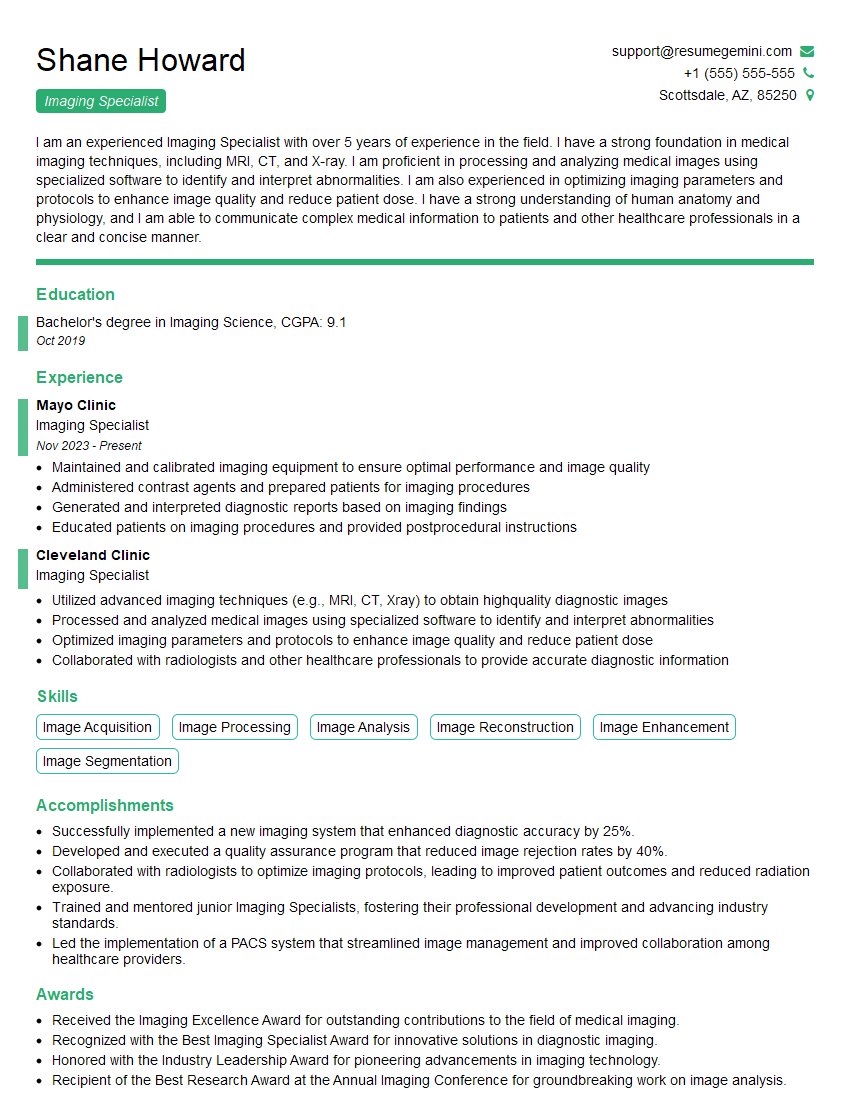
Mastering Image Quality Evaluation opens doors to exciting opportunities in various fields, from computer vision and multimedia to medical imaging and beyond. A strong understanding of this crucial area significantly enhances your career prospects. To maximize your chances, creating a compelling and ATS-friendly resume is essential. ResumeGemini is a trusted resource to help you build a professional resume that highlights your skills and experience effectively. We provide examples of resumes tailored to Image Quality Evaluation to guide you in crafting a winning application. Take the next step and build your dream career!

Explore more articles
Users Rating of Our Blogs
Share Your Experience
We value your feedback! Please rate our content and share your thoughts (optional).
What Readers Say About Our Blog
Very informative content, great job.
good