Interviews are opportunities to demonstrate your expertise, and this guide is here to help you shine. Explore the essential In-depth Knowledge of Lighting, Electronics, and Special Effects interview questions that employers frequently ask, paired with strategies for crafting responses that set you apart from the competition.
Questions Asked in In-depth Knowledge of Lighting, Electronics, and Special Effects Interview
Q 1. Explain the difference between HMI and LED lighting.
HMI (Hydrargyrum Medium-arc Iodide) and LED (Light Emitting Diode) lights are both powerful tools in the lighting industry, but they differ significantly in their technology, energy efficiency, and color rendering.
- HMI Lights: These lights use a high-intensity discharge arc lamp containing mercury iodide. They produce a bright, daylight-balanced light with excellent color rendition. However, they require a ballast to regulate power, generate significant heat, and are less energy-efficient compared to LEDs. They are known for their robust output and cinematic quality of light.
- LED Lights: LEDs are semiconductor devices that emit light when an electric current passes through them. They are highly energy-efficient, produce less heat, and have a much longer lifespan. LEDs come in various color temperatures and are easy to dim. However, high-power LEDs can still get warm and their color rendering, while improving rapidly, may not always match the superior quality of a well-calibrated HMI. Think of it this way: HMIs are like powerful, consistent spotlights; LEDs are more versatile and adaptable workhorses.
In short, HMIs are favored for their intense, crisp light quality suitable for large-scale productions and exterior shoots, while LEDs offer versatility, energy efficiency, and are increasingly preferred for smaller productions and applications where portability and power conservation are crucial.
Q 2. Describe your experience with different types of dimming systems.
My experience encompasses a variety of dimming systems, ranging from simple incandescent dimmers to sophisticated DMX-controlled LED systems.
- Incandescent Dimmers: These are the simplest, using a rheostat to control the voltage supplied to an incandescent bulb. They’re straightforward but inefficient, generating heat and only suitable for incandescent lamps.
- Triac Dimmers: These use a thyristor to control the AC waveform, enabling dimming of incandescent and halogen lamps, and some LED types but are less precise for LEDs.
- Electronic Dimmers (for LED): Specifically designed for LEDs, these dimmers provide constant current, avoiding flickering and prolonging the lifespan of the LEDs. They often incorporate features like programmable scenes and remote control.
- DMX-Controlled Systems: DMX (Digital Multiplex) is a widely adopted protocol for controlling lighting and other stage equipment. It allows for precise control of multiple lights, complex sequencing, and intricate lighting designs, commonly used in theatrical productions and large events.
I am proficient in troubleshooting issues with each type, from faulty wiring in simple systems to complex network issues with DMX setups. For example, I recently diagnosed a problem on set where some LED lights were flickering under DMX control, tracing the issue to a faulty DMX cable connection rather than a problem with the lights themselves.
Q 3. How do you troubleshoot a faulty lighting fixture on set?
Troubleshooting a faulty lighting fixture requires a systematic approach, prioritizing safety.
- Safety First: Always disconnect power to the fixture before any physical examination. Never work with live wires.
- Visual Inspection: Begin with a thorough visual inspection. Look for obvious signs of damage such as broken bulbs, frayed wiring, or loose connections.
- Check Power Supply: Ensure that power is reaching the fixture, checking fuses, breakers, and power cables. Sometimes the problem isn’t the fixture itself, but a simple power supply issue.
- Test Components: If possible, test individual components such as bulbs or ballasts to isolate the fault. For example, a simple bulb replacement might resolve the problem.
- Advanced Diagnostics: For more complex fixtures, I’d use a multimeter to check voltage and current readings. This helps pinpoint the exact location of the fault, whether it’s a short circuit, open circuit or a more complex issue with internal components.
- Documentation: Keep records of the troubleshooting steps, measurements taken, and any replacements made. This helps resolve future similar issues.
In one instance, a fixture on a film set wouldn’t turn on. Following these steps, we discovered a faulty ballast that needed replacement, resolving the issue quickly and minimizing production downtime.
Q 4. What safety precautions do you take when working with high-voltage equipment?
Safety is paramount when working with high-voltage equipment. I adhere to strict safety protocols including:
- Lockout/Tagout Procedures: Before working on any equipment, I always ensure the power is completely disconnected and locked out. I use lockout/tagout devices to prevent accidental re-energizing.
- Personal Protective Equipment (PPE): I always use appropriate PPE, including insulated gloves, safety glasses, and arc flash protective clothing as needed.
- Proper Training and Certification: I have undergone rigorous training on high-voltage safety procedures and possess relevant certifications, ensuring competence in handling such equipment.
- Working with a Partner: I always work with a partner whenever dealing with high voltage. This provides an extra level of safety and ensures someone is there to assist in case of an accident.
- Regular Inspections: I regularly inspect equipment for wear and tear, ensuring everything is in top condition to reduce the risk of malfunction.
My commitment to safety is unwavering, as even a minor mistake can have serious consequences. Following these protocols ensures a safe and productive work environment.
Q 5. Explain your understanding of color temperature and its impact on lighting design.
Color temperature is a crucial aspect of lighting design. It’s measured in Kelvin (K) and describes the perceived warmth or coolness of a light source. Lower Kelvin values (e.g., 2700K) represent warmer, more orange-toned light, while higher Kelvin values (e.g., 6500K) represent cooler, bluish light.
The impact on lighting design is substantial:
- Mood and Atmosphere: Warmer color temperatures create a cozy, intimate feeling, often used in restaurants or bedrooms. Cooler temperatures convey a sense of energy, professionalism, or sterility, common in offices or hospitals.
- Color Rendering: Different color temperatures affect how colors appear under the light. For example, skin tones may look warmer under lower Kelvin lights and cooler under higher ones.
- Consistency and Balance: Maintaining consistent color temperature throughout a scene is essential for a harmonious and balanced look. Inconsistent temperatures can create an unnatural or jarring effect.
For instance, when designing lighting for a dramatic scene, I might use a cooler color temperature to create tension, while a warmer temperature would be more appropriate for a romantic scene. Achieving the right color temperature is a key part of establishing the desired mood and visual aesthetics.
Q 6. Describe your experience with various types of lighting gels and their applications.
Lighting gels are thin, colored plastic films placed over lighting instruments to modify the color of the light. I have experience with a wide range of gels, including:
- CTO (Color Temperature Orange): Used to warm up cooler light sources, often used to match daylight-balanced lights with tungsten lights.
- CTB (Color Temperature Blue): Used to cool down warmer light sources. This is often used to balance tungsten lights with daylight.
- Color Gels: Available in a vast spectrum of colors, these gels allow for creative control over the color of the light. They can be used to create specific moods or highlight certain aspects of the scene.
- Diffusion Gels: These gels soften the light, reducing harsh shadows and creating a more diffused look.
- Frost Gels: Similar to diffusion gels, but these create a softer, more even diffusion.
Selecting the correct gel depends on the specific lighting needs of the scene. For example, to create a sunset effect, I might use a combination of CTO and a reddish-orange color gel, whereas to highlight a specific object, a saturated color gel might be employed. The application is highly contextual, requiring artistic judgment.
Q 7. How do you calculate the power requirements for a lighting setup?
Calculating power requirements for a lighting setup involves summing the power consumption of each individual light fixture. The process is straightforward but requires meticulous attention to detail.
- Identify each fixture and its wattage: This information can be found on the fixture itself or in its specifications. For example, a 1000-watt HMI would consume 1000 watts of power.
- Add up the wattage of all fixtures: Sum the wattage of all the lights, taking into account the number of each type. For example, 5 x 1000-watt HMIs and 10 x 100-watt LEDs would total 5000 + 1000 = 6000 watts.
- Add power for accessories: Consider additional power requirements for dimmers, power distribution units, and other accessories. Each item consumes power and should be accounted for.
- Account for power factor (PF): This is important for lights with electronic ballasts (like HMIs). The PF represents how effectively the power is used. A lower PF means you’ll need more power than just the wattage suggests.
- Calculate the total power demand: Add the power consumption of all lights and accessories, considering the PF.
- Choose appropriate power supply: Ensure the power supply has sufficient capacity to handle the total power demand. It’s wise to have a safety margin of around 10-20% to avoid overloading the system.
It’s crucial to carefully document this calculation for safety and efficiency. Incorrect power calculations can lead to overloading circuits, which can be dangerous and cause equipment failure. I always overestimate the power needed to account for unexpected factors.
Q 8. What are the different types of electronic circuits used in special effects?
Electronic circuits are the backbone of many special effects, enabling precise control and complex sequences. Different types are used depending on the effect’s needs. For example:
Simple switching circuits: These use relays or transistors to switch high-voltage circuits on and off for things like lighting strikes or explosions (simulated, of course!). A simple example would be using a relay controlled by a microcontroller to trigger a high-powered strobe light.
Timing circuits: These control the duration and sequencing of effects, crucial for synchronized pyrotechnics or lighting changes. 555 timers are classic examples, often used to create precise delays in a sequence. Imagine a sequence of colored lights changing at specific intervals for a theatrical production.
Amplifier circuits: These boost weak signals to control powerful actuators, like motors for moving platforms or solenoids for launching projectiles. Operational amplifiers (op-amps) are commonly used for their versatility and ability to handle both small control signals and large output currents.
Signal processing circuits: These circuits can modify signals, creating effects like fading, pulsing, or other dynamic changes in intensity or color. These often include microcontrollers or specialized integrated circuits for sophisticated control.
Power supplies: Crucial for ensuring the right voltage and current are delivered to various components. These can range from simple linear regulators to complex switching power supplies needed for high-power effects.
Q 9. Explain your experience with microcontrollers and their applications in special effects.
Microcontrollers are indispensable in modern special effects. Their programmability allows for precise timing, complex sequencing, and real-time control. I’ve extensively used Arduino and Raspberry Pi platforms in various projects.
For instance, I programmed an Arduino to control a series of LEDs to simulate flickering flames for a haunted house. The code incorporated random variations in brightness and timing to achieve a realistic effect. In another project, a Raspberry Pi controlled a complex robotic arm used for precise pyrotechnic deployment, ensuring safety and accuracy.
// Example Arduino code snippet for flickering LED
int ledPin = 9;
void setup() {
  pinMode(ledPin, OUTPUT);
}
void loop() {
  int brightness = random(0, 255);
  analogWrite(ledPin, brightness);
  delay(random(10, 100));
}
The power of microcontrollers lies in their ability to integrate multiple sensors and actuators, creating sophisticated and interactive effects that respond to real-time conditions.
Q 10. Describe your experience with different types of sensors used in special effects.
Sensors play a vital role in creating responsive and interactive special effects. My experience encompasses a range of sensor types:
Proximity sensors: These detect the presence of objects without physical contact, often used for triggering effects based on an actor’s position on stage. Infrared sensors and ultrasonic sensors are common choices. For example, I used an ultrasonic sensor to trigger a fog machine when an actor approached a specific area on stage.
Light sensors: These measure ambient light levels, allowing effects to adapt to changing lighting conditions. Photoresistors and photodiodes are frequently used. Imagine a scene where the intensity of a projected image changes dynamically based on the ambient light.
Pressure sensors: These detect pressure changes, useful for triggering effects based on physical interaction, such as footsteps triggering a sound effect or a pressure plate triggering a trap door. These are often used in interactive installations or escape rooms.
Accelerometers/Gyroscopes: These detect motion and orientation, useful for creating effects that react to movement, such as shaking a prop to trigger an explosion (simulated, of course). I utilized these to make a prop weapon react to the way an actor held it, adding realism to an action sequence.
The choice of sensor depends entirely on the specific effect being designed. Understanding the limitations and capabilities of each type is essential for successful implementation.
Q 11. How do you design and implement a safety system for pyrotechnics?
Safety is paramount when working with pyrotechnics. A robust safety system is a multi-layered approach:
Remote initiation: Pyrotechnics should never be initiated manually at close range. Remote triggering systems using radio signals or wired connections allow for safe operation from a distance.
Redundant systems: Employ multiple safety mechanisms. For example, a system might include both a primary and a backup firing system, ensuring that if one fails, the other can prevent accidental firing.
Ignition monitoring: Monitor the firing process to ensure that each device fires correctly. A failure to fire could mean a potentially dangerous live device remaining in place.
Emergency shutdown: A readily available and easily accessible emergency shutdown mechanism must be implemented to quickly halt the entire system in case of an emergency.
Clear communication: Effective communication between the pyrotechnician, the director, and the rest of the crew is absolutely vital. It allows everyone to remain informed during the setup and execution process.
Containment and suppression: Design the firing area to contain potential hazards. Fire extinguishers, sand, and other suppression systems should be readily available.
Regular inspections and maintenance of the pyrotechnic systems and related safety equipment are also crucial for ongoing safety.
Q 12. What are the different types of pyrotechnics and their applications?
Pyrotechnics encompass a wide variety of effects, each with specific applications:
Flash powder: Produces a bright flash of light, often used for simulated explosions or gunfire.
Black powder: A slower-burning powder, used for creating smoke, flame, or loud bangs. The amount of black powder used dictates the intensity of the effect.
Colored flame effects: Various chemicals added to pyrotechnic compositions produce different colored flames, vital for creating visually stunning effects.
Smoke effects: Generate varying amounts of colored or white smoke, crucial for creating atmospheric effects or obscuring vision for dramatic impact.
Sparkler effects: These generate showers of sparks, adding a shimmering or fiery element to a scene.
Fireworks: These range from small, handheld devices to large, aerial displays, each with different characteristics.
The selection of pyrotechnics is dictated by the desired effect, the safety regulations, and the environment.
Q 13. How do you troubleshoot a malfunctioning special effects device?
Troubleshooting malfunctioning special effects devices requires a systematic approach:
Safety first: Ensure the power is disconnected before attempting any repairs. Never work on live equipment.
Visual inspection: Carefully inspect all wiring, connections, and components for visible damage or loose connections.
Component testing: Use multimeters or other testing equipment to check the functionality of individual components, such as LEDs, sensors, or microcontrollers.
Signal tracing: If the problem is more complex, trace the signal path through the circuit to identify the point of failure. An oscilloscope can be very helpful here.
Code review (if applicable): If a microcontroller is involved, review the code for errors or logical flaws. Debugging tools and simulators can be invaluable.
Documentation: Thorough documentation of the system is essential for troubleshooting. Schematics, wiring diagrams, and code comments greatly simplify this process.
A systematic approach increases the likelihood of identifying and fixing the problem quickly and efficiently, minimizing downtime and ensuring safety.
Q 14. Explain your experience with different types of rigging techniques.
Rigging techniques are critical for safely suspending lights, speakers, or other equipment for special effects. My experience covers a range of techniques:
Counterweight systems: These use weights to balance the load, ensuring safe and controlled movement of heavy equipment.
Motorized rigging systems: These use electric motors for precise and automated control of lighting or other stage elements. This is particularly crucial for complex, synchronized effects.
Cable management: Proper cable routing and securing are critical for safety and to prevent tripping hazards.
Knot tying: Mastering various knot types is essential for secure and reliable rigging. Different knots have different strengths and applications.
Safety inspections: Rigging systems must be regularly inspected to ensure their integrity and safety. Any potential issues should be dealt with immediately.
Safety is paramount in rigging. Improper techniques can lead to serious accidents. Adherence to safety regulations and best practices is non-negotiable.
Q 15. Describe your experience with different types of rigging hardware.
My experience with rigging hardware encompasses a wide range of equipment, crucial for safely suspending lights, cameras, and other equipment on set. This includes understanding the strength and limitations of different materials, proper knot-tying techniques for safety, and the regulations surrounding weight capacity.
- Chain hoists: I’m proficient in using various chain hoists, from manual hand-chain hoists to electric chain motors, understanding their load capacities and the importance of regular inspections for wear and tear. For example, on a recent shoot, we used a 2-ton electric chain hoist to lift a large LED panel.
- Steel cables and wire rope: I have experience with selecting the appropriate diameter and construction of steel cables and wire rope based on the weight and application. This includes understanding the importance of proper crimping and swaging techniques to ensure secure connections.
- Scaffolding and platforms: Safety is paramount. I’m experienced in setting up and inspecting scaffolding and platforms to ensure they are stable and compliant with all relevant safety regulations before any equipment is placed on them. I always check for proper bracing and load distribution.
- Connectors and shackles: I understand the importance of using correctly sized and rated connectors and shackles, ensuring compatibility and avoiding weak points in the rigging system. Each piece must be inspected to prevent failure.
My experience ensures the safe and efficient execution of rigging tasks, minimizing risk and maximizing productivity on set.
Career Expert Tips:
- Ace those interviews! Prepare effectively by reviewing the Top 50 Most Common Interview Questions on ResumeGemini.
- Navigate your job search with confidence! Explore a wide range of Career Tips on ResumeGemini. Learn about common challenges and recommendations to overcome them.
- Craft the perfect resume! Master the Art of Resume Writing with ResumeGemini’s guide. Showcase your unique qualifications and achievements effectively.
- Don’t miss out on holiday savings! Build your dream resume with ResumeGemini’s ATS optimized templates.
Q 16. How do you ensure the safety of actors and crew during special effects sequences?
Ensuring the safety of actors and crew during special effects is paramount. It involves a multi-layered approach, combining meticulous planning, rigorous safety protocols, and constant vigilance.
- Risk assessment: Before any special effects sequence, we conduct a thorough risk assessment, identifying potential hazards and developing mitigation strategies. This includes analyzing the specific effects, the environment, and the actors’ movements.
- Safety briefing: A comprehensive safety briefing is mandatory for all crew members involved, explaining potential risks, emergency procedures, and the use of safety equipment. This briefing is tailored to the specific effects being used.
- Protective equipment: The appropriate personal protective equipment (PPE) is provided and its proper use is enforced. This includes items like fire-retardant clothing, eye protection, hearing protection, and respiratory protection depending on the specific effects.
- Controlled environment: The special effects environment is carefully controlled, minimizing hazards as much as possible. This could involve using safety barriers, isolating the effect area, or employing spotters and safety personnel.
- Rehearsals and testing: We rehearse the sequence multiple times, ensuring everyone understands their role and the timing is precise. We then conduct test runs of the effects to ensure they function as intended and pose no unexpected risks.
- Emergency procedures: We establish clear emergency procedures and communicate these to everyone involved. This includes evacuation plans, first aid protocols, and contact information for emergency services.
By adopting this layered approach, we minimize risks, protect our personnel, and ensure the safe and successful execution of special effects sequences.
Q 17. Explain your understanding of the electrical code relevant to film/TV production.
My understanding of the electrical code relevant to film/TV production is comprehensive, encompassing national and local regulations. It’s crucial for safety and legal compliance. This involves knowledge of:
- Voltage and amperage: I understand the dangers of high voltage and amperage, ensuring that all equipment is appropriately rated and protected. Mismatched equipment can lead to fires and serious injury.
- Grounding and bonding: Proper grounding and bonding are critical to preventing electrical shocks and fires. I know how to use ground fault circuit interrupters (GFCIs) and ensure that all metal parts of equipment are properly grounded.
- Cable management: Proper cable management is essential to avoid tripping hazards and prevent damage to cables. This includes using cable protectors, labeling cables clearly, and securing them appropriately.
- Lighting equipment: I’m familiar with the specific electrical requirements for various lighting instruments and their power distribution, including using appropriate dimmers, power distribution units, and cable connectors.
- Safety inspections: Regular safety inspections are vital, checking for damaged cables, loose connections, and overloaded circuits. This proactive approach helps prevent accidents.
I ensure all electrical work adheres to the relevant codes and regulations, protecting the safety of both the crew and the equipment. Ignoring these codes can result in significant fines, insurance issues, and potentially life-threatening situations.
Q 18. Describe your experience with different types of lighting instruments.
My experience with lighting instruments is extensive, covering a wide range of technologies and applications. I’m adept at choosing the right instrument for specific needs, considering factors like intensity, color temperature, beam angle, and power requirements.
- Tungsten lights: I have experience with various tungsten instruments, from Fresnel lenses to open-faced lights, understanding their characteristics and the need for careful handling due to heat generation.
- LED lights: I’m proficient in using LED lights, including panels, tubes, and fixtures, appreciating their energy efficiency, color rendering, and controllability. I can adjust color temperature and intensity with precision.
- HMI lights: I’m familiar with HMI (Hydrargyrum Medium-arc Iodide) lights, powerful and efficient but requiring special handling and safety precautions due to their intense light output and high voltage.
- Fluorescent lights: I understand the use of fluorescent lights, especially for practical applications and background lighting, balancing their output and color characteristics with other light sources.
- Moving lights: I have experience with various types of moving lights, including profile, wash, and beam lights, understanding their functionalities and programming for complex lighting effects. These require specialized software and control systems.
The choice of lighting instrument is highly context-dependent and requires a thorough understanding of the scene and desired effect. I tailor my choice to create the best possible lighting design.
Q 19. How do you create a lighting plot?
Creating a lighting plot is a systematic process that involves translating a director’s vision into a detailed plan for illuminating a scene. It’s the blueprint for the lighting setup, including instrument placement, color, intensity, and aiming.
- Scene analysis: First, I carefully analyze the scene, considering the mood, atmosphere, and story being told. What emotions should the lighting evoke? What are the key elements that need highlighting?
- Instrument selection: Based on the scene analysis, I select appropriate lighting instruments, considering their properties and the lighting needs. For example, a soft, diffused light might be used for a romantic scene, while sharp, directional light might be used for a dramatic one.
- Placement and aiming: I meticulously plan the placement and aiming of each light, ensuring proper coverage and avoiding unwanted shadows or reflections. A lighting diagram is crucial at this stage.
- Color and intensity: I determine the color temperature and intensity of each light to achieve the desired look and feel. Gel filters can modify the color of the light.
- Safety considerations: Throughout the process, safety is paramount. I ensure that all lights are securely rigged and positioned safely, considering weight limitations and potential hazards.
- Software implementation: The lighting plot is often translated into a lighting control console or software program to easily manage and control the lights during filming. This allows for precise adjustments and quick changes.
The result is a precise plan ensuring the lights enhance the scene’s narrative and create the desired visual impact, within a safe and efficient framework. The plot serves as a guide for the lighting crew during setup and filming.
Q 20. What software are you proficient in for lighting design and control?
I’m proficient in several software packages for lighting design and control. My expertise enhances efficiency and precision in creating and implementing lighting plans.
- Vectorworks: I use Vectorworks for creating detailed lighting plots, including precise instrument placement, aiming, and color specifications. Its 2D and 3D capabilities allow for thorough visualization and planning.
- ETC Eos family: I’m skilled in using the ETC Eos family of lighting consoles for controlling and programming complex lighting setups. This includes creating cues, chases, and other dynamic lighting effects.
- MA Lighting grandMA2: I also have experience with the MA Lighting grandMA2 console, known for its power and versatility in large-scale productions. It’s capable of controlling vast numbers of lighting fixtures.
- WYSIWYG: For complex visualisations and pre-visualisation, I utilise WYSIWYG to simulate lighting setups accurately. This allows us to test lighting configurations before they are implemented on set.
My proficiency in these software packages allows me to create and manage complex lighting designs efficiently and effectively, while providing a clear and detailed blueprint for the lighting crew.
Q 21. Describe your experience with different types of camera systems and their lighting requirements.
My experience with different camera systems and their lighting requirements is extensive, recognising that lighting needs vary significantly based on the camera’s sensor sensitivity, lens, and intended use.
- Film cameras: Film cameras typically require more light than digital cameras due to their lower sensitivity. I understand how to manage light levels to avoid overexposure or underexposure, ensuring proper image capture and minimizing grain.
- Digital cinema cameras: Digital cinema cameras have varying sensitivities, with some requiring less light than film. I’m adept at managing this dynamic range, understanding the relationship between ISO, aperture, and shutter speed. High dynamic range (HDR) capture requires careful consideration of exposure latitude.
- Broadcast cameras: Broadcast cameras often require precise lighting for accurate color reproduction and consistent image quality across different lighting conditions. I understand the importance of maintaining a balanced exposure for live broadcasts.
- Sensor size and lens considerations: The camera’s sensor size influences the depth of field and light gathering capabilities. Wider lenses demand more light than narrower telephoto lenses. I adjust lighting to compensate for these factors.
- Lighting styles: Depending on the camera system and desired look, different lighting styles are used. For instance, a highly contrasted, cinematic look might require more strategic lighting compared to a naturalistic or documentary style.
Understanding the nuances of each camera system and its lighting requirements is crucial for achieving the desired visual quality and avoiding technical issues. This holistic approach to camera and lighting interaction ensures a successful production.
Q 22. Explain your understanding of lighting ratios and their impact on the look of a scene.
Lighting ratios are the relative intensities of different light sources in a scene. They dramatically impact mood, depth, and the overall visual storytelling. A high-key scene, for instance, might have a ratio of 2:1 or 3:1 between the key light and the fill light, resulting in bright, cheerful visuals. This means the key light is two or three times brighter than the fill light. Conversely, a low-key scene might use a ratio of 8:1 or even higher, creating a darker, more dramatic mood with deep shadows.
Think of it like painting with light. A high ratio is like using bold strokes of light and dark, defining strong contrasts. A low ratio is like using soft blends, creating a more even, diffused look. For example, a romantic scene might employ a lower ratio to soften features and create a warmer ambiance, whereas a horror scene might benefit from a higher ratio to create suspense and shadows that conceal threats. The specific ratio depends entirely on the desired mood and aesthetic.
- Key Light: The primary light source, defining the subject’s main illumination.
- Fill Light: A softer light source used to reduce shadows cast by the key light and fill in details.
- Back Light: Light shining from behind the subject, separating it from the background and adding depth.
Q 23. How do you handle unexpected issues with lighting or special effects on set?
Handling unexpected issues on set requires quick thinking, resourcefulness, and a cool head. My approach involves a structured problem-solving process:
- Assessment: Quickly identify the nature and extent of the problem. Is it a blown bulb? A malfunctioning generator? A sudden power outage? Understanding the root cause is crucial.
- Communication: Immediately communicate the issue to the director and other relevant team members. Transparency prevents misunderstandings and allows for collective problem-solving.
- Solutions: Brainstorm potential solutions. This often involves improvisation. Could we use a different light source temporarily? Can we adjust the camera angle to minimize the impact of the issue? Do we have backup equipment?
- Implementation: Implement the chosen solution as efficiently as possible, always prioritizing safety. If the problem requires specialist expertise, I would delegate accordingly.
- Documentation: After resolving the issue, document what happened, the solution implemented, and lessons learned for future reference. This helps improve efficiency and prevent similar problems in the future.
For instance, if a crucial lighting fixture fails mid-shot, I might immediately switch to a backup fixture, while simultaneously requesting the crew to repair or replace the original. Meanwhile, I’d communicate with the director on how this might impact the shot and adapt the lighting accordingly.
Q 24. Describe your problem-solving skills in a high-pressure environment.
High-pressure environments demand efficient decision-making and swift action. My problem-solving approach is rooted in a combination of technical expertise, teamwork, and a systematic approach. I excel under pressure because I focus on breaking down complex problems into smaller, manageable tasks. I prioritize clear communication, keeping everyone informed of the situation and the steps being taken to resolve it.
For example, during a live broadcast, a sudden power surge caused multiple lighting fixtures to malfunction. Instead of panicking, I quickly assessed the damage, immediately switched to backup power sources, and delegated tasks to my team: one to check the faulty units, another to adjust the remaining lights, and a third to ensure the power supply was stable. Through coordinated efforts and clear instructions, we restored the lighting within minutes, ensuring the broadcast continued without interruption.
Q 25. Explain your experience with budgeting and scheduling for lighting and special effects.
Budgeting and scheduling for lighting and special effects is crucial for project success. I have extensive experience in creating detailed budgets that account for all equipment, personnel, and potential contingencies. This includes costs for rentals, consumables (e.g., gels, bulbs), and labor. I use project management software to create detailed schedules, breaking down tasks into smaller units with assigned responsibilities and timelines. I regularly monitor progress against the schedule and budget, alerting stakeholders of any potential issues or delays.
For example, before a large-scale production, I’d create a spreadsheet detailing each lighting fixture required, its rental cost, the number of technicians needed, their hourly rates, and the transportation costs. This ensures that all expenses are considered in advance and prevents budget overruns. The scheduling process involves creating a detailed Gantt chart that visualizes the tasks, their dependencies, and deadlines, enabling efficient resource allocation and timely completion of all work.
Q 26. Describe your experience working with different types of generators.
I am experienced with various types of generators, from smaller portable units for location shoots to larger, more powerful generators needed for extensive productions. My knowledge includes diesel, gasoline, and propane-powered generators. I understand the importance of selecting the appropriate generator based on power requirements, fuel efficiency, noise levels, and environmental considerations. Safety is paramount, and I am well-versed in generator safety procedures, including proper grounding, ventilation, and fuel handling. I can perform routine maintenance on generators, troubleshoot common issues, and ensure that all generators are correctly connected and operate safely throughout the production.
For example, on a remote location shoot, we had to choose between a quieter but less powerful gasoline generator and a noisier but more powerful diesel unit. After careful consideration of power needs for the lighting and other equipment, and taking into account potential noise disruption to the surrounding area, we selected the diesel generator, implementing noise reduction measures to mitigate the impact on the location.
Q 27. How do you maintain and troubleshoot lighting and special effects equipment?
Maintaining and troubleshooting lighting and special effects equipment is an integral part of my work. This involves regular inspections, cleaning, and preventative maintenance to ensure equipment is in optimal working condition. I’m proficient in diagnosing and resolving common issues, such as replacing bulbs, repairing wiring, cleaning lenses, and calibrating equipment. My knowledge extends to the safe handling and storage of equipment to extend its lifespan. I’m adept at using diagnostic tools and manufacturer documentation to pinpoint the root cause of problems.
For example, if a strobe light starts flickering, I’d first visually inspect the unit for any loose connections or physical damage. If that’s inconclusive, I’d check the power supply and then move to more in-depth troubleshooting, using a multimeter to test voltage and current levels. Manufacturer documentation is often invaluable in identifying and resolving the issue efficiently.
Q 28. What are the latest trends in lighting and special effects technology?
The lighting and special effects industry is constantly evolving. Several key trends are shaping the field:
- LED Technology advancements: LED lighting is becoming increasingly sophisticated, offering greater color accuracy, energy efficiency, and controllability. We are seeing the rise of LED fixtures with tunable white capabilities and incredibly high output, coupled with miniaturization for flexibility.
- Virtual Production: The integration of virtual sets and real-time compositing is revolutionizing filmmaking, allowing for complex special effects to be created on set in real time, rather than entirely in post-production. This involves using LED screens to project virtual environments onto sets and syncing cameras to seamlessly blend reality and virtual elements.
- Improved DMX and network control: Wireless and networked lighting control systems are enhancing control and efficiency, particularly on large-scale productions. Advanced software allows lighting designers to program and manage lighting cues and effects remotely, improving efficiency and flexibility.
- AI and Machine Learning in VFX: Artificial intelligence is starting to automate various VFX tasks like rotoscoping and object removal, improving speed and accuracy. Machine learning is contributing to more realistic and efficient processes in visual effects.
Keeping abreast of these trends is crucial for remaining competitive and delivering high-quality, innovative work.
Key Topics to Learn for In-depth Knowledge of Lighting, Electronics, and Special Effects Interview
- Lighting Fundamentals: Color temperature, light intensity (lux, foot-candles), light diffusion and control techniques (barn doors, gels, flags), three-point lighting setup, and different lighting styles (high-key, low-key).
- Lighting Equipment: Practical knowledge of various lighting instruments (Fresnels, PARs, LEDs, HMI), their applications, and limitations. Understanding dimmer control and power distribution.
- Electronics for Special Effects: Circuit design basics, understanding of microcontrollers (Arduino, Raspberry Pi) and their applications in lighting control and special effects. Familiarity with sensor technology (photoresistors, proximity sensors).
- Special Effects Techniques: Practical experience with creating various special effects (fog, smoke, haze), pyrotechnics (if applicable and safe), and practical application of lighting to create specific moods and atmospheres.
- Safety Protocols: Understanding and adhering to electrical safety regulations, handling of hazardous materials, and safe working practices in a studio or on location.
- Troubleshooting & Problem Solving: Diagnosing and resolving technical issues related to lighting, electronics, and special effects equipment. Demonstrating analytical and problem-solving skills.
- Software & Technologies: Familiarity with relevant software (lighting control consoles, 3D modeling software for lighting design, etc.) and industry-standard technologies.
- Workflow & Collaboration: Understanding the collaborative nature of filmmaking or stage production, and the importance of effective communication with other crew members.
Next Steps
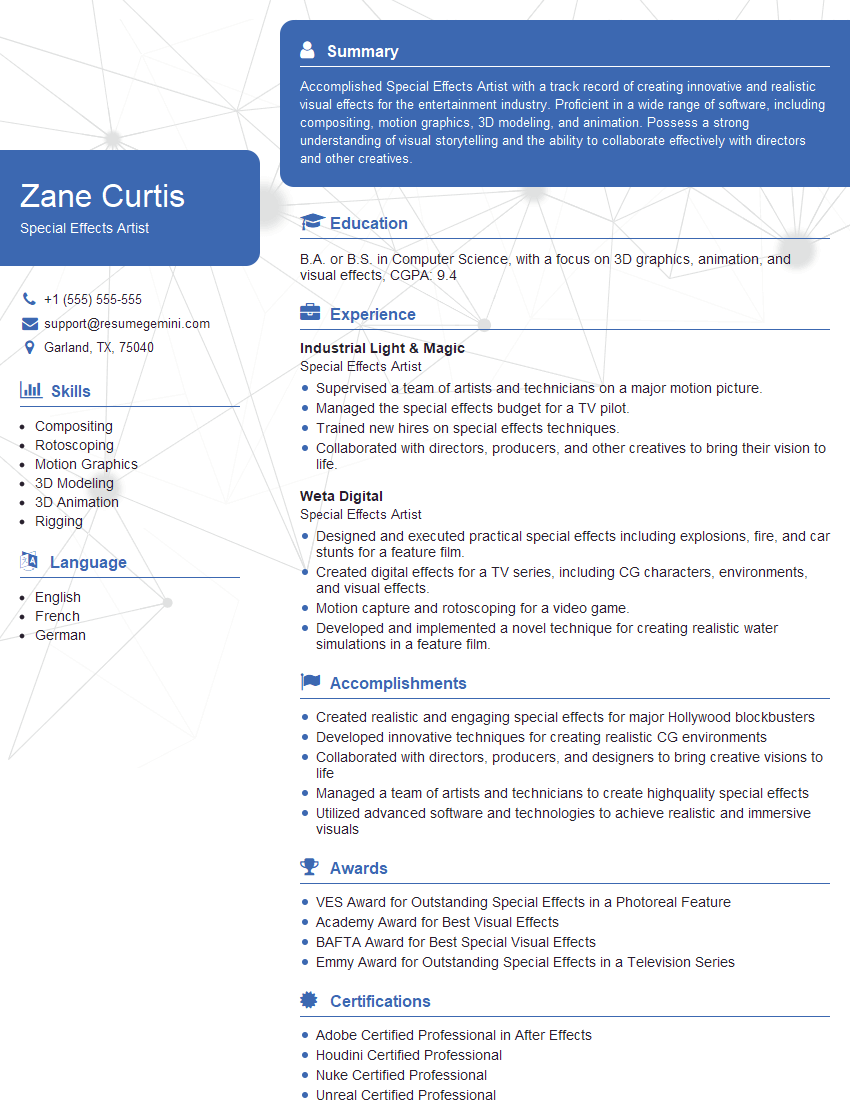
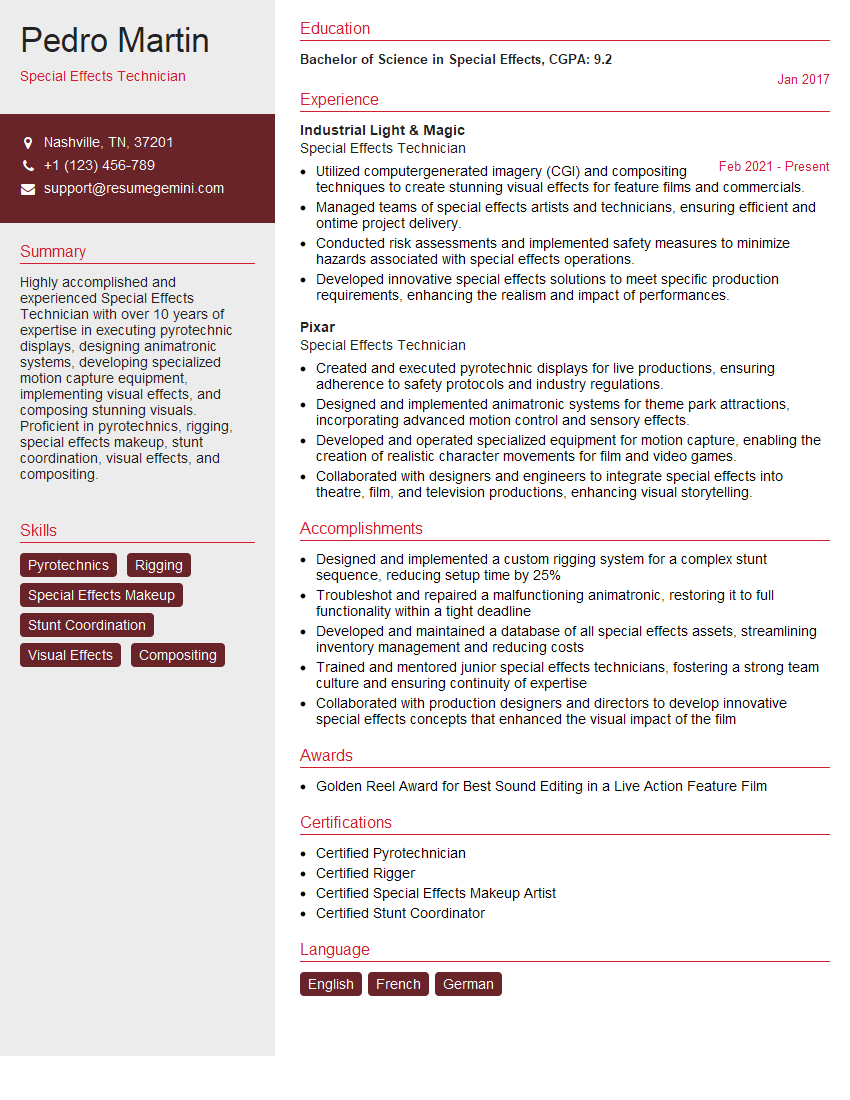
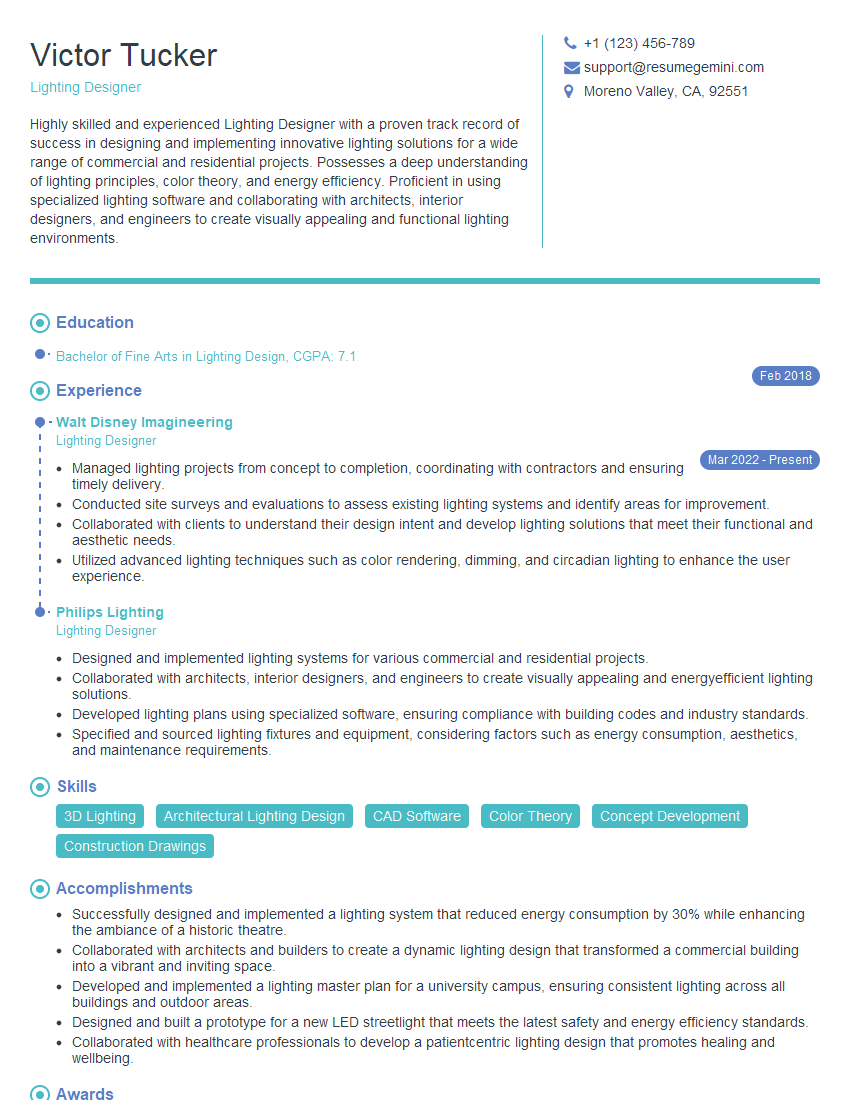
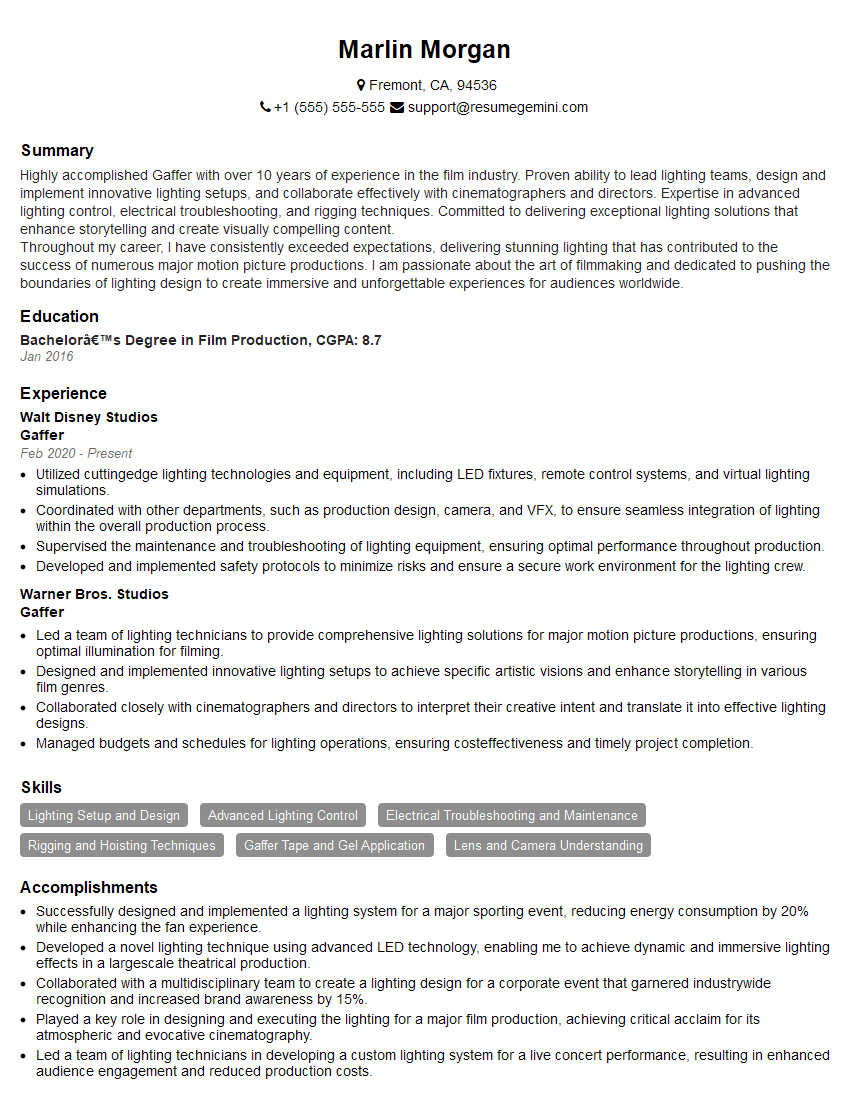
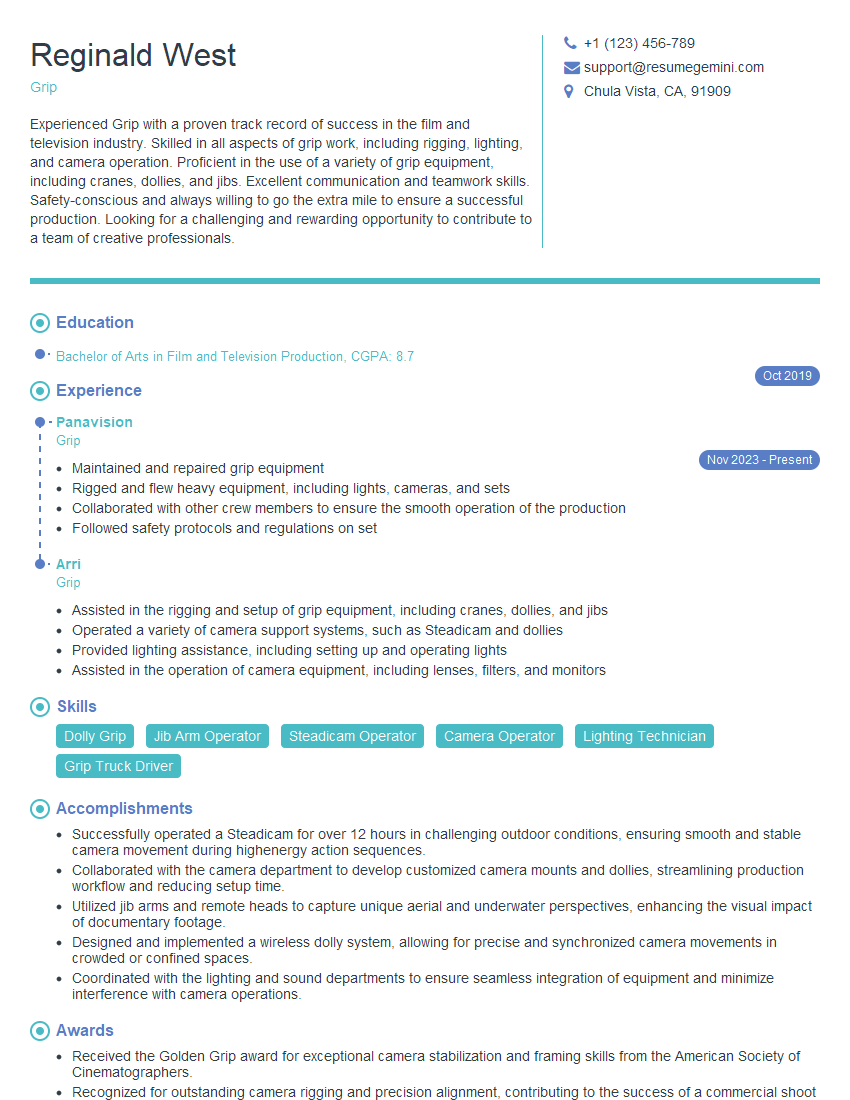
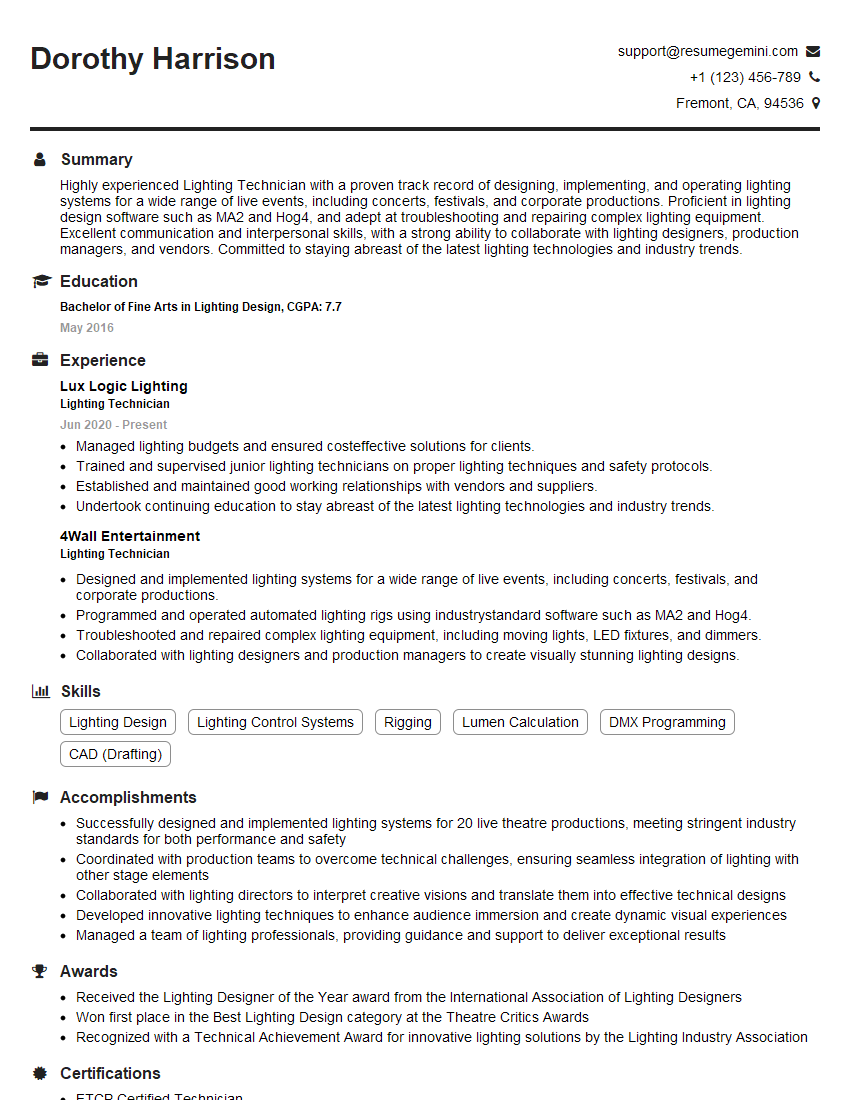
Mastering in-depth knowledge of lighting, electronics, and special effects is crucial for career advancement in film, theatre, events, or any field involving visual storytelling. A strong understanding of these areas demonstrates technical proficiency and problem-solving skills highly valued by employers. To significantly boost your job prospects, focus on crafting an ATS-friendly resume that highlights your skills and experience effectively. ResumeGemini is a trusted resource that can help you build a professional and impactful resume. Examples of resumes tailored to showcasing expertise in lighting, electronics, and special effects are available to guide you through the process.

Explore more articles
Users Rating of Our Blogs
Share Your Experience
We value your feedback! Please rate our content and share your thoughts (optional).
What Readers Say About Our Blog
Very informative content, great job.
good