The right preparation can turn an interview into an opportunity to showcase your expertise. This guide to Irrigation Systems Maintenance interview questions is your ultimate resource, providing key insights and tips to help you ace your responses and stand out as a top candidate.
Questions Asked in Irrigation Systems Maintenance Interview
Q 1. Describe your experience with different irrigation system types (e.g., drip, sprinkler, subsurface).
My experience spans across various irrigation system types, each with its own strengths and weaknesses. I’ve worked extensively with drip irrigation, sprinkler systems (both impact and rotor), and subsurface irrigation. Drip irrigation, for example, is highly efficient for delivering water directly to plant roots, minimizing water waste and maximizing water uptake. I’ve designed and maintained systems using both low-pressure, gravity-fed drip lines and pressure-compensating emitters for uneven terrain. Sprinkler systems, on the other hand, are well-suited for larger areas and offer flexibility in coverage patterns, though they are more prone to water loss through evaporation and wind drift. I’ve had experience with various nozzle types and pressure regulators to optimize sprinkler performance. Subsurface drip irrigation offers the advantages of both, conserving water while being suitable for larger areas; however, it demands careful system design and maintenance to prevent clogging. I’ve overseen the installation and maintenance of numerous subsurface systems, focusing on proper pipe layout and filter system implementation.
- Drip Irrigation: I once worked on a project where we replaced a poorly designed drip system with a pressure-compensating system, resulting in a 30% increase in water efficiency and a significant reduction in plant stress.
- Sprinkler Irrigation: In another project, I optimized the nozzle selection and spacing on a large-scale sprinkler system, lowering the water pressure and reducing water waste without impacting coverage.
- Subsurface Irrigation: I’ve successfully troubleshooted several clogged subsurface lines by implementing regular flushing schedules and employing specific cleaning solutions.
Q 2. Explain the process of troubleshooting a malfunctioning irrigation system.
Troubleshooting a malfunctioning irrigation system involves a systematic approach. It starts with identifying the specific problem – is it a lack of water in certain zones, low pressure throughout, or completely non-functional zones? I begin by inspecting the controller, checking if the valves are functioning correctly, ensuring the power supply is adequate, and verifying the programmed schedules. Next, I move to the pipes and fittings, checking for leaks or blockages. This often involves physically walking the lines, paying close attention to sounds (hissing suggests leaks), and visually inspecting for any obvious issues. I use a pressure gauge to measure water pressure at different points in the system, enabling me to pinpoint the problem area. For drip systems, I might use a flow meter to check emitter output. Finally, I’ll check the pump itself for proper operation and pressure. If the issue isn’t readily apparent, I’ll leverage tools like a pipe locator to pinpoint underground leaks or employ specialized equipment, such as a pressure testing system, to isolate the problem area.
Think of it like diagnosing a car problem; you wouldn’t start by replacing the engine without checking simpler things like the battery first.
Q 3. How do you identify and repair leaks in an irrigation system?
Identifying and repairing leaks is crucial for maintaining water efficiency and system integrity. Small leaks can often be detected by observing damp soil, lower-than-expected water pressure, or even listening for hissing sounds. Larger leaks will typically result in readily visible water flow. I use different methods depending on the type of leak and its location. For above-ground leaks, I would repair damaged fittings or replace sections of pipe. For underground leaks, I typically employ a combination of strategies. A pipe locator can help pinpoint the approximate location, and then careful excavation reveals the problem. Once the source of the leak is identified, the damaged section is repaired or replaced. Before backfilling, I’ll thoroughly pressure test the repaired area to ensure the leak has been completely sealed. For smaller, hard-to-locate leaks, I might utilize a leak detection dye or acoustic leak detection equipment.
For instance, I once used an acoustic leak detector to locate a pinhole leak in a buried PVC pipe; this saved significant time and effort compared to digging up a large area blindly.
Q 4. What are the common causes of low water pressure in an irrigation system?
Low water pressure in an irrigation system can stem from several sources. One common cause is a clogged filter; sediments and debris can restrict water flow, resulting in reduced pressure. Another frequent culprit is a partially closed valve, either intentionally or due to malfunction. A failing pump, due to wear and tear, reduced impeller efficiency or issues with its motor, can significantly lower the water pressure. Leaks in the system, even small ones, will also reduce the overall pressure. Finally, inadequate water supply from the main source – such as a low water pressure from the municipality – can also cause reduced pressure throughout the irrigation network. Diagnosing the root cause often requires a combination of visual inspection, pressure measurements, and a thorough understanding of the system’s layout.
I remember one case where low water pressure was initially attributed to a faulty pump, but after a thorough check, we found that a build-up of sediment had completely blocked the system’s main filter.
Q 5. Describe your experience with various irrigation controllers and their programming.
I have extensive experience with a range of irrigation controllers, from simple, manually timed units to sophisticated weather-based systems. I’m proficient in programming various brands and models, setting up individual zones, adjusting watering times, and configuring rain delays. I understand the importance of proper programming to ensure efficient irrigation and avoid overwatering or underwatering. I’m comfortable working with both analog and digital controllers and am familiar with using various programming interfaces. I understand the benefits of using smart controllers that can integrate weather data, soil moisture sensors, and other smart devices for improved water management. I can also configure controllers for various irrigation system components like valves, pumps, and sensors.
For example, I recently programmed a smart controller that incorporates evapotranspiration data from a local weather station to fine-tune the irrigation schedule dynamically based on changing weather conditions.
Q 6. How do you maintain and service irrigation pumps?
Maintaining and servicing irrigation pumps involves a regular schedule of inspections and preventative maintenance. This includes visually inspecting the pump for any signs of damage or leaks, checking the pump’s motor for overheating, and lubricating moving parts as necessary. I regularly check the pump’s impeller for wear and tear. I also examine the pump’s seals and bearings for any signs of wear or damage. A crucial aspect is regularly cleaning the pump’s intake strainer to remove any debris that may be obstructing water flow. I also check the pressure gauge and amp meter readings to ensure the pump is operating within its normal parameters. If any problems are detected, I might perform repairs, such as replacing worn bearings, seals, or impellers; and major issues might necessitate the replacement of the pump. I also document all maintenance activities and repairs in a detailed log.
Similar to a car engine, a neglected pump will lead to costly repairs down the line. Regular maintenance extends its lifespan and efficiency.
Q 7. What are your methods for scheduling irrigation based on weather conditions?
Scheduling irrigation based on weather conditions is crucial for water conservation and optimized plant health. My approach involves using weather data, either from local weather stations or online resources, to predict evapotranspiration (ET) rates. ET refers to the combined loss of water from the soil through evaporation and from plants through transpiration. Higher ET rates indicate a greater need for irrigation. I use this data to adjust watering schedules, increasing watering duration during hot, dry periods and reducing it during cooler, wetter spells. Some controllers automatically incorporate weather data, while others require manual adjustments based on my analysis. In addition to ET, I also consider soil type, plant type, and the overall landscape conditions. This might include incorporating soil moisture sensors in the system to provide real-time feedback on soil moisture levels, allowing for a more precise and responsive irrigation schedule. This data-driven approach optimizes water usage and prevents both overwatering and underwatering.
For example, during a particularly dry spell, I adjusted our irrigation schedules based on daily ET data, resulting in significant water savings compared to the previous year without compromising plant health.
Q 8. Explain your experience with backflow prevention devices.
Backflow prevention devices are crucial for protecting potable water supplies from contamination. They prevent the backflow of non-potable water, such as irrigation water, into the municipal water system. I have extensive experience installing, testing, and maintaining various types, including pressure vacuum breakers (PVBs), reduced pressure zone backflow preventers (RPZs), and double check valve assemblies (DCVs). For example, I recently diagnosed a faulty PVB on a large commercial landscape, traced the issue to a damaged check valve, and replaced it, preventing a potential contamination incident. My experience includes working with different sizes and types of devices to ensure they are correctly sized for the application and meet all local regulations. I regularly conduct annual testing and maintenance, documenting all findings and ensuring compliance with relevant codes.
Understanding the specific needs of each system is key; a small residential system may only require a simple PVB, while a larger commercial system may demand a more sophisticated RPZ with regular testing by a certified backflow tester. Proper installation and maintenance is not only vital for safety, but it’s also crucial for avoiding costly repairs and potential legal consequences.
Q 9. Describe your experience with different types of irrigation valves and their maintenance.
Irrigation valves are the workhorses of any irrigation system, controlling water flow to different zones. I’ve worked with a wide range, including diaphragm valves, ball valves, and solenoid valves. Each has its own maintenance requirements. Diaphragm valves, for instance, are known for their durability but can require diaphragm replacement over time. I’ve encountered situations where mineral buildup had restricted the flow, necessitating a thorough cleaning. Solenoid valves, commonly used in automated systems, can suffer from sticking or malfunctioning solenoids, often due to debris or electrical issues. Regular inspection, lubrication (where appropriate), and solenoid cleaning usually resolve these issues. Ball valves, while simple, need occasional lubrication to ensure smooth operation and prevent leaks. My approach involves a preventative maintenance schedule for each valve type, tailored to its specific vulnerability. For example, in sandy soil conditions, we might need more frequent cleaning and inspections of filter screens on valves compared to a system with clay soil. Visual inspection, operation testing, and flushing are part of my standard maintenance procedure for all valve types.
Q 10. How do you perform regular maintenance checks on an irrigation system?
Regular maintenance checks are paramount for efficient and reliable system operation. My approach involves a multi-step process. Firstly, I perform a visual inspection of the entire system, checking for leaks, broken pipes, damaged sprinklers, and clogged emitters. Then, I systematically test each valve, verifying its proper operation and noting any issues. I also check pressure gauges at various points in the system to identify any pressure drops indicating leaks or blockages. This is followed by thorough cleaning of filters and screens, which often accumulate debris and reduce efficiency. Finally, I inspect all backflow preventers and conduct annual testing as required by code. I document all findings, repairs, and maintenance activities in a detailed report, which helps in tracking system performance and planning future maintenance.
Think of it like a car’s regular check-up. Regular servicing prevents larger, more expensive problems down the road. A missed leak could lead to significant water waste and landscape damage. By performing these checks regularly, we catch minor issues before they escalate.
Q 11. What safety precautions do you take when working with irrigation systems?
Safety is always my top priority. Working with irrigation systems involves handling pressurized water and potentially exposed electrical components. I always start by turning off the main water supply before beginning any work. I wear appropriate personal protective equipment (PPE), including safety glasses, gloves, and sturdy footwear. When working near electrical components, I ensure the power is disconnected and locked out to prevent accidental shocks. I also exercise caution when digging near underground pipes to prevent damage and potential injuries. Furthermore, I’m aware of potential hazards like exposure to the sun and heat during outdoor work and take the necessary precautions, including wearing sunscreen and staying hydrated. All team members are briefed on safety protocols before commencing any work on irrigation systems.
Q 12. How do you manage irrigation system repairs during peak seasons?
Peak seasons present a unique challenge, as demands are high and downtime needs to be minimized. My strategy involves prioritizing repairs based on their urgency and impact. Critical repairs that affect large areas or essential functions are tackled first. We utilize a prioritized task list and a scheduling system that allows us to manage multiple concurrent repairs effectively. Sometimes, it necessitates working extended hours or deploying additional personnel to ensure timely completion of repairs. Proactive maintenance, such as regular inspections and preventative measures, also plays a crucial role in reducing the likelihood of emergency repairs during peak season. We build relationships with suppliers to ensure we have quick access to replacement parts to minimize delays. Clear communication with clients is essential to manage expectations during peak times.
Q 13. Explain your understanding of water conservation techniques in irrigation.
Water conservation is a critical aspect of responsible irrigation management. My understanding encompasses various techniques, including using water-efficient irrigation technologies such as drip irrigation and micro-spray systems, which deliver water directly to plant roots, minimizing evaporation and runoff. Implementing smart controllers with weather sensors ensures that irrigation is adjusted based on actual weather conditions, avoiding unnecessary watering during rain or periods of high humidity. Regular system audits help to identify leaks and inefficient components, which can lead to significant water savings. We also emphasize proper soil testing to understand the specific water requirements of the landscape and promote the use of drought-tolerant plant species. Properly maintaining the entire system to maximize efficiency is also crucial for water conservation. A well-maintained system can reduce water loss significantly. A combination of these strategies allows us to substantially reduce water consumption while maintaining healthy landscapes.
Q 14. How do you interpret irrigation system schematics and blueprints?
Irrigation system schematics and blueprints are essential for understanding the system’s layout, components, and functionality. I’m proficient in interpreting these documents. I can identify the location of valves, pipes, sprinklers, and other components; trace the flow of water through the system; understand the zoning scheme; and identify potential problem areas. The schematics provide a detailed map of the system’s infrastructure, while the blueprints offer additional information, such as pipe sizes, materials, and elevations. My ability to effectively interpret these documents is crucial for accurate troubleshooting, efficient maintenance planning, and future system upgrades or modifications. For instance, I’ve used schematics to quickly locate a leak in an underground pipe by tracing the pipeline layout and identifying pressure drop points. This saved significant time and effort in locating the problem area. The ability to quickly and accurately interpret these plans is invaluable in my work.
Q 15. Describe your experience with soil moisture sensors and their use in irrigation management.
Soil moisture sensors are invaluable tools in modern irrigation management. They measure the volumetric water content of the soil, providing real-time data that allows for precise irrigation scheduling. Instead of relying on fixed schedules or guesswork, we can optimize water usage based on actual soil conditions. This prevents both under-watering, which stresses plants and reduces yield, and over-watering, which wastes water and can lead to root rot and other problems.
My experience encompasses working with various sensor types, including tensiometers (measuring soil tension), capacitance probes (measuring dielectric constant), and neutron probes (measuring neutron moderation). I’ve used these sensors in diverse agricultural settings, from large-scale commercial farms to smaller residential landscapes. For example, I once helped a vineyard implement a sensor-based irrigation system, resulting in a 15% reduction in water consumption without impacting grape yield. The data from these sensors is typically integrated into a central control system, allowing for automated irrigation based on pre-set thresholds. We can also analyze historical data to refine irrigation strategies over time.
Career Expert Tips:
- Ace those interviews! Prepare effectively by reviewing the Top 50 Most Common Interview Questions on ResumeGemini.
- Navigate your job search with confidence! Explore a wide range of Career Tips on ResumeGemini. Learn about common challenges and recommendations to overcome them.
- Craft the perfect resume! Master the Art of Resume Writing with ResumeGemini’s guide. Showcase your unique qualifications and achievements effectively.
- Don’t miss out on holiday savings! Build your dream resume with ResumeGemini’s ATS optimized templates.
Q 16. How do you troubleshoot problems with irrigation system sensors and controllers?
Troubleshooting irrigation system sensors and controllers requires a systematic approach. I start with the simplest checks, moving to more complex diagnostics as needed. First, I visually inspect all connections, checking for loose wires, damaged cables, or corroded terminals. I then verify power supply to the sensors and controllers. Often, a simple power cycle can resolve minor glitches.
Next, I test the sensors themselves using a multimeter to ensure they’re outputting correct signals within their specified range. A faulty sensor might be producing erroneous readings, leading to incorrect irrigation decisions. If the sensors are functioning correctly, I examine the controller’s programming and settings. This might involve checking the thresholds for triggering irrigation, ensuring proper communication between the controller and sensors, and verifying the irrigation schedule’s logic. Finally, if the problem persists, I might use specialized diagnostic tools to pinpoint the fault, such as a flow meter to check for blockages in the lines or pressure gauges to identify pressure fluctuations.
For example, I once diagnosed a problem where a section of a large irrigation system wasn’t activating. After initially checking the wiring and power, I used a flow meter and identified a significant reduction in water flow, pointing to a partially clogged valve that was easily cleaned and resolved the issue.
Q 17. What experience do you have with using specialized irrigation testing equipment?
I have extensive experience using a variety of specialized irrigation testing equipment, including pressure gauges (to measure water pressure at different points in the system), flow meters (to measure water flow rates), and soil moisture sensors (as previously discussed). I also utilize pressure testers to check the integrity of sprinkler lines and locate leaks, and am proficient in using electromagnetic flow meters for larger scale systems. These tools are crucial for accurate system diagnostics and performance assessment.
For example, recently I used a pressure gauge to pinpoint a pressure drop in a particular zone of an irrigation system. This led me to discover a partially clogged filter which, once cleaned, restored efficient water distribution throughout the zone. The use of this equipment allows for a data-driven approach to maintenance, enabling proactive problem solving and preventative measures.
Q 18. How do you handle customer complaints or service issues related to irrigation systems?
Handling customer complaints and service issues requires patience, empathy, and a systematic approach. I start by actively listening to the customer’s concerns, ensuring I fully understand the problem. I then use my knowledge and experience to offer potential solutions and strategies to address the situation. It’s vital to maintain clear communication throughout the process, providing regular updates and managing expectations.
If the issue involves a malfunctioning component, I’ll follow my troubleshooting steps as outlined earlier. Once the problem is identified and resolved, I explain the cause of the issue and the solution applied to the customer, often demonstrating how to perform simple maintenance tasks. I also strive to proactively prevent future issues by offering advice on system maintenance, water management, and seasonal adjustments. I believe in building strong customer relationships based on trust and reliable service. For instance, a customer once complained of uneven watering. Thorough investigation revealed a malfunctioning sprinkler head; replacement quickly resolved the issue and built trust.
Q 19. Explain your experience with different types of irrigation piping and fittings.
My experience with irrigation piping and fittings covers a wide range of materials and types, including PVC (polyvinyl chloride), HDPE (high-density polyethylene), and galvanized steel. Each material has its own advantages and disadvantages in terms of cost, durability, and suitability for specific applications. PVC is common for its affordability and ease of installation, but is less durable than HDPE, which is more resistant to UV degradation and impact damage. Galvanized steel is strong and durable but is susceptible to corrosion.
I’m proficient in working with various fittings, including couplings, unions, elbows, tees, and valves. Selecting the right fitting for a specific application is crucial to ensure proper system functionality and longevity. I have experience with both threaded and solvent-welded connections, understanding the importance of proper installation techniques to avoid leaks and ensure long-lasting performance. I’ve worked on projects involving both above-ground and buried piping systems, employing appropriate trenching techniques and backfilling materials for buried systems.
Q 20. What is your understanding of water pressure regulators and their function?
Water pressure regulators are essential components in irrigation systems, maintaining consistent water pressure despite fluctuations in the main water supply. They prevent damage to sensitive components like sprinkler heads from excessive pressure and ensure even water distribution across the system. They function by restricting water flow when pressure is too high, and opening up when pressure is too low. A spring-loaded diaphragm or piston is commonly used to regulate the pressure.
I’ve worked with various types of pressure regulators, selecting the appropriate model based on the system’s requirements – flow rate and pressure range. Properly sized and installed pressure regulators are crucial for efficient and damage-free operation of the irrigation system. I have encountered scenarios where malfunctioning pressure regulators led to under-watering or damage to sprinkler heads. Replacing a faulty regulator and verifying its correct settings is a key aspect of troubleshooting and maintaining optimal system performance.
Q 21. Describe your experience with different types of sprinkler heads and nozzles.
Sprinkler heads and nozzles come in a variety of designs, each offering different spray patterns and throw distances. The selection depends on the specific application, soil type, and plant requirements. Rotary heads provide a large coverage area, ideal for open fields or lawns, while impact sprinklers are suited for larger areas needing higher pressure. Spray heads, with their various nozzle types, provide more precise control, suitable for flower beds or vegetable gardens.
I’m familiar with a wide range of nozzle types, including full-circle, part-circle, and adjustable nozzles, each with its unique spray pattern and flow rate. The selection of the appropriate sprinkler head and nozzle is crucial for ensuring even water distribution and maximizing efficiency. I’ve worked on projects involving both residential and commercial settings, adjusting sprinkler heads and nozzles to optimize water usage and ensure proper coverage. For example, I once optimized a golf course irrigation system by replacing low-efficiency sprinkler heads with more modern, high-efficiency models, significantly reducing water consumption without impacting turf quality.
Q 22. How do you determine the appropriate water pressure and flow rate for an irrigation system?
Determining the appropriate water pressure and flow rate for an irrigation system is crucial for efficient and effective watering. It’s a balancing act: too little pressure, and water won’t reach the furthest points; too much, and you risk damage to components and water waste. The process involves considering several factors.
- System Design: The type of irrigation (drip, sprinkler, etc.), the area to be covered, and the topography of the land all play a significant role. For instance, a sprinkler system on a sloped area requires higher pressure than a flat area to ensure even coverage.
- Emitter/Nozzle Requirements: Each emitter or sprinkler nozzle has a specific operating pressure and flow rate range. Exceeding these limits can lead to malfunctions or premature wear. Manufacturers provide this information in their specifications, which should be consulted carefully. For example, a low-flow drip emitter might only need 10-15 PSI, whereas a high-throw sprinkler might need 40-60 PSI.
- Pipe Sizing: The diameter of the pipes influences the pressure drop across the system. Smaller pipes lead to increased pressure loss over distance. Accurate pipe sizing calculations using online tools or engineering software are crucial to ensure adequate water delivery to all areas.
- Water Source Pressure: The pressure available from the water source (well, municipal supply) is the starting point. Pressure regulators are commonly used to adjust the pressure to the system’s requirements.
Practical Example: In a recent project, we used a pressure gauge at several points along a drip irrigation line to measure pressure drops. This data informed the selection of appropriately sized pipes and helped identify potential blockages. We also used online pipe sizing calculators to verify our selections and ensure adequate flow to each zone.
Q 23. What is your experience with repairing and maintaining drip irrigation lines and emitters?
My experience with repairing and maintaining drip irrigation lines and emitters is extensive. I’ve worked on systems ranging from small residential gardens to large-scale agricultural operations. Identifying and resolving issues requires a methodical approach.
- Line Repair: Leaks are common in drip lines, often caused by punctures, UV degradation, or root intrusion. Repair techniques involve replacing the damaged section of the line, using specialized repair couplers, or in some cases, re-routing the line entirely.
- Emitter Repair/Replacement: Clogged emitters are a frequent problem, often due to mineral buildup, algae growth, or debris. Cleaning with a wire or needle can sometimes resolve the issue. However, severely damaged or consistently clogging emitters are best replaced. I always recommend using high-quality, durable emitters that are suitable for the water quality.
- Pressure Testing: Regular pressure testing along the lines is crucial to identify leaks or pressure inconsistencies. Using a pressure gauge, I can locate and isolate problem areas quickly.
- Flushing: Periodically flushing the entire drip system is essential to remove accumulated sediments and prevent clogging. We achieve this by reversing the water flow and using flushing valves.
Real-world Example: I once encountered a drip irrigation system with multiple clogged emitters in a row. A visual inspection revealed a section of the line with significant mineral build-up inside. Rather than just replacing the emitters, we replaced the entire affected section of the line, preventing future clogs and saving time and resources.
Q 24. Describe your experience with the installation and maintenance of filtration systems for irrigation.
Filtration systems are critical for the longevity and efficiency of any irrigation system, especially drip irrigation. They protect the emitters and other components from damage by removing sediment, debris, and other contaminants from the water source. My experience encompasses both installation and maintenance of various filter types.
- Disc Filters: These are widely used and easy to maintain. They typically require regular cleaning or replacement of the filter discs. I ensure proper disc cleaning procedures are followed to avoid damage.
- Screen Filters: Suitable for removing larger debris, screen filters are often installed upstream of finer filters to extend their lifespan. I carefully select screen mesh size according to the water source characteristics.
- Sand Filters: Sand filters provide excellent filtration but require periodic backwashing to remove accumulated sediment. Proper backwashing techniques are crucial to avoid filter damage and maintain optimal filtration.
- Media Filters: These utilize specialized media to remove a broader range of contaminants. This includes multi-media filters that combine different media types for enhanced filtration, removing silt, sand, and iron.
Installation Considerations: When installing filtration systems, the location of the system relative to the water source and irrigation components is crucial. I carefully consider the required pressure drop across the filter and select the appropriate filter size and type. Regular system backwashing and maintenance schedules are also established during the initial installation process.
Q 25. How do you identify and address problems with clogging in drip irrigation systems?
Clogging in drip irrigation systems is a common issue that can significantly reduce water delivery and plant health. Effective troubleshooting requires a systematic approach.
- Visual Inspection: Begin by visually inspecting the lines for obvious blockages, bulges, or areas with reduced flow. This often involves walking along the lines and observing the emitters.
- Pressure Testing: Measuring pressure at various points along the line can help pinpoint areas of restricted flow. Significant pressure drops indicate a clog.
- Flushing: As previously mentioned, flushing the system is vital for removing accumulated sediment. The method may vary from manual flushing with a hose to a dedicated flushing system with air compressors.
- Chemical Cleaning: For stubborn clogs due to mineral buildup or algae, chemical cleaning solutions can be effective. These solutions need to be appropriately selected and carefully applied as they might damage irrigation components if not used correctly.
- Line Replacement: Severely clogged or damaged sections of the line may require replacement, ensuring longevity and optimal function.
Example: In one case, we found a significant drop in pressure at the end of a long drip line. By using a combination of pressure testing and visual inspection, we determined that the main cause was organic matter and root intrusion. Flushing and clearing the line partially resolved the issue, but eventually, a section of the line had to be replaced.
Q 26. Explain your understanding of water quality and its impact on irrigation systems.
Water quality significantly impacts irrigation systems. High levels of certain minerals, salts, or sediments can lead to clogging, corrosion, and reduced system efficiency. Understanding water quality parameters is essential for proper system design and maintenance.
- pH: Extreme pH levels can corrode pipes and fittings. A slightly acidic pH is generally preferable. Regular pH testing and adjustments may be necessary.
- Total Dissolved Solids (TDS): High TDS can lead to salt buildup and emitter clogging. This necessitates regular cleaning or the use of appropriate filtration techniques.
- Turbidity: High turbidity, indicating suspended solids, contributes directly to clogging. Filtration systems, appropriately sized for the level of turbidity, are needed to mitigate this.
- Iron and Manganese: These can stain irrigation components and restrict water flow. Specialized filtration media are often necessary to remove them.
Impact on System Design: Understanding water quality dictates filter selection and the frequency of maintenance activities. For example, a water source with high iron content requires a specialized filter that effectively removes iron to prevent staining and corrosion. Water high in dissolved salts may benefit from a reverse osmosis system to effectively remove them.
Q 27. Describe your experience with the use of irrigation scheduling software or apps.
Irrigation scheduling software and apps are invaluable tools for optimizing water usage and improving irrigation efficiency. My experience includes using various software and apps to program, monitor, and manage irrigation systems. These tools allow for more precise control over irrigation schedules.
- Weather-Based Scheduling: Many apps utilize local weather data to adjust watering schedules based on evapotranspiration rates. This prevents overwatering and conserves water.
- Soil Moisture Sensors: Integration with soil moisture sensors provides real-time data on soil moisture levels, enabling more precise watering based on actual needs rather than pre-programmed schedules.
- Remote Monitoring and Control: Many systems allow remote access to monitor system performance and adjust settings from anywhere. This enhances timely maintenance and rapid responses to issues.
- Data Analysis and Reporting: Software provides valuable data on water usage, run times, and other metrics, enabling informed decisions on system optimization.
Example: In a recent project, we integrated a weather-based irrigation app with a drip irrigation system. This resulted in a 20% reduction in water consumption compared to traditional fixed-time schedules, while maintaining plant health and yield. This data-driven approach minimizes water waste and enhances operational efficiency.
Q 28. How do you prioritize maintenance tasks to maximize efficiency and minimize downtime?
Prioritizing maintenance tasks is crucial for maximizing irrigation system efficiency and minimizing downtime. A systematic approach based on risk assessment and system criticality is essential.
- Risk Assessment: Identify components most susceptible to failure or those whose failure would have the most significant impact on the system. For instance, a main line leak is more critical than a single clogged emitter.
- Preventive Maintenance Schedule: Establish a regular schedule for routine tasks such as filter cleaning, pressure testing, and visual inspections. This proactively addresses potential problems before they escalate.
- Urgent vs. Routine Tasks: Prioritize urgent tasks (e.g., immediate leak repairs) over routine tasks based on their impact and urgency.
- Seasonal Considerations: Adapt the maintenance schedule to seasonal changes. For example, more frequent flushing might be necessary during periods of high water usage or when dealing with potentially harmful organisms.
- Record Keeping: Maintain accurate records of all maintenance activities. This aids in tracking the performance of the system and planning for future maintenance.
Example: We use a computerized maintenance management system (CMMS) to track all maintenance activities, schedule preventive maintenance, and assign tasks to our technicians. This system enables efficient management of our resources and provides better insights into the overall health of the irrigation systems we manage.
Key Topics to Learn for Irrigation Systems Maintenance Interview
- Water Source Management: Understanding different water sources (wells, reservoirs, municipal supply), their limitations, and efficient usage strategies. Practical application: Calculating water requirements for various irrigation systems based on crop type and climate.
- Pump Systems & Mechanics: Troubleshooting common pump malfunctions, understanding pump curves, and performing preventative maintenance. Practical application: Diagnosing and repairing a malfunctioning centrifugal pump, including pressure switch and motor checks.
- Irrigation System Components: Detailed knowledge of valves (ball, gate, butterfly), pipes (PVC, HDPE), filters, backflow preventers, and sprinklers (impact, rotor, drip). Practical application: Selecting appropriate pipe sizes based on flow rates and pressure.
- Control Systems & Automation: Familiarity with irrigation controllers (timers, weather-based controllers), sensors (soil moisture, rain), and data logging. Practical application: Programming an irrigation controller to optimize water usage based on weather data and soil conditions.
- Troubleshooting & Repair: Identifying and resolving common issues like leaks, clogs, broken pipes, and malfunctioning components. Practical application: Developing a systematic approach to diagnosing irrigation system failures and implementing effective repairs.
- Water Conservation Techniques: Implementing strategies to minimize water waste, including pressure regulation, leak detection, and efficient irrigation scheduling. Practical application: Calculating water savings achieved through implementing different water conservation measures.
- Safety Procedures: Understanding and adhering to safety protocols related to working with water, electricity, and heavy machinery. Practical application: Describing safe practices for working near energized equipment and handling hazardous materials.
- System Design & Layout: Understanding the principles of irrigation system design, including proper pipe sizing, emitter spacing, and water distribution uniformity. Practical application: Analyzing an existing irrigation system layout to identify potential areas for improvement.
Next Steps
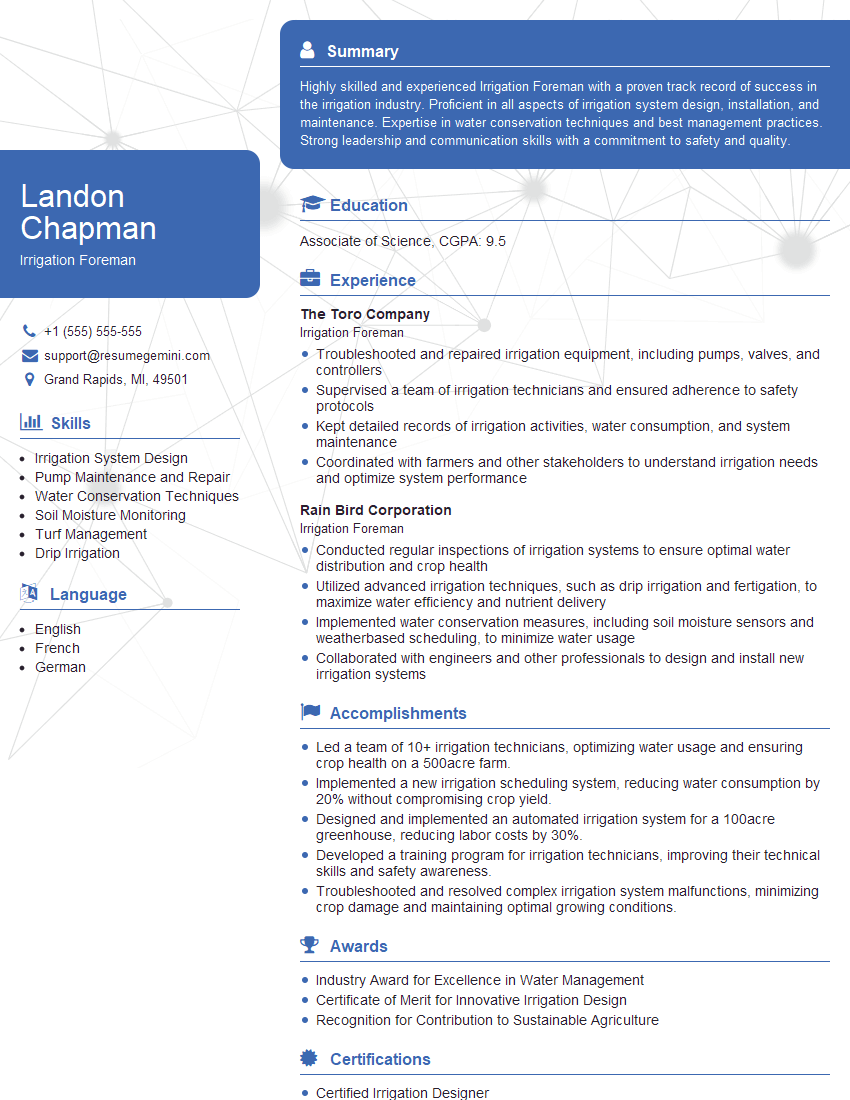
Mastering Irrigation Systems Maintenance opens doors to a rewarding career with excellent growth potential. Advancement opportunities often involve supervisory roles, specialized training, and higher earning potential. To maximize your job prospects, a well-crafted, ATS-friendly resume is crucial. ResumeGemini is a trusted resource to help you build a professional and impactful resume that highlights your skills and experience. They offer examples of resumes tailored to Irrigation Systems Maintenance to help you create a compelling application.
Explore more articles
Users Rating of Our Blogs
Share Your Experience
We value your feedback! Please rate our content and share your thoughts (optional).
What Readers Say About Our Blog
Very informative content, great job.
good