Are you ready to stand out in your next interview? Understanding and preparing for Knowledge of Sewing Machines interview questions is a game-changer. In this blog, we’ve compiled key questions and expert advice to help you showcase your skills with confidence and precision. Let’s get started on your journey to acing the interview.
Questions Asked in Knowledge of Sewing Machines Interview
Q 1. Describe your experience with different types of sewing machines (e.g., industrial, domestic, serger).
My experience spans across various sewing machine types, each with unique strengths and applications. Domestic sewing machines, like those found in homes, are versatile but generally less powerful and durable than their industrial counterparts. I’ve worked extensively with popular brands like Singer, Brother, and Janome, mastering their functionalities, from basic straight stitching to more intricate embroidery. Industrial sewing machines, on the other hand, are built for heavy-duty use, speed, and specific tasks. I have significant experience with single-needle and double-needle industrial machines used in garment manufacturing, possessing proficiency in their maintenance and operation. These machines excel at consistent stitching on heavy fabrics. Finally, sergers, or overlock machines, are specialized for finishing seams with a professional look and preventing fraying. I am adept at using sergers to create clean, durable finishes for various projects and fabrics, from lightweight knits to heavy denim.
Each type of machine demands a different skill set. For instance, while the precision needed for intricate embroidery on a domestic machine is crucial, industrial machine operation requires proficiency in speed and efficient handling of bulk materials. Serger operation calls for a understanding of tension adjustments for different fabric weights.
Q 2. Explain the process of threading a typical industrial sewing machine.
Threading an industrial sewing machine is a precise process, and variations exist based on the machine’s brand and model. However, the general principles remain consistent. Let’s assume a typical single-needle industrial machine.
- Begin at the spool pin: Place the spool of thread onto the spool pin, ensuring it’s securely fastened.
- Thread guide: Guide the thread through the designated thread guides. These are typically numbered and positioned in a specific order. Incorrect threading can cause skipped stitches or thread breakage.
- Take-up lever: The thread then passes through the take-up lever which regulates the thread feed during stitching. This lever moves up and down rhythmically as the machine operates.
- Tension discs: The thread then passes through a series of tension discs that regulate the tension of the upper thread. Correct tension is crucial for even stitching. Incorrect tension can result in skipped stitches or broken needles.
- Needle bar: Finally, the thread is inserted through the needle bar, threading through the eye of the needle. This final step needs to be precise, ensuring the thread smoothly passes through the eye without any strain.
Remember: Always consult your specific machine’s manual for detailed, model-specific threading instructions. Pictures and diagrams provided in the manual are invaluable!
Q 3. How do you troubleshoot a skipped stitch on a sewing machine?
Skipped stitches are a common sewing machine problem, often stemming from several potential causes. Troubleshooting involves systematic checking.
- Check the Needle: Bent, dull, or incorrectly inserted needles are primary culprits. Replace with a fresh, sharp needle of the correct size and type for the fabric.
- Thread Tension: Improper thread tension (both upper and lower) can lead to skipped stitches. Adjust the tension dials; the manual provides guidance. Too much tension causes breakage; too little causes skipped stitches.
- Thread Quality: Low-quality or damaged thread is a frequent cause. Use a good quality thread appropriate for your project and fabric type.
- Bobbin Winding: A poorly wound bobbin can cause skipped stitches. Check for uneven winding or loose thread on the bobbin. Re-wind the bobbin if necessary.
- Timing: Sometimes the sewing machine’s internal timing needs adjusting if the problem persists even after the previous checks. It often requires a professional technician.
Remember, solving skipped stitch problems is a systematic process of elimination. Start with the simplest checks and progress to more complex adjustments or repairs as necessary.
Q 4. What are the common causes of needle breakage?
Needle breakage is a frustrating but often preventable issue. Several factors contribute to this.
- Incorrect Needle Size: Using a needle size unsuitable for the fabric type and thickness is a major cause. Too fine a needle on thick fabric leads to bending or breakage. Conversely, using a heavy needle on thin fabric can cause holes and damage.
- Bent Needle: If the needle is bent, even slightly, it will easily break. Carefully inspect needles before use; replace immediately if bent.
- Dull Needle: A dull needle creates friction, resulting in increased stress and leading to breakage. Regularly change needles to ensure sharpness.
- Improper Needle Insertion: If the needle is not inserted correctly into the needle clamp, it won’t be properly secured, leading to breakage. Always follow the machine’s manual instructions.
- Incorrect Thread Tension: Extreme thread tension, either too tight or too loose, puts extra strain on the needle, increasing the risk of breakage.
- Foreign Objects: Pins, buttons, or other objects caught in the fabric can cause significant needle damage. Check your fabric carefully before sewing.
Preventing needle breakage is crucial for efficiency and safety. Regular inspection, proper needle selection, and careful operation are essential.
Q 5. How do you maintain and clean a sewing machine to ensure optimal performance?
Regular maintenance is key to ensuring your sewing machine’s longevity and optimal performance. A clean machine runs smoothly and produces quality stitches.
- Regular Cleaning: Use a soft brush or compressed air to remove lint, dust, and thread scraps from the bobbin case, feed dogs, and other moving parts. Be mindful not to damage any delicate components.
- Lubrication: Most sewing machines need occasional lubrication with sewing machine oil (avoid other oils). Follow your machine’s manual for lubrication points and frequency.
- Bobbin Case Cleaning: Regularly clean the bobbin case, paying particular attention to any lint build-up which can interfere with smooth thread flow. The bobbin case is often overlooked, yet crucial for correct operation.
- Needle Check and Change: Regularly inspect needles for damage, bends, or dullness. Replace needles as needed, even if they don’t appear outwardly damaged.
- Professional Servicing: Schedule professional servicing at least once a year, or more frequently if you use your machine extensively. A professional can identify potential problems and perform necessary adjustments or repairs.
Preventative maintenance is significantly cheaper and more efficient than fixing major problems later. Consider maintenance a small investment in the continued, high-quality performance of your sewing machine.
Q 6. What safety precautions do you follow when operating industrial sewing machines?
Safety is paramount when operating industrial sewing machines. These machines are powerful and can cause serious injury if not handled properly.
- Machine Guards: Ensure all safety guards are in place and functioning correctly. These guards protect your hands and fingers from the moving parts.
- Proper Clothing: Avoid loose clothing or jewelry that could get caught in the machine. Tie back long hair.
- Foot Pedal Safety: Keep the foot pedal clear of obstructions and use it carefully to avoid accidental starts or stops.
- Needle Guard: When not in use, use a protective cover over the needle to prevent accidental needle injury.
- Emergency Stop: Know the location and operation of the emergency stop button or switch.
- Training and Supervision: Make sure all operators are properly trained and supervised, especially when starting out.
Remember: industrial sewing machines are powerful tools that require respect and careful handling. Prioritize your safety and that of those around you.
Q 7. Describe your experience with different types of sewing machine needles.
Sewing machine needles come in a wide variety of types, each designed for specific fabric types and sewing techniques. The wrong needle can result in skipped stitches, broken needles, or damaged fabric.
- Universal Needles: These are general-purpose needles suitable for a wide range of fabrics, from lightweight cottons to medium-weight wools. They are the most commonly used needle type.
- Ballpoint Needles: Designed for knit fabrics, these needles have a rounded tip that glides between the fibers without piercing them, preventing snags and runs.
- Sharp Needles: Used for woven fabrics, including linens, silks, and other tightly woven materials. The sharp tip easily penetrates these fabrics.
- Jeans Needles: Stronger needles designed for heavy-duty fabrics like denim, canvas, and other tough materials.
- Embroidery Needles: These have a longer eye to accommodate thicker embroidery threads.
- Stretch Needles: These are specifically designed for stretch fabrics, like jersey knits and spandex, preventing damage or distortion during stitching.
Choosing the right needle is essential for creating professional-looking seams. Always refer to the needle size chart and select the appropriate needle size and type for your fabric and project. The needle size is often indicated by a number; a higher number indicates a finer needle.
Q 8. How do you identify and adjust the tension on a sewing machine?
Sewing machine tension refers to the balance between the upper and lower threads. Proper tension creates even, attractive stitches. Identifying and adjusting it involves a multi-step process. First, inspect your stitches. Loose stitches indicate too much tension on the lower thread (bobbin), while puckering or thread breakage points to too much upper tension. Most machines have a tension dial, usually a numbered knob on the top or side. Starting with a mid-range setting (usually around 4-5, but this varies by machine), you then carefully increase or decrease the number, sewing a test stitch each time.
For example, if the stitches are loose, try reducing the upper tension by one number and testing again. If stitches are puckered, you increase the upper tension. If the problem persists after adjusting the upper tension, the bobbin tension might be the issue. For some machines, you’ll need to open the bobbin case and adjust the screw or spring related to the bobbin tension, but I usually recommend referring to your machine’s manual for precise guidance on bobbin tension adjustment as it differs considerably across models.
Remember, always test your adjustments on a scrap fabric before using your good material. Consistent practice leads to quick diagnosis and adjustment!
Q 9. What are the different types of stitch patterns and their applications?
Sewing machine stitch patterns are incredibly diverse, each serving a unique purpose. Basic stitches include straight stitch (for seams and topstitching), zigzag stitch (for decorative purposes, securing seams, or mending), and backstitch (for reinforcing seams). More advanced options include satin stitch (for dense filling), blanket stitch (for decorative edges), buttonhole stitch (for creating buttonholes), and various decorative patterns.
- Straight Stitch: The foundation of sewing, used for seams, basting, and topstitching. Its strength and simplicity make it versatile.
- Zigzag Stitch: Excellent for stretchy fabrics, preventing seams from breaking, and creating decorative accents. I often use it to finish raw edges to prevent fraying.
- Satin Stitch: Creates a smooth, dense fill, ideal for embellishments, appliqués, and creating clean, finished edges on decorative work.
- Buttonhole Stitch: Creates buttonholes with varying sizes and types, which is a skill essential for any professional tailor.
The choice of stitch depends entirely on the project’s needs. A sturdy straight stitch is perfect for jeans, while a delicate zigzag stitch might be preferred for a silk blouse. Understanding the properties of each stitch is crucial for producing professional-quality work.
Q 10. Explain the importance of proper lubrication for sewing machine maintenance.
Proper lubrication is paramount for maintaining your sewing machine’s lifespan and performance. Sewing machines have numerous moving parts, and without adequate lubrication, friction causes wear and tear. This friction can lead to increased noise, sluggish operation, and eventual component failure. Imagine a car engine without oil; the consequences are disastrous! Similarly, neglecting lubrication in a sewing machine can be expensive to fix down the line.
Lubrication reduces friction, ensuring smooth operation of internal components such as gears, hooks, and bearings. The frequency of lubrication depends on usage; some machines only require lubrication once or twice a year, while those used extensively might need it more frequently. Always use the sewing machine oil recommended by the manufacturer. Applying the wrong type of oil can damage the machine. Regular lubrication keeps your machine running smoothly and prevents costly repairs.
Q 11. How do you diagnose and repair a broken bobbin case?
Diagnosing and repairing a broken bobbin case requires a methodical approach. First, remove the bobbin case and inspect it closely for any visible damage, such as bent or broken parts, chipped areas, or loose screws. Common problems include a bent latch, a damaged spring, or a misaligned hook.
If the damage is minor, such as a bent latch, you might be able to gently straighten it with a small tool, but this needs to be done very carefully; otherwise, you risk causing more damage. If there’s a broken piece, replacing the entire bobbin case is usually the most practical solution because attempting a repair on a small, delicate part could lead to increased complications. Always try to find an original replacement part to ensure perfect compatibility with your machine. Before putting in a new bobbin case, ensure everything is clean and properly adjusted. Referring to your machine’s manual is crucial for a successful repair or replacement.
Q 12. What are the signs of a worn-out sewing machine presser foot?
A worn-out presser foot exhibits several telltale signs. One of the most common is the appearance of scratches, dents or gouges on the soleplate (the bottom part that contacts the fabric). These imperfections can affect the evenness of the stitch or cause skipped stitches. The metal might be bent or warped, often visibly apparent when compared to a new presser foot. You’ll notice irregular stitch formations and inconsistent pressure on the fabric. The spring mechanism that controls the pressure can also weaken over time; this causes the fabric to feed unevenly. Another problem is the build-up of lint and debris, which might interfere with the presser foot’s functionality. A badly worn presser foot affects stitch quality, often leading to inconsistencies and frustrations. A professional will replace the presser foot to get back the desired stitch quality.
Q 13. What is your experience with different types of sewing machine feet (e.g., zipper foot, buttonhole foot)?
My experience with various sewing machine feet is extensive. I’m proficient with standard presser feet for straight and zigzag stitching, as well as specialized feet such as zipper feet, buttonhole feet, blind hem feet, and walking feet.
- Zipper Foot: Allows for precise stitching close to the zipper teeth without stitching over them. I use this often on coats, bags, and dresses.
- Buttonhole Foot: Creates professional-looking buttonholes with consistent size and shape. This foot type varies across machine brands and models, and understanding the nuances of each is crucial.
- Blind Hem Foot: Creates a nearly invisible hem, ideal for delicate fabrics and garments where stitch visibility is undesirable.
- Walking Foot: Feeds multiple layers of fabric evenly, particularly useful for quilting and working with thick materials. This foot aids in uniform feeding of thick fabrics to produce perfect seams.
Each foot is designed for specific applications, and understanding their functionality is key to achieving high-quality results in various sewing projects. I use these specialized feet regularly, enhancing the efficiency and precision of my work.
Q 14. Describe your experience with sewing machine speed regulation and its impact on stitch quality.
Sewing machine speed regulation significantly impacts stitch quality. Slow speeds allow for greater control and precision, especially when working with intricate designs or delicate fabrics. High speeds are beneficial for straight seams on simpler projects where speed is prioritized.
However, excessively high speeds can lead to poor stitch formation, skipped stitches, and uneven tension. Think of it like writing: you can write quickly for a note, but for a calligraphy piece, a slower, more controlled approach is necessary. Similarly, the speed you sew at has a direct impact on the resulting quality. My professional experience has taught me to adapt my speed to the project’s demands. For example, I’ll use a slower speed for finer fabrics and detailed embroidery, while I can utilize higher speeds for faster straight stitch work on sturdy fabrics.
Q 15. How do you handle jammed thread on a sewing machine?
A jammed thread is a common sewing machine frustration, but it’s usually easily solved. The first step is to identify where the jam is occurring. Is the thread caught under the presser foot, tangled around the bobbin case, or snagged somewhere in the feed mechanism? Once you locate the jam, carefully remove the thread. You might need tweezers or small scissors for delicate areas. For bobbin case jams, always remember to open the bobbin case carefully, ensuring not to damage any delicate parts. Always turn the hand wheel to release any tension before attempting to remove the jammed thread. If the thread is persistently jamming, check your thread tension – it might be too tight. Lastly, inspect the needle for any bends or damage; a damaged needle is a common cause of thread jams.
For example, I once had a student whose thread kept jamming because she was using a needle sized improperly for her fabric. A heavier fabric needs a heavier-duty needle to prevent breakage and thread jams. Choosing the correct needle for the job is vital.
Career Expert Tips:
- Ace those interviews! Prepare effectively by reviewing the Top 50 Most Common Interview Questions on ResumeGemini.
- Navigate your job search with confidence! Explore a wide range of Career Tips on ResumeGemini. Learn about common challenges and recommendations to overcome them.
- Craft the perfect resume! Master the Art of Resume Writing with ResumeGemini’s guide. Showcase your unique qualifications and achievements effectively.
- Don’t miss out on holiday savings! Build your dream resume with ResumeGemini’s ATS optimized templates.
Q 16. Explain the process of changing a sewing machine needle.
Changing a sewing machine needle is a straightforward process, but crucial for proper machine function and preventing damage. Always remember to unplug your machine before handling any internal components. First, raise the needle to its highest position by turning the hand wheel. Then, loosen the needle clamp screw (usually a small screw at the top of the needle clamp). Gently remove the old needle, pulling it straight out. Insert the new needle, making sure the flat side of the needle (the shaft) is facing towards the back of the machine. This ensures proper positioning in the needle clamp. Tighten the screw firmly, ensuring the needle is secure.
Incorrect needle insertion can cause broken needles, skipped stitches, and thread breakage. I frequently demonstrate this process to beginners, highlighting the importance of careful needle insertion and how to avoid common mistakes. For example, I’ve seen people accidentally bend a needle during insertion, leading to significant machine damage.
Q 17. Describe your experience working with various fabrics and their impact on stitch selection.
My experience spans a wide range of fabrics, from delicate silks and chiffons to heavy denim and canvas. The fabric type significantly influences stitch selection. Delicate fabrics require fine needles and stitches to avoid snagging or damage; a smaller stitch length and a more delicate needle should be used. Heavy fabrics, on the other hand, need stronger needles and longer stitches to prevent needle breakage and poor stitch penetration. Stretchy fabrics might call for a zigzag stitch or a stretch stitch to accommodate their movement and prevent puckering. Consider the fabric’s weight, weave, and stretch before selecting your needle and stitch type.
For instance, when sewing a silk blouse, I’d use a fine needle and a short, straight stitch or a very narrow zig-zag stitch. However, when sewing a heavy denim jacket, I’d opt for a heavier needle and a longer stitch length, perhaps a medium zig-zag for reinforcement. This understanding of fabric characteristics is essential to achieving professional-quality results.
Q 18. How do you handle different types of seams (e.g., straight, zigzag, overlock)?
Different seams serve different purposes. A straight stitch is the most basic and used for seams that need strength, such as in pants or skirts. A zigzag stitch is primarily used to finish raw edges, preventing fraying, and is commonly used for stretchy materials. An overlock stitch (or serger) creates a professional-looking seam finish, preventing fraying and creating a clean edge, often in apparel manufacturing. The choice depends on the fabric and the desired aesthetic.
In my experience, I’ve found that understanding the limitations and strengths of each seam type is crucial. For instance, using a straight stitch on a stretchy fabric could lead to seam breakage, while using a zigzag stitch on a heavy material might not be strong enough. So, a good seam selection makes for a more resilient and beautiful product.
Q 19. What is your experience with computerized sewing machines and their programming?
I have extensive experience with computerized sewing machines, including programming custom stitches and utilizing their advanced features. These machines offer a level of precision and customization unavailable in mechanical machines. I can program various stitch patterns, adjust stitch density, and even incorporate decorative elements into my sewing projects. The programming interfaces vary between brands, but the fundamental principles are generally similar. Many computerized machines offer pre-programmed stitches, which can save significant time.
For example, I once programmed a unique stitch pattern for a client’s custom embroidery project on a Brother computerized machine. The process involved creating a design in their software and then transferring it to the machine for execution. The advanced functions greatly improved our efficiency.
Q 20. How familiar are you with different sewing machine brands and their functionalities?
I’m familiar with a wide range of sewing machine brands, including but not limited to Brother, Singer, Janome, Bernina, and Pfaff. Each brand has its strengths and weaknesses, catering to different skill levels and sewing needs. Brother machines are often praised for their ease of use and affordability, while Bernina and Pfaff are known for their high-end features and durability. Understanding these differences allows me to recommend the most suitable machine for a particular user’s needs and budget. My familiarity extends to both mechanical and computerized machines across these brands.
For example, I would recommend a simple Singer to a beginner, while for a professional quilter, a high-end Bernina would be more appropriate, considering its precision and functionality.
Q 21. What is your experience with preventative maintenance for sewing machines?
Preventative maintenance is key to extending the lifespan of a sewing machine. Regular cleaning is paramount; removing lint and dust from the bobbin case, feed dogs, and other internal components is essential. Lubrication with appropriate sewing machine oil is crucial, keeping moving parts smooth and preventing friction-related wear. Proper needle and bobbin selection, according to fabric type, helps prevent damage to both components. Finally, periodic inspections and servicing by a qualified technician ensure optimal machine performance and longevity.
For example, I always advise my clients to regularly clean their machines after each project, as lint accumulation is a major culprit in sewing machine malfunctions. Neglecting regular cleaning can lead to significant repairs and eventually necessitate machine replacement.
Q 22. Describe a time you had to troubleshoot a complex sewing machine problem.
One particularly challenging case involved a vintage Singer sewing machine that was skipping stitches intermittently. Initially, I suspected a problem with the timing, a common issue in older machines. However, after carefully checking the timing mechanism and finding it correctly adjusted, I investigated further. I systematically checked the tension discs, the hook assembly, and the bobbin case for any abnormalities. The problem turned out to be a tiny piece of lint lodged in the hook race, subtly interfering with the smooth flow of the thread. Removing the lint solved the problem completely. This highlights the importance of meticulous and systematic troubleshooting, where eliminating potential causes one by one is crucial. It’s not always the obvious, major component causing the issue.
Q 23. What methods do you use to ensure consistent stitch length and width?
Consistent stitch length and width are paramount for professional results. I achieve this through a multi-pronged approach. Firstly, I always select the appropriate stitch length and width settings on the machine itself, based on the fabric and desired effect. Secondly, I carefully maintain consistent speed while sewing; rushing can lead to uneven stitches. Thirdly, I pay close attention to the fabric feed – ensuring the fabric moves smoothly and evenly through the machine. Lastly, regular machine maintenance, including cleaning and lubrication, is crucial. This prevents friction and ensures all moving parts are operating smoothly and consistently.
Q 24. How familiar are you with the different types of bobbins used in sewing machines?
I’m very familiar with various bobbin types. Common types include the class 15 bobbin (often found in Singer machines), the class 66 bobbin (used in many industrial machines), and the horizontal bobbins used in some modern domestic machines. Each type has specific dimensions and features. The class 15, for instance, is characterized by its top-winding design, while horizontal bobbins are loaded sideways. Understanding these differences is crucial because using the wrong bobbin type can lead to issues like skipped stitches, poor thread tension, and even damage to the sewing machine. I always make sure to use the bobbin type specified in the machine’s manual or recommended by the manufacturer.
Q 25. How do you determine the appropriate needle size and type for different fabrics?
Needle selection is critical for achieving quality results. The fabric dictates the needle size and type. For delicate fabrics like silk or chiffon, a very fine needle, size 60/8 or smaller, would be appropriate. A sharp needle is necessary to prevent snags. For heavier fabrics like denim or canvas, a heavier needle, size 14/90 or larger, is required. The needle type is also important; ballpoint needles are preferred for knit fabrics to prevent snagging the loops, while a universal needle can work on a variety of woven fabrics. Using the wrong needle size can lead to broken needles, damaged fabric, and poor stitch quality. Always consult a needle size chart and ensure you select the needle that complements the fabric.
Q 26. How do you handle different sewing machine foot pressures?
Sewing machine foot pressure is adjustable on many machines, and proper adjustment is essential. Too much pressure can cause puckering or distortion in the fabric, especially with thin or delicate materials. Too little pressure can result in skipped stitches or uneven feed. I adjust the pressure based on the fabric type. For delicate fabrics, I use a low pressure setting, barely enough to keep the fabric in place. For heavier fabrics, I increase the pressure accordingly. Some machines have dial settings for pressure adjustment, while others require adjusting a spring mechanism. Experimentation and careful observation are key to finding the optimal pressure for each fabric.
Q 27. What is your understanding of sewing machine timing adjustments?
Sewing machine timing refers to the precise coordination between the needle and the hook. Incorrect timing can lead to skipped stitches or other problems. The timing is usually adjusted by loosening screws, then shifting specific components (e.g. hook or needle plate) very slightly, testing after each small adjustment. It’s a delicate process that requires careful attention to detail and a thorough understanding of the machine’s internal mechanisms. This is where a technical manual is essential, along with practice and experience. Incorrectly adjusting the timing can damage the machine, so proceeding cautiously is crucial. Only attempt timing adjustments if you have the necessary expertise or have consulted with someone experienced.
Q 28. Describe your experience with sewing machine repair and component replacement.
I have extensive experience with sewing machine repair and component replacement. I’m proficient in diagnosing issues, ordering and sourcing replacement parts, and performing repairs, ranging from simple tasks like replacing needles and bobbins to more complex repairs involving the timing mechanism, motor, or electronic components. I have worked on a wide variety of sewing machine makes and models, both domestic and industrial. This experience includes replacing broken needles, worn feed dogs, tension assemblies, and motor belts. For more complex repairs, I will use diagnostic tools and consult repair manuals. I pride myself on being able to quickly diagnose problems and efficiently resolve them, minimizing downtime and ensuring the machine functions smoothly and reliably.
Key Topics to Learn for Your Knowledge of Sewing Machines Interview
- Machine Operation & Maintenance: Understanding the mechanics of different sewing machine types (e.g., industrial, domestic, serger), their functionalities, and routine maintenance procedures like cleaning, oiling, and troubleshooting minor issues.
- Stitch Types & Applications: Knowing various stitch types (straight stitch, zigzag, overlock, etc.), their properties, and appropriate applications for different fabrics and sewing projects. Be prepared to discuss the selection of the right stitch for a given task.
- Fabric Selection & Handling: Demonstrating knowledge of different fabric types (e.g., cotton, silk, leather), their properties, and appropriate needle and thread choices for each. This includes understanding fabric grain and its importance in sewing.
- Pattern Interpretation & Use: Explaining your ability to read and interpret sewing patterns, understand marking notations, and accurately cut and assemble fabric pieces according to pattern instructions.
- Troubleshooting & Problem Solving: Highlight your ability to identify and solve common sewing machine problems, such as skipped stitches, thread breakage, or needle jams. Showcasing problem-solving skills is crucial.
- Safety Procedures: Demonstrate awareness and adherence to safety regulations and best practices when operating sewing machines, including proper needle handling and machine maintenance.
- Industrial Sewing Machine Knowledge (if applicable): If the role involves industrial machines, be ready to discuss specific knowledge of those machines, including their unique features and maintenance requirements.
Next Steps
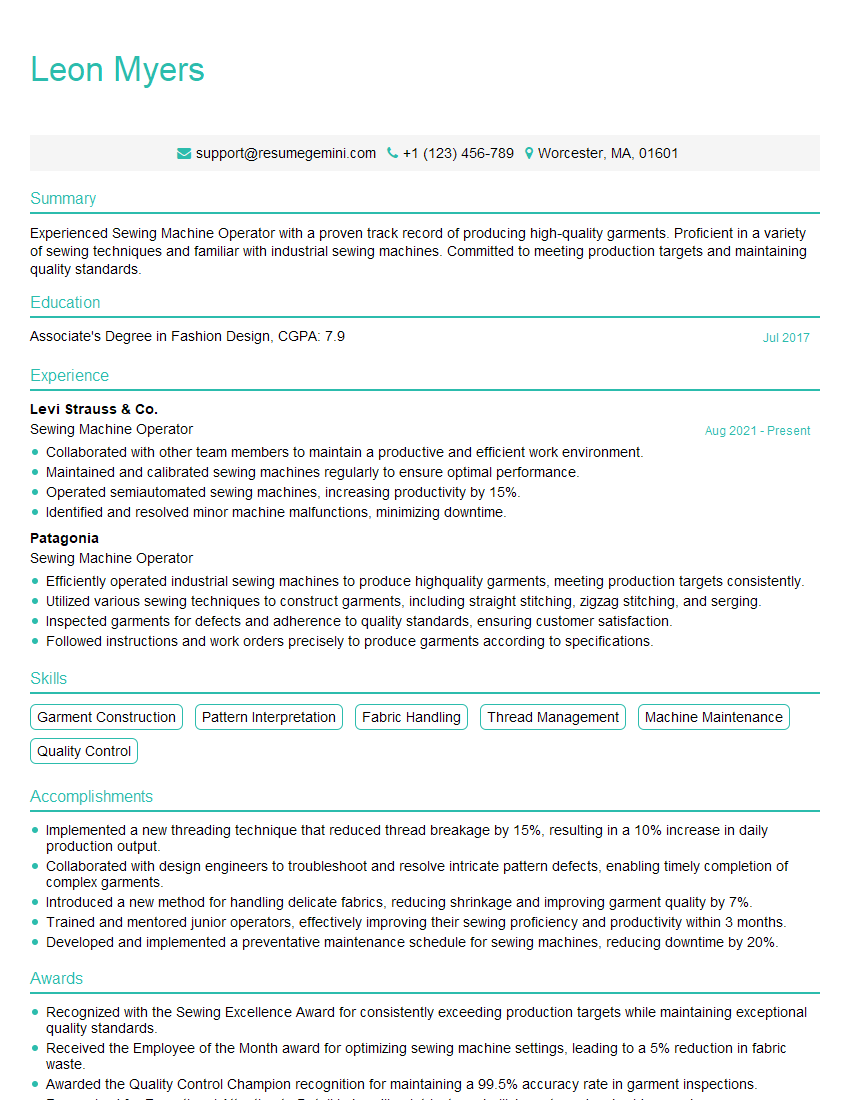
Mastering your knowledge of sewing machines is key to unlocking exciting career opportunities in the fashion, textile, or upholstery industries. A strong understanding of these techniques will set you apart from other candidates. To maximize your job prospects, crafting a compelling and ATS-friendly resume is crucial. ResumeGemini is a trusted resource that can help you build a professional resume that highlights your skills and experience effectively. Examples of resumes tailored specifically to showcasing Knowledge of Sewing Machines are available through ResumeGemini, providing you with a head start in your job search.
Explore more articles
Users Rating of Our Blogs
Share Your Experience
We value your feedback! Please rate our content and share your thoughts (optional).
What Readers Say About Our Blog
Very informative content, great job.
good