Interviews are opportunities to demonstrate your expertise, and this guide is here to help you shine. Explore the essential Knowledge of upholstery techniques interview questions that employers frequently ask, paired with strategies for crafting responses that set you apart from the competition.
Questions Asked in Knowledge of upholstery techniques Interview
Q 1. Describe your experience with different upholstery fabrics (e.g., leather, vinyl, fabric).
My experience with upholstery fabrics is extensive, encompassing a wide range of materials, each with unique properties and challenges. Leather, for instance, requires specialized tools and techniques due to its thickness and sensitivity. I’m adept at working with various leather types, from supple aniline leathers that require delicate handling to durable top-grain leathers suitable for high-traffic areas. Vinyl presents a different set of considerations; its synthetic nature makes it more resistant to wear and tear, but it can be less forgiving during the stitching process and prone to cracking if not handled correctly. Finally, fabrics range from delicate silks and velvets to robust cottons and durable blends. Each fabric type necessitates specific techniques to achieve a professional and durable finish. For example, a tightly woven fabric might require more precise cutting to avoid fraying, while a loose weave may benefit from interlining to improve its drape and longevity. I’ve worked with hundreds of different fabrics, from luxurious damasks to practical, stain-resistant microfiber, and I’m always keen to learn about and experiment with new materials.
Q 2. Explain the process of preparing a frame for reupholstering.
Preparing a frame for reupholstering is crucial for a successful outcome. It’s like laying the foundation for a house; if it’s not strong and stable, the whole project will suffer. The process typically begins with a thorough inspection for any damage, such as broken joints, loose dowels, or worn springs. Loose joints need to be reglued and reinforced, often with additional screws or wood glue. Worn springs must be replaced or repaired to ensure the piece’s structural integrity and comfort. Once the frame is structurally sound, I clean it meticulously, removing any old glue, tacks, or debris. Any areas of exposed wood may require sanding to create a smooth surface for the new fabric. Next, I apply a layer of burlap or a similar webbing to the frame, ensuring it’s taut and securely attached using staples. This provides a strong base for the padding and upholstery fabric to rest on, ensuring longevity. Finally, I might add additional support layers like foam or padding to areas that need extra cushioning.
Q 3. What types of stitching techniques are you proficient in?
My stitching repertoire includes a variety of techniques essential for high-quality upholstery. I’m proficient in hand-sewing, using both a straight stitch for seams and a whip stitch for finishing edges and securing fabric to the frame. Machine sewing is also a significant part of my skillset, allowing for faster and more consistent stitching on larger projects. I’m adept at using different stitch patterns, adjusting the tension to suit various fabrics. Specific techniques I frequently employ include French seams for a clean, invisible finish on delicate fabrics, saddle stitching for a durable and aesthetically pleasing look on leather projects, and blind stitching for attaching welt cords neatly and invisibly. The choice of stitch depends heavily on the project and the fabric’s nature; for example, a durable upholstery fabric might require a longer stitch length for strength, while a delicate silk might need a shorter, finer stitch to avoid damage.
Q 4. How do you measure and cut fabric for upholstery projects?
Accurate fabric measurement and cutting are paramount in upholstery. I begin by creating a precise template from the existing piece or by carefully measuring the various sections of the frame. These measurements account for seam allowances, which vary depending on the fabric and project demands. Once the templates are ready, I carefully lay them onto the fabric, paying close attention to the fabric’s nap or pattern direction to ensure a consistent aesthetic. The key here is to avoid stretching or distorting the fabric during the cutting process. Sharp shears are crucial for clean, precise cuts that minimize fraying. For complex shapes or curved surfaces, I use specialized techniques like easing or easing in the fabric, ensuring the fabric is distributed evenly over the padding and frame. Proper measurement and cutting prevent wasted fabric and contributes significantly to the final quality of the reupholstered piece.
Q 5. What tools and equipment are essential for your work?
My toolkit is comprehensive and includes both hand and power tools, each selected for its specific function in the upholstery process. Essential hand tools include various types of pliers (for staple removal and manipulation), upholstery needles, seam rippers, scissors (both fabric and heavy-duty), and measuring tapes. Power tools significantly expedite the process and add precision; these include an electric staple gun, sewing machine (preferably an industrial-strength model), and a pneumatic stapler for heavier work. In addition, I use specialized tools such as welt cord makers for creating decorative cords and seam rollers for pressing clean seams. Beyond tools, essential equipment includes a work table sturdy enough to support large pieces, a well-lit workspace, and ample storage for organizing my supplies, ensuring efficient workflow and safety.
Q 6. Describe your experience with different types of foam and padding.
My experience encompasses a variety of foam densities and padding materials, each chosen strategically depending on the desired level of comfort, support, and longevity. High-density foam provides robust support and resilience, making it ideal for seating areas that need to withstand significant wear. Conversely, lower-density foam offers softer cushioning and is well-suited for backrests or other areas requiring less structural support. I often use a layering technique, combining various foam densities to achieve a desired balance of comfort and firmness. Padding materials such as Dacron batting or fiberfill offer a softer layer of cushioning and also assist in contouring the upholstery, helping it conform to the shape of the frame. Selecting the correct foam and padding is critical in ensuring the comfort and durability of the final product. For example, using a high-density foam in a backrest would result in a hard and uncomfortable chair, while using a low-density foam for seating would mean a rapid sagging of the cushions.
Q 7. How do you handle fabric wrinkles and creases during the upholstery process?
Handling fabric wrinkles and creases is a crucial aspect of upholstery, as it directly affects the final aesthetic. Preventing wrinkles during the cutting and application process is key. I ensure the fabric is laid out smoothly, avoiding pulling or stretching. However, even with the most meticulous techniques, some wrinkles may occur. My approach involves a combination of techniques to address these. Steam is a powerful ally; a handheld steamer can effectively release wrinkles from many fabrics. Gentle stretching and careful repositioning of the fabric often resolves smaller creases. For stubborn wrinkles, I may use small weights or clamps to gently hold the fabric taut while it dries after steaming. In severe cases, I may need to carefully cut and replace the affected section to maintain the desired finish. In some cases, proper stretching during installation can prevent the appearance of creases on high traffic areas in the long term. The chosen technique depends heavily on the fabric’s type and the severity of the wrinkle; delicate materials require a more gentle approach.
Q 8. Explain your approach to repairing damaged upholstery.
My approach to upholstery repair begins with a thorough assessment of the damage. This involves carefully examining the affected area to determine the extent of the problem, identifying the cause (e.g., wear and tear, pet damage, structural failure), and assessing the necessary materials for repair. I then meticulously document my findings, including photos, to ensure accuracy and facilitate the repair process.
For minor repairs, such as small tears or loose seams, I might utilize techniques like patching, stitching, or glueing, depending on the fabric and damage type. For more extensive damage, I might need to replace sections of the upholstery, requiring careful removal of the old fabric, repair of the underlying structure (springs, webbing, padding), and installation of new fabric. Throughout the process, precision and attention to detail are paramount to ensure a seamless, high-quality repair that’s indistinguishable from the original.
For example, I recently repaired a classic armchair with a significant tear in the seat cushion. After assessing the damage, I carefully removed the damaged section of fabric, replaced the underlying foam, and then painstakingly matched the fabric using a similar piece to ensure consistency. The final result was flawless.
Q 9. What are your skills in working with different types of springs (e.g., sinuous, coil)?
I’m proficient in working with various types of springs used in upholstery, including sinuous springs and coil springs. Sinuous springs, also known as zig-zag springs, provide a basic support structure, typically used in less expensive pieces. They’re relatively straightforward to install and replace. Coil springs, on the other hand, offer a more luxurious and supportive feel, commonly found in high-end furniture. Working with coil springs requires more precision and understanding of spring tension and arrangement to ensure proper support and comfort.
My skills encompass not just installation but also repair and replacement. This includes diagnosing faulty springs, assessing their tension, and properly securing them to the frame. I understand the importance of proper spring placement and tension to achieve the desired comfort level and prevent sagging over time. I’ve worked on pieces ranging from simple sofas with sinuous springs to antique chairs with complex coil spring systems.
Q 10. How do you ensure the proper fit and tension of upholstery fabric?
Ensuring proper fit and tension of upholstery fabric is crucial for both aesthetics and durability. The process involves a combination of careful measurement, accurate cutting, and precise stretching techniques. I always start by taking precise measurements of the piece to be upholstered, allowing for seam allowances and fabric shrinkage. I then cut the fabric, paying close attention to matching patterns and grain direction, which is critical for appearance and strength.
Once the fabric is cut, I use a combination of hand-pulling and the use of specialized tools like upholstery tackers and pliers to secure the fabric to the frame. This requires a careful balance – too much tension can distort the fabric, leading to puckering or wrinkling, while insufficient tension might result in sagging or looseness over time. Experience plays a huge role in achieving the right tension, which is developed through years of practice.
Think of it like tying a knot – you need just the right amount of tightness to prevent it from coming undone, yet not so much as to constrict or damage the material.
Q 11. Describe your experience with welt cord application.
Welt cord application is a detail-oriented process that significantly enhances the look and feel of upholstered pieces. I’m skilled in creating and applying welt cord in various sizes and materials to achieve diverse aesthetic outcomes. The process begins with preparing the cord, ensuring its consistency in thickness and evenness. Then, I use a specialized needle or awl to feed the cord around the edge of the fabric. Precision is essential to maintain the neat, consistent shape of the welt and to prevent puckering.
I’m familiar with various welt cord application techniques, such as hand-sewing and machine-sewing, selecting the optimal method depending on the fabric type and design complexity. The choice of cord material and color plays a critical role in the final look, which I discuss with the client during the initial consultation. For example, a sleek, modern look might benefit from a thin, contrasting welt, while a more traditional style might suit a thicker, matching welt. The neatly finished welt significantly elevates the professionalism of the upholstery work.
Q 12. How do you handle challenging fabric patterns or designs during upholstery?
Handling challenging fabric patterns or designs requires patience, precision, and a strong understanding of fabric manipulation. The key is careful planning and meticulous execution. I begin by studying the pattern, identifying its repeating elements, and creating a layout plan to minimize waste and maximize pattern matching. This involves careful consideration of grain direction and potentially using templates to ensure accurate cutting.
Once the fabric is cut, the installation process requires extra attention to detail to maintain pattern continuity. This might involve adjusting the fabric tension slightly to align the patterns seamlessly, or carefully trimming excess fabric where needed. Sometimes, complex patterns necessitate multiple test-fitting stages to ensure a flawless final result. I find that using pins strategically to hold the fabric in place while temporarily tacking, significantly aids in maintaining alignment, particularly when dealing with directional patterns.
Q 13. What safety precautions do you follow while working with upholstery tools and materials?
Safety is my utmost priority. When working with upholstery tools and materials, I always adhere to strict safety guidelines. This includes using appropriate personal protective equipment (PPE), such as safety glasses to protect against flying debris, work gloves to prevent cuts and abrasions, and dust masks when working with materials that generate dust.
I handle sharp tools, like upholstery needles, awls, and utility knives, with extreme caution. Tools are stored safely when not in use. I maintain a clean and organized workspace to minimize the risk of tripping hazards or accidental injuries. Power tools like staple guns are used with awareness and careful consideration of their operation. Furthermore, I’m mindful of handling potentially harmful chemicals and glues following manufacturer guidelines, ensuring adequate ventilation and appropriate disposal.
Q 14. How do you manage time effectively on a project with a tight deadline?
Managing time effectively on a project with a tight deadline requires careful planning and efficient execution. I begin by breaking down the project into smaller, manageable tasks, creating a realistic timeline that accounts for each step. This includes fabric selection, material preparation, frame repair (if needed), and the upholstery process itself. I allocate specific time slots to each task, prioritizing critical elements to meet the deadline.
I communicate regularly with the client to ensure alignment on expectations and any potential adjustments needed. I maintain a well-organized workspace, preventing time loss from searching for tools or materials. I leverage my experience and expertise to work efficiently, employing time-saving techniques whenever possible, without compromising quality. If unforeseen challenges arise, I proactively adjust the timeline while keeping the client informed. For instance, if a material is unexpectedly delayed, I’ll communicate promptly and explore alternative solutions to minimize disruption to the project schedule.
Q 15. Explain your understanding of different types of adhesives used in upholstery.
Choosing the right adhesive is crucial in upholstery, as it directly impacts the durability and longevity of the finished piece. Different materials require different adhesives for optimal bonding.
- Contact Cement: This is a very popular choice for many upholstery applications because it creates a strong, permanent bond between fabrics and substrates like foam or wood. It’s commonly used for attaching fabrics to the frame of furniture or bonding foam layers together. Think of it like super glue, but specifically designed for textiles. It requires a precise application; both surfaces need to be coated and allowed to dry slightly before pressing together.
- Spray Adhesive: Often used for smaller projects or for applying thin layers of cushioning, spray adhesive provides good coverage but requires careful application to avoid excess build-up and sticking of the surfaces together before they are fully aligned. This is often best for lightweight materials or when you need even coverage across a large area.
- Hot Melt Glue: This is a quick-drying adhesive that uses heat to activate the bond. It’s ideal for quick fixes or attaching smaller pieces, like decorative trim or buttons, but it’s not as robust as contact cement for larger areas or areas subject to a lot of stress. I usually use it for minor tasks.
- Water-Based Adhesives: These are often used for more delicate materials, or when you need an easily reversible bond (although it rarely remains reversible after a certain time). This type of glue is usually gentler on fabrics, and is commonly found in the form of a glue stick or a more liquid-type glue.
The selection depends heavily on the specific project; for instance, I’d use contact cement for a sturdy sofa, spray adhesive for a chair’s padding, and hot melt glue for a button detail on an ottoman.
Career Expert Tips:
- Ace those interviews! Prepare effectively by reviewing the Top 50 Most Common Interview Questions on ResumeGemini.
- Navigate your job search with confidence! Explore a wide range of Career Tips on ResumeGemini. Learn about common challenges and recommendations to overcome them.
- Craft the perfect resume! Master the Art of Resume Writing with ResumeGemini’s guide. Showcase your unique qualifications and achievements effectively.
- Don’t miss out on holiday savings! Build your dream resume with ResumeGemini’s ATS optimized templates.
Q 16. How do you assess the condition of a piece of furniture before beginning reupholstery?
Assessing the condition of furniture before reupholstery is paramount. A thorough inspection prevents unforeseen issues and ensures a successful outcome. I start by systematically examining every component.
- Frame Inspection: I check for wood rot, cracks, loose joints, and insect infestation. Any structural damage needs repair before reupholstery, as it could compromise the integrity of the final product. If the structural integrity is compromised, I may need to refer the client to a furniture restoration expert.
- Spring System Evaluation: For pieces with springs (like sofas and chairs), I examine their tension, alignment, and overall integrity. Sagging springs need repair or replacement to ensure proper support and comfort. I will sometimes use techniques to reinforce existing springs or completely replace them depending on the need.
- Cushion Assessment: I evaluate the foam and padding for wear, compression, and integrity. Replacing worn cushions is often a critical part of the process for the comfort and longevity of the piece.
- Fabric Analysis: I carefully examine the existing fabric to assess its type, condition, and any potential challenges, like stains or tears. Understanding the fabric composition is key to choosing appropriate new fabric and finishing techniques.
This comprehensive evaluation allows me to develop an accurate estimate of time and materials needed, and to discuss any necessary repairs or replacements upfront with the client.
Q 17. Describe your experience with antique or vintage furniture upholstery.
Reupholstering antique or vintage furniture requires a different approach. It’s more than just replacing fabric; it involves preserving the historical integrity of the piece.
I have worked on several antique pieces, including a Victorian chaise lounge and a mid-century modern armchair. These projects demanded meticulous attention to detail. I typically begin by carefully documenting every step of the process – photographing and labeling removed components – to ensure accurate reassembly. Sourcing appropriate materials—fabric with an accurate color and texture reminiscent of the original style, or that complement it if the original is not available—is essential. It’s a rewarding yet sensitive process that blends artistic restoration and technical skill.
For example, on a project involving an antique settee with degraded padding, I sourced padding materials that matched historical techniques, ensuring the feel and support mimicked the original. I also ensured the upholstery tacks were appropriate for the period and era of the piece. Sometimes I have to source these materials from specialist suppliers.
Q 18. How do you deal with customer requests or changes during a project?
Open communication is key to handling customer requests and changes during a project. I always encourage clients to express their preferences early on.
If changes arise after the project has started, I discuss their implications in terms of cost and timeline. I’ll provide a revised quote, outlining any extra materials or labor involved, and we work together to reach a mutually acceptable solution. Transparency and clear expectations avoid any misunderstandings and ensure client satisfaction. I always give written updates and documentation about such changes.
For example, if a client decides to change the fabric midway through a project, I’ll explain the need for additional fabric, any potential delays due to sourcing, and adjust the final cost accordingly. I always strive for a collaborative approach, ensuring that any changes reflect their vision and stay within their budget.
Q 19. Explain your experience with different types of upholstery projects (e.g., chairs, sofas, car seats).
My experience encompasses a broad range of upholstery projects. I’ve worked on various furniture pieces, from chairs and sofas to car seats, each presenting unique challenges and techniques.
- Chairs: These can range from simple dining chairs to intricate wingbacks, each requiring a different approach to pattern making and construction. I’m proficient in handling various chair styles and the diverse materials used in their construction.
- Sofas: These are more complex projects requiring precise measurements and careful spring system management (if applicable). I possess the expertise to manage the different types of springs, web, padding, and fabric involved in completing a quality sofa project.
- Car Seats: These projects demand accuracy and attention to detail due to their tight spaces and specific fitting requirements. I have completed many projects involving custom car seat reupholstery and design work and am proficient in handling difficult and unusual materials often found in car seats.
My expertise lies in adapting my skills to the specific demands of each project, regardless of its scale or complexity. I maintain the highest standards across all project types, delivering durable and aesthetically pleasing results.
Q 20. What are your skills in pattern making and drafting?
Pattern making and drafting are fundamental skills in upholstery. I’m highly proficient in creating accurate patterns for various furniture shapes and sizes, and adapting patterns to fit specific client requirements.
I start by taking precise measurements of the furniture piece. Then, I create a template (often starting with paper patterns), which is then used to cut the fabric. I’m adept at manipulating patterns to accommodate different fabric types and finishes, ensuring optimal fabric usage and minimal waste. If there are unusual design elements, I’ll create a detailed template that breaks the task into manageable sections.
I also understand the importance of seam allowance when creating patterns, and take this into account when creating the final pieces. I have experience creating bespoke patterns based on the client’s specifications and have an extensive catalog of reference patterns for common furniture styles.
Q 21. How do you maintain the quality and consistency of your work?
Maintaining consistent quality is a priority. This involves several key strategies:
- Careful Material Selection: I choose high-quality fabrics, foams, and other materials from reputable suppliers. The quality of materials directly impacts the longevity and appearance of the finished product.
- Precise Measurement and Cutting: Accurate measurements and precise cutting are essential for a professional finish. I use precision tools and techniques to ensure that the pattern matches the structure perfectly, and that all cut pieces are consistent.
- Attention to Detail in Construction: Every stitch and seam must be perfect. My focus on meticulous construction ensures durability and a high-quality finish. I will often perform a quality check at several stages of the project.
- Quality Control Checks: At various stages of the project, I conduct thorough quality control checks to identify and rectify any flaws or inconsistencies. This proactive approach ensures that the final product meets my high standards.
- Continuous Learning: I keep my skills sharp by attending workshops, researching new techniques, and experimenting with different materials. This ensures that I remain at the forefront of upholstery practices.
My commitment to these strategies ensures the quality and consistency of my work, resulting in satisfied clients and lasting pieces of furniture.
Q 22. Describe your experience with different types of finishing techniques.
Finishing techniques are crucial for the longevity and aesthetic appeal of upholstered pieces. My experience encompasses a wide range, from traditional methods to contemporary approaches.
- Nailhead Trim: I’m proficient in applying nailhead trim, varying the spacing and patterns to achieve different looks, from classic to modern. This requires precision and an eye for detail to ensure even spacing and a clean finish.
- Piping: Creating welting or piping involves carefully encasing a cord in fabric, then sewing it to the edges of cushions or furniture pieces. I’m skilled in creating tailored piping that perfectly matches the fabric and enhances the design.
- Button Tufting: I have extensive experience with button tufting, from the precise placement of buttons to the secure attachment of springs and webbing. Different button styles and tufting patterns allow for a vast array of design possibilities, and I’m adept at creating both classic and contemporary looks.
- French Seams: For a clean, professional look, I employ French seams, which completely enclose raw edges for a durable and refined finish. This is particularly important for high-end pieces and fabrics that might fray easily.
- Modern Techniques: I’m also familiar with newer techniques, like using specialty adhesives for cleaner seams and incorporating innovative trim options, such as metallic accents or braided cords.
I believe in adapting my finishing techniques to the specific requirements of each project, always prioritizing quality and a visually stunning result. For example, a delicate antique chair might call for traditional methods like hand-stitching, while a modern sofa might benefit from the use of specialized adhesives for a streamlined look.
Q 23. How do you handle difficult customers or unexpected problems?
Handling difficult customers or unexpected problems requires patience, clear communication, and a problem-solving approach. I always start by actively listening to the customer’s concerns and validating their feelings. Then, I clearly explain the technical aspects of the issue, using layman’s terms to avoid confusion.
For instance, if a customer is unhappy with the color of the fabric, I calmly review the fabric sample they approved, explaining any potential variances due to lighting or batch differences. If a problem arises during the upholstery process (e.g., a damaged fabric), I immediately assess the situation, explore solutions, such as sourcing replacement fabric, and keep the customer informed every step of the way.
Transparency is key; I’ve found that proactively communicating potential challenges and outlining different solutions builds trust and helps manage expectations. Sometimes, compromise is necessary—maybe a slight adjustment to the design, or a reasonable discount on the final price. My goal is always to find a mutually acceptable resolution that leaves the customer satisfied.
Q 24. What are your strengths and weaknesses as an upholsterer?
My strengths as an upholsterer include my meticulous attention to detail, my proficiency in a wide range of techniques, and my ability to adapt to different styles and client needs. I’m also a quick learner, always eager to adopt new methods and materials. I pride myself on my ability to visualize a finished piece from its initial design stage and execute it with precision.
A potential area for improvement is time management, particularly when juggling multiple projects simultaneously. To mitigate this, I am actively implementing project management techniques and prioritizing tasks to improve efficiency and meet deadlines consistently.
Q 25. What are your salary expectations?
My salary expectations are in line with the industry standard for experienced upholsterers with my skill set and experience in this region. I’m open to discussing a specific salary range based on the complete compensation package, including benefits and opportunities for professional development.
Q 26. Why are you interested in this upholstery position?
I’m interested in this upholstery position because of [Company Name]’s reputation for high-quality craftsmanship and commitment to customer satisfaction. I’ve admired your work for some time and believe my skills and experience align perfectly with your company values. The opportunity to contribute my expertise to such a respected firm and work on challenging projects is very appealing.
Q 27. Where do you see yourself in five years in the upholstery field?
In five years, I see myself as a highly skilled and respected member of the [Company Name] team. I envision expanding my expertise into more specialized areas of upholstery, such as antique restoration or custom design. I would also like to mentor and train junior upholsterers, sharing my knowledge and experience to help develop the next generation of skilled craftspeople.
Key Topics to Learn for Your Upholstery Techniques Interview
- Fabric Selection and Preparation: Understanding different fabric types (e.g., cotton, linen, leather), their properties, and appropriate preparation methods for upholstery projects. Consider discussing pre-shrinking techniques and appropriate cleaning methods.
- Frame Preparation and Repair: Knowledge of inspecting and repairing existing frames, including identifying common issues like loose joints or damaged wood. Discuss different techniques for reinforcing and strengthening frames for optimal upholstery results.
- Cutting and Pattern Making: Explain your proficiency in accurately cutting fabric according to patterns, adapting patterns for different furniture shapes, and managing fabric waste efficiently. Mention any experience with creating your own patterns.
- Padding and Filling Techniques: Demonstrate your understanding of various padding materials (e.g., foam, cotton batting, fiberfill) and their appropriate applications based on furniture type and desired comfort level. Discuss layered padding techniques and their impact on the final product.
- Stapling and Tucking Techniques: Detail your proficiency in using pneumatic staplers and other tools, maintaining neat and secure upholstery while minimizing visible staples. Explain different tucking and stitching methods for achieving a professional finish.
- Upholstery Tools and Equipment: Discuss your familiarity with various upholstery tools (e.g., staple gun, hammer, shears, sewing machine), their proper usage, and safety procedures. Mention any experience with specialized tools or techniques.
- Troubleshooting and Problem Solving: Describe your approach to identifying and resolving common upholstery challenges (e.g., fabric wrinkles, uneven padding, staple mishaps). Highlight your ability to adapt and find solutions in diverse situations.
- Finishing Touches and Detailing: Explain your attention to detail in finishing the upholstery project, including techniques for creating clean seams, edges, and corners. Discuss methods for concealing seams and achieving a high-quality, professional appearance.
Next Steps
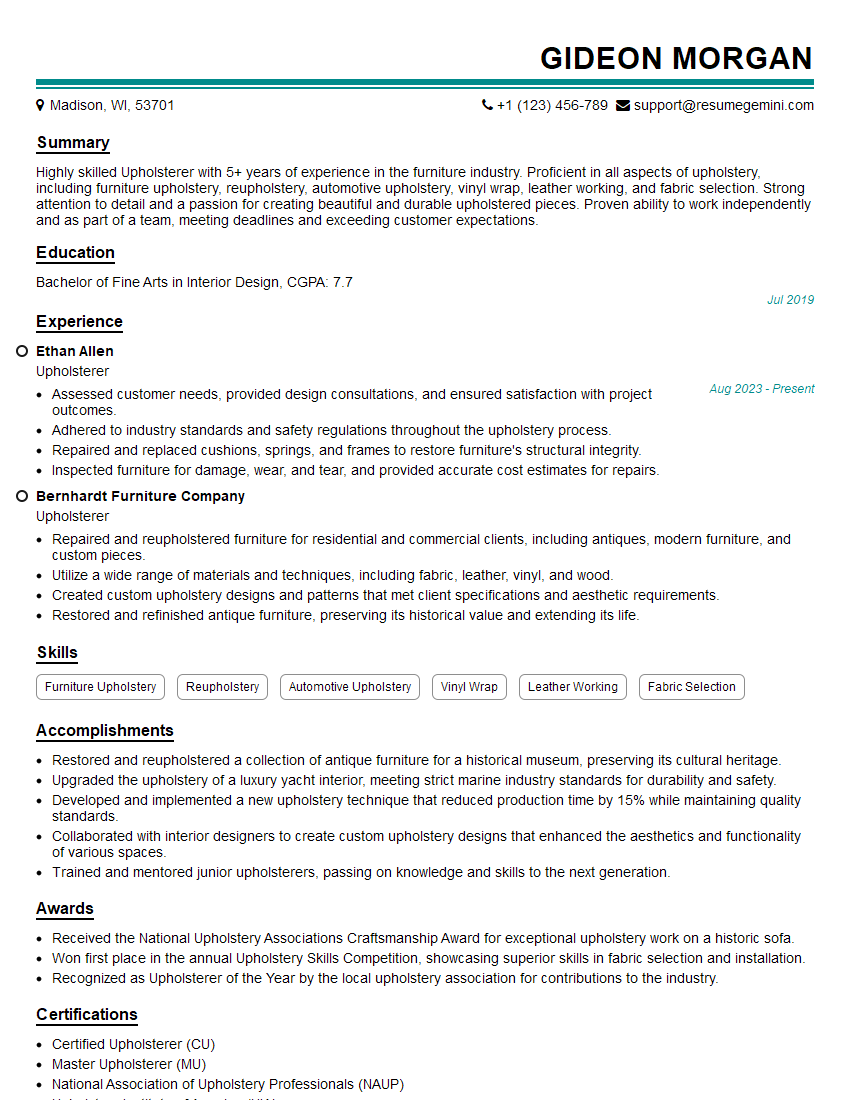
Mastering upholstery techniques is crucial for career advancement, opening doors to higher-paying roles and more specialized projects. An ATS-friendly resume is essential for getting your application noticed by recruiters. To make your application stand out, use ResumeGemini to build a powerful and impactful resume that highlights your skills and experience effectively. ResumeGemini provides examples of resumes tailored to upholstery techniques roles, helping you present yourself as the ideal candidate.
Explore more articles
Users Rating of Our Blogs
Share Your Experience
We value your feedback! Please rate our content and share your thoughts (optional).
What Readers Say About Our Blog
Very informative content, great job.
good