Interviews are more than just a Q&A session—they’re a chance to prove your worth. This blog dives into essential Label Attaching interview questions and expert tips to help you align your answers with what hiring managers are looking for. Start preparing to shine!
Questions Asked in Label Attaching Interview
Q 1. Describe your experience with different label application methods (manual, automated).
My experience spans both manual and automated label application methods. Manual application, while seemingly simple, requires precision and consistency, especially for high-volume tasks. I’ve worked extensively with hand-held label applicators, perfecting techniques for accurate placement on various surfaces and shapes. This includes everything from applying labels to small vials in a pharmaceutical setting to larger boxes in a warehousing environment. Automated methods, on the other hand, offer significantly higher throughput and reduced risk of human error. I’ve managed and operated several automated labeling systems, from simple roll-fed labelers to complex integrated systems incorporating conveyor belts, sensors, and sophisticated software control.
For instance, in a previous role, we transitioned from a fully manual labeling process for small electronics to an automated system. This resulted in a 300% increase in productivity and a significant reduction in label misplacement. The transition required careful planning, including employee retraining and rigorous testing to ensure seamless integration into the existing workflow.
Q 2. What types of labeling machines are you familiar with?
I’m familiar with a wide array of labeling machines, categorized by application and technology. These include:
- Roll-fed labelers: These are common for high-volume applications, dispensing labels from a roll and applying them to products moving along a conveyor. They range from simple, basic models to sophisticated units with features like print-and-apply functionality.
- Pressure-sensitive labelers: These utilize pressure-sensitive adhesives and are suitable for various label materials and product shapes. I’ve worked with both intermittent and continuous motion machines within this category.
- Wrap-around labelers: Ideal for cylindrical products, these machines wrap a single label completely around the item.
- Print-and-apply labelers: These combine printing and label application, allowing for variable data such as barcodes or serial numbers to be printed directly onto each label before application.
- Tamper-evident labelers: Designed to provide security features, these machines apply labels that are difficult to remove without obvious signs of tampering.
My experience covers both the operation and maintenance of these machines, including understanding their mechanical and electronic components.
Q 3. How do you ensure accurate and consistent label placement?
Ensuring accurate and consistent label placement is paramount. This involves a multifaceted approach focusing on machine calibration, label material selection, and process optimization. Proper machine calibration is crucial – checking sensor alignment, label dispensing mechanisms, and print registration (if applicable) is a regular part of my routine. I use precision tools and measurement devices to ensure accuracy. For instance, I might use a micrometer to check the gap between the label dispensing mechanism and the product surface.
Selecting the appropriate label material for the product and application environment is also key. A label with insufficient adhesion will lead to peeling or detachment, while overly strong adhesive might damage the product. Finally, optimization involves fine-tuning parameters like label speed, pressure, and temperature to achieve optimal performance and reduce waste. Regularly monitoring the labeling process and making adjustments as needed is essential for consistent results.
Q 4. Explain your process for troubleshooting label application issues.
My troubleshooting process is systematic and data-driven. When a label application issue arises, I follow these steps:
- Identify the problem: Is it misalignment, label damage, incorrect application, or something else? Documenting the specifics of the problem is crucial.
- Gather data: Analyze the labeling data, machine logs, and production reports to identify trends or patterns.
- Check the obvious: Inspect the label supply, ensure there are no jams or obstructions in the machine, verify proper settings, and check the label material for defects.
- Isolate the cause: Is the problem related to the label material, the machine’s mechanical components, or the software? Systematic testing will help narrow down the possibilities.
- Implement the solution: Once the root cause is identified, apply the appropriate fix. This may involve adjusting machine settings, replacing worn parts, or even software updates.
- Prevent recurrence: Implement preventative maintenance procedures and operator training to minimize the likelihood of the problem recurring.
For instance, if labels are consistently misaligned, I would first check the sensor alignment and then the conveyor belt tracking. I would then check the label’s own specifications for size and tolerance.
Q 5. What are the common causes of label misalignment or damage?
Common causes of label misalignment or damage include:
- Improper machine calibration: Incorrectly aligned sensors or misadjusted dispensing mechanisms can lead to misaligned labels.
- Defective label material: Damaged labels, poor adhesive, or inconsistent label dimensions can result in misalignment or peeling.
- Product inconsistencies: Variations in product size, shape, or surface texture can affect label application.
- Environmental factors: Temperature and humidity fluctuations can influence adhesive performance.
- Mechanical issues: Worn or damaged machine parts, such as rollers or belts, can cause inconsistencies.
- Software glitches: In automated systems, software errors can lead to incorrect label placement or data printing.
For example, inconsistent product size could lead to labels being applied unevenly. A simple solution is to add additional sensors to measure the dimensions of the product before labeling.
Q 6. How do you maintain the cleanliness and efficiency of labeling equipment?
Maintaining labeling equipment involves a regular schedule of cleaning and preventative maintenance. This ensures both operational efficiency and the longevity of the equipment. Cleaning protocols depend on the type of equipment, but generally involve removing accumulated debris, dust, and label residue. I use appropriate cleaning solutions and tools, following manufacturer guidelines to avoid damaging sensitive components. I regularly lubricate moving parts and replace worn components proactively to prevent breakdowns.
Preventative maintenance includes tasks like checking sensor alignment, tightening belts, and inspecting rollers for wear. A well-maintained labeling machine produces high-quality labels consistently and minimizes downtime. Regular inspections and documentation help me track maintenance history and predict potential future problems.
Q 7. Describe your experience with different adhesive types and their applications.
My experience covers a wide range of adhesive types, each with its own characteristics and suitability for different applications. Common types include:
- Permanent adhesives: Provide strong bonds that are difficult to remove, ideal for applications where labels need to remain attached for extended periods.
- Removable adhesives: Allow labels to be easily removed without leaving residue, suitable for temporary labeling or applications where product reuse is possible.
- Ultra-high bond adhesives: Particularly strong and resistant to environmental factors like temperature and moisture.
- Cryogenic adhesives: Maintain adhesion even at extremely low temperatures.
- Hot-melt adhesives: Applied in molten form and solidify quickly, offering excellent bonding strength.
The choice of adhesive depends critically on the substrate (the surface the label is applied to), the label material, the environmental conditions, and the required duration of adhesion. For example, I might choose a removable adhesive for a product that may need to be relabeled or returned, and a permanent adhesive for something like a medical device requiring long-term identification.
Q 8. How do you handle labels with varying sizes and shapes?
Handling labels of varying sizes and shapes requires a versatile approach. It’s not a one-size-fits-all solution; the method depends on the labeling machinery and the label material.
For example, with automated label applicators, we often use adjustable settings to accommodate different dimensions. This might involve changing the label feed mechanism, adjusting sensor positions to detect the label’s edges accurately, or modifying the pressure rollers to ensure proper adhesion. For smaller, more irregularly shaped labels, we might use a different applicator altogether, potentially one with a more precise placement system, or even resort to manual application for very specialized cases.
Imagine applying small, circular stickers to round bottles versus large, rectangular labels to boxes. The machine settings—the speed, pressure, and placement—would be completely different. We carefully program the machine or adjust the settings based on the specific label and product dimensions, always testing before large-scale application to avoid wastage.
Q 9. What safety precautions do you take when operating labeling machinery?
Safety is paramount in label application. We adhere to strict protocols to prevent accidents. This begins with thorough training on all equipment, covering emergency shut-off procedures and safe operating practices. We also wear appropriate personal protective equipment (PPE), including safety glasses, gloves, and, where necessary, hearing protection. Regular machine maintenance and inspection are critical to identify and prevent malfunctions. The work area is kept clean and organized to prevent tripping hazards. Furthermore, we utilize lockout/tagout procedures whenever performing maintenance or repairs on any labeling equipment to prevent accidental activation.
For instance, before starting any labeling machine, we conduct a comprehensive safety check. This might involve visually inspecting the machine, checking all guards are in place, and ensuring all moving parts are functioning correctly. We also establish clear communication protocols so that only authorized personnel operate the equipment.
Q 10. How do you ensure labels are correctly aligned with product information?
Accurate label alignment is crucial for product presentation and regulatory compliance. We achieve this through a combination of methods. Automated labeling systems often employ advanced vision systems to precisely locate the product and position the label accordingly. These systems use cameras and software to detect the product’s position and orientation, ensuring the label is placed correctly. For simpler applications, we might use guides or templates to ensure consistent placement.
Let’s say we’re labeling jars of jam. We might use a mechanical guide to ensure the label is centered and aligned with the jar’s top. Alternatively, using a sensor, the machine can detect the top of the jar, and then position the label accordingly. For manual applications, consistent, careful placement using visual cues and guides is paramount.
Q 11. Describe your experience with quality control procedures in label application.
Quality control is an integral part of our labeling process. We use a multi-step approach to ensure accuracy and consistency. This includes pre-application checks of the labels themselves to ensure there is no damage or printing errors. During the application process, regular spot checks are made to verify correct alignment, adhesion, and the absence of defects. Post-application, we conduct random sampling and visual inspections to identify any issues that might have been missed. We also maintain detailed records, including production logs and quality control reports.
For example, in a food product labeling setting, we might use a statistical sampling method to check a percentage of the labeled products for correct label placement, legibility of the text, and proper adhesion. If defects exceed a predetermined threshold, the entire batch might be rejected or require re-labeling.
Q 12. How do you identify and rectify labeling errors?
Identifying and rectifying labeling errors requires a systematic approach. First, we identify the type of error: is it misalignment, incorrect label, poor adhesion, or a printing defect? Then, we investigate the root cause. This might involve inspecting the labeling equipment, reviewing the label design, or assessing the product handling process. Once the root cause is identified, corrective actions are taken. This could involve recalibrating the machinery, adjusting settings, replacing defective labels, or retraining personnel.
If we find, for instance, that labels are consistently misaligned, we might check the sensor calibration on the machine, or adjust the guide mechanisms. If there’s a recurring printing defect, we would contact our label supplier. A well-documented process of error reporting and resolution is key.
Q 13. What is your experience with different label materials (paper, vinyl, etc.)?
I have extensive experience with various label materials. Paper labels are cost-effective for many applications, but their durability is limited. Vinyl labels, on the other hand, offer superior durability and resistance to water and abrasion, making them ideal for outdoor or demanding environments. We also work with specialized labels like those with tamper-evident features, heat-resistant materials, or those requiring specific adhesives for different substrate types. Material selection depends on factors such as the product, the application environment, and the desired lifespan of the label.
For example, a food product might use a paper label that conforms to food safety regulations, while a product intended for outdoor use would require a more durable vinyl label with UV resistance to prevent fading. We carefully consider each factor and specify the most appropriate label material for the task.
Q 14. How do you handle damaged or defective labels?
Handling damaged or defective labels requires immediate attention to avoid delays and product errors. Damaged labels are usually removed from the production line and disposed of according to company procedures. Depending on the volume of damage, we might need to assess whether the label supplier needs to be contacted. We maintain a supply of replacement labels to minimize downtime. If the issue is with the adhesive, or the labels are damaged during the application process, this may indicate a need to re-evaluate the machine settings or the product handling procedures. Thorough record-keeping helps us track the frequency and types of damage to identify trends and prevent future occurrences.
For example, if a large number of labels are creased, we might investigate the label storage conditions or adjust the label feeder settings. The goal is to pinpoint the cause of the damage and implement a preventive measure to avoid repetitions.
Q 15. Explain your understanding of barcode and RFID label applications.
Barcode and RFID (Radio-Frequency Identification) labels are both crucial for efficient product tracking and identification, but they differ significantly in their technology and applications. Barcodes, like the ubiquitous UPC codes on grocery items, are optical labels that store data in the form of bars and spaces. A scanner reads these patterns, translating them into a unique identifier. They are cost-effective and widely compatible but are limited by their line-of-sight reading requirement and susceptibility to damage.
RFID labels, on the other hand, use radio waves to transmit data. They contain a microchip and antenna, enabling contactless reading from a distance. This makes them ideal for tracking items in challenging environments or high-volume applications. For example, RFID is frequently used in inventory management for clothing retailers, allowing for quick and accurate stock counts without manual scanning of individual items. While more expensive upfront, RFID offers superior data density and enhanced capabilities like real-time tracking and temperature monitoring, making them more suitable for high-value goods or those requiring extensive data capture.
- Barcode Applications: Retail checkout, library book tracking, package identification.
- RFID Applications: Supply chain management, asset tracking, livestock identification, access control.
Career Expert Tips:
- Ace those interviews! Prepare effectively by reviewing the Top 50 Most Common Interview Questions on ResumeGemini.
- Navigate your job search with confidence! Explore a wide range of Career Tips on ResumeGemini. Learn about common challenges and recommendations to overcome them.
- Craft the perfect resume! Master the Art of Resume Writing with ResumeGemini’s guide. Showcase your unique qualifications and achievements effectively.
- Don’t miss out on holiday savings! Build your dream resume with ResumeGemini’s ATS optimized templates.
Q 16. Describe your experience with high-speed labeling systems.
My experience with high-speed labeling systems spans several years, working with various manufacturers and configurations. I’ve been involved in the implementation and optimization of systems capable of applying labels at rates exceeding 100 items per minute. This includes working with both pressure-sensitive and adhesive label applicators. For example, in one project, we transitioned from a slower, manual labeling process to an automated system using a high-speed labeler integrated with a conveyor belt system. This not only significantly increased production efficiency but also improved label placement accuracy and reduced human error. Troubleshooting mechanical issues such as label jams, sensor malfunctions, and misaligned applicator heads are part of my daily routine. I’m proficient in diagnosing and resolving these problems quickly to minimize downtime.
Furthermore, I am familiar with different label applicator types, including those using various technologies such as thermal transfer printing and inkjet printing, which are crucial for adapting to diverse label materials and production requirements. I understand the importance of safety procedures when operating these systems, including regular maintenance checks and adherence to safety protocols.
Q 17. How do you maintain production targets while ensuring quality labeling?
Balancing production targets with quality labeling is a crucial aspect of this role, and I approach it systematically. First, I meticulously plan the labeling process, including defining clear quality control checkpoints at various stages of production. This often involves setting acceptable ranges for label placement accuracy, print quality, and label adhesion. Regular monitoring and real-time adjustments are crucial.
For instance, if we notice a drop in label adhesion, we investigate the cause—is it a problem with the adhesive, the application pressure, or the surface of the product? Addressing the root cause ensures long-term quality. Similarly, if we see inconsistencies in label placement, we may need to adjust the applicator settings or the conveyor belt speed. Adopting a proactive approach, by monitoring key performance indicators (KPIs) like defect rate and throughput, enables early identification of potential problems and prevents significant production issues.
Finally, continuous improvement is key. Regularly reviewing our processes, analyzing data, and implementing necessary adjustments ensures we remain efficient and maintain high-quality standards while meeting or exceeding production targets.
Q 18. How do you prioritize tasks in a fast-paced labeling environment?
Prioritization in a fast-paced labeling environment is critical. I use a combination of techniques to manage tasks efficiently. I begin with a clear understanding of production schedules and deadlines. I then prioritize tasks based on urgency and importance, using methods such as the Eisenhower Matrix (urgent/important). This helps me identify which tasks need immediate attention and which can be scheduled for later.
For instance, addressing a machine malfunction that’s halting production is obviously higher priority than a less urgent task like label design refinement. Effective communication with the team is also crucial. Keeping everyone informed of priorities and potential bottlenecks ensures everyone is working collaboratively towards shared goals. I also use project management software to track progress, assign tasks, and identify potential delays, fostering transparency and accountability.
Q 19. Describe your experience working with different labeling software.
My experience encompasses various labeling software packages, including NiceLabel, BarTender, and LabelView. I am comfortable designing and managing label templates, integrating them with databases for variable data printing (e.g., serial numbers, batch codes), and generating reports for quality control purposes. For instance, I’ve used NiceLabel to create complex labels with multiple data fields, barcodes, and images, integrating with our ERP system to automatically populate product information. This automated process significantly improved efficiency and minimized data entry errors. Each software has its strengths; I can adapt quickly to the specific needs of a project by choosing the best suited tool.
Q 20. How do you handle unexpected production delays or equipment malfunctions?
Unexpected delays or equipment malfunctions necessitate a calm, systematic approach. My first step is to assess the situation—what exactly is the problem, and how severely is it impacting production? Once I have a clear understanding, I initiate troubleshooting. This might involve checking sensors, reviewing error logs, or consulting technical manuals. If the issue is beyond my expertise, I immediately involve the appropriate maintenance personnel or contact the equipment manufacturer for support.
In the meantime, I work to minimize the impact on production. This could involve rerouting work to alternative equipment, temporarily switching to a manual process, or prioritizing other tasks that aren’t affected by the malfunction. Post-incident analysis is crucial—I document the issue, the resolution steps, and any preventative measures to avoid similar problems in the future. This continuous learning approach improves efficiency and minimizes downtime in the long run.
Q 21. What is your experience with inventory management related to labels?
Effective inventory management for labels is crucial for preventing production stoppages and minimizing waste. I utilize various strategies, including implementing a just-in-time (JIT) inventory system to ensure we have the necessary labels without excessive stock. Regular stock checks, tracking label usage, and analyzing consumption patterns are vital to maintaining optimal inventory levels. This prevents shortages and reduces storage costs. We also implement a rigorous system for tracking label specifications—type, size, adhesive, and quantity—to avoid ordering errors. A well-maintained inventory management system gives us real-time visibility, allowing for proactive ordering and reducing the risk of unexpected delays.
Furthermore, I regularly review our label consumption data to identify any potential inefficiencies or waste. For example, if we’re consistently overstocking certain label types, we adjust our ordering quantities accordingly. This data-driven approach optimizes our inventory management and contributes to cost savings.
Q 22. How do you ensure compliance with industry regulations regarding labeling?
Ensuring compliance with industry regulations in label attaching is paramount. It’s not just about sticking a label; it’s about adhering to legal requirements that protect consumers and ensure product safety. This involves understanding and meticulously following regulations like the FDA’s labeling requirements for food and drugs, the GHS (Globally Harmonized System) for chemical labeling, and any other relevant regional or industry-specific standards. For example, pharmaceutical labeling must meet strict guidelines regarding dosage information, warnings, and lot numbers. My process involves:
- Regularly reviewing updated regulations: Staying current on changes is crucial. I subscribe to relevant industry newsletters and attend workshops to maintain up-to-date knowledge.
- Implementing a robust quality control system: This includes checklists for label verification, ensuring accurate information and proper placement. Each step, from label design to final application, is meticulously reviewed to prevent non-compliance.
- Maintaining detailed records: Comprehensive documentation, including label design approvals, material certifications, and application logs, provides a clear audit trail for compliance verification.
- Collaborating with regulatory experts: When uncertainty arises concerning specific regulations, consulting with specialized legal or regulatory professionals helps ensure adherence.
Essentially, compliance isn’t just a checklist but an ingrained part of my workflow, ensuring that every label attached meets legal and ethical standards.
Q 23. Describe your experience with different types of label adhesives and their properties.
My experience spans a wide range of label adhesives, each with unique properties suitable for different applications. Think of it like choosing the right glue for a specific project – you wouldn’t use superglue to attach a delicate fabric to paper!
- Permanent Adhesives: These offer strong bonds that are resistant to moisture, temperature fluctuations, and abrasion. They’re ideal for labels that need to stay put, such as those on durable goods or products exposed to harsh environments. I’ve used these extensively in automotive and industrial settings.
- Removable Adhesives: These allow for easy label removal without leaving residue. They are crucial for applications where labels need to be changed frequently, like promotional labels or temporary pricing tags in retail environments. I’ve found these particularly useful in short-term marketing campaigns.
- Pressure-Sensitive Adhesives: These are the most common type, relying on pressure for adhesion. They are versatile and widely used across various industries. They provide a good balance between ease of application and lasting adhesion.
- Hot-Melt Adhesives: These adhesives are applied in molten form and solidify quickly, offering high bonding strength. They are used in high-speed label applications, often with automated equipment. I have extensive experience using these in large-scale packaging operations.
Choosing the right adhesive involves considering factors such as substrate material, label material, environmental conditions, and the desired longevity of the bond. Selecting the wrong adhesive can lead to label detachment or damage to the product.
Q 24. What are the different methods for applying labels to curved or irregular surfaces?
Applying labels to curved or irregular surfaces requires specialized techniques and sometimes, specialized equipment. A simple straight label application won’t work here; you need to adapt your approach.
- Contour Labeling: This involves using flexible label materials that conform to the shape of the surface. This might include using stretchable vinyl labels or employing a heat-shrinking process where the label shrinks to fit the contours.
- Shrink Sleeve Labeling: A plastic sleeve is printed with the label and then shrunk onto the product using heat. This is especially effective for cylindrical or oddly shaped containers. I’ve used this extensively in bottling and beverage applications.
- Wraparound Labeling: For partially curved surfaces, the label can be designed to wrap around the product, ensuring complete coverage. This requires careful measurement and precise placement. This method is often used for products with cylindrical components.
- Manual Application with Adjustments: In some cases, careful hand application, using techniques to stretch and manipulate the label material, can be effective for smaller-scale operations and unique product shapes.
The choice of method often depends on the product’s geometry, the material of the product, and the desired level of precision and automation.
Q 25. How do you maintain a clean and organized workspace in a labeling environment?
Maintaining a clean and organized workspace in a labeling environment is essential for efficiency, safety, and quality control. It’s also crucial for preventing errors and cross-contamination. Imagine a messy kitchen – you wouldn’t want to cook there! The same principle applies to labeling.
- Designated storage areas: Labels, adhesive rolls, and equipment should be stored in designated areas to prevent clutter and accidental damage.
- Regular cleaning schedules: Spills and adhesive residue should be cleaned immediately to prevent build-up and potential hazards. This also helps keep equipment in optimal condition.
- Waste management: Proper disposal of waste materials like label scraps and used adhesive rolls is crucial to maintain cleanliness and comply with environmental regulations.
- 5S Methodology: Implementing the 5S principles (Sort, Set in Order, Shine, Standardize, Sustain) provides a structured framework for workplace organization. This leads to more efficient workflow and fewer errors. I’ve found that implementing 5S greatly improves productivity and morale.
A clean and organized workspace not only promotes efficiency but also contributes to a safer and more productive work environment.
Q 26. What is your understanding of the importance of accurate labeling in various industries?
Accurate labeling is absolutely critical across diverse industries for various reasons. It’s far more than just an identification tag; it’s a cornerstone of safety, legality, and effective communication.
- Consumer Safety: Accurate labeling ensures consumers have the necessary information to use products safely. This includes warnings, instructions, and ingredient lists. Incorrect labeling can lead to accidents or health problems.
- Legal Compliance: Accurate labeling is a legal requirement in most industries. Failure to comply can result in significant penalties and legal repercussions. Think of food products and their necessary allergen warnings – crucial for consumer safety and legal compliance.
- Product Traceability: Accurate labeling allows for effective product tracking, essential for recall management and supply chain efficiency. If a product needs to be recalled due to a fault, it needs to be accurately identified via its labeling.
- Brand Protection: Consistent and accurate labeling helps protect brand reputation and consumer trust. Inconsistent or inaccurate labeling undermines trust.
In short, accurate labeling is fundamental to maintaining consumer confidence, complying with legal requirements, and safeguarding public health.
Q 27. Describe your experience with using various tools and equipment involved in label attachment.
My experience encompasses a wide array of label application tools and equipment. The choice of tool depends greatly on the scale of the operation, the type of label, and the substrate being labeled.
- Manual Label Applicators: These are basic hand-held devices for smaller-scale operations. They’re ideal for quick applications where precision isn’t paramount.
- Automatic Label Applicators: These machines offer high-speed, consistent label application, significantly increasing productivity in large-scale settings. I’ve worked extensively with these in high-volume manufacturing environments.
- Thermal Transfer Printers: These printers create labels with high-quality prints, often used for barcodes and other variable data. The printed labels are then applied manually or automatically.
- Label Dispensers: These ensure the labels are dispensed smoothly and accurately, improving efficiency and reducing wasted labels.
- Specialized Label Application Heads: For more complex applications, like curved surfaces, these heads are designed to adapt to unique product shapes and provide consistent label placement.
Proficiency with these tools and equipment is vital for efficiency and quality in any labeling operation. My expertise extends beyond simple usage to include troubleshooting and preventative maintenance.
Q 28. How do you adapt your labeling techniques to accommodate various product sizes and shapes?
Adapting labeling techniques to accommodate diverse product sizes and shapes involves a multifaceted approach. It’s about flexibility and problem-solving.
- Custom Label Design: Labels are often designed to fit specific product shapes and sizes, ensuring complete coverage and aesthetic appeal. I’ve worked extensively with designers to optimize label sizes and shapes.
- Adjustable Application Equipment: Many automatic label applicators offer adjustable settings to handle various product dimensions. This ensures consistent application, regardless of product size variations.
- Multiple Label Sizes: In some cases, having multiple label sizes pre-printed allows for greater flexibility in handling a range of products. This approach is particularly useful in smaller-scale operations.
- Modular Application Systems: Sophisticated systems allow for the integration of different label application heads and conveyors, allowing for effective handling of a variety of product shapes and sizes. This is common in automated packaging lines.
The key is to have a flexible approach and the ability to choose the right tools and techniques based on the specific requirements of the product and the production environment. I’ve successfully managed large-scale labeling projects with complex product variations by employing this adaptability.
Key Topics to Learn for Label Attaching Interview
- Labeling Methods: Understanding various label application techniques (e.g., pressure-sensitive, glue-applied, thermal transfer) and their suitability for different products and materials.
- Equipment Operation: Familiarize yourself with different label application machines, their functionalities, maintenance, and troubleshooting common issues. This includes understanding safety protocols and preventative maintenance.
- Material Handling: Learn about proper handling of labels, adhesives, and products to ensure efficient and accurate application, minimizing waste and damage.
- Quality Control: Mastering techniques for inspecting label placement, alignment, and overall quality to meet industry standards and client specifications. This includes understanding quality metrics and reporting procedures.
- Production Efficiency: Explore strategies for optimizing label application speed and accuracy, minimizing downtime, and maximizing output while maintaining high quality.
- Safety Procedures: Demonstrate a thorough understanding of all relevant safety regulations and practices related to machinery operation, material handling, and workplace safety.
- Problem-Solving & Troubleshooting: Develop your ability to identify and resolve common issues encountered during label application, such as label misalignment, adhesive issues, or machine malfunctions.
- Industry Best Practices: Stay updated on the latest industry trends, technologies, and best practices related to label application and packaging.
Next Steps
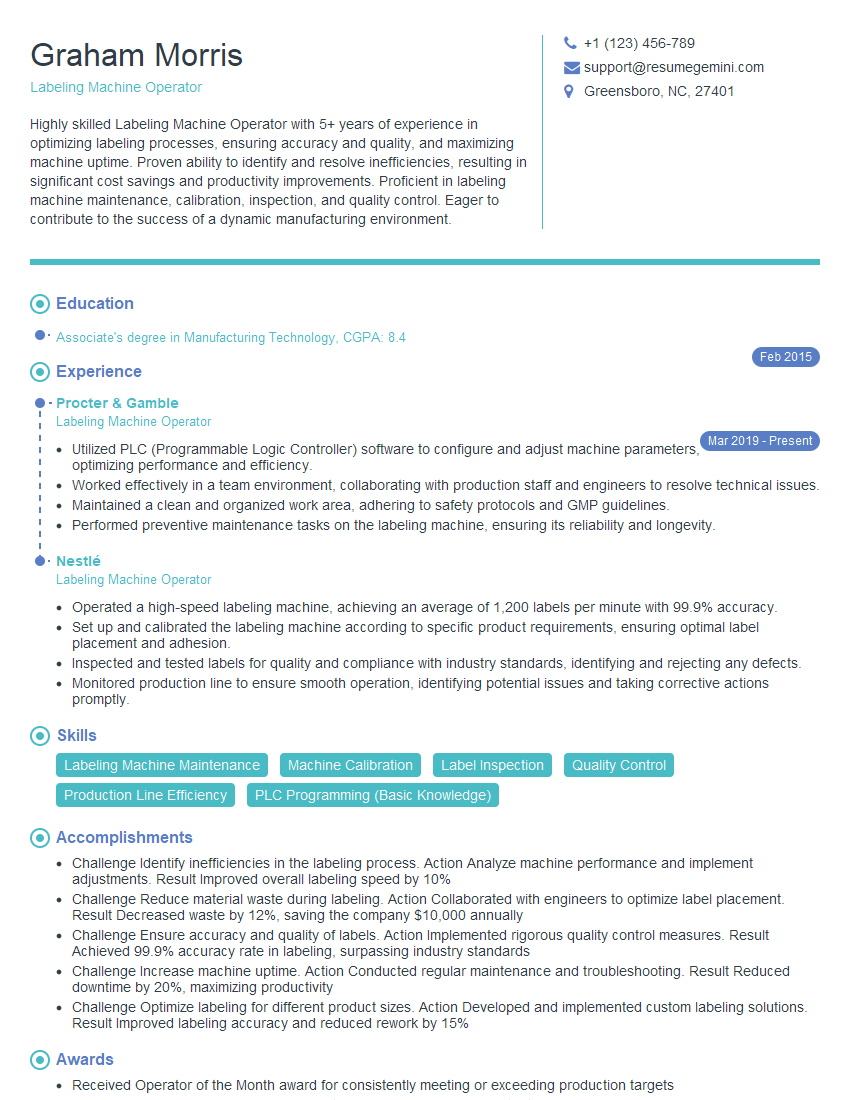
Mastering label attaching skills opens doors to diverse roles within manufacturing, logistics, and packaging industries, offering excellent career growth potential. A strong resume is crucial for showcasing your abilities to potential employers. Building an ATS-friendly resume that highlights your key skills and experience is essential for increasing your job prospects. ResumeGemini is a trusted resource to help you create a professional and impactful resume. Examples of resumes tailored to Label Attaching are available to guide you through the process.
Explore more articles
Users Rating of Our Blogs
Share Your Experience
We value your feedback! Please rate our content and share your thoughts (optional).
What Readers Say About Our Blog
Very informative content, great job.
good