Interviews are more than just a Q&A session—they’re a chance to prove your worth. This blog dives into essential Land Clearing and Grading interview questions and expert tips to help you align your answers with what hiring managers are looking for. Start preparing to shine!
Questions Asked in Land Clearing and Grading Interview
Q 1. Describe your experience with different land clearing techniques.
My experience encompasses a wide range of land clearing techniques, tailored to specific project needs and environmental considerations. This includes:
- Manual Clearing: For smaller projects or sensitive areas, we utilize hand tools like axes, chainsaws, and brush cutters. This method offers precision and minimizes collateral damage, particularly important when dealing with delicate ecosystems.
- Mechanical Clearing: For larger-scale projects, we employ heavy machinery like bulldozers, excavators, and feller bunchers. Bulldozers are excellent for pushing over trees and clearing large tracts of land, while excavators are used for precise removal and site shaping. Feller bunchers are particularly efficient for high-volume tree harvesting. The choice of equipment depends heavily on the density of vegetation and terrain characteristics.
- Controlled Burning (Prescribed Burning): Under strict regulatory oversight and with appropriate permits, controlled burning is sometimes used to clear underbrush and prepare land for replanting. It’s a cost-effective method, but requires a highly skilled team to ensure safety and prevent uncontrolled wildfires.
- Chemical Clearing (Herbicides): In specific situations, targeted herbicide application may be used to control unwanted vegetation, such as invasive species or dense undergrowth. This approach is often environmentally sensitive, focusing on minimizing impact on surrounding plants and animals.
The selection of the optimal technique is a critical decision that depends on factors like project size, budget, environmental sensitivity, and the type of vegetation present. We always conduct a thorough site assessment to determine the best approach.
Q 2. Explain the process of site preparation for a residential development.
Site preparation for a residential development is a multi-phased process requiring meticulous planning and execution. It typically involves:
- Site Analysis and Planning: This crucial initial step involves surveying the land, identifying potential challenges like wetlands, steep slopes, or underground utilities, and developing a detailed site plan that complies with all local regulations and building codes.
- Land Clearing: Utilizing the appropriate techniques discussed earlier (manual, mechanical, or a combination), we clear the site of trees, brush, and other vegetation, ensuring safe disposal or responsible repurposing of materials.
- Grading and Excavation: This phase involves leveling the land, creating building pads, excavating for basements, and preparing the site for utilities installation. Careful consideration must be given to drainage patterns to prevent water accumulation and erosion.
- Utility Installation: Following grading, we prepare the site for the installation of water, sewer, gas, and electrical lines. This often requires coordination with utility companies to ensure compliance with their standards.
- Soil Compaction and Stabilization: To provide a stable foundation for construction, we compact the soil to the required density. This step is crucial for preventing settlement and ensuring long-term structural integrity of the buildings.
- Erosion and Sediment Control: Throughout the entire process, we implement measures like silt fences, sediment basins, and temporary seeding to prevent soil erosion and runoff pollution.
Effective communication and coordination between different teams (engineering, construction, environmental) is crucial to ensure a smooth and efficient process.
Q 3. How do you ensure compliance with environmental regulations during land clearing?
Environmental compliance is paramount in land clearing. We strictly adhere to all applicable federal, state, and local regulations. This includes:
- Obtaining Necessary Permits: Before commencing any work, we obtain all required permits from relevant environmental agencies. This process often involves submitting detailed plans and environmental impact assessments.
- Protecting Wetlands and Endangered Species: We conduct thorough surveys to identify and protect any wetlands, endangered species habitats, or other environmentally sensitive areas. Our work plans are designed to avoid or minimize any impact on these areas. We frequently employ specialists in ecology and environmental protection to guide our work.
- Minimizing Soil Erosion and Sedimentation: Implementing best management practices (BMPs) for erosion control is crucial. This includes using silt fences, sediment basins, and other control measures to prevent runoff and protect water quality.
- Proper Waste Management: We carefully manage all waste materials generated during land clearing, ensuring appropriate disposal or recycling in compliance with local regulations. This can include processing and reusing lumber, composting organic debris, and proper disposal of hazardous materials.
- Post-Clearing Restoration: Where appropriate, we implement post-clearing restoration plans to remediate any disturbances and enhance the environmental quality of the cleared area, such as replanting native vegetation.
We maintain detailed records of all our activities, including permit applications, environmental impact assessments, and compliance monitoring data. This documentation is crucial for demonstrating our commitment to environmental responsibility.
Q 4. What safety measures do you implement on a land clearing and grading site?
Safety is our top priority. We implement a comprehensive safety program that includes:
- Pre-Job Safety Briefing: All personnel receive a thorough briefing before commencing any work, outlining potential hazards and safety procedures specific to the site.
- Personal Protective Equipment (PPE): All workers are required to wear appropriate PPE, including hard hats, safety glasses, hearing protection, and high-visibility clothing.
- Equipment Maintenance and Inspection: All heavy equipment is regularly inspected and maintained to ensure safe and reliable operation. We follow strict maintenance schedules and address any potential mechanical issues promptly.
- Designated Work Zones and Traffic Control: We establish clearly defined work zones and implement traffic control measures to prevent accidents involving heavy equipment and personnel.
- Emergency Response Plan: A comprehensive emergency response plan is in place, including procedures for dealing with injuries, equipment malfunctions, and other unforeseen events.
- Regular Safety Audits and Training: We conduct regular safety audits and provide ongoing safety training to all personnel to reinforce safe work practices and address any potential hazards.
We maintain a zero-tolerance policy for unsafe practices and actively encourage employees to report any safety concerns.
Q 5. Describe your experience operating heavy equipment (specify types).
I have extensive experience operating a range of heavy equipment, including:
- Bulldozers: Proficient in operating various sizes of bulldozers for land clearing, grading, and earthmoving tasks. I’m experienced in both blade and ripper operations.
- Excavators: Skilled in operating excavators for precise excavation, trenching, and material handling. I’m familiar with different attachment types and their applications.
- Loader Backhoes: Experienced in using loader backhoes for digging, loading, and material transport. I understand the safe operation of these versatile machines in various terrain conditions.
- Graders: I possess experience in operating motor graders for fine grading, road construction, and creating smooth surfaces.
My experience encompasses both routine operations and complex tasks in challenging terrain. I always prioritize safe and efficient equipment operation while adhering to all safety regulations.
Q 6. How do you manage soil erosion and sedimentation during grading?
Managing soil erosion and sedimentation during grading is critical for environmental protection and preventing costly remediation efforts. We utilize a variety of strategies:
- Contour Grading: We carefully shape the land to follow natural contours, minimizing steep slopes that are prone to erosion.
- Terracing: For steep slopes, we create terraces to reduce the gradient and prevent significant erosion.
- Vegetative Stabilization: We promptly stabilize graded areas with temporary or permanent vegetation to anchor the soil and prevent runoff.
- Erosion Control Blankets and Mats: These materials help to prevent erosion and provide a stable surface for vegetation to establish.
- Silt Fences and Sediment Basins: These barriers trap sediment from runoff, preventing it from reaching waterways.
- Diversion Ditches and Swales: These channels guide runoff away from sensitive areas and toward designated drainage points.
- Mulching: Applying mulch to exposed soil surfaces helps to retain moisture and reduce erosion.
We carefully monitor conditions throughout the grading process, adjusting our techniques as needed to ensure effective erosion control. Regular inspections and documentation are vital for compliance and effective management.
Q 7. Explain your understanding of different grading methods.
My understanding of grading methods includes a range of techniques, each suited to different applications and site conditions:
- Rough Grading: This initial phase involves removing large amounts of soil to establish the overall site contours and create building pads. It’s often performed using heavy equipment like bulldozers and excavators.
- Fine Grading: This more precise stage involves smoothing the surface to create a level or gently sloped area for construction. Motor graders are typically used for this process.
- Cut and Fill: This common method involves removing soil from one area (cut) and placing it in another (fill) to level the site or create desired features. Careful calculations and planning are essential to minimize earthwork volume.
- Slope Grading: This involves shaping slopes to create stable and aesthetically pleasing landscapes. It requires careful consideration of drainage patterns and soil stability.
- Swale Grading: Creating shallow channels to guide runoff and manage drainage on a site. This method assists in erosion control and promotes water infiltration.
The selection of the optimal grading method depends on several factors, including the site’s topography, soil conditions, the intended use of the land, and budget constraints. Effective grading requires skilled operators and careful planning to achieve the desired results while minimizing environmental impacts.
Q 8. How do you read and interpret site plans and blueprints for land clearing and grading?
Reading site plans and blueprints for land clearing and grading requires a keen eye for detail and a solid understanding of engineering drawings. I start by identifying the key elements: property boundaries, existing structures and utilities (marked with symbols and often color-coded), proposed grades (often shown with contour lines indicating elevation), and areas designated for clearing and grubbing. I carefully examine the scale of the drawing to accurately assess distances and dimensions. For example, a contour line representing a 1-foot elevation change will be visually spaced differently depending on the scale used. Understanding symbols is crucial; I’m familiar with industry-standard symbols representing things like trees, rocks, wetlands, and utilities. I also look for notes and specifications, which often clarify ambiguous details or provide instructions on specific procedures. Finally, I always cross-reference the plan with any provided survey data to ensure consistency and identify any potential discrepancies.
For example, if the plan shows a significant elevation change across a short distance, I know that requires careful planning of cut and fill operations to avoid soil instability or erosion.
Q 9. Describe your experience with GPS technology in land clearing and grading.
GPS technology is indispensable in modern land clearing and grading. I have extensive experience using GPS-enabled machinery, including bulldozers, excavators, and graders. This allows for precise site surveying, accurate cut and fill calculations, and efficient machine operation. I’m proficient in using both real-time kinematic (RTK) and precise point positioning (PPP) GPS systems. RTK systems provide centimeter-level accuracy in real-time, essential for tasks like establishing precise grade elevations. PPP systems offer similar accuracy but don’t require a base station, making them useful for larger projects or remote locations. I’ve utilized GPS data to create digital terrain models (DTMs) which provide a 3D representation of the site’s topography, helping in pre-planning and in monitoring progress against the design during and after the project.
For instance, on a recent highway construction project, we used RTK GPS on our graders to ensure the road base was perfectly graded to within a tolerance of +/- 0.1 feet, maximizing drainage and preventing costly rework.
Q 10. How do you handle unexpected site conditions during land clearing?
Unexpected site conditions are a common challenge in land clearing and grading. My approach is proactive and systematic. Before work begins, a thorough site assessment is crucial; however, unforeseen issues can still arise. When encountering something unexpected – such as encountering unexpected bedrock, unstable soil, or buried utilities – I immediately halt operations and assess the situation. Safety is paramount. I then consult the site plans again, cross-reference with any available geological surveys and utility plans, and contact the project engineer or client to discuss the best course of action. This might involve revising the plan, securing permits for additional work, or bringing in specialized equipment.
For example, on one job we uncovered an old, undocumented underground fuel tank. We immediately stopped work, contacted the environmental agency, and implemented a remediation plan, ensuring both safety and environmental compliance. The added cost and time were substantial, highlighting the importance of thorough pre-planning and risk mitigation.
Q 11. What is your experience with different types of blasting techniques?
My experience encompasses various blasting techniques, always prioritizing safety and environmental regulations. I’m familiar with different types of explosives and their applications. This includes using controlled blasting for rock removal in areas requiring precision, such as near existing structures or utilities. I also have experience with mass blasting for large-scale excavation projects, where efficiency is prioritized. Before any blasting, a thorough site investigation and pre-blast survey are crucial to assess the geology and surrounding environment. I strictly adhere to all relevant safety protocols, including establishing safe blast zones and utilizing appropriate personal protective equipment (PPE). Post-blast inspections are conducted to ensure compliance with specifications and environmental impact is minimized. Proper documentation and reporting of all blasting activities are essential.
For instance, when working on a mountainside excavation project, we utilized carefully designed controlled blasting patterns to minimize vibration and potential damage to nearby properties.
Q 12. How do you ensure the accuracy of grading to meet project specifications?
Ensuring grading accuracy is critical for a successful project. This relies on a combination of precise surveying, careful machine operation, and consistent quality control. We use automated machine control systems integrated with GPS technology, allowing for real-time feedback and adjustments during grading operations. Regular checks are performed using laser levels or total stations to verify that grades are within the specified tolerances. This data is then used to make any necessary adjustments to the machines. I’m also proficient in interpreting and managing the data from these surveying instruments, ensuring it accurately reflects the project’s specifications.
For example, during a large-scale site preparation for a new housing development, we maintained grade tolerances of +/- 0.05 feet, allowing for smooth pavement construction and efficient drainage.
Q 13. Explain your experience with surveying and leveling techniques.
Surveying and leveling techniques form the foundation of accurate land clearing and grading. My expertise includes using various surveying instruments like total stations, laser levels, and GPS systems to establish benchmark points, create site maps, and determine precise elevations. I understand different leveling techniques, including differential leveling and trigonometric leveling, and I can choose the most appropriate method depending on the project’s complexity and site conditions. I’m skilled in data processing and analysis, using survey software to generate contour maps, cross-sections, and volumetric calculations, which help in planning and optimizing the earthmoving process.
For example, establishing a precise grid of benchmark points is essential for guiding the heavy machinery and ensuring the final grade meets design specifications. Any errors here can have cascading effects on the whole project.
Q 14. How do you manage a team of heavy equipment operators?
Managing a team of heavy equipment operators requires strong leadership, communication, and safety awareness. I begin by ensuring each operator is properly trained and certified on the specific machines they operate. Clear communication is key; I provide daily briefings outlining the day’s tasks, safety procedures, and any specific challenges. I emphasize safety protocols and regularly monitor the work to ensure compliance. This includes regular inspections of equipment to prevent malfunctions and ensure all safety measures are followed. I foster a collaborative environment, encouraging operators to communicate any issues or concerns. I also utilize productivity tracking methods to monitor the team’s progress and identify areas for improvement. Regular feedback and training sessions keep the team updated with best practices and advancements in equipment and techniques.
For example, establishing a clear chain of command and communication protocol is crucial in a complex site with multiple machines operating simultaneously. This helps to prevent accidents and ensures smooth workflow.
Q 15. What is your experience with site drainage planning and implementation?
Site drainage planning is crucial for preventing erosion, water damage, and ensuring a stable foundation for any construction. My experience encompasses the entire process, from initial site assessment and hydrological studies to the implementation and final inspection of drainage systems. This includes designing and installing systems such as swales, ditches, culverts, French drains, and subsurface drainage systems. For example, on a recent project involving a hillside development, we conducted a thorough topographical survey to identify potential runoff areas. Based on this data, we designed a series of swales and a subsurface drainage system to efficiently channel water away from the building sites, preventing erosion and protecting the foundations. We also considered the local climate and soil conditions to ensure the long-term effectiveness of the system. Proper drainage planning not only mitigates risks but also ensures the longevity and value of the project.
Career Expert Tips:
- Ace those interviews! Prepare effectively by reviewing the Top 50 Most Common Interview Questions on ResumeGemini.
- Navigate your job search with confidence! Explore a wide range of Career Tips on ResumeGemini. Learn about common challenges and recommendations to overcome them.
- Craft the perfect resume! Master the Art of Resume Writing with ResumeGemini’s guide. Showcase your unique qualifications and achievements effectively.
- Don’t miss out on holiday savings! Build your dream resume with ResumeGemini’s ATS optimized templates.
Q 16. How do you handle soil compaction issues during grading?
Soil compaction is a common problem during grading, reducing soil permeability and potentially causing structural issues. My approach involves a multi-pronged strategy. First, we meticulously plan the grading process to minimize the number of passes heavy equipment makes over any given area. Second, we utilize appropriate compaction techniques, often adjusting the type and weight of equipment based on the soil type and desired compaction level. For example, in clay soils, we’d use lighter equipment to avoid over-compaction, while sandy soils might require heavier equipment. Third, we regularly monitor soil moisture content during compaction to ensure optimal results. If compaction is excessive, we use methods like ripping or deep aeration to improve soil structure and permeability. Imagine trying to build a house on a compressed sponge – it’s not stable. Similarly, addressing soil compaction ensures a solid foundation for any structure.
Q 17. Describe your knowledge of different soil types and their impact on grading.
Understanding soil types is fundamental to successful grading. Different soils have vastly different properties affecting their workability and behavior during grading. For instance, clay soils are cohesive and can become very sticky when wet, making them difficult to work with. Sandy soils, on the other hand, are well-drained but can be prone to erosion. Silty soils are somewhere in between. My experience includes identifying soil types through visual inspection and laboratory testing. This information informs our equipment selection, grading techniques, and the development of erosion control plans. For example, on a project with expansive clay soils, we scheduled the grading during drier periods and implemented measures to prevent soil erosion. Knowing the soil type allows us to proactively manage challenges and avoid costly delays or failures.
Q 18. What is your experience with cut and fill calculations?
Cut and fill calculations are essential for determining earthwork volumes, optimizing material use, and estimating project costs. My experience encompasses using both manual methods and sophisticated computer software (like AutoCAD Civil 3D) to perform these calculations. This involves analyzing topographic surveys to determine the difference between existing and proposed ground levels. The software helps generate accurate cut and fill volumes, identifying areas requiring excavation (‘cut’) and areas where material can be placed (‘fill’). We then optimize the placement of fill material to minimize transport distances and costs. Think of it like a giant 3D puzzle; we need to strategically move earth to create the desired shape, minimizing waste and maximizing efficiency. Accurate cut and fill calculations are critical for a project’s financial success.
Q 19. How do you manage waste materials generated during land clearing?
Managing waste materials generated during land clearing is crucial for environmental responsibility and cost-effectiveness. Our approach adheres strictly to all relevant environmental regulations. This starts with careful planning and separation of materials. We separate topsoil for potential reuse, recycle or repurpose suitable materials (like lumber), and properly dispose of debris and hazardous materials at licensed facilities. For example, we might use the topsoil from the excavation to create berms or backfill areas, minimizing the amount of material sent to landfills. We also maintain detailed records of waste generation and disposal, ensuring complete transparency and compliance. This comprehensive approach not only reduces our environmental impact but also lowers overall project costs.
Q 20. Explain your experience with utility locating and protection.
Utility locating and protection are paramount for safety and preventing costly damage. Before any earthmoving activity begins, we always engage professional utility locating services to identify the precise locations of underground utilities (power lines, gas lines, water pipes, etc.). We then establish clear boundaries and implement safety measures to protect those utilities throughout the project. This includes marking the utility locations, using hand tools near identified lines, and implementing measures such as shoring or trench boxes as needed. Think of it as a minefield – proper locating and protection are vital to prevent accidents and maintain a safe work environment. Failure to properly locate and protect utilities can lead to serious injuries or significant project delays.
Q 21. How do you ensure project timelines and budgets are met?
Meeting project timelines and budgets requires careful planning, efficient execution, and proactive problem-solving. We start with a detailed project schedule, factoring in potential delays and incorporating contingency plans. This includes regular monitoring of progress, proactive communication with the client and subcontractors, and the efficient allocation of resources. We use project management software to track progress, manage costs, and identify potential issues early on. If challenges arise, we work collaboratively to develop effective solutions without compromising safety or quality. For example, unforeseen weather conditions might cause delays, but we might mitigate this by adjusting the schedule or using alternative methods. Open communication and proactive management are key to successfully completing projects on time and within budget.
Q 22. What are your strategies for dealing with challenging terrain?
Tackling challenging terrain in land clearing and grading requires a multifaceted approach. It’s not just about brute force; it’s about strategic planning and utilizing the right tools and techniques.
- Site Assessment: A thorough survey is crucial. This involves identifying slopes, soil types (rock, clay, sand), vegetation density, and potential obstacles like underground utilities or wetlands. We use topographic surveys and soil testing to inform our strategy.
- Equipment Selection: The equipment choice depends heavily on the terrain. Steep slopes might require specialized excavators with articulated booms for stability. Rocky terrain necessitates rock breakers and possibly even blasting (with appropriate permits and safety measures). For softer soils, bulldozers or scrapers are efficient.
- Phased Approach: Instead of tackling the entire site at once, we often break it down into manageable phases. This allows us to address the most difficult areas first and adapt the approach as needed. For example, we might start with clearing the easiest sections to establish access roads and staging areas before moving to the tougher parts.
- Safety Protocols: Challenging terrain increases safety risks. We implement stringent safety measures, including regular inspections of equipment, proper personal protective equipment (PPE) use, and detailed site-specific safety plans. This also includes employing experienced operators and supervisors who understand the risks associated with challenging terrains.
For example, on a recent project with a steep, rocky hillside, we utilized a combination of a high-reach excavator for initial clearing, followed by a smaller, more maneuverable excavator for precise grading near the top. We also incorporated temporary retaining walls in vulnerable areas to prevent erosion and ensure the safety of our crew.
Q 23. Describe your problem-solving skills related to unexpected problems on a site.
Unexpected problems are inevitable in land clearing and grading. My problem-solving approach is systematic and focuses on rapid assessment, creative solutions, and effective communication.
- Assessment: The first step is to accurately identify the problem. This involves a thorough on-site inspection and potentially additional testing (e.g., soil sampling).
- Risk Evaluation: Once identified, we evaluate the risk associated with the problem – its potential impact on the project timeline, budget, and safety.
- Solution Brainstorming: This involves bringing together the relevant team members (operators, supervisors, engineers) to brainstorm possible solutions. We consider multiple options and weigh their pros and cons, factoring in cost, safety, and practicality.
- Solution Implementation: We select the best solution and implement it safely and efficiently, documenting the process and any changes made to the original plan.
- Post-Problem Analysis: After the problem is resolved, we conduct a post-problem analysis to identify the root cause, understand why it wasn’t caught earlier, and improve our processes for future projects. This analysis may involve changes to the project plan, additional training for the team, or improvements to equipment maintenance.
For instance, discovering unexpected bedrock during excavation required a shift in strategy. Instead of continuing with the original plan, we brought in a rock breaker and adjusted the grading plan to accommodate the rock formation, documenting the change for the client and updating the project timeline.
Q 24. How do you prioritize tasks on a large land clearing and grading project?
Prioritizing tasks on a large project involves a combination of logical sequencing, risk assessment, and client communication.
- Sequencing: We use a critical path method (CPM) to establish a logical sequence of tasks. Tasks that impact subsequent steps are prioritized. For instance, clearing access roads is typically prioritized before beginning major excavation to ensure efficient movement of equipment and materials.
- Risk Mitigation: Tasks with higher safety risks or potential delays are prioritized based on their impact on the overall project. For example, removing hazardous materials (asbestos, etc.) is given precedence over less critical tasks.
- Client Alignment: Client priorities are factored into the prioritization process. For instance, if the client is especially concerned about completing a specific section on time, we’ll adjust the task sequencing accordingly.
- Resource Allocation: We must consider the availability of resources (personnel, equipment) when prioritizing tasks. Tasks requiring specialized equipment or personnel with specific expertise may need to be scheduled accordingly.
We often use project management software to visually represent the task dependencies, progress, and potential roadblocks. This makes it easy to adjust priorities as needed throughout the project.
Q 25. What is your familiarity with different types of earthmoving equipment?
My familiarity with earthmoving equipment is extensive, encompassing various types used in land clearing and grading operations.
- Bulldozers: I’m proficient in operating and maintaining various bulldozer models, understanding their applications for clearing, pushing, and grading in different soil conditions.
- Excavators: I have experience with both hydraulic excavators (for digging and precise work) and long-reach excavators (for reaching difficult areas).
- Scrapers: I understand the use of scrapers for efficiently moving large volumes of earth across longer distances.
- Loaders: My experience includes operating wheel loaders and skid steers for material handling, loading trucks, and site cleanup.
- Graders: I’m skilled in using motor graders to create smooth and level surfaces for roads, pads, and other areas.
- Specialized Equipment: I have experience with specialized equipment like rock breakers, trenchers, and compactors as needed for specific site conditions.
Beyond operation, I understand the maintenance requirements for each type of equipment, crucial for minimizing downtime and ensuring safety. I can also troubleshoot common mechanical issues and coordinate with mechanics for more complex repairs. This practical understanding ensures efficient and effective use of resources on projects.
Q 26. Describe your experience with site cleanup and restoration.
Site cleanup and restoration are critical for minimizing environmental impact and ensuring client satisfaction. My experience includes:
- Waste Management: This involves sorting and disposing of debris according to local regulations. We carefully separate materials like wood, concrete, and metal for recycling or proper disposal in landfills.
- Erosion Control: We use techniques like seeding, mulching, and installing erosion control blankets to prevent soil erosion and protect water quality.
- Topsoil Management: When possible, we carefully remove and stockpile topsoil before clearing and grading and replace it afterward to facilitate revegetation.
- Revegetation: We work with landscape architects or other specialists to select appropriate plant species for the area’s climate and soil conditions and help establish them after grading.
- Final Grading and Shaping: We conduct final grading to create even surfaces, properly sloped areas for drainage, and address any remaining imperfections.
On a recent project, we implemented a comprehensive restoration plan that included re-seeding disturbed areas with native grasses and shrubs, resulting in a significant reduction in erosion and an improved landscape.
Q 27. How do you maintain a safe work environment for your team?
Maintaining a safe work environment is paramount. My approach is proactive, involving multiple layers of safety measures.
- Pre-Project Planning: Detailed safety plans are developed before commencing any work, including site-specific risk assessments, emergency response plans, and PPE requirements.
- Training and Communication: All team members receive comprehensive safety training, including regular refresher courses on relevant safety regulations and procedures. Open communication channels ensure immediate reporting of any safety concerns.
- Site Inspections: Regular inspections of the site and equipment are conducted to identify and address potential hazards promptly.
- Equipment Maintenance: Regular maintenance of equipment ensures proper functioning and minimizes the risk of mechanical failures that could cause accidents.
- Enforcement of Safety Rules: Strict adherence to safety rules is enforced, and disciplinary action is taken for any violations.
- Emergency Preparedness: Emergency response plans are practiced regularly, ensuring that everyone knows their role in the event of an accident or emergency.
For instance, we implement a ‘toolbox talk’ system at the beginning of each workday where we discuss the day’s tasks and related safety concerns. This proactive approach fosters a culture of safety awareness among the entire team.
Q 28. What are your skills in using relevant software (e.g., AutoCAD, Civil 3D)?
I’m proficient in using several relevant software packages for land clearing and grading projects.
- AutoCAD: I’m skilled in creating and manipulating 2D drawings, including site plans, grading plans, and utility layouts. I can use AutoCAD to create precise drawings for design and communication purposes.
- Civil 3D: I’m experienced with Civil 3D’s capabilities in 3D modeling, surface modeling, and earthwork calculations. This software allows for more accurate volume calculations and better visualization of grading plans.
- Other Software: I also have familiarity with various project management software (like MS Project or Primavera P6) for task scheduling, resource allocation, and progress tracking.
My proficiency in these tools enables accurate design, efficient planning, and effective communication with clients and other stakeholders. For example, in a recent project, I used Civil 3D to create a 3D model of the site, allowing us to visualize the earthwork volumes accurately and optimize the grading plan, resulting in cost savings and efficiency gains.
Key Topics to Learn for Land Clearing and Grading Interview
- Site Analysis and Planning: Understanding site surveys, soil conditions, and environmental regulations to develop effective clearing and grading plans.
- Clearing Techniques: Knowledge of various clearing methods (e.g., manual, mechanical, and explosive) and their appropriate applications based on site conditions and project requirements.
- Grading Principles: Mastering the principles of earthmoving, including cut and fill calculations, slope stability, and drainage considerations.
- Equipment Operation and Maintenance: Familiarity with common land clearing and grading equipment (e.g., bulldozers, excavators, graders) and their safe and efficient operation, including preventative maintenance schedules.
- Safety Regulations and Procedures: In-depth understanding of OSHA regulations and best practices for ensuring workplace safety during land clearing and grading operations.
- Environmental Considerations: Knowledge of erosion control measures, sediment management, and minimizing environmental impact during the clearing and grading process.
- Project Management and Cost Estimation: Ability to manage projects effectively, including scheduling, budgeting, and resource allocation for land clearing and grading activities.
- Problem-Solving and Troubleshooting: Demonstrating the ability to identify and resolve issues related to equipment malfunctions, unforeseen site conditions, and project delays.
- Blueprint Reading and Interpretation: Proficiency in reading and interpreting engineering drawings and specifications relevant to land clearing and grading projects.
Next Steps
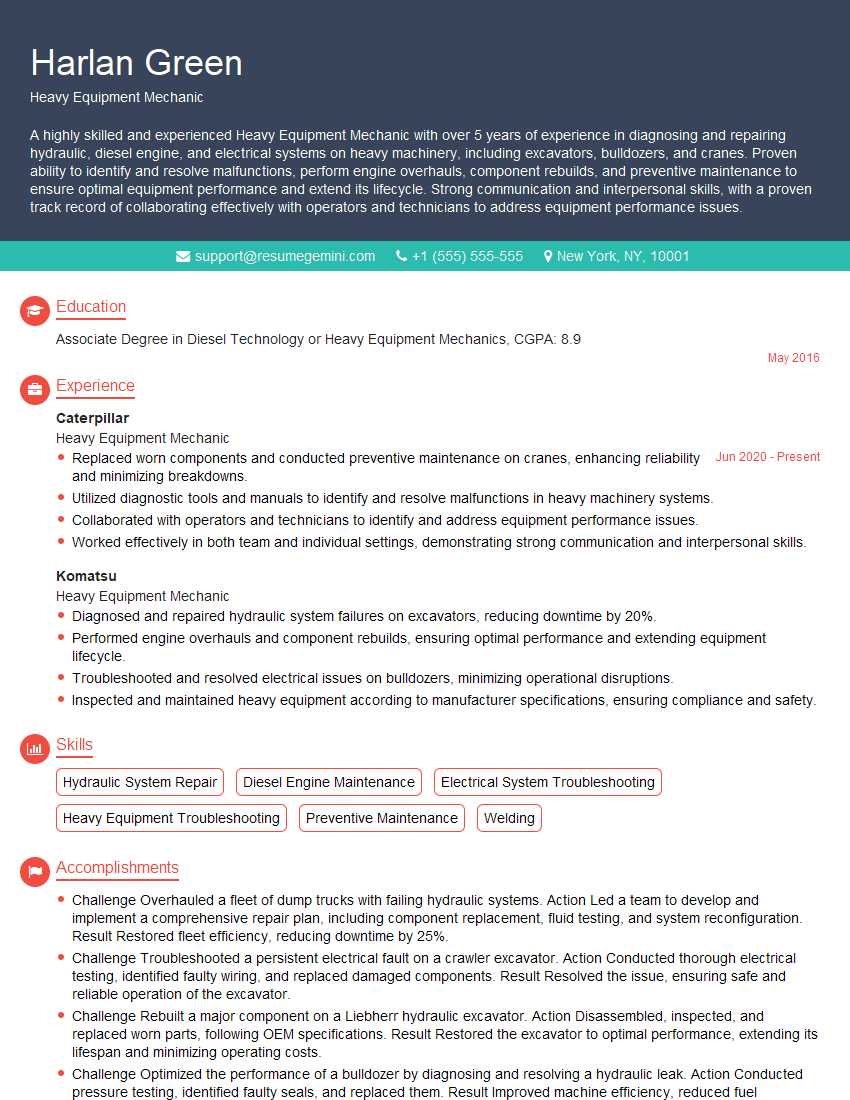
Mastering Land Clearing and Grading opens doors to exciting career opportunities and significant professional growth within the construction and infrastructure industries. A strong understanding of these skills is highly valued by employers. To increase your chances of landing your dream job, crafting an ATS-friendly resume is crucial. This ensures your application gets noticed by hiring managers. We recommend using ResumeGemini to build a compelling and effective resume. ResumeGemini provides tools and resources to create a professional document that highlights your qualifications. Examples of resumes tailored to Land Clearing and Grading are available to help guide you.

Explore more articles
Users Rating of Our Blogs
Share Your Experience
We value your feedback! Please rate our content and share your thoughts (optional).
What Readers Say About Our Blog
Very informative content, great job.
good