Interviews are more than just a Q&A session—they’re a chance to prove your worth. This blog dives into essential Laser Processing and Surface Engineering interview questions and expert tips to help you align your answers with what hiring managers are looking for. Start preparing to shine!
Questions Asked in Laser Processing and Surface Engineering Interview
Q 1. Explain the principle of laser ablation.
Laser ablation is a process where a material’s surface is removed by irradiating it with a high-intensity laser beam. The laser’s energy is absorbed by the material, causing rapid heating and phase transformation. This leads to the ejection of material in the form of plasma, vapor, or micro-particles. Think of it like using a very precise, incredibly hot scalpel to remove a tiny amount of material. The process is highly controllable, allowing for intricate patterns and precise material removal.
The key mechanism involves the interaction of photons with the material’s electrons. These excited electrons transfer energy to the lattice structure, causing rapid heating and ultimately leading to ablation. The process parameters, such as laser pulse duration, wavelength, and fluence (energy per unit area), significantly influence the ablation efficiency and surface morphology.
Q 2. Describe different types of lasers used in material processing and their applications.
Several laser types are employed in material processing, each with unique characteristics and applications:
- CO2 Lasers: These deliver high power in the infrared region (10.6 μm), making them ideal for cutting and engraving non-metallic materials like wood, plastics, and fabrics. Their long wavelength results in deeper penetration into the material.
- Nd:YAG Lasers: These solid-state lasers operate in the near-infrared (1.06 μm) and offer good versatility. They are frequently used for marking, welding, and surface treatment of metals and ceramics. The shorter wavelength leads to higher precision and surface quality compared to CO2 lasers.
- Fiber Lasers: Characterized by high beam quality, efficiency, and power scalability, these lasers are becoming increasingly popular. Their applications span welding, cutting, and surface treatment of various materials, particularly metals. The high beam quality allows for more intricate processing.
- Ultrafast Lasers (Femtosecond Lasers): These lasers produce extremely short pulses, delivering high peak power while minimizing heat-affected zones. This feature makes them suitable for delicate applications such as micromachining, ophthalmic surgery, and creating highly precise surface structures.
The choice of laser depends heavily on the material being processed, the desired outcome (cutting, welding, marking, etc.), and the required precision. For instance, a CO2 laser might be preferred for cutting thick acrylic, while a femtosecond laser would be chosen for micro-drilling a silicon wafer.
Q 3. What are the safety precautions necessary when working with lasers?
Working with lasers necessitates stringent safety precautions due to the potential for eye and skin damage. These precautions include:
- Eye Protection: Wearing appropriate laser safety eyewear is paramount, and the eyewear must be rated for the specific laser wavelength and power. Improper eyewear can lead to severe eye injury or blindness.
- Enclosure and Beam Path Control: The laser beam should be contained within a protective enclosure whenever possible. The beam path should be clearly marked and accessible only to authorized personnel.
- Proper Ventilation: Laser processing can generate hazardous fumes and particles, requiring adequate ventilation to remove them from the work area.
- Laser Safety Training: All personnel working with lasers must receive comprehensive safety training covering procedures, emergency responses, and equipment operation.
- Emergency Shutdown Procedures: Clearly defined emergency shutdown procedures must be established and regularly practiced.
Neglecting laser safety can have devastating consequences. Always prioritize safety and adhere to all established protocols.
Q 4. How does laser power affect the quality of a laser-processed surface?
Laser power significantly influences the quality of the processed surface. Higher power generally leads to faster processing speeds but can also result in:
- Increased Heat-Affected Zone (HAZ): Higher power can cause excessive heating, leading to a larger HAZ and potentially altering the material’s properties near the processed area. This can affect mechanical strength or other material properties.
- Rougher Surface Finish: Excessive power can melt or vaporize more material than necessary, leaving a rougher surface finish. This is undesirable for many applications.
- Formation of Cracks or Defects: High power densities can induce thermal stress, causing cracking or other surface defects.
Conversely, lower power results in slower processing speeds but can lead to a finer surface finish and a smaller HAZ, improving the overall quality. Optimizing the laser power is crucial for achieving the desired surface characteristics and balancing processing speed with quality.
For example, in precision micromachining, a lower power setting is chosen to minimize damage to the surrounding material, while in industrial cutting applications, high power is preferred for speed and efficiency, even if it results in a slightly rougher cut that can be cleaned later.
Q 5. Explain the concept of laser beam focusing and its impact on processing.
Laser beam focusing involves concentrating the laser energy into a small spot size using a lens. The focal spot size directly impacts the energy density and ultimately the processing outcome. A tightly focused beam delivers high energy density, resulting in:
- Increased Ablation Rate: Higher energy density leads to more efficient material removal.
- Improved Precision: A small spot size allows for very fine features and intricate processing.
- Deeper Penetration: For certain materials and applications, a smaller spot size can result in deeper penetration of the laser beam.
However, overly tight focusing can lead to issues like:
- Increased risk of damage to the focusing optics:
- Higher peak power leading to plasma formation and non-uniform ablation:
The optimal focal spot size is determined by the specific application, material, and desired process outcome. It’s a balance between achieving high energy density for efficiency and preventing damage or undesirable effects.
Think of it like a magnifying glass focusing sunlight. A smaller focal spot concentrates more energy, creating a higher temperature and potentially even starting a fire. Similarly, a tightly focused laser beam delivers a higher energy density to the material surface.
Q 6. Describe different laser scanning techniques used in surface engineering.
Various laser scanning techniques are used in surface engineering to create desired surface textures and patterns:
- Raster Scanning: The laser beam scans the surface in a series of parallel lines, like a printer. This is a common approach for creating large-area surface modifications or patterns.
- Vector Scanning: The laser beam follows a predefined path, often following a specific design or pattern. This is suitable for creating intricate designs or features.
- Spiral Scanning: The laser beam scans in a spiral pattern from the center outwards, often used for efficient processing of circular or radial features.
- Random Scanning: The laser beam position is determined randomly, useful for creating specific surface roughness or texture.
The choice of scanning technique depends on the desired surface morphology, the complexity of the pattern, and the processing efficiency requirements. For example, raster scanning is commonly used in laser cladding, while vector scanning might be preferred for creating laser-induced periodic surface structures (LIPSS).
Q 7. What are the advantages and disadvantages of laser processing compared to traditional methods?
Laser processing offers several advantages over traditional methods:
- High Precision and Accuracy: Lasers can create extremely fine features and intricate patterns with high accuracy.
- Non-Contact Processing: No physical contact is needed, minimizing material wear and damage.
- High Speed: Laser processing is often faster than traditional methods, particularly for automated applications.
- Flexibility: Lasers can be easily programmed to create various patterns and shapes.
- Minimized Material Waste: Precise material removal results in minimal waste.
However, there are also some disadvantages:
- High Initial Investment: Laser systems can be expensive to purchase and maintain.
- Safety Concerns: Lasers pose safety risks, necessitating stringent precautions.
- Heat Affected Zone (HAZ): Depending on the process parameters and material, a HAZ might be generated, affecting the material’s properties.
- Expertise Required: Operation and maintenance of laser systems require skilled personnel.
The decision to utilize laser processing hinges on weighing these advantages and disadvantages against the specific application and budget. For intricate and high-precision applications where speed and quality are paramount, laser processing frequently outweighs traditional techniques. However, for simpler tasks or those with limited budgets, traditional methods might remain more suitable.
Q 8. How do you select the appropriate laser parameters for a specific material and application?
Selecting the right laser parameters is crucial for successful laser processing. It’s like choosing the right tools for a specific job – using a hammer to screw in a screw wouldn’t work!
The process involves considering several factors:
- Material Properties: The material’s absorption coefficient at the laser wavelength is paramount. For example, metals generally absorb well in the infrared (IR) range, while some polymers require UV lasers. Thermal conductivity and melting/boiling points also dictate the energy density and pulse duration needed.
- Desired Outcome: Are you cutting, welding, marking, or surface treating? Cutting requires high power density to vaporize material rapidly, while welding needs lower power density for controlled melting and fusion. Marking often utilizes lower energy to alter surface properties.
- Laser Type & Wavelength: Different lasers (e.g., CO2, Nd:YAG, fiber lasers) emit different wavelengths and have varying beam qualities. The choice depends on the material’s absorption characteristics and desired precision.
- Laser Parameters: These include power, pulse duration (for pulsed lasers), pulse repetition rate, scan speed, and spot size. Each needs careful optimization. For instance, increasing power increases the cutting speed but may lead to unwanted heat-affected zones (HAZ).
Example: Cutting stainless steel requires a high-power fiber laser with a short pulse duration for fast and clean cuts. However, marking the same steel might use a lower power, longer pulse duration to create an etched design without significant material removal.
In practice, iterative experimentation and simulation software often guide parameter selection. Starting with literature values as a baseline and then fine-tuning through controlled experiments is a common approach.
Q 9. Explain the concept of thermal effects in laser processing and how to control them.
Thermal effects are inherent in laser processing because lasers deliver concentrated energy. These effects can be beneficial (e.g., melting for welding) or detrimental (e.g., excessive heat causing damage). Managing them is crucial for process control.
Understanding the Thermal Effects: Laser energy is absorbed by the material, causing a rise in temperature. This leads to:
- Melting: Material transitions from solid to liquid state.
- Vaporization: Material transitions from liquid to gaseous state.
- Heat Affected Zone (HAZ): The area surrounding the main processing zone experiencing temperature changes, potentially altering material properties.
- Thermal Stress: Rapid heating and cooling can induce stress, leading to cracking or warping.
Controlling Thermal Effects:
- Pulse Duration & Repetition Rate: Shorter pulses with lower repetition rates minimize heat input, reducing HAZ and thermal stress. This is particularly useful for delicate materials or precise processes.
- Beam Spot Size: A smaller spot size increases the power density, which is necessary for cutting and high-speed processing but can also increase thermal damage. Larger spot sizes distribute the energy more broadly, mitigating localized heating.
- Scan Speed: A slower scan speed allows for more heat input, suitable for welding or processes requiring deep penetration, but a faster scan speed minimizes heat accumulation and improves surface finish for tasks like marking.
- Assist Gas: Using assist gases (e.g., nitrogen, oxygen) can help remove molten material from the cutting zone (in cutting applications), cool the workpiece, and control the oxidation process.
- Cooling Systems: Implementing appropriate cooling mechanisms, like compressed air or liquid cooling, is vital for controlling workpiece temperature and preventing thermal damage.
Example: In laser welding, a carefully chosen combination of pulse duration, repetition rate, and spot size ensures sufficient heat for melting but prevents excessive heat that could cause deformation or porosity in the weld.
Q 10. Describe various surface treatments achieved through laser processing.
Laser processing offers a wide array of surface treatments, impacting both surface properties and appearance. Think of it as a highly precise ‘paintbrush’ for materials, allowing modifications at a microscopic level.
- Surface Cleaning: Removing contaminants like oxides, grease, or coatings by vaporizing or ablating them. This improves surface adhesion and quality for subsequent processes.
- Surface Hardening: Creating a hardened surface layer by rapidly heating and quenching the material. This increases wear resistance and durability, common in tools and components under stress.
- Surface Alloying: Melting and mixing a surface layer with another material to modify its properties. For instance, adding nitrogen creates a nitrided surface with improved hardness and corrosion resistance.
- Surface Texturing: Creating patterns or textures on a surface to improve friction, aesthetics, or biocompatibility. Micro-structured surfaces can also improve performance in applications such as heat exchangers.
- Surface Marking & Engraving: Creating permanent marks, logos, or designs by ablating or modifying the surface layer. This can be used for traceability, branding, or aesthetics.
Example: Laser surface hardening is often used on engine components like crankshafts to enhance their fatigue life. Laser texturing is utilized in biomedical implants to promote bone growth and integration.
Q 11. How do you measure and characterize the surface roughness after laser processing?
Measuring and characterizing surface roughness is critical to assessing the quality and performance of laser-processed surfaces. Roughness impacts friction, wear, reflectivity, and even biocompatibility.
Common techniques include:
- Profilometry: Using a stylus to mechanically scan the surface and measure its height variations. This is a widely used technique offering high accuracy but can be slow and potentially damage delicate surfaces.
- Confocal Microscopy: Employing optical sectioning to create a 3D map of the surface topography. It’s non-contact, offering high resolution and suitable for delicate surfaces.
- Atomic Force Microscopy (AFM): Providing nanometer-scale resolution, ideal for characterizing extremely fine surface features. It’s an excellent technique but is slower and more specialized.
- Optical Profilometry: Employing optical techniques like interferometry or focus variation to create a 3D map of the surface. This method is non-contact and relatively fast.
The obtained data is usually analyzed to calculate roughness parameters, such as:
- Ra (Average Roughness): The arithmetic mean of the absolute deviations from the mean line.
- Rz (Maximum Height): The difference between the highest peak and the lowest valley.
- Rq (Root Mean Square Roughness): The square root of the mean of the squares of the deviations from the mean line.
The choice of technique and parameters depends on the application and required precision. A detailed surface characterization is often necessary for quality control and optimization of the laser processing parameters.
Q 12. What are the common challenges encountered during laser processing, and how do you address them?
Laser processing, despite its advantages, faces several challenges.
- Heat Affected Zone (HAZ): Excessive heat can lead to material degradation, warping, or cracking. This is mitigated by optimized laser parameters, cooling systems, and assist gases.
- Surface Quality: Achieving the desired surface finish (e.g., roughness, texture) requires careful control of laser parameters and often iterative experimentation.
- Process Stability: Maintaining consistent results over time requires precise control of the laser and processing environment. Regular maintenance and calibration are crucial.
- Material Interactions: Predicting how different materials will react to laser processing can be challenging, requiring material-specific expertise and often trial-and-error.
- Cost: Laser systems and their maintenance can be expensive, making it essential to choose the most appropriate technology for the application.
- Safety Concerns: Laser processing involves high-power beams that pose safety risks. Proper safety measures, such as laser safety glasses and enclosures, are essential.
Addressing these challenges requires a multi-pronged approach, including thorough process planning, material characterization, optimized laser parameters, robust process control systems, and strict adherence to safety protocols.
Q 13. Explain the difference between laser cutting, welding, and marking.
Laser cutting, welding, and marking are distinct applications of laser processing, each employing different laser parameters and achieving different outcomes.
- Laser Cutting: Uses high power density to vaporize or melt material, creating a precise cut. Think of it like a very fine, intensely hot knife. The choice of laser and parameters depends on the material thickness and desired cut quality. Assist gases are often used to remove molten material from the cut kerf.
- Laser Welding: Employs lower power density to melt the edges of two materials, which fuse together upon cooling. It’s like using a very focused and controllable heat source to join materials. The weld’s strength and quality depend on parameter selection, material compatibility, and fixturing.
- Laser Marking: Uses lower energy to alter the surface properties of the material, creating marks, logos, or data codes. It’s more like a sophisticated etching process. The type of marking (e.g., ablation, annealing) and the resulting surface finish depend heavily on the material and laser settings.
Analogy: Imagine a hot knife – cutting uses high heat to quickly remove material, welding uses moderate heat to fuse materials together, and marking uses minimal heat to alter the surface without significant material removal.
Q 14. Describe the process of laser cladding and its applications.
Laser cladding is an additive manufacturing process where a layer of material is deposited onto a substrate using a laser beam. Imagine painting with molten metal, but with incredible precision.
The Process: A laser beam melts a powder feedstock (often metallic alloys or ceramics) as it is directed onto the substrate. The molten material mixes with the substrate’s surface layer, forming a homogenous clad layer upon cooling. This process can be repeated to build up multiple layers of desired thickness and composition.
Applications:
- Surface Hardening & Wear Resistance: Cladding with hard materials like tungsten carbide enhances wear resistance of components in demanding environments, such as engine parts or cutting tools.
- Corrosion Resistance: Applying corrosion-resistant materials, like stainless steel or nickel-based alloys, to components exposed to harsh environments protects them from degradation.
- Repair & Restoration: Laser cladding can repair damaged or worn components by rebuilding the surface layer with the original material or a more resistant substitute.
- Functional Gradient Materials: Creating materials with tailored properties by varying the composition and thickness of the cladding layers, which can lead to high-performance structures.
Example: Laser cladding is used to repair turbine blades in gas turbines, restoring their surface integrity and extending their lifespan. It’s also used in the aerospace industry to enhance the wear and corrosion resistance of critical components.
Q 15. What is the role of laser optics in the overall laser processing system?
Laser optics are the heart of any laser processing system, responsible for guiding, shaping, and controlling the laser beam to precisely interact with the target material. Think of them as the sophisticated plumbing system delivering the laser’s power. They comprise various components working in concert:
- Laser Resonator Mirrors: These mirrors reflect the laser beam back and forth within the laser cavity, amplifying it to the desired power.
- Beam Expanders/Reducers: These optical elements adjust the beam diameter, influencing the intensity and focal spot size on the workpiece. A larger beam diameter results in a lower intensity but a wider area of processing. Conversely, a smaller beam results in higher intensity, suitable for fine features.
- Focusing Lenses: These lenses converge the beam to a small focal spot, maximizing power density for processes like welding, cutting, or ablation. The choice of lens material (e.g., ZnSe for CO2 lasers, fused silica for YAG lasers) and focal length directly impacts the processing outcome.
- Scan Heads/Galvanometers: These rapidly steer the beam across the material surface for precise patterning and processing of complex geometries.
- Beam Splitters/Combiners: These components divide or combine laser beams for applications requiring multiple beams or for monitoring purposes.
Improperly designed or aligned optics can lead to reduced efficiency, uneven processing, and even damage to the optical components themselves. For instance, misaligned mirrors can significantly reduce the laser power output, while a poorly chosen lens can result in a defocused beam, producing poor quality welds or cuts.
Career Expert Tips:
- Ace those interviews! Prepare effectively by reviewing the Top 50 Most Common Interview Questions on ResumeGemini.
- Navigate your job search with confidence! Explore a wide range of Career Tips on ResumeGemini. Learn about common challenges and recommendations to overcome them.
- Craft the perfect resume! Master the Art of Resume Writing with ResumeGemini’s guide. Showcase your unique qualifications and achievements effectively.
- Don’t miss out on holiday savings! Build your dream resume with ResumeGemini’s ATS optimized templates.
Q 16. Explain the importance of laser beam quality (M² factor).
The beam quality factor, M², is a crucial parameter that describes how well a laser beam maintains its shape and focus over distance. It quantifies the divergence of the beam and its ability to be focused to a small spot size. A lower M² value (ideally approaching 1) indicates a near-diffraction-limited beam, implying excellent collimation and the ability to achieve a tightly focused spot, leading to higher precision and power density in processing.
Imagine shining two flashlights: one with a tightly focused, parallel beam (low M²), and another with a widely diverging beam (high M²). The first one can easily burn a hole in a piece of paper at a distance, whereas the second one will require closer proximity or a longer exposure time. In laser processing, a low M² value is vital for applications requiring fine features and precise control, such as micromachining, while high M² beams are more suitable for processes requiring wider area treatment, like surface hardening or cladding.
In real-world scenarios, a higher M² value might necessitate increased laser power to achieve the desired processing results, increasing costs and potentially damaging the material due to heat buildup.
Q 17. How does pulse duration impact laser material interaction?
Pulse duration dramatically affects how a material interacts with a laser. It dictates whether the interaction is primarily thermal or non-thermal.
- Ultrashort Pulses (femtoseconds to picoseconds): With extremely short pulse durations, the energy is delivered so rapidly that heat diffusion is minimal. This enables precise ablation (material removal) with minimal heat-affected zones (HAZ), perfect for micromachining delicate materials like silicon or polymers. Think of it as a quick, precise surgical strike.
- Short Pulses (nanoseconds): These pulses allow for more heat diffusion than ultrashort pulses, but still result in relatively shallow HAZs. They are commonly used in laser marking, cleaning, and precise cutting applications.
- Long Pulses (milliseconds to continuous wave): With longer pulses, substantial heat diffusion occurs, leading to significant HAZs and melting/vaporization processes. These are suitable for welding, surface hardening, and cutting thicker materials. This is more like a slow, steady burn.
The choice of pulse duration depends heavily on the material’s properties, the desired outcome, and the level of precision required. For example, creating fine features on a delicate electronic component demands ultrashort pulses, while welding two thick steel plates requires longer pulses to provide sufficient energy for the process.
Q 18. Describe different types of laser-induced damage in materials.
Laser-induced damage can manifest in various forms, depending on laser parameters and material properties.
- Thermal Damage: This involves melting, vaporization, and even thermal shock cracking due to rapid heating and cooling. It’s characterized by significant HAZ and possible material modification.
- Ablation: This is material removal through vaporization or ejection of material, typically resulting in clean cuts or features. However, excessive ablation can also lead to unwanted damage or rough surfaces.
- Plasma Formation: Intense laser irradiation can ionize the material, creating a plasma plume. While useful for some applications, the plasma can shield the material from subsequent laser energy, impacting process efficiency.
- Fracture/Cracking: Thermal stresses induced by rapid heating and cooling can cause cracking or fracture within the material, especially in brittle materials. This can be minimized by controlling the laser parameters.
- Color Centers: Laser irradiation in certain materials can lead to the creation of color centers, which are defects that alter the optical properties of the material. This is a concern in optical components.
Understanding these damage mechanisms is critical for selecting appropriate processing parameters to minimize unwanted effects and achieve the desired outcome. For example, choosing the correct pulse duration and fluence can minimize thermal damage and increase precision during laser cutting.
Q 19. What are the different types of laser-material interactions (e.g., melting, vaporization, etc.)?
Laser-material interactions encompass a range of phenomena, primarily determined by laser parameters (power, pulse duration, wavelength) and material properties (absorption, thermal conductivity, melting point).
- Reflection: A portion of the laser energy is always reflected from the material’s surface. This is influenced by the material’s surface finish and the laser’s wavelength.
- Absorption: The material absorbs a portion of the laser energy, leading to heating. The absorption coefficient determines how efficiently the material absorbs energy at a given wavelength.
- Melting: Sufficient energy absorption causes the material to melt, changing its physical state. This is often used in laser welding or surface modification.
- Vaporization: Higher energy absorption leads to vaporization, creating a vapor plume and removing material. This is the basis of laser cutting and ablation.
- Sublimation: Some materials transition directly from solid to gas phase without melting. This is seen with certain polymers or ceramics.
- Chemical Reactions: Laser interaction can induce chemical reactions, creating new compounds or modifying the material’s composition.
For instance, laser welding uses the melting and solidification of metals to join parts, whereas laser cutting relies on vaporization to remove material precisely.
Q 20. Explain the concept of resonant absorption in laser processing.
Resonant absorption occurs when the laser’s frequency matches a natural vibrational frequency of the material’s atoms or molecules. This leads to significantly enhanced absorption compared to non-resonant absorption. Imagine pushing a child on a swing: pushing at the right frequency (resonance) dramatically increases the swing’s amplitude. Similarly, resonant absorption results in a much higher energy uptake by the material at the specific wavelength.
This phenomenon is particularly important in laser processing of certain materials. For example, CO2 lasers (10.6 µm wavelength) are highly effective in processing materials like wood or polymers because the laser frequency resonates with certain vibrational modes of the material’s molecules. This leads to efficient cutting and marking. The use of specific laser wavelengths to exploit resonant absorption allows for increased processing speed and efficiency, reducing energy consumption.
Conversely, if the laser frequency does not match any vibrational modes (non-resonant absorption), less energy will be absorbed, requiring higher laser power to achieve the desired result.
Q 21. How does the choice of assist gas influence laser processing outcomes?
The choice of assist gas significantly influences laser processing outcomes, particularly in processes like cutting, welding, and surface treatment. The gas interacts with the laser beam and the molten/vaporized material, affecting heat transfer, plume removal, and the quality of the final product.
- Oxygen (O2): Often used in laser cutting of metals. It supports combustion, increasing the cutting speed and reducing kerf width (the width of the cut). It also helps remove molten material from the kerf.
- Nitrogen (N2): A common choice for laser cutting of non-metals and some metals, where oxidation is undesirable. It acts as a shielding gas, preventing oxidation and improving cut quality.
- Argon (Ar): Used extensively in laser welding of metals. It prevents oxidation and improves the weld bead’s quality by protecting the molten pool from atmospheric contamination.
- Helium (He): Used in some laser applications for its high thermal conductivity, helping to dissipate heat from the processing zone.
For example, cutting stainless steel with oxygen results in a much faster cut compared to using nitrogen due to the exothermic oxidation reaction. Conversely, cutting acrylic with oxygen would lead to undesirable burning and discoloration, making nitrogen a far better choice. The selection of assist gas should always consider the material being processed and the specific application requirements. Improper gas selection can lead to decreased processing efficiency, poor quality outcomes, and even material damage.
Q 22. Describe different methods for measuring laser power and beam profile.
Measuring laser power and beam profile is crucial for optimizing laser processing. Power measurement is typically done using a power meter, which absorbs the laser beam and converts the absorbed energy into a measurable electrical signal. There are different types of power meters, including thermal power meters (using a thermopile) and photodiodes, each suitable for specific wavelengths and power ranges. For example, a thermal power meter is better suited for high-power lasers due to its higher damage threshold.
Beam profile measurement provides information about the spatial distribution of the laser beam’s intensity. Common methods include:
- Knife-edge method: A sharp edge is scanned across the beam, and the transmitted power is measured. The derivative of the transmitted power curve provides the beam profile.
- CCD camera-based methods: A CCD camera equipped with a suitable lens and filter captures an image of the beam. Software then analyzes the image to determine the beam profile parameters, such as beam diameter and shape.
- Beam analyzers: These instruments combine the sensing element and analysis software into a single, user-friendly device, providing quick and accurate beam profile measurements. They often offer advanced features like automatic analysis and report generation.
Choosing the right method depends on factors like laser wavelength, power, and the required accuracy.
Q 23. What are the key considerations for designing a laser processing system?
Designing a laser processing system requires careful consideration of several key factors. Think of it like building a finely tuned machine; each component plays a vital role.
- Laser source selection: The choice depends on the application (e.g., CO2 for cutting, fiber lasers for marking, ultrafast lasers for micromachining). Power, wavelength, and pulse characteristics are critical. For example, a high-power CO2 laser is ideal for cutting thick metals, while a femtosecond laser offers exceptional precision for micro-machining delicate parts.
- Beam delivery system: This includes mirrors, lenses, and optical fibers that guide the laser beam to the workpiece. Alignment precision is vital to prevent beam distortion and ensure consistent processing.
- Workpiece handling: This involves mechanisms for precise positioning, clamping, and movement of the workpiece during processing. The system must accommodate the size, shape, and material properties of the workpiece. For intricate components, robotic systems are frequently employed for automated processing.
- Process control system: This is the ‘brains’ of the operation, enabling precise control of laser power, pulse duration, scan speed, and other parameters. Feedback control systems, using sensors like pyrometers or vision systems, help maintain process stability and quality.
- Safety features: Laser processing systems must incorporate comprehensive safety features, including interlocks, beam shutters, and protective enclosures, to prevent accidental exposure to the laser beam.
In essence, the design should optimize for speed, accuracy, repeatability and safety, all while considering the specific needs of the processing application.
Q 24. How do you ensure the reproducibility of laser processing results?
Reproducibility is paramount in laser processing. Inconsistent results can lead to costly rework and product failure. Think of baking a cake – you need the same ingredients and baking time to get the same result.
Several strategies ensure reproducible results:
- Precise control of laser parameters: Consistent power, pulse duration, repetition rate, and scan speed are crucial. Calibration and regular maintenance of the laser system and control software is key.
- Stable processing environment: Temperature fluctuations, vibrations, and air currents can affect the outcome. Maintaining a controlled environment mitigates these issues.
- Consistent workpiece handling: Consistent clamping, positioning, and feeding of the workpiece ensures consistent laser interaction. Automated systems help maintain this consistency.
- Process monitoring and feedback control: Real-time monitoring of key process parameters (e.g., temperature, melt pool depth) allows for immediate adjustments to compensate for variations. Closed-loop control systems automatically adjust parameters to maintain desired processing conditions.
- Regular system calibration and maintenance: Regular calibration of the laser system, power meter, and other instruments ensures accurate measurements and consistent performance.
By diligently following these practices, consistent and reproducible results can be achieved.
Q 25. Explain different methods for controlling laser beam position and orientation.
Controlling laser beam position and orientation is critical for precise material processing. Imagine trying to write with a pen without control – it’d be a mess!
Several methods are used:
- Galvanometer scanners: High-speed rotating mirrors precisely direct the laser beam, enabling complex 2D patterns and rapid scanning. This is commonly used in laser marking and engraving.
- XY stages: These motorized stages precisely move the workpiece under a stationary laser beam. This approach offers high precision for larger areas and is often used in laser cutting and welding.
- Aerodynamic focusing: This involves using gas flow to shape and direct the laser beam for applications like laser cutting and drilling.
- Computer numerical control (CNC) systems: CNC systems integrate motion control with laser processing, enabling complex 3D processing with high precision and repeatability.
- Robotic arms: For more complex operations and larger workpieces, robotic arms offer flexibility and programmability for precise beam positioning and orientation.
The optimal method depends on the application’s requirements for speed, accuracy, and complexity.
Q 26. What are the environmental implications of laser processing?
Laser processing, while highly efficient, has environmental implications that must be carefully managed. It’s like any powerful technology; responsible use is vital.
Key considerations include:
- Air pollution: Laser processing can generate fumes, dust, and other airborne pollutants, especially when processing certain materials. Proper ventilation and filtration systems are necessary to mitigate these issues. For example, during laser cutting of metals, harmful fumes like metal oxides can be generated.
- Waste generation: Laser processing generates waste materials, including scrap metal, dust, and spent processing gases. Proper waste management and recycling procedures are crucial to minimize environmental impact.
- Energy consumption: Laser systems consume significant amounts of electricity. Energy-efficient laser systems and process optimization can reduce energy consumption.
- Noise pollution: Some laser processing equipment can generate significant noise, requiring noise reduction measures such as soundproofing.
Minimizing the environmental impact of laser processing requires careful attention to these factors, incorporating best practices throughout the entire lifecycle of the system, from design to disposal.
Q 27. How do you troubleshoot common problems encountered in laser processing equipment?
Troubleshooting laser processing equipment requires a systematic approach. It’s like diagnosing a car problem; you need to identify the symptoms and trace the cause.
Common problems and troubleshooting steps:
- Low laser power output: Check the laser power supply, cooling system, and optical components for faults. Clean mirrors and lenses and recalibrate the power meter.
- Inconsistent beam profile: Inspect optical components for damage or misalignment. Check for dust or debris in the beam path. Replace damaged components or realign the optical system.
- Poor processing quality: Check for variations in laser parameters, workpiece positioning, and processing environment. Adjust parameters, optimize processing strategy, and improve workpiece handling.
- Safety interlock issues: Inspect safety sensors and interlocks for damage or malfunction. Repair or replace faulty components and ensure proper functionality.
- System malfunctions: Refer to the system’s troubleshooting manual or contact the manufacturer’s technical support for assistance. Detailed error logs and maintenance records can help identify recurring issues.
A well-maintained system with regular preventative maintenance and a systematic troubleshooting approach significantly reduces downtime and improves processing efficiency. Keeping detailed logs of operations and maintenance is crucial for efficient troubleshooting.
Key Topics to Learn for Laser Processing and Surface Engineering Interview
- Laser Fundamentals: Understanding laser types (e.g., CO2, Nd:YAG, fiber), beam characteristics (wavelength, power, pulse duration), and laser-material interactions.
- Laser Ablation and Micromachining: Explore the principles behind material removal using lasers, including applications in microfabrication, surface texturing, and thin-film deposition.
- Laser Welding and Cladding: Learn about the process of joining materials using laser energy, including different welding techniques and the effect of laser parameters on weld quality.
- Laser Surface Modification: Understand techniques like laser shock peening, laser heat treatment, and laser glazing, and their impact on material properties (hardness, wear resistance, corrosion resistance).
- Surface Engineering Principles: Grasp concepts like surface roughness, topography, adhesion, and their correlation with laser processing parameters and desired surface properties.
- Process Optimization and Control: Familiarize yourself with methods for optimizing laser processing parameters to achieve desired results, including the use of sensors and feedback control systems.
- Material Characterization Techniques: Understand common techniques used to analyze the surface properties and microstructure of materials after laser processing (e.g., microscopy, spectroscopy, profilometry).
- Safety Protocols and Regulations: Become familiar with safety precautions and regulations related to the operation of lasers and handling of laser-processed materials.
- Practical Applications: Review real-world applications of laser processing and surface engineering across various industries (e.g., automotive, aerospace, medical devices, electronics).
- Troubleshooting and Problem-Solving: Practice diagnosing and resolving common issues encountered during laser processing, such as inconsistencies in surface quality or unexpected material behavior.
Next Steps
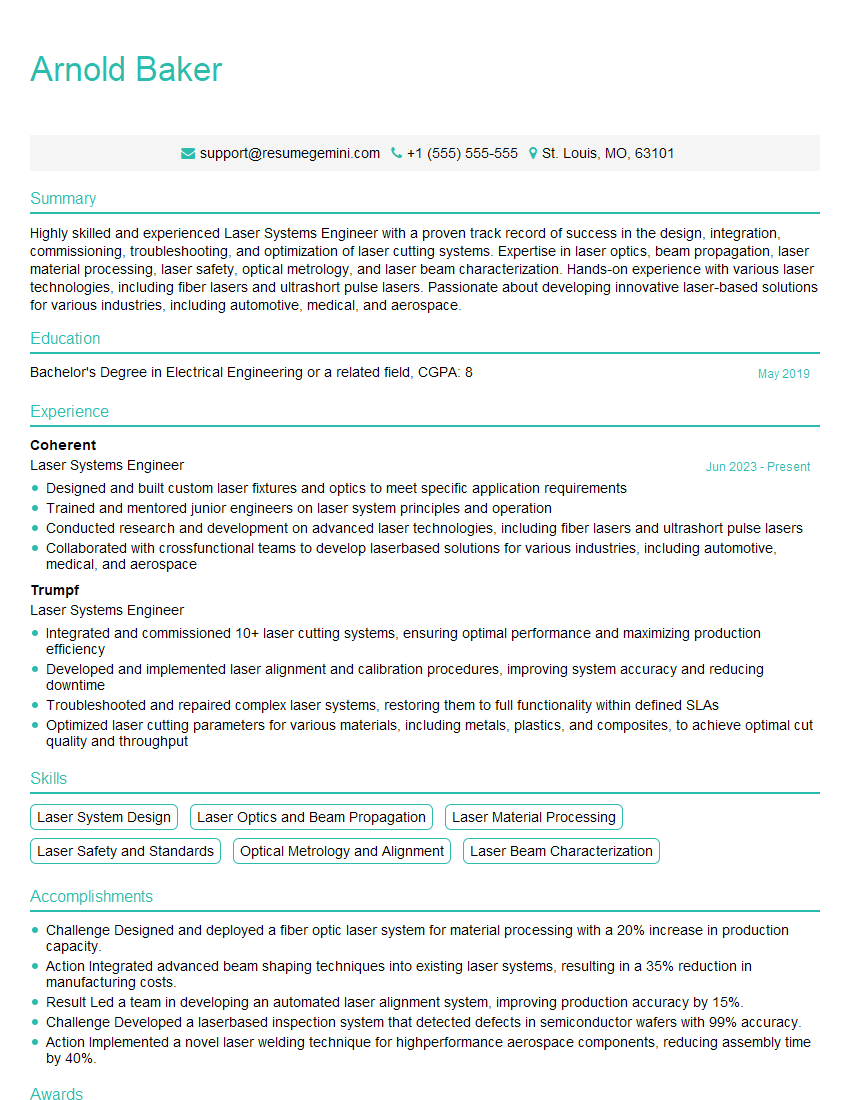
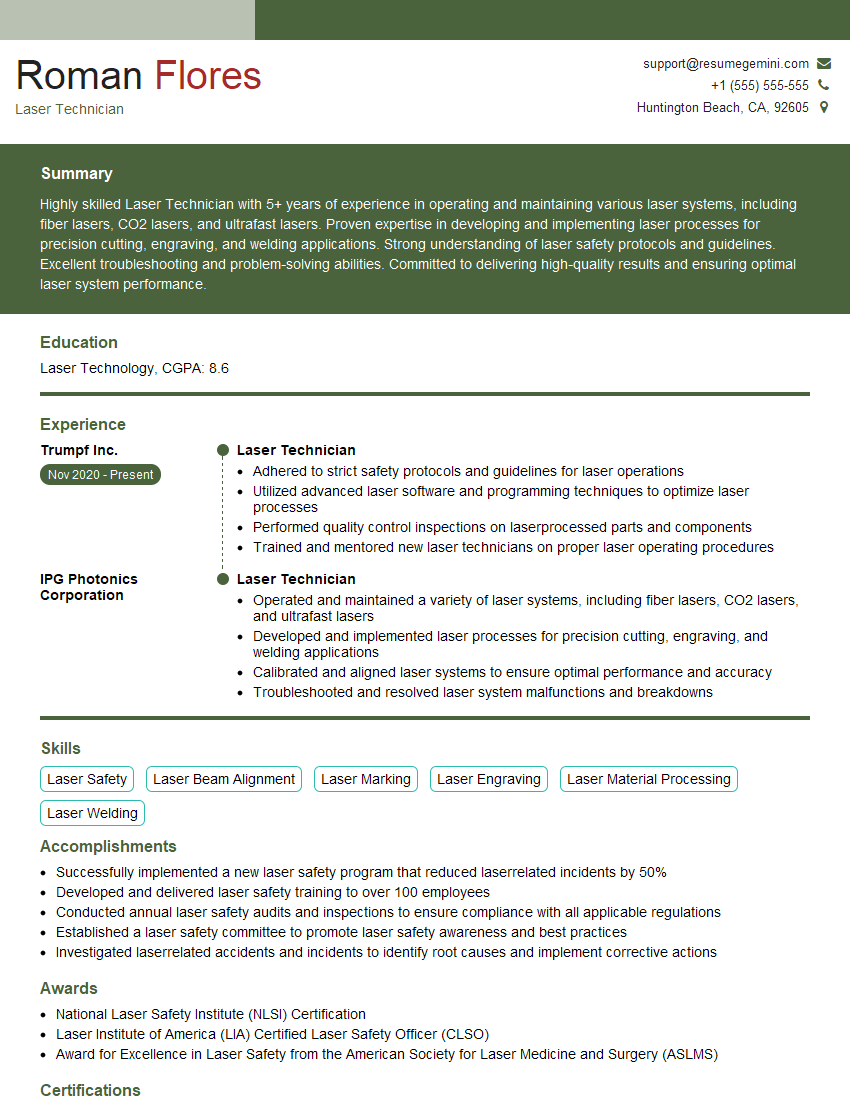
Mastering Laser Processing and Surface Engineering opens doors to exciting and rewarding careers in cutting-edge technologies. Demonstrating a strong understanding of these concepts is crucial for securing your ideal position. To maximize your chances, creating an ATS-friendly resume is essential. This ensures your qualifications are effectively communicated to potential employers. We recommend using ResumeGemini, a trusted resource for building professional and impactful resumes. ResumeGemini provides examples of resumes specifically tailored to Laser Processing and Surface Engineering to guide you in showcasing your skills and experience effectively.
Explore more articles
Users Rating of Our Blogs
Share Your Experience
We value your feedback! Please rate our content and share your thoughts (optional).
What Readers Say About Our Blog
Very informative content, great job.
good