Every successful interview starts with knowing what to expect. In this blog, we’ll take you through the top Lumberjacking interview questions, breaking them down with expert tips to help you deliver impactful answers. Step into your next interview fully prepared and ready to succeed.
Questions Asked in Lumberjacking Interview
Q 1. Describe your experience with different felling techniques.
Felling techniques are crucial for safe and efficient tree harvesting. My experience encompasses several methods, each chosen based on tree species, size, terrain, and surrounding obstacles.
Humboldt Method: This involves making a directional notch (back cut and face cut) and then a felling cut to control the tree’s fall. It’s suitable for most trees and is the technique I use most often. I’ve used this successfully on everything from smaller pines to larger Douglas firs, adjusting the notch angle according to the lean of the tree.
Open-Face Method: Preferred for trees with a significant lean, this method involves a larger face cut, and eliminates the need for a back cut. It’s essential to accurately assess the lean and ensure sufficient support for the tree during the felling process. I’ve successfully used this on leaning trees near power lines, prioritizing safety above all else.
Around-the-Tree Method: This is typically used on smaller trees or when a very precise felling direction is crucial. A complete cut is made around the tree, ensuring a clean and controlled fall. I often use this for clearing smaller trees in areas where precision is paramount.
Selecting the appropriate technique is paramount; a misjudgment can lead to dangerous situations. Thorough assessment and experience are key.
Q 2. Explain the safety procedures you follow when operating a chainsaw.
Chainsaw safety is non-negotiable. My routine includes:
Pre-operational checks: Always inspect the saw for chain sharpness, bar lubrication, and proper tension. A dull chain increases effort and risk of kickback. I never start work with a malfunctioning saw.
Personal Protective Equipment (PPE): This includes chainsaw chaps, safety helmet with visor and hearing protection, safety glasses, and gloves. I never compromise on PPE – it’s the first line of defense.
Proper stance and grip: Maintaining a firm, balanced stance and a secure grip on the saw handle prevents kickback and reduces fatigue. I always practice safe cutting techniques.
Work area clearance: I ensure that the felling area is clear of obstacles and people. Proper escape routes are also planned.
Refueling safety: I only refuel the saw in a well-ventilated area, with the engine completely shut off, and always prevent spillage. I am aware of the flammability of chainsaw fuel.
Safety isn’t just a checklist; it’s a mindset. Every cut is approached with caution and awareness. One lapse in safety can have devastating consequences.
Q 3. How do you assess tree risk and plan a safe felling operation?
Assessing tree risk involves a methodical approach. I consider:
Tree species and health: Certain species are more prone to failure. Disease, decay, and insect infestation can significantly weaken a tree. I carefully check for signs of rot or damage.
Tree size and shape: Larger, taller trees pose greater risks. Unusual shapes, such as leaning trees or those with significant branches, require extra care. I measure the tree and note any unusual features.
Surrounding obstacles: Power lines, buildings, other trees, and the terrain all influence the felling plan. I always identify potential hazards and incorporate safe distances into my strategy.
Weather conditions: High winds can significantly affect the tree’s fall and increase the risk. I avoid felling operations in inclement weather.
Once the assessment is complete, I develop a felling plan, including the chosen felling technique, escape routes, and communication strategies with my team if applicable. Safety is the primary concern, and the plan is always adaptable to changing circumstances.
Q 4. What are the different types of logging equipment you are familiar with?
My experience includes operating a variety of logging equipment:
Chainsaws: Various sizes and models, tailored to specific tasks.
Skidders: Used for moving felled trees from the felling site to a landing area. I’m proficient in operating both cable and grapple skidders.
Feller bunchers: Mechanized harvesters that cut and bunch trees for easier processing. My experience includes operating various feller buncher models from different manufacturers.
Log loaders: Used for loading logs onto trucks for transport.
Forwarders: These machines transport felled trees directly to the landing area, offering an alternative to skidders, especially in challenging terrain.
Familiarity with this diverse range of equipment allows me to adapt to various logging operations and conditions.
Q 5. Describe your experience operating a skidder or feller buncher.
I have extensive experience operating both skidders and feller bunchers.
Skidder operation: My experience includes maneuvering skidders through varied terrain, effectively utilizing cable or grapple systems to efficiently move logs while minimizing ground disturbance. I understand the importance of proper load distribution to prevent damage to the machine and the environment.
Feller buncher operation: I am skilled in operating feller bunchers to effectively cut and gather trees, adjusting the cutting head and delimbing mechanisms to efficiently process different species and sizes of trees. I am comfortable with the hydraulics and controls involved in operating this equipment.
Proficient operation requires a keen understanding of the machinery’s capabilities and limitations, as well as awareness of safety procedures in all situations. Experience builds confidence and efficiency in handling these powerful machines.
Q 6. How do you maintain logging equipment to ensure optimal performance and safety?
Regular maintenance is vital for optimal performance and safety. My routine includes:
Daily inspections: Checking fluid levels (oil, hydraulic fluid, fuel), tire pressure, and the overall condition of the equipment before every shift. I address any issues immediately.
Regular servicing: Adhering to manufacturer’s recommended service intervals, including changing filters, lubricating moving parts, and inspecting for wear and tear. I keep detailed maintenance logs.
Addressing problems promptly: Minor problems, if ignored, can lead to major breakdowns and potential hazards. I report any issues to the supervisor promptly.
Safety checks: Ensuring that all safety features, such as guards, emergency stops, and lights, are functional.
Proper maintenance isn’t just about extending equipment life; it’s a crucial element of safety. A well-maintained machine is a safer machine.
Q 7. What are the common safety hazards associated with logging and how do you mitigate them?
Logging presents numerous safety hazards:
Falling trees: The most significant risk. Proper tree assessment, felling techniques, and clear work areas minimize this.
Chainsaw accidents: Kickback, cuts, and injuries are common. PPE, proper techniques, and maintenance are crucial.
Equipment malfunctions: Regular maintenance and inspections help prevent these.
Terrain hazards: Uneven ground, steep slopes, and slippery conditions increase the risk of falls and injuries. Careful maneuvering of equipment and awareness of the terrain are essential.
Environmental hazards: Exposure to weather, wildlife, and potential airborne hazards require awareness and appropriate precautions.
Mitigation involves proactive risk assessment, comprehensive training, adherence to safety procedures, regular equipment maintenance, and teamwork. My approach is to anticipate and manage risks before they become accidents.
Q 8. Explain your understanding of timber scaling and measurement techniques.
Timber scaling is the process of accurately measuring the volume of logs, crucial for determining their value and managing forest resources. Several techniques exist, each with its strengths and limitations.
Scribner Decimal C Scale: This is a widely used method that employs a table or a specialized scale to determine board-foot volume based on log diameter and length. It’s relatively simple but can underestimate volume for certain log shapes.
Doyle Scale: Similar to Scribner, Doyle uses a table but tends to underestimate volume more significantly, particularly for smaller logs. It’s less precise but faster for quick estimations.
International 1/4-inch Log Rule: This is considered more accurate than Scribner or Doyle, providing a closer approximation to actual volume. It accounts for taper (the gradual decrease in diameter from the base to the top of the log) more effectively.
Smalian’s Formula: This is a precise mathematical method that involves measuring the diameter at both ends of the log and calculating volume using a formula (Volume = (A1 + A2)/2 * L, where A1 and A2 are the areas of the cross sections at both ends, and L is the length). It’s highly accurate but more time-consuming.
Electronic scaling devices: Modern technology uses laser scanners or other instruments to quickly and accurately determine log volume. These systems are highly efficient but require a significant investment.
The choice of technique often depends on the specific application, available resources, and required accuracy level. For example, a quick assessment might use Doyle, while a precise inventory would opt for Smalian’s formula or electronic scaling.
Q 9. How do you identify different tree species and assess their timber quality?
Identifying tree species and assessing timber quality requires a keen eye and experience. It involves several key steps:
Visual Identification: This involves examining the tree’s bark texture, color, and pattern; leaf shape, size, and arrangement; branching patterns; and overall tree form. For instance, the rough, deeply furrowed bark of an oak is distinctly different from the smooth, grey bark of a beech.
Wood Characteristics: Once felled, the wood’s color, grain pattern, density, and presence of knots and other defects are examined. Hardwoods generally have closed pores and a more varied grain pattern, whereas softwoods have distinct grain patterns with visible resin canals.
Growth Rings: Counting growth rings reveals the tree’s age and can indicate past environmental stresses influencing wood quality. Wide rings suggest rapid growth and potentially weaker wood, while narrow rings signify slower growth and higher density.
Defect Assessment: This involves evaluating the presence of knots, decay, checks (cracks), and other defects that affect the wood’s strength and value. The size, location, and type of defects are considered.
Experienced lumberjacks can often identify species from afar. However, for critical assessments or when dealing with less familiar species, wood identification guides or laboratory analysis might be necessary. Furthermore, timber quality grading standards (e.g., those from the American Lumber Standard Committee) provide a structured system for evaluating and classifying lumber based on its intended use.
Q 10. Describe your experience with pre-harvest planning and site preparation.
Pre-harvest planning is essential for efficient and safe logging operations, minimizing environmental impact and maximizing yield. It typically includes:
Site Assessment: This involves analyzing the terrain, identifying potential hazards (e.g., steep slopes, unstable ground, waterways), and mapping tree locations and species.
Road Planning: Designing and constructing logging roads to provide safe access for harvesting equipment while minimizing soil erosion and damage to the environment.
Harvesting Plan: This details the method of felling (e.g., directional felling to avoid damage to nearby trees), the sequence of tree removal, and the handling of felled logs. It also considers riparian zones and other environmentally sensitive areas.
Equipment Selection: Choosing appropriate machinery based on terrain, tree size, and logging methods. For example, smaller, more maneuverable equipment is better suited to steep slopes.
Safety Plan: Developing a comprehensive plan addressing potential risks, including pre-work inspections of equipment, worker training, communication protocols, and emergency response procedures.
Site preparation involves clearing the area around trees to be felled, ensuring safe access for machinery and minimizing damage to remaining vegetation. This may include removing underbrush or smaller trees to create a safe working space.
For example, in a recent project, we meticulously planned the road network to avoid a sensitive wetland area, using a specialized harvesting technique to minimize ground disturbance. This not only protected the environment but also made the operation more efficient.
Q 11. How do you handle unexpected situations or emergencies during logging operations?
Unexpected situations in logging are common, ranging from equipment malfunctions to weather-related events. Effective handling requires preparedness and decisive action.
Equipment Failure: Having backup equipment or the ability to quickly repair malfunctions is crucial. A pre-planned maintenance schedule and readily available spare parts significantly reduce downtime.
Weather Events: Monitoring weather forecasts is essential. Operations should be suspended in severe weather conditions to prevent accidents and ensure worker safety. This might involve securing equipment and evacuating personnel.
Tree Failure: Trees can fall unpredictably. Maintaining safe felling practices, such as proper planning and use of safety equipment, reduces risk. Designated safety zones and clear communication channels among workers are vital.
Injuries: A comprehensive first-aid and emergency response plan is essential, including immediate access to medical aid and trained personnel.
My approach to unexpected situations is based on prioritizing safety, rapid assessment of the situation, and efficient problem-solving. Open communication and adherence to established safety protocols are paramount. A detailed incident report is created for each event to improve future operations.
Q 12. What is your experience with first aid and emergency response in a logging environment?
First aid and emergency response are critical in the logging environment. I hold a current certification in wilderness first aid and have extensive experience in providing immediate medical assistance in remote locations.
First Aid Training: My training encompasses wound care, CPR, and the management of various injuries common in logging (e.g., lacerations, fractures, sprains).
Emergency Procedures: I’m familiar with emergency evacuation procedures, including utilizing satellite communication or other means to contact emergency services in areas with limited cell service.
Accident Prevention: My role actively involves preventing accidents through training and promoting a safety-conscious work environment. This includes daily pre-work safety meetings and equipment inspections.
In one instance, I administered first aid to a coworker who sustained a severe laceration. My quick action, including controlling the bleeding and ensuring proper transport, likely prevented further complications.
Q 13. Explain your understanding of environmental regulations related to logging.
Environmental regulations related to logging vary by jurisdiction but generally aim to protect forests, waterways, and wildlife. Understanding these regulations is crucial for compliance and sustainable forestry.
Harvesting Restrictions: These regulations often specify allowable cut levels, protection of sensitive areas (e.g., wetlands, riparian zones), and restrictions on felling methods.
Reforestation Requirements: Many jurisdictions mandate replanting or other measures to ensure forest regeneration after logging. This may involve specific species requirements or planting densities.
Erosion and Sediment Control: Regulations aim to minimize soil erosion and sedimentation of waterways through measures such as road design, buffer zones, and best management practices.
Waste Management: Regulations govern the handling of logging residue, aiming to minimize waste and prevent pollution.
Permits and Licensing: Logging operations typically require various permits and licenses. Understanding the requirements and obtaining necessary permits is paramount.
Staying informed about current regulations, working closely with regulatory agencies, and engaging in continuous professional development are key to ensuring legal compliance.
Q 14. How do you ensure sustainable logging practices in your work?
Sustainable logging involves managing forests responsibly to ensure their long-term health and productivity while meeting present needs. My approach encompasses several key strategies:
Selective Harvesting: Instead of clear-cutting, we prioritize removing only mature or less desirable trees, leaving younger trees to grow and maintain forest biodiversity.
Reduced-Impact Logging: This involves using techniques that minimize damage to the forest ecosystem, such as planning skid trails carefully to reduce soil erosion and protecting residual trees.
Reforestation and Afforestation: We actively participate in replanting logged areas, ensuring that the forest regenerates quickly. In some cases, we undertake afforestation, planting trees in areas that were previously not forested.
Wildlife Habitat Conservation: We work to minimize the impact on wildlife by maintaining habitat corridors and considering the needs of local species during planning and operation.
Monitoring and Assessment: We regularly monitor the logged areas to assess the effectiveness of our sustainable practices and make adjustments as needed.
One example is a project where we employed reduced-impact logging techniques on a steep slope, reducing soil erosion by 75% compared to conventional methods. This demonstrated the benefits of sustainable practices both environmentally and economically.
Q 15. What is your experience with using GPS and other technology in logging operations?
GPS technology has revolutionized logging. We use handheld GPS units to precisely locate trees for harvesting, minimizing waste and maximizing efficiency. More advanced systems, like those integrated into harvesting machines, provide real-time data on the machine’s position, ensuring accurate felling and minimizing damage to surrounding trees. For example, I once used a GPS-guided feller buncher to harvest a particularly dense stand of Douglas fir. The system’s precision allowed me to navigate the tight spaces and avoid damaging high-value trees, resulting in a significantly higher yield. Beyond GPS, we also utilize mapping software to plan logging roads and identify areas with challenging terrain to preemptively address potential safety hazards.
Other technological advancements we leverage include laser scanning for creating detailed 3D models of the forest, which aid in pre-harvest planning and optimization. This detailed information allows for better assessment of the volume of harvestable timber, the identification of environmental sensitivities, and more precise planning of the logging operation.
Career Expert Tips:
- Ace those interviews! Prepare effectively by reviewing the Top 50 Most Common Interview Questions on ResumeGemini.
- Navigate your job search with confidence! Explore a wide range of Career Tips on ResumeGemini. Learn about common challenges and recommendations to overcome them.
- Craft the perfect resume! Master the Art of Resume Writing with ResumeGemini’s guide. Showcase your unique qualifications and achievements effectively.
- Don’t miss out on holiday savings! Build your dream resume with ResumeGemini’s ATS optimized templates.
Q 16. Describe your experience with working in challenging terrain and weather conditions.
Working in challenging terrain and weather is an inherent part of logging. I’ve faced steep slopes, dense undergrowth, rocky terrain, and extreme weather conditions – from freezing rain and heavy snow to scorching heat and torrential downpours. My experience has taught me the importance of careful planning and risk assessment. For instance, during a particularly snowy winter, we used specialized tracked machines rather than wheeled machines to navigate the deep snow and maintain safe operations. We also implemented additional safety protocols, such as increased communication frequency and stricter adherence to pre-determined procedures.
Adaptability is key. We adjust our techniques based on the specific challenges presented by the environment. A steeper slope might require a different felling technique to prevent trees from rolling, while heavy rain mandates a slower pace to avoid soil erosion and maintain safety. I am comfortable working long hours in challenging weather conditions to ensure projects are completed safely and on schedule.
Q 17. How do you communicate effectively with your team members and supervisors?
Effective communication is paramount in logging. We use a combination of methods to ensure clear and timely information flow. This includes pre-job briefings where we discuss the day’s plans, potential hazards, and specific tasks. During the operation, we utilize two-way radios for immediate communication, ensuring everyone is aware of their surroundings and any changes in plans. For example, if a tree falls unexpectedly, immediate radio communication prevents accidents.
Beyond verbal communication, we also use visual signals and established hand signals for communicating in noisy or high-risk situations. Following the job, we conduct debriefings to discuss lessons learned and areas for improvement. This constant communication and feedback loop helps maintain a safe and productive work environment. I believe in fostering an open and respectful dialogue with my team members and supervisors, ensuring everyone feels comfortable voicing concerns or suggesting improvements.
Q 18. Describe your problem-solving skills in relation to equipment malfunction or unforeseen circumstances.
Problem-solving is a crucial skill in logging. Equipment malfunctions and unforeseen circumstances are common. My approach is systematic: first, assess the situation safely. Then, identify the root cause of the problem. Finally, develop and implement a solution, prioritizing safety. For example, if a chainsaw malfunctions, I will first ensure the area is safe before attempting any repairs. If I can’t fix it, I’ll communicate the issue to my supervisor and utilize a backup chainsaw.
One time, a large tree fell unexpectedly and blocked the logging road. We quickly assessed the situation, determined the safest approach to remove the obstruction, and used a winch and other heavy equipment to clear the path efficiently and safely. My experience allows me to approach these situations calmly and methodically, finding practical solutions that minimize downtime and prioritize safety.
Q 19. How do you manage your time effectively and prioritize tasks in a fast-paced logging environment?
Time management in logging requires careful planning and prioritization. We use daily checklists and pre-planned schedules to allocate tasks based on urgency and importance. I frequently utilize scheduling software to coordinate team efforts and monitor progress. The key is to anticipate potential delays and incorporate buffer time into the schedule to account for unforeseen issues.
Prioritizing tasks is crucial. High-risk tasks are always tackled first, minimizing the possibility of accidents. Furthermore, we prioritize tasks based on their impact on overall productivity and project deadlines. Efficient time management not only increases productivity but also minimizes cost and risk. I always aim to be proactive rather than reactive in managing my time and resources.
Q 20. Explain your understanding of different cutting techniques for different tree species.
Different tree species require different cutting techniques. For example, hardwoods like oak and maple are denser and harder, requiring sharper chains and more precise cuts to avoid binding or kickback. Softwoods, such as pine and fir, are easier to cut but may require different techniques to avoid splintering or damage to the wood. I am proficient in various felling techniques, including the notch cut and the face cut, and I adapt my technique based on the tree species, its size, and the surrounding environment.
Understanding the grain pattern and the direction of lean is crucial. Incorrect cutting can lead to dangerous situations, especially with large trees. I am extensively trained in safety precautions and different cutting techniques. We use specialized tools, for example using different sized saws for different size trees for efficiency and safety.
Q 21. How do you ensure the safety of yourself and your team while working with heavy machinery?
Safety is the utmost priority. We follow stringent safety protocols, including daily pre-job briefings, regular equipment inspections, and adherence to established safety procedures. The use of personal protective equipment (PPE), including helmets, safety glasses, hearing protection, and appropriate clothing, is mandatory. Before starting any operation, we assess the work area for potential hazards, such as unstable trees, overhead power lines, or uneven terrain.
Maintaining a safe distance from operating machinery is crucial. We implement traffic control measures and clear communication to ensure that everyone understands the location and movements of heavy equipment. Regular training and refresher courses on safety procedures are vital in maintaining a safe work environment. I actively participate in these courses and lead safety discussions with my team members.
Q 22. Describe your experience with different types of wood and their properties.
My experience encompasses a wide range of wood types, each with unique properties influencing their applications. For instance, Douglas fir is known for its strength and durability, making it ideal for structural lumber and heavy construction. Conversely, Redwood is prized for its natural resistance to rot and decay, often used in exterior applications like decking and siding. Maple, with its fine grain and hardness, is a favorite for furniture making. Pine, a softer wood, is commonly used for framing and less demanding applications due to its affordability and workability. I’ve also worked extensively with hardwoods like oak and cherry, appreciating their density, rich color, and suitability for fine woodworking. Understanding these variations is crucial for selecting the right wood for specific projects and maximizing efficiency in the logging process.
- Strength: Measured by its resistance to bending, compression, and shear forces. Douglas fir excels here.
- Durability: The wood’s ability to withstand decay, insect infestation, and weathering. Redwood’s natural oils contribute significantly to its durability.
- Workability: How easily the wood can be cut, shaped, and finished. Pine is generally considered easy to work with.
- Density: The mass of the wood per unit volume. Hardwoods like oak are denser than softwoods like pine.
Q 23. How familiar are you with different types of logging permits and regulations?
Navigating logging permits and regulations is a critical aspect of responsible lumberjacking. My familiarity extends to various permit types, including those for timber harvesting, road construction, and riparian buffer zone management. I’m adept at interpreting land ownership maps, understanding environmental impact assessments, and adhering to regulations concerning endangered species protection and sustainable harvesting practices. For example, in my previous role, we had to obtain a specific permit detailing the harvesting plan for a plot of land containing an endangered owl habitat; this required meticulous planning to minimize disturbance to the protected area. I also stay updated on changes in legislation and regulations, ensuring compliance at all times. This includes awareness of specific requirements regarding logging practices within protected areas, steep slopes, and water bodies.
Q 24. What are some common maintenance issues with chainsaws and how do you address them?
Chainsaw maintenance is paramount for safety and efficiency. Common issues include chain sharpening, bar lubrication, air filter cleaning, and carburetor adjustment. A dull chain reduces cutting power and increases the risk of kickback, whereas a poorly lubricated bar leads to increased friction and potential damage. I regularly inspect the chain for wear and tear and sharpen it using a file or grinder, following the manufacturer’s recommendations. I always ensure adequate bar oil flow by checking the reservoir frequently. A clogged air filter restricts engine performance and should be cleaned or replaced regularly. Carburetor adjustments, while more complex, are crucial for optimal fuel-air mixture and engine power, which I can manage effectively. I also maintain a comprehensive tool kit for preventative maintenance and quick repairs in the field.
Q 25. Describe your experience with log loading and transportation procedures.
Log loading and transportation are crucial stages demanding precision and safety. My experience involves various techniques, from using skidders and loaders to efficiently gather and stack logs, to securing them onto trucks and trailers for transportation to the mill. I’m proficient in using different types of loading equipment, ensuring logs are properly secured to prevent shifting during transit. Proper log stacking techniques are essential, optimizing space and preventing damage. We use binders, chains, and other appropriate equipment to secure the load, ensuring stability and safety on the road. I am also familiar with weight limits and transportation regulations, ensuring compliance with all relevant laws and safety guidelines.
Q 26. How do you prevent damage to the surrounding environment during logging operations?
Environmental protection is integrated into every stage of our logging operations. We employ techniques like directional felling to minimize damage to surrounding trees, and implement buffer zones to protect water bodies and sensitive ecosystems. Proper road design and maintenance limit soil erosion and habitat disruption. Selective harvesting promotes biodiversity, while replanting efforts restore the forest’s health. We monitor water quality and employ erosion control measures such as water bars and silt fences to minimize environmental impacts. Compliance with all environmental regulations is not merely a requirement; it’s an integral part of our operational ethos.
Q 27. Explain your understanding of the different phases involved in a logging project.
A typical logging project involves several distinct phases: Planning & Pre-harvesting (assessing the area, obtaining permits, planning roads, and marking trees); Harvesting (felling, limbing, bucking, and skidding); Log Transportation (loading and hauling to the mill); and Post-harvesting (cleanup, replanting, and site restoration). Effective project management involves careful coordination between all phases to minimize costs and maximize efficiency while maintaining safety and environmental standards. For example, thorough planning minimizes unnecessary road construction, reducing environmental impact and saving time and money. I oversee all stages, ensuring smooth transitions and adherence to safety protocols.
Q 28. Describe your experience with working in a team environment and adhering to strict safety protocols.
Safety is non-negotiable in lumberjacking. I’ve consistently worked in collaborative teams, adhering strictly to safety protocols. This includes daily safety briefings, proper use of personal protective equipment (PPE), and effective communication among team members. I’m trained in first aid and emergency response procedures. We use designated signaling systems to coordinate activities and prevent accidents, for example using hand signals while working with heavy machinery. My experience includes developing and implementing safety plans that cover risk assessment, hazard mitigation, and emergency response. A collaborative, safety-conscious team is essential for success and accident prevention in this high-risk environment. I foster this culture by leading by example and ensuring all team members understand and follow the rules.
Key Topics to Learn for Lumberjacking Interview
- Tree Felling Techniques: Understanding various felling methods (directional felling, hinge cutting), safety procedures, and the impact of tree species and environmental factors.
- Safe Operating Procedures for Chainsaws and Other Equipment: Demonstrate knowledge of proper maintenance, safe handling, and emergency procedures for chainsaws, axes, wedges, and other lumberjacking tools.
- Timber Harvesting and Processing: Explain the process from tree selection to final product, including bucking, limbing, debarking, and skidding techniques.
- Wood Measurement and Estimation: Discuss methods for accurately assessing timber volume and value, including board-foot calculations and scaling techniques.
- Environmental Considerations and Sustainable Forestry: Show awareness of responsible forestry practices, reforestation, and minimizing environmental impact.
- Health and Safety Regulations: Demonstrate understanding of relevant safety regulations, personal protective equipment (PPE) requirements, and emergency response protocols.
- Teamwork and Communication: Highlight experience in collaborating effectively within a team environment, communicating clearly, and adhering to safety protocols.
- Problem-Solving and Decision-Making in Challenging Conditions: Discuss your ability to assess and respond to unexpected situations, such as equipment malfunctions or hazardous weather conditions.
- Knowledge of Different Wood Species: Demonstrate understanding of various tree types, their properties (hardwoods vs. softwoods), and their applications.
Next Steps
Mastering lumberjacking skills opens doors to a rewarding career with excellent growth potential. To maximize your job prospects, it’s crucial to present your qualifications effectively. Creating an ATS-friendly resume is essential for getting your application noticed by potential employers. We recommend using ResumeGemini, a trusted resource, to build a professional and impactful resume. Examples of resumes tailored specifically to the lumberjacking industry are available to guide you.
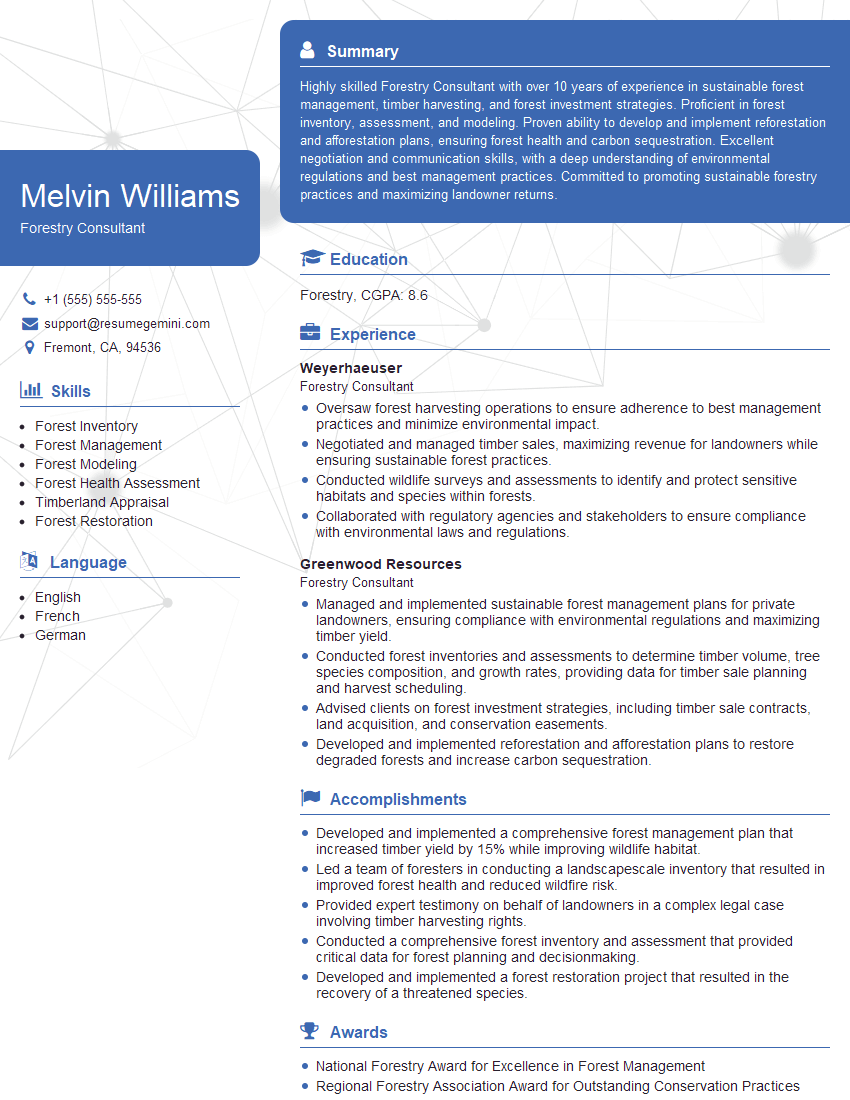
Forestry Consultant Resume Sample

Forestry Technician Resume Sample

Logging Supervisor Resume Sample

Loader Operator Resume Sample

Bucker Resume Sample

Logger Resume Sample

Sawyer Resume Sample

Skidder Operator Resume Sample

Tree Faller Resume Sample

Timber Harvester Operator Resume Sample

Logging Equipment Mechanic Resume Sample

Hauler Resume Sample
Explore more articles
Users Rating of Our Blogs
Share Your Experience
We value your feedback! Please rate our content and share your thoughts (optional).
What Readers Say About Our Blog
Very informative content, great job.
good