Preparation is the key to success in any interview. In this post, we’ll explore crucial Maritime Law and Policy interview questions and equip you with strategies to craft impactful answers. Whether you’re a beginner or a pro, these tips will elevate your preparation.
Questions Asked in Maritime Law and Policy Interview
Q 1. Explain the concept of ‘limitation of liability’ in maritime law.
Limitation of liability in maritime law is a crucial concept that protects shipowners and other parties involved in maritime operations from potentially crippling financial losses arising from accidents or incidents at sea. Essentially, it limits their liability to a specific amount, preventing their complete financial ruin. This isn’t a complete exemption from responsibility; it simply caps the amount they can be forced to pay.
The amount of limitation is typically based on the ship’s tonnage or value, and varies depending on the jurisdiction and specific legislation. For instance, a small fishing vessel would have a much lower liability limit than a massive container ship. This system balances the need to compensate victims fairly while ensuring the maritime industry’s viability. Without it, even a single major accident could bankrupt a shipping company, potentially impacting numerous stakeholders, including crew members, cargo owners, and even port economies.
Consider a scenario where a cargo ship collides with a bridge, causing significant damage. The limitation of liability would define the maximum amount the ship owner would have to pay for the damages, even if the actual costs exceed that limit. This protection is not without conditions; it typically requires demonstrating that the accident wasn’t due to the shipowner’s willful misconduct or recklessness. Therefore, the concept carefully balances the protection of businesses with the need for accountability.
Q 2. What are the key provisions of the Carriage of Goods by Sea Act (COGSA)?
The Carriage of Goods by Sea Act (COGSA) is a US federal statute that governs the liability of carriers for cargo loss or damage during ocean transportation. It’s crucial for international trade, offering a standardized framework for contracts of carriage. Key provisions include:
- Carrier’s Duty of Due Diligence: COGSA mandates that the carrier must exercise due diligence to make the ship seaworthy and properly equip it before and at the beginning of the voyage. This includes ensuring the vessel is fit for the cargo and the intended voyage.
- Limitation of Liability: Similar to the broader concept of limitation of liability, COGSA limits the carrier’s liability to a fixed amount per package or unit, unless the shipper declares a higher value and pays accordingly. This protects carriers from potentially devastating financial losses but also encourages accurate cargo declarations.
- Notice of Loss or Damage: COGSA sets a timeframe for the shipper to notify the carrier about any damage or loss to the cargo. Failure to provide timely notice might affect the shipper’s ability to claim compensation.
- Time Limits for Suit: COGSA dictates specific deadlines for initiating legal action against the carrier. This prevents protracted litigation and offers both parties some certainty.
- Perils of the Sea: COGSA generally exempts carriers from liability for losses or damages caused by perils of the sea—events like storms, unavoidable accidents at sea, etc. However, this exception doesn’t apply if the carrier failed to exercise due diligence.
COGSA offers a balance between the protection of carriers and the rights of cargo owners. While it limits liability, it also imposes responsibilities on carriers and sets clear procedures for handling claims.
Q 3. Describe the process of maritime arbitration.
Maritime arbitration is a dispute resolution method favored in the shipping industry for its efficiency, confidentiality, and expertise. It avoids the complexities and delays often associated with court litigation. Parties involved in a maritime dispute, such as cargo owners, carriers, or insurers, can agree to settle their disagreements through arbitration rather than a court of law.
The process typically involves:
- Agreement to Arbitrate: The parties agree in advance (often through a contract clause) to submit any future disputes to arbitration.
- Selection of Arbitrator(s): An arbitrator or panel of arbitrators, usually experienced in maritime law, is chosen. The parties might jointly agree on an arbitrator or use an institution like the London Maritime Arbitrators Association (LMAA) or the American Arbitration Association (AAA) to select one.
- Presentation of Evidence and Arguments: Both sides present their case, including documents, expert testimony, and witness statements, before the arbitrator(s).
- Arbitral Award: After considering the evidence and arguments, the arbitrator(s) render an award—a binding decision that resolves the dispute. This award is typically final and enforceable like a court judgment.
Imagine a contract dispute between a shipper and a carrier regarding damaged goods. Arbitration offers a faster and less expensive alternative to court proceedings, allowing the parties to resolve the issue with a specialist knowledgeable in maritime matters. The confidential nature of arbitration is also attractive to many, protecting commercially sensitive information.
Q 4. What are the different types of maritime insurance and their coverages?
Maritime insurance is vital in mitigating the financial risks inherent in shipping and other marine activities. Several types of coverage exist:
- Hull and Machinery Insurance: This covers damage to the vessel itself, including its engine, hull, and other components. It protects against physical damage, loss, or liabilities arising from accidents or other incidents.
- Protection and Indemnity (P&I) Insurance: P&I insurance protects against third-party liabilities, such as injuries to crew members, damage to other vessels, or pollution caused by the ship. It’s crucial for covering the extensive liabilities shipowners can face.
- Cargo Insurance: This protects the cargo owner from loss or damage to goods during transportation. Different coverage levels exist, from basic coverage against specified perils to more comprehensive protection.
- Freight Insurance: This covers the potential loss of freight revenue if the cargo is damaged or lost. The insurer compensates the shipowner for the loss of income.
- Liability Insurance (beyond P&I): This can cover liabilities that extend beyond those typically covered by P&I, such as specific environmental pollution risks or liability for dock damage.
For example, a shipowner would secure hull and machinery insurance to protect their vessel. A cargo owner shipping valuable goods would purchase cargo insurance to protect against losses during transit. P&I insurance is essential for all shipowners to cover potentially significant liabilities.
Q 5. Explain the role of the International Maritime Organization (IMO).
The International Maritime Organization (IMO) is a specialized agency of the United Nations responsible for improving maritime safety and security, preventing marine pollution by ships, and facilitating cooperation among nations on maritime matters. It’s a critical player in setting global standards and regulations.
The IMO’s role encompasses:
- Developing and Implementing International Maritime Standards: The IMO develops international conventions, codes, and guidelines on various aspects of maritime activity, such as safety of life at sea (SOLAS), prevention of marine pollution (MARPOL), and maritime security (ISPS Code). These regulations are adopted by member states and implemented globally.
- Facilitating Cooperation and Technical Assistance: The IMO promotes collaboration between member states to address common maritime challenges, providing technical assistance and capacity building to developing countries to improve their maritime safety and environmental standards.
- Addressing Maritime Issues: The IMO deals with emerging issues like climate change, maritime security threats, and the development of autonomous shipping. It plays a pivotal role in addressing the environmental impact of shipping and finding sustainable solutions.
The IMO’s work significantly impacts global shipping and trade. Its regulations ensure a safer and more environmentally responsible maritime environment, benefiting all nations and the global community.
Q 6. Define the concept of ‘general average’ in maritime law.
General average in maritime law is a principle where all parties involved in a sea voyage share the losses incurred to save the vessel and cargo from a common peril. This ensures that nobody bears the entire burden of a sacrifice made to safeguard the whole venture. It’s a fundamental concept for risk allocation in shipping.
Imagine a situation where a ship encounters a storm and the captain orders the jettisoning of some cargo to prevent the ship from sinking. The loss of this cargo is a ‘general average sacrifice’. Once the ship reaches its destination, all parties involved (ship owner, cargo owners) contribute proportionally to compensate the owner of the jettisoned cargo. The proportional contributions are determined based on the value of their respective interests (the value of the ship and the value of the saved cargo). This ensures fairness and risk sharing among all participants.
General average requires several conditions to be met: there must be a common danger, a reasonable sacrifice to avoid danger, a successful outcome, and a deliberate action by the captain.
Q 7. How does the Salvage Convention apply to maritime salvage operations?
The International Convention on Salvage 1989 (Salvage Convention) governs maritime salvage operations, providing a framework for rewarding salvors—those who rescue vessels or cargo in distress. It aims to encourage salvage efforts by providing a clear legal basis for compensation, promoting efficient and prompt rescue operations.
Key aspects of how the Salvage Convention applies include:
- No-Cure-No-Pay: The Convention emphasizes a ‘no-cure-no-pay’ principle, meaning salvors are only entitled to compensation if they successfully complete the salvage operation. This incentivizes effective and efficient rescue efforts, as salvors only receive payment for a successful rescue.
- Salvage Reward: The Convention sets forth principles for determining the amount of salvage reward, considering factors like the skill and bravery of the salvors, the risks involved, the value of the property saved, and the time and expenses incurred. The reward can be substantial, reflecting the significant effort and potential danger involved in these operations.
- Convention’s Hierarchy: The convention lays out a hierarchy for determining salvage awards in cases of conflicting claims, ensuring that the most deserving parties receive fair compensation.
- Salvage Security: The convention provides mechanisms to ensure that the salvors receive their due compensation by allowing them to place an arrest or lien on the saved vessel.
The Salvage Convention’s impact is significant, as it provides a clear, internationally recognized system for compensating those who risk their lives and resources to rescue vessels and cargo in distress. This ensures that the crucial work of salvage remains incentivized and contributes to overall maritime safety.
Q 8. What are the key elements of a valid maritime contract?
A valid maritime contract, like any contract, requires several key elements to be legally binding. Think of it like a handshake that’s legally watertight! These essential elements include:
- Offer and Acceptance: A clear offer from one party and an unequivocal acceptance from the other. For example, a shipowner offering to transport goods and a charterer accepting that offer at the agreed-upon price.
- Consideration: Something of value exchanged between the parties. This could be money, goods, or services. In a charter party (a contract for the use of a vessel), the consideration might be the freight payment for the shipowner and the use of the vessel for the charterer.
- Intention to Create Legal Relations: Both parties must intend the agreement to be legally binding, not just a friendly arrangement. This is generally presumed in commercial contracts like maritime contracts.
- Capacity to Contract: Both parties must have the legal capacity to enter into a contract. This means they must be of legal age and have the mental capacity to understand the terms.
- Legality of Purpose: The contract’s purpose must be legal. A contract to smuggle illegal goods, for instance, would be void.
- Certainty of Terms: The terms of the contract must be clear, certain, and unambiguous. Vague or contradictory terms can render the contract unenforceable.
Failure to meet any of these criteria could lead to the contract being void or voidable, meaning it may not be legally enforceable.
Q 9. Explain the concept of ‘flag state jurisdiction’ and its limitations.
Flag state jurisdiction refers to the authority of a country (the ‘flag state’) over ships that fly its flag. Imagine it as the ship’s ‘home country’ having ultimate legal control. This includes the power to enforce its laws and regulations concerning the ship’s construction, operation, and crew. For example, the flag state can inspect the vessel, investigate accidents, and prosecute offences committed onboard.
However, flag state jurisdiction has limitations. It primarily applies to matters occurring onboard the ship or concerning the ship itself. It doesn’t necessarily extend to incidents occurring in foreign territorial waters or to matters affecting other countries’ interests. This is where other jurisdictions like the port state and the state where damage occurs come into play. Enforcement can be challenging if the flag state is unwilling or unable to effectively exercise its jurisdiction, leading to issues of ‘flags of convenience’ where ships register in countries with lax regulations.
Q 10. Discuss the legal implications of a ship collision.
A ship collision can have serious legal implications, often involving complex liability issues. Determining fault is paramount. The principles of maritime collision law, often based on international conventions and national laws, focus on establishing negligence or fault. Was one vessel at fault, or were both to blame? Consider factors like: navigation rules, lookout procedures, speed, and sea conditions.
Legal actions can range from property damage claims (repair costs, loss of cargo) to personal injury claims (medical expenses, lost wages, pain and suffering). Insurers play a significant role, and many cases are settled out of court. If a court case ensues, evidence, including navigational records, witness testimony, and expert opinions, is crucial in establishing liability. International conventions like the Convention on the International Regulations for Preventing Collisions at Sea (COLREGs) provide a framework for determining fault, but specific application can be complex and case-specific.
In cases of significant loss of life or environmental damage, investigations by flag states, port states, and potentially international organizations like the IMO are common.
Q 11. What are the key aspects of port state control?
Port state control (PSC) is a mechanism allowing coastal states to inspect foreign vessels entering their ports to verify compliance with international maritime regulations, specifically those related to safety and environmental protection. Think of it as a ‘border control’ for ships, ensuring they meet minimum standards. PSC inspections cover various aspects, including:
- Hull and machinery: Ensuring the vessel is seaworthy and its equipment is functioning correctly.
- Navigation equipment: Checking the functionality of navigational aids like radar, GPS, and communication systems.
- Safety equipment: Verifying the presence and condition of lifeboats, life rafts, fire-fighting systems, and personal protective equipment.
- Crew certification and documentation: Confirming that the crew has the necessary qualifications and that all relevant documents are in order.
- Pollution prevention: Assessing compliance with MARPOL (International Convention for the Prevention of Pollution from Ships) regulations.
PSC inspections can lead to detentions if serious deficiencies are found, preventing the vessel from sailing until these issues are rectified. This serves as a powerful tool to enhance maritime safety and protect the marine environment. The Paris MoU and Tokyo MoU are examples of PSC schemes focusing on specific regions.
Q 12. Describe the role of a P&I club.
A Protection and Indemnity (P&I) club is essentially a mutual insurance association for shipowners and other maritime businesses. Imagine it as a cooperative insurance company, where members pool their resources to share the risks inherent in maritime operations. P&I clubs provide insurance coverage for liabilities that are not typically covered by hull and machinery insurance, such as:
- Third-party liability: Covering claims arising from collisions, cargo damage, personal injury to crew or passengers, and pollution.
- Crew liabilities: Protecting against claims from crew members for injuries or illness.
- Legal costs: Providing financial assistance for legal defense and settlements.
P&I clubs also offer a wide range of other services, including risk management advice, legal assistance, and claims handling. Membership in a P&I club is crucial for most shipowners as it provides crucial financial protection against potentially catastrophic liabilities.
Q 13. How does the International Convention for the Safety of Life at Sea (SOLAS) impact maritime operations?
The International Convention for the Safety of Life at Sea (SOLAS) is a crucial international treaty setting minimum safety standards for merchant ships. Think of it as the global ‘safety manual’ for ships. Its impact on maritime operations is extensive, covering:
- Hull integrity and structural strength: Ensuring ships are built and maintained to withstand the rigors of the sea.
- Fire protection and fire detection: Establishing standards for fire prevention and suppression systems.
- Life-saving appliances: Mandating sufficient lifeboats, life rafts, and other survival equipment.
- Communication: Requiring appropriate communication systems for safety.
- Safety management: Promoting a safety management system onboard.
SOLAS compliance is mandatory for most merchant ships. Non-compliance can lead to serious consequences, including port state control detentions and legal penalties. SOLAS is regularly updated to reflect technological advancements and evolving safety concerns, making it a dynamically evolving piece of legislation.
Q 14. Explain the significance of the International Convention on Civil Liability for Bunker Oil Pollution Damage.
The International Convention on Civil Liability for Bunker Oil Pollution Damage (Bunker Convention) addresses the liability for pollution caused by the discharge of bunker fuel oil from ships. This is a significant issue because bunker fuel, used to power vessels, can cause significant environmental damage if spilled. The convention establishes a strict liability regime for shipowners, meaning they are liable for pollution damage even if they are not at fault, subject to certain exceptions. It also establishes a compensation fund to cover claims exceeding the shipowner’s liability limits.
Its significance lies in its ability to provide a mechanism for prompt and effective compensation to victims of bunker oil pollution, including coastal states affected by the pollution. The convention contributes to environmental protection by incentivizing shipowners to take preventative measures to avoid spills and manage the risks associated with handling bunker fuel. The existence of the convention and the compensation fund offers a critical safety net for those affected by this type of pollution.
Q 15. What are the legal implications of marine pollution?
Marine pollution carries severe legal implications, stemming from international conventions like the MARPOL Convention (International Convention for the Prevention of Pollution from Ships) and national laws. These regulations aim to protect the marine environment from harmful substances. Violations can lead to significant consequences.
- Civil Liability: Polluters can face substantial fines and be held liable for cleanup costs. For instance, a tanker spilling oil could be ordered to pay millions for remediation efforts and compensate affected parties (fishermen, coastal businesses).
- Criminal Penalties: Depending on the severity and intent, criminal charges can be brought against individuals or corporations, resulting in imprisonment and hefty fines. This is especially true for intentional pollution or negligence leading to catastrophic events.
- Port State Control: A vessel found in violation of MARPOL regulations in a port can be detained until corrective actions are taken. This can disrupt shipping schedules and incur significant expenses for the vessel owner.
- Blacklisting: Repeat offenders can be blacklisted by port authorities, preventing them from entering certain ports and significantly hampering their operations.
The legal ramifications depend on the type of pollution, the amount spilled, the degree of negligence, and the jurisdiction involved. International cooperation is crucial in enforcing these laws, but challenges remain in tracking and prosecuting offenders across different countries.
Career Expert Tips:
- Ace those interviews! Prepare effectively by reviewing the Top 50 Most Common Interview Questions on ResumeGemini.
- Navigate your job search with confidence! Explore a wide range of Career Tips on ResumeGemini. Learn about common challenges and recommendations to overcome them.
- Craft the perfect resume! Master the Art of Resume Writing with ResumeGemini’s guide. Showcase your unique qualifications and achievements effectively.
- Don’t miss out on holiday savings! Build your dream resume with ResumeGemini’s ATS optimized templates.
Q 16. Discuss the challenges of enforcing maritime law in international waters.
Enforcing maritime law in international waters presents unique challenges due to the lack of a single governing authority. While international conventions provide a framework, enforcement relies on the cooperation of various nation-states, leading to several hurdles:
- Jurisdictional Gaps: Determining which nation has jurisdiction over a crime committed on the high seas can be complex and often depends on the flag state of the vessel or the state where the pollution originates. This can lead to a lack of accountability if multiple states refuse to act.
- Resource Constraints: Many coastal states lack the resources – financial and technological – for effective maritime surveillance and enforcement. Tracking and apprehending offenders on the vast expanse of the ocean requires sophisticated equipment and personnel.
- Lack of Uniform Enforcement: Even when a violation is identified, differing interpretations and enforcement standards across countries can hinder effective action. What constitutes a serious infraction in one country might be considered a minor offense elsewhere.
- State Sovereignty: States are reluctant to interfere with the operations of vessels flagged by other nations unless there’s a clear violation of international law, or if the incident has a direct impact on their territory.
International cooperation through organizations like the International Maritime Organization (IMO) is crucial in addressing these challenges. Enhanced information sharing, improved surveillance technologies, and strengthened regional agreements are essential for more effective enforcement in international waters.
Q 17. Explain the role of maritime liens in securing claims against vessels.
Maritime liens are a crucial tool for securing claims against vessels. They are a type of security interest that attaches to a vessel itself, allowing creditors to seize and sell the vessel to satisfy their debt. They exist independently of the vessel’s ownership, which means that even if the vessel is sold, the lien remains attached.
- Types of Maritime Liens: These can include liens for things like unpaid wages of the crew, repairs, supplies, towage services, and damages arising from maritime collisions. They’re often prioritized according to a defined hierarchy.
- Enforcement: To enforce a maritime lien, a creditor must initiate legal proceedings and obtain a court order to arrest the vessel. This means the vessel is legally seized and cannot leave the port until the claim is settled.
- Priority: Maritime liens generally take priority over other types of claims against the vessel, with certain liens, such as those for wages, often ranking higher than others.
- Example: If a ship repair company isn’t paid for its services, it can place a maritime lien on the vessel. This gives them the right to initiate an arrest of the vessel until their invoice is paid.
Maritime liens provide a critical safety net for those providing services to ships, ensuring they have a mechanism to recover payment, even if the vessel owner is insolvent.
Q 18. What are the key differences between a charter party and a bill of lading?
Charter parties and bills of lading are both vital documents in maritime transport, but they serve different purposes and have different parties involved.
- Charter Party: This is a contract between the shipowner and the charterer (the person hiring the ship) governing the use of a vessel for a specific voyage or period. It details the terms of the agreement, including the freight rate, the voyage route, the cargo to be carried, and responsibilities of each party. It is essentially a lease agreement for the ship.
- Bill of Lading: This is a document issued by the carrier (typically the shipowner or their agent) to the shipper acknowledging receipt of the cargo for transportation. It acts as a receipt for the goods, a contract of carriage, and a document of title. It details the cargo, its destination, and the conditions of carriage. The bill of lading is transferable, enabling the shipper to sell the goods in transit.
Key Differences: A charter party is a contract between the shipowner and the charterer, concerning the use of the entire vessel. A bill of lading is a document of title and a contract of carriage between the carrier and the shipper, concerning specific goods carried on a vessel, not necessarily the entire vessel.
Imagine renting a car (charter party) versus receiving a receipt for your package shipped via courier (bill of lading). Both relate to transportation, but serve different purposes.
Q 19. Explain the implications of a ship’s arrest.
A ship’s arrest is a legal process where a court orders the seizure of a vessel to secure a claim against its owner or operator. It’s a powerful remedy available to creditors in maritime law.
- Grounds for Arrest: Arrest can be initiated for various reasons, including unpaid debts (like crew wages, port dues, or repair bills), breach of contract (like failure to deliver cargo), and liability for collision damage. The creditor must demonstrate a valid legal claim against the vessel.
- Procedure: The creditor applies to a court for a warrant of arrest. Once granted, maritime marshals or similar authorities seize the vessel, preventing its movement or use until the claim is resolved. This can severely disrupt the vessel’s operations and cause significant financial losses.
- Consequences: The arrest prevents the vessel from generating revenue during the period of seizure. This can impact operational efficiency and result in financial losses for the owner. The owner must also cover the costs associated with the arrest, including legal fees and storage charges.
- Release: The vessel is released only after the claim is settled, a bond is posted, or a court order is issued. The arrest process can be lengthy and expensive, necessitating prompt resolution.
A ship’s arrest serves as a strong incentive for timely payment and responsible behavior in the maritime industry. It underscores the importance of upholding contractual obligations and adhering to maritime regulations.
Q 20. What are the key considerations for negotiating a marine insurance policy?
Negotiating a marine insurance policy requires careful consideration of several factors to ensure adequate protection.
- Type of Coverage: Different policies cater to specific needs. Hull and machinery insurance covers the vessel itself, while cargo insurance protects the goods being transported. Protection and Indemnity (P&I) insurance covers third-party liability claims.
- Value of Assets: Accurate valuation of the vessel, cargo, or other insured assets is critical to determine the appropriate coverage amount. Underinsurance can lead to significant financial losses in the event of a claim.
- Risk Assessment: The insurer assesses the risks associated with the vessel, its crew, the cargo type, and the voyage route. High-risk ventures necessitate higher premiums and potentially stricter conditions.
- Policy Exclusions: Carefully review the policy exclusions to understand what is not covered. Common exclusions include acts of war, deliberate acts of the insured, and inherent vice (damage due to the nature of the goods).
- Clauses and Conditions: Pay close attention to the terms and conditions, including deductibles, limitations of liability, and claims procedures. Clear communication with the insurer ensures understanding.
- Insurer Reputation: Choosing a reputable insurer with a proven track record of handling maritime claims is crucial. Check their financial strength and their history of fair claims handling.
Effective negotiation involves a thorough understanding of your risks and clearly communicating your needs to the insurer. Seeking professional advice from a maritime insurance broker can be invaluable in this process.
Q 21. Describe the process for resolving maritime disputes.
Resolving maritime disputes often involves a combination of negotiation, mediation, arbitration, and litigation. The choice of method depends on several factors, including the nature of the dispute, the parties involved, and their preferences.
- Negotiation: Parties attempt to reach a settlement through direct discussions. This is the least formal method and often the most cost-effective if successful.
- Mediation: A neutral third party assists parties in reaching a mutually agreeable solution. The mediator facilitates communication but does not impose a decision.
- Arbitration: Parties present their cases to an arbitrator or a panel of arbitrators, who make a binding decision. Arbitration is often favored for its efficiency and specialized expertise in maritime matters.
- Litigation: This involves filing a lawsuit in a court of law. Litigation is the most formal, time-consuming, and costly method but provides the potential for appeal.
Many maritime contracts include arbitration clauses specifying the rules and procedures for dispute resolution. The International Chamber of Commerce (ICC) and various maritime arbitration centers offer established procedures and experienced arbitrators to handle such disputes.
The choice of dispute resolution method should always consider cost-efficiency, time constraints, and the level of formality required to achieve a just outcome. The aim is always to find the most efficient and cost-effective means to resolve the matter while ensuring fairness.
Q 22. Explain the concept of ‘unseaworthiness’ and its consequences.
Unseaworthiness, in maritime law, refers to a vessel’s condition that renders it unfit to perform its intended voyage safely. This isn’t just about a leaky hull; it encompasses any deficiency in the vessel, its equipment, crew, or even its management that poses a risk to the crew, cargo, or the environment. Think of it like this: a car lacking essential brakes is unroadworthy; similarly, a ship with faulty navigation equipment or an insufficiently trained crew is unseaworthy.
The consequences of operating an unseaworthy vessel are severe. Owners and operators face potential liability for injuries sustained by crew members, damage to cargo, and environmental damage. This can lead to significant financial penalties, legal battles, and reputational damage. In extreme cases, criminal charges may be filed.
For example, if a ship sets sail with a known faulty engine, and this results in a collision due to the inability to maneuver, the owner could be liable for the damages and injuries caused. This liability often extends to those responsible for overseeing the vessel’s condition – from the captain to senior management ashore.
Q 23. Discuss the legal aspects of crew employment in the maritime industry.
The legal aspects of crew employment in the maritime industry are complex and governed by a variety of international and national laws. Key considerations include contracts of employment, minimum wage requirements, working hours, health and safety regulations, and repatriation rights. International conventions, such as the Maritime Labour Convention (MLC), 2006, set minimum standards that many nations incorporate into their national laws.
Crew members are typically employed under contracts that detail their duties, pay, working conditions, and terms of termination. These contracts must adhere to applicable national and international laws. Crucially, the MLC, 2006, aims to protect seafarers’ rights, ensuring fair wages, reasonable working hours, decent accommodation, and access to healthcare. Failure to comply can result in significant fines and legal repercussions for shipowners.
Dispute resolution mechanisms vary, often involving national courts, arbitration, or specialized maritime tribunals. Understanding the specifics of relevant employment laws is vital for both seafarers and employers to ensure compliance and resolve disputes effectively.
Q 24. How does the International Convention on Standards of Training, Certification and Watchkeeping for Seafarers (STCW) affect seafarers?
The International Convention on Standards of Training, Certification and Watchkeeping for Seafarers (STCW) is a crucial international treaty setting minimum standards for the training, certification, and watchkeeping of seafarers. It aims to enhance safety at sea and prevent marine casualties by ensuring that seafarers possess the necessary skills and qualifications.
The STCW Convention’s impact on seafarers is profound. It directly affects their training, enabling them to perform their duties safely and competently. Seafarers must meet the minimum standards set by the Convention to be certified and obtain employment on international voyages. This means undergoing specific training courses, passing examinations, and accumulating the required sea time. The standards cover various roles, from navigating officers to engine room personnel, ensuring all have the necessary competency.
The Convention also affects the safety of ships and the environment, by ensuring ships are crewed by adequately trained and certified personnel. Failure to comply with STCW standards can result in legal action against shipowners, including detention of vessels and denial of port entry.
Q 25. Explain the differences between various types of charter parties (e.g., time charter, voyage charter).
Charter parties are contracts governing the hiring of a vessel. Different types cater to varying needs. Time charters essentially lease the vessel to a charterer for a specified period, usually months or years. The owner retains responsibility for the vessel’s maintenance, insurance, and crew, while the charterer operates the vessel and pays hire. Think of it as leasing a car – you pay a monthly fee to use it, but the owner handles maintenance.
Voyage charters, in contrast, involve hiring the vessel for a single voyage or a series of voyages between specified ports. The charterer pays a lump sum or a rate per ton of cargo carried. The owner retains overall control of the vessel, including the crew, but the charterer dictates the cargo and routing. This is like hiring a taxi for a specific journey.
Bareboat charters, or demise charters, are a more extensive form where the charterer assumes virtually all responsibilities of ownership, including maintenance and crew. The owner essentially becomes a financier, receiving periodic hire payments. This is analogous to leasing a property – the lessee takes on all upkeep responsibilities.
Each charter type has unique clauses specifying responsibilities, liabilities, and payment terms. Understanding these differences is critical in mitigating potential disputes.
Q 26. What is the role of a maritime lawyer in a vessel collision case?
In vessel collision cases, a maritime lawyer plays a crucial role in representing the interests of their clients, who might be owners, operators, or even injured crew members. Their expertise is vital for navigating the complex legal landscape surrounding liability, causation, and damages.
Their tasks encompass investigating the incident, gathering evidence (such as voyage data recorders, witness statements, and expert reports), and determining liability based on collision regulations and general maritime principles. They advise on potential claims, defend against claims, negotiate settlements, and, if necessary, represent their client in court or arbitration. They need a deep understanding of maritime regulations, international conventions, and evidence admissibility in maritime courts.
For example, a lawyer might analyze radar plots, navigational charts, and witness testimonies to establish fault in a collision, arguing for or against the liability of their client. They might also assess and quantify damages, including repair costs, loss of earnings, and compensation for injuries.
Q 27. Discuss the legal implications of piracy and armed robbery against ships.
Piracy and armed robbery against ships are serious crimes with far-reaching legal implications. International law, including the UN Convention on the Law of the Sea (UNCLOS), criminalizes piracy, defining it as an illegal act of violence or detention committed at sea. Armed robbery is a related offense, often targeting cargo or cash onboard.
States have a duty to cooperate in suppressing piracy and armed robbery. This can involve naval patrols, joint operations, and prosecution of captured pirates. Shipowners also have responsibilities – implementing security measures, reporting incidents, and potentially contributing to the costs of anti-piracy efforts. Victims may also claim compensation from insurers or potentially from states that fail to uphold their responsibilities in protecting ships in their waters.
The legal implications for captured pirates extend to potential prosecution under national or international law, potentially leading to lengthy prison sentences. Shipowners who fail to take reasonable security measures may face liability for losses or injuries suffered as a consequence of piracy or armed robbery. The legal process is complex and can involve international cooperation and jurisdiction disputes.
Q 28. Explain the role of the International Tribunal for the Law of the Sea (ITLOS).
The International Tribunal for the Law of the Sea (ITLOS) is a judicial body established under UNCLOS. Its primary role is to settle disputes concerning the interpretation and application of the Convention. It is, in essence, the supreme court for matters relating to the law of the sea.
ITLOS’s jurisdiction includes disputes between states regarding maritime boundaries, navigation rights, maritime delimitation, and the exploitation of marine resources. It also hears cases involving alleged violations of UNCLOS, such as excessive fishing or damage to the marine environment. States can refer disputes to ITLOS through a process of consent, often through treaties or special agreements.
The Tribunal’s decisions are binding on the parties involved in the specific case. While ITLOS plays a crucial role in resolving disputes peacefully and maintaining order in the maritime environment, its decisions are primarily concerned with state-to-state interactions rather than issues involving individuals or private companies.
Key Topics to Learn for Your Maritime Law and Policy Interview
- International Maritime Law Conventions: Understand the core principles and application of key conventions like SOLAS, MARPOL, and the UNCLOS. Consider case studies demonstrating their practical impact.
- Maritime Jurisdiction and Dispute Resolution: Explore the complexities of jurisdiction in maritime disputes, including flag state, port state, and coastal state jurisdiction. Familiarize yourself with arbitration and litigation processes in this field.
- Maritime Transportation Law: Master the legal framework governing contracts of carriage, charter parties, and bills of lading. Practice analyzing hypothetical scenarios involving cargo damage or delays.
- Maritime Insurance and Liability: Develop a strong understanding of hull and machinery insurance, protection and indemnity (P&I) clubs, and the principles of limitation of liability. Be prepared to discuss case law related to insurance claims.
- Salvage and Wreck Removal: Learn the legal and practical aspects of salvage operations, including the rights and obligations of salvors and owners. Explore the legal frameworks governing wreck removal and environmental protection.
- Port State Control and Enforcement: Understand the role of port state control in ensuring compliance with international maritime regulations. Analyze the consequences of non-compliance and the legal ramifications for vessels and operators.
- Maritime Security and Anti-Piracy: Explore the legal and policy responses to maritime security threats, including piracy and terrorism. Consider the role of international cooperation and the application of relevant legislation.
- Environmental Protection in Maritime Law: Gain a comprehensive understanding of regulations aimed at protecting the marine environment from pollution caused by shipping activities. Be ready to discuss the legal challenges and enforcement mechanisms involved.
Next Steps
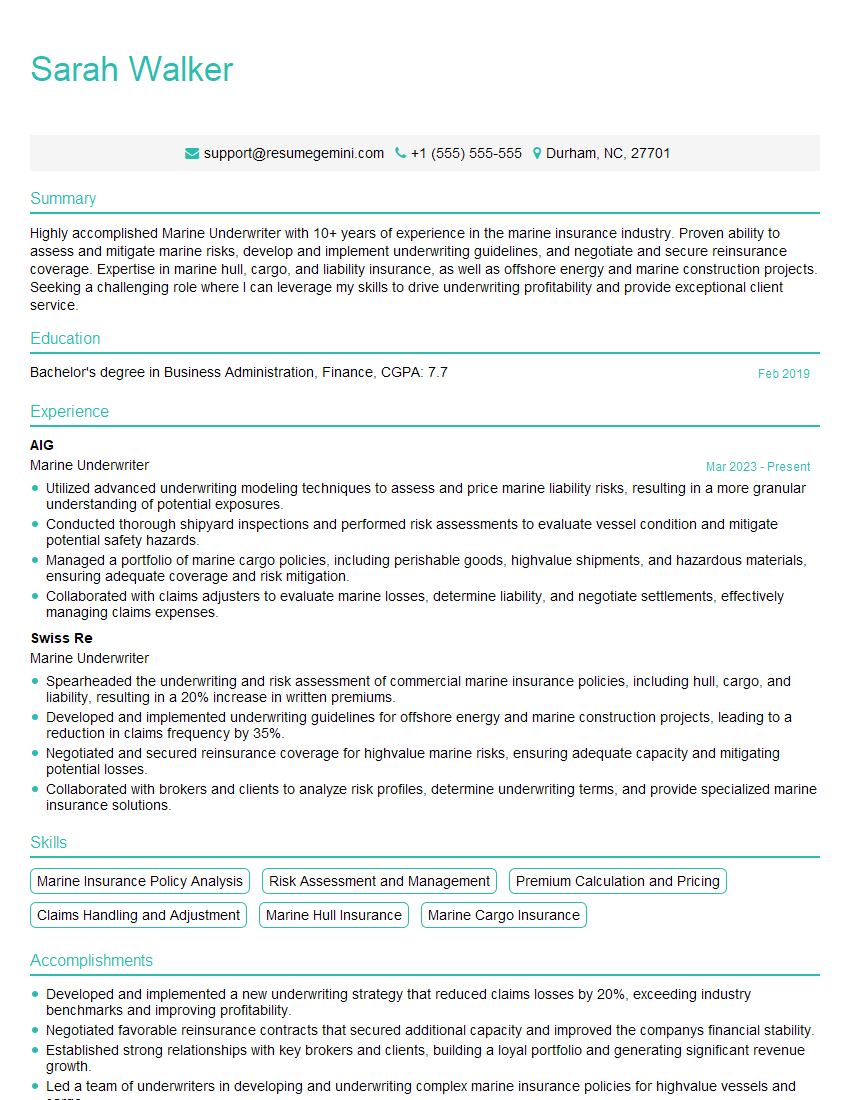
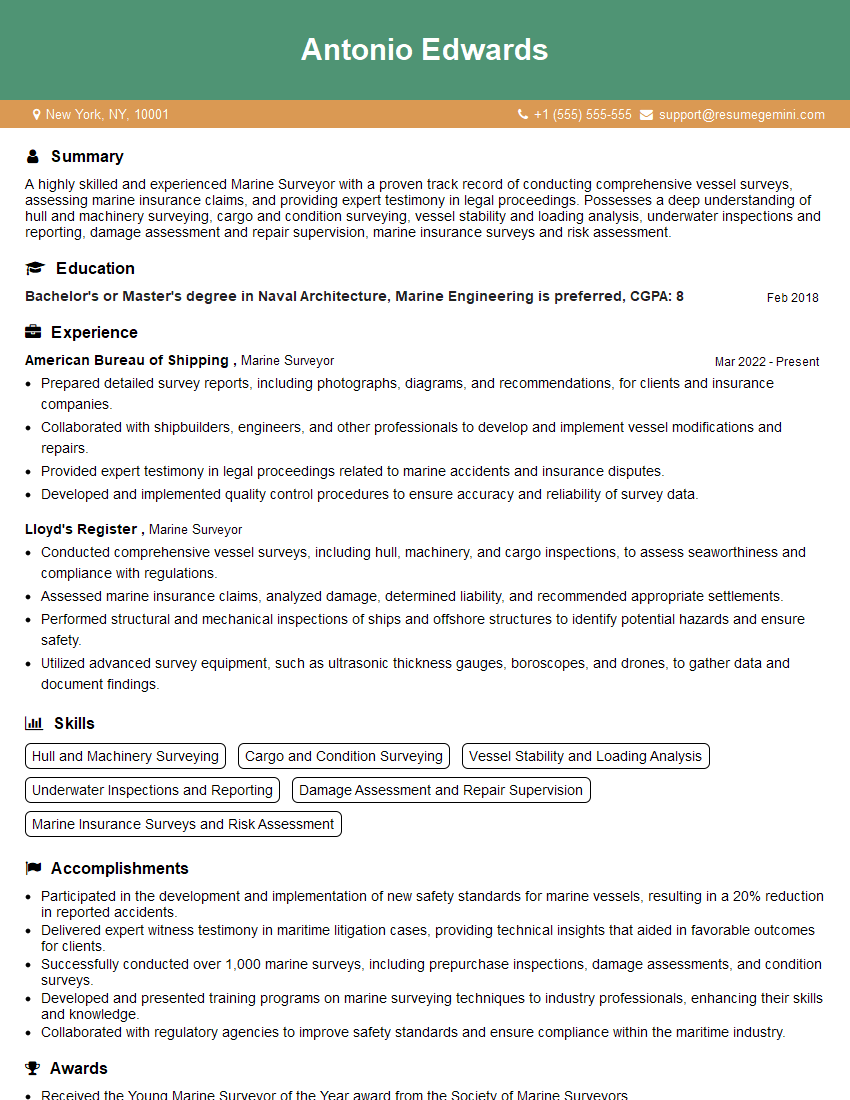
Mastering Maritime Law and Policy is crucial for a successful and rewarding career in this dynamic field. A strong understanding of these complex legal frameworks will significantly enhance your professional prospects and open doors to exciting opportunities. To maximize your chances of landing your dream role, it’s vital to present yourself effectively. Creating an ATS-friendly resume is essential for getting your application noticed. We highly recommend using ResumeGemini to build a professional and impactful resume tailored to your specific skills and experience. ResumeGemini offers readily available examples of resumes specifically crafted for Maritime Law and Policy professionals, helping you showcase your qualifications effectively and stand out from the competition.
Explore more articles
Users Rating of Our Blogs
Share Your Experience
We value your feedback! Please rate our content and share your thoughts (optional).
What Readers Say About Our Blog
Very informative content, great job.
good