Preparation is the key to success in any interview. In this post, we’ll explore crucial Music Notation interview questions and equip you with strategies to craft impactful answers. Whether you’re a beginner or a pro, these tips will elevate your preparation.
Questions Asked in Music Notation Interview
Q 1. Explain the difference between a staff and a stave.
The terms “staff” and “stave” are often used interchangeably, especially in American and British English respectively. Both refer to the five horizontal lines upon which musical notation is written, along with the spaces between them. Think of it as the foundational framework for writing music. Each line and space represents a specific pitch, determined by the clef placed at the beginning of the staff.
While the distinction is largely semantic, some might argue that ‘stave’ is more commonly used in formal academic contexts or when discussing historical music notation.
Q 2. Describe the various types of clefs and their uses.
Clefs are symbols that indicate the pitch of notes written on the staff. They’re essential because they establish the reference point for all other notes on that particular staff. Here are some common types:
- Treble Clef (G Clef): Shaped like a stylized ‘G,’ it positions the note G above middle C on the second line of the staff. Commonly used for higher-pitched instruments like violins, flutes, and soprano voices.
- Bass Clef (F Clef): Resembling a stylized ‘F,’ it places the note F below middle C on the fourth line of the staff. Used for lower-pitched instruments like cellos, bassoons, and bass voices.
- Alto Clef (C Clef): A less common clef, its shape resembles a backwards ‘C’, placing middle C on the line that it encircles. Historically used for alto voices and some instruments, now less prevalent.
- Tenor Clef (C Clef): Similar to the alto clef, but placed higher on the staff, positioning middle C on the fourth line.
The choice of clef depends entirely on the range of the instrument or voice being notated.
Q 3. What are the different types of note values and how are they represented?
Note values represent the duration of a note. They’re visually represented by the shape of the note head and the presence or absence of flags, beams, or dots.
- Whole Note (Semibreve): A hollow oval, it lasts for four beats in 4/4 time.
- Half Note (Minim): A hollow oval with a stem, it lasts for two beats in 4/4 time.
- Quarter Note (Crotchet): A hollow oval with a stem and a flag, it lasts for one beat in 4/4 time.
- Eighth Note (Quaver): A hollow oval with a stem and two flags (or a beam connecting multiple eighth notes), it lasts for half a beat in 4/4 time.
- Sixteenth Note (Semiquaver): A hollow oval with a stem and four flags (or beams), lasting for a quarter beat in 4/4 time.
Adding a dot after a note increases its duration by half its original value. For example, a dotted half note is equal to three beats in 4/4 time.
Q 4. Explain the concept of time signatures and their significance.
Time signatures are numerical notations at the beginning of a musical piece that indicate the meter or rhythmic organization of the music. They’re written as a fraction, e.g., 4/4. The top number represents the number of beats per measure, and the bottom number represents the type of note that receives one beat.
For instance, 4/4 (common time) means there are four quarter notes per measure. 3/4 (waltz time) means there are three quarter notes per measure. The time signature is crucial because it dictates the rhythmic structure and pulse of the music, acting as a roadmap for the performer and composer alike.
Q 5. How are key signatures indicated and what do they represent?
Key signatures are symbols at the beginning of a staff that indicate the key (or tonality) of a piece of music. They consist of sharps (#) or flats (♭) placed on the staff lines and spaces. Each sharp or flat raises or lowers the pitch of a specific note within the scale.
For example, a key signature with two sharps (F# and C#) indicates the key of D major or B minor. The key signature informs the performer of the notes that are altered throughout the piece, simplifying the reading and performance of the music. It essentially establishes the tonal center and the notes that will be considered ‘natural’ within the piece’s harmonic context.
Q 6. Describe the use of accidentals and their placement within a musical score.
Accidentals are symbols that temporarily alter the pitch of a note. They include sharps (#), flats (♭), and naturals (♮). A sharp raises the note by a half step, a flat lowers it by a half step, and a natural cancels a previous sharp or flat within the same measure.
Accidentals are placed immediately before the note they affect. Their placement is crucial because their impact is only temporary – they only affect the specific note they modify unless repeated with a similar note within the same measure.
Q 7. How are dynamics indicated in music notation?
Dynamics refer to the loudness or softness of the music. They’re indicated in musical notation using Italian terms:
ppp(pianississimo): very, very softpp(pianissimo): very softp(piano): softmp(mezzo piano): moderately softmf(mezzo forte): moderately loudf(forte): loudff(fortissimo): very loudfff(fortississimo): very, very loudcresc.(crescendo): gradually getting louderdecresc.(decrescendo): gradually getting softer
These terms are usually written above or below the staff, guiding the performer on how to express the emotional and dynamic aspects of the music.
Q 8. Explain the use of articulation markings (e.g., staccato, legato).
Articulation markings are crucial for conveying the nuances of musical expression. They tell the performer how to shape the sound of individual notes and phrases. Think of them as instructions for the performer’s touch.
- Staccato: Indicates a short, detached note. Imagine a pianist playing with a light, bouncy touch. The note is played crisply and then immediately released. It’s often represented by a dot placed above or below the note.
. - Legato: Means ‘tied’ or ‘connected’. Notes are played smoothly and connected, with no audible gap between them. This creates a flowing, lyrical sound. It’s often indicated by a slur (a curved line) connecting the notes.
(slur)
For example, a staccato passage might sound bright and lively, while a legato melody might sound melancholic and flowing. The choice of articulation dramatically impacts the overall feeling of the music.
Q 9. What are the different types of rests and their durations?
Rests represent silence in music, and their duration corresponds to the note values they replace. Just as notes have different lengths, so do rests. They’re essential for creating rhythmic variety and pauses within a piece.
- Whole rest: Equivalent to a whole note (four beats in 4/4 time).
- Half rest: Equivalent to a half note (two beats in 4/4 time).
- Quarter rest: Equivalent to a quarter note (one beat in 4/4 time).
- Eighth rest: Equivalent to an eighth note (half a beat in 4/4 time).
- Sixteenth rest: Equivalent to a sixteenth note (a quarter of a beat in 4/4 time).
The shapes of rests vary depending on their duration. Imagine them as visual representations of the silence they represent, with longer rests having more complex shapes.
Q 10. How are slurs and ties used in music notation?
Slurs and ties are both curved lines used in music notation, but they serve different purposes. They’re vital for shaping phrasing and connecting notes.
- Slurs: Connect notes that should be played legato (smoothly connected). They indicate phrasing and grouping of notes within a melody. Think of them as connecting notes to form a musical phrase, much like a sentence in written language.
- Ties: Connect two notes of the same pitch, extending the duration of the first note. They’re used to create notes longer than what’s available in a given time signature. This is particularly common when dealing with longer note values that might exceed a single measure.
The key difference lies in the pitch: slurs connect notes of different pitches, while ties connect notes of the same pitch. A skilled musician understands the subtle differences between a slurred phrase and a tied note, impacting rhythm and phrasing significantly.
Q 11. Explain the function of articulation markings like accents and sforzandos.
Accents and sforzandos both emphasize notes, but they differ in intensity and duration. They add dynamic punch to a musical phrase.
- Accent: Indicates a slightly stronger emphasis on a single note. It’s a subtle increase in volume, often used to highlight rhythmic points or to bring attention to a specific note within a phrase. It is usually indicated by a ‘>’ symbol above or below the note.
- Sforzando (sf): Indicates a sudden, forceful accent. It’s a more dramatic emphasis, resulting in a marked increase in volume that decays back to the original dynamic level. This creates a powerful, emphatic sound.
Imagine a sentence where you emphasize a certain word; an accent is a gentle stress, while a sforzando is a forceful shout. The context determines the appropriate use of each.
Q 12. How are repeats and codas indicated in music notation?
Repeats and codas are crucial for indicating sections of music to be repeated or for specifying endings. They streamline notation, avoiding unnecessary repetition of large sections.
- Repeats: Usually indicated by repeat signs (dots within the barlines at the beginning and end of a section)
:||:. Sometimes, these signs are accompanied by words or abbreviations like “Da Capo” (D.C.) meaning “from the beginning”. - Codas: Indicate alternative endings. The coda symbol (a curved line with a small vertical line at the end) directs the performer to a section marked as the coda, which often provides a different closing than the main section’s ending.
Effectively reading and interpreting repeat signs and codas are crucial for musicians to accurately perform the intended musical structure.
Q 13. Describe the use of various types of brackets and braces in music notation.
Brackets and braces in music notation are used for grouping and organizing elements within a score. They provide visual clarity and help delineate different musical sections or voices.
- Brackets: Often used to enclose a group of notes that should be played together as a single unit (often with a crescendo or diminuendo). They also help group systems of notes with similar ornamentation.
- Braces: Typically used to group multiple staves (lines of music) together, particularly when indicating different parts of the same instrument (like two staves for piano, representing treble and bass clef) or indicating a combination of instrumental parts.
These symbols greatly aid in readability and help musicians interpret the composer’s intentions regarding phrasing and overall structure.
Q 14. How are different instrumental parts organized within a score?
In a musical score, different instrumental parts are organized into separate staves. Each stave represents a specific instrument or voice. Staves are usually grouped together based on their role within the ensemble. The order is often determined by the instrumentation’s traditional arrangement or the composer’s preferences, for example, strings (violins I and II, violas, cellos, basses) often appear at the top of the score.
Each stave often includes a clef indicating the pitch range of the instrument or voice and a name indicating the instrument or part. This clear organization allows musicians to easily find their parts within the entire score, making the collaboration between multiple musicians smooth and efficient.
Q 15. What are the common software used for music notation (e.g., Sibelius, Finale)?
The music notation software landscape is quite diverse, but several programs stand out as industry standards. Sibelius and Finale are arguably the two most popular, offering comprehensive tools for creating and editing scores. They’re used by composers, arrangers, and publishers worldwide, supporting everything from simple melodies to complex orchestral works. Other strong contenders include Dorico (known for its ease of use and modern interface), MuseScore (a free, open-source option with growing capabilities), and Notion (a newer program gaining popularity for its versatility).
- Sibelius: Renowned for its elegant interface and powerful engraving features.
- Finale: A long-standing industry veteran, known for its extensive functionality and robust scripting capabilities.
- Dorico: A relatively newer program praised for its intuitive workflow and efficient handling of large projects.
- MuseScore: A free and open-source option, perfect for beginners or those on a budget.
- Notion: A relatively newer program that emphasizes ease of use across a wide range of music creation tasks.
Career Expert Tips:
- Ace those interviews! Prepare effectively by reviewing the Top 50 Most Common Interview Questions on ResumeGemini.
- Navigate your job search with confidence! Explore a wide range of Career Tips on ResumeGemini. Learn about common challenges and recommendations to overcome them.
- Craft the perfect resume! Master the Art of Resume Writing with ResumeGemini’s guide. Showcase your unique qualifications and achievements effectively.
- Don’t miss out on holiday savings! Build your dream resume with ResumeGemini’s ATS optimized templates.
Q 16. Explain your experience with music notation software.
My experience with music notation software spans over fifteen years, encompassing all aspects of score creation, from initial sketching to final print-ready output. I’m highly proficient in Sibelius and Finale, having used them extensively for composing, arranging, transcribing, and editing scores for various ensembles, from solo piano pieces to large-scale orchestral works. I’ve also worked with Dorico and MuseScore, appreciating their unique strengths. My proficiency extends to utilizing the advanced features of these programs, such as custom palettes, expression maps, and automation techniques, to streamline my workflow and enhance the quality of my work. For instance, I’ve used Sibelius’s powerful scripting capabilities to automate repetitive tasks in preparing scores for large ensembles, saving significant time and effort.
Q 17. Describe your process for preparing a complex orchestral score for print.
Preparing a complex orchestral score for print involves a meticulous multi-stage process. It’s more than just getting the notes right; it’s about clarity, consistency, and professional presentation. My process typically follows these steps:
- Initial Composition/Arrangement: This is where the music takes shape within the software, ensuring all parts are accurately notated and voiced appropriately.
- Part Extraction and Review: Individual parts are extracted and carefully reviewed for potential errors or inconsistencies. This often involves playtesting and making adjustments to ensure clarity and playability.
- System and Page Layout: Careful planning of system breaks and page layout is crucial for optimal readability and aesthetic appeal. This involves considering breath marks, phrase markings and overall visual balance.
- Proofreading and Final Adjustments: Multiple rounds of proofreading are essential to catch any remaining errors. I frequently enlist a colleague to proofread my scores for a fresh perspective.
- Export and File Preparation: The final score is exported in various formats, including PDF, MusicXML, and potentially others depending on the publisher’s requirements.
For instance, when preparing a score for a symphony orchestra, I often use Sibelius’s features to create custom layouts for different instrument groups, ensuring optimal spacing and clarity for each section. This level of detail is key to ensuring the score is both functional and aesthetically pleasing for the musicians.
Q 18. How do you ensure accuracy and consistency in your music notation?
Accuracy and consistency are paramount in music notation. My approach involves a combination of meticulous attention to detail, leveraging software features, and employing systematic checking methods. I begin with a thorough understanding of the musical style and conventions relevant to the piece. I then use the software’s tools for spellchecking and automatic formatting, ensuring consistency in things like note spacing, slurs, and articulation markings. Regular cross-checking against the original source material and employing a second proofreader are also essential steps.
For example, I might create custom styles within my notation software to maintain consistency in things like text font and size, ensuring uniformity throughout the score. This attention to detail minimizes the chance of errors and produces a professionally polished result.
Q 19. How do you handle revisions and corrections in a musical score?
Handling revisions and corrections efficiently requires a well-organized approach. I utilize the version control features within my notation software (like Sibelius’s revision history) to track changes. This allows me to easily revert to previous versions if needed. For larger revisions, I might create separate versions of the score, clearly labeled to distinguish between the revisions. Clear communication with the composer or client is essential to ensure all changes are addressed accurately and efficiently. Using comments and annotations within the score itself helps to clarify the requested changes and facilitates smooth collaboration.
Q 20. Explain your workflow for transcribing a piece of music from audio.
Transcribing music from audio is a challenging process requiring a blend of musical ear, technical skill, and patience. My workflow involves several stages:
- Audio Preparation: I begin by analyzing the audio quality, determining if any enhancements (noise reduction, etc.) are necessary.
- Initial Transcription: Using notation software, I enter the melody and basic harmony, focusing on the overall structure and key elements.
- Detailed Transcription: I carefully refine the transcription, adding rhythmic details, articulations, dynamics, and other expressive markings.
- Verification and Refinement: I play back the transcribed music using the software’s playback function to compare it to the original audio. This iterative process helps identify and correct inaccuracies.
- Final Polishing: The final step involves proofreading and ensuring the accuracy and consistency of the entire transcription, paying close attention to details like accidentals and rhythmic nuances.
Software like Antares Auto-Tune can help with pitch correction when dealing with recordings that are slightly out of tune. The process requires a keen ear, knowledge of music theory, and proficiency in the chosen notation software.
Q 21. How familiar are you with music theory concepts related to harmony and counterpoint?
My familiarity with music theory concepts related to harmony and counterpoint is extensive. I have a deep understanding of chord progressions, voice leading, and contrapuntal techniques. This understanding is crucial for accurate transcription, arranging, and composition work. I can readily analyze complex harmonic structures, identify voice crossings, and make informed decisions regarding voicing and overall musical balance. I regularly apply these principles to ensure the accuracy and aesthetic quality of my work. For example, when transcribing a Baroque fugue, a thorough grasp of counterpoint is essential for accurately representing the intricate interplay of voices.
Q 22. How would you approach engraving a piece with unusual or complex rhythmic patterns?
Engraving music with unusual rhythmic patterns requires a methodical approach. First, I meticulously analyze the rhythm, breaking it down into its smallest constituent parts. Think of it like assembling a complex jigsaw puzzle – each note and rest is a piece. I identify the underlying pulse and any subdivisions, using tuplets (e.g., triplets, quintuplets) or other notational devices to represent these accurately. For example, a complex rhythmic pattern might involve groupings of 7 eighth notes where a standard 4/4 time signature wouldn’t directly represent it. In such a case, I might use a combination of beams and brackets to show the groupings clearly.
Then, I carefully consider the visual impact. Cluttered notation hinders readability. I might use rests strategically to create visual breathing points, or employ different types of note stems to prevent overlap and improve clarity. Software like Sibelius or Finale allows for advanced rhythmic manipulation and visual adjustments, allowing me to fine-tune the appearance to make even complex rhythms easy to read.
Finally, I would always double-check my work, both for accuracy and visual coherence. I might even play the passage back using a notation software’s playback feature to ensure the engraving accurately reflects the composer’s intent.
Q 23. Describe your experience with preparing scores for different instruments or ensembles.
My experience spans various instruments and ensembles, from solo piano pieces to full orchestral scores. Each instrument presents unique challenges. For instance, a solo violin piece demands careful attention to the nuances of bowing and fingering, often requiring specific notation conventions to reflect the performer’s technique. For a wind ensemble, I need to be particularly mindful of range and articulation markings, as different instruments have different capabilities. With orchestral scores, organization is key. Part layout, spacing, and the use of system breaks are crucial to ensure readability for each instrumentalist. I always consult instrument-specific style guides to ensure accuracy.
I’ve worked with scores ranging from chamber music, where close attention to balance and voicing is essential, to large-scale symphonic works where keeping track of multiple instrumental sections presents logistical challenges. I approach each score with its specific requirements in mind, adapting my methods to ensure clarity and ease of reading for the intended performers.
Q 24. How do you deal with ambiguous or unclear notation in a source material?
Encountering ambiguous notation in source materials is common, especially when dealing with older scores or manuscripts. My approach is multi-pronged. First, I thoroughly examine the context. Are there other passages that provide clues? Do the surrounding notes suggest a likely interpretation? I might consult historical performance practices or scholarly articles to gain further insight. If the ambiguity remains, I will carefully note my interpretations and any uncertainties in the score, sometimes adding editorial notes to highlight these areas for the performers.
If there are multiple viable interpretations, I might even present them as options, with clear indications in the score about the uncertainties in the source material. Transparency is critical. It’s better to acknowledge ambiguity than to impose a potentially inaccurate interpretation. I would always strive to communicate my editorial decisions clearly and justify them based on available evidence.
Q 25. How do you manage your time and prioritize tasks when working on multiple projects?
Managing multiple projects effectively involves careful planning and prioritization. I use a project management system (either digital or analog) to track deadlines, tasks, and progress on each project. I break down larger projects into smaller, manageable tasks. This helps to avoid feeling overwhelmed and provides a sense of accomplishment as each task is completed. I also prioritize projects based on deadlines and importance. Urgent tasks with approaching deadlines naturally take precedence.
Time blocking is essential. I allocate specific time slots for different tasks and stick to the schedule as much as possible. This minimizes interruptions and maximizes focus. Regular self-assessment and flexible adjustment of my schedule are crucial. If one project requires more time than anticipated, I adjust my schedule accordingly, ensuring all projects are ultimately completed to the highest standard.
Q 26. Describe a situation where you had to troubleshoot a problem with music notation software.
In one project, I encountered an issue with Sibelius where complex tuplets weren’t displaying correctly. The software was seemingly ignoring the rhythmic values I had input. My initial troubleshooting steps involved checking my input for errors, restarting the software, and ensuring all updates were installed. These standard steps didn’t resolve the issue. I then consulted Sibelius’s extensive online help documentation and forums, discovering a known bug related to a specific interaction between tuplets and a particular dynamic marking.
The solution involved a workaround: slightly altering the placement of the dynamic marking. This seemingly minor adjustment resolved the display problem, allowing the tuplets to render correctly. This experience highlights the importance of thorough research and problem-solving when dealing with music notation software. Sometimes, the solution isn’t about fixing a fundamental bug but finding a creative workaround within the software’s constraints.
Q 27. How do you ensure the legibility and clarity of your music notation?
Legibility and clarity are paramount. I use a consistent and appropriate font size, ensuring all notes, rests, and symbols are easily discernible. Appropriate spacing between staves, systems, and notes is vital. Overly cluttered notation is extremely difficult to read. I also utilize clear and consistent articulation markings, dynamics, and other expression symbols. The choice of notation software plays a significant role. High-quality software such as Sibelius or Finale offers advanced features for controlling the visual presentation of the score.
Regular review and proofreading are essential. A fresh pair of eyes can often spot errors or areas for improvement that I might have missed. I also test the readability of my notation on different screen sizes and print resolutions, ensuring that the score remains clear and uncluttered regardless of the display method.
Q 28. What are some of the challenges you have encountered in music notation, and how did you overcome them?
One major challenge I’ve faced is dealing with conflicting interpretations of historical scores. Different editions or scholarly analyses may offer varying interpretations of ambiguous passages. In such cases, a deep dive into historical context, performance practices, and musicological research is vital. Reconciling these different perspectives and making informed editorial decisions requires both musical expertise and scholarly rigor.
Another challenge is balancing the demands of accuracy with the need for visual clarity in complex scores. Sometimes, technically accurate notation can look visually messy, hindering readability. Overcoming this involves creative use of layout techniques, including strategic use of spacing, rests, and system breaks. It requires striking a balance between maintaining the integrity of the musical information and presenting it in a way that’s clear and easy to read. It’s a constant process of refinement and iterative improvement.
Key Topics to Learn for Music Notation Interview
- Pitch and Intervals: Understanding the relationships between notes and their intervals, including major, minor, perfect, and augmented intervals. Practical application: Analyzing melodic and harmonic progressions in various musical styles.
- Rhythm and Meter: Mastering time signatures, note values, rests, and rhythmic complexities. Practical application: Accurately transcribing and interpreting complex rhythmic patterns.
- Key Signatures and Scales: Understanding major and minor scales, their relative relationships, and the function of key signatures. Practical application: Analyzing the tonal center and harmonic structure of a piece of music.
- Time Signatures and Meter Changes: Understanding the structure of different time signatures and how to navigate meter changes within a piece. Practical application: Accurately notating and performing music with complex rhythmic changes.
- Clefs and Ledger Lines: Understanding the different clefs (treble, bass, alto, tenor) and how to interpret notes written on ledger lines. Practical application: Reading and notating music across different ranges.
- Dynamics and Articulation: Understanding the nuances of dynamics (loudness and softness) and articulation (how notes are played or sung). Practical application: Interpreting and accurately representing expressive elements in musical scores.
- Chord Symbols and Roman Numeral Analysis: Understanding chord progressions and their function within a key, using Roman numeral analysis. Practical application: Analyzing and constructing harmonic structures in different musical styles.
- Music Theory Fundamentals: A strong grasp of basic music theory concepts, including harmony, counterpoint, and form. Practical application: Analyzing the overall structure and musical meaning of a piece.
Next Steps
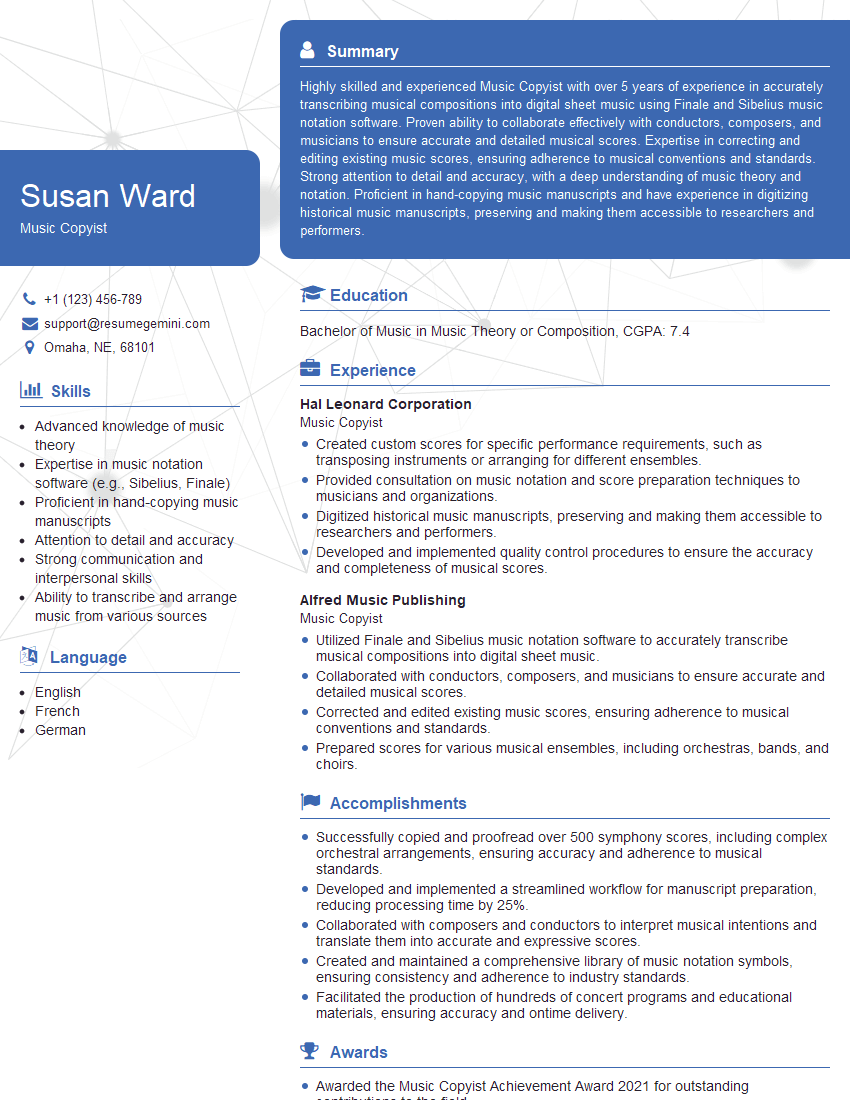
Mastering music notation is crucial for career advancement in various music-related fields, from composition and arranging to music education and publishing. A strong understanding of these concepts will significantly enhance your interview performance and open doors to exciting opportunities. To maximize your job prospects, focus on building an ATS-friendly resume that highlights your skills and experience effectively. ResumeGemini is a trusted resource for crafting professional and impactful resumes, and they offer examples tailored specifically to the Music Notation field. Take advantage of these resources to create a resume that truly showcases your capabilities.
Explore more articles
Users Rating of Our Blogs
Share Your Experience
We value your feedback! Please rate our content and share your thoughts (optional).
What Readers Say About Our Blog
Very informative content, great job.
good