Interviews are opportunities to demonstrate your expertise, and this guide is here to help you shine. Explore the essential Non-Linear Optics interview questions that employers frequently ask, paired with strategies for crafting responses that set you apart from the competition.
Questions Asked in Non-Linear Optics Interview
Q 1. Explain the difference between linear and nonlinear optical processes.
The core difference between linear and nonlinear optics lies in how a material responds to incident light. In linear optics, the material’s polarization (the induced dipole moment per unit volume) is directly proportional to the applied electric field of the light. Think of it like a spring: you pull it a little, it stretches a little. Double the pull, double the stretch. This leads to phenomena like refraction and reflection, where the light’s frequency remains unchanged.
Nonlinear optics, however, comes into play when the applied electric field is strong enough to cause a non-proportional response. It’s like stretching a rubber band – the response isn’t linear; the further you stretch, the harder it becomes. This non-linearity leads to the generation of new frequencies, not present in the incident light. Examples include second-harmonic generation and sum-frequency generation.
Q 2. Describe the phenomenon of second-harmonic generation (SHG).
Second-harmonic generation (SHG) is a nonlinear optical process where two photons of the same frequency interact within a nonlinear material to produce a single photon with double the frequency (and therefore, half the wavelength). Imagine two waves colliding and merging into a single, higher-energy wave. This process requires a material lacking inversion symmetry, meaning its crystal structure isn’t symmetric upon inversion through a point. Without this asymmetry, the second-order nonlinear susceptibility (the measure of the material’s response) vanishes.
For example, if you shine a laser at 1064 nm (infrared) onto a suitable crystal like potassium dihydrogen phosphate (KDP), you’ll observe a green light at 532 nm (visible), the second harmonic. This is because two infrared photons have combined to form a single green photon.
Q 3. What are the key requirements for efficient SHG?
Efficient SHG relies on several key factors:
- High nonlinear susceptibility (χ(2)): The material must possess a large second-order nonlinear susceptibility, indicating a strong response to the incident light. Different crystals have different susceptibilities.
- Phase matching: The fundamental and second-harmonic waves must travel at the same speed to ensure constructive interference and efficient energy transfer. We’ll discuss this further in the next question.
- High optical quality: The crystal must be free from defects and impurities to minimize scattering and absorption losses.
- Appropriate crystal orientation: The crystal orientation must be precisely adjusted to optimize the phase matching condition.
- High intensity of the fundamental beam: SHG is a nonlinear process; higher intensity means a greater probability of interaction between photons.
Q 4. Explain the concept of phase matching in nonlinear optics.
Phase matching in nonlinear optics is crucial for efficient frequency conversion. The fundamental wave and the generated wave (e.g., the second harmonic) travel at different speeds in a birefringent crystal (a crystal with different refractive indices for different polarizations). This difference in speeds leads to a phase mismatch, causing destructive interference between the waves, hindering efficient energy transfer to the generated frequency. Phase matching is the technique to counteract this.
Various methods achieve phase matching, including:
- Type I phase matching: Both fundamental photons have the same polarization, resulting in a second harmonic with orthogonal polarization.
- Type II phase matching: Fundamental photons have orthogonal polarizations, resulting in a second harmonic with a polarization different from both.
- Angle tuning: Rotating the crystal to find the angle where the refractive indices for the fundamental and second harmonic waves are equal.
- Temperature tuning: Adjusting the crystal temperature to alter refractive indices and achieve phase matching.
Think of it like two waves walking together: if they stay in step (phase matched), their combined amplitude grows. If they’re out of step, their effects cancel each other out.
Q 5. What are the different types of nonlinear optical crystals and their applications?
Numerous nonlinear optical crystals exist, each with unique properties suitable for different applications:
- Potassium dihydrogen phosphate (KDP): Widely used for SHG and other nonlinear processes, particularly in high-power laser systems. It’s relatively easy to grow large, high-quality crystals.
- Lithium niobate (LiNbO3): Used in various applications, including SHG, optical parametric oscillation, and electro-optic modulators. It’s known for its high nonlinearity and good electro-optic properties.
- Beta barium borate (BBO): Excellent for UV and visible SHG, offering broad transparency and high damage threshold.
- Potassium titanyl phosphate (KTP): Frequently employed for infrared SHG and optical parametric oscillators. It has good resistance to optical damage.
The choice of crystal depends heavily on the specific wavelengths involved and the desired nonlinear process. For instance, BBO is preferred for shorter wavelengths, while KTP is better suited for longer ones.
Q 6. Explain the concept of third-harmonic generation (THG).
Third-harmonic generation (THG) is a nonlinear optical process where three photons of the same frequency interact within a nonlinear material to generate a single photon with triple the frequency (and one-third the wavelength). This process involves the third-order nonlinear susceptibility (χ(3)) of the material. Unlike SHG, THG can occur in materials with inversion symmetry because it’s a third-order process.
For example, if you shine a near-infrared laser at 1550 nm on a suitable material, THG might produce an ultraviolet light at ~517 nm. Similar phase-matching considerations apply to THG, though they can be more complex because three waves interact.
Q 7. What is the difference between SHG and THG?
The key differences between SHG and THG are:
- Order of nonlinearity: SHG is a second-order process (χ(2)), requiring materials without inversion symmetry. THG is a third-order process (χ(3)), occurring in materials with or without inversion symmetry.
- Number of photons: SHG involves two photons merging into one. THG involves three photons merging into one.
- Frequency multiplication: SHG doubles the input frequency. THG triples the input frequency.
- Material requirements: SHG requires materials lacking inversion symmetry. THG can occur in materials with or without inversion symmetry, though efficient THG often requires specific material properties.
In essence, both generate new frequencies, but they do so through different mechanisms and with different material requirements. The choice between using SHG or THG depends heavily on the desired output frequency and the available input laser sources.
Q 8. Describe the process of sum-frequency generation (SFG).
Sum-frequency generation (SFG) is a nonlinear optical process where two input beams of different frequencies, ω1 and ω2, interact within a nonlinear medium to generate a new output beam at the sum of their frequencies, ω3 = ω1 + ω2. Imagine it like mixing two musical notes to create a higher-pitched sound. This process relies on the nonlinear susceptibility of the material, specifically the χ(2) term, which describes the material’s response to the combined electric fields of the input beams.
The efficiency of SFG depends on several factors, including the intensity of the input beams, the nonlinear susceptibility of the material, the phase matching condition (ensuring the generated wave travels in the same direction as the input waves), and the length of the interaction within the nonlinear medium. Phase matching is crucial; if the waves are out of phase, the generated light will destructively interfere, reducing the overall efficiency.
Example: SFG is used in surface science to probe the vibrational modes of molecules adsorbed on surfaces. By tuning the input frequencies to resonate with specific molecular vibrations, a strong SFG signal is generated, providing information about the surface composition and structure. This technique is highly surface-specific because the nonlinear process is only efficient at interfaces.
Q 9. What is difference frequency generation (DFG)?
Difference-frequency generation (DFG) is the inverse process of sum-frequency generation. Here, two input beams of frequencies ω1 and ω2 (where ω1 > ω2) interact in a nonlinear medium to generate a new beam at the difference frequency, ω3 = ω1 – ω2. Think of it as subtracting one musical note from another to create a lower-pitched sound. Again, the χ(2) nonlinear susceptibility is crucial for this process.
DFG is particularly useful for generating light in the mid-infrared (MIR) spectral region, which is important for many applications in spectroscopy and sensing. This is because it allows one to use readily available laser sources in the visible or near-infrared and efficiently generate MIR light through the nonlinear process. Similar to SFG, phase matching is critical for efficient DFG.
Example: DFG is employed in generating tunable mid-infrared light sources for applications in environmental monitoring, chemical analysis, and medical diagnostics. By varying the frequencies of the input lasers, one can scan the MIR spectrum and obtain detailed information about the composition and properties of the sample under investigation.
Q 10. Explain parametric amplification and oscillation.
Parametric amplification and oscillation are based on the interaction of a strong pump beam with a weaker signal beam in a nonlinear crystal. In parametric amplification, the pump beam’s energy is transferred to the signal beam, increasing its intensity. The process also generates an idler beam, conserving energy and momentum.
Parametric oscillation is similar but involves a cavity that provides feedback for the signal and idler beams. This leads to sustained oscillation and generation of a coherent signal and idler beam, even with a weak input signal. Imagine a swing being pushed (pump beam); the swing (signal beam) gets progressively higher, and the energy transfer is so efficient that the swing continues to move even after the initial push has stopped (due to the cavity feedback).
Both processes are governed by the χ(2) nonlinearity and rely on phase matching. Parametric amplification finds applications in low-noise signal amplification, and parametric oscillation provides a source of tunable coherent light, especially important in laser spectroscopy and quantum information science.
Q 11. What is stimulated Raman scattering?
Stimulated Raman scattering (SRS) is a nonlinear process involving the interaction of light with molecular vibrations. When an intense laser beam (pump beam) interacts with a material, some of its energy can be transferred to excite molecular vibrations. This results in the generation of a Stokes beam (lower frequency than the pump) and an anti-Stokes beam (higher frequency than the pump).
The Stokes beam is amplified because the process is stimulated, meaning that the presence of a Stokes photon increases the probability of further scattering events. This results in the creation of a significant Stokes signal, which can be quite intense, offering excellent sensitivity. SRS is inherently a third-order nonlinear process, dependent on the χ(3) nonlinear susceptibility.
Example: SRS microscopy is used for highly sensitive chemical imaging. By analyzing the frequency shifts of the Stokes light, researchers can identify different types of molecules and their distribution within a sample, offering a powerful tool for biological and materials science research. It provides vibrational specificity, a key advantage over techniques like fluorescence microscopy.
Q 12. What is stimulated Brillouin scattering?
Stimulated Brillouin scattering (SBS) is another nonlinear process where light interacts with acoustic waves (phonons) in a material. When a strong laser beam passes through a medium, it can create acoustic waves via electrostriction (changes in material density due to electric field). These acoustic waves then interact with the incident light, causing scattering and generating a Stokes beam (shifted to a lower frequency) and an anti-Stokes beam (shifted to a higher frequency).
SBS can be quite efficient and is sensitive to the material’s acoustic properties. The frequency shift of the Stokes beam is proportional to the frequency of the acoustic wave, which is determined by the material’s acoustic velocity and the scattering angle. SBS is also a third-order nonlinear process described by χ(3).
Example: SBS is used in phase conjugation, a technique where a distorted light beam can be ‘cleaned’ by reversing its phase distortions. This is useful in compensating for distortions caused by atmospheric turbulence in optical communication systems or high-power laser systems.
Q 13. Explain the concept of optical Kerr effect.
The optical Kerr effect is a third-order nonlinear process where the refractive index of a material changes in response to an applied intense optical field. Essentially, the material’s refractive index becomes dependent on the intensity of the light passing through it. This intensity-dependent refractive index change is due to the alignment of molecules in the electric field of the light, thus altering the material’s polarizability.
The change in refractive index, Δn, is proportional to the intensity of the light, I: Δn = n2I, where n2 is the nonlinear refractive index coefficient. The Kerr effect is responsible for several other nonlinear phenomena such as self-phase modulation and cross-phase modulation.
Example: The optical Kerr effect is used in all-optical switching devices where the refractive index change is used to control the propagation of light through a waveguide. By applying an intense control beam, the refractive index of the waveguide can be modified to switch the light from one path to another.
Q 14. What is self-phase modulation?
Self-phase modulation (SPM) is a nonlinear effect where the phase of an optical pulse changes due to its own intensity variation. It arises from the intensity-dependent refractive index associated with the optical Kerr effect. As the intensity varies across the pulse, the refractive index changes accordingly, resulting in a time-varying phase shift across the pulse.
This phase modulation leads to spectral broadening of the pulse, meaning that the pulse acquires a broader range of frequencies than its initial frequency. This spectral broadening can be significant for high-intensity pulses and can have both positive and negative effects in optical systems. It affects pulse shape and can cause pulse distortions.
Example: SPM is a significant effect in fiber optic communication systems. While it can cause pulse broadening and distortion, leading to reduced bit rates, it also forms the basis of techniques for generating ultra-short pulses in lasers with pulse compression techniques.
Q 15. What is cross-phase modulation?
Cross-phase modulation (XPM) is a nonlinear optical phenomenon where the refractive index of a medium is altered by the intensity of a different optical wave propagating through it. Imagine two waves traveling along an optical fiber; the stronger wave changes the refractive index experienced by the weaker wave, thus modifying its phase. This phase shift is proportional to the intensity of the stronger wave.
Think of it like this: two cars are driving down a highway. One car (stronger wave) is much larger and heavier, it creates a sort of ‘dip’ in the road surface (change in refractive index). The smaller car (weaker wave) behind it then experiences a slight change in its path due to this ‘dip’, even though the larger car didn’t directly interact with it. This indirect interaction is analogous to the phase shift in XPM.
XPM is important in optical communication because it can lead to both signal distortion and, under certain circumstances, to efficient wavelength conversion. In high-speed systems, managing XPM effects is critical to ensure clear signal transmission.
Career Expert Tips:
- Ace those interviews! Prepare effectively by reviewing the Top 50 Most Common Interview Questions on ResumeGemini.
- Navigate your job search with confidence! Explore a wide range of Career Tips on ResumeGemini. Learn about common challenges and recommendations to overcome them.
- Craft the perfect resume! Master the Art of Resume Writing with ResumeGemini’s guide. Showcase your unique qualifications and achievements effectively.
- Don’t miss out on holiday savings! Build your dream resume with ResumeGemini’s ATS optimized templates.
Q 16. Describe four-wave mixing.
Four-wave mixing (FWM) is a nonlinear optical process where three input waves at frequencies ω1, ω2, and ω3 interact within a nonlinear medium to generate a fourth wave at frequency ω4 = ω1 + ω2 – ω3. This process conserves energy and momentum.
Essentially, you have three waves ‘mixing’ together to create a new wave. The frequencies don’t just add up; they interact in a specific way dictated by the nonlinear susceptibility of the material. Imagine three musical instruments playing different notes simultaneously; the combination of their sounds generates a new, emergent tone – that’s conceptually similar to how FWM works.
FWM has significant applications. It can be a source of noise in optical communication systems, but it can also be harnessed for wavelength conversion, where a signal is shifted to a different frequency. This is beneficial for multiplexing and demultiplexing signals in optical networks. FWM is also used in parametric amplification, improving the strength of weak signals.
Q 17. What is the role of nonlinear optics in optical communication systems?
Nonlinear optics plays a crucial role in modern optical communication systems, primarily due to its ability to manipulate and process optical signals at high speeds. Several key applications include:
- Wavelength conversion: Nonlinear processes like FWM enable shifting signals between wavelengths, allowing for flexible network management and efficient use of spectral resources.
- Optical regeneration: Nonlinear devices can be used to amplify and reshape optical signals, compensating for signal degradation over long distances.
- All-optical switching: Nonlinear effects can be employed to switch optical signals between different paths, eliminating the need for optoelectronic conversion and enabling faster switching speeds.
- Optical signal processing: Nonlinear interactions enable advanced signal processing functions like modulation format conversion and spectral slicing.
Without nonlinear optics, many advanced capabilities of modern high-speed optical communication networks would be impossible to achieve.
Q 18. How is nonlinear optics used in optical sensors?
Nonlinear optics provides a powerful set of tools for optical sensing due to its sensitivity to minute changes in the properties of the medium. Several examples include:
- Second-harmonic generation (SHG) microscopy: SHG relies on the generation of light at double the frequency of the input light when it interacts with a non-centrosymmetric material. This is particularly useful for imaging biological structures with specific molecular orientations.
- Surface plasmon resonance (SPR) sensing: Nonlinear optical methods can enhance the sensitivity of SPR sensors, which detect changes in refractive index near a metal surface, thus allowing for very precise detection of biomolecules.
- Raman spectroscopy: Although often considered a linear effect, nonlinear Raman techniques push the limits of sensitivity, permitting analysis of ultra-low concentrations of molecules.
- Nonlinear optical Kerr effect sensing: The change in refractive index proportional to the light intensity allows for the development of sensors detecting extremely small changes in environmental factors.
The high sensitivity and specificity offered by these nonlinear optical techniques make them extremely valuable for a wide range of sensing applications in biology, chemistry, and environmental monitoring.
Q 19. Discuss the applications of nonlinear optics in microscopy.
Nonlinear optics has revolutionized microscopy, particularly in the realm of super-resolution imaging. Key applications include:
- Two-photon microscopy: This technique uses a longer-wavelength, lower-energy laser pulse that only excites fluorophores when two photons simultaneously arrive at the same location. This leads to significantly improved resolution and reduced photodamage compared to traditional microscopy.
- Third-harmonic generation (THG) microscopy: THG microscopy is a label-free technique that relies on the generation of light at triple the input frequency at interfaces between different materials. This allows for high-resolution imaging of cellular structures without the need for fluorescent labels.
- Stimulated emission depletion (STED) microscopy: While not strictly a nonlinear process itself, STED achieves super-resolution by using a depletion beam to suppress fluorescence outside a small region. The interaction between the excitation and depletion beams is inherently nonlinear in nature.
These nonlinear optical microscopy techniques allow for visualization of biological structures and processes with unprecedented detail, leading to breakthroughs in various fields like neuroscience and cell biology.
Q 20. Explain the use of nonlinear optics in data storage.
Nonlinear optics is increasingly explored for high-density data storage due to its capacity for multi-dimensional data encoding. Several approaches are being investigated:
- Multi-layered optical data storage: Nonlinear materials can be used to create multiple layers of data storage within a single medium, thus significantly increasing storage density. Different layers can be addressed by using different wavelengths or polarizations.
- Holographic data storage: Nonlinear optical processes are essential for efficient writing and reading of holograms, which store data in the form of interference patterns. This technique allows for parallel data access, leading to potentially high data transfer rates.
- Nonlinear optical switching for memory devices: Nonlinear optical phenomena can be used to create optical switches for memory cells, leading to fast and energy-efficient data storage.
While still under development, these nonlinear optics-based methods hold promise for next-generation data storage technologies that exceed the capabilities of current magnetic and flash memory.
Q 21. Describe the concept of optical bistability.
Optical bistability describes a system where multiple stable output states exist for the same input intensity. This means the system’s response isn’t simply proportional to the input; instead, there’s a ‘hysteresis’ effect where the output depends on the history of the input.
Imagine a light switch that behaves strangely. If you switch it on at a certain voltage, it might stay on even if the voltage is lowered below its ‘on’ threshold. You only switch it off once you lower the voltage drastically. This ‘memory’ of its previous state is characteristic of optical bistability.
Optical bistability is achieved using nonlinear optical elements that exhibit intensity-dependent transmission or reflection. Fabry-Perot resonators filled with nonlinear materials are commonly used to demonstrate this effect. Applications include optical memory devices, all-optical logic gates, and optical limiters.
Q 22. What are the limitations of nonlinear optical materials?
Nonlinear optical materials, while offering exciting possibilities, face several limitations. One key constraint is their susceptibility to damage at high intensities. The very nonlinearity that makes them useful can lead to optical breakdown or material degradation if the incident light power surpasses a critical threshold. This is because the high electric fields associated with intense light can ionize atoms within the material, causing irreversible changes.
Another limitation is the relatively small nonlinearity exhibited by many materials. To achieve significant nonlinear effects, you often require either extremely high intensities, which can cause damage as mentioned above, or very long interaction lengths, making the devices bulky and impractical. The trade-off between efficiency and damage threshold is a critical design consideration. Furthermore, the response time of many nonlinear materials can be relatively slow, limiting their application in high-speed optical systems. Lastly, finding materials with simultaneously large nonlinearity, high transparency, good damage threshold, and easy processability for device fabrication can be extremely challenging, often involving careful material engineering and synthesis.
For example, while some organic materials exhibit exceptionally large nonlinearities, their susceptibility to photodegradation often limits their practical lifespan. Inorganic materials, such as some crystals, may offer better durability but their nonlinearities are generally lower. The search for new materials with optimized properties remains an active area of research.
Q 23. How can you characterize nonlinear optical materials?
Characterizing nonlinear optical materials requires a multi-faceted approach, employing various techniques to measure their key properties. A fundamental parameter is the nonlinear refractive index (n2), which quantifies the change in refractive index with optical intensity. This is often measured using techniques like Z-scan, which involves passing a Gaussian beam through the material and analyzing the far-field intensity profile as a function of the sample position. The change in beam profile directly relates to n2.
Another crucial characteristic is the nonlinear susceptibility (χ(n)), where ‘n’ represents the order of nonlinearity (e.g., χ(3) for third-order effects). This parameter determines the strength of the nonlinear interaction and is often measured using techniques like Maker fringe measurements or degenerate four-wave mixing (DFWM). Maker fringes, for example, analyze the interference pattern created by reflected light from a nonlinear sample and a reference surface to determine χ(2). DFWM utilizes the interference of multiple beams to generate a signal proportional to χ(3).
Beyond these, other characterization methods include analyzing the material’s absorption spectrum to identify any potential two-photon absorption, measuring its damage threshold using intense laser pulses, and assessing its temporal response using techniques like ultrafast spectroscopy. Each method contributes vital information for selecting appropriate materials for specific nonlinear optical applications.
Q 24. Explain the role of polarization in nonlinear optical processes.
Polarization plays a crucial role in nonlinear optical processes, influencing both the efficiency and the type of nonlinear interaction observed. Nonlinear susceptibilities are tensors, meaning their value depends on the polarization states of the interacting light fields. This polarization dependence arises from the anisotropic nature of the material’s electronic structure and the symmetry of its crystal lattice. For example, in second-order nonlinear processes like second-harmonic generation (SHG), the efficiency is maximized when the input and output polarizations are appropriately aligned with the crystallographic axes. The specific relationship between input and output polarization is governed by the non-zero elements of the χ(2) tensor.
Consider SHG in a crystal lacking inversion symmetry. If we use linearly polarized light at frequency ω as the input, the output at 2ω will also be linearly polarized, but its polarization direction will depend on the input polarization direction and the crystal’s orientation. In contrast, third-order processes like Kerr effect are less sensitive to polarization. However, even in these cases, specific polarization configurations can be used to optimize or suppress particular nonlinear effects. Techniques such as polarization-resolved measurements provide detailed information on the polarization dependence and help characterize the symmetry properties of the nonlinear material.
For instance, in a fiber-optic communication system, maintaining a controlled polarization state is critical to minimize the impact of nonlinear effects like stimulated Raman scattering and four-wave mixing which can be strongly polarization-dependent.
Q 25. What are some common nonlinear optical phenomena observed in optical fibers?
Optical fibers, despite being designed for linear transmission, exhibit various nonlinear optical phenomena at high optical powers. These effects can both be detrimental and exploited for useful applications. Some common examples include:
- Stimulated Raman Scattering (SRS): In SRS, photons from a high-intensity pump wave lose energy to excite vibrational modes of the silica glass, creating Stokes shifted photons at a lower frequency. This can lead to signal distortion and power loss.
- Stimulated Brillouin Scattering (SBS): Similar to SRS, but involves the interaction of light with acoustic phonons, causing the backscattering of light at a slightly lower frequency. SBS can severely limit the power that can be transmitted through a fiber.
- Four-Wave Mixing (FWM): This involves the interaction of three waves to generate a fourth wave with a new frequency. FWM can lead to cross-talk and interference between different wavelength channels in a wavelength-division multiplexing (WDM) system.
- Self-Phase Modulation (SPM): The intensity-dependent refractive index alters the phase of the propagating light wave, causing spectral broadening and chirp (frequency variation over time).
- Cross-Phase Modulation (XPM): The intensity of one wave affects the phase of another, leading to cross-talk between different channels in a multi-channel system.
Understanding and managing these nonlinear effects is critical for designing high-capacity, long-haul optical communication systems. Techniques like dispersion management, proper power control, and the use of appropriate fiber designs are employed to mitigate these limitations or even exploit them for applications like optical regeneration.
Q 26. How does temperature affect nonlinear optical processes?
Temperature significantly influences nonlinear optical processes. The primary effect is through its impact on the material’s refractive index, absorption coefficient, and the phonon population. Changes in refractive index with temperature can alter the phase-matching conditions in processes like SHG, potentially reducing the efficiency. Similarly, thermal variations can affect the nonlinear susceptibility of the material.
Increased temperature often leads to an increase in phonon population. This can enhance stimulated Raman scattering, because more vibrational modes are available for energy transfer. Conversely, some nonlinear effects, such as those relying on electronic transitions, may show temperature-dependent changes due to thermal expansion and changes in electronic band structures. The absorption coefficient is also temperature-dependent and can have an impact on the energy dissipation and overall nonlinear process efficiency. In some materials, temperature-induced changes can even lead to phase transitions, drastically altering the nonlinear optical properties.
For example, in applications involving high-power lasers, temperature management becomes crucial to prevent thermal lensing effects, which can distort the beam and degrade system performance. In the design and operation of nonlinear optical devices, careful temperature control and stabilization are essential to ensure stable and predictable performance.
Q 27. Describe your experience working with specific nonlinear optical techniques.
My research experience extensively involves characterization and application of nonlinear optical materials and techniques. I have worked extensively with Z-scan measurements to determine nonlinear refractive indices of various organic and inorganic materials. This involved meticulous experimental setup, data acquisition, and analysis using established fitting procedures. Furthermore, I’ve conducted degenerate four-wave mixing (DFWM) experiments to measure third-order nonlinear susceptibilities. This required a precise control of laser beam parameters and careful signal processing to extract the χ(3) values.
My work also involved the design and fabrication of photonic devices utilizing nonlinear optical crystals for applications such as second-harmonic generation (SHG). This entailed selecting appropriate crystals based on their nonlinear properties and phase-matching characteristics, and designing the crystal geometry and orientation to optimize the SHG efficiency. This included the use of numerical modeling tools to optimize the design parameters for improved conversion efficiency and stability. In addition, I’ve explored the characterization of optical fibers for their nonlinear responses using techniques such as Raman spectroscopy. I’ve analyzed the results to understand and mitigate the limitations associated with the various nonlinear effects in high-power fiber optic systems.
Q 28. Discuss a challenging problem you faced in nonlinear optics and how you solved it.
One particularly challenging problem I encountered was achieving efficient and stable second-harmonic generation in a novel organic crystal with exceptionally high nonlinearity but a low damage threshold. The high nonlinearity was promising, but the low damage threshold limited the input power, reducing the SHG efficiency. We initially tried optimizing the crystal geometry and phase-matching conditions through numerical simulations. However, this only provided a small improvement.
The breakthrough came from realizing that the crystal’s sensitivity to temperature fluctuations was the primary cause of instability and low conversion efficiency. The solution involved designing a sophisticated temperature control system that maintained a highly stable temperature environment around the crystal. This system incorporated a high-precision temperature controller, thermal insulation, and a feedback loop to compensate for ambient temperature variations. This meticulous approach not only stabilized the output but also surprisingly allowed us to increase the pump power without inducing damage, leading to a substantial enhancement in the SHG efficiency. The project highlighted the importance of considering all factors—including environmental considerations—when optimizing the performance of nonlinear optical devices.
Key Topics to Learn for Non-Linear Optics Interview
- Nonlinear Susceptibility: Understand the origin and tensorial nature of χ(2) and χ(3), including their dependence on material properties and light polarization.
- Second-Harmonic Generation (SHG): Master the theoretical description of SHG, including phase-matching techniques and applications in microscopy and frequency conversion.
- Optical Parametric Oscillation (OPO): Learn the principles of OPOs, their tuning mechanisms, and their use in generating tunable coherent light sources.
- Third-Harmonic Generation (THG): Explore the theory and applications of THG, focusing on its sensitivity to material interfaces and its role in nonlinear microscopy.
- Self-Focusing and Filamentation: Understand the intensity-dependent refractive index and its consequences, including self-focusing and the formation of optical filaments.
- Nonlinear Absorption: Explore two-photon absorption, saturable absorption, and their applications in optical limiting and ultrafast lasers.
- Raman Scattering: Grasp the principles of stimulated Raman scattering and its applications in frequency conversion and optical fiber communications.
- Practical Applications: Familiarize yourself with the diverse applications of nonlinear optics in fields such as optical communications, biophotonics, materials science, and quantum information processing.
- Problem-Solving: Practice solving problems involving coupled wave equations, phase matching, and nonlinear optical phenomena calculations.
Next Steps
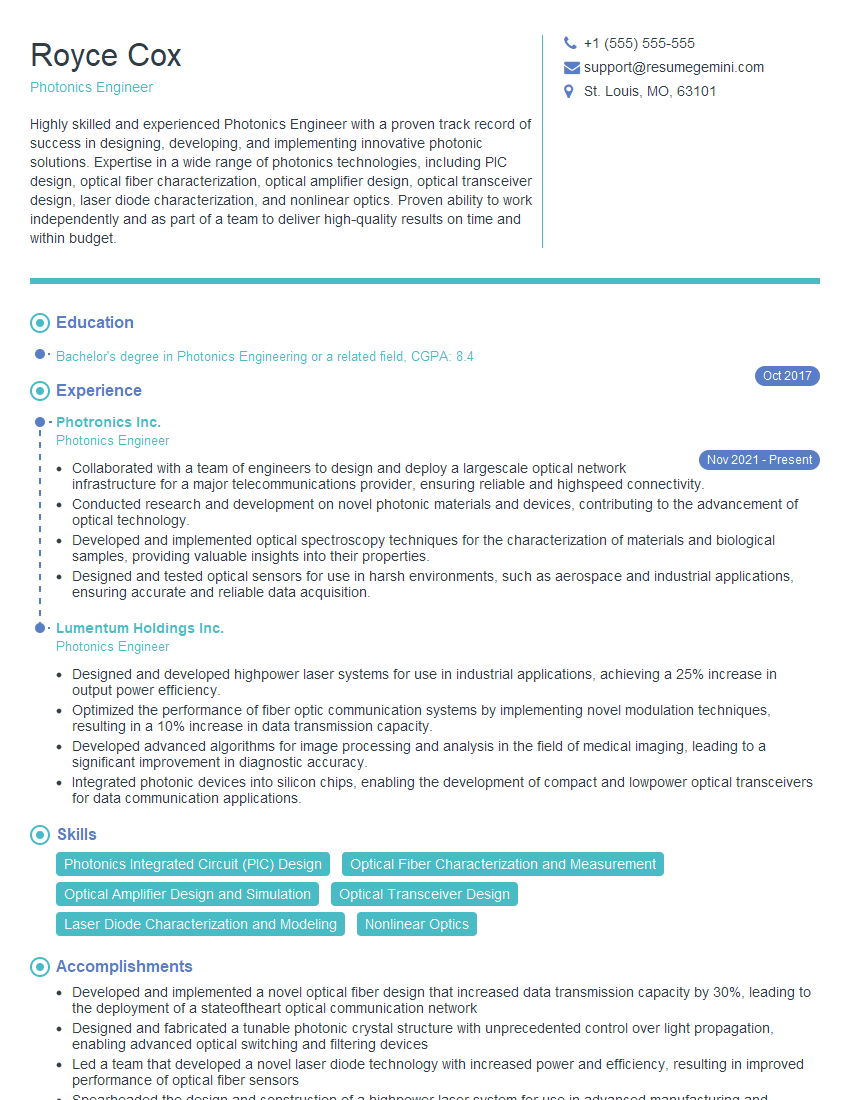
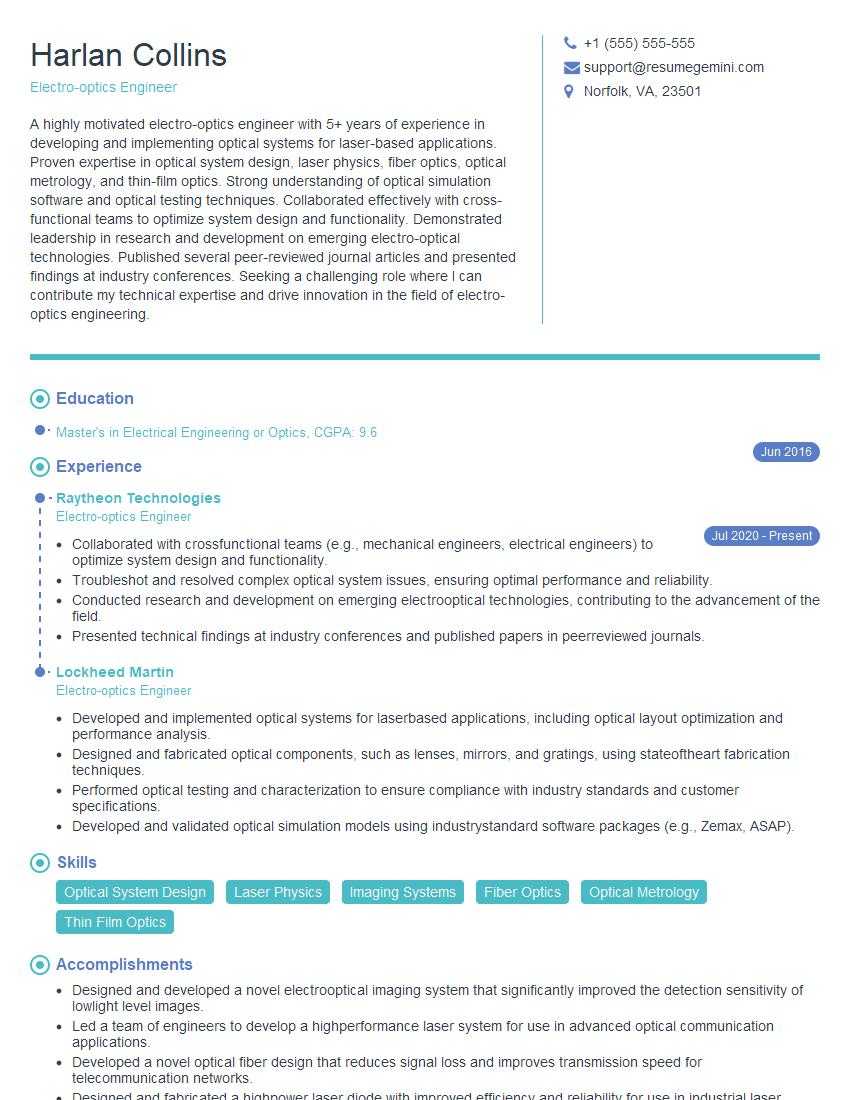
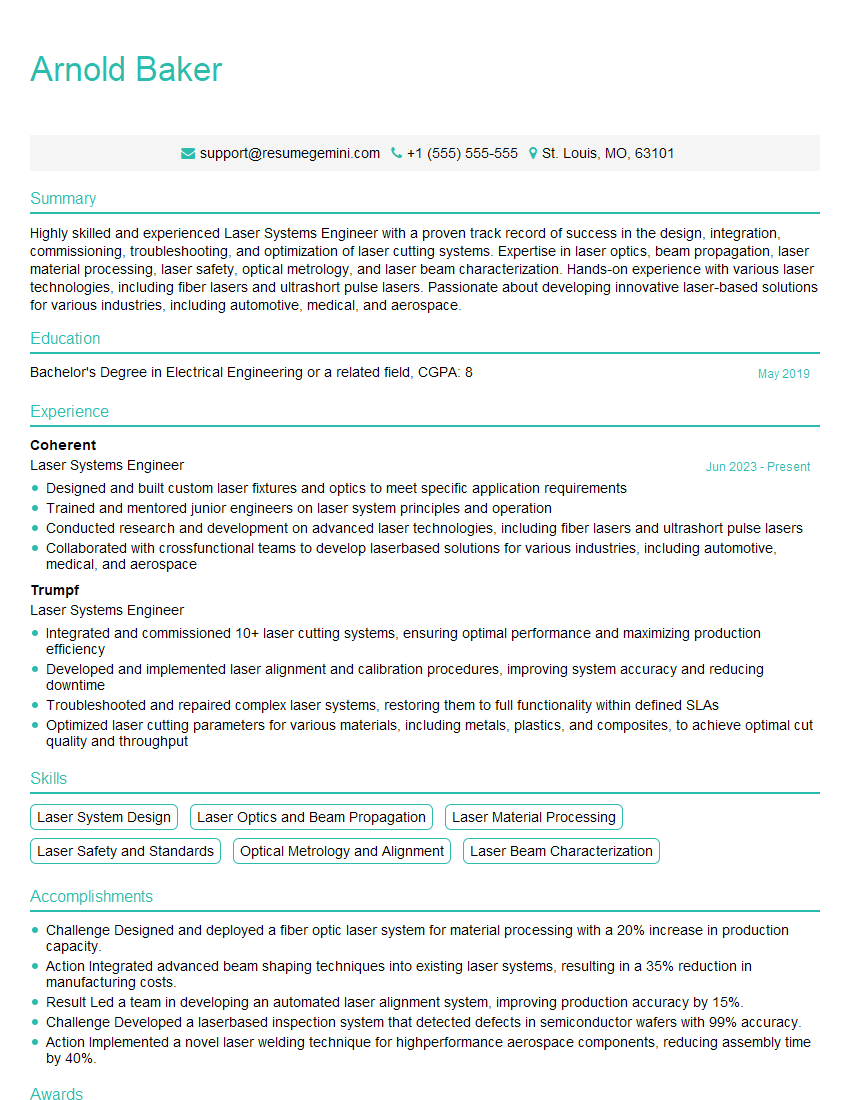
Mastering Non-Linear Optics opens doors to exciting career opportunities in cutting-edge research and development. To maximize your job prospects, a well-crafted resume is crucial. An ATS-friendly resume ensures your application gets noticed by recruiters and hiring managers. We highly recommend using ResumeGemini to build a professional and impactful resume that highlights your skills and experience effectively. ResumeGemini provides examples of resumes tailored to Non-Linear Optics to help you create a compelling document that showcases your expertise. Invest time in crafting a strong resume – it’s your first impression and a key step toward your successful career in this dynamic field.


Explore more articles
Users Rating of Our Blogs
Share Your Experience
We value your feedback! Please rate our content and share your thoughts (optional).
What Readers Say About Our Blog
Very informative content, great job.
good