Are you ready to stand out in your next interview? Understanding and preparing for Operating high-speed printing machines interview questions is a game-changer. In this blog, we’ve compiled key questions and expert advice to help you showcase your skills with confidence and precision. Let’s get started on your journey to acing the interview.
Questions Asked in Operating high-speed printing machines Interview
Q 1. What types of high-speed printing machines have you operated?
Throughout my career, I’ve had extensive experience operating a variety of high-speed printing machines. This includes large-format sheet-fed presses like Heidelberg Speedmaster and Komori Lithrone, web offset presses such as Goss Community and manroland web systems, and even some digital printing systems like HP Indigo and Xerox iGen. Each machine presents unique challenges and opportunities, requiring a nuanced understanding of their individual mechanics and capabilities.
- Sheet-fed presses excel in high-quality, short-to-medium run jobs, offering precise color control and versatility in paper stock.
- Web offset presses are ideal for high-volume, long-run projects like newspapers and magazines, prioritizing speed and efficiency.
- Digital presses offer on-demand printing with fast turnaround times and personalized output, perfect for short runs and variable data printing.
Q 2. Describe your experience with color calibration and registration on a printing press.
Color calibration and registration are critical for high-quality printing. Think of it like this: color calibration is ensuring all the colors are accurate and consistent, while registration is making sure that all the colors perfectly align on the printed image. My experience involves using sophisticated color management systems like G7 and Pantone libraries. I’ve extensively used densitometers and spectrophotometers to measure ink densities and ensure color consistency across the entire print run. For registration, I meticulously adjust the impression cylinders and feeder mechanisms to ensure perfect alignment between the different color plates (cyan, magenta, yellow, and black – CMYK). For example, I once had to troubleshoot a misregistration issue on a large-format print job. Through careful examination of the print, I identified that one of the feeder rollers was slightly worn, causing a minor shift in the paper feed, which led to registration problems. Replacing the roller completely resolved the issue.
Q 3. Explain the process of setting up a printing job, including paper selection and ink adjustments.
Setting up a printing job is a multi-step process. It begins with careful paper selection, considering factors like grammage (weight), finish (coated, uncoated), and moisture content to ensure smooth feeding and optimal ink absorption. Next, the job specifications, such as color profiles, resolution, and required quantity are loaded into the press’s computer system. Ink adjustments are crucial; I meticulously adjust the ink keys (controls regulating ink flow) to match the required color density according to the job specifications. This often involves fine-tuning each color individually, using color charts and software to ensure accuracy. Before the actual run, I always print test sheets to check registration, color, and overall quality, making further adjustments as needed. Think of it like baking a cake; you need the right ingredients (paper and ink) and precise measurements (ink adjustments) to get the perfect result.
Q 4. How do you identify and troubleshoot common printing problems, such as misregistration or color inconsistencies?
Troubleshooting is a key part of the job. Misregistration is often tackled by checking the feeder, impression cylinders, and grippers for alignment problems. I systematically go through each component, checking for wear and tear or misalignment using tools such as precision gauges and measuring devices. Color inconsistencies are investigated by analyzing the ink density using a densitometer, checking ink fountain solutions, and inspecting the plates for wear. For instance, if I find that one color is consistently lighter than the others, I’ll first check the ink fountain and make necessary adjustments to the ink flow. If that doesn’t solve it, I might examine the printing plate for damage or wear. A systematic approach, along with careful observation and understanding of the machine’s mechanics, is key.
Q 5. What safety procedures do you follow when operating high-speed printing machinery?
Safety is paramount. Before operating any high-speed printing machine, I always perform a thorough machine inspection, ensuring all safety guards are in place, emergency stops are functioning, and all moving parts are adequately lubricated. I wear appropriate personal protective equipment (PPE), including safety glasses, hearing protection, and gloves. I meticulously follow lockout/tagout procedures when performing maintenance or repairs to prevent accidental starts. Moreover, I maintain a clean and organized workspace to minimize tripping hazards and potential accidents. Regular safety training keeps me updated on best practices and evolving safety regulations.
Q 6. What is your experience with different types of printing inks?
My experience encompasses various ink types, including conventional solvent-based inks, UV (ultraviolet) curable inks, and water-based inks. Solvent-based inks are known for their vibrant colors and durability; however, their high VOC (volatile organic compound) content necessitates proper ventilation and handling. UV inks are rapidly curing, offering advantages in terms of speed and reduced drying time, but require specialized UV curing units. Water-based inks are environmentally friendly and have lower VOC content, making them a popular choice for eco-conscious printing, although their color vibrancy and durability may sometimes be less compared to solvent-based inks.
Q 7. How do you maintain and clean high-speed printing machines?
Maintaining and cleaning high-speed printing machines involves regular scheduled procedures and preventative maintenance. Daily cleaning involves removing excess ink and paper dust, ensuring that rollers and blankets are clean to maintain consistent print quality. Weekly maintenance may include more thorough cleaning of components like ink fountains and rollers, as well as checking for wear and tear. Preventative maintenance includes regular lubrication, replacing worn parts proactively, and conducting thorough inspections of all moving parts to ensure optimal performance and longevity of the machine. This preventative care reduces downtime and significantly improves the lifespan and efficiency of the equipment. Think of it as servicing a car; regular maintenance prevents costly repairs later.
Q 8. Describe your experience with pre-press procedures and quality control checks.
Pre-press procedures are crucial for ensuring a smooth and efficient printing process. My experience encompasses everything from file preparation and color management to proofing and final approval. Quality control checks are integrated throughout this stage. I meticulously examine files for resolution, color accuracy, and proper formatting, ensuring they are optimized for the chosen printing method. This often involves using color profiles (like ICC profiles) to guarantee color consistency across different devices. For example, I’ve encountered instances where a client’s design had low-resolution images, leading to blurry printouts. Addressing this involved communication with the client to obtain higher-resolution images, preventing a costly reprint. My proofing process always includes a hard copy proof, allowing for a final visual check before proceeding to printing. This ensures that the client’s expectations are met and costly errors are avoided.
- File preparation: Checking image resolution, color modes (CMYK vs. RGB), fonts, and bleed settings.
- Color management: Using color profiles to maintain consistency between digital and printed outputs.
- Proofing: Creating and reviewing hard copy proofs for color accuracy and overall visual quality.
- Pre-flight checks: Utilizing software to automatically identify potential printing problems, such as missing fonts or images.
Q 9. What is your experience with different types of printing substrates (paper, cardstock, etc.)?
My experience extends to a wide range of printing substrates, including various paper weights and finishes (gloss, matte, uncoated), cardstock (ranging from thin index to thick cover stock), and even specialty materials like canvas or synthetic papers. Understanding the properties of each substrate is vital for optimal print quality. For instance, a lighter weight paper might be suitable for brochures, while a heavier cardstock is essential for business cards requiring durability. Different substrates require different printing settings. A heavier paper will necessitate adjustments to the printing press’s pressure and feed system to avoid jams or poor image transfer. I’ve worked with clients requiring specific paper stocks that enhance their branding – like using textured stock for a luxurious feel. Working with these diverse substrates requires a keen eye for detail to ensure a successful print job, free of issues like show-through or poor ink adhesion.
Q 10. How do you handle paper jams and other operational issues?
Paper jams are a common occurrence in high-speed printing. My approach is systematic and efficient. First, I identify the type of jam (e.g., upstream, downstream, within the feeder). Then, I safely access the jammed area, carefully removing the jammed paper to avoid damaging the machine or the remaining sheets. For example, a common upstream jam might be due to misaligned paper in the feeder tray. I address this by readjusting the paper guides and ensuring the paper stack is even and free of any wrinkles. If the jam is more complex (e.g., paper wrapped around rollers), I refer to the machine’s troubleshooting manual and may contact the manufacturer’s support if needed. Beyond paper jams, I’m proficient in resolving other issues such as ink misalignment, registration problems, or sensor malfunctions – often using diagnostic tools built into the machine to pinpoint the root cause.
- Identify the jam type: Upstream (feeder), downstream (delivery), or internal.
- Safe access and removal: Carefully remove jammed paper without causing further damage.
- Troubleshooting: Consult manuals or manufacturer support for complex issues.
- Preventative measures: Regularly inspect the paper feed system and ensure proper paper handling.
Q 11. What is your experience with post-press finishing techniques (cutting, folding, binding)?
Post-press finishing is an essential element in delivering a high-quality printed product. My experience includes various techniques such as cutting (using guillotine cutters or die-cutting machines), folding (different types including letter folds, z-folds, and parallel folds), and binding (perfect binding, saddle-stitch binding, wire-o binding). Choosing the right finishing technique is crucial; for example, perfect binding is suitable for books or magazines, while saddle-stitch binding is ideal for brochures. I’ve worked on projects where precise die-cutting was needed to create unique shapes, and projects requiring careful folding to avoid creases or misalignment. Accuracy and efficiency are key in this stage, as any errors here can compromise the final product and impact client satisfaction. A recent project required precise die-cutting of custom shapes for invitations, and attention to detail ensured a perfect result.
Q 12. How familiar are you with different printing techniques (offset, digital, screen printing)?
I’m familiar with various printing techniques, including offset, digital, and screen printing. Offset lithography (offset printing) is best for large print runs and high-quality images due to its precision. Digital printing is suited for smaller runs, personalized printing, and faster turnaround times. Screen printing excels in producing bold graphics and printing on unusual substrates. I understand the strengths and limitations of each method. The choice of technique depends largely on factors like the project’s size, budget, and desired quality. I’ve used offset printing for large marketing campaigns, digital printing for personalized stationery, and screen printing for customized t-shirts – each requiring a different level of technical understanding and process adaptation.
Q 13. How do you ensure consistent print quality throughout a long run?
Maintaining consistent print quality throughout a long run demands meticulous attention to detail and preventative measures. Regular monitoring of ink levels, color calibration, and paper feed is crucial. I perform regular color checks using color bars and make adjustments to the press settings as needed throughout the print job. Regular cleaning of the printing press components also prevents issues like ink buildup which can result in inconsistent color or blotchy printouts. I also keep a watchful eye on the substrate for any changes in paper thickness or moisture content that could affect printing consistency. Proactive monitoring and immediate adjustments minimize variations and guarantee the production of consistently high-quality prints.
Q 14. What is your experience with maintaining printing press maintenance logs and records?
Maintaining accurate printing press maintenance logs is essential for ensuring smooth operation and efficient troubleshooting. I meticulously document all maintenance activities, including cleaning schedules, parts replacements, and any repairs or adjustments made to the press. These logs include the date, time, task performed, any issues encountered, and the parts used (including serial numbers if applicable). This detailed record-keeping assists in predicting potential problems, tracking equipment performance, and complying with safety and quality standards. It’s also invaluable for future maintenance planning and identifying trends that might indicate necessary upgrades or preventative maintenance procedures. For instance, consistent ink problems might signal the need for a preventive cleaning of the ink system.
Q 15. How do you prioritize tasks and manage your time effectively in a fast-paced printing environment?
Prioritizing tasks in a high-speed printing environment is crucial for efficiency and meeting deadlines. I utilize a combination of techniques, including job scheduling software, which allows me to input job details like priority, due date, and required materials. This creates a prioritized queue that guides my workflow. In addition to this, I utilize a visual Kanban board (either physical or digital) to track the progress of each job, allowing for immediate identification of bottlenecks or delays. This visual representation helps me quickly assess the workload and re-prioritize as needed, particularly in case of urgent requests or machine malfunctions. For example, a last-minute rush order with a tight deadline would be immediately flagged and moved to the top of the queue, potentially delaying less critical jobs.
Time management in this fast-paced setting is all about optimizing workflow. I aim to minimize downtime by anticipating potential issues, ensuring the necessary materials are readily available, and performing regular preventative maintenance on equipment. Think of it like a well-oiled machine – if each component works smoothly, the entire process runs efficiently. This also includes proactive communication with colleagues and clients to manage expectations and address any potential delays.
Career Expert Tips:
- Ace those interviews! Prepare effectively by reviewing the Top 50 Most Common Interview Questions on ResumeGemini.
- Navigate your job search with confidence! Explore a wide range of Career Tips on ResumeGemini. Learn about common challenges and recommendations to overcome them.
- Craft the perfect resume! Master the Art of Resume Writing with ResumeGemini’s guide. Showcase your unique qualifications and achievements effectively.
- Don’t miss out on holiday savings! Build your dream resume with ResumeGemini’s ATS optimized templates.
Q 16. Describe your experience with troubleshooting malfunctions related to feeder systems, inking units and delivery systems.
Troubleshooting malfunctions is a daily aspect of this job. My experience covers a wide range of issues across feeder systems, inking units, and delivery systems. For instance, a common feeder system problem involves paper jams or misfeeds. I systematically investigate these by checking for obstructions, ensuring proper paper alignment, and adjusting the feeder rollers’ pressure. If the problem persists, I might inspect the sensors for malfunctions or check the paper itself for defects like moisture or excessive static.
Inking unit issues often involve ink viscosity problems, improper ink distribution, or insufficient ink supply. My approach involves checking the ink supply, adjusting the ink fountain keys, and cleaning the rollers and doctor blades. Sometimes, the issue might require adjustments to the ink temperature or even a complete ink change if it’s degraded.
Delivery system problems usually manifest as issues with stacking, sheet misalignment, or wrinkles. I would first check the delivery belts and rollers for wear, ensuring proper tension and alignment. Misalignment often requires fine adjustments to the delivery guides. If the problem persists, I may check the air pressure within the system, or inspect the delivery tray and its associated components for blockages.
In all cases, thorough record-keeping is essential. I document the issue, the troubleshooting steps taken, and the resolution, which aids in future diagnostics and prevents recurring problems. Having a structured approach, coupled with experience in identifying common patterns in malfunctions, allows for faster and more efficient troubleshooting.
Q 17. What is your familiarity with various types of printing plates?
My familiarity with various printing plates is extensive. I’ve worked with a wide range, including photopolymer plates (both flexographic and offset), metal plates (offset lithographic), and digital plates (for direct-to-plate printing). Each type has its advantages and disadvantages, making them suitable for different printing applications and press types.
Photopolymer plates offer flexibility and cost-effectiveness, especially for shorter runs and less demanding applications. They’re common in flexographic printing. Metal plates, on the other hand, are more durable and suitable for long runs and high-quality work in offset lithography. Digital plates offer speed and convenience, eliminating the need for traditional plate-making processes, making them ideal for short-run jobs and quick turnarounds. Understanding the properties of each type – their durability, sensitivity to light, and image resolution – is crucial for selecting the appropriate plate for a given job and optimizing print quality.
Furthermore, I’m proficient in handling and processing plates, including plate mounting, cleaning, and storing them properly to maintain their quality and longevity. I’m also adept at recognizing signs of plate wear and tear, and making appropriate decisions regarding plate replacement to avoid print quality degradation.
Q 18. How do you manage ink viscosity and maintain proper ink levels?
Maintaining proper ink viscosity and levels is vital for consistent print quality. Ink viscosity is controlled using viscosity gauges and ink conditioners. Too thick, and the ink won’t transfer properly, leading to uneven coverage and poor print quality. Too thin, and it can cause blurring and excessive ink bleeding. The viscosity must be adjusted based on temperature, humidity, and ink type. I regularly monitor viscosity using a gauge, and make adjustments with conditioners according to the manufacturer’s guidelines.
Maintaining proper ink levels is equally important. Running low on ink can lead to inconsistencies, while excessive ink can cause clogging and waste. I use the machine’s ink level indicators to monitor the supply and refill the ink tanks as needed. In some cases, ink agitation might be required to ensure even distribution within the tank, avoiding settling and color inconsistencies. Regular cleaning of the inking system is also crucial to prevent build-up and maintain consistent ink flow.
Q 19. Explain your experience with different types of drying systems in high-speed printing.
High-speed printing demands efficient drying systems. I’m familiar with several, including infrared (IR) dryers, ultraviolet (UV) dryers, and air dryers, each suited to specific inks and substrates.
IR dryers use heat to evaporate solvents from the ink, which is effective for solvent-based inks. However, excessive heat can damage the substrate. UV dryers use ultraviolet light to cure UV-curable inks, resulting in instant drying, which is advantageous for high-speed presses and applications that require immediate further processing. Air dryers rely on forced air to accelerate solvent evaporation, providing a gentle approach that’s less likely to damage the substrate, but usually slower than IR or UV.
My experience includes adjusting dryer parameters (temperature, airflow, intensity) to optimize drying speed and ensure complete ink curing, preventing smudging or offsetting. The choice of drying system and its parameters depend heavily on the ink type, substrate, and desired production speed. It’s a balancing act between speed and quality, with the objective being complete and consistent drying without compromising the substrate or the print quality.
Q 20. How do you monitor and adjust printing pressure to maintain quality?
Maintaining consistent print pressure is essential for high-quality output. I adjust pressure using the press’s control panel, carefully making incremental adjustments based on the type of substrate, ink, and desired image quality. Too little pressure leads to light, faint prints, while too much pressure results in uneven ink distribution, causing smudging or excessive ink transfer.
Monitoring printing pressure involves regular checks of print samples using densitometers and spectrophotometers to assess ink density and color consistency. I also visually inspect the printed sheets for signs of poor ink transfer, such as light areas or uneven coverage. If inconsistencies are noted, I make adjustments to the pressure settings and monitor the results until a consistent and high-quality print is achieved. The process involves a lot of trial and error, fine-tuning, and consistent monitoring to achieve optimal print quality across the entire run.
Q 21. How proficient are you in using printing software (e.g., RIP software)?
I’m proficient in using various RIP (Raster Image Processor) software packages. My experience includes software like Esko, EFI Fiery, and Kodak Prinergy. These programs are crucial for processing digital files into a format that the printing press can understand. I use them to adjust color profiles, manage halftones, optimize image resolution, and control the overall quality of the output. For example, I can adjust color separations to ensure accurate color reproduction or use color management tools to calibrate the output to specific standards.
Moreover, I’m adept at troubleshooting issues within the RIP software, such as resolving color discrepancies, fixing file processing errors, and optimizing settings for different substrates and ink types. My skills extend to pre-flighting jobs to ensure compatibility with the printing press and identifying potential problems before they lead to production delays or print quality issues. Familiarity with the capabilities of different RIP software enables me to make informed decisions about optimizing the workflow for various print projects.
Q 22. What is your experience with preventative maintenance of printing equipment?
Preventative maintenance is crucial for keeping high-speed printing machines running smoothly and efficiently. It’s like regularly servicing a car – you catch small issues before they become major breakdowns. My experience encompasses a wide range of tasks, including:
- Regular inspections: Daily checks of ink levels, paper feeds, rollers, and sensor functionality. I meticulously document everything, ensuring no detail is overlooked.
- Cleaning procedures: Thorough cleaning of ink nozzles, rollers, and paper paths to prevent jams and maintain print quality. This involves using appropriate cleaning solutions and following manufacturer guidelines precisely.
- Lubrication: Applying lubricants to moving parts according to the manufacturer’s schedule to minimize friction and wear. This extends the life of the machine significantly.
- Part replacements: Proactive replacement of worn-out parts, like rollers or belts, based on usage and manufacturer recommendations. This prevents unexpected downtime.
- Software updates: Installing the latest firmware updates to optimize performance and address known bugs. This often involves coordinating with IT to ensure seamless integration.
For example, during my time at PrintFast, I implemented a new preventative maintenance schedule that reduced downtime by 15% in the first quarter. This involved training junior operators on best practices and establishing a clear system for tracking maintenance tasks.
Q 23. Describe a time you had to troubleshoot a complex printing problem. What was your approach?
One time, we experienced a recurring banding issue on a high-volume Xerox iGen machine. The banding, a consistent light and dark pattern across the print, was intermittent and difficult to pinpoint. My approach was systematic:
- Data collection: I gathered print samples showing the banding at different times and under various conditions. I also checked the machine’s error logs for any clues.
- Isolation: I began by systematically eliminating potential causes. I checked the ink supply, ensuring consistent pressure and flow. I then examined the drum, cleaning and inspecting for damage.
- Testing: After cleaning the drum, the problem persisted. I then ran several test prints using different paper stocks and print settings to identify whether the problem was paper-related or machine-related.
- Diagnosis: After numerous tests, I discovered a faulty sensor within the imaging unit was misinterpreting the paper feed, leading to inconsistent ink application.
- Solution: I replaced the faulty sensor, and the banding issue was resolved. This experience highlighted the importance of thorough data collection and systematic troubleshooting.
Q 24. How do you interpret and act upon print quality control reports?
Print quality control reports are essential for monitoring the performance of the printing equipment and ensuring consistent output. I interpret these reports by looking at several key metrics, including:
- Color accuracy: Reports usually show color deviations from the target values. This helps me identify if adjustments to the color profiles are needed.
- Density: Density variations can indicate problems with ink flow or inconsistencies in the print process.
- Sharpness and resolution: Blurred or pixelated prints can point to issues with the imaging unit or the print drivers.
- Registration: Misregistration (colors not aligning correctly) may indicate mechanical issues within the press.
- Dot gain: This refers to the spreading of ink dots, affecting sharpness. Excess dot gain could mean adjustments to ink viscosity or print pressure are required.
I act upon these reports by making necessary adjustments to the machine settings, replacing worn parts, or addressing underlying mechanical problems. If the issue is persistent, I escalate it to the maintenance team for further investigation.
Q 25. How do you stay updated on the latest advancements in high-speed printing technology?
Staying current in high-speed printing is vital for success in this field. I utilize several strategies:
- Industry publications: I subscribe to trade journals like Printing Impressions and WhatTheyThink to stay abreast of new technologies and industry trends.
- Manufacturer websites and training: I regularly visit the websites of major printing equipment manufacturers (like HP Indigo, Xerox, and Kodak) to learn about new product releases and access training materials.
- Conferences and workshops: Attending industry events like drupa and Graph Expo allows me to network with peers and see the latest advancements in action.
- Online courses and webinars: Online platforms offer numerous courses on advanced printing techniques and troubleshooting strategies, enhancing my skillset continually.
For instance, I recently completed a webinar on the latest advancements in inkjet technology, which significantly enhanced my understanding of variable data printing.
Q 26. What are your strengths and weaknesses as a high-speed printing machine operator?
My strengths lie in my meticulous attention to detail, my ability to troubleshoot complex problems systematically, and my commitment to continuous learning. I am adept at working under pressure, handling high-volume print jobs with efficiency and accuracy. I am also a team player and enjoy collaborating with others to achieve common goals.
My weakness is that I sometimes get bogged down in the details, and I am working on delegating more effectively when appropriate. However, I believe this attention to detail ensures the highest level of quality in my work.
Q 27. What are your salary expectations?
Based on my experience and skills, and considering the salary range for similar positions in this region, my salary expectations are between $X and $Y per year.
Q 28. Do you have any questions for me?
Yes, I have a few questions. Firstly, what are the specific types of high-speed printing machines used in this role? Secondly, what are the company’s procedures for handling emergency equipment malfunctions? Finally, what are the opportunities for professional development and advancement within the company?
Key Topics to Learn for Operating High-Speed Printing Machines Interview
- Machine Operation & Maintenance: Understanding the intricacies of high-speed printing machinery, including setup, operation, and routine maintenance procedures. This includes preventative maintenance schedules and troubleshooting common malfunctions.
- Quality Control & Troubleshooting: Practical application of quality control measures during the printing process. Identifying and resolving printing defects, such as misalignment, color inconsistencies, and paper jams. This includes understanding the root causes of these issues.
- Safety Procedures & Regulations: Knowledge of and adherence to all relevant safety protocols and industry regulations related to operating high-speed printing equipment. This includes personal protective equipment (PPE) usage and emergency procedures.
- Production Efficiency & Optimization: Strategies for maximizing production output while maintaining high quality standards. This includes understanding workflow optimization, material handling, and minimizing downtime.
- Understanding Print Processes: A theoretical understanding of different printing methods (e.g., offset, digital) and their applications. Knowing the strengths and limitations of each method and how they relate to the specific machines you operate.
- Pre-press and Post-press Operations: Familiarity with the processes that occur before and after the printing phase, such as file preparation and finishing techniques (binding, cutting, etc.). Understanding how these processes impact the overall efficiency and quality of the final product.
- Digital Print Technology & Workflow: If applicable to the role, understanding the digital printing workflow, including preflighting, RIP software, and color management.
Next Steps
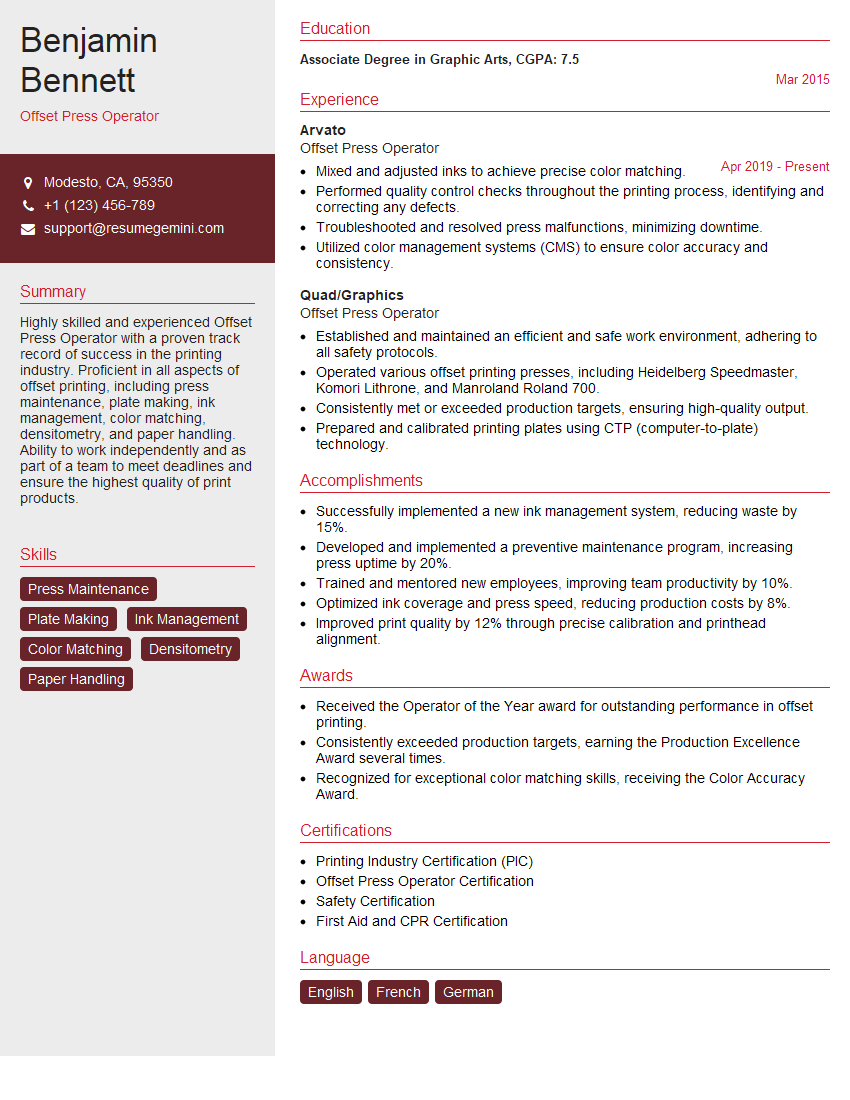
Mastering the operation of high-speed printing machines opens doors to rewarding careers with excellent growth potential. Your expertise in this field is highly valuable, leading to specialized roles and increased earning capacity. To secure your dream job, it’s crucial to present your skills effectively. Creating an ATS-friendly resume is paramount for getting your application noticed by recruiters and hiring managers. ResumeGemini can help you build a compelling and effective resume that highlights your qualifications. ResumeGemini provides examples of resumes tailored to Operating High-Speed Printing Machines to help guide you. Invest in your future; build a strong resume and showcase your skills!




Explore more articles
Users Rating of Our Blogs
Share Your Experience
We value your feedback! Please rate our content and share your thoughts (optional).
What Readers Say About Our Blog
Very informative content, great job.
good