Unlock your full potential by mastering the most common Optical Characterization interview questions. This blog offers a deep dive into the critical topics, ensuring you’re not only prepared to answer but to excel. With these insights, you’ll approach your interview with clarity and confidence.
Questions Asked in Optical Characterization Interview
Q 1. Explain the principle of ellipsometry and its applications in optical characterization.
Ellipsometry is a powerful non-destructive optical technique used to characterize the optical properties of thin films and surfaces. It measures the change in polarization of light reflected from a sample. The principle relies on the fact that the polarization state of light changes upon reflection, depending on the refractive index and thickness of the material. By analyzing this change, we can extract information about the sample’s optical constants (refractive index and extinction coefficient) and thickness.
Imagine shining polarized light onto a surface; the reflected light will have a different polarization state than the incident light. Ellipsometry precisely measures this change in polarization. This change is mathematically related to the optical properties of the material. Sophisticated algorithms then use this information to calculate the sample’s properties.
Applications: Ellipsometry finds widespread use in semiconductor manufacturing for monitoring thin film growth (e.g., silicon dioxide, silicon nitride), characterizing optical coatings (e.g., anti-reflective coatings), studying self-assembled monolayers, and analyzing biomolecular interactions on surfaces.
Q 2. Describe different types of spectroscopy techniques used for optical characterization.
Several spectroscopy techniques are crucial for optical characterization. They all involve measuring how a material interacts with light of different wavelengths or frequencies. The choice of technique depends on the specific information needed about the sample.
- UV-Vis Spectroscopy: Measures the absorption and transmission of light in the ultraviolet and visible regions. It’s widely used to determine band gaps of semiconductors and the concentration of chromophores in solutions.
- FTIR (Fourier-Transform Infrared) Spectroscopy: Measures the absorption of infrared light, providing information about the vibrational modes of molecules. It’s invaluable for identifying functional groups and analyzing the chemical composition of materials.
- Raman Spectroscopy: Measures the inelastic scattering of light, providing information about vibrational, rotational, and other low-frequency modes of molecules. It’s complementary to FTIR and is often used for studying crystalline structures and identifying molecules.
- Photoluminescence Spectroscopy: Measures the light emitted by a material after excitation with a light source. It reveals information about the electronic energy levels and radiative recombination processes within the material, crucial for understanding optoelectronic devices.
Each technique provides a unique perspective on a material’s optical properties, and often, combining multiple techniques provides the most comprehensive characterization.
Q 3. How would you determine the refractive index of a thin film using optical techniques?
Determining the refractive index of a thin film often involves ellipsometry, as described earlier. Another common technique is spectrophotometry using a technique like the Cauchy model or more advanced methods.
Using Spectrophotometry: The process usually involves measuring the transmittance and reflectance of the thin film at multiple wavelengths. Then, using a model (e.g., a transfer matrix model), which considers the light’s interactions with the film and substrate, one can solve for the refractive index. The specific equations are complex and depend on the model used. Commercial software packages readily facilitate this calculation.
Using Ellipsometry: As mentioned previously, ellipsometry directly measures the change in polarization of light reflected from the thin film. This change is directly related to the refractive index and thickness. Specialized ellipsometry software provides this calculation based on the measured data.
The choice between these methods depends on factors like the required accuracy, the availability of equipment, and the complexity of the sample.
Q 4. What are the key differences between UV-Vis, FTIR, and Raman spectroscopy?
UV-Vis, FTIR, and Raman spectroscopy are all optical techniques but probe different aspects of a material’s properties:
- UV-Vis Spectroscopy: Focuses on electronic transitions (movement of electrons between energy levels) typically in the ultraviolet and visible range. This is used to determine band gaps (in semiconductors), identify chromophores (color-producing molecules), and quantify the concentration of substances in solution.
- FTIR Spectroscopy: Explores vibrational transitions (molecular bond stretching and bending) in the infrared region. This helps identify functional groups in molecules (e.g., C=O, O-H, C-H bonds) and determine the chemical composition of materials.
- Raman Spectroscopy: Also probes vibrational transitions, but through a different mechanism (inelastic scattering). It is sensitive to different vibrational modes compared to FTIR and is often used to complement FTIR data, providing a more complete picture. It’s particularly useful for studying crystalline structures.
In summary, while all three techniques use light-matter interaction, they differ significantly in the type of transitions they probe (electronic vs. vibrational) and the information they provide about the material.
Q 5. Explain the concept of optical absorption and its relationship to band gap energy.
Optical absorption refers to the process where a material absorbs light, reducing the intensity of light transmitted through it. This absorption is intimately related to the material’s electronic structure, particularly its band gap energy.
In a semiconductor or insulator, the band gap (Eg) represents the energy difference between the valence band (where electrons are bound) and the conduction band (where electrons are free to move). When a photon of light with energy (hν) equal to or greater than the band gap energy (hν ≥ Eg) strikes the material, it can excite an electron from the valence band to the conduction band. This excitation process is what causes light absorption.
The absorption coefficient (α) quantifies how strongly a material absorbs light at a specific wavelength. For direct band gap semiconductors, the absorption coefficient near the band edge is typically related to the photon energy by the following equation: α ∝ (hν – Eg)1/2 . By plotting (αhν)2 versus hν and extrapolating the linear portion to zero, we can determine the band gap energy.
Materials with smaller band gaps absorb light at lower energies (longer wavelengths), while those with larger band gaps absorb light at higher energies (shorter wavelengths). This principle is fundamental to the design and function of various optoelectronic devices like solar cells and photodetectors.
Q 6. How do you calibrate and maintain optical characterization instruments?
Calibration and maintenance are critical for ensuring the accuracy and reliability of optical characterization instruments. The specific procedures vary depending on the instrument, but some general principles apply.
- Regular Cleaning: Optical components (lenses, mirrors, detectors) should be cleaned regularly to remove dust and fingerprints, which can significantly affect the measurements.
- Wavelength Calibration: Spectrometers need regular wavelength calibration using a known standard (e.g., a mercury lamp) to ensure accurate wavelength measurements.
- Baseline Correction: Before each measurement, a baseline correction is typically performed to account for background signals or instrument noise.
- Standard Samples: Measurements with standard samples (materials with well-known optical properties) are performed periodically to check the instrument’s performance and identify any potential drifts.
- Environmental Control: Temperature and humidity control are often important, particularly for sensitive instruments, to prevent variations in the optical properties of the components and the samples.
- Preventative Maintenance: Following the manufacturer’s instructions for preventative maintenance, such as replacing lamps or detectors at recommended intervals, is crucial for longevity and reliable performance.
Detailed calibration and maintenance procedures are usually outlined in the instrument’s manual. Regular check-ups by qualified technicians are highly recommended for complex instruments.
Q 7. Describe your experience with data analysis techniques used in optical characterization.
My experience with data analysis in optical characterization encompasses a wide range of techniques. I am proficient in using various software packages such as OriginPro, MATLAB, and specialized software that accompanies specific instruments (e.g., ellipsometry software).
Common Analysis Techniques:
- Curve Fitting: Fitting experimental data to theoretical models (e.g., Tauc plots for band gap determination, Cauchy model for refractive index calculation) to extract relevant parameters.
- Data Smoothing and Noise Reduction: Employing techniques like Savitzky-Golay filtering or moving averages to improve the signal-to-noise ratio and enhance data clarity.
- Peak Fitting and Deconvolution: Analyzing complex spectra containing overlapping peaks to separate individual contributions and identify different components.
- Statistical Analysis: Performing statistical analysis to assess data quality, identify outliers, and determine the uncertainty in the extracted parameters.
- Image Analysis: For techniques like microscopy, image processing and analysis techniques are used to quantify structural properties.
I’m also experienced in writing custom scripts (e.g., in MATLAB or Python) to automate data processing and analysis tasks, improving efficiency and reproducibility.
For example, in a recent project involving the characterization of thin film solar cells, I used ellipsometry data to determine the thickness and refractive index of each layer and then combined this information with UV-Vis absorption data to model the device’s optical performance.
Q 8. What are the limitations of ellipsometry and how can they be overcome?
Ellipsometry is a powerful technique for measuring the optical properties of thin films and surfaces, but it does have limitations. One major limitation is its sensitivity to surface roughness. A rough surface scatters light, leading to inaccurate measurements. Another limitation is the assumption of a homogenous layer. If the film is not uniform in thickness or composition, the ellipsometric results will be an average, potentially masking important variations. Finally, analyzing complex multilayer structures can become computationally intensive and may require sophisticated modeling techniques.
These limitations can be overcome through several strategies. For surface roughness, careful sample preparation is crucial. Techniques like chemical-mechanical polishing (CMP) can create highly smooth surfaces. For inhomogeneous films, advanced modeling techniques incorporating roughness parameters and compositional gradients can improve accuracy. This often involves using more sophisticated models beyond simple Cauchy models, potentially requiring advanced software packages to accurately fit the data. For multilayer structures, careful sample design and multiple-angle ellipsometry measurements can greatly improve the accuracy of the extracted parameters. For example, instead of just measuring at a single angle of incidence, measuring at multiple angles allows for a better discrimination between layer properties.
Q 9. How do you interpret ellipsometric data to extract material properties?
Ellipsometry measures the change in polarization of light reflected from a sample. The raw data is typically presented as psi (Ψ) and delta (Δ), which represent the amplitude ratio and phase difference between the parallel and perpendicular polarization components of the reflected light, respectively. To extract material properties, we use optical models to fit these Ψ and Δ values. These models describe the interaction of light with the material layers present. A simple example is a single layer on a substrate, where the model incorporates the layer’s thickness and refractive index, and the substrate’s refractive index. More complex structures require more complex models.
The fitting process involves adjusting the model parameters (e.g., thickness, refractive index, extinction coefficient) until the calculated Ψ and Δ values match the measured data. This often involves using specialized software with optimization algorithms. Once a good fit is achieved, the extracted parameters directly represent the material properties of interest. For instance, the refractive index at a specific wavelength tells us about the material’s interaction with light at that wavelength, potentially revealing valuable information about its electronic structure.
Q 10. Explain the concept of scattering and its impact on optical measurements.
Scattering refers to the redirection of light from its original path due to interactions with particles or inhomogeneities within a material. These inhomogeneities can range from microscopic defects to larger scale variations in the material’s structure. The impact on optical measurements depends on the nature and size of the scatterers, as well as the wavelength of the light. Rayleigh scattering, for example, is dominant when the scatterers are much smaller than the wavelength, leading to a strong dependence on wavelength (λ-4).
Scattering significantly affects measurements by reducing the signal strength in the desired direction and introducing noise. In ellipsometry, scattering can lead to inaccurate Ψ and Δ values, resulting in errors in the extracted material properties. In microscopy, scattering can blur images and reduce resolution. To mitigate scattering effects, careful sample preparation, such as polishing or embedding, can be employed to reduce surface roughness or internal defects. Additionally, techniques like confocal microscopy can improve image quality by rejecting out-of-focus light.
Q 11. Describe your experience with different types of optical microscopy.
My experience encompasses several types of optical microscopy, including bright-field, dark-field, phase-contrast, fluorescence, and confocal microscopy. Bright-field microscopy is the most common, but it struggles with transparent samples. Dark-field microscopy excels at visualizing scattering objects by blocking direct light and only imaging scattered light. Phase-contrast microscopy is ideal for visualizing transparent samples by converting phase differences into intensity variations. Fluorescence microscopy enables the visualization of fluorophores, which are particularly useful in biological applications or when you need specific labeling of structures.
Confocal microscopy provides high-resolution, three-dimensional images by eliminating out-of-focus light. I’ve used these techniques extensively in analyzing various samples, from thin films and nanostructures to biological cells. For example, I used confocal microscopy to image the cross-section of a multilayered film to confirm its structure and to quantify variations in thickness. Choosing the right technique depends on the nature of the sample and the information sought. For example, if I need to analyze the morphology of a surface with high resolution, confocal microscopy is ideal, but if I just need a quick overview of the sample, a simple bright-field microscope may suffice.
Q 12. How would you troubleshoot a problem with an optical characterization instrument?
Troubleshooting an optical characterization instrument involves a systematic approach. First, I’d start with the basics: checking the instrument’s power supply, ensuring proper alignment of the optical components, and verifying the calibration. I’d then move onto a more detailed examination of the source, detectors and data acquisition system. Often, simple issues like misalignment or a malfunctioning detector can cause significant problems.
For example, if the signal is weak or noisy, I might check the source intensity, the detector sensitivity and the optical path for obstructions or misalignment. If the data looks incorrect, I would verify the software settings and check the data acquisition protocol. I often use a standard sample to verify the instrument’s performance. If all the checks fail, I would consult the instrument’s manual and contact the manufacturer’s technical support. A methodical approach, starting with simple checks and progressively moving to more complex ones, is always essential for effective troubleshooting.
Q 13. Explain the principles of optical fiber characterization.
Optical fiber characterization involves measuring various properties critical for communication and sensing applications. Key parameters include attenuation (loss of signal strength over distance), refractive index profile (how the refractive index varies across the fiber’s cross-section), numerical aperture (a measure of the light-gathering ability), and chromatic dispersion (variation in the propagation speed of light with wavelength).
Attenuation is often measured using a light source, optical fiber under test and a power meter. The refractive index profile is typically measured using techniques like near-field scanning optical microscopy (NSOM) or interferometry. Numerical aperture is determined by measuring the acceptance angle, which is the maximum angle at which light can be coupled into the fiber. Chromatic dispersion is measured by observing the temporal broadening of pulses as they propagate through the fiber. These measurements provide essential information for selecting and optimizing fiber designs for different applications. For example, in high-speed communication systems, minimizing chromatic dispersion is crucial.
Q 14. What are the key challenges in characterizing optical materials with complex structures?
Characterizing optical materials with complex structures, such as photonic crystals or metamaterials, presents significant challenges. The complexity arises from their periodic or disordered nanostructures, leading to intricate light-matter interactions not easily described by simple models. The presence of multiple scattering and diffraction effects makes accurate modeling and measurement difficult. Furthermore, fabricating such structures with high precision is a challenge in itself, introducing uncertainties in the characterization process.
Overcoming these challenges often requires advanced characterization techniques such as finite-difference time-domain (FDTD) simulations, which numerically solve Maxwell’s equations to model light propagation in complex structures. Experimental techniques like angle-resolved scattering measurements, electron microscopy, and spectroscopic ellipsometry are often combined to obtain comprehensive information about the material’s structure and optical properties. The analysis and interpretation of data from these experiments require advanced computational tools and a deep understanding of electromagnetic theory. In many cases, a collaborative approach between experimentalists and theorists is crucial to ensure accurate and reliable characterization of such complex materials.
Q 15. How do you ensure the accuracy and reproducibility of optical measurements?
Ensuring accurate and reproducible optical measurements is paramount. It involves a multi-pronged approach encompassing meticulous experimental design, rigorous calibration procedures, and robust data analysis techniques. Think of it like baking a cake – you need the right ingredients (equipment, samples), the right recipe (method), and the right oven temperature (controlled environment) to get a consistent, delicious result.
Calibration: Regularly calibrating all instruments (spectrometers, ellipsometers, etc.) against known standards is crucial. This minimizes systematic errors and ensures consistent readings across different measurement sessions. For instance, a spectrophotometer needs to be calibrated using certified wavelength and absorbance standards.
Environmental Control: Maintaining stable environmental conditions (temperature, humidity) is vital, especially for sensitive measurements. Fluctuations can introduce significant errors. Imagine trying to measure the refractive index of a liquid on a hot, sunny day versus a cool, controlled lab setting – the results will differ.
Sample Preparation: Consistent sample preparation is key. This includes factors such as surface cleanliness, sample thickness uniformity, and proper mounting. For example, dust particles on a sample surface can drastically alter light scattering measurements.
Measurement Repetition: Repeating measurements multiple times and performing statistical analysis (discussed in the next question) allows for the identification and mitigation of random errors. Averaging multiple measurements improves data reliability.
Documentation: Meticulous record-keeping is non-negotiable. Detailed documentation of experimental parameters, data acquisition methods, and data processing steps is vital for reproducibility and verification.
Career Expert Tips:
- Ace those interviews! Prepare effectively by reviewing the Top 50 Most Common Interview Questions on ResumeGemini.
- Navigate your job search with confidence! Explore a wide range of Career Tips on ResumeGemini. Learn about common challenges and recommendations to overcome them.
- Craft the perfect resume! Master the Art of Resume Writing with ResumeGemini’s guide. Showcase your unique qualifications and achievements effectively.
- Don’t miss out on holiday savings! Build your dream resume with ResumeGemini’s ATS optimized templates.
Q 16. Describe your experience with statistical analysis of optical data.
Statistical analysis is integral to optical characterization. It allows us to extract meaningful information from noisy data, quantify uncertainties, and make informed conclusions. My experience spans various statistical methods including:
Descriptive Statistics: Calculating mean, standard deviation, median, and other descriptive measures to summarize data and identify potential outliers.
Hypothesis Testing: Applying t-tests, ANOVA, and other hypothesis tests to compare measurements and determine the significance of observed differences. For example, I’ve used t-tests to compare the refractive indices of two different samples to determine if there’s a statistically significant difference.
Regression Analysis: Utilizing linear and non-linear regression to fit models to data, such as fitting a Lorentzian curve to Raman spectroscopy peaks to determine peak position and width.
Error Propagation: Calculating the uncertainty in derived parameters based on the uncertainties in individual measurements. For example, when calculating the thickness of a thin film using ellipsometry, propagating the uncertainties in the ellipsometric parameters (ψ and Δ) is crucial.
I am adept at using statistical software packages like OriginPro, MATLAB, and Python libraries (SciPy, NumPy) to perform these analyses. I have used these techniques extensively in studies relating to thin film characterization, photonic crystal analysis and optical spectroscopy.
Q 17. What software packages are you proficient in for optical characterization data analysis?
My proficiency in software packages for optical characterization data analysis includes:
OriginPro: This is my go-to software for general data analysis, curve fitting, and visualization. Its user-friendly interface and extensive functionalities are ideal for various spectroscopic data analysis needs.
MATLAB: I use MATLAB for more complex data analysis and algorithm development, especially for image processing and advanced statistical modelling. Its extensive toolboxes are extremely beneficial for analyzing large datasets and developing custom algorithms.
Python (with SciPy, NumPy, and Matplotlib): Python is invaluable for scripting, automating data processing, and creating custom analysis pipelines. Libraries like SciPy provide a wide range of mathematical and statistical functions, while NumPy is essential for efficient array manipulation, and Matplotlib excels at data visualization.
Commercial software specific to instrumentation: I’m proficient with the data analysis software provided by specific vendors for instruments like ellipsometers, spectrophotometers, and optical microscopes. This ensures I can fully exploit the capabilities of each instrument.
Q 18. How do you handle outliers or noisy data in optical measurements?
Outliers and noisy data are common in optical measurements. Several strategies are used to address them:
Identifying Outliers: Visual inspection of data plots, along with statistical tests (e.g., Grubb’s test) are used to identify outliers. If an outlier is due to a clear experimental error (e.g., a power surge during the measurement), it can be simply removed. However, if the cause is unclear, it’s advisable to investigate.
Smoothing Techniques: Techniques like moving average smoothing or Savitzky-Golay filtering can be applied to reduce noise, but care must be taken not to over-smooth the data and lose important features.
Robust Statistical Methods: Robust statistical methods, which are less sensitive to outliers, such as median filtering and robust regression, can be utilized to obtain more reliable estimates of parameters.
Data Transformation: Sometimes, data transformation (e.g., logarithmic transformation) can improve the linearity and reduce the impact of outliers.
Careful Experimental Design: The best way to handle outliers and noise is to prevent them in the first place. This involves careful experimental design, including adequate signal-to-noise ratio, control of experimental conditions, and appropriate sample preparation.
Q 19. Explain the concept of optical path length and its importance in optical measurements.
Optical path length (OPL) refers to the distance light travels through a medium, considering the refractive index of that medium. It’s calculated as OPL = n * d, where ‘n’ is the refractive index and ‘d’ is the geometrical distance. Think of it like this: light travels slower in a denser medium (higher refractive index), so it effectively travels a longer distance even if the physical distance is the same.
OPL is crucial in many optical measurements because:
Phase calculations: In interferometry and ellipsometry, the OPL determines the phase shift of light waves, which is essential for determining thickness, refractive index, and other material properties.
Waveguide design: In integrated optics and waveguide design, the OPL dictates the propagation of light through the waveguide, affecting the waveguide’s performance.
Optical component design: Accurate calculation of OPL is critical in the design of lenses, prisms, and other optical components to achieve the desired optical properties.
Spectroscopy: In absorption and transmission spectroscopy, OPL influences the absorbance or transmission of light through the sample.
Ignoring OPL can lead to significant errors in optical measurements. For example, inaccurately calculating the OPL in a thin film measurement can result in incorrect determination of the film thickness.
Q 20. Describe your experience with thin film deposition techniques and their impact on optical properties.
I have extensive experience with thin film deposition techniques and their impact on optical properties. My work involves characterizing films deposited using various methods, including:
Sputtering: I’ve worked with both DC and RF magnetron sputtering to deposit various dielectric and metallic thin films. The sputtering parameters (gas pressure, power, substrate temperature) significantly influence the film’s microstructure, and consequently its optical properties, such as refractive index, extinction coefficient, and optical band gap. I have used this technique to deposit anti-reflective coatings and conductive films.
Chemical Vapor Deposition (CVD): I have experience with CVD techniques, including atomic layer deposition (ALD), to deposit high-quality thin films with precise thickness control. ALD allows for excellent control over the film’s composition and uniformity, leading to consistent optical properties.
Evaporation: Thermal evaporation is another technique I’ve used to deposit thin films, primarily for creating metallic and dielectric layers. The evaporation rate and substrate temperature are crucial factors determining the optical properties of the deposited film.
After deposition, I employ various optical characterization techniques (discussed in the next question) to determine the optical constants (refractive index, extinction coefficient) and thicknesses of the deposited films. Understanding the relationship between deposition parameters and optical properties allows for optimizing the deposition process to achieve the desired optical performance. For instance, by carefully controlling the sputtering parameters, we can tailor the refractive index of an anti-reflective coating to minimize reflections at a specific wavelength.
Q 21. How would you choose the appropriate optical characterization technique for a specific material?
Selecting the appropriate optical characterization technique depends entirely on the material’s properties and the information required. The choice involves considering factors such as:
Material type: Is it a bulk material, a thin film, a liquid, or a powder? Different techniques are suitable for different material forms.
Optical properties of interest: Are you interested in refractive index, extinction coefficient, absorption, transmission, scattering, fluorescence, or other properties?
Material thickness: The thickness of the sample can dictate the choice of technique. For extremely thin films, techniques like ellipsometry are preferred, while for thicker samples, spectrophotometry might be sufficient.
Spatial resolution: Do you need high spatial resolution to map the optical properties across the sample? Techniques like microscopy or near-field optical microscopy might be necessary in such cases.
Sensitivity: The required sensitivity to detect small changes in optical properties is another critical factor.
For example:
Spectrophotometry: Ideal for measuring transmission and reflection spectra of relatively thick samples.
Ellipsometry: Best for measuring the optical properties (refractive index and extinction coefficient) and thickness of thin films.
Raman spectroscopy: Excellent for identifying vibrational modes of molecules, providing structural information about the material.
Optical microscopy: Useful for visualizing the surface morphology and identifying defects.
A thorough understanding of the various techniques and their capabilities is crucial to making an informed decision. In practice, I often employ a combination of techniques to obtain a comprehensive understanding of the material’s optical properties.
Q 22. Explain the concept of polarization and its role in optical characterization.
Polarization refers to the orientation of the electric field vector in an electromagnetic wave, like light. Imagine light as a wave oscillating; polarization describes the direction of this oscillation. Unpolarized light oscillates in all directions, while polarized light oscillates along a specific plane. This seemingly simple property plays a crucial role in optical characterization because it allows us to selectively analyze specific components of light interacting with a material.
In optical characterization, we use polarizers – components that transmit light only with a specific polarization – to understand material properties. For example, analyzing the polarization state of light reflected from a surface can reveal information about the surface’s roughness or the orientation of molecules within it. Techniques like ellipsometry utilize polarized light to determine the thickness and refractive index of thin films with exquisite precision. Another example is studying birefringent materials – materials with different refractive indices for different polarization directions – which are essential in many optical devices.
Consider the example of analyzing stress in a plastic component. When stressed, the plastic becomes slightly birefringent. By passing polarized light through the stressed component and analyzing the resulting polarization changes, we can map the stress distribution within the material, aiding in quality control and design improvements.
Q 23. Describe your experience with designing and conducting optical experiments.
Throughout my career, I’ve designed and conducted numerous optical experiments, ranging from basic spectroscopy to advanced techniques like time-resolved fluorescence and Raman microscopy. I’ve worked extensively with lasers, optical fibers, spectrometers, and various detectors. One significant project involved designing an experiment to characterize the optical properties of novel semiconductor nanomaterials. This required careful alignment of laser sources, selection of appropriate filters and lenses, and meticulous optimization of detection parameters to achieve high signal-to-noise ratios. We used a custom-built setup involving a confocal microscope for high spatial resolution measurements. Another memorable project focused on developing a rapid, non-destructive method for assessing the quality of thin-film coatings using ellipsometry. This involved developing algorithms for data analysis and interpretation and comparing our results with established techniques.
In both projects, a key aspect was careful experimental design. This involved considering factors such as the sensitivity of the detectors, the power of the light sources, and potential sources of noise or error. I also gained valuable experience in data analysis and interpretation, using various software packages to process and visualize the acquired data. Data analysis was key in both projects in order to extract meaningful results.
Q 24. How do you ensure the safety of yourself and others while operating optical instruments?
Safety is paramount in optical characterization. Lasers, in particular, pose significant hazards. My approach to safety is multifaceted. Firstly, I always adhere to established laboratory safety protocols and guidelines. This includes wearing appropriate eye protection (laser safety goggles rated for the specific wavelengths used), ensuring that laser beams are properly enclosed and shielded, and posting clear warnings to prevent accidental exposure. Secondly, I regularly inspect and maintain equipment to ensure it’s in good working order and that safety interlocks are functioning correctly. Thirdly, I am trained in laser safety procedures and emergency response protocols. I always make sure the laboratory has the necessary safety equipment, such as fire extinguishers and emergency eyewash stations.
Beyond lasers, other safety considerations include handling fragile optical components carefully to prevent damage and potential injury from broken glass. I’m familiar with the safety data sheets (SDS) for all chemicals used in experiments and ensure proper ventilation and waste disposal.
Finally, I believe in fostering a strong safety culture within the team. Regular safety training sessions and open communication regarding safety concerns are critical to preventing accidents.
Q 25. What are the latest advancements in optical characterization techniques?
The field of optical characterization is constantly evolving. Recent advancements include:
- Super-resolution microscopy techniques: Techniques like stimulated emission depletion (STED) and photoactivated localization microscopy (PALM) allow for imaging beyond the diffraction limit of light, revealing nanoscale details of materials.
- Nonlinear optical microscopy: Techniques like two-photon microscopy and second harmonic generation microscopy provide high contrast and depth penetration for imaging biological and materials science samples.
- Terahertz spectroscopy: This offers a powerful tool to probe vibrational modes and other low-frequency dynamics in materials, complementing traditional infrared and Raman spectroscopy.
- Advanced data analysis techniques: Machine learning and artificial intelligence are being increasingly applied to analyze complex optical spectra, allowing for more efficient and accurate identification and characterization of materials.
- Integration of optical characterization with other techniques: Combining optical characterization with other techniques, such as scanning electron microscopy (SEM) and X-ray diffraction (XRD), provides a comprehensive understanding of the material.
These advancements are pushing the boundaries of what we can learn about materials at increasingly smaller length scales and higher temporal resolutions.
Q 26. Describe your experience with the analysis of complex optical spectra.
My experience in analyzing complex optical spectra encompasses both experimental data acquisition and theoretical interpretation. I’m proficient in using various software packages like Origin, MATLAB, and specialized spectroscopy software for data processing and fitting. I have analyzed Raman, infrared, UV-Vis, and fluorescence spectra to extract information such as vibrational modes, electronic transitions, band gaps, and lifetimes. For example, in studying a novel organic semiconductor, I was able to deconvolute overlapping peaks in the UV-Vis absorption spectrum to determine the contributions of different electronic transitions and precisely calculate the band gap of the material. Further, I’ve used principal component analysis (PCA) to identify subtle variations in the spectra of a set of samples with slightly different compositions and this assisted in optimizing the synthesis procedure.
When dealing with complex spectra, I typically employ a combination of curve fitting algorithms and theoretical models to identify individual spectral features and extract meaningful parameters. A thorough understanding of the physical processes underlying the spectral features is essential for accurate and reliable analysis.
Q 27. How do you interpret optical properties in the context of material composition and structure?
Optical properties are intrinsically linked to the material’s composition and structure. The absorption and scattering of light depend on the electronic structure, the presence of impurities, and the crystallographic arrangement of atoms. For instance, the color of a material is directly related to its electronic band structure and its absorption characteristics at visible wavelengths. Metals typically appear shiny because they reflect light effectively due to their delocalized electrons. Semiconductors have a band gap separating their valence and conduction bands, and their absorption spectrum changes dramatically near this band gap energy. Insulators, on the other hand, have a large band gap and typically do not absorb visible light.
The microstructure of a material also plays a significant role. For instance, scattering from grain boundaries or defects in a crystal can significantly affect light transmission and scattering. In porous materials, the porosity influences light scattering and can lead to unique optical properties. Advanced characterization techniques allow us to connect the optical response to specific structural and compositional details.
Consider the example of analyzing the purity of a silicon wafer using infrared spectroscopy. The presence of impurities can cause changes in the absorption spectrum, allowing us to quantify the concentration of the impurities and assess the quality of the wafer.
Q 28. Explain your experience with automating optical characterization processes.
I have extensive experience automating optical characterization processes using LabVIEW and Python scripting. Automation is crucial for increasing throughput, improving reproducibility, and reducing human error. In one project, I automated a system for measuring the thickness and refractive index of thin films using ellipsometry. This involved controlling the instrument, acquiring data, and performing the necessary calculations automatically, significantly reducing the time required for each measurement. The automation involved using LabVIEW to control the ellipsometer, acquire data, and perform the necessary calculations to determine thickness and refractive index. This reduced the analysis time from several hours per sample to a few minutes. Another example involved the development of a robotic system for automated Raman spectroscopy, where a robot arm positioned samples under the microscope and collected spectra automatically. This increased the throughput of measurements considerably.
Developing automated systems requires careful consideration of hardware and software integration, including data acquisition, processing, and analysis. It’s also important to implement appropriate error handling and quality control measures to ensure the reliability of the automated system.
Key Topics to Learn for Optical Characterization Interview
- Spectroscopy Techniques: Understand the principles and applications of various spectroscopic methods like UV-Vis, FTIR, Raman, and ellipsometry. Be prepared to discuss their strengths and limitations in characterizing different materials.
- Optical Microscopy: Familiarize yourself with different microscopy techniques such as bright-field, dark-field, fluorescence, and confocal microscopy. Focus on how these techniques provide structural and compositional information about materials.
- Refractive Index and its Measurement: Master the concept of refractive index and its relationship to material properties. Be prepared to discuss different methods for measuring refractive index, including Abbe refractometry and ellipsometry.
- Light-Matter Interaction: Develop a strong understanding of how light interacts with matter, including absorption, reflection, transmission, and scattering. This is fundamental to interpreting optical characterization data.
- Data Analysis and Interpretation: Practice interpreting optical spectra and microscopy images. Be prepared to discuss common data analysis techniques and troubleshoot potential issues in data acquisition and analysis.
- Specific Applications: Depending on the role, focus on specific applications relevant to the job description. This may include semiconductor characterization, thin film analysis, polymer characterization, or biological imaging.
- Problem-Solving: Prepare to discuss how you would approach a problem involving optical characterization. Focus on your ability to identify the appropriate technique, analyze the data, and draw meaningful conclusions.
Next Steps
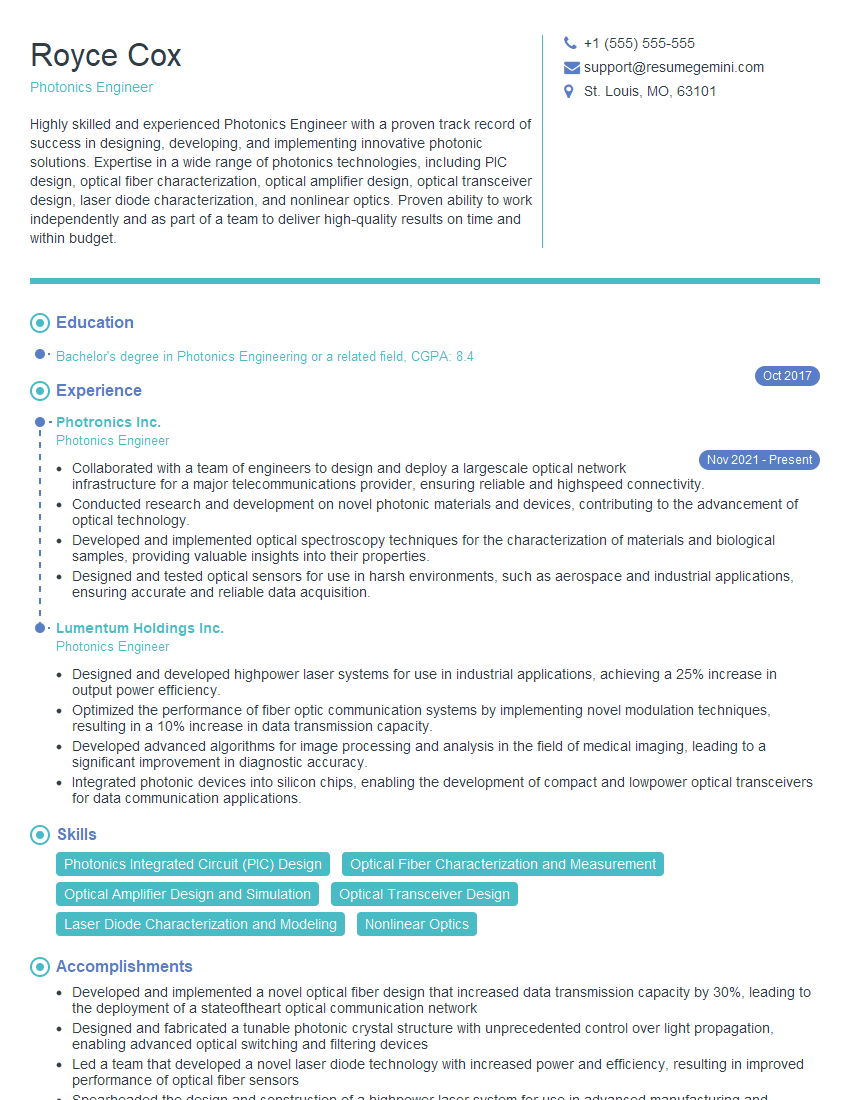
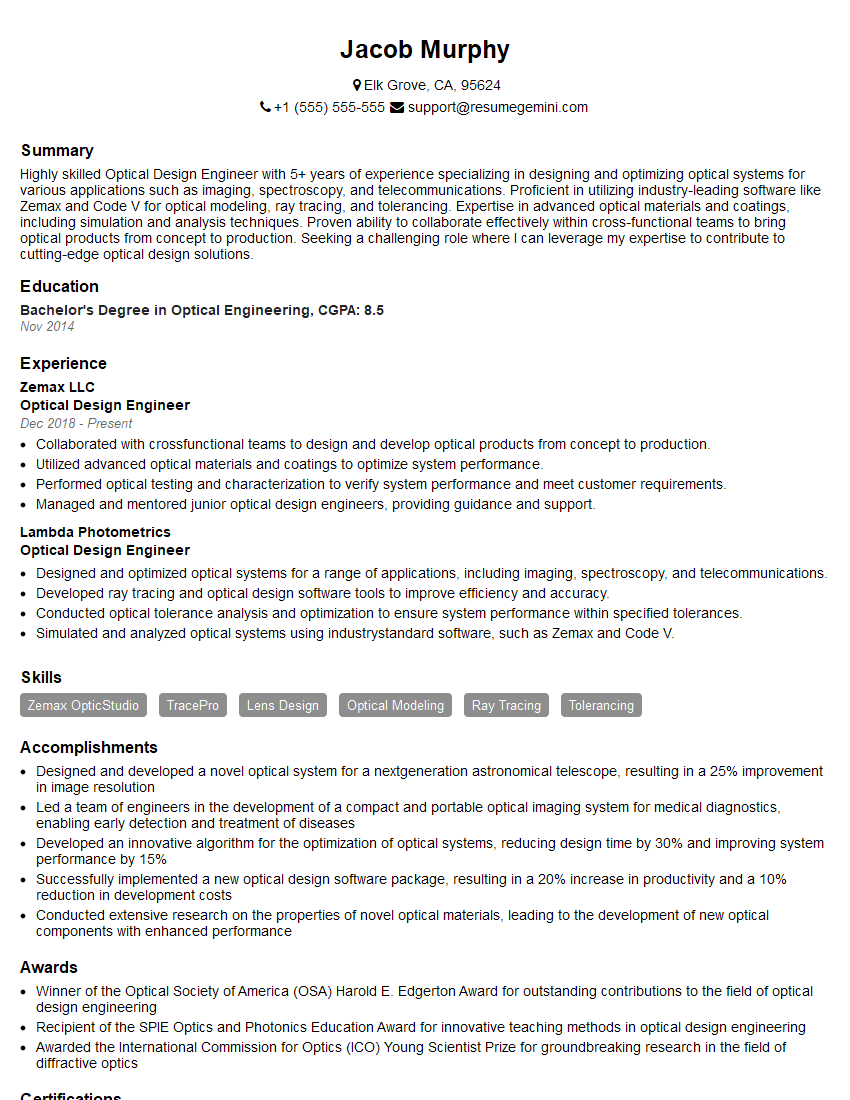
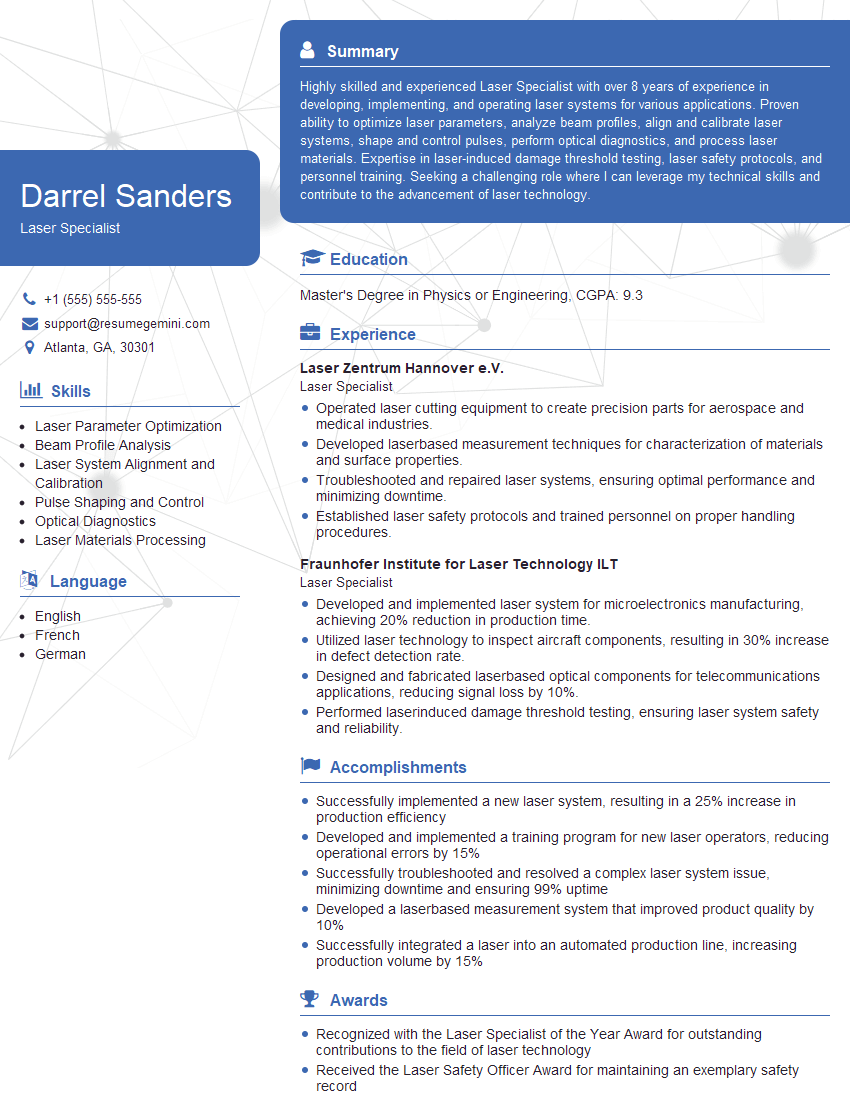
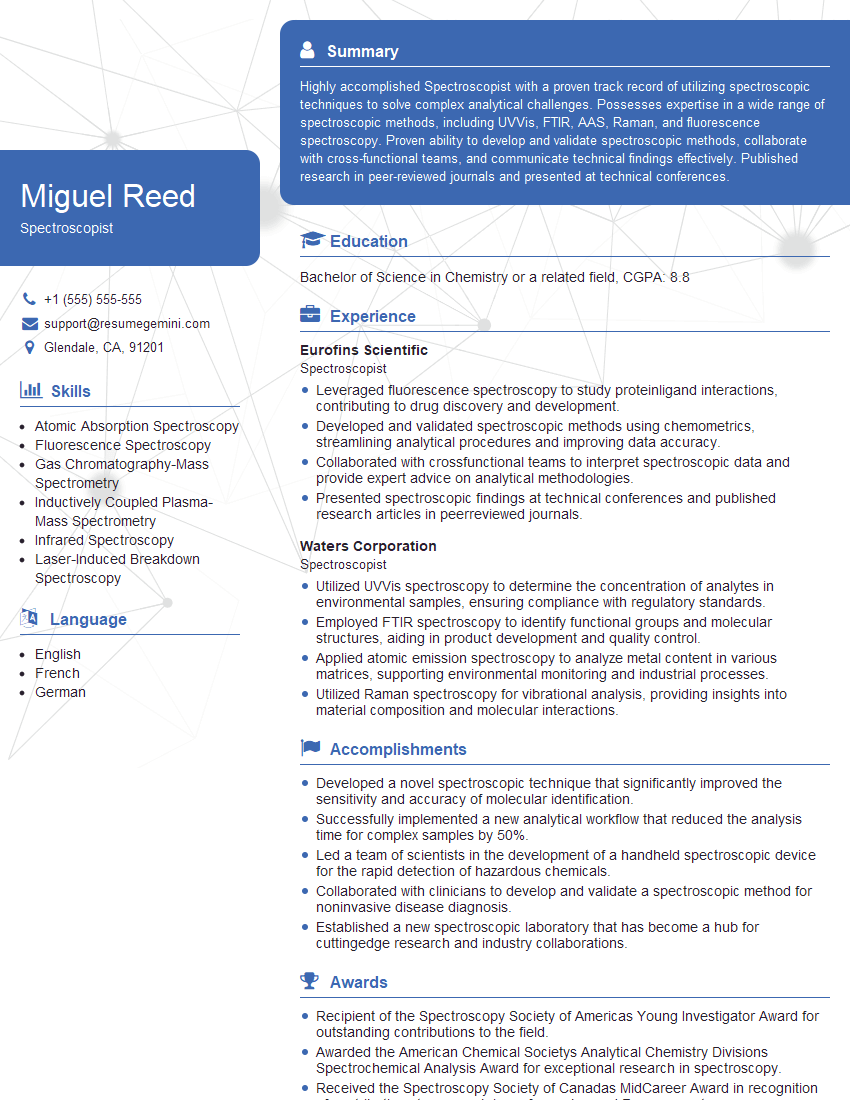
Mastering optical characterization opens doors to exciting career opportunities in diverse fields like materials science, photonics, and nanotechnology. A strong understanding of these techniques is highly valued by employers, significantly boosting your career prospects. To make your application stand out, it’s crucial to present your skills and experience effectively through a well-crafted resume. Creating an ATS-friendly resume is key to ensuring your application gets noticed by recruiters. We strongly recommend using ResumeGemini to build a professional and impactful resume that highlights your expertise in optical characterization. ResumeGemini provides helpful tools and examples of resumes tailored to this specific field, allowing you to showcase your qualifications in the best possible light.
Explore more articles
Users Rating of Our Blogs
Share Your Experience
We value your feedback! Please rate our content and share your thoughts (optional).
What Readers Say About Our Blog
Very informative content, great job.
good