The thought of an interview can be nerve-wracking, but the right preparation can make all the difference. Explore this comprehensive guide to Pantograph Training interview questions and gain the confidence you need to showcase your abilities and secure the role.
Questions Asked in Pantograph Training Interview
Q 1. Explain the principle of operation of a pantograph.
A pantograph operates on the principle of similar triangles. Imagine two triangles sharing a common angle. If you move one point of the larger triangle, the corresponding point on the smaller triangle will move proportionally. In a pantograph machine, this principle is used to enlarge or reduce a pattern. A stylus traces the original design, and a cutting tool, connected through a system of levers and joints, replicates the movement but at a different scale. The ratio of the scaling is determined by the geometry of the linkage system.
Think of it like a simple drawing tool: if you trace a small image with the stylus, the cutting tool will carve a larger version of the same image on the workpiece. The precision of the pantograph hinges on the accuracy of the linkage system and the rigidity of its structure.
Q 2. Describe different types of pantographs and their applications.
There are several types of pantographs, each suited to different applications:
- 2D Pantographs: These are the most common type, used for engraving and cutting two-dimensional patterns on flat surfaces. They’re widely used in industries like jewelry making, sign making, and wood carving.
- 3D Pantographs: These advanced machines can create three-dimensional reliefs and sculptures. They require sophisticated control systems and are employed in more complex applications like mold making and artistic sculpting.
- CNC Pantographs: Computer Numerical Control (CNC) pantographs use computer-aided design (CAD) software for precise control over the cutting process. This allows for highly accurate and repeatable results, perfect for mass production.
- Manual Pantographs: While less common, manual pantographs rely entirely on the operator’s skill and control. These are often used for smaller, intricate work where automated precision isn’t critical.
The choice of pantograph depends on the complexity of the design, the required precision, the material being worked, and the production volume.
Q 3. How do you ensure accuracy and precision during pantograph operation?
Accuracy and precision during pantograph operation are paramount. Several techniques ensure this:
- Calibration: Regular calibration using precision gauges ensures the pantograph’s linkage system maintains the correct scaling ratio. Any deviation needs immediate correction.
- Rigid Structure: The machine’s structure must be exceptionally rigid to prevent vibrations or flex that could introduce errors during cutting. A sturdy base and robust linkages are essential.
- Sharp Tools: Using sharp, properly maintained tools minimizes inaccuracies caused by dull cutting edges. Regular sharpening or replacement is crucial.
- Stable Workpiece: The material being worked should be securely clamped to prevent movement during the cutting process. This minimizes errors caused by workpiece shifting.
- Proper Material Selection: Choosing the appropriate material for the job ensures that the workpiece reacts predictably to the cutting tool, avoiding unexpected results.
For example, in engraving a delicate jewelry piece, slight inaccuracies can significantly impact the final product’s quality. Therefore, meticulous attention to calibration and tool sharpness is vital.
Q 4. What are the common causes of errors in pantograph work and how are they addressed?
Errors in pantograph work stem from various sources:
- Inaccurate Scaling: Incorrect calibration or damaged linkages lead to scaled patterns that deviate from the original design.
- Tool Wear: Dull or damaged cutting tools result in uneven cuts and imprecise details.
- Vibrations: Machine vibrations from surrounding equipment or improper mounting can lead to inconsistent cuts.
- Workpiece Movement: Insufficient clamping or improper material handling causes the workpiece to shift during cutting, leading to distorted patterns.
- Software Errors (CNC): Incorrect programming or glitches in the CNC software can introduce errors in automated pantographs.
Addressing these errors involves troubleshooting the specific cause. For instance, addressing inaccurate scaling requires recalibrating the machine or repairing any damaged linkages. Tool wear necessitates sharpening or replacing the tools. Vibration issues might need machine isolation or base reinforcement. Addressing software errors in CNC machines requires careful review and debugging of the CAM program.
Q 5. Explain the role of CAD/CAM software in pantograph programming.
CAD/CAM software plays a vital role in modern pantograph programming, especially for CNC pantographs. CAD (Computer-Aided Design) software allows the creation and manipulation of the desired design digitally. This design is then translated into a set of instructions for the machine via CAM (Computer-Aided Manufacturing) software.
The CAM software generates the toolpaths – the precise movements the cutting tool must follow to replicate the design. This process involves optimizing cutting parameters like speed, depth, and feed rate for optimal performance and surface finish. CAM software also simulates the cutting process, allowing operators to identify potential issues before actual machining commences.
For example, a jeweler might design a complex ring pattern in CAD software, and then the CAM software generates the precise toolpaths for a CNC pantograph to engrave the design onto the ring, ensuring accurate and efficient cutting.
Q 6. Describe the process of setting up a pantograph for a specific job.
Setting up a pantograph for a specific job involves a methodical approach:
- Select the correct pantograph type and accessories: Choose a machine appropriate for the material and design complexity. Select appropriate cutting tools and clamping mechanisms.
- Prepare the workpiece: Clean and secure the workpiece on the machine’s table using appropriate clamps to prevent movement.
- Import or create the design (CNC): For CNC pantographs, import the CAD design into CAM software to generate toolpaths. This often involves optimizing cutting parameters based on material and tool type.
- Calibrate the machine: Ensure the pantograph is accurately calibrated to the desired scaling ratio. This often involves using precision gauges.
- Install the cutting tool: Securely mount the cutting tool, ensuring it’s sharp and in optimal condition.
- Test run (optional): A test run on a scrap piece of material can identify potential problems before proceeding with the actual workpiece.
- Execute the job: Begin the cutting process, monitoring the machine closely to ensure it operates smoothly and accurately.
For manual pantographs, this process is more intuitive, but careful attention to scaling, tool sharpness and workpiece stability remains crucial.
Q 7. How do you perform routine maintenance on a pantograph machine?
Routine maintenance is crucial for maintaining the accuracy and longevity of a pantograph machine:
- Regular cleaning: Keep the machine clean from dust, debris, and metal shavings. This prevents interference with the mechanical components.
- Lubrication: Lubricate moving parts according to the manufacturer’s recommendations to reduce wear and tear. Use appropriate lubricants for the specific parts.
- Inspection of linkages: Regularly inspect the linkages for signs of wear, damage, or looseness. Any detected problems require immediate attention.
- Tool maintenance: Sharpen or replace cutting tools as needed to ensure clean cuts. Store tools properly to prevent damage.
- Calibration checks: Periodically calibrate the machine using precision gauges to maintain accuracy.
- Software updates (CNC): Keep the CNC software updated with the latest patches and updates to fix bugs and improve performance.
A well-maintained pantograph delivers consistent accuracy and reduces the likelihood of errors or downtime. Neglecting maintenance can lead to costly repairs and inaccurate work.
Q 8. What safety precautions are essential when working with a pantograph?
Safety is paramount when operating a pantograph. Think of it like this: you’re working with a precision instrument capable of inflicting serious injury if mishandled. Therefore, always begin by ensuring the machine is properly grounded. This prevents electrical shocks. Next, always wear appropriate safety glasses or a face shield to protect your eyes from flying debris. Hearing protection is also advisable due to the noise generated during operation. Furthermore, never attempt to adjust the machine while it’s running. Always turn off the power and wait for all moving parts to come to a complete stop before undertaking any adjustments or maintenance. Finally, proper training and understanding of the machine’s controls are essential. A moment’s carelessness can lead to a serious accident. Think of the pantograph as a powerful tool that demands respect and careful handling.
- Grounding the machine
- Wearing safety glasses/face shield
- Using hearing protection
- Never adjusting during operation
- Proper training
Q 9. How do you troubleshoot common pantograph malfunctions?
Troubleshooting pantograph malfunctions often involves a systematic approach. Let’s say the pantograph isn’t cutting correctly. First, check the cutting tool itself for damage or dullness. A blunt tool won’t cut cleanly. Second, verify the correct ratio is set for the desired scaling. Incorrect ratios lead to inaccurate reproduction. Third, inspect the tracing stylus; a damaged or improperly aligned stylus affects the accuracy of the cut. Fourth, examine the machine’s linkages for any looseness or binding that may inhibit smooth operation. Finally, check the power supply to ensure it’s functioning correctly and supplying the required voltage. Sometimes, a simple issue like a loose connection can cause major problems. Often, you can isolate the problem by checking each component systematically. Remember to always power down the machine before any inspection or repair.
- Inspect the cutting tool
- Verify the scaling ratio
- Check the tracing stylus
- Examine the linkages
- Inspect the power supply
Q 10. Explain the concept of scaling and ratio in pantograph operation.
The concept of scaling and ratio is fundamental to pantograph operation. Imagine you want to enlarge a small sketch into a larger piece of artwork. The pantograph allows you to do this by precisely adjusting the ratio of the input (your sketch) to the output (the enlarged artwork). The ratio is determined by the relative lengths of the linkages in the machine. For example, a 2:1 ratio means that for every 1 unit of movement of the tracing stylus, the cutting tool moves 2 units. Conversely, a 1:2 ratio will produce a smaller output than the input. The accuracy of this scaling is crucial to the quality of the finished product. Incorrect ratios lead to distortion or inaccurate reproductions. Think of it like a lever system: the distances of the linkages determine the magnification or reduction.
For example: A 3:1 ratio would mean the final output is three times larger than the input design.
Q 11. What are the different materials that can be processed using a pantograph?
Pantographs are versatile machines capable of processing a variety of materials. The specific material dictates the choice of cutting tool. Common materials include wood (various types), plastics (acrylic, polycarbonate etc.), soft metals (aluminum, brass), and even some types of foam. However, hard materials like steel or stone typically require different machining techniques. The material’s hardness and grain structure affect the cutting speed and tool life. For example, a harder wood would require a sharper, more durable bit than a softer wood. This choice ensures both safety and productivity.
- Wood (various types)
- Plastics (acrylic, polycarbonate)
- Soft metals (aluminum, brass)
- Foam
Q 12. How do you select the appropriate cutting tools for various materials?
Selecting the appropriate cutting tool is critical for optimal performance and a quality finished product. The choice depends heavily on the material being processed. For wood, you’d choose router bits of appropriate size and profile. For plastics, specialized engraving bits or cutters may be necessary. Soft metals might require a different type of cutter altogether, perhaps one designed for milling. Consider the material’s hardness: harder materials demand more robust and durable tools. The tool’s shape and size are also vital; the correct profile ensures the intended cut is achieved. For intricate designs, smaller bits are needed. Choosing the wrong tool can lead to poor cuts, tool breakage, or even damage to the machine. Think of it like this: you wouldn’t use a screwdriver to hammer in a nail. The same principle applies here; you need the right tool for the job.
Q 13. Describe the process of tool changing and adjustment in a pantograph.
Tool changing and adjustment is a straightforward process, but safety remains paramount. Always power down the machine before any alterations. The procedure typically involves loosening the tool clamp (specific mechanisms vary depending on the machine model), carefully removing the old tool, and then inserting the new tool. Ensure the new tool is securely clamped before restarting the machine. Adjustments might involve altering the height of the tool relative to the material. This ensures the correct depth of cut. Incorrect adjustment might result in a shallow or overly deep cut, impacting the quality of the finished product. Precise and careful adjustments are key, as are double checks to ensure secure clamping after any tool changes.
Q 14. How do you ensure the quality of the finished product using a pantograph?
Ensuring the quality of the finished product involves several steps. First, accurate scaling is crucial; this ensures the output matches the input design. Second, proper tool selection and sharp tools create clean, precise cuts. Third, maintaining correct cutting speeds and feed rates is important; too fast, and you may burn or damage the material; too slow, and the operation takes far too long. Fourth, regular maintenance and lubrication prevent wear and tear on the machine, thereby ensuring accuracy. Fifth, careful material selection contributes to the quality of the finished piece. Lastly, a well-maintained machine operating under the correct parameters will consistently produce quality results. If problems occur, a thorough troubleshooting approach, as described earlier, will help diagnose the cause and provide a solution.
Q 15. Explain the importance of proper workpiece clamping and fixturing.
Proper workpiece clamping and fixturing are absolutely crucial in pantograph operation for achieving accurate and consistent results. Think of it like this: if you’re trying to draw a perfect circle freehand, it’s difficult. But with a steady hand and a good guide, it becomes much easier. Similarly, a securely clamped workpiece prevents movement during the cutting process, ensuring the pantograph’s tracing accurately translates to the material.
Improper clamping can lead to several issues:
- Inaccurate reproduction: Vibrations or shifts in the workpiece will result in a distorted final product.
- Damage to the workpiece: A poorly clamped piece can slip, causing it to be scratched or marred by the cutting tool.
- Tool damage: The cutting tool may collide with the fixture if the workpiece is not secured properly, potentially damaging the tool or the machine.
To avoid these problems, I always use appropriate clamping methods depending on the workpiece material and size. For example, I might employ vacuum chucks for flat, smooth surfaces, or use vises and clamps for more irregular shapes. It’s essential to distribute clamping pressure evenly to avoid warping or damage. I also ensure the fixture is rigid and stable to prevent any unwanted movement.
Career Expert Tips:
- Ace those interviews! Prepare effectively by reviewing the Top 50 Most Common Interview Questions on ResumeGemini.
- Navigate your job search with confidence! Explore a wide range of Career Tips on ResumeGemini. Learn about common challenges and recommendations to overcome them.
- Craft the perfect resume! Master the Art of Resume Writing with ResumeGemini’s guide. Showcase your unique qualifications and achievements effectively.
- Don’t miss out on holiday savings! Build your dream resume with ResumeGemini’s ATS optimized templates.
Q 16. How do you interpret engineering drawings and specifications for pantograph work?
Interpreting engineering drawings and specifications is fundamental to successful pantograph work. It’s like reading a map before embarking on a journey – without it, you’re likely to get lost! I meticulously examine the drawings to understand the dimensions, tolerances, and the intricate details of the design. This includes noting the material type, its thickness, and any special instructions or surface finishes required.
For example, a drawing might specify a tolerance of ±0.01mm for a particular feature. This dictates the precision needed during the pantograph operation. I use precision measuring tools to ensure that the workpiece is correctly positioned and that the pantograph is set up according to the specifications. I’m also very careful to understand any notes regarding the cutting depth and the required surface finish, ensuring these are incorporated into my setup and process.
Q 17. Describe your experience with different types of pantograph control systems.
My experience encompasses several pantograph control systems, ranging from simple manual controls to sophisticated CNC (Computer Numerical Control) systems. Manual systems provide direct control and are ideal for small, intricate work where precise adjustments are needed. However, they are also more time-consuming and require a high degree of operator skill.
CNC systems, on the other hand, offer automation, higher precision, and repeatability, making them suitable for large-scale production or complex designs. I have extensive experience programming and operating CNC pantographs, using CAM (Computer-Aided Manufacturing) software to generate the necessary toolpaths. This ensures accurate and consistent reproduction of even the most complex designs. I am also familiar with various digital readouts (DROs) and other feedback mechanisms to monitor and optimize the cutting process.
I am proficient in troubleshooting issues with both manual and CNC systems, understanding the mechanics and electronics involved. For example, I’m adept at diagnosing issues related to stepper motor malfunctions, servo drive problems, and software glitches.
Q 18. How do you manage and organize your work to ensure efficiency?
Efficient work organization is paramount in pantograph operation. I approach each project systematically, starting with a thorough review of the engineering drawings and specifications. I then carefully plan the setup, including selecting the appropriate tooling, clamping methods, and cutting parameters.
Before starting the actual cutting process, I conduct a test run on a sample piece to fine-tune the settings. This helps in preventing errors and ensures the desired quality of the final product. I maintain a clean and organized workspace to avoid accidents and ensure smooth operation. I also use a well-defined workflow, documenting every step, including material usage, processing time, and any adjustments made. This organized approach helps in troubleshooting and improves efficiency over time.
Q 19. Explain your experience with different cutting speeds and feed rates.
Cutting speed and feed rate are critical parameters that influence the quality and efficiency of pantograph operations. Selecting the wrong values can lead to suboptimal results or even damage to the tool or workpiece. The optimal settings depend heavily on the material being worked, the cutting tool used, and the desired surface finish.
For instance, harder materials like hardened steel would require lower cutting speeds and feed rates compared to softer materials like wood or aluminum. I have experience working with a wide range of materials and tools, and I’ve developed a good intuition for selecting the appropriate parameters. I often refer to manufacturer’s recommendations and also conduct experimental runs to refine the settings for optimum performance.
For example, when working with a new material, I might start with conservative settings, gradually increasing the speed and feed rate until I achieve the desired surface finish and avoid any tool chatter or workpiece damage. This iterative approach helps to optimize both speed and quality.
Q 20. How do you handle unexpected situations or breakdowns during operation?
Unexpected situations or breakdowns are an inherent part of any machining operation. My approach to handling such situations involves a systematic troubleshooting process. First, I prioritize safety—ensuring the machine is turned off and the area is secure. Then, I systematically analyze the problem, starting with the most likely causes.
For example, if the machine stops unexpectedly, I would check the power supply, the control system, and the tooling before considering more complex issues. I have a good understanding of the mechanical and electrical components of the pantograph and can often diagnose the problem quickly. If the issue is beyond my immediate expertise, I consult technical manuals, contact support personnel, or involve other qualified technicians.
Documentation plays a crucial role here; a well-maintained logbook allows me to quickly identify and solve recurring issues. Preventive maintenance, such as regular lubrication and tool inspection, helps minimize unexpected breakdowns.
Q 21. Describe your experience with different types of pantograph applications (engraving, milling, etc.).
I have extensive experience across diverse pantograph applications, primarily engraving, milling, and routing. Engraving involves creating fine details, requiring precise control and sharp tooling. I have engraved intricate designs onto various materials, ranging from jewelry to signage, using different tool types and depths of cut.
Milling applications involve removing larger amounts of material, typically to create three-dimensional shapes or contours. This demands a different approach, prioritizing feed rates and cutting depths for efficient material removal while maintaining accuracy and surface finish. I’ve worked on projects ranging from creating custom molds to producing complex parts for mechanical assemblies.
Routing, similar to milling, but typically uses larger cutting tools, is ideal for creating channels, grooves, or shaping larger pieces of material. Each application requires a distinct set of skills and expertise, and my experience allows me to adapt my techniques based on the task at hand, always ensuring precision and efficiency.
Q 22. How do you ensure the accuracy of the pantograph’s tracing mechanism?
Ensuring the accuracy of a pantograph’s tracing mechanism is paramount for achieving precise replication. It hinges on several key factors. Firstly, the mechanical linkage must be perfectly calibrated and free from any play or looseness. Any slight imperfections will magnify as the pantograph scales the artwork, leading to inaccuracies. Think of it like a lever system; a small movement at one end can result in a larger movement at the other. Secondly, the tracing stylus must be precisely aligned with the pantograph’s pivots. Any misalignment will introduce errors in the tracing process. Regularly checking for proper alignment using precision measuring tools is crucial. Finally, the material of the tracing stylus itself must be appropriate for the surface being traced. A hard stylus might damage delicate artwork while a soft one could be subject to wear and tear, causing inaccuracies.
For example, before starting a job, I always visually inspect the pantograph’s linkages for any signs of wear or damage, and I use a dial indicator to measure the accuracy of its movement. Any adjustments are meticulously documented for future reference and traceability.
Q 23. Explain the importance of regular calibration and its procedures.
Regular calibration is essential for maintaining the pantograph’s accuracy and consistency over time. The mechanical components are subject to wear and tear, leading to gradual changes in the pantograph’s ratio. This can lead to significant errors in reproduction, especially over larger scales. Calibration involves adjusting the pantograph’s linkages to restore its specified ratio. This typically involves using precision measuring tools to ensure the correct proportions between the tracing and cutting arms are maintained.
My typical procedure begins with a thorough cleaning of the pantograph mechanism. This removes any debris that may interfere with accurate measurements. Then, I use a calibrated gauge to verify the ratio of the pantograph arms. Any deviations are corrected by making minute adjustments to the linkage screws. The entire process is carefully documented, including the date, time, and any adjustments made. This ensures traceability and helps identify any potential issues in the future. It’s a methodical and patient process, but the resulting precision is vital for producing quality work. Think of it like tuning a musical instrument – a small adjustment can make a big difference in the final result.
Q 24. Describe your experience with different software used in pantograph programming.
While pantograph operation itself is primarily a mechanical process, I’ve worked extensively with various software systems that support and optimize the process. In my experience, CAD software plays a crucial role in preparing artwork for pantograph reproduction. Programs like AutoCAD or SolidWorks allow me to design and manipulate the artwork digitally before physical production. This allows me to make modifications and ensure the design is optimized for the pantograph’s capabilities, preventing potential issues during cutting. Beyond CAD, CAM software (Computer-Aided Manufacturing) further enhances efficiency. These systems allow for the creation of detailed toolpaths, dictating the exact movements of the pantograph cutting head. This ensures optimal cutting speed and minimizes material waste.
For instance, I once used SolidWorks to design a complex three-dimensional model, then exported the data to a CAM software package that generated the precise G-code instructions for the pantograph CNC machine, allowing for the automated production of high-precision parts. Each software plays its role in enhancing accuracy and efficiency. The combination of precise digital design and automated CNC operation has proven invaluable in creating highly detailed and intricate pieces.
Q 25. How do you optimize the pantograph’s cutting parameters for different materials?
Optimizing cutting parameters for different materials is crucial for achieving clean cuts, preventing material damage, and maximizing efficiency. Different materials have varying densities, hardness, and heat tolerances. These properties directly impact the choice of cutting speed, feed rate, and depth of cut.
For example, when cutting soft wood like pine, a higher cutting speed and feed rate is acceptable. But with harder materials such as hardwoods or metals, a slower speed and feed rate are necessary to prevent tool breakage and ensure a clean, accurate cut. The depth of cut also needs adjustment; a deeper cut might be preferable for thicker materials, while a shallower cut might be needed for delicate work or softer materials to prevent tearing or chipping. Experimentation and iterative adjustment based on trial cuts are essential. I also maintain detailed records of the optimal parameters for each material I frequently work with, to maintain consistency and improve efficiency over time.
Q 26. Describe your experience with different types of cutting fluids and their applications.
Cutting fluids play a vital role in pantograph operations, particularly when working with metals. They lubricate the cutting tool, reducing friction and heat generation, which extends tool life and improves cutting quality. The type of cutting fluid used depends heavily on the material being processed. Water-soluble fluids are common for general-purpose applications, offering good lubrication and cooling. Oil-based fluids are often used for heavier-duty applications, providing superior lubrication and protection against rust. Some specialized cutting fluids, such as those containing chemical additives, can enhance the cutting process further by preventing chip build-up or improving surface finish.
For instance, when cutting aluminum, I typically use a water-soluble cutting fluid that provides efficient cooling and prevents overheating. However, for harder materials like steel, I might opt for an oil-based fluid to ensure sufficient lubrication and prevent tool wear. Selecting the appropriate cutting fluid is critical for achieving optimal cutting performance, efficiency, and extending the lifespan of cutting tools.
Q 27. How do you maintain a clean and organized work environment around the pantograph?
Maintaining a clean and organized workspace around the pantograph is crucial for safety, efficiency, and the quality of the work produced. A cluttered workspace increases the risk of accidents and can hinder the smooth flow of work. My approach involves a multi-pronged strategy: First, I implement a systematic approach to tool and material organization. This includes clearly labeled storage containers and designated areas for different tools, materials, and work-in-progress. Second, regular cleaning is non-negotiable. This involves removing all debris, scraps, and excess cutting fluid immediately after use. Third, I frequently inspect the machine itself for any signs of debris build-up. Any accumulated dust or chips can interfere with the machine’s functionality and lead to inaccurate cuts. A clean and organized workspace not only contributes to higher productivity but significantly improves overall safety in the workshop. Think of it as maintaining a clean surgical theatre—precise operation demands a pristine environment.
Q 28. Describe a time you had to solve a complex problem related to pantograph operation.
One time, I encountered a significant challenge when replicating a highly detailed relief carving. The pantograph was producing slightly inconsistent results, with some areas exhibiting minor inaccuracies in the depth of cut. After systematic troubleshooting, we realized the problem stemmed from minute variations in the tension of the pantograph’s linkages. These variations were too small to be detected by standard measuring tools. We implemented a novel solution involving high-precision strain gauges attached to the linkages. These gauges provided a highly sensitive measurement of the tension, allowing us to fine-tune the linkages with unprecedented accuracy. This resolved the inconsistencies and allowed us to achieve the high-fidelity replication required. The problem highlighted the critical importance of meticulous attention to detail in maintaining and operating pantographs and also demonstrated that even minor imperfections can have a significant impact on the final result, highlighting the necessity of exploring advanced diagnostic and adjustment methodologies.
Key Topics to Learn for Pantograph Training Interview
- Fundamentals of Pantograph Mechanisms: Understand the basic principles of pantograph operation, including linkage geometry and mechanical advantage.
- Design and Analysis: Learn to analyze the forces and stresses within a pantograph system, and apply this knowledge to design modifications and improvements.
- Material Selection and Properties: Explore the impact of material selection on pantograph performance, considering factors like strength, durability, and wear resistance.
- Manufacturing Processes: Familiarize yourself with common manufacturing techniques used in pantograph production, including machining, welding, and assembly.
- Troubleshooting and Maintenance: Develop your ability to identify and resolve common problems encountered in pantograph operation and maintenance.
- Applications and Case Studies: Study diverse applications of pantographs in various industries and analyze successful case studies to enhance your understanding.
- Advanced Concepts (if applicable): Depending on the seniority of the role, delve into more advanced topics such as dynamic analysis, control systems, or specific industry-relevant applications.
Next Steps
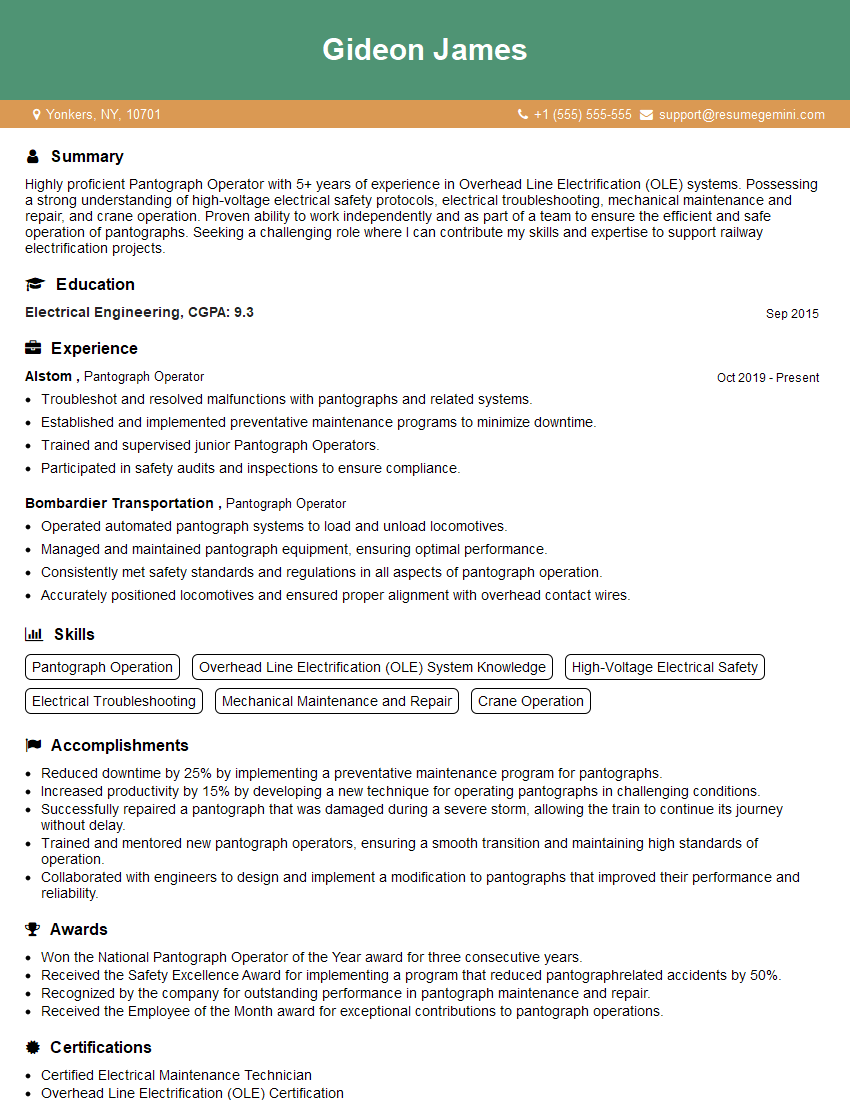
Mastering Pantograph Training opens doors to exciting career opportunities in engineering, manufacturing, and related fields. A strong understanding of pantograph technology demonstrates valuable problem-solving skills and a commitment to technical excellence. To maximize your job prospects, create an ATS-friendly resume that highlights your skills and experience effectively. We strongly recommend using ResumeGemini, a trusted resource for building professional resumes. Examples of resumes tailored to Pantograph Training are available to help guide you through this process. Good luck with your interview preparation!
Explore more articles
Users Rating of Our Blogs
Share Your Experience
We value your feedback! Please rate our content and share your thoughts (optional).
What Readers Say About Our Blog
Very informative content, great job.
good