Unlock your full potential by mastering the most common Stencil Creation and Preparation interview questions. This blog offers a deep dive into the critical topics, ensuring you’re not only prepared to answer but to excel. With these insights, you’ll approach your interview with clarity and confidence.
Questions Asked in Stencil Creation and Preparation Interview
Q 1. What types of materials are commonly used for stencil creation?
The choice of stencil material significantly impacts the stencil’s durability, precision, and the final print quality. Common materials include:
- Mylar: A popular choice due to its flexibility, durability, and ability to withstand multiple uses. It’s excellent for fine detail and intricate designs.
- Vinyl: Offers good durability and is relatively inexpensive. Thicker vinyl is better suited for larger stencils and coarser designs, while thinner vinyl is suitable for finer details. It is very versatile and easily weeded.
- Acetate: A less durable option, often used for single-use stencils or simple designs. It is transparent, which makes alignment easy.
- Cardboard or Paper: Used for quick, low-budget projects, these materials are not reusable and are less precise than others. They’re ideal for simple designs or one-off uses.
The ideal material depends on the project’s complexity, the number of prints needed, and the budget.
Q 2. Describe the different methods for creating stencils.
Several methods exist for creating stencils, each with its strengths and weaknesses:
- Hand-cutting: This traditional method uses an X-ACTO knife or similar cutting tool on a chosen material. This provides fine control but can be time-consuming for complex designs. It’s great for smaller quantities or highly unique designs.
- Computer-cut stencils (CNC Cutting): This precision method uses specialized software (like Illustrator or CorelDRAW) and a cutting machine (like a Cricut or Silhouette) to cut intricate designs with remarkable accuracy and speed. This is ideal for large quantities or complex designs.
- Laser cutting: Ideal for high-volume production of stencils with fine details, laser cutting provides exceptional accuracy and speed. It’s suitable for intricate designs and large orders, although it’s generally a more expensive method.
- Screen printing: While often the final output process, you can create a stencil for another method, like spray painting, by creating an image with a block-out screen printing method to block parts of a substrate.
The best method depends on factors such as design complexity, budget, production volume, and desired precision.
Q 3. Explain the process of preparing a stencil for screen printing.
Preparing a stencil for screen printing involves several crucial steps:
- Design Preparation: The design is created digitally (often in vector format) and sized correctly for the screen. Accurate sizing is crucial for registration and final product dimensions.
- Film Output: The design is then printed onto a transparent film, ensuring the correct orientation for screen printing. Any issues with the file will be directly translated to the film and the final print.
- Stencil Application: The film is carefully placed on the screen, often using registration marks for accurate placement. The process of transferring the image onto the screen varies depending on the chosen emulsion type (direct or indirect).
- Exposure: The screen is then exposed to a UV light source, which hardens the emulsion where it’s not blocked by the film. This creates the open areas for ink to pass through.
- Washout: After exposure, the unexposed emulsion is washed away, leaving the design open on the screen. This step needs careful attention to detail, to avoid damaging the stencil.
- Inspection: A thorough inspection is crucial before printing. Any imperfections in the stencil, like pinholes or incompletely washed-out areas, will lead to defects in the prints.
Proper stencil preparation is critical for achieving high-quality, consistent screen prints.
Q 4. How do you ensure the accuracy and precision of a stencil?
Accuracy and precision are paramount in stencil creation. Here’s how to ensure them:
- High-Resolution Images: Use high-resolution vector graphics (like .AI or .EPS) for your designs to ensure sharp, clean edges when cutting the stencil. Avoid low-resolution raster images (like .JPG or .PNG) unless you’re using a method that is appropriate for them, like a block-out screen printing process.
- Precise Cutting Techniques: Employ appropriate cutting techniques. For hand-cutting, use a sharp blade and steady hand. For machine cutting, ensure the machine settings are calibrated accurately.
- Registration Marks: Include registration marks on your design to ensure accurate placement on the screen or substrate. This is especially crucial for multi-color prints.
- Test Prints: Conduct test prints before starting a large production run to verify the stencil’s accuracy and identify any potential issues.
- Material Selection: Choose high-quality stencil material appropriate for the complexity and durability requirements of the project.
By focusing on these aspects, you can drastically reduce errors and maintain consistent print quality.
Q 5. What are the common challenges encountered during stencil preparation?
Several challenges can arise during stencil preparation:
- Stencil Distortion: This can occur due to improper handling or storage of the stencil material. This can be especially problematic with thin materials like acetate and vinyl.
- Uneven Cuts: Hand-cutting can lead to uneven or jagged edges, especially in complex designs. Machine cutting requires proper calibration and maintenance.
- Clogging: In screen printing, clogged areas of the screen can occur due to improper cleaning or emulsion buildup.
- Weeding Issues: With vinyl, incompletely weeding the design can lead to unwanted material remaining and ruining the print.
- Registration Problems: Misalignment of multiple-color stencils can produce inaccurate and visually unappealing prints. This can arise from various factors from misalignment during production, to issues with the original file.
Careful planning, meticulous execution, and regular equipment maintenance can minimize these challenges.
Q 6. How do you troubleshoot issues with stencil registration?
Stencil registration issues are often frustrating but solvable. Troubleshooting strategies include:
- Verify Registration Marks: Double-check that the registration marks are accurately placed on the design and consistently aligned on the screen or substrate.
- Inspect the Stencil: Carefully examine the stencil for any distortions, tears, or imperfections that might cause misalignment.
- Check Screen Tension: Loose screen tension can contribute to registration problems, especially in screen printing. Ensure the screen is properly stretched and secured.
- Adjust Squeegee Pressure and Speed: Uneven pressure or speed during screen printing can cause the stencil to shift. Experiment to find the optimal settings.
- Use a Registration System: Investing in a sophisticated registration system can dramatically improve accuracy, particularly for multi-color prints.
Systematic troubleshooting and attention to detail are key to resolving registration issues.
Q 7. Describe your experience with different stencil cutting techniques.
My experience encompasses a range of stencil cutting techniques, from traditional hand-cutting to advanced computer-aided methods.
- Hand-cutting with X-ACTO knives: I’ve extensively used X-ACTO knives for creating stencils, particularly for smaller, intricate designs. This method demands patience and precision, and I’ve honed my skills to achieve clean, consistent cuts.
- Computer-aided cutting (CNC): I’m proficient in using software like Adobe Illustrator and CorelDRAW to design and prepare files for computer-aided cutting machines (like Cricut or Silhouette). This allows me to create highly accurate, complex stencils efficiently. I understand the nuances of vector graphics and the importance of proper file preparation for optimal cutting results.
- Laser cutting: While less hands-on than other methods, I have experience working with laser cutters to create high-volume, precisely cut stencils. Understanding material compatibility and laser settings are crucial for achieving optimal results.
My experience across diverse techniques enables me to select the most appropriate method based on the project’s requirements and deliver high-quality results.
Q 8. What software are you familiar with for stencil design?
My expertise in stencil creation spans a wide range of software. For simple designs, I often use readily available vector graphics editors like Adobe Illustrator or Inkscape. These programs allow for precise control over lines, shapes, and text, crucial for creating clean, crisp stencils. For more complex designs, especially those involving intricate details or photo-realistic elements, I leverage software like CorelDRAW or Affinity Designer. These offer advanced features like powerful tracing tools and non-destructive editing capabilities, allowing for iterative refinement and adjustments without damaging the original artwork. Finally, I’m also proficient in using CAD software, particularly when dealing with technical stencils requiring very high precision, such as those used in industrial applications or circuit board creation.
For example, when creating a stencil for a hand-painted mural, Illustrator’s ease of use in managing complex shapes and vector paths proved invaluable. In contrast, for a highly detailed automotive paint mask stencil, the capabilities of CorelDRAW’s advanced tools were necessary to ensure precision.
Q 9. How do you maintain the quality and durability of your stencils?
Maintaining stencil quality and durability is paramount. It begins with choosing the right material; for instance, Mylar is a popular choice due to its flexibility, durability, and resistance to chemicals. However, the process extends beyond material selection. I always optimize the design itself, avoiding overly thin lines or intricate detailing that might compromise the stencil’s integrity during use. For robust stencils, I use thicker materials or reinforce particularly vulnerable areas with additional layers. Proper cutting techniques, using a sharp blade to minimize fraying and ensuring clean, consistent cuts, are also vital. Post-cutting, I carefully handle the stencil to prevent bending or damage, and depending on the material, I may consider a protective coating to add an extra layer of longevity and resilience against wear and tear.
Think of it like building a house – the foundation (material selection) is crucial, followed by the design (optimizing the stencil’s layout for durability) and careful construction (precise cutting and handling).
Q 10. Explain the importance of proper stencil cleaning and storage.
Proper cleaning and storage are absolutely essential for extending a stencil’s lifespan and maintaining its quality. After each use, I thoroughly clean the stencil to remove any residual paint or material. The cleaning method depends on the stencil material and the type of paint or ink used. Generally, gentle soap and water work well, but for more stubborn residue, specialized cleaning solutions may be necessary. It’s important to avoid harsh chemicals that could damage the stencil. After cleaning, the stencil should be completely dried before storage to prevent mold or mildew. Storage itself is crucial; I store stencils flat, away from direct sunlight and heat, to prevent warping or degradation. For long-term storage, I often use archival-quality folders or protective sleeves to further minimize damage.
Imagine neglecting your valuable paint brushes – they’d quickly become unusable. Similarly, ignoring stencil cleaning and storage invites premature wear and tear, rendering them ineffective.
Q 11. What are the key considerations when choosing a stencil material for a specific application?
Choosing the right stencil material hinges on several factors, primarily the application. For example, thin, flexible materials like Mylar are suitable for intricate designs and curved surfaces. They’re easily adaptable and can conform to various shapes, making them ideal for things like airbrushing or cake decorating. However, for high-volume production or applications requiring high durability, thicker, more resilient materials like polycarbonate or metal stencils are preferred. They can withstand repeated use and are less prone to tearing or warping. The type of paint or ink used also plays a crucial role; some materials are more resistant to certain solvents than others. Furthermore, the desired level of detail influences the material choice; intricate designs may need a thinner material to capture fine lines, while bolder designs can afford thicker, more robust options.
A simple analogy would be selecting the right tool for a job: you wouldn’t use a screwdriver to hammer a nail.
Q 12. How do you handle complex designs or intricate details during stencil creation?
Handling complex designs requires a methodical approach. First, I break down the design into smaller, manageable sections. This makes the process less overwhelming and allows for more precise control during cutting. Secondly, I utilize precision cutting tools tailored to the stencil’s material and the level of detail required. Laser cutting offers unparalleled accuracy for intricate designs, while a sharp blade remains suitable for many applications. I always focus on clean cuts to minimize imperfections and ensure the stencil is free of any unwanted residue. When cutting by hand, it’s imperative to use a cutting mat to protect the surface and ensure straight lines. Finally, for exceptionally complex elements, I may even employ multiple stencils, layering them strategically to build up the complete design. This is especially useful when dealing with intricate overlaps or gradients.
Think of it like assembling a complex jigsaw puzzle; breaking it down into smaller sections and focusing on one piece at a time dramatically simplifies the task.
Q 13. Describe your experience with using different types of stencil adhesives.
My experience with stencil adhesives is extensive. I’ve worked with various types, including temporary adhesives (like low-tack masking tape) for single-use stencils or applications where easy removal is crucial, and permanent adhesives (like spray adhesives or specialized stencil-mounting glues) for reusable stencils where secure adherence is paramount. The choice depends largely on the substrate, the stencil material, and the application. For delicate surfaces, I always opt for low-tack adhesives to prevent damage. When working with porous materials, I might use a thicker adhesive to ensure a strong bond and prevent bleeding. I’m also careful to consider the adhesive’s compatibility with the stencil material; some adhesives can degrade certain plastics or other materials over time. Testing the adhesive on a small, inconspicuous area before applying it to the entire stencil is an essential practice.
Selecting the wrong adhesive is like using the wrong type of glue – it could ruin the entire project.
Q 14. How do you ensure the longevity of a stencil used in high-volume production?
Ensuring longevity in high-volume production requires a multi-pronged approach. Firstly, selecting extremely durable stencil materials, such as high-quality metal or specialized polymers, is non-negotiable. Secondly, the stencil design itself must be robust, avoiding intricate details that are prone to wear. Thirdly, proper cleaning procedures are crucial; after each use, thorough and consistent cleaning is essential to prevent buildup and degradation. Using specialized cleaning solutions and employing automated cleaning systems can significantly improve efficiency and prolong the stencil’s life. Fourthly, regular inspection of the stencil for wear and tear is essential; damaged areas might be repaired, or the stencil might need to be replaced before it significantly impacts production quality. Finally, proper storage, protecting it from environmental factors and physical damage, is a critical aspect of extending its lifespan.
Think of it as preventative maintenance for a high-performance machine – regular inspection, cleaning, and mindful operation are critical to keeping it running at peak efficiency for a prolonged period.
Q 15. What safety measures do you employ when working with stencil-making materials?
Safety is paramount when working with stencil-making materials. Many materials, like solvents and chemicals used in etching or cutting processes, pose health risks. My safety protocols begin with a thorough risk assessment of each project, identifying potential hazards associated with the chosen materials and techniques.
- Personal Protective Equipment (PPE): I always use appropriate PPE, including safety glasses, gloves (nitrile or other suitable material based on the chemical used), and a respirator when dealing with dust, fumes, or aerosols. For example, when working with laser cutters, I wear laser safety glasses. When using spray adhesives, a respirator is mandatory.
- Ventilation: Adequate ventilation is crucial. I work in a well-ventilated area, or use a local exhaust ventilation system if working with particularly volatile materials. This minimizes exposure to harmful vapors.
- Material Handling: I handle all materials with care, avoiding spills and properly disposing of waste according to local regulations. Unused chemicals are stored securely and labeled appropriately.
- Emergency Preparedness: I always have a readily available first-aid kit and a clear emergency response plan in place. I’m familiar with the safety data sheets (SDS) for all materials used and understand the necessary first-aid procedures in case of accidental exposure.
By adhering to these safety measures, I ensure a safe and productive working environment, minimizing the risk of injury or health problems.
Career Expert Tips:
- Ace those interviews! Prepare effectively by reviewing the Top 50 Most Common Interview Questions on ResumeGemini.
- Navigate your job search with confidence! Explore a wide range of Career Tips on ResumeGemini. Learn about common challenges and recommendations to overcome them.
- Craft the perfect resume! Master the Art of Resume Writing with ResumeGemini’s guide. Showcase your unique qualifications and achievements effectively.
- Don’t miss out on holiday savings! Build your dream resume with ResumeGemini’s ATS optimized templates.
Q 16. How do you assess the suitability of a stencil for a particular printing technique?
Assessing stencil suitability depends heavily on the chosen printing technique. The stencil material’s properties—thickness, flexibility, durability, and chemical resistance—must match the printing method and substrate. For example, a thin, delicate stencil might be ideal for screen printing on soft fabrics, while a thicker, more rigid stencil would be necessary for spray painting onto a rough surface.
- Screen Printing: Requires stencils that are durable enough to withstand repeated ink applications and cleaning. Mesh count and stencil material (e.g., polyester, nylon) influence print quality and longevity.
- Spray Painting: Benefits from thicker, more robust stencils that can resist the force of the spray and prevent paint bleed-through. Materials like Mylar or even laser-cut card stock can work well.
- Airbrushing: Typically uses fine detail stencils made from thin materials, allowing for precise control and intricate designs. Often vinyl stencils are used for this purpose.
- Block Printing: Employs thicker, more resilient stencils carved from materials like linoleum or rubber, capable of withstanding repeated pressure from printing blocks.
I always consider the stencil’s potential for distortion or tearing under the pressure or stresses of the chosen printing method. The proper balance of stencil characteristics and the demands of the print job is vital for successful outcomes.
Q 17. Describe your process for verifying the accuracy of a finished stencil.
Verifying stencil accuracy is a crucial step. I use a multi-stage approach to ensure the stencil perfectly reproduces the intended design.
- Visual Inspection: After creating the stencil, I carefully inspect it under good lighting, checking for any imperfections, misalignments, or missing details. This helps catch simple errors early on.
- Test Print: I always perform a test print on a scrap piece of the same material as the final print. This test print allows me to identify any issues with registration, sizing, or potential defects before committing to the actual print run. The test often helps to refine the stencil’s positioning or identify areas needing minor adjustments.
- Measurement Verification: For precise designs, I use measuring tools such as calipers or rulers to verify critical dimensions and ensure consistency. This is especially critical for stencils with complex geometries or tight tolerances.
- Digital Comparison (When Applicable): When working from digital designs, I might compare the final stencil against the original digital file for size and accuracy, confirming the conversion process hasn’t introduced errors.
By employing these verification methods, I ensure the finished stencil meets the highest standards of accuracy and precision, leading to high-quality prints.
Q 18. Explain your understanding of color separation in stencil creation.
Color separation in stencil creation is the process of breaking down a multi-colored design into individual color components, each requiring its own stencil. This allows for accurate reproduction of the full-color design through successive print runs, one color at a time. Think of it like building a layered cake: each layer represents a different color.
For example, if I’m creating a stencil for a design with red, blue, and yellow elements, I would create three separate stencils, one for each color. Each stencil would only include the areas corresponding to its assigned color. This process is often handled using software like Adobe Illustrator or Photoshop, allowing for precise separation and alignment of colors. The key is careful planning and alignment of the individual color stencils during printing to achieve accurate registration and a sharp, clean final product. Accurate registration markers are critical during the process.
Q 19. What steps do you take to prevent stencil damage or distortion during use?
Preventing stencil damage or distortion during use is vital for maintaining print quality and minimizing waste. Several techniques help protect the stencil:
- Proper Material Selection: Choosing a stencil material suited to the printing technique and substrate is crucial. A durable material is less likely to tear or deform under stress.
- Careful Handling: Handling the stencil with care, avoiding unnecessary bending or stretching, helps prevent damage. Storage in a clean, dry place, away from extreme temperatures, further protects the stencil.
- Adhesive Application: If using an adhesive to secure the stencil, I use a thin, even layer to prevent bubbling or warping. The type of adhesive should also be compatible with both the stencil and substrate material.
- Protective Coatings (When Necessary): For applications where the stencil might be exposed to abrasion or harsh chemicals, I might apply a thin layer of protective coating to increase its lifespan and durability. This is particularly important for stencils that need multiple uses.
- Cleaning and Storage: After use, I always carefully clean the stencil, removing any ink or residue according to the material’s specifications. Proper cleaning prolongs the stencil’s life and prevents buildup that might clog openings or damage the stencil.
These preventative steps ensure the stencil remains in optimal condition throughout the printing process, resulting in consistent, high-quality prints.
Q 20. How do you adapt your stencil-making techniques for different substrate materials?
Adapting stencil-making techniques for different substrates requires careful consideration of material compatibility and printing method. The substrate’s surface texture, absorbency, and resilience influence stencil material selection and application.
- Smooth Surfaces (e.g., Glass, Metal): Often work well with thin, flexible stencils. Adhesives may be required to secure the stencil to the surface.
- Porous Surfaces (e.g., Fabric, Wood): Might require thicker stencils to prevent bleed-through. The stencil’s material should be compatible with the substrate and printing medium. Using a sealant on porous substrates before stenciling can help prevent bleed-through.
- Textured Surfaces (e.g., Rough Concrete, Brick): Benefit from thicker, more resilient stencils capable of withstanding pressure and conforming to surface irregularities. A gap between the stencil and the surface might be created to prevent uneven pressure.
For example, when stenciling on fabric, I might choose a stencil made of a soft material like acetate or vinyl, whereas for painting on a rough stone surface, a more rigid stencil made of a thicker material would be more appropriate. The method of applying the printing medium (ink, paint, etc.) would also influence my choice of stencil material and thickness to avoid bleed-through or insufficient transfer of ink/paint.
Q 21. Describe your experience with using automated stencil-making equipment.
My experience with automated stencil-making equipment includes working with CNC (Computer Numerical Control) routers and laser cutters. These machines allow for precise and repeatable stencil creation, particularly useful for high-volume or complex designs.
- CNC Routers: I’ve used CNC routers to cut stencils from various materials, including wood, acrylic, and even metal, depending on the project requirements. This offers great flexibility in terms of material choice and thickness.
- Laser Cutters: Laser cutters provide exceptional precision for intricate designs. They’re particularly useful for creating stencils from thin materials such as vinyl or acetate, resulting in clean, sharp cuts with minimal material waste. The speed and automation of laser cutting significantly increases efficiency compared to manual methods.
- Software Integration: Both CNC routers and laser cutters require specialized software for design input and machine control. My experience includes proficiency in various CAD/CAM (Computer-Aided Design/Computer-Aided Manufacturing) software packages necessary to prepare designs for these automated systems. This includes proper file formats (DXF, AI, etc.) and nesting strategies to optimize material usage.
Automated stencil-making allows for greater consistency, precision, and efficiency, especially when producing large numbers of identical stencils. However, it’s important to note the upfront investment costs and ongoing maintenance associated with these machines. Manual stencil creation still holds a place for small-scale projects or designs that demand unique techniques or artistic expression.
Q 22. How do you handle revisions or corrections in an already prepared stencil?
Handling revisions on a prepared stencil depends heavily on the type of stencil and the nature of the correction. For example, minor adjustments to a digitally produced film positive can be easily rectified with photo editing software before burning the stencil. This allows for quick and precise changes without wasting materials.
For direct-to-screen stencils (made by exposing emulsion directly to light), smaller corrections might be achievable with a sharp blade and careful removal of the unwanted emulsion, followed by re-coating and re-exposing that specific area. However, this is only feasible for very small corrections; larger revisions might necessitate starting over.
In a professional setting, I’d prioritize a digital workflow for its ease of revision. Think of it like editing a document versus rewriting it by hand – far more efficient. This minimizes waste and improves turnaround times. A detailed revision system is key. Clear communication with the client about the nature of the changes and their impact on the final product is crucial before any revisions are undertaken.
Q 23. How do you manage different file formats used in stencil design?
Stencil design utilizes a range of file formats, each with its strengths and weaknesses. Common formats include:
- .AI (Adobe Illustrator): A vector format ideal for crisp lines and scalability, suitable for creating complex designs without losing quality.
- .EPS (Encapsulated PostScript): Another vector format, often used for exchanging files between different design programs.
- .PDF (Portable Document Format): A versatile format compatible with most software, useful for final proofing and printing to film positives.
- .PSD (Adobe Photoshop): A raster format that allows for photo manipulation, useful when incorporating complex images or photographic elements into the design. However, it’s essential to be mindful of resolution as raster images can lose quality when scaled.
- .TIFF (Tagged Image File Format): High-quality raster format, good for print-ready files.
My workflow involves standardizing on vector formats (.AI or .EPS) for the design phase, ensuring clean, scalable artwork. This is later converted to a high-resolution raster format (.TIFF) suitable for screen printing.
Q 24. What is your experience with quality control procedures for stencils?
Quality control (QC) is paramount in stencil creation. My QC procedures start with meticulous design review, ensuring the artwork is accurate and vector-based for optimal printing. I verify all technical specifications such as color profiles, resolution (especially for raster-based images), and that the artwork is sized correctly for the final application.
During the stencil production, I inspect the emulsion coating for evenness, paying attention to any pinholes or inconsistencies. Post-exposure, I carefully examine the stencil for proper exposure and registration. Before printing, I perform a test print to evaluate the stencil’s quality, checking for sharpness, detail, and any defects that might affect the final print. A thorough QC process minimizes errors and ensures a high-quality end product, reducing waste and rework.
Documentation of each step is crucial; this helps track issues and identify areas for improvement. Employing a checklist ensures no step is overlooked.
Q 25. Explain your understanding of different screen mesh counts and their impact on stencil design.
Screen mesh count (the number of threads per inch) directly influences the stencil’s properties and print quality. A higher mesh count (e.g., 190 or 230) results in finer detail and sharper prints, but it also means less ink flow. These are ideal for intricate designs and fine halftones. A lower mesh count (e.g., 80 or 110) permits greater ink deposit, making it suitable for bolder designs and larger areas of solid color. The mesh choice should align with the design; a high-detail design on a coarse mesh will result in a blurry, less defined print. Conversely, a simple design on a fine mesh will be wasteful and may even cause the stencil to clog.
For example, a t-shirt design with fine lettering would benefit from a 190 mesh, while a poster print with large blocks of color would be better suited to an 80 or 110 mesh. Choosing the appropriate mesh is a crucial decision that heavily impacts print quality and efficiency.
Q 26. How would you troubleshoot a stencil that produces blurry or unclear prints?
Troubleshooting blurry or unclear prints from a stencil usually involves systematically checking several factors:
- Emulsion exposure: Under-exposure leads to a weak stencil with poor ink blocking. Over-exposure might result in a stencil that’s too hard, preventing proper ink release. Proper exposure time and intensity are crucial.
- Screen tension: A loose screen will sag and cause the print to be inconsistent and blurry. Proper tension is essential for sharp prints.
- Mesh count: Incorrect mesh count relative to the design intricacy can cause blurred prints. A higher mesh count is typically needed for finer details.
- Squeegee pressure and angle: Excessive pressure can cause blurry prints by forcing too much ink under the stencil, while inadequate pressure won’t transfer enough ink.
- Stencil condition: Damage to the stencil, such as debris or pinholes, will compromise print quality. Check for any defects.
- Ink viscosity: The right ink viscosity ensures proper transfer; too thick, and it won’t flow; too thin, and the stencil will flood.
Debugging involves examining each element step by step. I usually start with the simplest checks (stencil condition, squeegee technique) before moving to more complex ones (exposure, mesh). A methodical approach helps isolate the problem quickly.
Q 27. How do you determine the appropriate emulsion thickness for a stencil?
Emulsion thickness is critical; too thin, and the stencil won’t be durable; too thick, and it might clog or produce uneven prints. The optimal thickness depends on factors like the mesh count, design complexity, and the printing technique.
Manufacturers usually provide guidelines for emulsion application. I often rely on a combination of experience and practical testing to determine the right emulsion thickness. This might involve applying different layers and testing the stencil’s performance. Too thick an emulsion requires more exposure time. Too thin an emulsion requires less. Experience guides the intuition in this aspect. Ultimately, the goal is to achieve a stencil that’s strong enough to withstand the printing process while allowing for crisp and consistent ink transfer.
Q 28. Describe your experience with emulsion coating techniques for screen printing stencils.
Emulsion coating is a key step in stencil preparation. My experience covers various techniques, from manual coating using a scoop coater (for a more even layer) to the use of automated emulsion coating equipment in higher-volume settings.
Manual Coating: This involves spreading emulsion evenly across the screen using a scoop coater. The consistency of the emulsion needs to be correct to prevent uneven application. I ensure a smooth and uniform coat, avoiding bubbles or streaks. This method demands careful attention and steady hand.
Automated Coating: Automated equipment provides consistent emulsion coating thickness and greater efficiency. The process requires setting parameters based on emulsion viscosity, screen size, and desired emulsion thickness. I often work with systems that provide precise control and allow for repeatable results, significantly reducing the risk of human error.
Regardless of the method, the focus is always on achieving a consistent, even coat of emulsion without any flaws. This is crucial for achieving crisp, high-quality prints.
Key Topics to Learn for Stencil Creation and Preparation Interview
- Understanding Stencil Design Principles: Explore the fundamentals of effective stencil design, including factors like material selection, dimensional accuracy, and overall aesthetic considerations. Consider how different design choices impact the final output.
- Stencil Production Techniques: Familiarize yourself with various stencil creation methods, from hand-cutting techniques to digital fabrication processes like laser cutting or 3D printing. Understand the advantages and limitations of each method and when to apply them.
- Material Preparation and Handling: Master the skills necessary for properly preparing materials for stencil application. This includes understanding surface preparation, adhesion techniques, and material compatibility considerations.
- Application Techniques and Best Practices: Learn and practice different application techniques for various materials and surfaces. Understand troubleshooting common application issues, like bleeding or uneven coverage.
- Quality Control and Inspection: Develop the ability to critically assess the quality of your stencils and the finished product. Know how to identify and rectify imperfections.
- Safety Procedures and Regulations: Understand and adhere to all relevant safety protocols and regulations associated with stencil creation and the materials used.
- Project Management and Workflow: Discuss your experience managing stencil creation projects from initial design to final product delivery. This includes estimating time, managing resources, and meeting deadlines.
Next Steps
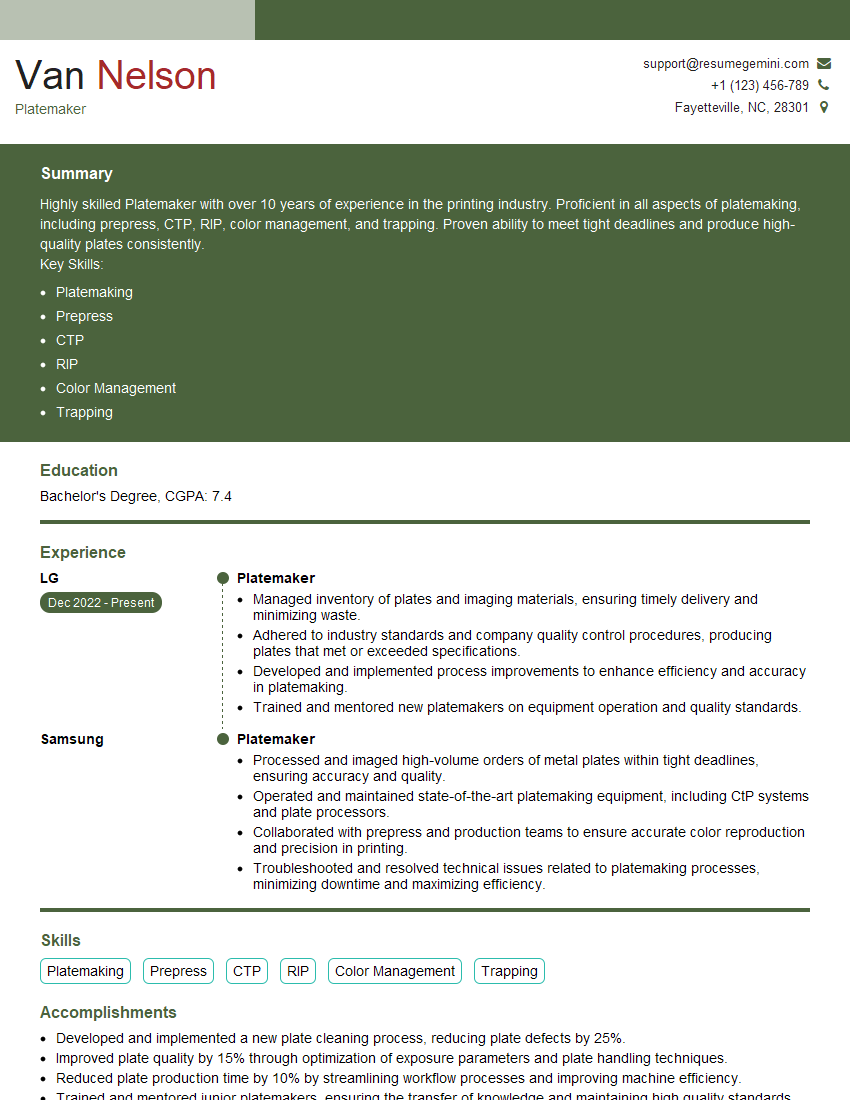
Mastering Stencil Creation and Preparation opens doors to exciting opportunities in various creative and technical fields. A strong understanding of these skills demonstrates valuable problem-solving abilities and attention to detail, highly sought-after qualities in many industries. To maximize your job prospects, creating an ATS-friendly resume is crucial. ResumeGemini is a trusted resource that can help you build a professional and impactful resume that showcases your skills effectively. Examples of resumes tailored to Stencil Creation and Preparation are available to help guide you. Take the next step towards your dream career – invest time in crafting a compelling resume that reflects your expertise.

Explore more articles
Users Rating of Our Blogs
Share Your Experience
We value your feedback! Please rate our content and share your thoughts (optional).
What Readers Say About Our Blog
Very informative content, great job.
good