Interviews are opportunities to demonstrate your expertise, and this guide is here to help you shine. Explore the essential Phase Equilibria and Thermodynamics interview questions that employers frequently ask, paired with strategies for crafting responses that set you apart from the competition.
Questions Asked in Phase Equilibria and Thermodynamics Interview
Q 1. Explain the Gibbs Phase Rule and its applications.
The Gibbs Phase Rule is a fundamental equation in thermodynamics that predicts the number of degrees of freedom (F) in a system at equilibrium. It’s a powerful tool for understanding phase transitions and predicting the behavior of multicomponent systems. The rule is expressed as:
F = C - P + 2
Where:
- F = Degrees of freedom (number of intensive variables that can be changed independently without altering the number of phases in equilibrium).
- C = Number of components (chemically independent constituents).
- P = Number of phases (physically distinct and homogeneous regions).
Applications: The Gibbs Phase Rule finds extensive use in various fields:
- Material Science: Predicting the number of phases present in alloys at different temperatures and compositions.
- Chemical Engineering: Designing and optimizing separation processes like distillation and crystallization.
- Geology: Understanding the formation and evolution of rocks and minerals under various pressure and temperature conditions. For example, it helps predict the conditions necessary for the formation of certain mineral assemblages.
- Meteorology: Analyzing atmospheric systems and predicting weather patterns. For instance, it can be used to understand cloud formation based on temperature and pressure.
Example: Consider a pure substance (C=1). At the triple point (solid, liquid, and gas phases coexist, P=3), the degrees of freedom are F = 1 – 3 + 2 = 0. This means no intensive variables can be changed without altering the number of phases present; the triple point is invariant.
Q 2. Describe different types of phase diagrams (e.g., P-T, P-V, T-x,y).
Phase diagrams are graphical representations of the conditions (temperature, pressure, composition) under which different phases of a substance or mixture coexist at equilibrium. Several types exist, each highlighting different aspects of phase behavior:
- P-T Diagrams (Pressure-Temperature): These diagrams show the relationship between pressure and temperature at which different phases of a pure substance exist. Key features include the triple point (where solid, liquid, and gas coexist), critical point (where the distinction between liquid and gas disappears), and sublimation curve.
- P-V Diagrams (Pressure-Volume): These diagrams primarily illustrate the relationship between pressure and volume for a pure substance, often showing the phase boundaries and the processes involved in phase transitions. Useful for visualizing work done in various thermodynamic processes.
- T-x Diagrams (Temperature-Composition): These diagrams show the relationship between temperature and composition for mixtures of two or more components at constant pressure. They are crucial in understanding liquid-liquid equilibria, solid-liquid equilibria (like eutectic and peritectic systems), and liquid-vapor equilibria (for binary mixtures).
- T-x,y Diagrams (Temperature-Composition): These diagrams are an extension of T-x diagrams for vapor-liquid equilibrium, showing the composition of both the liquid (x) and vapor (y) phases at equilibrium at a given temperature. They are widely used in distillation calculations.
Each diagram is extremely useful in its own context for understanding phase behavior and designing separation processes.
Q 3. What are the assumptions of ideal solution theory?
Ideal solution theory simplifies the study of mixtures by making several key assumptions, although many real-world solutions deviate from this ideal behavior:
- No volume change on mixing: The total volume of the solution is the sum of the volumes of the individual components.
- No heat change on mixing (ΔHmix = 0): The enthalpy of mixing is zero, meaning no energy is released or absorbed during the mixing process.
- Random mixing: Molecules of different components interact with each other in the same way as they interact with themselves. There are no preferential interactions.
- All components obey Raoult’s Law: The partial vapor pressure of each component is proportional to its mole fraction in the liquid phase.
These assumptions lead to simplified equations for calculating thermodynamic properties of mixtures, making them easier to analyze. However, remember that real solutions seldom meet these strict conditions.
Q 4. How do you calculate the activity coefficient using different models (e.g., Raoult’s Law, Henry’s Law) ?
Activity coefficients (γ) correct for deviations from ideality. They represent the ratio of the actual activity (a) of a component to its mole fraction (x): γ = a/x.
Raoult’s Law: For a component in an ideal solution, its activity is equal to its mole fraction (a = x), and therefore the activity coefficient is 1 (γ = 1). For non-ideal solutions, Raoult’s Law can be modified by including the activity coefficient: Pi = γixiPi* where Pi is the partial pressure, xi is the mole fraction, and Pi* is the vapor pressure of pure component i.
Henry’s Law: Henry’s law applies to dilute solutions where a component’s partial pressure is directly proportional to its mole fraction. It’s usually applied to the solute in a dilute solution. The activity coefficient is implicitly defined in the Henry’s Law constant. Pi = KHxi where KH is the Henry’s law constant. For non-ideal behavior this can be modified to include the activity coefficient: Pi = γiKHxi. The activity coefficient in Henry’s Law is calculated relative to the infinitely dilute state.
Other Models: More complex models like the Margules equation, van Laar equation, Wilson equation, NRTL, and UNIQUAC equations are used to calculate activity coefficients for non-ideal solutions, usually employing experimentally determined parameters.
Q 5. Explain the concept of fugacity and its significance in phase equilibria.
Fugacity (f) is a thermodynamic property that represents the ‘effective’ partial pressure of a component in a real system, accounting for non-ideal behavior. It’s a measure of the escaping tendency of a component from a phase. While pressure is a directly measurable quantity, fugacity is a more fundamental concept when dealing with non-ideal gases and liquids.
Significance in Phase Equilibria: For equilibrium between two phases (e.g., liquid and vapor), the fugacity of a component in each phase must be equal. This is a more general and accurate statement than saying the partial pressures are equal, which only holds true for ideal systems. The equality of fugacities is the criterion for equilibrium in a real system. Fugacity allows us to extend the concepts of equilibrium to real systems exhibiting significant deviations from ideality.
Calculating Fugacity: Fugacity can be calculated using equations of state (like the Peng-Robinson or Soave-Redlich-Kwong equations) or activity coefficients for liquid mixtures. The fugacity coefficient (Φ) is defined as the ratio of fugacity to pressure: Φ = f/P. For ideal gases, Φ = 1.
Q 6. Discuss the limitations of ideal solution theory.
Ideal solution theory, despite its simplicity, suffers from several limitations because real solutions seldom exhibit ideal behavior:
- Intermolecular Forces: Real molecules interact through attractive or repulsive forces. Ideal solution theory ignores these interactions, assuming all intermolecular forces are equal. In reality, different molecules often have different intermolecular forces, leading to deviations from ideality.
- Volume Changes on Mixing: Ideal solutions assume no volume change upon mixing. In reality, volume changes can occur due to differences in molecular sizes and packing arrangements.
- Heat Effects on Mixing: Ideal solutions assume no heat is released or absorbed upon mixing. However, many real solutions exhibit either positive or negative heats of mixing (endothermic or exothermic mixing processes), which affect thermodynamic properties.
- Limited Applicability to Concentrated Solutions: Ideal solution theory is generally more accurate for dilute solutions. As the concentration increases, deviations from ideality become more significant.
- Non-volatile Solutes: The theory predominantly applies to volatile components; it’s not easily adaptable to solutions containing non-volatile solutes.
These limitations highlight the need for more sophisticated models (like activity coefficient models) to accurately describe the behavior of real solutions.
Q 7. What is the Clausius-Clapeyron equation and how is it used?
The Clausius-Clapeyron equation describes the relationship between the vapor pressure of a substance and its temperature along a phase boundary (e.g., the liquid-vapor equilibrium curve). It is particularly useful for estimating changes in vapor pressure with temperature.
The equation is given by:
dP/dT = ΔHvap / (TΔVvap)
Where:
- dP/dT is the rate of change of pressure with respect to temperature.
- ΔHvap is the enthalpy of vaporization (heat required to vaporize one mole of liquid).
- T is the absolute temperature.
- ΔVvap is the change in volume during vaporization.
Simplified Form: A simplified form, often used for liquids, assumes that the molar volume of the liquid is negligible compared to the molar volume of the gas. This yields:
ln(P2/P1) = -ΔHvap/R * (1/T2 - 1/T1)
where P1 and P2 are the vapor pressures at temperatures T1 and T2 respectively, and R is the ideal gas constant.
Applications:
- Estimating boiling points: Knowing the enthalpy of vaporization, we can predict boiling points at different pressures.
- Determining enthalpy of vaporization: By measuring the vapor pressure at different temperatures, we can determine the enthalpy of vaporization.
- Analyzing phase diagrams: It helps understand the slope of the liquid-vapor coexistence curve on P-T phase diagrams.
The Clausius-Clapeyron equation provides a valuable tool for understanding and predicting the vapor pressure behavior of substances across a temperature range.
Q 8. Describe different types of phase transitions (e.g., boiling, melting, sublimation).
Phase transitions represent changes in the physical state of a substance, driven by variations in temperature and/or pressure. These transitions involve a change in the arrangement and interactions of molecules, leading to distinct physical properties.
Melting: The transition from a solid to a liquid. Think of ice melting into water – the rigid crystalline structure of ice breaks down as thermal energy overcomes the intermolecular forces holding the molecules together.
Boiling/Vaporization: The transition from a liquid to a gas. This occurs when the vapor pressure of the liquid equals the surrounding pressure. Imagine boiling water – the liquid molecules gain enough kinetic energy to escape the liquid phase and enter the gaseous phase.
Sublimation: The transition from a solid directly to a gas, bypassing the liquid phase. Dry ice (solid carbon dioxide) is a classic example. It transforms directly into gaseous CO2 at atmospheric pressure.
Freezing: The reverse of melting – a liquid transforming into a solid. Water freezing into ice is a common example.
Condensation: The reverse of vaporization – a gas transforming into a liquid. Dew forming on grass in the morning is a result of water vapor in the air condensing.
Deposition: The reverse of sublimation – a gas directly transforming into a solid. Frost forming on a cold surface is an example of deposition.
Q 9. Explain the concept of critical point and triple point.
The critical point and triple point are crucial points on a phase diagram, graphically representing the conditions (temperature and pressure) at which different phases of a substance coexist.
Critical Point: This point represents the temperature and pressure above which the distinction between liquid and gas phases disappears. Beyond the critical point, there’s a single, supercritical fluid phase. Imagine trying to boil water in a pressure cooker – at high enough pressure and temperature, the distinction between liquid and gaseous water becomes blurred.
Triple Point: This is the unique temperature and pressure at which all three phases of a substance (solid, liquid, and gas) coexist in thermodynamic equilibrium. For water, the triple point is at 0.01°C and 611.657 Pa. It’s a very specific and precise condition.
These points are important in understanding the behavior of substances under different conditions and are crucial in designing various industrial processes.
Q 10. How do you determine the equilibrium constant for a chemical reaction?
The equilibrium constant (K) for a chemical reaction quantifies the ratio of products to reactants at equilibrium. It tells us about the extent to which a reaction proceeds towards product formation.
For a generic reversible reaction:
aA + bB ⇌ cC + dD
The equilibrium constant is given by:
K = ([C]c[D]d) / ([A]a[B]b)
where [A], [B], [C], and [D] represent the equilibrium concentrations of the respective species, and a, b, c, and d are their stoichiometric coefficients.
Determining K involves measuring the equilibrium concentrations of all reactants and products. This can be done experimentally through various analytical techniques like spectroscopy or chromatography. Alternatively, thermodynamic data (Gibbs free energy change) can be used to calculate K.
The value of K provides valuable insights into the reaction’s spontaneity and equilibrium position. A large K indicates that the reaction favors product formation, while a small K suggests that the reactants are dominant at equilibrium.
Q 11. Explain the concept of chemical potential.
Chemical potential (µ) is a thermodynamic property that measures the change in Gibbs free energy of a system when a small amount of a substance is added to it, while keeping other parameters like temperature and pressure constant. Think of it as the ‘escaping tendency’ of a component from a phase.
In simpler terms, it represents how much the system’s free energy changes when you add or remove a bit of a particular substance. A higher chemical potential means the substance tends to move out of that phase, while a lower potential indicates a tendency to enter that phase.
At equilibrium, the chemical potential of each component is the same in all phases. This principle is fundamental to understanding phase equilibria. For example, at equilibrium between liquid and vapor phases, the chemical potential of a component is identical in both phases.
Q 12. Describe the different methods used to measure phase equilibria (e.g., experimental methods, simulation).
Measuring phase equilibria employs a variety of techniques, both experimental and computational.
Experimental Methods: These methods involve directly measuring the properties of a system under different conditions. Examples include:
Differential Scanning Calorimetry (DSC): Measures heat flow during phase transitions, providing information about transition temperatures and enthalpies.
Thermogravimetric Analysis (TGA): Measures weight changes as a function of temperature, useful for studying decomposition and phase transitions involving weight loss or gain.
Pressure-Volume-Temperature (PVT) measurements: Determine the equilibrium phase behavior over a range of pressures and temperatures, often used to construct phase diagrams.
Simulation Methods: These utilize computational techniques to predict phase equilibria. Examples include:
Molecular Dynamics (MD): Simulates the motion of individual molecules, providing insights into microscopic behavior and phase transitions.
Monte Carlo (MC) simulations: Uses statistical methods to sample the configuration space of a system, helping to determine equilibrium properties.
Equation of State (EOS) modeling: Employs mathematical equations to relate pressure, volume, and temperature, providing a predictive tool for phase behavior.
The choice of method depends on the system’s complexity, the desired level of detail, and the available resources.
Q 13. What are the challenges in modeling non-ideal solutions?
Modeling non-ideal solutions presents significant challenges because intermolecular interactions deviate significantly from the assumptions of ideality (i.e., molecules interact equally). Ideal solutions assume that the forces of attraction between like and unlike molecules are identical, which is rarely true in reality.
Challenges include:
Accurate representation of intermolecular forces: Modeling the complex interactions between different molecules in a solution is crucial, but it’s computationally demanding and often requires advanced techniques.
Activity coefficients: To account for non-ideality, activity coefficients are introduced, modifying the concentration terms in equilibrium expressions. Accurately predicting these activity coefficients requires sophisticated models like those based on the activity coefficient models like NRTL (Non-Random Two-Liquid) or UNIQUAC (UNIversal QUAsi-Chemical).
Phase behavior complexities: Non-ideal solutions can exhibit more intricate phase behavior, including azeotropes (mixtures that boil at a constant composition) and liquid-liquid immiscibility, which require more sophisticated modeling approaches.
Overcoming these challenges requires a combination of experimental data, robust theoretical models, and advanced computational tools.
Q 14. How do you apply phase equilibria principles to design separation processes (e.g., distillation, extraction)?
Phase equilibria principles are fundamental to designing efficient separation processes. Understanding the phase behavior of mixtures is crucial to selecting and optimizing separation techniques.
Distillation: This relies on the difference in the vapor pressures of the components in a liquid mixture. By carefully controlling temperature and pressure, we can separate components based on their relative volatilities. Phase diagrams are essential for designing distillation columns and predicting the separation efficiency.
Extraction: This separates components by exploiting their different solubilities in two immiscible liquid phases. Understanding the liquid-liquid equilibrium is key to designing extraction processes and selecting suitable solvents. Distribution coefficients, determined from phase equilibria data, guide the selection of optimal operating conditions.
By carefully analyzing the phase diagrams and understanding equilibrium relationships, we can optimize operating parameters, choose appropriate solvents, and design efficient and cost-effective separation processes. This minimizes energy consumption and maximizes product recovery, leading to significant economic benefits in various industrial applications, from petrochemical refining to pharmaceuticals.
Q 15. Explain the concept of azeotropes and how they affect separation processes.
Azeotropes are mixtures of two or more liquids whose proportions cannot be altered by simple distillation. This occurs because the vapor phase has the same composition as the liquid phase at a specific boiling point. Imagine trying to separate water and ethanol by boiling; normally, the more volatile component (ethanol) would evaporate first, leaving behind a more water-rich mixture. However, at a specific composition (approximately 96% ethanol, 4% water), the liquid and vapor have the identical composition, making separation by simple distillation impossible.
This significantly affects separation processes. Traditional distillation methods fail for azeotropic mixtures. To separate components, more advanced techniques are needed, such as extractive distillation (adding an entrainer that modifies the relative volatilities), pressure-swing distillation (exploiting the variation of azeotropic composition with pressure), or membrane separation.
For instance, in the production of absolute ethanol (100% ethanol), the ethanol-water azeotrope is a major hurdle. To obtain pure ethanol, extractive distillation using benzene or other suitable entrainers is often employed.
Career Expert Tips:
- Ace those interviews! Prepare effectively by reviewing the Top 50 Most Common Interview Questions on ResumeGemini.
- Navigate your job search with confidence! Explore a wide range of Career Tips on ResumeGemini. Learn about common challenges and recommendations to overcome them.
- Craft the perfect resume! Master the Art of Resume Writing with ResumeGemini’s guide. Showcase your unique qualifications and achievements effectively.
- Don’t miss out on holiday savings! Build your dream resume with ResumeGemini’s ATS optimized templates.
Q 16. Describe different types of activity coefficient models (e.g., Wilson, NRTL, UNIQUAC).
Activity coefficient models are used to account for deviations from ideal solution behavior. They relate the activity of a component in a mixture to its mole fraction. Several models exist, each with strengths and weaknesses:
- Wilson: Emphasizes local composition; accounts for the difference in molecular size and interactions between components. It’s relatively simple but fails to accurately represent systems with strong interactions (e.g., those exhibiting liquid-liquid phase separation).
- NRTL (Non-Random Two-Liquid): Considers both local composition and non-randomness of molecular arrangements. Handles liquid-liquid equilibria better than Wilson. It is more computationally intensive than Wilson.
- UNIQUAC (Universal Quasi-Chemical): Combines a local composition model with a combinatorial part that explicitly considers size and shape differences of molecules. It’s powerful and widely applicable, performing well for a broad range of systems.
The choice of model depends on the specific system and required accuracy. For instance, UNIQUAC is often preferred for complex mixtures due to its greater accuracy and applicability, while Wilson might suffice for relatively simple mixtures with limited interactions.
Q 17. How do you determine the parameters for activity coefficient models?
Activity coefficient model parameters are typically determined by regressing experimental data. This involves fitting the model to experimental measurements, such as vapor-liquid equilibrium (VLE) data (e.g., temperature, pressure, and compositions of both the liquid and vapor phases) or liquid-liquid equilibrium (LLE) data. The parameters (e.g., binary interaction parameters in Wilson, NRTL, and UNIQUAC) are adjusted iteratively until the model’s predictions closely match the experimental observations. Software packages like Aspen Plus or ProMax are frequently used for this purpose.
The regression process minimizes an objective function, often the sum of squared deviations between experimental and predicted values. A robust experimental dataset is crucial for obtaining reliable parameters. The quality of the fit can be evaluated by statistical measures such as the root mean squared error (RMSE) or the average absolute deviation (AAD).
Q 18. Explain the concept of Gibbs free energy and its role in phase equilibrium.
Gibbs free energy (G) is a thermodynamic potential that measures the maximum reversible work that may be performed by a thermodynamic system at a constant temperature and pressure. It’s a crucial function in phase equilibrium because at constant temperature and pressure, a system will spontaneously evolve towards a state of minimum Gibbs free energy.
In phase equilibrium, the Gibbs free energy of each phase is equal. Consider a liquid-vapor equilibrium. At equilibrium, the Gibbs free energy of the liquid phase is equal to the Gibbs free energy of the vapor phase. If the Gibbs free energy of one phase is lower, the system will evolve until equilibrium is reached, and the Gibbs free energy is minimized. This principle governs many phase transitions, including boiling, melting, and sublimation.
Q 19. Describe the application of thermodynamics in process optimization.
Thermodynamics plays a pivotal role in process optimization by providing a framework for analyzing energy efficiency, reaction spontaneity, and phase behavior. For example, thermodynamic analysis can be used to identify the optimal operating temperature and pressure for a chemical reaction to maximize yield or minimize energy consumption.
In chemical process design, thermodynamic calculations help determine the feasibility and efficiency of separation processes, reactor design, and heat integration. By minimizing Gibbs free energy changes, we can optimize reaction conditions for higher conversion rates. Similarly, understanding enthalpy changes helps optimize heat exchange networks for increased energy recovery and reduced operating costs.
For instance, in designing a distillation column, thermodynamic models predict the required number of trays and reflux ratio for a given separation based on relative volatilities derived from thermodynamic properties.
Q 20. How do you use thermodynamic data (e.g., enthalpy, entropy, Gibbs free energy) to predict phase behavior?
Thermodynamic data—enthalpy (H), entropy (S), and Gibbs free energy (G)—are used to predict phase behavior through the Gibbs phase rule and equilibrium relationships. For example, the Clausius-Clapeyron equation relates vapor pressure to enthalpy of vaporization, allowing us to predict boiling points under different pressures.
For multi-component systems, activity coefficient models, as previously discussed, leverage thermodynamic data to predict phase compositions at equilibrium. By combining these models with equations of state, we can accurately predict the behavior of complex mixtures under various conditions. For instance, we can predict the dew point and bubble point of a mixture based on temperature, pressure, and composition using equations of state and activity coefficient models.
Software packages employing advanced algorithms and thermodynamic databases are essential for practical applications of this predictive capability.
Q 21. What is the difference between enthalpy and internal energy?
Both enthalpy and internal energy are thermodynamic state functions that represent the energy content of a system. The key difference lies in how they account for work done by or on the system.
Internal energy (U) represents the total energy stored within a system, encompassing kinetic and potential energies of its molecules. Enthalpy (H) is defined as H = U + PV, where P is pressure and V is volume. It accounts for internal energy and the work done by the system against the external pressure during expansion or contraction.
In simpler terms, internal energy focuses only on the energy within the system, while enthalpy includes the energy associated with volume changes. For processes occurring at constant pressure (like many chemical reactions), enthalpy changes (ΔH) are a more convenient measure of energy transfer than internal energy changes (ΔU) because they directly reflect heat exchanged with the surroundings.
Q 22. Explain the concept of entropy and its significance in thermodynamics.
Entropy, at its core, is a measure of disorder or randomness within a system. Imagine a neatly stacked deck of cards (low entropy) versus the same deck after being thoroughly shuffled (high entropy). In thermodynamics, it quantifies the number of possible microscopic arrangements corresponding to a given macroscopic state. The significance of entropy lies in its role in predicting the spontaneity of processes. The second law of thermodynamics dictates that the total entropy of an isolated system can only increase over time, or remain constant in ideal cases of reversible processes. This means that natural processes tend to proceed in the direction of increasing disorder. For example, heat naturally flows from a hot object to a cold object, increasing the overall entropy of the system. This principle has vast implications, guiding us in understanding everything from the efficiency of engines to the prediction of chemical reaction feasibility.
Q 23. Describe the first and second laws of thermodynamics.
The First Law of Thermodynamics, also known as the law of conservation of energy, states that energy cannot be created or destroyed, only transformed from one form to another. Think of it like a bank account: the total amount of energy remains constant, but it can be transferred between different accounts (potential energy, kinetic energy, heat, etc.).
The Second Law of Thermodynamics, as mentioned earlier, focuses on entropy. It states that the total entropy of an isolated system always increases over time, or remains constant in ideal cases of reversible processes. This law defines the directionality of natural processes. It explains why heat spontaneously flows from hot to cold, and why it’s impossible to build a perfectly efficient heat engine (some energy is always lost as unusable heat, increasing entropy).
Q 24. What are the different types of thermodynamic processes (e.g., isothermal, adiabatic, isobaric)?
Thermodynamic processes are categorized based on how system properties change. Some common types include:
- Isothermal Process: The temperature remains constant throughout the process. Imagine a gas expanding slowly in a heat bath; heat is exchanged to maintain a constant temperature.
- Adiabatic Process: No heat exchange occurs between the system and its surroundings. A rapidly expanding gas, like in a piston, is a good approximation.
- Isobaric Process: The pressure remains constant. A process taking place at atmospheric pressure is an example.
- Isochoric (or Isometric) Process: The volume remains constant. Heating a gas in a rigid container is an isochoric process.
- Isoenthalpic Process: The enthalpy remains constant. Throttling of a gas through a valve is approximately isenthalpic.
These processes are idealizations; real-world processes often involve a combination of these.
Q 25. How do you calculate the work done in different thermodynamic processes?
Calculating work done depends on the process type:
- Isothermal Process (Ideal Gas):
W = nRT ln(V2/V1)where n is the number of moles, R is the gas constant, T is the temperature, and V1 and V2 are the initial and final volumes. - Isobaric Process:
W = P(V2 - V1)where P is the constant pressure, and V1 and V2 are the initial and final volumes. - Adiabatic Process (Ideal Gas):
W = (P1V1 - P2V2)/(γ - 1)where P1 and V1 are the initial pressure and volume, P2 and V2 are the final pressure and volume, and γ is the heat capacity ratio (Cp/Cv). - Isochoric Process:
W = 0(No volume change, therefore no work done).
For non-ideal gases or other systems, more complex equations or numerical methods are needed.
Q 26. Explain the concept of heat capacity and its significance.
Heat capacity represents the amount of heat required to raise the temperature of a substance by a certain amount. It’s crucial for understanding and predicting how a system’s temperature will change in response to heat transfer. We have two main types:
- Specific Heat Capacity (c): The amount of heat required to raise the temperature of one unit mass (e.g., 1 gram or 1 kg) of a substance by 1 degree Celsius (or 1 Kelvin). This is an intensive property, meaning it doesn’t depend on the amount of substance.
- Molar Heat Capacity (Cm): The amount of heat required to raise the temperature of one mole of a substance by 1 degree Celsius (or 1 Kelvin). This is also an intensive property.
Heat capacity is essential in various applications, including designing heat exchangers, predicting temperature changes during reactions, and in many calculations across chemical engineering.
Q 27. Describe the use of thermodynamic software packages (e.g., Aspen Plus, Pro/II) in solving phase equilibrium problems.
Thermodynamic software packages like Aspen Plus and Pro/II are indispensable tools for solving complex phase equilibrium problems. These packages use sophisticated equations of state (e.g., Peng-Robinson, Soave-Redlich-Kwong) and activity coefficient models (e.g., NRTL, UNIQUAC) to predict phase behavior. They allow engineers to simulate various process conditions, such as temperature, pressure, and composition, to determine the resulting phase equilibrium. For example, one could model a distillation column to determine the optimal operating conditions for separation of components. The software handles the complex calculations involved in determining vapor-liquid equilibrium, liquid-liquid equilibrium, or solid-liquid equilibrium, saving significant time and effort compared to manual calculations.
These packages also help in designing and optimizing chemical processes, predicting thermodynamic properties, and analyzing process safety.
Q 28. Explain how you would troubleshoot a discrepancy between predicted and experimental phase equilibrium data.
Discrepancies between predicted and experimental phase equilibrium data require a systematic troubleshooting approach:
- Data Verification: Double-check the experimental data for accuracy and consistency. Were the measurements performed correctly? Are there any potential sources of error in the experimental setup?
- Model Selection: Assess the appropriateness of the thermodynamic model used for prediction. Does the model accurately represent the system’s behavior under the given conditions? Consider using a more sophisticated model if necessary, or perhaps a model tailored to the specific chemicals involved.
- Parameter Estimation: Examine the parameters used in the model (e.g., interaction parameters in activity coefficient models). Are these parameters reliable and appropriate for the specific system and conditions? Consider fitting these parameters to experimental data, if possible.
- Purity of Components: Ensure the purity of the chemicals used in both the experiment and the prediction. Impurities can significantly affect phase behavior.
- Non-idealities: Account for non-ideal behavior of the system. Are deviations from ideality substantial enough to influence the results? If so, appropriate models reflecting the non-idealities must be considered.
- Experimental Conditions: Verify that the experimental conditions (temperature, pressure, composition) are accurately reflected in the model inputs. Even small deviations can lead to significant discrepancies.
By systematically investigating these factors, you can pinpoint the root cause of the discrepancy and improve the accuracy of your predictions.
Key Topics to Learn for Phase Equilibria and Thermodynamics Interview
- Gibbs Phase Rule: Understand its derivation and application in predicting the number of degrees of freedom in multi-component systems. Consider practical examples involving different phases (solid, liquid, gas).
- Phase Diagrams: Master the interpretation of P-T, P-V, and T-x diagrams for single and multi-component systems. Be prepared to discuss lever rules and tie lines.
- Thermodynamic Properties: Develop a strong understanding of internal energy, enthalpy, entropy, Gibbs free energy, and Helmholtz free energy. Be able to relate these properties to phase transitions and equilibrium conditions.
- Chemical Potential: Grasp the concept of chemical potential and its role in determining phase equilibrium. Understand its application in solving problems related to phase separation and chemical reactions.
- Fugacity and Activity: Learn how to use fugacity and activity coefficients to account for non-ideal behavior in real systems. Be ready to discuss their application in various industrial processes.
- Clausius-Clapeyron Equation: Understand its derivation and application in predicting the vapor pressure of a substance as a function of temperature. Consider practical examples in distillation and evaporation.
- Thermodynamic Cycles: Be familiar with common thermodynamic cycles such as the Carnot cycle, Rankine cycle, and Brayton cycle, and their relevance to energy conversion and power generation.
- Problem-Solving Approaches: Practice solving numerical problems involving phase equilibria calculations and thermodynamic property evaluations. Develop a structured approach to problem-solving.
Next Steps
Mastering Phase Equilibria and Thermodynamics is crucial for a successful career in chemical engineering, materials science, and related fields. A strong understanding of these principles opens doors to exciting opportunities in research, development, and process optimization. To maximize your job prospects, creating an ATS-friendly resume is essential. This ensures your qualifications are effectively communicated to potential employers. ResumeGemini is a trusted resource to help you build a professional and impactful resume tailored to your specific skills and experience. We offer examples of resumes specifically designed for candidates with expertise in Phase Equilibria and Thermodynamics to guide you in creating your own exceptional resume.

Senior Research Scientist Resume Sample
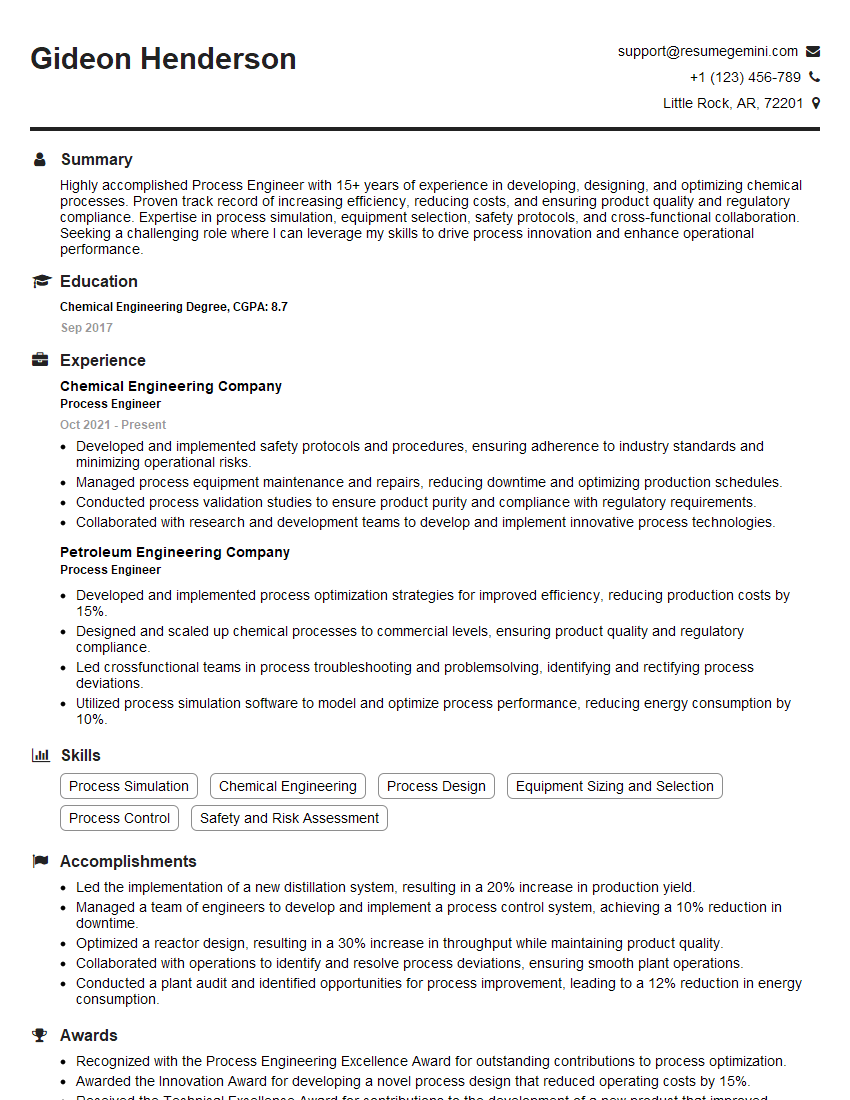
Process Engineer Resume Sample

Thermodynamics Engineer Resume Sample
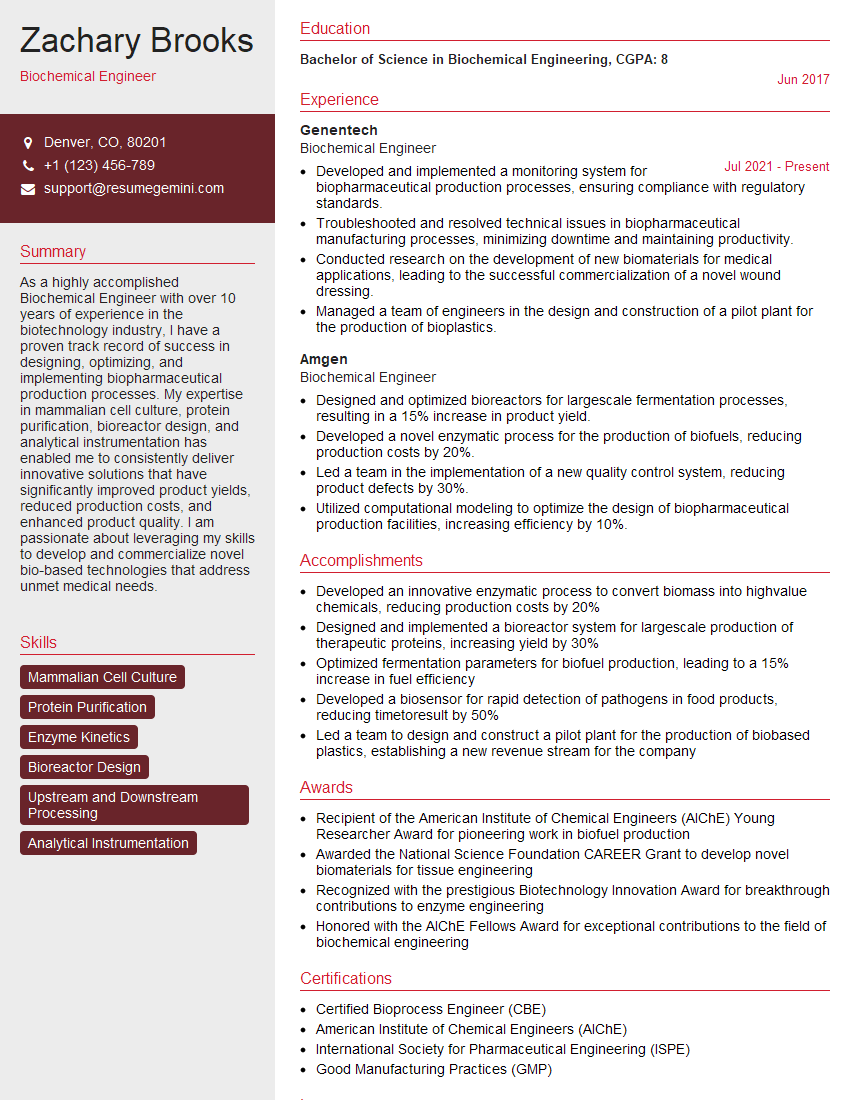
Biochemical Engineer Resume Sample

Chemical Engineer Resume Sample

Environmental Engineer Resume Sample

Professor of Chemical Engineering Resume Sample

Petroleum Engineer Resume Sample
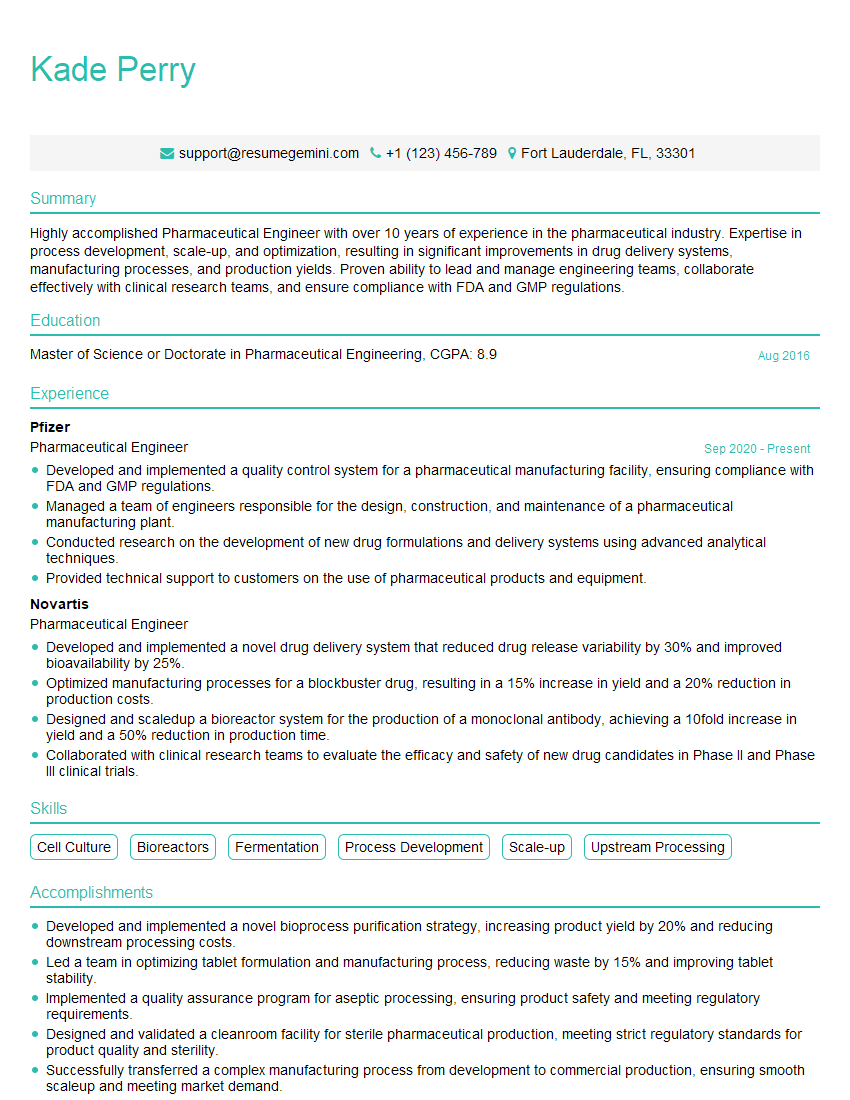
Pharmaceutical Engineer Resume Sample

Materials Scientist Resume Sample
Explore more articles
Users Rating of Our Blogs
Share Your Experience
We value your feedback! Please rate our content and share your thoughts (optional).
What Readers Say About Our Blog
Very informative content, great job.
good