Preparation is the key to success in any interview. In this post, we’ll explore crucial Plumbing and Electrical interview questions and equip you with strategies to craft impactful answers. Whether you’re a beginner or a pro, these tips will elevate your preparation.
Questions Asked in Plumbing and Electrical Interview
Q 1. Explain the difference between PVC and CPVC pipe.
Both PVC (Polyvinyl Chloride) and CPVC (Chlorinated Polyvinyl Chloride) are common types of plastic pipe used in plumbing, but they have key differences in their properties and applications. PVC is a rigid, inexpensive plastic pipe suitable for cold water distribution and drainage systems. CPVC, however, is a more resilient material that can withstand higher temperatures. This makes it ideal for hot water lines and applications where higher temperatures might be encountered.
- Temperature Resistance: CPVC can handle significantly higher temperatures (up to 200°F) than PVC (around 140°F), making it suitable for hot water applications.
- Pressure Resistance: While both offer good pressure resistance, CPVC generally shows slightly better performance under higher pressures.
- Flexibility: PVC is more rigid, while CPVC exhibits slightly more flexibility, making it easier to work with in some installations.
- Cost: PVC is generally less expensive than CPVC.
Think of it like this: PVC is your workhorse for cold water; CPVC is the heavy-duty version for situations requiring higher temperatures, such as hot water heaters or radiant floor heating systems. Choosing the right pipe depends heavily on the intended application and local plumbing codes.
Q 2. Describe the process of troubleshooting a faulty circuit breaker.
Troubleshooting a faulty circuit breaker involves a systematic approach to ensure safety and identify the root cause. Never attempt this while the breaker is still on.
- Safety First: Turn off the main power breaker to the entire house before starting any troubleshooting. This is crucial for your safety.
- Visual Inspection: Carefully examine the circuit breaker. Look for any signs of damage, such as scorch marks, cracks, or a visibly tripped breaker (usually indicated by a switch that’s in the ‘off’ position).
- Resetting the Breaker: If the breaker has simply tripped (the switch is in the ‘off’ position), gently switch it back to the ‘on’ position. If it immediately trips again, there’s a problem in the circuit.
- Identify the Circuit: Determine which electrical outlets and appliances are connected to the faulty circuit. This usually requires checking the breaker panel’s labeling or a house wiring diagram.
- Check for Overloads: If multiple high-wattage appliances (like space heaters or hair dryers) are running simultaneously on the same circuit, this can lead to an overload, tripping the breaker. Unplug some appliances to test this hypothesis.
- Check for Short Circuits: A short circuit is a dangerous situation where a wire is touching a metal surface or another wire, resulting in a surge of current. This can cause the breaker to trip. You may need a multimeter to check for continuity (check for shorts). If you find a short circuit, immediately call a qualified electrician.
- Call an Electrician: If you cannot identify the problem or if the breaker continues to trip after following these steps, call a qualified electrician. Electrical work can be dangerous, and it’s best to leave complex issues to the professionals.
Q 3. What are the common causes of low water pressure?
Low water pressure can stem from several sources, both inside and outside your home. Here’s a breakdown of common causes:
- Clogged Pipes: Mineral deposits, rust, or debris can restrict water flow, reducing pressure. This is often the case with older homes.
- Faulty Water Meter: A malfunctioning water meter can restrict water flow.
- Problems with the Main Water Line: A leak in the main water line supplying your home significantly lowers overall pressure.
- Low Water Pressure in the Neighborhood: Water main repairs, bursts, or high demand times in your community can sometimes result in reduced pressure for multiple homes.
- Sediment Buildup in Pipes: Over time, sediment builds up in pipes which can gradually restrict water flow. This is particularly common in areas with hard water.
- Kinked or Damaged Pipes: A kink or damage in the piping system can restrict water flow, leading to lower pressure.
- Partially Closed Valves: Check all valves in the system, including the main shut-off valve, to ensure they are fully open.
- Aerators: The aerators on your faucets can become clogged with mineral deposits, restricting water flow. Cleaning or replacing them might resolve the issue.
Troubleshooting requires systematically checking each of these aspects. It’s advisable to consult a plumber if you’re unable to isolate the problem.
Q 4. How do you identify and repair a leaking faucet?
Identifying and repairing a leaking faucet depends on the type of faucet and the source of the leak. Let’s cover a common scenario: a dripping faucet with a compression-type cartridge.
- Identify the Leak Source: Determine if the leak is coming from the spout, the handle, or the base of the faucet.
- Turn Off the Water Supply: Shut off the water supply to the faucet using the shut-off valves located under the sink. This is paramount to preventing further water damage.
- Disassemble the Faucet: Consult a diagram or video relevant to your specific faucet model to correctly disassemble the unit. Typically, this involves removing handles, cartridges, and possibly O-rings.
- Inspect Components: Carefully examine the internal components of the faucet for worn-out O-rings, washers, or damaged seals. These are the typical culprits of leaks.
- Replace Worn Parts: Replace any worn or damaged parts with new ones of the correct size and type. It’s wise to purchase replacement parts beforehand rather than finding out at the end that you are missing a vital component.
- Reassemble the Faucet: Carefully put the faucet back together according to the manufacturer’s instructions or video tutorials. Ensure everything is properly seated and tightened.
- Turn On Water Supply: Slowly turn the water supply back on and check for any remaining leaks.
- Test: Run the faucet for several minutes to verify that the leak has been fixed.
If you are uncomfortable performing this repair yourself or if the faucet is particularly complex, it’s always advisable to call a licensed plumber.
Q 5. Explain the difference between AC and DC electricity.
The core difference between AC (Alternating Current) and DC (Direct Current) electricity lies in the direction of electron flow.
- Direct Current (DC): Electrons flow in one consistent direction. Think of a battery – it produces a constant flow of electrons from the positive terminal to the negative terminal. This is simple and efficient for powering many smaller devices.
- Alternating Current (AC): The direction of electron flow periodically reverses. The electrons oscillate back and forth, changing direction 50 or 60 times per second (depending on the region’s standard). This is advantageous for long-distance transmission of electricity because AC voltage can be easily stepped up or down using transformers, minimizing energy loss over long distances.
Analogy: Imagine a river (DC) flowing constantly in one direction versus a seesaw (AC) going up and down. Both transfer energy, but they do so in different ways, making each suited for different applications.
Q 6. What safety precautions do you take when working with electricity?
Safety is paramount when working with electricity. Here are some crucial precautions:
- Turn Off the Power: Always turn off the power at the breaker box before working on any electrical wiring or components. Never rely solely on a light switch.
- Use Proper Tools: Employ insulated tools specifically designed for electrical work. Never use tools with damaged insulation.
- Wear Protective Gear: Use rubber gloves and safety glasses to protect yourself from electrical shocks and potential injuries.
- Avoid Contact with Water: Never work with electricity when your hands are wet or in damp conditions. Water significantly increases the risk of electrical shock.
- Never Work Alone: If possible, always have someone else present when working with electricity. This allows for immediate assistance in case of an accident.
- Understand Your Limits: Know your limitations. If you’re unsure about a task, do not attempt it; consult a qualified electrician.
- Check for Voltage: Use a non-contact voltage tester to confirm power is off before working on any electrical circuit or appliance.
Remember, complacency is a leading cause of electrical accidents. Always treat electricity with respect and caution.
Q 7. How do you calculate the amperage required for a specific appliance?
Calculating the amperage required for a specific appliance requires knowing its wattage and voltage. We use the following formula:
Amperage (A) = Wattage (W) / Voltage (V)
For example: A 1500-watt hairdryer operating on 120 volts requires:
Amperage = 1500W / 120V = 12.5A
Therefore, you would need a circuit with at least a 15-amp capacity to safely operate the hairdryer. Always round up to the next highest breaker size for safety. Note that the appliance’s nameplate usually states the wattage and voltage. Make sure to factor in the total amperage draw when multiple appliances are on the same circuit; you don’t want to exceed the circuit’s maximum capacity.
Q 8. Describe the different types of pipe fittings and their applications.
Pipe fittings are crucial components in plumbing systems, connecting pipes of different sizes, materials, or directions. They ensure water flow and system integrity. There are numerous types, each serving a specific purpose:
- Couplings: Join two pipes of the same diameter. Think of them as simple connectors, like linking two sections of train track.
- Elbows: Change the direction of the pipe flow, typically by 90 degrees (a right-angle bend) or 45 degrees. Essential for navigating corners and obstacles in your home’s plumbing.
- Tees: Create a branch point, allowing water to flow in three directions. Imagine a road intersection – one pipe continues straight, while two others branch off.
- Reducers/Adaptors: Connect pipes of different diameters. These are like adapters allowing you to connect your phone charger to your laptop (though this is a very loose analogy!).
- Unions: Allow for easy disconnection of pipes without cutting or damaging them. These are incredibly handy for maintenance or repairs.
- Caps: Seal the end of a pipe, preventing leaks or unwanted flow. It’s like a plug for a pipe.
- Nipples: Short pipes used to connect other fittings. They act as short connectors between fittings.
The choice of fitting depends on the specific application, pipe material (e.g., PVC, copper, CPVC), and pressure requirements. For example, high-pressure systems require fittings rated for those pressures. Incorrect fitting selection can lead to leaks, system failure, or even property damage.
Q 9. Explain the function of a GFCI outlet.
A Ground Fault Circuit Interrupter (GFCI) outlet is a life-saving device designed to protect against electric shock. It works by constantly monitoring the electrical current flowing through the circuit. If it detects an imbalance – meaning current is flowing out of the circuit and into the ground, potentially through a person – it rapidly interrupts the power flow. This happens much faster than a standard circuit breaker.
This is crucial because even small amounts of current leaking to the ground can be fatal. A typical scenario where a GFCI is life-saving is if someone accidentally drops an electrical appliance into water. The GFCI immediately cuts the power, preventing electrocution. GFCIs are mandatory in bathrooms, kitchens, and outdoor locations, areas where water and electricity are commonly found, making them vital for safety.
Q 10. How do you troubleshoot a clogged drain?
Troubleshooting a clogged drain involves a systematic approach. First, you need to identify the type of clog and its location. It could be something as simple as a hair clog in a shower drain or a more serious blockage further down the line.
Here’s a step-by-step guide:
- Try a plunger: Start with a simple plunger. Make sure the plunger creates a good seal around the drain opening and pump vigorously.
- Boiling Water: Pouring boiling water down the drain can help melt grease or soap clogs.
- Chemical Drain Cleaners: Use chemical drain cleaners as a last resort; these can be harsh on pipes and the environment. Follow the instructions carefully.
- Plumbing Snake (Auger): For tougher clogs, a plumbing snake is a valuable tool. Carefully feed the snake into the drain and rotate it to break up or retrieve the obstruction.
- Hydro Jetting (Professional): For persistent clogs or clogs too deep to reach with a snake, professional hydro jetting may be required. This uses high-pressure water to clear the clog.
If the clog persists after these steps, it’s time to call a professional plumber.
Q 11. What are the different types of electrical wiring methods?
Electrical wiring methods dictate how wires are run and secured within a building’s structure. Safety and code compliance are paramount. Here are common methods:
- Romex (NM-B): This is a non-metallic sheathed cable commonly used in residential construction. It’s relatively easy to install but may not be suitable for all environments.
- BX (AC Cable): Armored cable, offering greater protection against physical damage than Romex. It’s often used in more demanding applications.
- Conduit: Pipes or tubing used to enclose and protect wires, offering high protection against damage. Conduit comes in various materials like PVC, metal, and flexible conduits. This is often required in commercial and industrial settings.
- Knob and Tube Wiring: An older wiring method using insulated wires run through porcelain knobs and tubes. While functional in some cases, it’s generally considered outdated and potentially unsafe.
The chosen method depends on factors like building codes, the environment (e.g., damp areas), and the overall project complexity. Remember, adherence to local electrical codes is non-negotiable for safety and legality.
Q 12. Explain the concept of grounding and its importance in electrical systems.
Grounding is a critical safety feature in electrical systems. It provides a low-resistance path for fault currents to flow directly to the earth, preventing dangerous voltage buildup on conductive surfaces.
Imagine your electrical system as a water system. Without proper grounding, a fault (like a leak) can cause voltage to build up on metal parts, creating a shock hazard. Grounding acts as a drain, safely diverting that unwanted electrical flow into the earth. A properly grounded system ensures that if a fault occurs, the circuit breaker will trip, cutting off power before anyone gets injured.
The importance of grounding cannot be overstated. It’s a key element in preventing electric shocks, fires, and equipment damage. All electrical systems should be properly grounded according to relevant codes and standards.
Q 13. How do you diagnose and repair a sump pump?
Diagnosing and repairing a sump pump involves a methodical process. Sump pumps are crucial for preventing basement flooding, so understanding their operation is vital.
Diagnosis:
- Check for Power: Ensure the pump is receiving power. Check the circuit breaker and outlet.
- Inspect the Float Switch: The float switch activates the pump when water reaches a certain level. Make sure it’s not stuck or damaged.
- Examine the Pump Housing: Look for any clogs or debris within the pump housing. Remove any obstructions.
- Listen for Sounds: Listen for unusual noises such as grinding or humming, which could indicate motor problems.
- Test the Discharge Line: Make sure the discharge line is clear and unobstructed.
Repair:
Depending on the diagnosis, repairs might include replacing the float switch, cleaning debris, or even replacing the entire pump motor. For complex issues, it’s best to consult a professional.
Q 14. Describe the different types of water heaters and their operating principles.
Water heaters are essential appliances providing hot water for various household needs. Several types exist, each with its own operating principles:
- Conventional Tank Water Heaters: These store hot water in a tank, continuously heating it to maintain a set temperature. They’re the most common type, relying on either gas or electric heating elements. Think of it as a large thermos constantly kept hot.
- Tankless Water Heaters (On-Demand): These heat water only when needed, eliminating the need for a storage tank. They are more energy-efficient than tank heaters but generally more expensive upfront. They heat water instantly as you need it, like a very fast-heating kettle.
- Heat Pump Water Heaters: These use electricity to move heat from one place to another rather than generating it directly. They’re highly energy-efficient but might be slower to heat water than conventional systems. They’re like an air conditioner, but in reverse: they move heat into the water.
The choice depends on factors like household size, hot water usage patterns, budget, and energy costs. Each type offers advantages and disadvantages; careful consideration is essential for selecting the right water heater for your needs.
Q 15. What are the different types of pipe materials and their suitability for different applications?
Choosing the right pipe material is crucial in plumbing, as it directly impacts the system’s lifespan, durability, and resistance to corrosion. Several materials are commonly used, each with its own strengths and weaknesses.
- Copper: Known for its durability, resistance to corrosion, and longevity. It’s ideal for hot and cold water supply lines and is often used in high-quality residential and commercial applications. However, it’s relatively expensive.
- PVC (Polyvinyl Chloride): A cost-effective and lightweight option, PVC is excellent for drainage and sewer lines. It’s resistant to corrosion but can become brittle in extremely cold temperatures and is not suitable for high-pressure applications or hot water.
- CPVC (Chlorinated Polyvinyl Chloride): A stronger and more heat-resistant version of PVC. CPVC can handle hot water effectively and is often used for hot water distribution lines. Still, it’s not as durable as copper.
- PEX (Cross-linked Polyethylene): A flexible plastic tubing that’s becoming increasingly popular. PEX is resistant to freezing and corrosion, easy to install, and relatively inexpensive. It’s a good choice for both hot and cold water lines. However, it can be prone to damage from UV radiation.
- Galvanized Steel: Historically prevalent but less common now due to its susceptibility to rust and corrosion. Galvanized steel pipes are still found in older buildings.
The choice of pipe material depends on factors like budget, application (hot/cold water, drainage), pressure requirements, temperature fluctuations, and the overall lifespan desired for the system. For example, while copper offers superior longevity, PEX might be more economical for a new home construction project.
Career Expert Tips:
- Ace those interviews! Prepare effectively by reviewing the Top 50 Most Common Interview Questions on ResumeGemini.
- Navigate your job search with confidence! Explore a wide range of Career Tips on ResumeGemini. Learn about common challenges and recommendations to overcome them.
- Craft the perfect resume! Master the Art of Resume Writing with ResumeGemini’s guide. Showcase your unique qualifications and achievements effectively.
- Don’t miss out on holiday savings! Build your dream resume with ResumeGemini’s ATS optimized templates.
Q 16. Explain the function of a pressure relief valve in a water heater.
A pressure relief valve (PRV) on a water heater is a critical safety device. Its primary function is to prevent dangerous pressure buildup within the tank. Think of it as a pressure safety valve, like a pressure cooker’s release valve.
As water heats, it expands. If this expansion isn’t controlled, excessive pressure can build up inside the tank, potentially leading to a catastrophic explosion. The PRV senses when the pressure exceeds a preset limit (usually around 150 PSI). When this occurs, the valve opens, releasing hot water and reducing the pressure within the tank back to a safe level. Regularly inspecting and testing the PRV is crucial to ensure it operates correctly.
A malfunctioning PRV can cause significant damage and pose serious safety risks, so it’s essential to address any issues immediately. You’ll usually hear a hissing sound if the PRV is discharging – this is normal if it happens infrequently, but frequent hissing warrants inspection.
Q 17. How do you test for voltage using a multimeter?
Testing for voltage using a multimeter is fundamental to electrical safety. Always prioritize safety; never test live wires without proper training and safety precautions.
First, select the AC voltage setting on your multimeter (usually denoted with a symbol like ‘~’). The range should be higher than what you anticipate; starting with a higher range is safer. Then, carefully connect the multimeter’s probes to the circuit you’re testing. The black probe typically goes to the ground or neutral point, and the red probe connects to the live wire. The multimeter will display the voltage reading.
For example, if testing a standard US household outlet, you’d expect a reading of around 120V. Remember to turn off the power at the breaker before making any connections, even when testing. It’s always best to double-check with a non-contact voltage tester before touching anything.
Example: Setting the multimeter to 250VAC, connect the black probe to the neutral wire and the red probe to the hot wire. Expect a reading of approximately 120VAC.Q 18. Describe the process of installing a new electrical outlet.
Installing a new electrical outlet involves several crucial steps, and safety should always be the top priority. Always ensure the power is turned off at the breaker before starting.
- Turn off the power: Locate the correct breaker and switch it off.
- Mount the outlet box: Securely fasten the outlet box to the wall studs using appropriate screws.
- Install the outlet: Push the outlet into the box, ensuring the wires are easily accessible.
- Connect the wires: Connect the hot wire (usually black), neutral wire (usually white), and ground wire (usually bare copper or green) to the appropriate terminals on the outlet, following color codes and using wire connectors.
- Secure the wires: Tuck the wires neatly into the box, ensuring no wires are pinched or exposed.
- Attach the faceplate: Securely attach the faceplate to the outlet box.
- Test the outlet: Turn the power back on at the breaker and test the outlet using a tester or appliance. If it doesn’t work, double-check all connections.
Always consult local electrical codes, as regulations vary by location. Incorrect wiring can lead to dangerous electrical hazards.
Q 19. Explain the importance of proper pipe sizing for plumbing systems.
Proper pipe sizing is critical for maintaining adequate water pressure and flow throughout a plumbing system. Undersized pipes can lead to reduced water pressure, especially during peak demand times, while oversized pipes are wasteful and unnecessary.
Pipe size is measured in diameter, usually expressed in inches or millimeters. The correct size depends on factors such as the expected water flow rate, the distance the water needs to travel, and the number of fixtures served. For example, a main water line supplying multiple bathrooms and a kitchen needs a larger diameter pipe compared to a line serving just a single toilet.
Using undersized pipes creates friction, reducing water pressure. Imagine trying to push a large volume of water through a narrow straw. On the other hand, oversized pipes lead to unnecessary material costs and potential energy loss from increased water volume.
Plumbing codes provide guidelines for appropriate pipe sizing, but a professional plumber will perform calculations based on the specific requirements of the building and the expected water demand. Inadequate pipe sizing will impact the system’s efficiency and even potentially damage equipment such as water heaters or pumps.
Q 20. How do you interpret plumbing and electrical blueprints?
Reading plumbing and electrical blueprints requires understanding the symbols and conventions used. These blueprints are essentially detailed maps of the system, showing the location of pipes, wires, fixtures, and other components.
Plumbing blueprints will typically show the location and size of pipes, the type of fittings (e.g., elbows, tees, unions), the location of fixtures (toilets, sinks, showers), and the drainage system layout. Symbols represent different pipe materials, diameters, and fixture types.
Electrical blueprints similarly use symbols to represent electrical components such as switches, outlets, circuit breakers, lighting fixtures, and wiring pathways. They’ll show the layout of electrical circuits, their capacity, and the connections between different parts of the system.
Understanding the legend or key is essential for interpreting these blueprints. Experience with reading such diagrams is key. Over time, you build familiarity with the commonly used symbols, allowing you to visualize the entire system from the two-dimensional drawing. If you’re not already familiar, there are many resources available, such as online courses and technical manuals, to help you learn to interpret these essential plans.
Q 21. Describe the different types of plumbing fixtures and their installation.
Plumbing fixtures are the components that connect the plumbing system to the user. There’s a wide variety of fixtures, each with its own installation method.
- Toilets: Typically installed by bolting them to the floor and connecting the water supply line and the drain line. Precise alignment is essential for proper functionality.
- Sinks: Mounted on a countertop or pedestal and connected to the water supply and drain lines. Depending on the type (e.g., drop-in, undermount), the installation process varies.
- Showers: Involve installing a showerhead, valve, and potentially a shower pan, with connections to hot and cold water supplies and the drain.
- Bathtubs: Similar to showers but often larger and may require more complex installation procedures.
- Faucets: Installed on sinks, bathtubs, and showers, connecting to the water supply lines.
Installation requires careful attention to detail, ensuring proper sealing to prevent leaks, and accurate connections to prevent cross-contamination of hot and cold water lines. Different fixtures have specific installation instructions and requirements which must be followed.
For example, when installing a toilet, you need to ensure the wax ring forms a proper seal between the toilet and the drain flange to prevent leaks. Similar attention to detail is crucial with all fixtures. Improper installation can lead to leaks, clogs, and other issues.
Q 22. What are the common causes of electrical shorts?
Electrical shorts, or short circuits, occur when an unintended path for electricity is created, bypassing the normal circuit. Imagine a river unexpectedly finding a shortcut to the sea – instead of flowing through the designed channels, it takes a shorter, often more damaging route. This often leads to overheating and potentially fires.
- Damaged Insulation: Worn or frayed wires, especially in older buildings, are a prime culprit. Think of the insulation as the protective barrier around the wire; if it’s compromised, the wires can touch and create a short.
- Loose Connections: Poorly tightened connections can lead to arcing and eventual shorts. Loose screws in electrical boxes or receptacles can cause significant problems.
- Water Damage: Moisture is a conductor of electricity. Water entering electrical equipment or wiring can easily create a short circuit, especially if it interacts with exposed wires.
- Overloaded Circuits: Plugging too many appliances into a single circuit can overload it, causing overheating and potentially leading to shorts. Think of a highway jam; too many cars trying to use the same limited space cause problems.
- Rodents: Rodents chewing on wires are a common cause of shorts, especially in attics or basements. They create pathways for current flow where none should exist.
Identifying the source of a short requires careful inspection and testing, often using specialized tools like a multimeter to check continuity and voltage. Repairing a short always requires shutting off the power to the circuit first – safety is paramount!
Q 23. Explain the concept of conduit bending and its importance.
Conduit bending is the art of shaping metal pipes (conduits) to safely and neatly route electrical wiring within a structure. It’s crucial for protecting wires from damage and maintaining a safe and organized electrical system. Think of it like building a highway system for electricity.
Proper bending is essential for:
- Protection: Conduits shield wiring from physical damage, moisture, and corrosion.
- Code Compliance: Most building codes mandate the use of conduits for electrical wiring in specific situations.
- Aesthetics: Neatly bent conduits enhance the appearance of the electrical installation.
- Safety: Proper bending prevents sharp bends that could damage the wires.
Bending is typically done using specialized tools like a bender and a hickey, which allow for consistent and accurate bends. Different types of bends – 90-degree, 45-degree, etc. – are created using these tools, requiring skill and experience to achieve a smooth, safe bend.
Q 24. How do you calculate the required size of a conduit for a specific wiring configuration?
Calculating conduit fill is critical to ensure adequate space for the wires within the conduit. Overfilling can lead to overheating and potential fire hazards. We use tables and formulas based on the National Electrical Code (NEC) to determine the appropriate size.
The process typically involves:
- Identifying the Wire Types and Sizes: Different wire types (e.g., THHN, XHHW) have different diameters.
- Determining the Number of Wires: Count the total number of wires within the conduit.
- Consulting NEC Tables: NEC Chapter 9 provides tables showing the allowable fill percentage for different conduit types and wire combinations. This percentage is crucial because cramming too many wires into a conduit will compromise the ability to dissipate heat.
- Calculating the Total Area: Using the wire diameters and the number of wires, calculate the total cross-sectional area of the wires.
- Determining the Conduit Size: Compare the total wire area to the allowable fill percentage in the NEC tables to determine the minimum conduit size needed.
For example, if the total area of wires is 0.6 square inches and the NEC allows for 40% fill, you’d need a conduit with at least 1.5 square inches of internal area. Note that this is a simplified overview; using the official NEC tables and local codes is essential for accurate calculations.
Q 25. Describe the different types of electrical panels and their applications.
Electrical panels, also known as breaker boxes or distribution boards, are the central point for distributing electrical power within a building. Different types cater to various needs and applications.
- Standard Circuit Breaker Panels: These are the most common type found in residential and small commercial buildings. They use circuit breakers to protect individual circuits from overloads and short circuits.
- Load Centers: Similar to standard panels, but sometimes offer additional features like main lugs, which allow for the connection of a larger service entrance.
- Meter Enclosures: Often combined with panels, they contain the electric meter that measures electricity consumption.
- Subpanels: Used to distribute power from a main panel to a remote area of a building. Think of them as smaller branch offices of the main electrical system.
- GFCI Panels: Ground Fault Circuit Interrupter panels offer enhanced safety by providing ground fault protection for all circuits, protecting against electrical shocks.
The type of panel used depends on factors such as the size and type of building, the electrical load, and safety requirements. Proper sizing and installation are critical for a safe and reliable electrical system.
Q 26. What is the purpose of a thermal overload protector?
A thermal overload protector is a safety device that shuts off the power to a circuit when it detects excessive heat. Think of it as a fire alarm for your electrical system. It prevents overheating, which is a major cause of electrical fires. These protectors are often incorporated into motors, transformers, and other electrical equipment.
How it works:
They usually employ a bimetallic strip or a thermal fuse. When the temperature rises above a predetermined threshold, the bimetallic strip bends or the fuse melts, opening the circuit and interrupting the flow of electricity. Once the temperature cools down, the device will usually reset and allow power to flow again.
Examples include the thermal protectors in appliances like electric heaters, hair dryers, and electric motors.
Q 27. Describe the process of installing a new plumbing fixture.
Installing a new plumbing fixture involves careful planning and execution to ensure proper functionality and watertight seals. The process varies slightly depending on the fixture (toilet, sink, shower, etc.), but some general steps include:
- Shutting off the Water Supply: Always start by turning off the water supply to the area where you’ll be working.
- Disconnecting the Old Fixture (if applicable): Carefully disconnect the water supply lines, drain lines, and any other connections to the old fixture.
- Preparing the Rough-in: Ensure the rough-in (pipes and connections) are correctly positioned and aligned to accommodate the new fixture.
- Installing the New Fixture: Follow the manufacturer’s instructions carefully. This often involves connecting the water supply lines, drain lines, and securing the fixture to the wall or floor.
- Testing for Leaks: Turn the water supply back on and carefully check for any leaks around the connections. Tighten any loose connections as needed.
- Connecting the Drain Lines: Securely connect the drain lines, ensuring proper drainage and preventing clogs.
- Finishing Touches: Install any required caulking or sealant to ensure a watertight seal, and attach any decorative elements.
Remember to always use appropriate tools and materials, and consult professional resources if needed. Plumbing is critical to prevent leaks and water damage – if unsure, always consult a licensed plumber.
Q 28. How do you handle emergency plumbing or electrical situations?
Emergency plumbing and electrical situations demand immediate and careful action. Safety is paramount.
Electrical Emergencies:
- Power Outage: Check the breaker box for tripped breakers. If a breaker keeps tripping, it signals an overload or short circuit that needs professional attention.
- Shocks: Never touch a person experiencing an electrical shock directly. Instead, shut off the power at the source or use a non-conductive material (like a wooden broom handle) to separate the person from the electrical source. Call for emergency medical services.
- Sparks or Smoke: If you notice sparks or smoke coming from electrical equipment or wiring, immediately shut off the power at the source. Never attempt repairs yourself – call a qualified electrician.
Plumbing Emergencies:
- Water Leaks: Locate the source of the leak and shut off the water supply to that area. If the leak is severe, call a plumber immediately to prevent water damage.
- Clogged Drains: Try using a plunger or drain snake. If the clog persists, contact a plumber.
- Frozen Pipes: Protect exposed pipes from freezing. If pipes have already frozen, slowly thaw them to prevent bursting.
In any emergency situation, prioritize safety. Shut off the power or water supply if possible before attempting any repairs, and always call a qualified professional for assistance when needed. Prevention is better than cure – regular inspections and maintenance can help mitigate emergency situations.
Key Topics to Learn for Plumbing and Electrical Interview
- Plumbing Systems: Understanding water supply and drainage systems, including pipe sizing, pressure calculations, and fixture installation. Practical application: Troubleshooting common plumbing issues like leaks and low water pressure.
- Electrical Circuits: Knowledge of basic circuit theory, including Ohm’s Law, series and parallel circuits, and electrical safety regulations. Practical application: Wiring diagrams interpretation and fault finding in residential or commercial settings.
- Plumbing Codes and Regulations: Familiarity with local and national plumbing codes to ensure compliance and safety in installations and repairs. Practical application: Applying code knowledge to ensure projects meet standards.
- Electrical Codes and Regulations: Understanding NEC (National Electrical Code) or equivalent standards for safe and compliant electrical work. Practical application: Ensuring installations adhere to safety regulations and best practices.
- Troubleshooting and Diagnostics: Developing systematic approaches to identify and resolve problems in plumbing and electrical systems. Practical application: Using diagnostic tools and techniques to pinpoint malfunctions.
- Material Selection: Knowledge of various plumbing and electrical materials, their properties, and appropriate applications. Practical application: Selecting the right materials for specific jobs, considering factors like durability and cost.
- Tools and Equipment: Proficiency in using common plumbing and electrical tools and equipment. Practical application: Safe and efficient use of tools to perform tasks.
- Safety Procedures: Prioritizing safety protocols in all plumbing and electrical work. Practical application: Following safety guidelines for lockout/tagout, working at heights, and handling hazardous materials.
- Blueprint Reading: Ability to interpret plumbing and electrical schematics and blueprints. Practical application: Understanding project requirements and plans from drawings.
- Customer Service and Communication: Effective communication with clients and colleagues. Practical application: Clearly explaining technical issues to non-technical audiences.
Next Steps
Mastering plumbing and electrical skills opens doors to a rewarding and diverse career with excellent growth potential. To maximize your job prospects, invest time in crafting a strong, ATS-friendly resume that highlights your skills and experience effectively. ResumeGemini is a trusted resource to help you build a professional resume that stands out. They provide examples of resumes tailored to the Plumbing and Electrical industry, ensuring your application makes a lasting impression.
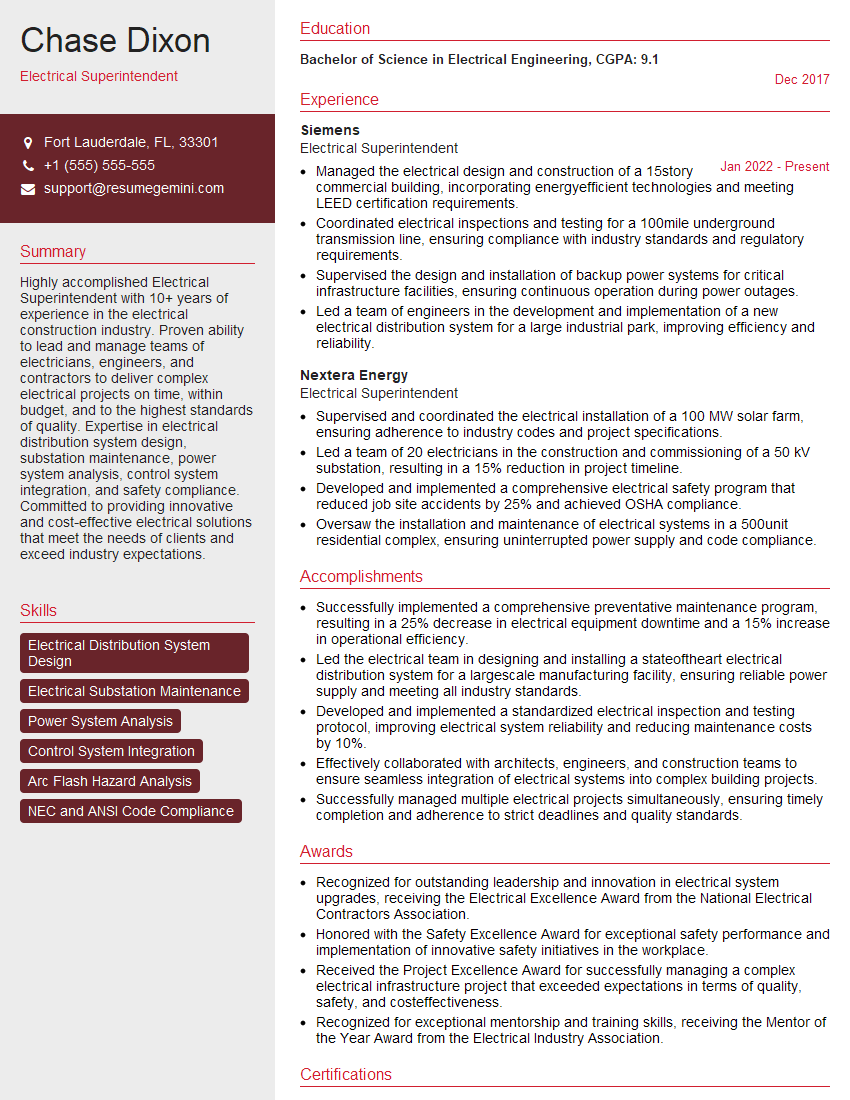
Electrical Superintendent Resume Sample
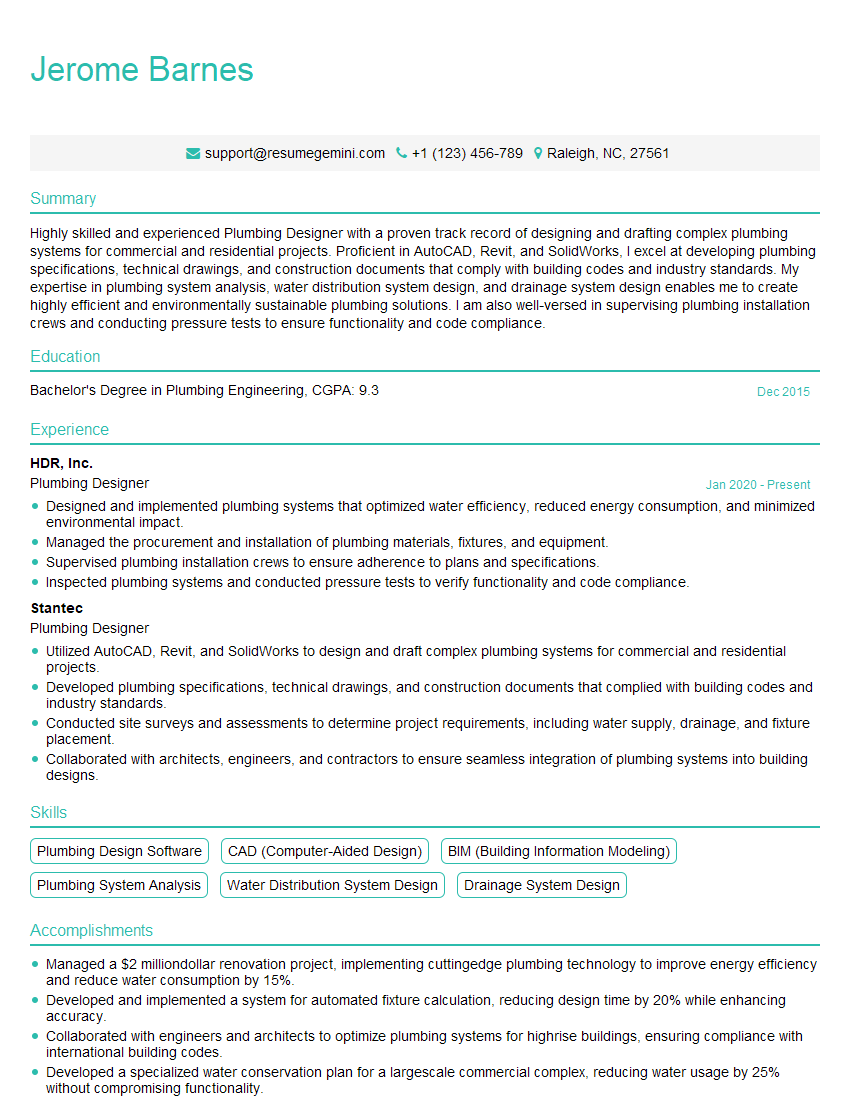
Plumbing Designer Resume Sample
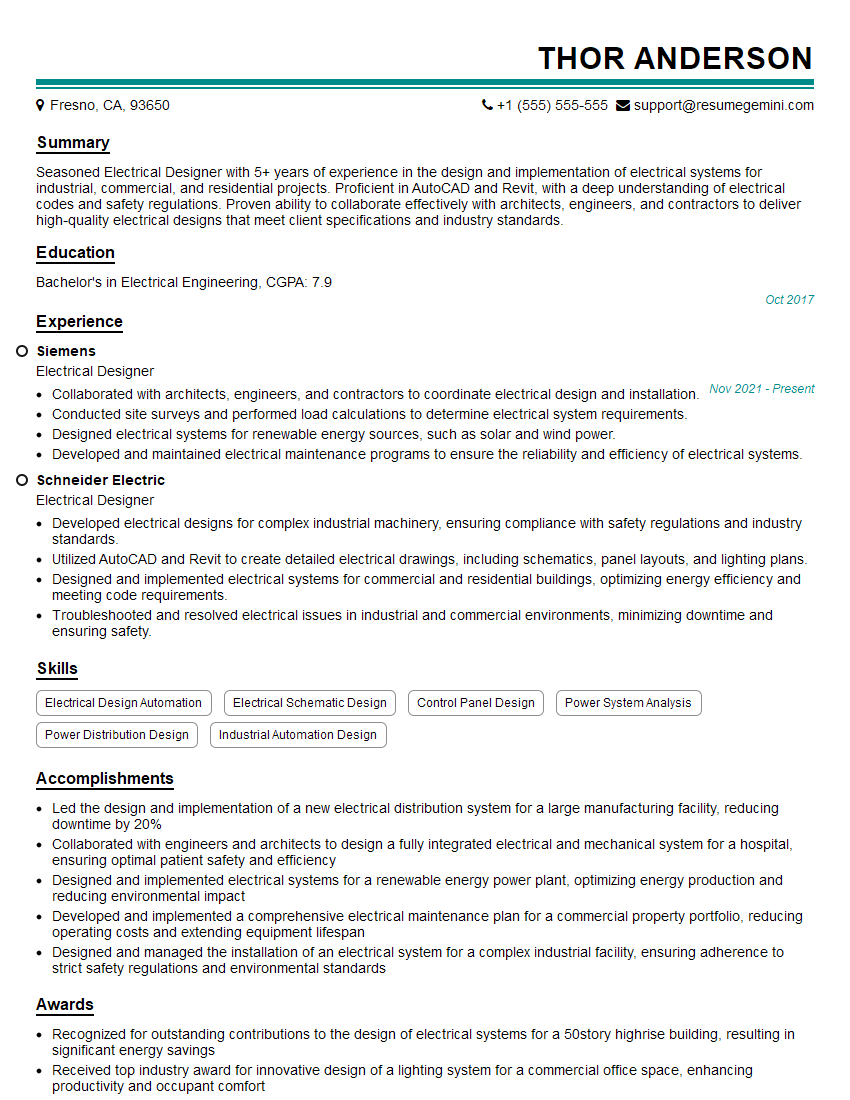
Electrical Designer Resume Sample
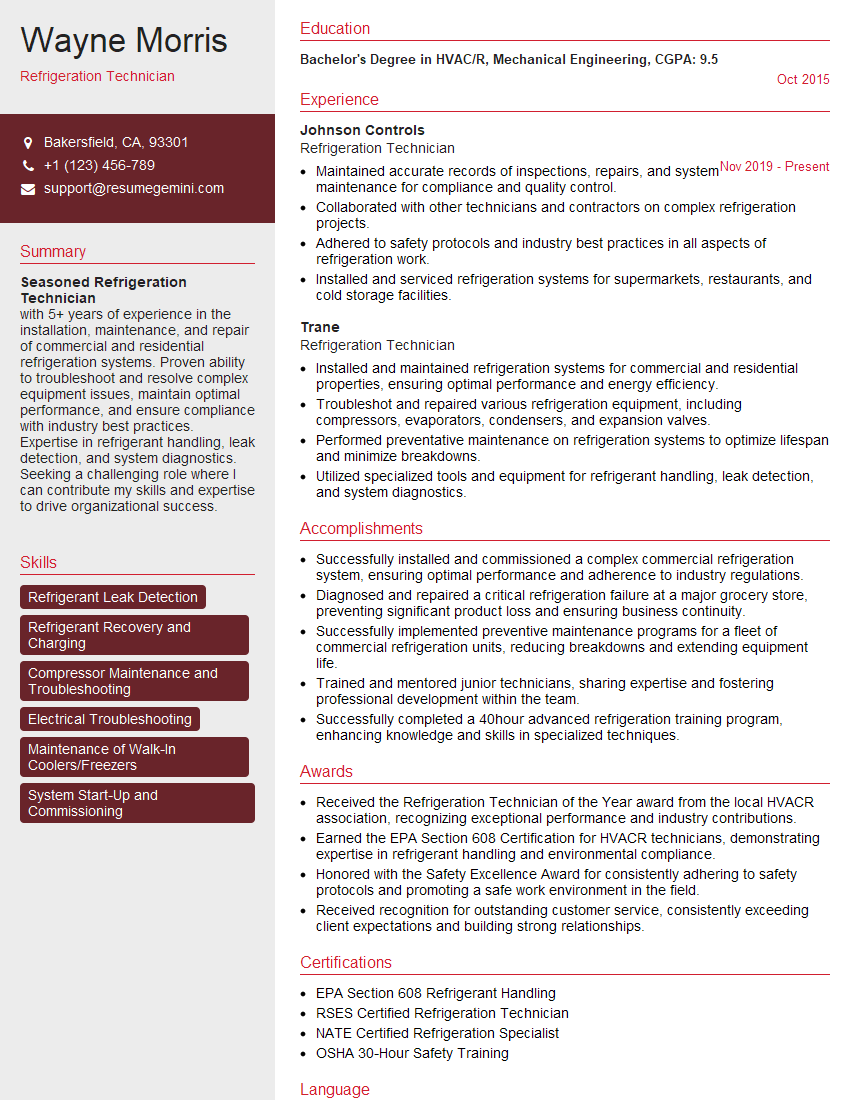
Refrigeration Technician Resume Sample
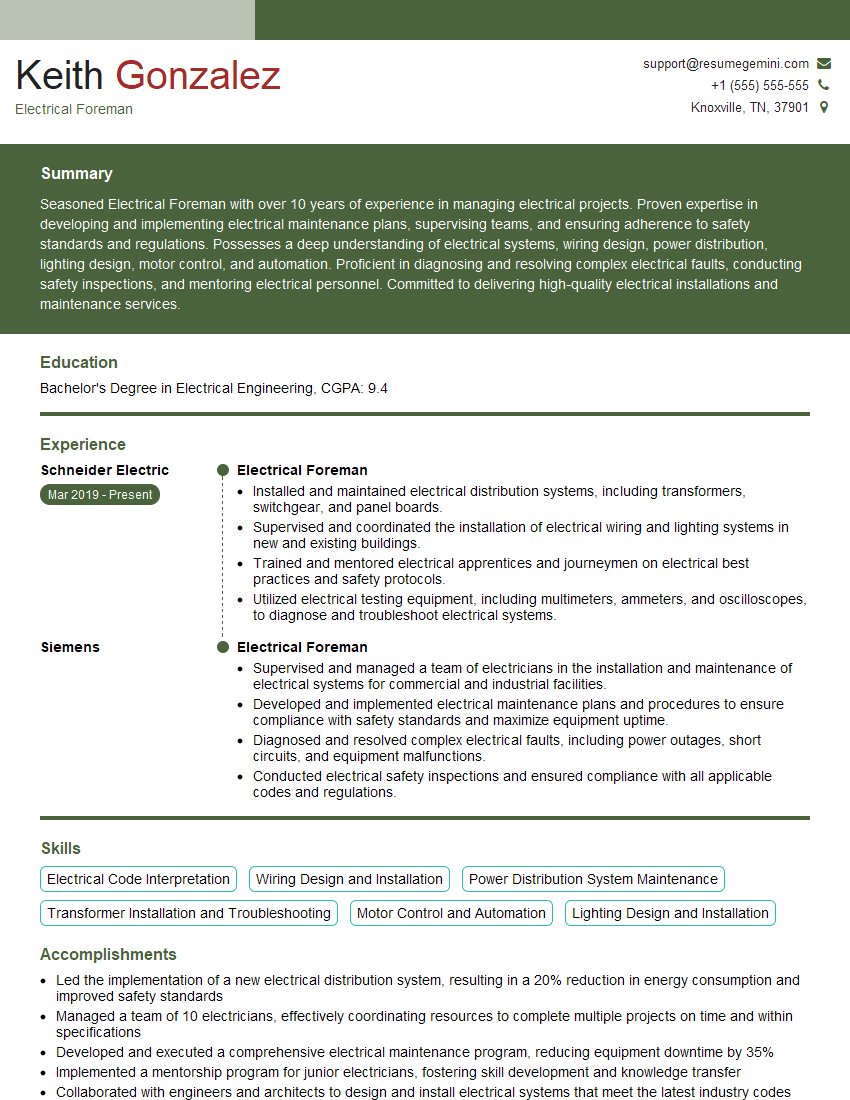
Electrical Foreman Resume Sample
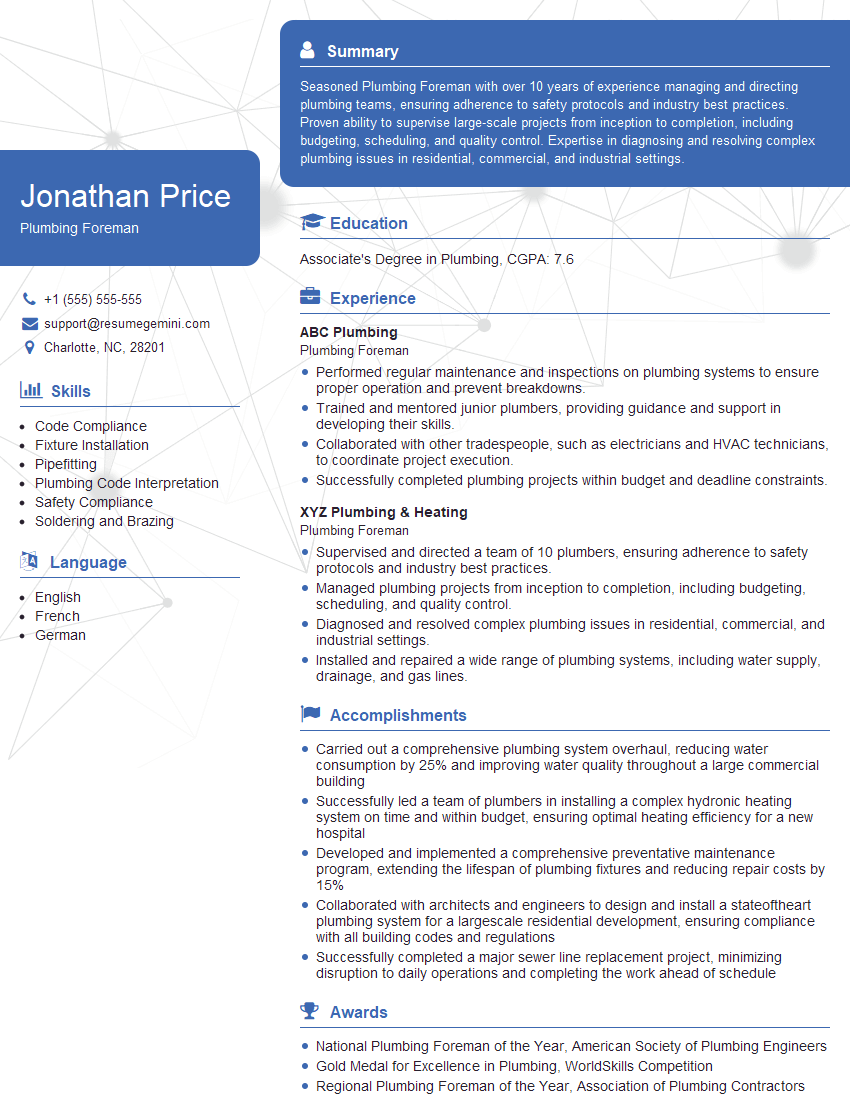
Plumbing Foreman Resume Sample
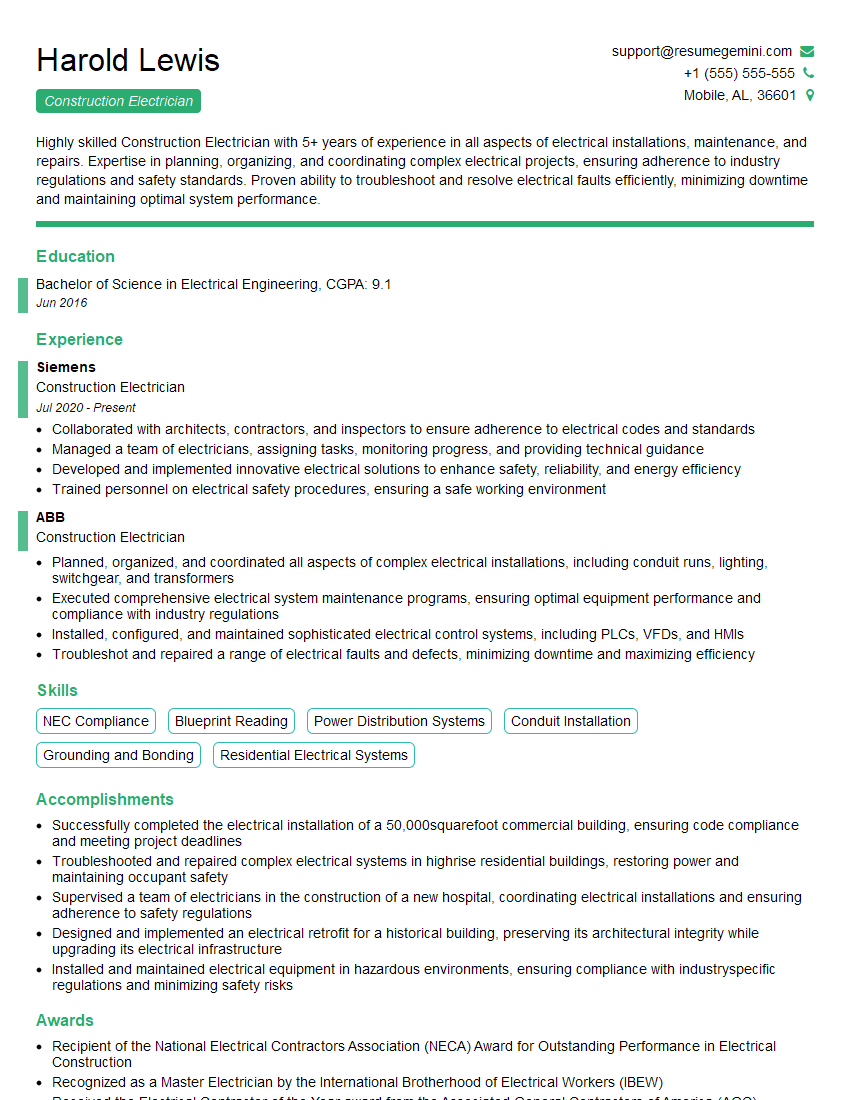
Construction Electrician Resume Sample
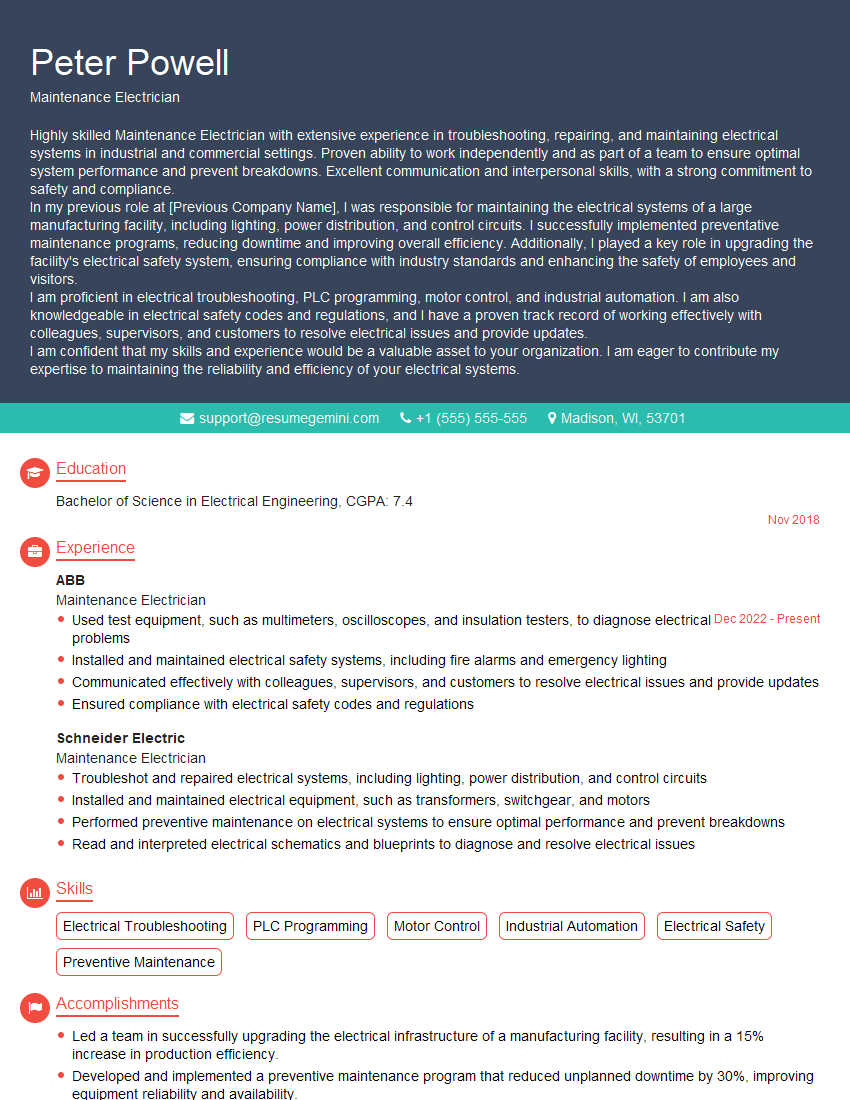
Maintenance Electrician Resume Sample
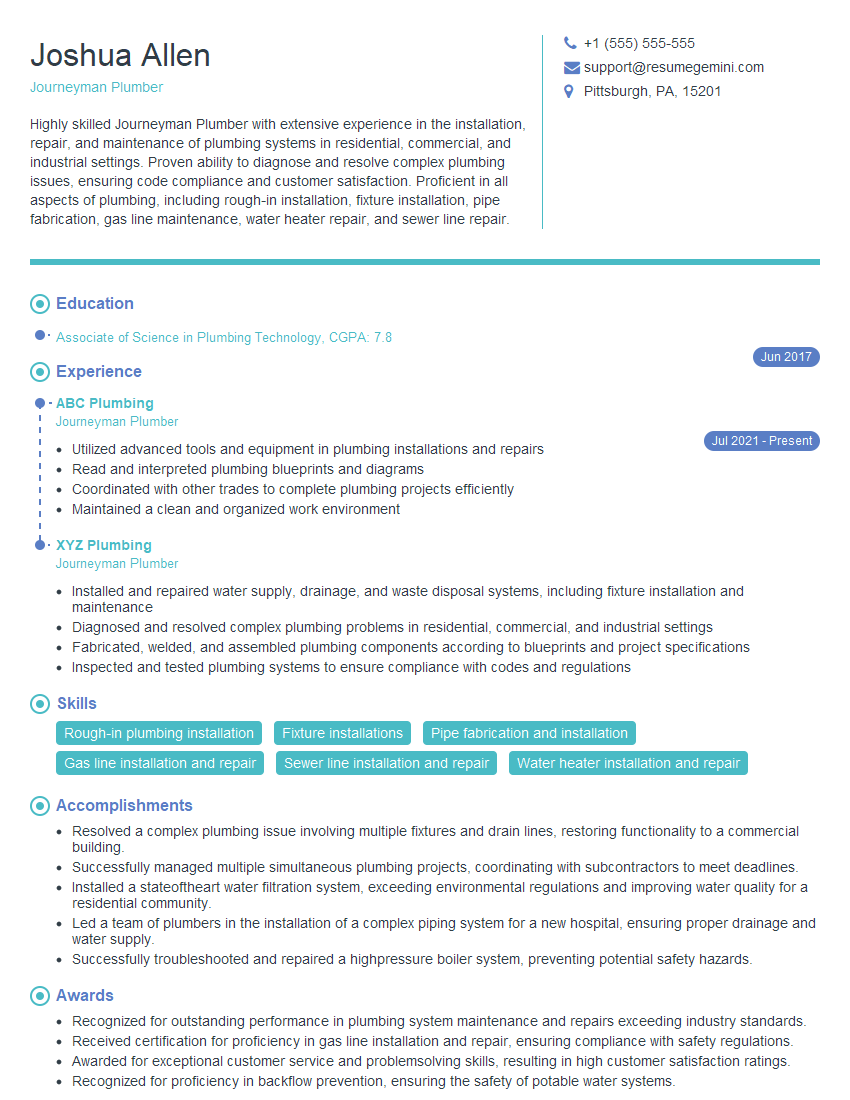
Journeyman Plumber Resume Sample
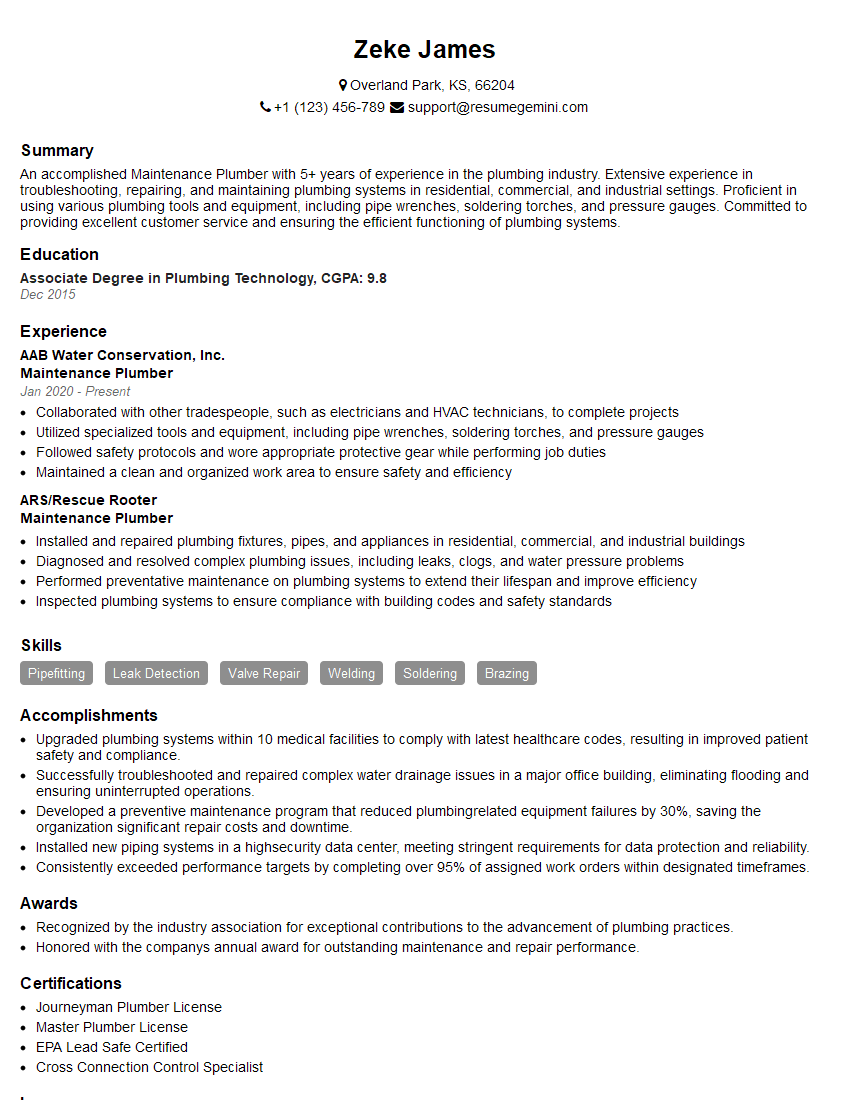
Maintenance Plumber Resume Sample
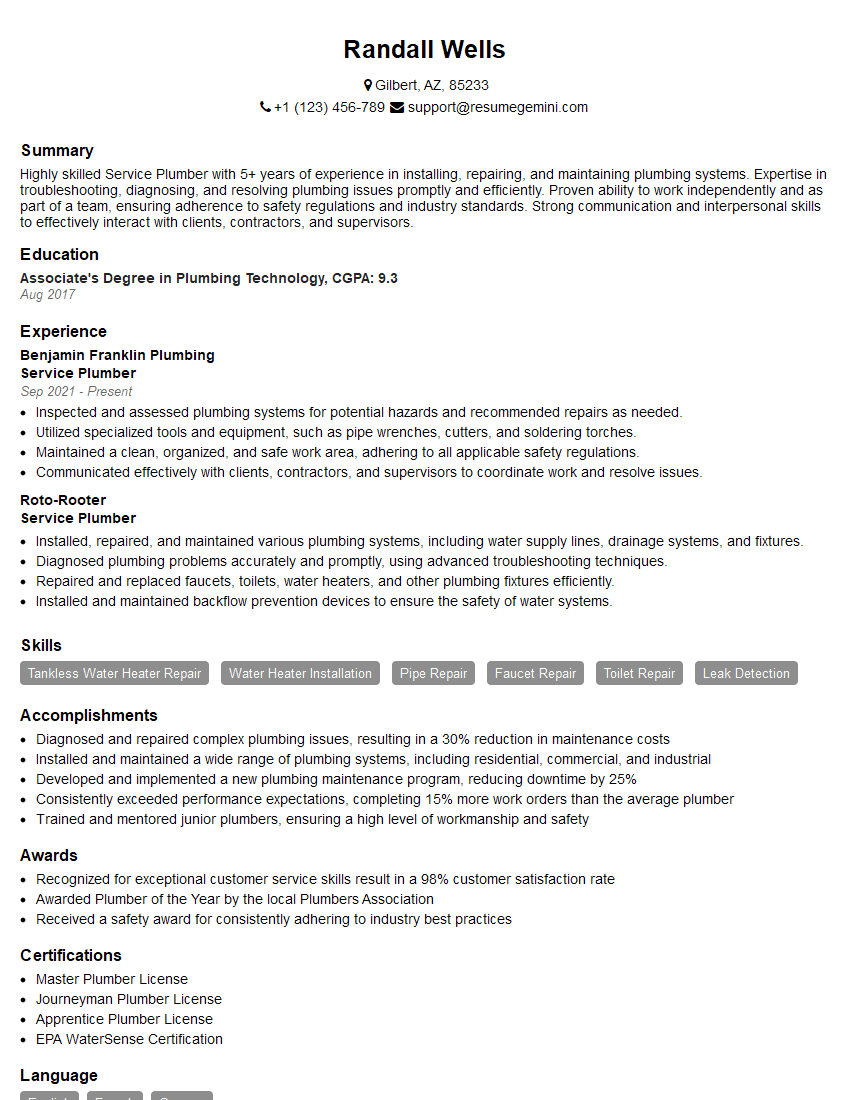
Service Plumber Resume Sample
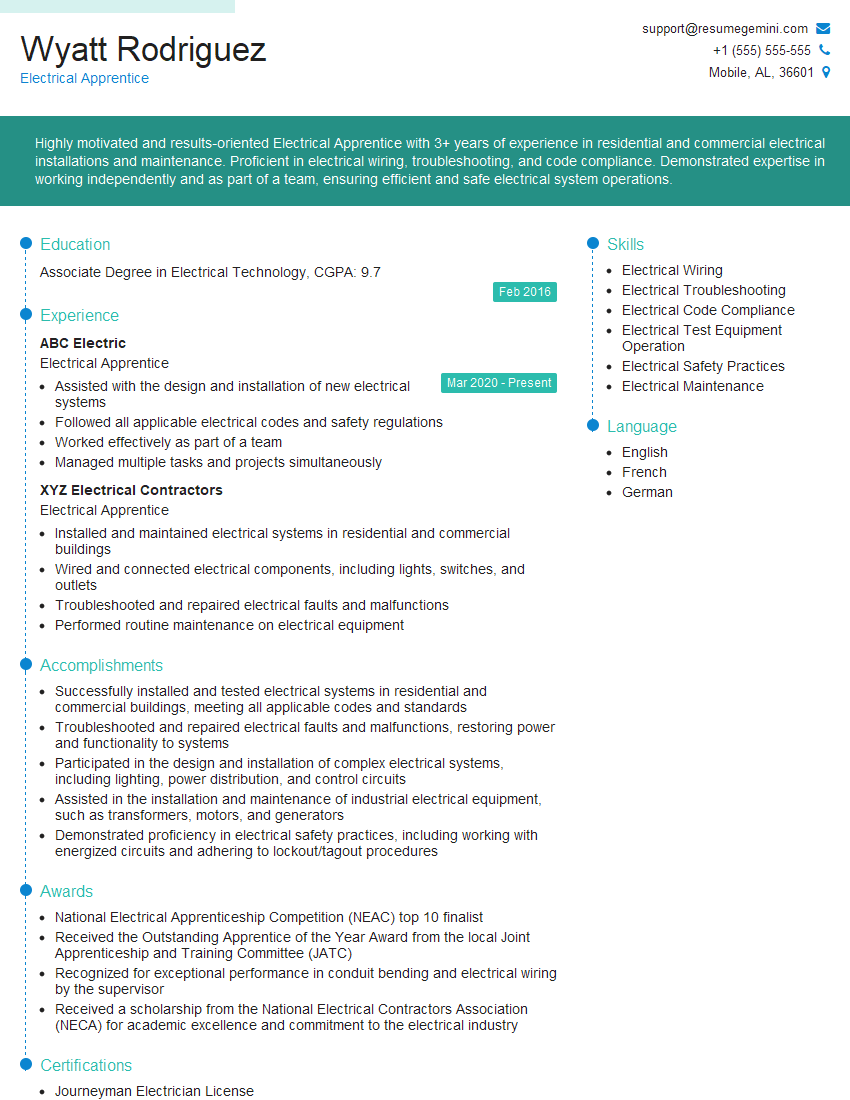
Electrical Apprentice Resume Sample
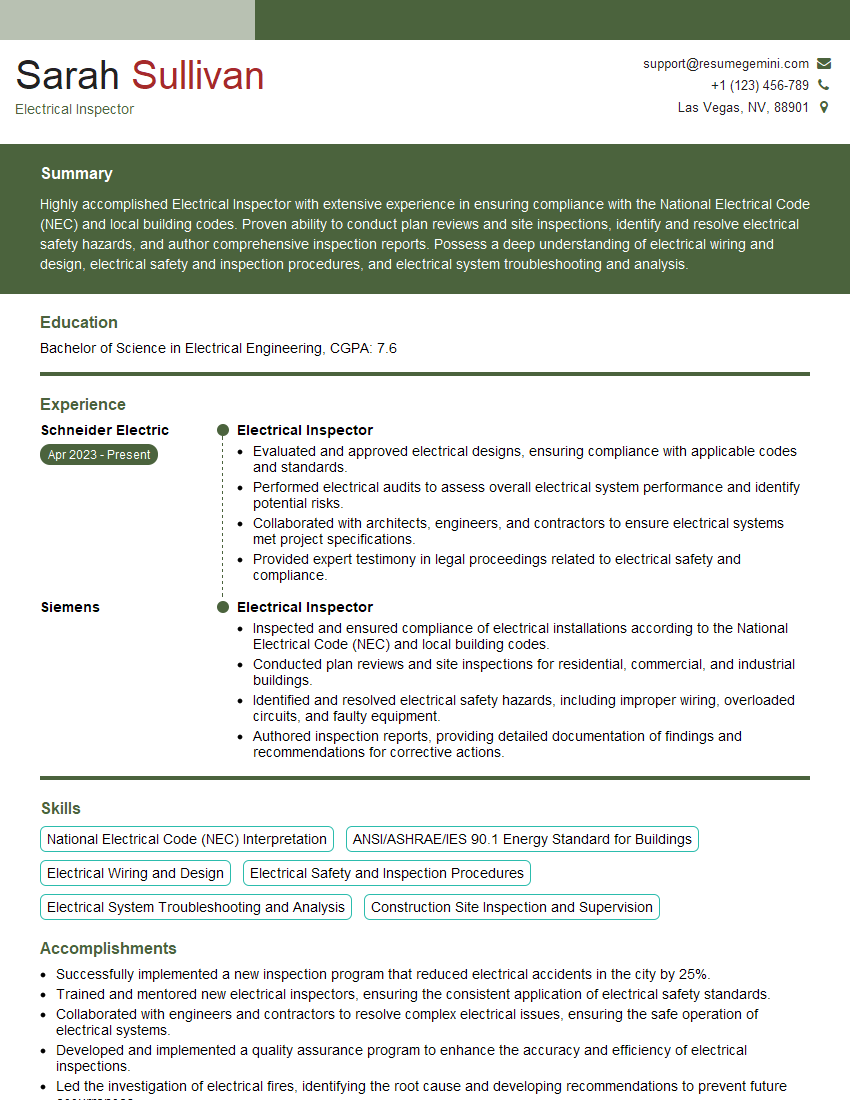
Electrical Inspector Resume Sample
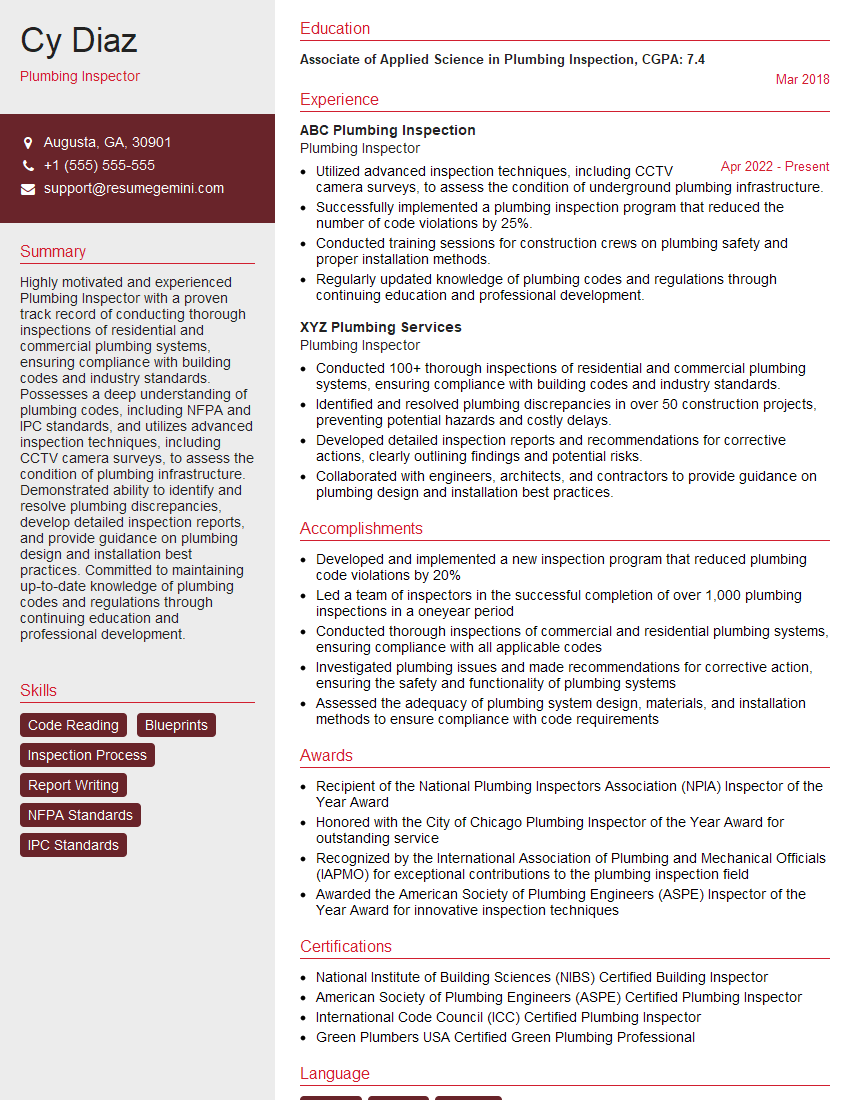
Plumbing Inspector Resume Sample
Explore more articles
Users Rating of Our Blogs
Share Your Experience
We value your feedback! Please rate our content and share your thoughts (optional).
What Readers Say About Our Blog
Very informative content, great job.
good