Preparation is the key to success in any interview. In this post, we’ll explore crucial PMI Analysis interview questions and equip you with strategies to craft impactful answers. Whether you’re a beginner or a pro, these tips will elevate your preparation.
Questions Asked in PMI Analysis Interview
Q 1. Explain the different types of project risk responses.
Project risk responses are strategies implemented to address identified project risks. They aim to either reduce the probability of a risk occurring or minimize its impact if it does. The Project Management Institute (PMI) identifies four main types:
- Avoidance: Eliminating the risk altogether. For example, if a risk is the reliance on a specific supplier with a history of delays, you might switch to a more reliable supplier. This is often the most proactive but not always the most feasible response.
- Mitigation: Reducing the probability or impact of the risk. This involves developing strategies to lessen the likelihood or severity of the negative event. For example, if the risk is a potential software bug, you could implement rigorous testing and code reviews to reduce the chance of bugs reaching production.
- Transference: Shifting the risk to a third party. This could involve purchasing insurance to cover potential losses from a specific risk, or outsourcing a high-risk task to a specialized vendor who carries that risk.
- Acceptance: Accepting the risk and its potential consequences. This might be the choice if the risk is low-impact or if the cost of mitigating it outweighs the potential damage. For example, a minor delay on a low-priority task might be acceptable.
The choice of response depends on a risk’s probability, impact, and the resources available to the project team. A risk register is used to document identified risks, their responses, and owners.
Q 2. Describe earned value management (EVM) and its key metrics.
Earned Value Management (EVM) is a project performance measurement technique that integrates scope, schedule, and cost data to provide a comprehensive assessment of project progress and performance. It helps project managers assess whether the project is on track, ahead, or behind schedule and budget. Key metrics include:
- Planned Value (PV): The budgeted cost of work scheduled to be completed at a given point in time. Think of it as the planned budget for a specific point.
- Earned Value (EV): The value of the work actually completed at a given point in time. This is determined by the percentage of work completed multiplied by the budget for the whole task.
- Actual Cost (AC): The actual cost incurred to complete the work performed at a given point in time.
Using these metrics, other critical indicators can be calculated:
- Schedule Variance (SV): EV – PV. A positive SV indicates the project is ahead of schedule, while a negative SV shows it’s behind.
- Cost Variance (CV): EV – AC. A positive CV indicates the project is under budget, while a negative CV shows it’s over budget.
- Schedule Performance Index (SPI): EV / PV. An SPI greater than 1 means the project is ahead of schedule; less than 1 indicates it’s behind.
- Cost Performance Index (CPI): EV / AC. A CPI greater than 1 means the project is under budget; less than 1 indicates it’s over budget.
Imagine building a house: PV might be the total budget for foundation work. EV is the value of the foundation work already finished. AC is the actual money spent on the foundation work so far. By comparing these, you gain a clear picture of the foundation phase’s progress and cost-effectiveness.
Q 3. How do you calculate the critical path in a project network diagram?
The critical path in a project network diagram is the sequence of activities that determines the shortest possible duration to complete the entire project. Any delay on activities on the critical path directly impacts the project’s overall completion time.
Calculating it involves:
- Forward Pass: Starting from the project’s beginning, calculate the earliest start (ES) and earliest finish (EF) times for each activity. The ES is the latest EF of its predecessor(s), and the EF is the ES plus the activity’s duration.
- Backward Pass: Starting from the project’s end, calculate the latest start (LS) and latest finish (LF) times for each activity. The LF is the earliest LF of its successor(s), and the LS is the LF minus the activity’s duration.
- Critical Path Identification: Activities with zero total float (TF = LS – ES = LF – EF) constitute the critical path. These activities cannot be delayed without delaying the entire project.
Imagine a simple project with three tasks: A (duration 5 days), B (duration 3 days), and C (duration 4 days). A must be completed before B and C, and B must be completed before C. The forward pass would show that C is the last activity, making the critical path A-C, with a total duration of 9 days.
Q 4. What are the key components of a project management plan?
A comprehensive project management plan is crucial for successful project execution. Key components include:
- Scope Management Plan: Describes how the project scope will be defined, validated, and controlled.
- Schedule Management Plan: Outlines how the project schedule will be developed, managed, and controlled, including methods for scheduling, resource allocation, and progress tracking.
- Cost Management Plan: Defines how project costs will be estimated, budgeted, and controlled. It details methods for cost control and variance analysis.
- Quality Management Plan: Describes how quality will be ensured throughout the project lifecycle. It outlines quality standards, control processes, and metrics.
- Resource Management Plan: Details how resources (human, material, equipment) will be acquired, allocated, and managed.
- Communications Management Plan: Defines how communication will be planned, managed, and monitored, including communication methods, frequency, and stakeholders.
- Risk Management Plan: Outlines how project risks will be identified, analyzed, responded to, and monitored.
- Procurement Management Plan: If applicable, it describes how goods and services will be procured from external vendors.
- Stakeholder Management Plan: Defines how stakeholder engagement and management will be conducted throughout the project.
A well-defined project management plan acts as a roadmap, ensuring alignment among team members and providing a clear framework for decision-making.
Q 5. What is the difference between a work breakdown structure (WBS) and a project network diagram?
Both the Work Breakdown Structure (WBS) and the project network diagram are crucial project planning tools, but they serve different purposes:
- Work Breakdown Structure (WBS): A hierarchical decomposition of the project scope into smaller, manageable components. It’s a deliverable-oriented structure, focusing on *what* needs to be done. It’s like a detailed outline of the project’s scope, showing the hierarchy of deliverables.
- Project Network Diagram: A graphical representation of the project’s activities and their dependencies. It shows the sequence of activities, their durations, and the relationships between them. It focuses on *how* and *when* the work will be done. It’s a visual roadmap of task dependencies and durations.
Imagine building a house. The WBS might break down the project into: Foundation, Walls, Roofing, Interior, Exterior. The network diagram shows the sequence: Foundation must be completed before Walls, Walls before Roofing, etc., along with the duration of each task. The WBS defines the deliverables, while the network diagram shows the workflow.
Q 6. Explain the concept of a project baseline and its importance.
A project baseline is a formally approved version of the project scope, schedule, and cost. It serves as a benchmark against which actual project performance is measured. It’s created after the project planning phase and is used to monitor progress and detect deviations.
Its importance lies in:
- Performance Measurement: Provides a standard to measure progress and identify variances.
- Change Control: Any changes to the baseline require a formal change request process, ensuring controlled modifications and preventing uncontrolled scope creep.
- Communication and Accountability: It creates a shared understanding of expectations among stakeholders, promoting transparency and accountability.
Think of it as a blueprint that is formally approved; any changes to the blueprint require approval before implementation. This prevents unplanned alterations that could lead to project delays and cost overruns.
Q 7. How do you handle schedule variances and cost variances in a project?
Schedule and cost variances indicate deviations from the project baseline. Handling them involves:
- Identify and Analyze: Use EVM metrics (SV, CV, SPI, CPI) to pinpoint the nature and extent of the variances. Understand the root causes behind the deviations. For example, is a schedule variance due to resource constraints, unforeseen technical challenges, or scope creep?
- Develop Corrective Actions: Create a plan to address the variances. This could involve accelerating critical tasks, reallocating resources, negotiating changes to the scope, or adjusting the budget. For example, if cost variance is negative (over budget), strategies might include streamlining processes, negotiating better deals with suppliers, or cutting back on non-critical elements.
- Implement and Monitor: Execute the corrective actions and carefully monitor their effectiveness. Track progress, revisit the root cause analysis if needed, and adjust the plans accordingly.
- Report and Communicate: Regularly communicate the status of the variances and the corrective actions to stakeholders. Transparency is key to maintaining trust and support.
Handling schedule and cost variances is an iterative process that requires proactive monitoring, effective communication, and a willingness to adjust the project plan as needed. This emphasizes the importance of rigorous monitoring and regular reporting to identify and rectify issues early.
Q 8. Describe different conflict resolution techniques.
Conflict resolution is a crucial skill for project managers. It involves identifying the source of conflict, understanding the perspectives of all involved parties, and finding a solution that satisfies everyone to the greatest extent possible. There isn’t one ‘best’ method, but several techniques are commonly employed, chosen based on the specific conflict and the personalities involved.
- Collaborating: This involves working together to find a solution that satisfies everyone’s needs. It’s ideal for complex issues requiring creative solutions and strong relationships. Example: Two team members have conflicting ideas for a marketing campaign. Instead of choosing one, they brainstorm together, combining the best elements of both ideas.
- Compromising: Each party gives up something to reach a mutually acceptable solution. It’s effective when time is limited or a quick resolution is needed. Example: Two departments need the same resource at the same time. They compromise by splitting the resource’s time or finding an alternative resource.
- Avoiding: This involves postponing the conflict or withdrawing from it. This is suitable for minor issues or when emotions are running high, allowing time to cool off. Example: A minor disagreement arises between team members during a stressful project phase. The manager chooses to address it later when everyone is less stressed.
- Accommodating: One party prioritizes the other party’s needs over their own. This is useful when the issue is more important to the other party or when maintaining harmony is crucial. Example: A senior developer prioritizes a junior developer’s request for help, even if it means slightly delaying his own task.
- Competing: One party imposes their solution. This approach is only appropriate in emergencies or when a quick, decisive action is required. Example: A critical project deadline is approaching, and a crucial decision needs to be made immediately. The project manager makes the call to ensure the deadline is met.
Choosing the right technique depends on the context. A skilled project manager will assess the situation, consider the personalities involved, and choose the approach most likely to lead to a positive outcome.
Q 9. What is the role of stakeholder management in project success?
Stakeholder management is absolutely paramount to project success. Stakeholders are anyone who is affected by or can affect the project. This includes clients, team members, management, users, and even the broader community. Effective stakeholder management ensures that everyone’s expectations are understood, managed, and met. This involves proactive communication, engagement, and conflict resolution.
Without it, projects can easily fail due to misunderstandings, unmet expectations, or lack of support. For example, if a key stakeholder is unhappy with the progress or direction of a project, they could withdraw funding or actively oppose the project’s completion. Conversely, keeping stakeholders informed and engaged promotes buy-in and collaboration, leading to a higher likelihood of achieving project goals within budget and on schedule. Think of it as building and maintaining positive relationships with everyone impacted by the project. Successful projects are built on strong stakeholder relationships.
Q 10. Explain the importance of risk register and risk management plan.
The Risk Register and Risk Management Plan are essential tools for proactive risk management. The Risk Register is a centralized repository of all identified risks, including their description, probability, impact, and assigned owner. It’s a living document, constantly updated as the project progresses and new information emerges. Think of it as a comprehensive checklist of potential problems.
The Risk Management Plan outlines the process for identifying, analyzing, responding to, and monitoring project risks. It details the methods used for risk identification (e.g., brainstorming, SWOT analysis), the criteria for assessing risk probability and impact, and the strategies for mitigating or responding to risks (e.g., avoidance, mitigation, transference, acceptance). This plan ensures a consistent and organized approach to risk management throughout the project lifecycle.
Both documents work together: the Risk Register documents the identified risks, while the Risk Management Plan lays out the framework for how those risks are managed. Without a well-maintained Risk Register and a robust Risk Management Plan, projects become highly vulnerable to unexpected events, potentially leading to delays, cost overruns, and even failure. A proactive approach to risk management, using these tools, minimizes these possibilities and maximizes the chances of project success.
Q 11. How do you prioritize project tasks?
Prioritizing project tasks is critical for efficient project execution. Various techniques exist, and the best approach often depends on the project’s nature and the available information. Here are some common methods:
- MoSCoW Method: Categorizes tasks into Must have, Should have, Could have, and Won’t have. This helps focus on essential tasks first.
- Prioritization Matrix (Eisenhower Matrix): Organizes tasks based on urgency and importance (Do, Decide, Delegate, Delete).
- Value vs. Effort: Plots tasks based on their value to the project and the effort required. High-value, low-effort tasks are prioritized first.
- Dependency Analysis: Identifies tasks that depend on others and sequences them accordingly. Critical path analysis is a sophisticated form of dependency analysis.
- Risk-Based Prioritization: Prioritizes tasks that pose the highest risk if delayed or not completed successfully.
Often, a combination of these methods is used. For instance, I might use the MoSCoW method to define the essential tasks and then apply a prioritization matrix to sequence those tasks based on urgency and importance. The key is to be transparent with the team about the chosen prioritization method and ensure everyone understands the rationale behind the sequencing of tasks.
Q 12. What is the purpose of a project charter?
The Project Charter formally authorizes the project and provides a high-level overview of the project’s objectives, scope, and expectations. Think of it as the project’s birth certificate and initial roadmap. It sets the stage for the entire project by outlining:
- Project Purpose and Objectives: Clearly defines what the project aims to achieve.
- Project Scope: Specifies what is included and excluded from the project.
- Stakeholders: Identifies key stakeholders and their roles.
- High-Level Requirements: Provides a summary of the key requirements.
- Project Manager and Team: Assigns roles and responsibilities.
- Budgetary Constraints: Defines the approved budget.
- Timeline: Provides a high-level timeline.
The Project Charter is a crucial document because it provides a common understanding of the project’s goals and boundaries for everyone involved. It serves as the foundation for subsequent project planning and execution. Without it, the project lacks a clear direction and authorization, making it difficult to manage effectively.
Q 13. What are some common project management methodologies?
Many project management methodologies exist, each with its own strengths and weaknesses. Some common ones include:
- Waterfall: A linear, sequential approach where each phase must be completed before the next begins.
- Agile: An iterative and incremental approach emphasizing flexibility and collaboration.
- Scrum: A framework within Agile focusing on short, iterative cycles (sprints).
- Kanban: A visual workflow management system focusing on limiting work in progress.
- Lean: A methodology focused on eliminating waste and maximizing value.
- PRINCE2: A structured framework emphasizing control and governance.
The choice of methodology depends on the project’s nature, size, complexity, and the organization’s culture. For instance, Waterfall is suitable for well-defined projects with stable requirements, while Agile is preferred for projects with evolving requirements and a need for flexibility.
Q 14. What is the difference between agile and waterfall methodologies?
Waterfall and Agile are two fundamentally different approaches to project management. Waterfall is a sequential process; each phase is completed before moving to the next. Requirements are defined upfront and changes are difficult and costly to implement. It’s best suited for projects with stable, well-understood requirements. Think of it as building a house step-by-step, from foundation to roof.
Agile, on the other hand, is iterative and incremental. It focuses on delivering working software frequently through short cycles called sprints. Requirements can evolve throughout the project, and collaboration with stakeholders is central. It’s ideal for projects with evolving requirements, a need for flexibility, and a focus on delivering value quickly. Think of it as building a house in modular sections, adapting the design as you go based on feedback.
The key difference lies in their flexibility and adaptability. Waterfall is rigid and change-averse, while Agile embraces change and adapts to evolving needs. Choosing between the two depends on the project’s specific needs and context.
Q 15. How do you create a project budget?
Creating a project budget involves a thorough estimation of all costs associated with completing the project. It’s not just about adding up numbers; it’s a strategic process that requires careful planning and consideration of various factors.
Step 1: Define the Scope: Clearly define the project deliverables and activities. A well-defined scope is crucial to prevent cost overruns. For example, if you’re building a house, define the specifics: materials, labor, permits, etc. Avoid vague descriptions.
Step 2: Resource Estimation: Identify all resources needed – materials, labor, equipment, software licenses, etc. Estimate the cost of each resource. Consider potential price fluctuations and buffer for unexpected expenses. Using historical data, if available, provides a strong baseline.
Step 3: Activity Costing: Assign costs to each task or activity identified in the project schedule. This usually involves estimating the time required for each task and multiplying it by the cost of the resources involved. For example, painting a room might require two workers for four hours at $50 per hour each, totaling $400.
Step 4: Contingency Planning: Build a contingency buffer (typically 5-10% of the total budget) to account for unforeseen risks and issues. This is crucial for absorbing unexpected cost overruns.
Step 5: Review and Approval: The budget should be reviewed and approved by relevant stakeholders to ensure alignment and accountability. Regular reviews throughout the project lifecycle are essential.
Example: Imagine building a website. You’d estimate costs for design ($2000), development ($5000), testing ($500), content creation ($1000), and hosting ($200/year). Adding a 10% contingency ($920), the total budget would be approximately $9620.
Career Expert Tips:
- Ace those interviews! Prepare effectively by reviewing the Top 50 Most Common Interview Questions on ResumeGemini.
- Navigate your job search with confidence! Explore a wide range of Career Tips on ResumeGemini. Learn about common challenges and recommendations to overcome them.
- Craft the perfect resume! Master the Art of Resume Writing with ResumeGemini’s guide. Showcase your unique qualifications and achievements effectively.
- Don’t miss out on holiday savings! Build your dream resume with ResumeGemini’s ATS optimized templates.
Q 16. How do you track project progress against the baseline?
Tracking project progress against the baseline involves comparing planned performance with actual performance. The baseline is essentially the approved project plan – including the schedule, budget, and scope. Monitoring deviations allows for timely corrective actions.
Methods for Tracking:
- Earned Value Management (EVM): A powerful technique using metrics like Planned Value (PV), Earned Value (EV), and Actual Cost (AC) to assess project performance. It provides insights into schedule and cost variance.
- Gantt Charts: Visually represent the schedule, showing planned versus actual completion of tasks. Deviations are easily identified.
- Progress Reports: Regular status reports (weekly, bi-weekly) summarizing progress, identifying issues, and projecting future performance. These often include dashboards and key performance indicators (KPIs).
- Meetings and Reviews: Regular meetings with the project team and stakeholders to discuss progress, resolve issues, and make necessary adjustments to the plan.
Addressing Deviations: Once deviations are identified (e.g., tasks behind schedule or budget overruns), analyze the root causes and implement corrective actions. This might involve adjusting the schedule, reallocating resources, or renegotiating scope.
Example: If a task was planned to be completed by week 5 but is only 50% complete, you’d identify the reasons for delay (e.g., resource unavailability, unexpected technical issues). The corrective action might involve adding resources or re-prioritizing tasks.
Q 17. Explain the concept of critical chain project management.
Critical Chain Project Management (CCPM) is a method that focuses on managing the project’s critical chain – the longest sequence of dependent tasks determining the project’s overall duration. Unlike traditional methods that focus on individual task durations and buffers, CCPM focuses on resource constraints and project completion time.
Key Concepts:
- Critical Chain: The sequence of tasks with the least total float that determines the project duration.
- Resource Constraints: CCPM explicitly acknowledges resource limitations and their impact on the project schedule.
- Project Buffers: Instead of adding buffers to individual tasks, CCPM uses project buffers placed at the end of the critical chain to absorb any unforeseen delays.
- Feeding Buffers: Buffers are sometimes placed before major milestones or critical tasks to protect against delays in earlier stages.
Benefits: CCPM improves project predictability by focusing on resource constraints and reducing multi-tasking, resulting in more realistic schedules and timely project completion. It promotes better resource allocation and improves overall project success rates.
Example: In a software development project, the critical chain might be the sequence of coding, testing, and deployment. Instead of adding buffers to each phase, a single project buffer is added at the end to account for unforeseen delays during any stage.
Q 18. Describe different types of project communication plans.
Project communication plans outline how information will be shared among stakeholders throughout the project lifecycle. Effective communication is vital for project success. Different plans cater to various project needs and stakeholder preferences.
Types of Communication Plans:
- Formal Communication: Includes structured documents like project charters, reports, meeting minutes, and presentations. This ensures clear documentation and a formal record of discussions and decisions.
- Informal Communication: Uses less formal methods like email, instant messaging, and casual conversations. Facilitates quick information exchange but may lack documentation for future reference.
- Verbal Communication: Face-to-face meetings, phone calls, and presentations. Allows for immediate feedback and clarification, but it is not always easily documented.
- Written Communication: Emails, letters, reports, and presentations. Provides a written record of communication, but may lack the immediacy of verbal communication.
- Visual Communication: Gantt charts, dashboards, and other visual aids. Effectively convey complex information concisely.
Effective Communication Plans: A well-defined plan should identify stakeholders, communication methods, frequency of communication, responsible parties, and escalation procedures for handling critical issues.
Example: A construction project might use a combination of formal reports for progress updates, informal email communication for day-to-day queries, and meetings for addressing critical issues. A detailed communication matrix would define who needs what information, when, and how.
Q 19. How do you handle changes to project scope?
Handling changes to project scope requires a systematic and controlled approach to ensure that the project remains on track and within budget. Scope creep – uncontrolled changes – is a major source of project failure.
Process for Handling Scope Changes:
- Change Request: Any scope change should be formally documented as a change request. This should clearly describe the proposed change, its impact on the project timeline and budget, and justification.
- Change Control Board (CCB): A designated group evaluates the change request and its implications. They consider the impact on cost, schedule, and quality.
- Impact Assessment: The CCB analyzes the impact of the change on various project aspects. This may involve updating the project plan, budget, and schedule.
- Approval or Rejection: The CCB approves or rejects the change request based on the impact assessment and project goals.
- Implementation: If approved, the change is incorporated into the project plan and executed. This may involve updating the project documentation and communicating the changes to the project team and stakeholders.
Importance of Documentation: Maintain a detailed record of all scope changes, including the change request, impact analysis, approval process, and implementation details. This helps to manage risk and ensure accountability.
Example: If a client requests a new feature in a software development project after the initial scope has been defined, a formal change request needs to be submitted, evaluated, approved (or rejected), and incorporated into the project plan, with appropriate adjustments to the schedule and budget.
Q 20. What is the purpose of a project closure report?
The purpose of a project closure report is to formally document the completion of a project, summarize its performance, and provide lessons learned for future projects. It’s a critical step in the project lifecycle, serving as a valuable record for organizational learning.
Key Elements of a Project Closure Report:
- Project Summary: Brief overview of the project goals, objectives, and key accomplishments.
- Performance Evaluation: Assessment of the project’s performance against the baseline plan, including schedule, budget, and scope adherence.
- Lessons Learned: Identification of successes and failures during the project. This should include recommendations to avoid similar problems in future endeavors.
- Financial Summary: Detailed overview of project costs and budget variances. Explains any overruns or savings.
- Stakeholder Feedback: Summary of feedback received from key stakeholders on the project outcomes and performance.
- Recommendations: Suggestions for improving project management processes and practices based on lessons learned.
Benefits: Closure reports serve as a valuable repository of knowledge, providing insights into project success factors, contributing to organizational learning, improving future project outcomes, and facilitating knowledge transfer.
Example: After completing a software development project, the closure report would summarize the delivered features, assess if the project met the initial schedule and budget, note any significant challenges faced and how they were overcome, highlight successful approaches, and recommend changes to the development process for future projects.
Q 21. Explain the importance of project documentation.
Project documentation is crucial for successful project management. It provides a central repository of information, facilitating communication, monitoring progress, and managing risks. Thorough documentation minimizes confusion and ensures project continuity.
Importance of Project Documentation:
- Improved Communication: Provides a single source of truth for all stakeholders, reducing misunderstandings and ensuring everyone is on the same page.
- Effective Monitoring and Control: Allows for tracking progress against the plan and identifying potential issues early on.
- Risk Management: Documents potential risks, mitigation strategies, and contingency plans.
- Knowledge Transfer: Facilitates the sharing of knowledge and lessons learned with future projects.
- Accountability: Provides a clear record of decisions, actions, and responsibilities.
- Auditing and Compliance: Supports compliance with regulations and industry standards.
Types of Project Documentation: This includes project charters, plans (schedule, budget, communication, risk), requirements documentation, meeting minutes, reports, and lessons learned documents.
Example: A software development project requires detailed documentation of user stories, technical specifications, test cases, and release notes. This ensures that the final product meets the requirements and that everyone understands the system’s functionality.
Q 22. Describe your experience using project management software.
Throughout my career, I’ve extensively utilized various project management software, including Microsoft Project, Jira, and Asana. My experience spans from simple task management to complex project scheduling and resource allocation. For instance, in a recent project involving the development of a new mobile application, we used Jira to track tasks, assign resources, and monitor progress. Its Kanban board functionality was particularly useful for visualizing the workflow and identifying bottlenecks. In another project, Microsoft Project’s Gantt chart capabilities were crucial for scheduling interdependent tasks and managing dependencies effectively. My proficiency extends to utilizing these tools’ reporting functionalities to generate progress updates, track burn-down charts, and analyze project performance against the baseline plan. I’m also comfortable adapting to new software as needed and am always eager to learn and implement best practices for optimal utilization.
Q 23. How do you manage project resources effectively?
Effective resource management is a cornerstone of successful project delivery. My approach involves a multi-pronged strategy beginning with thorough resource identification and planning. This includes identifying all necessary resources – human, material, financial, and technological – and estimating their availability and requirements. I use techniques like Resource Leveling and Resource Smoothing within project management software to optimize resource allocation and prevent over-allocation. For example, if a particular team member is overloaded, I’ll analyze the project schedule, assess task dependencies, and potentially re-allocate tasks or adjust timelines to ensure they aren’t overburdened. Regular monitoring and communication are key. I actively track resource utilization, identify potential conflicts early, and proactively address any resource constraints through communication with team members and stakeholders. This often involves negotiating priorities and securing additional resources where necessary. Ultimately, the goal is to optimize resource usage while maintaining project schedule and quality.
Q 24. How do you identify and mitigate project risks?
Risk management is an ongoing process that starts at the project’s inception. I begin by conducting a thorough risk assessment, using tools like SWOT analysis and brainstorming sessions with the project team. This helps identify potential risks, their likelihood, and potential impacts. I then prioritize these risks based on their severity using a risk matrix. For example, a high-likelihood, high-impact risk, such as a key supplier’s delay, would demand immediate attention. For each identified risk, I develop mitigation strategies. These strategies can be proactive, like implementing quality control measures to prevent defects, or reactive, like having contingency plans for potential delays. The chosen strategies are documented within a risk register, which is regularly reviewed and updated throughout the project lifecycle. This ensures that our response remains appropriate as the project progresses and new risks may emerge. For example, on a past project involving a software implementation, we identified the risk of inadequate user training. We mitigated this by creating a comprehensive training program and conducting pilot testing with a smaller user group, allowing us to refine the training before widespread rollout.
Q 25. What are the key performance indicators (KPIs) you would track for a project?
The KPIs I track depend on the specific project objectives, but generally, I focus on a combination of cost, schedule, and scope KPIs. These include:
- Schedule Variance (SV): Measures the difference between earned value and planned value, indicating schedule performance.
- Cost Variance (CV): Shows the difference between earned value and actual cost, highlighting cost performance.
- Schedule Performance Index (SPI): Indicates the efficiency of the schedule, showing if the project is ahead or behind schedule.
- Cost Performance Index (CPI): Shows cost efficiency, indicating whether the project is over or under budget.
- Burn-down Charts: Visual representation of remaining work versus time, providing insights into progress and potential issues.
- Defect Rate: Tracks the number of defects discovered and rectified, indicating quality control effectiveness.
Q 26. Describe a time you had to make a difficult decision in a project.
In a previous project, we faced a critical situation where a key component of the software we were developing failed unexpectedly just a week before the launch date. The decision to either postpone the launch, impacting our client’s marketing campaign, or proceed with a potential risk of significant post-launch issues was incredibly difficult. We held a meeting with the entire project team, client representatives, and stakeholders. After a thorough analysis, weighing the pros and cons of each option, and considering the potential costs and risks associated with both choices, we decided to implement a temporary workaround, delaying some minor features to address the most critical issues, and launch the project on time. While this involved significant extra work, it preserved the client’s marketing plans and prevented major financial losses. This decision reinforced the importance of risk mitigation strategies, transparent communication, and collaborative decision-making in handling high-pressure situations.
Q 27. Explain your understanding of the PMI Code of Ethics and Professional Conduct.
The PMI Code of Ethics and Professional Conduct serves as a guiding framework for project managers, emphasizing responsibility, respect, fairness, and honesty. It outlines four key values: responsibility, respect, fairness, and honesty. These values are woven into every aspect of project management, from stakeholder communication to resource allocation. For example, the principle of responsibility mandates that I take ownership of my decisions and actions and hold myself accountable for project outcomes. Respect requires that I treat all stakeholders with dignity and consider their perspectives. Fairness dictates that I allocate resources and opportunities equitably and provide equal chances for success. Honesty necessitates that I provide accurate and transparent information to all stakeholders, even in challenging circumstances. Adherence to this Code ensures ethical conduct and builds trust, essential for the success of any project and the overall reputation of the project management profession.
Q 28. How do you use data analysis to inform project decisions?
Data analysis is fundamental to informed decision-making in project management. I utilize data from various sources – project management software, progress reports, stakeholder feedback, and financial records – to track performance against baselines, identify trends, and predict potential issues. For example, using earned value management (EVM) data, I can analyze the cost and schedule performance of a project, identify areas where we are underperforming or overspending, and then take corrective actions to stay on track. Data visualization tools such as dashboards and charts help to communicate complex information clearly and concisely to stakeholders. Predictive analytics, incorporating historical project data and trend analysis, helps anticipate potential problems and allows proactive adjustments. By proactively analyzing project data and using it to inform decision making, I can enhance project performance, optimize resource utilization, and mitigate risks effectively, leading to more successful project outcomes.
Key Topics to Learn for PMI Analysis Interview
- Understanding Project Management Institute (PMI) Standards: Familiarize yourself with the core principles and methodologies outlined by PMI, including Agile and Waterfall approaches. This forms the foundation of any PMI-related role.
- Project Initiation and Planning: Master the techniques involved in defining project scope, objectives, and deliverables. Practice applying these concepts to hypothetical scenarios.
- Risk Management in PMI Analysis: Learn to identify, analyze, and mitigate potential project risks. Understand the various risk response strategies and their application.
- Resource Allocation and Management: Develop a strong understanding of how to effectively allocate resources (human, financial, material) throughout the project lifecycle, considering constraints and optimization techniques.
- Communication and Stakeholder Management: Practice effective communication strategies for keeping stakeholders informed and engaged. Understanding the importance of clear, concise reporting is crucial.
- Monitoring and Controlling: Grasp the methods for tracking progress against the project plan, identifying deviations, and implementing corrective actions. Learn to analyze project performance data.
- Earned Value Management (EVM): Understand the principles and calculations behind EVM, a key technique for measuring project performance and forecasting completion.
- Closing and Post-Project Review: Understand the processes involved in formally closing a project and conducting a thorough post-project review to learn from experiences and improve future projects.
- Problem-Solving and Decision-Making: Develop your ability to analyze complex situations, identify root causes, and propose effective solutions within a project management context.
Next Steps
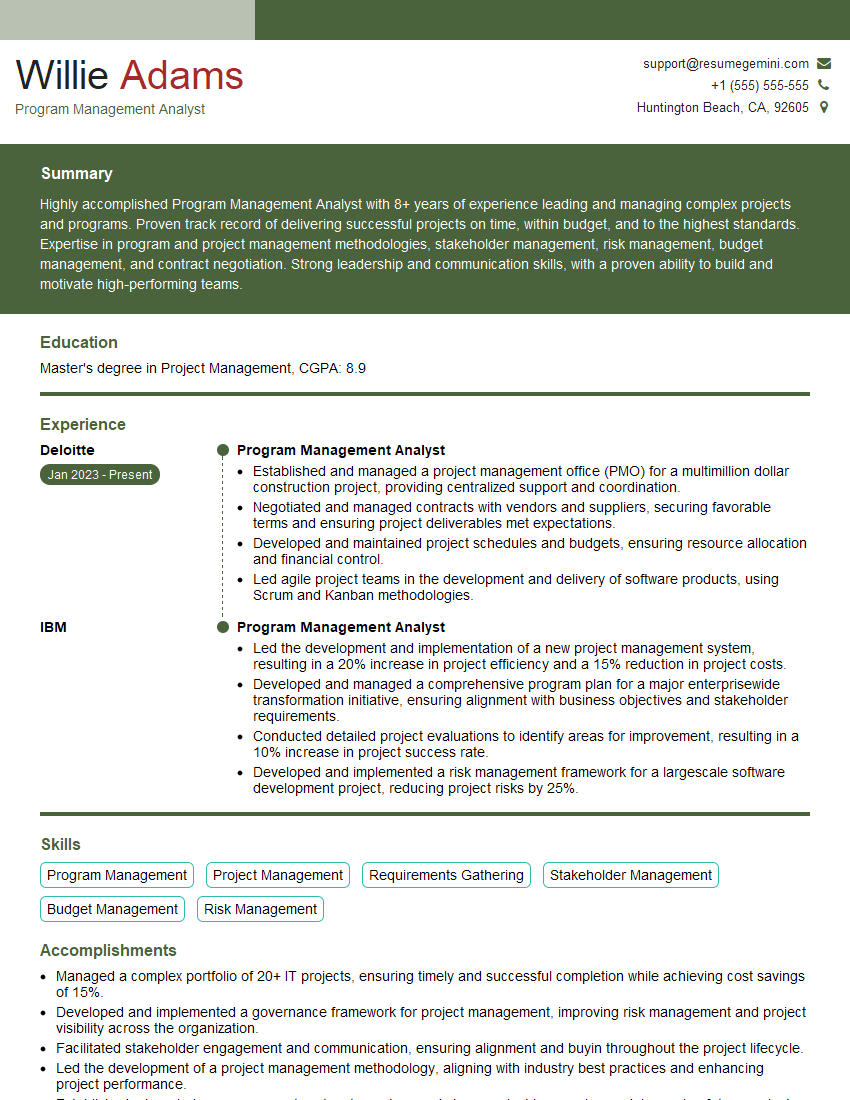
Mastering PMI Analysis significantly enhances your career prospects in project management, opening doors to leadership roles and higher earning potential. To maximize your chances of landing your dream job, crafting an ATS-friendly resume is essential. This ensures your qualifications are effectively communicated to hiring managers. We strongly recommend leveraging ResumeGemini to build a professional and impactful resume. ResumeGemini provides a user-friendly platform and offers examples of resumes tailored to PMI Analysis roles to help you present your skills and experience in the best possible light.
Explore more articles
Users Rating of Our Blogs
Share Your Experience
We value your feedback! Please rate our content and share your thoughts (optional).
What Readers Say About Our Blog
Very informative content, great job.
good