The right preparation can turn an interview into an opportunity to showcase your expertise. This guide to Precision Agriculture Principles interview questions is your ultimate resource, providing key insights and tips to help you ace your responses and stand out as a top candidate.
Questions Asked in Precision Agriculture Principles Interview
Q 1. Explain the core principles of precision agriculture.
Precision agriculture, also known as precision farming, is a management strategy that uses information technology to enhance farming practices. Its core principles revolve around site-specific crop management, meaning that inputs (fertilizers, pesticides, water, etc.) are applied only where and when needed, optimizing resource use and minimizing environmental impact. This contrasts sharply with traditional farming’s blanket application methods. The principles can be summarized as:
- Site-Specific Management: Tailoring practices to the unique characteristics of each field area.
- Data Integration and Analysis: Combining data from various sources (sensors, satellite imagery, GPS) to gain insights.
- Variable Rate Technology (VRT): Applying inputs at varying rates across the field based on identified needs.
- Technology Integration: Employing a range of technologies (GPS, sensors, GIS software) to collect, analyze, and act on data.
- Decision Support Systems: Using software and algorithms to assist in making informed management decisions.
For instance, instead of applying the same amount of fertilizer across an entire field, precision agriculture would identify areas with nutrient deficiencies and only apply fertilizer to those specific locations, thus reducing costs and minimizing environmental runoff.
Q 2. Describe the role of GPS/GNSS in precision farming.
GPS (Global Positioning System) and GNSS (Global Navigation Satellite System), which encompasses GPS and other satellite-based positioning systems like GLONASS and Galileo, are fundamental to precision agriculture. They provide the spatial location data necessary for site-specific management. By accurately determining the location of farm machinery, GPS/GNSS enables:
- Precision Mapping: Creating maps of fields showing variations in soil properties, crop health, and yield.
- Variable Rate Application: Guiding machinery to apply inputs at varying rates across the field, based on the maps.
- Automated Steering: Enabling autonomous or assisted steering of tractors and other machinery, reducing overlap and improving efficiency.
- Data Logging: Recording the location and timing of all field operations.
Imagine a farmer using GPS-guided equipment to apply fertilizer. The system ensures the fertilizer is applied only where it’s needed, preventing wastage and environmental pollution. The accuracy of GPS/GNSS significantly impacts the effectiveness of precision farming practices.
Q 3. What are the different types of sensors used in precision agriculture, and what data do they collect?
A wide array of sensors are used in precision agriculture to collect crucial data about the field and crops. These can be broadly categorized as:
- Soil Sensors: Measure soil properties like moisture content, temperature, nutrient levels (e.g., nitrogen, phosphorus, potassium), pH, and electrical conductivity. Examples include probes inserted directly into the soil or sensors mounted on machinery.
- Plant Sensors: Assess plant health and growth parameters. These include sensors that measure leaf area index, chlorophyll content (indicators of plant vigor), and canopy temperature (indicative of water stress). Remote sensing technologies like hyperspectral cameras also fall under this category.
- Environmental Sensors: Monitor weather conditions such as temperature, humidity, rainfall, and wind speed. This data is crucial for irrigation scheduling and pest/disease prediction.
- Yield Monitors: Mounted on harvesting machinery, these measure and record yield in real-time, creating yield maps that pinpoint high- and low-yielding areas.
The data collected by these sensors helps farmers make informed decisions regarding irrigation, fertilization, pest control, and other management practices, ultimately leading to improved efficiency and profitability.
Q 4. How is remote sensing used to monitor crop health and yield?
Remote sensing, primarily using satellite and aerial imagery (e.g., drones), plays a crucial role in monitoring crop health and yield prediction. Different wavelengths of light are captured, revealing information not visible to the naked eye. Techniques include:
- Multispectral Imaging: Using sensors that capture images in multiple wavelengths of light, revealing variations in vegetation indices such as NDVI (Normalized Difference Vegetation Index). A healthy crop typically shows high NDVI values.
- Hyperspectral Imaging: Provides high spectral resolution, enabling the detection of subtle variations in plant physiology and stress indicators. This can help identify nutrient deficiencies or diseases at early stages.
- Thermal Imaging: Measures temperature variations in the canopy, helping to identify areas experiencing water stress or other environmental problems.
For example, NDVI analysis from satellite imagery can create a map showing variations in crop vigor across a field. Areas with low NDVI can be targeted for corrective actions, such as supplemental irrigation or fertilization. This allows for early detection of problems before they significantly impact yield.
Q 5. Explain the concept of variable rate technology (VRT).
Variable Rate Technology (VRT) is the application of inputs (fertilizers, pesticides, seeds, water) at varying rates across a field based on site-specific needs. This contrasts with traditional methods that apply inputs uniformly. VRT relies on precision mapping and data analysis to identify areas requiring different levels of inputs. For example:
- Variable Rate Fertilization (VRF): Applies different amounts of fertilizer based on soil nutrient levels and crop needs.
- Variable Rate Seeding (VRS): Adjusts seeding rates based on soil conditions and desired plant density.
- Variable Rate Irrigation (VRI): Applies water based on soil moisture levels, optimizing water use and preventing water stress.
- Variable Rate Spraying (VRS): Applies pesticides or herbicides only where needed, reducing chemical use and environmental impact.
A farmer might use VRF to apply more fertilizer to nutrient-deficient areas identified through soil testing and less to areas with adequate nutrients, thus maximizing yield while minimizing input costs and environmental consequences.
Q 6. Describe the process of creating a yield map.
Creating a yield map involves recording yield data during harvest and georeferencing it to the field location. This is typically done using a yield monitor integrated with a GPS receiver on the combine harvester. The process involves:
- Yield Monitoring: The yield monitor on the combine measures yield (e.g., bushels per acre) in real-time as the crop is harvested.
- GPS Data Acquisition: The GPS receiver simultaneously records the combine’s location at frequent intervals.
- Data Logging: Both yield and GPS data are logged and stored electronically.
- Data Processing: The logged data is processed using GIS software to create a map showing yield variations across the field. This often involves interpolating data points to create a continuous surface.
- Map Visualization: The resulting yield map shows variations in yield as a color-coded image, allowing farmers to identify high-yielding and low-yielding areas.
These yield maps provide valuable information for future planning and decision-making. For example, low-yielding areas can be analyzed to identify potential problems (e.g., poor soil conditions, pest damage) and implement corrective actions in subsequent seasons.
Q 7. How is GIS used in precision agriculture planning and management?
Geographic Information Systems (GIS) are powerful tools for planning and managing precision agriculture operations. GIS integrates spatial data (location-based information) with other data types (e.g., soil properties, yield data, imagery) to create informative maps and visualizations. GIS is used for:
- Field Mapping and Analysis: Creating maps of fields showing variations in soil types, topography, and other relevant factors.
- Precision Input Management: Guiding variable rate technology applications based on site-specific needs, using GIS to create prescription maps.
- Crop Monitoring: Integrating remote sensing data (satellite imagery, drone data) into GIS to assess crop health and identify problem areas.
- Yield Analysis: Integrating yield maps into GIS to analyze yield variations and identify areas for improvement.
- Farm Management Decision Support: Using GIS to visualize and analyze diverse farm data, enabling better decision-making about planting, fertilization, and harvesting.
For example, a farmer might use GIS to overlay a soil test map with a yield map to identify areas where soil nutrient deficiencies correlate with low yield, allowing for targeted fertilization strategies. GIS provides a powerful visual interface for integrating and analyzing spatial data, enhancing decision-making in precision agriculture.
Q 8. What are the benefits and challenges of using drones in precision agriculture?
Drones, or unmanned aerial vehicles (UAVs), are revolutionizing precision agriculture by offering a cost-effective and efficient way to collect high-resolution data across large fields. This data, typically imagery and other sensor readings, provides invaluable insights for informed decision-making.
- Benefits:
- High-resolution imagery: Drones equipped with multispectral or hyperspectral cameras capture detailed images revealing variations in plant health, stress, and nutrient deficiencies that are invisible to the naked eye. For instance, detecting nitrogen deficiency in a corn field early on can allow for targeted fertilization, saving money and boosting yield.
- Accessibility: Drones can access difficult-to-reach areas, like steep slopes or waterlogged fields, providing comprehensive coverage that traditional methods may miss.
- Time and cost efficiency: Compared to manual surveys or airplane-based imagery, drone surveys are quicker and often more affordable, enabling more frequent monitoring.
- Improved monitoring: Regular drone flights allow farmers to track crop growth, identify problem areas, and adjust management strategies in real-time.
- Challenges:
- Regulatory hurdles: Drone operations are subject to regulations that vary by region, requiring licenses and adherence to specific flight procedures.
- Data processing: Analyzing the vast amounts of data generated by drones requires specialized software and expertise. Processing large datasets and converting them into actionable insights can be time-consuming.
- Weather dependency: Drone flights are susceptible to adverse weather conditions like strong winds or rain, which can disrupt data acquisition.
- Battery life: Drone battery life limits flight duration, requiring multiple flights for larger fields.
- High initial investment: Purchasing and maintaining drones, along with necessary software and training, can represent a significant initial investment.
Q 9. Explain the role of data analytics in precision agriculture decision-making.
Data analytics is the backbone of precision agriculture, transforming raw data from various sources (sensors, drones, GPS, etc.) into actionable insights that optimize farm operations. This process involves using statistical methods, machine learning, and other techniques to identify trends, patterns, and anomalies within the data.
For example, analyzing soil sensor data combined with yield maps from previous seasons can help farmers identify areas with nutrient deficiencies or compaction issues. This information enables them to apply fertilizers or tillage only where needed, minimizing waste and maximizing efficiency. Predictive modeling, using historical data and weather forecasts, can help farmers anticipate potential problems and proactively adjust irrigation, fertilization, or pest control strategies.
In essence, data analytics empowers farmers to move from reactive to proactive management, leading to improved resource use, higher yields, and better profitability. Think of it as a sophisticated decision support system, guiding every step of the farming process.
Q 10. What are some common data management challenges in precision agriculture?
Effective data management in precision agriculture is crucial but often presents significant hurdles. The sheer volume, variety, and velocity (the three Vs of big data) of data generated necessitate robust systems to handle it efficiently.
- Data integration: Integrating data from diverse sources (GPS, sensors, weather stations, farm management software) into a unified system is challenging. Different platforms often use incompatible formats, requiring complex data transformation and integration processes.
- Data storage and security: Storing large volumes of data securely and accessibly requires considerable storage capacity and robust security protocols to protect valuable farm information from loss or unauthorized access.
- Data analysis expertise: Analyzing complex datasets requires specialized skills in statistics, data science, and GIS (Geographic Information Systems). Farmers may lack in-house expertise and rely on external consultants, adding to costs.
- Data interoperability: Ensuring seamless exchange of data between different software platforms and devices is critical. Lack of standardized data formats often hampers effective data sharing and collaboration.
- Data quality: Ensuring the accuracy and reliability of collected data is crucial. Sensor malfunctions, human errors during data entry, and inaccurate GPS readings can lead to flawed decision-making.
Q 11. Describe different soil sampling techniques used in precision agriculture.
Soil sampling is a foundational practice in precision agriculture, providing crucial information on soil properties that guide site-specific management decisions. Different techniques are used depending on the scale and objectives of the sampling program.
- Grid sampling: A systematic approach where soil samples are collected at regular intervals across the field, creating a grid pattern. This method provides a comprehensive overview of soil variability, allowing for the creation of precise nutrient management zones.
- Zone sampling: Based on prior knowledge of field variability, such as visible differences in topography, vegetation, or soil type, samples are collected from distinct zones within the field. This is more efficient than grid sampling for fields with relatively homogenous areas.
- Management zone sampling: This is a more advanced technique that uses data from various sources (yield maps, remote sensing, soil sensors) to delineate management zones based on factors influencing crop production. Samples are then collected from each identified zone, which can be based on factors like soil type, elevation and historical yield.
- Composite sampling: Multiple samples are combined to create a representative sample for a particular area. This approach is cost-effective but sacrifices detailed spatial information.
Regardless of the technique, proper sampling protocols, including consistent depth, sample size, and laboratory analysis, are essential for accurate and reliable results.
Q 12. How are weather data and forecasting incorporated into precision agriculture strategies?
Weather data and forecasting are indispensable in precision agriculture, providing critical insights for optimizing irrigation, fertilization, and pest management. Real-time weather data, obtained from on-farm weather stations or subscription services, allows for immediate adjustments to irrigation schedules based on evapotranspiration rates.
Predictive models, incorporating historical weather data and forecasts, can help farmers anticipate potential problems such as drought stress or frost damage. For example, a forecast predicting a period of heavy rainfall might prompt farmers to adjust planting schedules to avoid waterlogging. Similarly, predictions of high winds might influence decisions regarding the application of pesticides or fertilizers.
Integration of weather data with other precision agriculture tools, such as yield monitoring systems and variable-rate technology, enables highly adaptive management strategies that optimize resource use and mitigate risks associated with unpredictable weather patterns.
Q 13. Discuss the integration of precision agriculture with farm management software.
Farm management software (FMS) acts as a central hub for managing and integrating various aspects of farm operations, including data from precision agriculture technologies. Modern FMS platforms provide tools for data visualization, analysis, and decision support, often incorporating data from yield monitors, GPS receivers, sensors, and remote sensing platforms.
Integration with precision agriculture tools allows FMS to track key parameters like soil conditions, crop health, and weather patterns, providing a comprehensive picture of farm performance. This enables farmers to make informed decisions regarding inputs, resource allocation, and overall farm management strategies. The FMS can generate reports, forecasts and analyses that help farmers optimize their operations and make more informed decisions across the entire farm.
For instance, FMS could automatically create variable rate fertilizer applications based on soil nutrient maps generated from precision agriculture sensors, eliminating manual calculation and optimizing fertilizer application.
Q 14. Explain the concept of site-specific management (SSM).
Site-specific management (SSM) is a core principle of precision agriculture that involves tailoring farm management practices to the unique characteristics of specific areas within a field. Instead of applying a uniform approach across the entire field, SSM uses data to identify and manage zones with different needs.
For example, a field might be divided into zones based on soil type, topography, yield history, or plant health. Within each zone, management practices like fertilization, irrigation, and pest control are optimized based on the specific characteristics of that zone. This targeted approach enhances efficiency, reduces input costs, minimizes environmental impact, and often leads to improved yields.
Implementing SSM requires collecting and analyzing data to identify management zones, then developing and implementing tailored management practices for each zone. The process involves an iterative cycle of data collection, analysis, implementation, and evaluation to refine management strategies over time. Think of it as treating each part of the field as a unique entity with its own requirements.
Q 15. How can precision agriculture improve water usage efficiency?
Precision agriculture significantly improves water usage efficiency by enabling site-specific irrigation. Instead of blanket watering an entire field, sensors and data analysis pinpoint areas needing water, delivering it only where and when necessary. This targeted approach minimizes water waste due to runoff or over-watering in already saturated areas.
For instance, soil moisture sensors can detect the precise moisture level in different parts of a field. This data feeds into a variable rate irrigation system, which adjusts the water flow accordingly. Imagine a farmer with a field that has a slight slope; the lower areas retain more water naturally. A precision agriculture system would intelligently reduce irrigation in those areas, conserving water and preventing potential problems like waterlogging.
Furthermore, technologies like remote sensing using satellite or drone imagery can assess the overall health and water stress levels of crops, allowing for proactive adjustments to the irrigation schedule. This preemptive approach ensures that plants receive the precise amount of water they need to thrive, maximizing yields while minimizing resource consumption.
Career Expert Tips:
- Ace those interviews! Prepare effectively by reviewing the Top 50 Most Common Interview Questions on ResumeGemini.
- Navigate your job search with confidence! Explore a wide range of Career Tips on ResumeGemini. Learn about common challenges and recommendations to overcome them.
- Craft the perfect resume! Master the Art of Resume Writing with ResumeGemini’s guide. Showcase your unique qualifications and achievements effectively.
- Don’t miss out on holiday savings! Build your dream resume with ResumeGemini’s ATS optimized templates.
Q 16. How can precision agriculture reduce fertilizer and pesticide application?
Precision agriculture optimizes fertilizer and pesticide application through variable rate technology (VRT) and targeted treatments. Instead of uniformly applying these inputs across the entire field, VRT uses sensor data and mapping to apply varying amounts based on the specific needs of each area. This approach minimizes waste, reduces environmental impact, and lowers costs.
For example, nutrient sensors might analyze soil samples to determine the precise nitrogen, phosphorus, and potassium levels in different zones of a field. This information guides the application of fertilizer only where it is needed most, preventing over-fertilization which can lead to runoff and groundwater contamination. Similarly, sensors can detect pest or disease infestations, enabling targeted pesticide application only to affected areas, reducing chemical use overall and minimizing harm to beneficial insects and other organisms.
Another important aspect is the use of predictive modeling. By combining historical data, weather forecasts, and sensor data, algorithms can forecast the likelihood of pest outbreaks or nutrient deficiencies. This allows for proactive measures, potentially eliminating the need for full-scale pesticide or fertilizer applications altogether.
Q 17. Describe different types of agricultural sensors and their applications.
A wide array of agricultural sensors are crucial in precision agriculture. These sensors collect data on various factors influencing crop growth and yield.
- Soil Sensors: These measure soil properties like moisture, temperature, pH, nutrient levels (e.g., nitrogen, phosphorus, potassium), and salinity. They provide critical insights for irrigation scheduling, fertilizer application, and assessing soil health.
- Plant Sensors: These assess plant health indicators like canopy temperature, chlorophyll content, and leaf area index (LAI). This information helps monitor stress levels, detect diseases early, and optimize growth conditions.
- Weather Stations: These record essential weather data such as temperature, humidity, rainfall, wind speed, and solar radiation. This data aids in precise irrigation and fertilization scheduling, pest and disease management, and optimizing harvesting times.
- Remote Sensing: Technologies like drones and satellites capture high-resolution imagery and multispectral data to map field variability, assess crop health, and identify problem areas across large areas. Examples include NDVI (Normalized Difference Vegetation Index) for estimating biomass.
- Yield Monitors: These are mounted on harvesters to measure the yield in real-time, providing valuable data for evaluating the effectiveness of management practices and identifying high- and low-yielding zones within a field.
Q 18. Explain the role of machine learning in precision agriculture.
Machine learning (ML) plays a transformative role in precision agriculture by enabling complex data analysis and predictive modeling. ML algorithms can process vast amounts of data from various sensors and sources to identify patterns, predict outcomes, and automate decision-making processes.
For example, ML can be used to develop predictive models for crop yield, based on historical data, weather forecasts, soil conditions, and other relevant factors. These models allow farmers to make informed decisions about planting, fertilization, and irrigation, maximizing yields and minimizing risks. Furthermore, ML can assist in disease and pest detection, identifying subtle changes in plant health indicators that might go unnoticed by the human eye. This early detection allows for prompt intervention, preventing widespread outbreaks and minimizing crop losses.
Another application is the optimization of resource allocation. ML algorithms can analyze sensor data and optimize irrigation scheduling, fertilizer application, and pesticide use, ensuring that these resources are applied precisely where and when they are most effective, leading to better resource management.
Q 19. Discuss the ethical considerations related to data privacy in precision agriculture.
Data privacy is a critical ethical consideration in precision agriculture. The extensive data collection from sensors, drones, and other sources raises concerns about the security and confidentiality of sensitive information. This includes data about farm operations, land ownership, yields, and potentially even personal information of farmers and their employees.
Ethical considerations include: Data Ownership: Who owns the data collected? Is it the farmer, the sensor manufacturer, or the data analysis company? Data Security: How is the data protected from unauthorized access or breaches? What measures are in place to prevent data loss or misuse? Data Transparency: How is the data used, and are farmers fully informed about how their data is being processed and shared? Data Consent: Have farmers explicitly given informed consent for the collection and use of their data?
Addressing these ethical concerns requires robust data management protocols, clear data ownership agreements, stringent security measures, and transparent data usage policies. Farmers need to be actively involved in discussions surrounding data governance and should have control over how their data is collected, stored, and used.
Q 20. What are some common challenges in implementing precision agriculture technologies?
Implementing precision agriculture technologies presents several challenges:
- High Initial Investment Costs: Precision agriculture equipment and software can be expensive, creating a significant barrier to entry for many farmers, especially smaller operations.
- Data Management and Analysis: Managing and interpreting the vast amounts of data generated by precision agriculture technologies requires specialized skills and software. This can be challenging for farmers who lack the technical expertise.
- Technological Expertise: Successfully implementing and maintaining precision agriculture technologies requires technical skills and knowledge. Farmers may need training and support to effectively use these technologies.
- Infrastructure Requirements: Reliable internet connectivity and access to adequate power sources are crucial for many precision agriculture technologies. These infrastructure requirements can be lacking in some areas.
- Integration Challenges: Integrating different precision agriculture technologies and software platforms can be complex and require significant effort.
- Weather Dependency: The effectiveness of precision agriculture technologies can be affected by unpredictable weather patterns.
Q 21. How do you assess the ROI of a precision agriculture investment?
Assessing the return on investment (ROI) of a precision agriculture investment requires a comprehensive approach. It involves comparing the costs of implementing the technology with the benefits it generates.
A thorough ROI assessment should consider:
- Costs: Include the initial investment in equipment and software, ongoing maintenance costs, data analysis fees, and training costs.
- Benefits: Quantify the increased yields, reduced input costs (fertilizers, pesticides, water), improved efficiency, and minimized risks. These benefits can be expressed in terms of increased revenue, reduced expenses, or both.
- Time Horizon: The ROI analysis should consider the timeframe over which the investment is expected to generate benefits. This could be several years.
- Risk Assessment: Identify potential risks and uncertainties that could affect the ROI, such as equipment failures, data inaccuracies, or adverse weather conditions.
- Benchmarking: Compare the expected ROI of the precision agriculture investment with alternative investment opportunities or conventional farming practices.
By carefully evaluating these factors, farmers can make informed decisions about the economic viability of precision agriculture investments, ensuring that the chosen technologies align with their specific needs and contribute to the long-term sustainability and profitability of their operations.
Q 22. What software and tools are you familiar with in precision agriculture?
My experience encompasses a wide range of software and tools used in precision agriculture. This includes Geographic Information Systems (GIS) software like ArcGIS and QGIS for spatial data analysis and map creation. I’m proficient in using remote sensing software such as ENVI and ERDAS Imagine to process satellite and drone imagery. For data management and analysis, I’m skilled with R and Python, utilizing packages like raster, sp, and ggplot2 in R, and libraries such as numpy, pandas, and scikit-learn in Python. Furthermore, I have hands-on experience with various precision agriculture platforms and software used for variable rate technology (VRT), such as those provided by John Deere, Trimble, and AGCO. These platforms allow for the management and application of inputs based on spatially variable data.
- GIS Software: ArcGIS, QGIS for creating maps and analyzing spatial patterns of soil properties, yield, and other agricultural parameters.
- Remote Sensing Software: ENVI, ERDAS Imagine for processing multispectral and hyperspectral imagery to assess crop health and yield potential.
- Data Analysis Software: R and Python for statistical modeling, data visualization, and machine learning applications in agriculture.
- Precision Agriculture Platforms: John Deere, Trimble, AGCO software for managing VRT applications.
Q 23. Describe your experience with data analysis and interpretation in an agricultural context.
Data analysis and interpretation are central to my work. I regularly use statistical methods to analyze yield data, soil properties (e.g., pH, organic matter, nutrient content), and remotely sensed data from various sources like satellites and drones. For instance, I’ve used regression analysis to model the relationship between nitrogen application rates and corn yield, helping optimize fertilizer usage. I also employ spatial statistical techniques like kriging to interpolate data and create continuous maps of soil properties, essential for site-specific management. Furthermore, I utilize machine learning algorithms (e.g., Random Forests, Support Vector Machines) for predictive modeling, forecasting yields, and identifying areas needing attention.
For example, in one project, we used multispectral imagery to identify stressed areas in a soybean field. By analyzing Normalized Difference Vegetation Index (NDVI) values, we pinpointed nutrient deficiencies and implemented a targeted fertilizer application. This resulted in a 15% increase in yield in the treated areas compared to untreated sections. The entire process, from data acquisition to interpretation and implementation, showcases my skills in handling agricultural data effectively.
Q 24. How do you stay updated on the latest advancements in precision agriculture?
Staying current in the rapidly evolving field of precision agriculture requires a multifaceted approach. I regularly attend conferences such as the American Society of Agronomy (ASA) meetings and Precision Agriculture conferences. I actively follow leading journals and publications like Precision Agriculture and Computers and Electronics in Agriculture. Online resources such as research databases (e.g., Web of Science, Scopus) and industry websites are also vital. Engaging with professional networks through organizations like the ASA and attending webinars are also crucial for gaining insights into cutting-edge technologies and best practices. Keeping up with industry blogs and participating in online forums allows me to connect with other experts and learn about new developments.
Q 25. Describe your experience with troubleshooting precision agriculture technologies.
Troubleshooting precision agriculture technologies requires a systematic approach. I begin by thoroughly understanding the problem, gathering relevant data (sensor readings, error messages, environmental conditions), and identifying potential causes. My experience includes addressing issues with GPS accuracy, sensor malfunctions (e.g., faulty yield monitors or soil sensors), data transmission problems, and software glitches. A step-by-step diagnostic process is used, starting from the simplest solutions (e.g., checking connections and calibrations) and progressing to more complex investigations. I leverage both my practical experience and theoretical knowledge to isolate the source of the problem. In many cases, this might involve using data analysis techniques to identify patterns that indicate a specific issue. If necessary, I collaborate with equipment manufacturers or specialists to resolve complex technical difficulties.
For example, I once encountered a situation where a variable-rate fertilizer applicator was not applying the correct amount of fertilizer based on the prescription map. Through careful data analysis, we discovered a communication error between the GPS receiver and the application controller. After resolving the communication issue, the system functioned correctly.
Q 26. Explain your understanding of different soil types and their impact on crop growth.
Understanding soil types is critical for optimizing crop production. Different soil types vary significantly in their physical and chemical properties, directly impacting water retention, nutrient availability, and root growth. For example, sandy soils have excellent drainage but poor water retention and low nutrient-holding capacity. Clay soils retain water well but can be poorly drained and have limited aeration, affecting root development. Loamy soils, a balanced mixture of sand, silt, and clay, offer the best combination of properties for many crops. Soil texture, structure, and organic matter content greatly influence water infiltration, nutrient cycling, and overall soil health.
Beyond texture, soil pH significantly influences nutrient availability. A slightly acidic to neutral pH (6.0-7.0) is optimal for most crops, as it ensures adequate availability of essential nutrients. Soil testing is crucial to determine the precise pH and nutrient levels, allowing for targeted amendments to correct deficiencies or imbalances. This site-specific approach is a cornerstone of precision agriculture, enabling farmers to optimize fertilizer and lime applications based on the specific needs of each field area.
Q 27. How do you communicate complex technical information to non-technical audiences?
Communicating complex technical information to non-technical audiences requires clear, concise language and effective visualization. I avoid jargon and technical terms whenever possible, using analogies and relatable examples to simplify complex concepts. For example, when explaining NDVI, I might use the analogy of a plant’s health being like a person’s complexion—a healthy, green plant has a high NDVI, similar to a healthy person’s vibrant complexion.
Visual aids, such as maps, charts, and graphs, are extremely important. They effectively convey patterns and trends in data, making the information more accessible. I also focus on the practical implications of the technical information, explaining how it will directly benefit the farmer, such as increased yields or reduced input costs. Storytelling, highlighting successful case studies, helps make the information more engaging and memorable.
Q 28. Describe a time you solved a challenging problem related to precision agriculture.
In one project, we were tasked with improving the yield of a cornfield that had experienced inconsistent yields across different sections. After thorough soil sampling and analysis, we found significant variations in soil pH and nutrient levels across the field. Traditional methods wouldn’t have effectively addressed these localized problems. We used a combination of GIS mapping, remote sensing data (NDVI from drones), and soil data to develop a site-specific fertilizer and lime application plan. This involved creating variable-rate prescriptions for each nutrient and lime application, ensuring each area received exactly what it needed.
The result was a substantial improvement in yield uniformity and an overall 20% increase in total yield compared to the previous year. This success highlighted the power of integrating various precision agriculture technologies and data-driven decision making to address complex agricultural challenges. The project required integrating data from several different sources and combining them into a coherent strategy – a task that required strong data analysis and problem-solving skills.
Key Topics to Learn for Precision Agriculture Principles Interview
- GPS and GNSS Technology in Agriculture: Understanding different GNSS systems, accuracy levels (RTK, PPK), and their applications in precision farming.
- Data Acquisition and Management: Explore various sensor technologies (e.g., yield monitors, multispectral imagery, soil sensors), data formats, and methods for data storage and processing.
- Variable Rate Technology (VRT): Learn the principles of VRT for fertilizer, seed, and pesticide application. Understand the benefits and challenges of implementing VRT systems.
- Precision Soil Management: Master techniques like soil sampling, analysis, and mapping for site-specific nutrient management and optimized irrigation.
- Remote Sensing and GIS in Precision Agriculture: Understand how remote sensing data (aerial and satellite imagery) and GIS are used for crop monitoring, yield prediction, and field management.
- Precision Livestock Farming: Explore technologies used for monitoring animal health, productivity, and behavior, including sensors, data analytics, and automated systems.
- Data Analysis and Interpretation: Develop skills in statistical analysis, data visualization, and interpretation of data from various precision agriculture technologies to make informed decisions.
- Precision Agriculture Economics and Sustainability: Evaluate the economic and environmental impacts of precision agriculture technologies and practices.
- Challenges and Limitations: Be prepared to discuss the challenges associated with adopting precision agriculture, such as high initial investment costs, data security, and technical expertise required.
- Future Trends in Precision Agriculture: Discuss emerging technologies and their potential impact on the industry, such as AI, machine learning, and robotics.
Next Steps
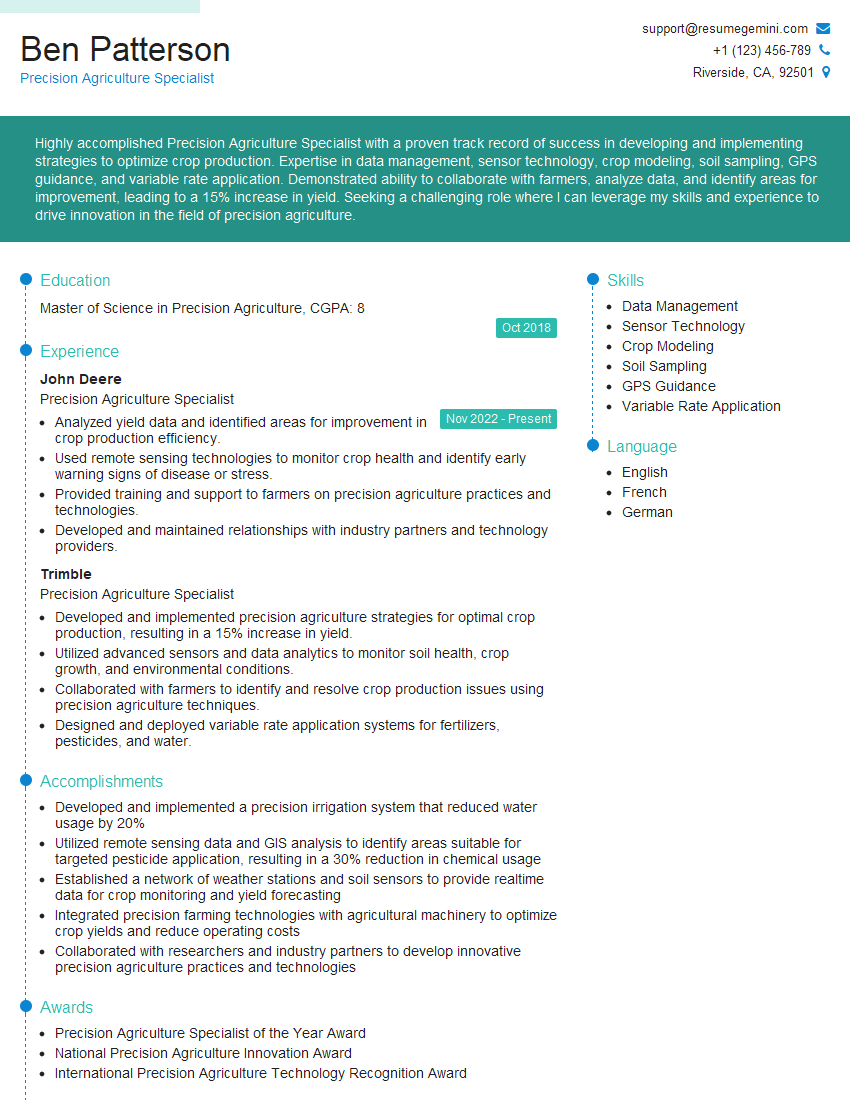
Mastering Precision Agriculture Principles is crucial for career advancement in this rapidly evolving field. A strong understanding of these concepts will significantly enhance your interview performance and job prospects. To stand out from other candidates, creating a compelling and ATS-friendly resume is vital. ResumeGemini offers a trusted platform to build a professional resume that effectively showcases your skills and experience. We provide examples of resumes tailored to Precision Agriculture Principles to help you craft a winning application. Invest the time in perfecting your resume – it’s your first impression on potential employers.
Explore more articles
Users Rating of Our Blogs
Share Your Experience
We value your feedback! Please rate our content and share your thoughts (optional).
What Readers Say About Our Blog
Very informative content, great job.
good