Every successful interview starts with knowing what to expect. In this blog, we’ll take you through the top Press Preparation interview questions, breaking them down with expert tips to help you deliver impactful answers. Step into your next interview fully prepared and ready to succeed.
Questions Asked in Press Preparation Interview
Q 1. Explain the process of color profile management in prepress.
Color profile management in prepress is crucial for ensuring accurate color reproduction across different devices and workflows. It involves assigning and converting color spaces to maintain consistency from design to print. Think of it like translating a language – your design software might use one ‘language’ (color space) while your printing press uses another. Color profile management acts as the interpreter, making sure the message (the colors) remains faithful.
The process typically involves:
- Identifying the source profile: This is the color space of your original design file (e.g., sRGB for web design, Adobe RGB for print design).
- Choosing the destination profile: This is the color space of your printing device (e.g., ISO Coated v2 (ECI) for offset printing). This profile is specific to the press and its inks.
- Color conversion: Software like Adobe Photoshop or Acrobat utilizes color management modules (CMMs) to convert the colors from the source profile to the destination profile. This involves complex calculations to ensure accurate color rendering.
- Proofing: Soft proofing (on screen) and hard proofing (printed proof) are vital steps to verify the accuracy of the color conversion before sending the job to the press. This allows for adjustments before expensive printing begins.
For instance, if a vibrant red appears correctly on your monitor (sRGB), but the destination profile (ISO Coated v2) interprets it differently, color management will adjust the red’s CMYK values to match the intended color on the printed output. Failing to manage color profiles can result in significant color shifts, leading to costly reprints.
Q 2. Describe your experience with different types of printing plates.
My experience encompasses a wide range of printing plates, each with its own advantages and disadvantages. I’ve worked extensively with:
- Conventional (PS) Plates: These are the traditional workhorses, using photosensitive materials. They offer good quality and are relatively cost-effective, but are slower to process than modern alternatives.
- Computer-to-Plate (CTP) Plates: These are imaged directly by a digital device (CTP imager), eliminating the intermediary film stage. CTP plates offer higher precision, faster turnaround times, and reduced waste compared to conventional plates. I’ve worked with both thermal and violet laser CTP systems.
- Flexographic Plates: Used for flexible packaging and labels, these plates require specific imaging and processing techniques. I have experience with photopolymer plates and their various durability levels.
- Offset Plates (various types): I’ve used different plate types tailored for specific printing press configurations and ink systems, including surface plates and those designed for UV inks.
Choosing the right plate type is crucial and depends on factors like print run length, print quality requirements, press type, and budget. For instance, for a short print run of high-quality brochures, I’d recommend CTP plates. But for a large print run of simple packaging, conventional plates might be more cost-effective.
Q 3. How do you ensure accurate color reproduction in your work?
Accurate color reproduction is paramount. My approach involves a multi-faceted strategy:
- Color Profile Management (as described above): This forms the foundation of consistent color reproduction.
- Proofing: I always utilize both soft and hard proofs. Soft proofing gives a preview on screen, while hard proofing offers a physical representation of the final printed output, allowing for adjustments based on the actual press conditions.
- Color Calibration: Regular calibration of my monitor and printer is essential to ensure accurate on-screen representation of colors.
- Communication with the Printer: Open communication with the print shop, providing them with all necessary color profiles and specifications, is crucial. Understanding the press’s capabilities and limitations is also vital.
- Spot Color Management: For specific colors that must be precisely matched (corporate logos, for example), I work with spot color specifications and ensure the printer has the correct inks.
A memorable instance involved a client’s logo with a unique pantone color. By carefully managing the spot color and verifying it in the hard proof, we avoided costly reprints and maintained brand consistency.
Q 4. What software are you proficient in for prepress tasks (e.g., Adobe Acrobat, InDesign, Photoshop)?
My prepress workflow heavily relies on Adobe Creative Suite applications, particularly:
- Adobe InDesign: For page layout and design, especially for multi-page documents.
- Adobe Photoshop: For image editing, retouching, and color correction.
- Adobe Illustrator: For vector graphics manipulation and creating artwork.
- Adobe Acrobat Pro: For PDF creation, preflighting, and ensuring file compatibility. I use its preflight capabilities to check for missing fonts, low-resolution images, and other potential problems.
I’m also proficient in other tools relevant to prepress, like imposition software (discussed further below) and color management utilities.
Q 5. Describe your experience with trapping and its importance in print.
Trapping is a crucial technique in prepress that involves intentionally overlapping colors to prevent gaps or misregistration between adjacent color areas. Imagine two colored blocks sitting next to each other; without trapping, a tiny gap might appear between them during the printing process due to slight misalignment of the printing plates. Trapping closes these gaps, ensuring a clean, professional finish.
There are two main types of trapping:
- Spread Trapping: The overlapping color extends slightly onto the adjacent color, covering any potential gaps.
- Choke Trapping: The adjacent color is slightly reduced in size to accommodate the overlap.
The choice between spread and choke trapping depends on the specifics of the design and printing process. I’ve used both in my work, often selecting the method through the imposition software. Improper trapping can lead to unsightly white gaps between colors, especially noticeable on large areas or fine lines. It’s a critical aspect of ensuring high-quality print output.
Q 6. How do you handle a file with low resolution or missing fonts?
Handling low-resolution files or missing fonts requires a systematic approach:
- Low-Resolution Images: If the resolution is insufficient, I first attempt to contact the client to obtain a higher-resolution version. If this isn’t possible, I’d assess whether the image’s size and placement in the document necessitate a high resolution. Sometimes, resampling might be acceptable for small, less-critical images but it can degrade quality. In other cases, the image may need to be replaced or removed.
- Missing Fonts: When a file is missing fonts, the first step is to identify the missing fonts. I would then either find and install the correct fonts or replace them with suitable alternatives that maintain a similar appearance. A crucial part of this process is checking font embeddings to ensure legal compliance and print consistency.
I always use preflight checks to identify such issues early in the process to avoid last-minute surprises. It’s much easier and cheaper to resolve these issues before the job goes to press.
Q 7. Explain your experience with imposition software.
Imposition software is essential for arranging pages in the correct order and orientation on a printing sheet, optimizing ink usage and minimizing waste. My experience includes working with several industry-standard imposition tools. I’m comfortable creating complex imposition schemes for various print formats, including booklets, brochures, and leaflets.
These software packages usually provide:
- Automatic imposition: Features that allow quick imposition of standard page counts and sizes.
- Customizable layouts: Ability to create unique imposition plans tailored to specific job requirements.
- Nesting capabilities: Efficient placement of multiple jobs on a single printing sheet.
- Print-ready PDF generation: Outputting optimized PDFs for sending directly to the printing press.
Proper imposition is critical for efficiency and print quality. A poorly imposed job can lead to significant waste and errors during printing. My expertise allows me to ensure optimal imposition, which saves costs and reduces the chances of issues on the press.
Q 8. How do you identify and correct prepress errors?
Identifying and correcting prepress errors is crucial for ensuring high-quality prints. It’s a multi-step process involving meticulous attention to detail and a deep understanding of the printing process. Think of it like baking a cake – if you miss an ingredient or don’t follow the recipe exactly, the final product suffers.
My approach starts with a thorough preflight check using dedicated software. This automatically checks for issues like missing fonts, low-resolution images, color profile mismatches, and overset text. I then perform a visual inspection, looking for things the software might miss, such as incorrect bleeds, margins, or color inconsistencies.
- Missing Fonts: I’d ensure all fonts used are embedded in the PDF or available on the output device. This prevents font substitutions that can drastically alter the look of the design.
- Low-Resolution Images: Images below 300 DPI (dots per inch) for print often result in blurry or pixelated output. I replace these with high-resolution alternatives.
- Color Profile Mismatches: Using the wrong color profile (e.g., sRGB instead of CMYK) leads to significant color shifts. I always ensure that the correct CMYK profile is applied.
- Overset Text: Text extending beyond the defined boundaries is a common issue. I adjust the text or design to fit within the designated area.
Finally, I create a soft proof, which provides a digital representation of the final printed product, allowing me to catch any remaining issues before the actual printing commences. Corrections are made iteratively, with each step carefully reviewed before proceeding.
Q 9. What is your experience with PDF workflows and preflighting?
PDF workflows are the backbone of modern prepress. My expertise encompasses the entire process, from receiving client files to preparing them for the printing press. Preflighting is the crucial first step, essentially a quality control check. I use industry-standard software like Acrobat Pro to preflight PDFs, ensuring they meet the required specifications for the intended printing method and press. This includes verifying color spaces, image resolutions, font embedding, and checking for any structural flaws in the PDF file itself.
For example, I recently worked on a project where the client supplied a PDF with several embedded images that were far below the required resolution for high-quality print. My preflighting process flagged this immediately, allowing me to request higher-resolution images from the client and prevent a costly reprint. The use of actions and automated workflows in Acrobat Pro significantly streamlines this process, letting me check hundreds of files quickly and efficiently.
Example action: Create an action that automatically checks for missing fonts, low resolution images and color profiles in a batch of PDF files.Q 10. Describe your troubleshooting process when encountering prepress issues.
Troubleshooting prepress issues is a detective-like process. I start by systematically isolating the problem using a structured approach. Think of it as a medical diagnosis: You start with the broad symptoms and narrow down to the cause.
- Identify the Symptom: Precisely describe the problem – is it a color issue, a font problem, a trapping problem, or something else?
- Gather Information: Check the preflight report, examine the PDF file meticulously, and assess the print specifications (paper type, printing method, etc.).
- Isolate the Cause: Based on the information gathered, systematically rule out potential causes until you pinpoint the source of the problem. For example, if colors appear dull, check the color profile, the image resolution, or the ink density.
- Implement the Solution: Once the cause is identified, apply the appropriate corrective action. This could involve replacing an image, adjusting color profiles, or modifying the design.
- Test and Verify: After applying the fix, thoroughly test the results to ensure the problem is resolved completely before proceeding to print.
Documentation is key. I meticulously record each step of the process, including the initial problem, the steps taken to resolve it, and the final results. This creates a valuable repository of knowledge and helps in preventing similar issues in the future.
Q 11. Explain the difference between CMYK and RGB color models.
CMYK and RGB are two different color models used in different contexts. RGB (Red, Green, Blue) is an additive color model used for screens, like your computer monitor or phone. Think of shining colored lights on a dark surface – combining red, green, and blue light produces different colors, including white when all three are combined.
CMYK (Cyan, Magenta, Yellow, Black) is a subtractive color model used for printing. It works by subtracting colors from white light. Imagine starting with a white sheet of paper; applying cyan, magenta, and yellow inks subtracts parts of the white light to create various colors. Black (K) is added to improve color depth and reduce the amount of cyan, magenta, and yellow needed.
The key difference lies in how color is produced. RGB adds light to create color, while CMYK subtracts light to create color. Therefore, an image designed in RGB will look different when printed directly in CMYK. A crucial step in prepress is converting RGB images to CMYK using appropriate color management techniques to minimize color shifts between screen and print.
Q 12. What is your experience with different types of paper and their impact on print quality?
Paper selection significantly impacts print quality. Different papers have different characteristics affecting color reproduction, ink absorption, and the overall feel of the final product. Think about the difference between printing a photograph on glossy photo paper versus matte cardstock – the visual impact is dramatically different.
- Coated Papers: These have a smooth surface, resulting in vibrant color reproduction and sharp image detail. They are ideal for high-quality photographs and marketing materials.
- Uncoated Papers: These have a rougher texture and absorb ink differently, resulting in a more matte finish. They are often used for books, brochures, and documents where a more natural, less glossy feel is desired.
- Paper Weight: This impacts the stiffness and durability of the printed piece. Heavier papers are more substantial and provide a higher perceived quality, while lighter papers are suitable for large-volume printing to reduce costs.
My experience spans a wide range of paper types, and I understand how each impacts the print job. For example, I’d choose a heavy, coated stock for a high-impact brochure, whereas for a novel I’d select a lighter, uncoated stock to minimize the weight and printing costs.
Q 13. How do you ensure the consistency of colors across multiple print runs?
Maintaining color consistency across multiple print runs requires careful attention to detail and the use of color management tools. Think of it as baking the same cake multiple times – you need to follow the exact recipe each time to get the same result.
This starts with establishing a reliable color profile for the chosen paper and printing method. This profile acts as a reference point for accurate color reproduction. We use calibrated monitors and color management software to ensure that colors on screen are accurately reflected in print.
- Color Standards: Utilizing color standards like Pantone matching system (PMS) for specific colors is crucial, especially for brand colors that require absolute accuracy across different print runs.
- Proofs: Soft and hard proofs are essential for comparing color values against the established standard. Hard proofs (printed proofs) are particularly important for confirming color accuracy on the specific paper and printing press being used.
- Press Calibration: Regular calibration of the printing press ensures consistent ink density and color reproduction. This involves adjusting the press to match the color profile and reduce variations.
By meticulously following these steps, I guarantee consistent color reproduction across multiple print runs, maintaining brand identity and visual integrity.
Q 14. Explain your experience with proofing methods (e.g., soft proof, hard proof).
Proofing methods are vital for ensuring the accuracy of the final printed piece. A soft proof is a digital representation of the final product, usually displayed on a calibrated screen, while a hard proof is a physical print on the same paper and using the same printing method as the final job.
Both types of proofs play different but equally critical roles. Soft proofs are efficient for initial color and layout checks, enabling quick iterations and reducing the need for multiple hard proofs. However, a soft proof can’t completely replicate the final output due to variations in screen calibration and the limitations of digital representation. That’s why hard proofs are essential for a final confirmation of color, ink coverage, and overall print quality.
My approach usually involves creating both soft and hard proofs. Soft proofs are employed in early stages for rapid feedback and correction; while hard proofs serve as the ultimate validation before mass production, giving clients the exact feel and look of the final printed material. The hard proof is a crucial communication tool ensuring everyone is on the same page before initiating the full print run.
Q 15. What is your experience with color calibration and profiling?
Color calibration and profiling are crucial for ensuring consistent color reproduction across different devices and throughout the printing process. Think of it like setting up a perfectly tuned musical instrument – each note needs to be precisely calibrated to play in harmony. My experience involves using colorimeters and spectrophotometers to measure color accurately and create ICC profiles for various printing substrates and presses. These profiles act like a translator, ensuring the colors you see on your screen are faithfully replicated on the printed material. For example, I once worked on a project involving Pantone colors for a luxury packaging client. By meticulously creating and applying ICC profiles, we were able to maintain the brand’s exacting color standards across all their products, avoiding costly reprints and ensuring brand consistency.
This process generally involves several steps:
- Measuring: Using a spectrophotometer to capture the precise color values of a test chart printed on the target substrate.
- Profiling: Software then analyzes this data, creating an ICC profile that maps the device’s color space to a standard color space (like sRGB or Adobe RGB).
- Application: This profile is then embedded in the print file, ensuring the printing device interprets and renders colors correctly.
Troubleshooting color discrepancies often involves revisiting each step of this process, checking for issues like incorrect profile selection, substrate variations, or press inconsistencies.
Career Expert Tips:
- Ace those interviews! Prepare effectively by reviewing the Top 50 Most Common Interview Questions on ResumeGemini.
- Navigate your job search with confidence! Explore a wide range of Career Tips on ResumeGemini. Learn about common challenges and recommendations to overcome them.
- Craft the perfect resume! Master the Art of Resume Writing with ResumeGemini’s guide. Showcase your unique qualifications and achievements effectively.
- Don’t miss out on holiday savings! Build your dream resume with ResumeGemini’s ATS optimized templates.
Q 16. How do you manage large print jobs with tight deadlines?
Managing large print jobs with tight deadlines requires meticulous planning and effective resource allocation. Think of it like orchestrating a complex symphony – every instrument (person, machine, resource) must play its part perfectly and in perfect time. My approach involves a multi-pronged strategy:
- Detailed Job Breakdown: Dividing the job into smaller, manageable tasks, assigning responsibilities, and setting realistic deadlines for each stage.
- Efficient Workflow: Implementing streamlined workflows, leveraging automation tools wherever possible (e.g., automated imposition software), and minimizing manual intervention to reduce errors and processing time.
- Regular Monitoring & Communication: Maintaining constant communication with the client and the printing team, using project management tools to track progress, identify potential bottlenecks, and proactively address issues before they escalate.
- Contingency Planning: Building in buffer time to account for unexpected delays and having backup plans in place to handle potential equipment malfunctions or material shortages.
For instance, I once managed a 50,000-piece direct mail campaign with a 2-week deadline. By carefully planning each phase (from file preparation to printing and delivery), implementing automated imposition, and utilizing a dedicated team, we delivered the project on time and within budget. The key was proactive communication and the ability to anticipate and resolve potential problems before they impacted the overall schedule.
Q 17. Describe your experience with imposition and its importance in reducing waste.
Imposition is the process of arranging pages of a document in the correct order on a printing sheet to optimize printing efficiency and minimize waste. Think of it like a skilled jigsaw puzzle master arranging pieces to create a complete picture. It involves digitally arranging pages to be printed onto larger sheets, which are then cut and folded to produce the final product. The importance of proper imposition in reducing waste is paramount, especially in large print runs. Poor imposition can lead to significant material waste and increased production costs.
My experience includes using imposition software to create efficient layouts for various printing formats, considering factors such as sheet size, paper grain, and binding requirements. I’ve worked on projects ranging from simple brochures to complex multi-page books, optimizing the layout to minimize the number of sheets required. For instance, using ‘gang-running’ (printing multiple jobs simultaneously) on a large format sheet not only reduces paper waste but also cuts down significantly on printing time.
Furthermore, careful consideration of imposition during the prepress stage allows for effective bleed and trim settings, minimizing the need for reprints due to errors in page alignment and margins.
Q 18. Explain the role of prepress in achieving cost-effective printing.
Prepress plays a vital role in achieving cost-effective printing. It’s the crucial groundwork that lays the foundation for a successful and economical print job. Think of it as the architect’s blueprints – meticulously planned to ensure the project is built efficiently and without unnecessary expenses. By identifying and addressing potential issues before they reach the press, prepress significantly reduces the risk of costly reprints, material waste, and production delays.
My expertise in prepress ensures:
- Early Error Detection: Identifying potential errors in design, layout, and image resolution before printing, saving time and resources.
- Optimized File Preparation: Ensuring print files are correctly formatted and ready for printing, avoiding costly delays and press adjustments.
- Efficient Imposition: Minimizing paper waste and maximizing sheet utilization, reducing material costs.
- Color Management: Ensuring consistent color reproduction, avoiding costly reprints due to color inconsistencies.
In a practical scenario, I once saved a client significant money by identifying a critical error in their artwork during the prepress proofing stage. This allowed us to correct the error before printing, preventing a costly reprint of thousands of units. The prepress stage is truly the cornerstone of cost-effective print production.
Q 19. How do you ensure the accuracy of barcodes and other critical elements in a print job?
Ensuring the accuracy of barcodes and other critical elements is paramount, as errors can have significant consequences ranging from logistical problems to financial losses. Think of it like ensuring the proper functioning of a highly sensitive instrument; the tiniest misalignment or defect can disrupt its efficiency. My approach is multi-layered:
- Verification Tools: Utilizing barcode verification software to confirm that barcodes meet industry standards (e.g., GS1 guidelines) and are easily readable by scanners. This often involves checking the barcode’s symbology, checksum, and quiet zone.
- Proofreading & Quality Control: Implementing rigorous proofreading procedures, involving multiple checkpoints to verify the accuracy of all critical information, including barcodes, serial numbers, and other critical data.
- High-Resolution Output: Ensuring that critical elements are printed at high resolution to prevent pixelation or blurriness, guaranteeing scannability.
- Pre-flight Checks: Using pre-flight software to automatically identify potential errors such as missing fonts, color profile issues, and incorrect image resolutions, significantly reducing risks before the printing process.
A specific example involved a project with serialized tickets for a large event. By using barcode verification software, we ensured each ticket’s barcode was unique and correctly formatted, preventing chaos and confusion at the event entry gates.
Q 20. How familiar are you with different types of printing presses and their requirements?
I’m familiar with a range of printing presses, including offset, digital, screen, and flexographic presses, understanding their respective capabilities, limitations, and specific requirements. Think of it like knowing the diverse tools in a craftsman’s workshop, each with its own unique purpose and application. My experience allows me to select the most appropriate press for each project, optimizing cost-effectiveness and quality.
Offset printing is ideal for large-volume jobs with high-quality color reproduction. Digital printing is suitable for smaller runs with shorter turnaround times and personalized content. Screen printing excels in producing bold graphics on various materials like t-shirts, while flexographic printing is commonly used for packaging applications. I understand the intricacies of each process, including things like ink selection, paper requirements, and press settings, enabling me to deliver optimal results for each print job.
For instance, I’ve worked on projects requiring the high-volume capabilities of offset printing for mass-produced brochures and the versatility of digital printing for personalized marketing materials, always carefully selecting the technology that best matches the project’s specifications and budget.
Q 21. Explain your experience with variable data printing.
Variable data printing (VDP) is a powerful technique that allows for the personalization of printed materials, creating unique pieces for each recipient. Think of it like crafting custom-made invitations— each one bearing a unique message and design. My experience includes working with VDP software to create targeted marketing campaigns, personalized direct mail pieces, and transactional documents with unique identifiers. This involves integrating databases with design software to dynamically populate information such as names, addresses, images, and personalized messages within the print file.
I’m proficient in handling various data formats and ensuring the seamless integration of data with the print design. I’ve used VDP to create highly effective targeted marketing campaigns, resulting in significantly improved response rates compared to generic mass mailings. For example, I worked on a campaign for a local business that wanted to target their customers with specific offers based on past purchase history. Using VDP, we created personalized mailers that included specific product recommendations and discount codes tailored to each recipient, significantly boosting sales.
Q 22. How do you maintain quality control throughout the prepress process?
Maintaining quality control in prepress is paramount. It’s a multi-layered process that begins with meticulous file checking and extends throughout the entire workflow. We employ a system of checks and balances at every stage.
Initial File Assessment: The first step involves rigorously checking client-submitted files for resolution, color space (ensuring it’s CMYK for print), fonts (embedding or outlining as needed), bleeds, and overall file integrity. We use tools like preflight software to automate many of these checks, flagging potential issues before they become major problems.
Proofing: We generate soft proofs (digital proofs) for client approval, allowing for corrections before printing. We also utilize hard proofs (physical prints) for critical projects requiring precise color matching.
Color Management: Consistent color management is crucial. We use ICC profiles to ensure accurate color reproduction across different devices and stages of the prepress process. This involves carefully calibrating monitors and printers and using industry-standard color management software. Mismatched profiles can lead to significant color shifts between the digital proof and the final printed product.
Quality Checks at Each Stage: Throughout the process—from trapping to imposition—we conduct regular quality checks. This might involve visually inspecting files for artifacts or inconsistencies or running automated checks to confirm proper settings. Think of it like building a house—each step needs a quality control check to make sure the foundation is solid.
Process Documentation: We maintain detailed records of every step in the process. This includes file versions, client approvals, and any adjustments made. This documentation is vital for troubleshooting and quality assurance.
Q 23. Describe your experience with digital asset management systems.
I have extensive experience using various digital asset management (DAM) systems, including [Mention specific DAM systems you are familiar with, e.g., Adobe Experience Manager, Canto, Bynder]. My proficiency extends beyond simply storing files; I’m adept at implementing robust metadata tagging, version control, and workflow automation. This ensures easy retrieval of assets, prevents version conflicts, and streamlines collaboration across teams.
For instance, in a recent project involving numerous high-resolution images for a large-scale brochure, the DAM system was instrumental in organizing and managing the assets. It enabled efficient tracking of revisions, approvals, and final versions, contributing significantly to the project’s timely completion. It allows for easy sharing with clients and internal teams so everyone is working from the most up-to-date files. The system’s search functionality was crucial for quickly locating specific images based on keywords or metadata tags, eliminating the time wasted on manual file searches. This saves significant time and improves project efficiency.
Q 24. What is your approach to handling client revisions during prepress?
Handling client revisions is a critical part of the prepress process. My approach is centered around clear communication, version control, and efficient workflow management. I initiate the revision process by clearly documenting the changes requested and assigning them a unique version number. This ensures traceability and prevents confusion.
We use a collaborative proofing system, where revisions are tracked, documented, and approved digitally. This allows for quick feedback and avoids miscommunication. I’m transparent about time constraints and communicate any potential delays that revisions may cause. It’s about balancing client satisfaction with the operational realities of meeting deadlines.
For example, in one project, a client requested several significant changes late in the process. I documented all changes, updated file versions, and provided a revised timeline to the client, proactively communicating any potential impact on the final delivery date. Open communication was key to ensuring a smooth process and a satisfied client.
Q 25. How do you stay up-to-date with the latest technologies and trends in prepress?
Staying current in prepress demands continuous learning. I actively participate in industry webinars and conferences, read trade publications like [Mention relevant publications], and follow key influencers and companies on social media. I also engage in online courses and workshops focused on new technologies and software updates.
Specifically, I dedicate time each week to explore new developments in areas such as color management, automation software, and advancements in print technology. For instance, I’ve recently been exploring the implementation of AI-powered tools for automated preflighting and image enhancement, which improves accuracy and streamlines the workflow. Keeping up-to-date helps me make informed decisions regarding technology investments for the company and to recommend best practices to the team.
Q 26. Explain your experience with working under pressure and meeting tight deadlines.
Working under pressure and meeting tight deadlines is an integral part of my role. I thrive in fast-paced environments and have a proven track record of delivering high-quality work, even under pressure. My organizational skills, meticulous planning, and ability to prioritize tasks are essential in these situations. I prioritize tasks based on urgency and deadlines, leveraging project management tools and techniques to efficiently manage multiple projects simultaneously.
I remember a time when we had to produce a high-volume print job with an extremely tight turnaround. I leveraged our workflow automation tools to optimize the processes, and the team worked extended hours with close communication to ensure timely completion. This is an example of the collaborative environment I thrive in. Through efficient task delegation, clear communication, and flexible problem-solving, we delivered the product successfully on time.
Q 27. Describe a time you had to solve a complex prepress problem. What was your solution?
One challenging situation involved a client’s complex, multi-layered PDF file causing errors during imposition. The file contained numerous embedded images with varying resolutions and color profiles, leading to inconsistencies and rendering issues. It was preventing our automated imposition software from working correctly. The solution wasn’t simply to reprint, but to understand the root of the problem.
My approach involved a systematic troubleshooting process:
Detailed File Analysis: I used preflight software to diagnose the specific problems within the PDF. This pinpointed the inconsistent embedded images as the main cause of the errors.
Client Collaboration: I discussed the issues with the client and secured their approval to work with revised source files, instead of directly working with the problematic PDF.
Image Optimization: I then worked with the client to get the original source files, resolving image inconsistencies by converting images to consistent color profiles and resolution.
Re-creation and Testing: After resolving the source files, I re-created the PDF and tested the imposition process. This addressed the root problem and improved quality. The file processed smoothly through the imposition process.
Through this methodical approach, we successfully resolved the issue, ensuring a high-quality final product. This highlighted the importance of thorough file checking and the value of proactive communication with clients.
Q 28. How do you prioritize tasks effectively in a fast-paced prepress environment?
Prioritizing tasks in a fast-paced prepress environment requires a strategic approach. I utilize a combination of techniques, including:
Deadlines and Urgency: I prioritize tasks based on their deadlines and urgency. The most time-sensitive projects always come first.
Project Complexity: I also consider project complexity. More intricate projects may require more time, so their timelines are factored into the overall schedule.
Dependency Management: I carefully analyze task dependencies. For instance, I might need to complete the preflight process before proceeding with imposition, so these dependent tasks need to be scheduled accordingly.
Project Management Tools: I rely on project management software or tools like [mention tools, e.g. Asana, Trello, Jira] to track progress, manage deadlines, and assign tasks efficiently. These tools provide an overview and facilitate workflow management.
Flexibility and Adaptation: Unexpected situations always arise, so it’s critical to be flexible and adaptable to re-prioritize tasks when needed. For example, a sudden client request may push other less urgent items down the queue.
This combined approach ensures that all projects are managed effectively, meeting deadlines without sacrificing quality.
Key Topics to Learn for Press Preparation Interview
- Pre-Press Processes: Understanding file preparation, color management (CMYK, RGB), image resolution, and file formats (PDF, TIFF, JPEG) crucial for print production.
- Proofing and Quality Control: Practical application of color proofing methods, identifying potential printing errors, and implementing quality control checks throughout the process.
- Print Production Techniques: Familiarity with various printing methods (offset, digital, large format), their applications, and limitations. Understanding the impact of different substrates on the final product.
- Press Operation & Maintenance: Basic understanding of press mechanics, common issues, troubleshooting strategies, and preventative maintenance procedures.
- Color Management Systems: Theoretical knowledge of color spaces, color profiles (ICC profiles), and practical application in achieving consistent color reproduction across different stages of production.
- Workflow and Automation: Understanding the importance of efficient workflows, utilizing prepress software and automation tools to streamline the process and improve productivity.
- Imposition and Plate Making: Knowledge of imposition techniques for efficient printing sheet layout and understanding the role of platemaking in the overall process.
- Problem-Solving and Troubleshooting: Developing strategies for identifying and resolving common prepress issues, such as color discrepancies, image defects, and file format incompatibilities.
Next Steps
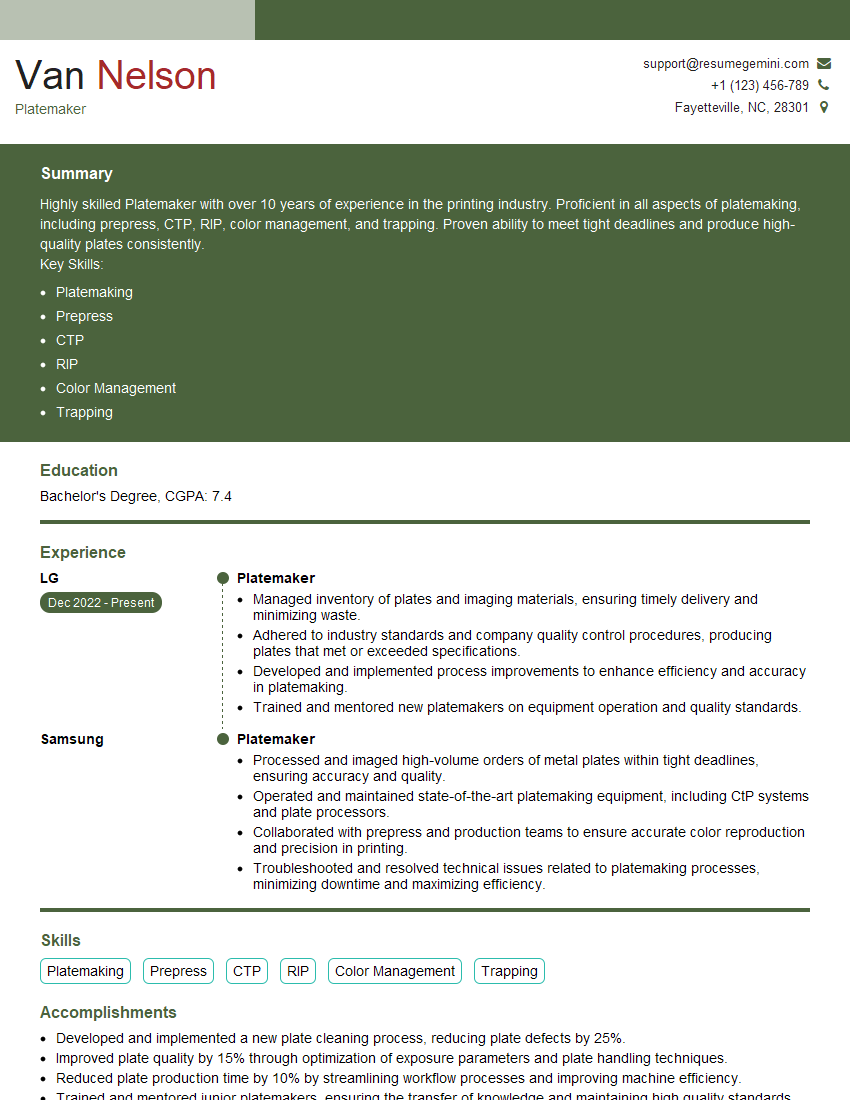
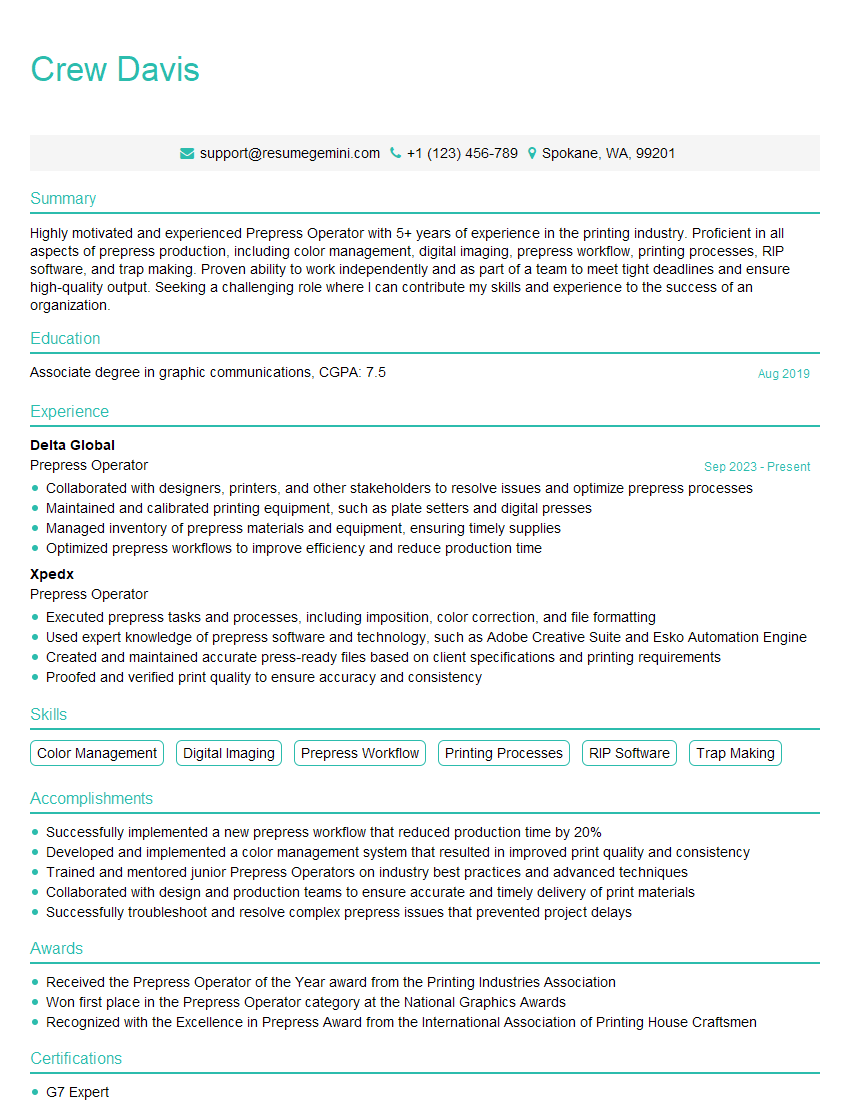
Mastering Press Preparation opens doors to exciting career opportunities in the printing and publishing industries, offering diverse roles and continuous learning. A strong understanding of these concepts is vital for demonstrating your expertise and securing your desired position. To significantly increase your job prospects, creating an ATS-friendly resume that highlights your skills and experience is crucial. We recommend using ResumeGemini, a trusted resource, to build a professional and impactful resume. ResumeGemini provides examples of resumes tailored to Press Preparation to guide you through the process, ensuring your application stands out.


Explore more articles
Users Rating of Our Blogs
Share Your Experience
We value your feedback! Please rate our content and share your thoughts (optional).
What Readers Say About Our Blog
Very informative content, great job.
good