Are you ready to stand out in your next interview? Understanding and preparing for Pricing Software (e.g., Zilliant, Vendavo) interview questions is a game-changer. In this blog, we’ve compiled key questions and expert advice to help you showcase your skills with confidence and precision. Let’s get started on your journey to acing the interview.
Questions Asked in Pricing Software (e.g., Zilliant, Vendavo) Interview
Q 1. Explain the difference between cost-plus pricing and value-based pricing.
Cost-plus pricing and value-based pricing represent fundamentally different approaches to setting prices. Cost-plus pricing is straightforward: you calculate your product’s cost, add a predetermined markup (e.g., a percentage of cost or a fixed amount), and arrive at your selling price. It’s simple to understand and implement, making it attractive for businesses with predictable costs and low competition.
However, it ignores market dynamics and customer perception of value. If your competitors offer similar products at lower prices (even if they have higher costs), your cost-plus price might be uncompetitive. For example, if a widget costs $10 to produce, and you apply a 20% markup, your price becomes $12. But, if competitors sell similar widgets for $11, you might lose sales despite your seemingly reasonable markup.
Value-based pricing, conversely, centers on the value your product or service delivers to the customer. This requires understanding customer needs, pain points, and the value proposition relative to competitors. You might conduct market research to assess willingness to pay, then set a price that reflects that perceived value. This could be higher than a cost-plus calculation, or potentially lower, depending on the overall market and competitive landscape. For example, a software solution that increases efficiency for a client by saving them significant labor costs might justify a higher price, even if its production costs are high.
In essence, cost-plus pricing is reactive and internally focused, while value-based pricing is proactive and externally focused, driven by customer needs and market dynamics. Sophisticated pricing software like Zilliant and Vendavo helps businesses move towards value-based pricing by providing data-driven insights into customer segmentation, price elasticity, and optimal pricing strategies.
Q 2. Describe your experience with Zilliant or Vendavo. What modules are you familiar with?
I have extensive experience using Zilliant, specifically in their Price Optimization and Price Modeling modules. My experience includes building and deploying sophisticated pricing models that incorporate various factors like cost, competition, customer segmentation, and price elasticity. I’ve worked with both the rule-based and machine learning algorithms within Zilliant to create dynamic pricing strategies.
For example, in a project for a large telecommunications company, I used Zilliant to optimize their pricing for bundled services. By leveraging the advanced analytics capabilities, we were able to increase profitability by 15% while maintaining customer satisfaction. This involved segmenting customers based on their value and sensitivity to price, then tailoring price offers accordingly.
While I haven’t directly worked with Vendavo, I’m familiar with its capabilities, particularly in the areas of CPQ (Configure, Price, Quote) and Sales Performance Management. The core principles of optimal pricing strategies are fundamentally similar across different platforms; it’s primarily the user interface and specific analytical tools that differ. The key is understanding how to leverage the software to apply best practices in pricing strategy.
Q 3. How would you handle a situation where your pricing recommendations are rejected by sales?
When my pricing recommendations are rejected by the sales team, my approach is collaborative and data-driven. I understand that sales teams are incentivized to close deals, and sometimes perceived short-term gains might outweigh long-term strategic pricing goals.
My first step is to understand their concerns. Why are they rejecting the recommendations? Is it about specific price points? Concerns about customer acceptance? Perceived difficulty in selling at the recommended price? I would engage in a discussion, presenting the data supporting my recommendations. This could include market analysis, competitive benchmarking, and the potential impact on overall profitability if the recommendations aren’t followed. I might illustrate the data using visual aids to help convey the points effectively.
If there are valid concerns, I would collaboratively explore alternative options. Maybe we can refine the segmentation, adjust the price points for specific customer segments, or modify the offer to include additional value-added services to justify the higher price. The goal is to find a pricing strategy that achieves both revenue goals and sales team objectives. Documentation and transparent communication are crucial throughout this process, to ensure alignment and understanding.
Q 4. Explain the concept of price elasticity and how it impacts pricing decisions.
Price elasticity measures the responsiveness of demand to a change in price. Specifically, it indicates the percentage change in quantity demanded resulting from a one percent change in price. High price elasticity implies that a small price change significantly impacts demand (e.g., luxury goods); low price elasticity means demand is relatively insensitive to price changes (e.g., necessities like gasoline).
Understanding price elasticity is crucial for pricing decisions. For highly elastic products, small price increases can drastically reduce sales, while significant price cuts might be needed to stimulate demand. For inelastic products, pricing strategies can focus on maximizing revenue through higher prices, as demand remains relatively stable.
For example, consider a software company introducing a new app. If the app is considered a luxury item with readily available alternatives, it’s likely to have high price elasticity. A slight price increase may lead to a significant drop in downloads, while a significant discount might be needed to boost sales. Conversely, a necessary medical device or life-saving drug is usually price inelastic. Even substantial price increases may not dramatically affect demand because customers are more likely to pay a premium.
Pricing software like Zilliant helps determine price elasticity using advanced statistical modeling and historical sales data, enabling more precise price setting and revenue optimization.
Q 5. How do you identify and address price erosion?
Price erosion is the gradual decline in prices over time, often due to competitive pressure, increased costs, or a shift in market dynamics. Identifying and addressing price erosion requires a multi-pronged approach.
First, monitor pricing across your product portfolio and identify which products are experiencing the most significant price declines. This often involves analyzing historical data, market research, and competitor pricing. Then, dive deeper to understand the *cause* of the erosion. Is it due to increased competition? Are your costs rising faster than you can compensate for through price increases? Is your product becoming commoditized? Is your brand losing market share?
Addressing the erosion involves different strategies depending on the underlying cause. For instance, if competition is driving price erosion, you could enhance your product differentiation, focus on building stronger customer relationships, or improve your sales and marketing strategies to create more perceived value. If cost increases are the issue, look for efficiency improvements to reduce your costs. You might also need to implement value engineering to reduce the cost of your product without sacrificing its functionality.
Finally, regular price reviews and adjustments are essential for proactively managing price erosion. This is where pricing software comes in handy, providing timely insights and allowing for data-driven adjustments to pricing strategies.
Q 6. What are some common challenges in implementing a new pricing strategy?
Implementing a new pricing strategy can present several challenges. One common hurdle is resistance to change within the organization. Sales teams, accustomed to established pricing practices, may be hesitant to adopt new strategies, especially if they perceive them as more difficult or less lucrative in the short-term.
Another major challenge is data availability and quality. Accurate and comprehensive data on costs, customer segments, and competitor pricing is crucial for effective pricing decisions. Lack of data or poor data quality can lead to inaccurate pricing models and ultimately, ineffective strategies.
Lack of alignment across departments is another significant challenge. Sales, marketing, finance, and product development must be aligned on the new pricing strategy to ensure seamless implementation. Without alignment, the strategy is likely to fail, as different departments might work against each other.
Finally, accurately measuring the impact of the new strategy can be difficult. It requires robust reporting and analytics to track key performance indicators (KPIs) such as revenue growth, profit margins, and customer retention. Without effective measurement, it’s impossible to determine if the new strategy is successful.
Q 7. How do you measure the success of a pricing initiative?
Measuring the success of a pricing initiative involves tracking several key performance indicators (KPIs) related to revenue, profitability, and customer behavior.
Revenue growth is a primary metric. Has the new pricing strategy led to increased revenue compared to the previous period or the projections? Profit margin improvements are another essential indicator. Are margins increasing as a result of the price changes, reflecting the effectiveness of the new pricing strategy in optimizing profitability?
Customer churn rate (how many customers are leaving) should also be monitored. A successful pricing strategy shouldn’t drastically increase customer churn. Ideally, the change should lead to improved customer satisfaction and retention. Price realization (the difference between the list price and the actual price received) can also provide valuable insights into sales effectiveness and the market’s acceptance of the new prices. Market share change can reflect the competitive impact of the new pricing. Finally, customer lifetime value (CLTV) analysis helps assess the long-term impact on profitability by measuring the total revenue generated by a customer over their relationship with the company.
By comprehensively tracking these KPIs, you can gain a clear understanding of the overall effectiveness of your pricing initiative and make necessary adjustments to maximize its impact. Sophisticated pricing software often provides dashboards and reporting tools to streamline this measurement process.
Q 8. What is your experience with different pricing optimization techniques?
Pricing optimization techniques aim to find the price point that maximizes profitability. My experience encompasses a range of methods, including:
- Cost-plus pricing: This is a straightforward approach where a fixed markup is added to the cost of goods sold. While simple, it often ignores market dynamics and customer willingness to pay. For example, a 20% markup on a product costing $10 would result in a $12 price.
- Value-based pricing: This focuses on the perceived value to the customer. It requires understanding customer needs and preferences and then setting a price that reflects that value. For instance, a premium coffee brand might charge more due to its perceived superior quality and taste.
- Competitive pricing: This involves analyzing competitor pricing and positioning your product accordingly. A new entrant might price slightly lower than established players to gain market share.
- Price elasticity analysis: This statistical technique measures how demand changes in response to price changes. This is crucial for understanding the sensitivity of your customer base to price adjustments. A high elasticity means even small price increases lead to significant demand drops.
- Algorithmic pricing (using software like Zilliant or Vendavo): These advanced tools leverage machine learning to analyze vast datasets and dynamically optimize prices based on factors such as customer segment, product characteristics, and market conditions. I have extensive experience using these platforms to identify optimal pricing strategies in various industries.
My experience spans across various industries, from software licensing to consumer goods, allowing me to tailor pricing strategies to specific market contexts.
Q 9. Describe your experience with data analysis and its role in pricing.
Data analysis is the backbone of effective pricing. My experience involves using data to understand customer behavior, market trends, and the impact of pricing decisions. This includes:
- Customer Segmentation: Identifying distinct customer groups based on their purchasing behavior, demographics, and other relevant characteristics. This allows for tailored pricing strategies.
- Price Sensitivity Analysis: Analyzing the relationship between price changes and demand using regression analysis, conjoint analysis, or other statistical methods. This helps to determine the optimal price range for different customer segments.
- Market Analysis: Understanding competitive pricing strategies, market share dynamics, and overall market trends. This information is crucial for setting competitive prices and making informed pricing decisions.
- Sales Data Analysis: Analyzing historical sales data to identify patterns, trends, and the impact of past pricing decisions. This provides valuable insights for future pricing strategies.
- Profitability Analysis: Analyzing the profitability of different products, customer segments, and pricing strategies. This helps to identify areas for improvement and optimize overall profitability.
I am proficient in using various statistical software packages like R and Python for data analysis, as well as data visualization tools to communicate findings effectively.
Q 10. How familiar are you with different pricing models (e.g., tiered pricing, subscription pricing)?
I’m very familiar with various pricing models. Understanding the nuances of each is key to successful pricing strategy implementation:
- Tiered Pricing: This involves offering different price points based on the quantity purchased, features included, or service level. For example, a software company might offer basic, premium, and enterprise tiers with varying features and prices.
- Subscription Pricing: This recurring revenue model charges customers a regular fee for access to a product or service. Examples include Netflix, Spotify, and SaaS applications. It’s important to consider factors like churn rate and customer lifetime value when implementing this model.
- Value Pricing: This focuses on the customer’s perceived value of the product or service rather than cost. A luxury car brand uses value pricing to justify higher prices based on brand reputation, quality, and features.
- Freemium Pricing: A common model offering a basic product for free while charging for premium features or functionalities. This attracts a large user base and converts a segment to paying customers.
- Bundle Pricing: Offering multiple products or services together at a discounted price compared to buying them individually. This encourages higher spending per customer.
The selection of the optimal model depends on the specific product, target market, and business goals.
Q 11. How would you determine the optimal price for a new product launch?
Determining the optimal price for a new product launch is a multi-step process requiring a thorough understanding of the market and the product itself. Here’s a structured approach:
- Market Research: Conduct thorough research to understand the target market, competitive landscape, and customer needs and preferences. This includes analyzing competitor pricing, assessing customer willingness to pay, and understanding the perceived value of the product.
- Cost Analysis: Determine the total cost of producing and distributing the product, including manufacturing, marketing, and distribution expenses. This forms the basis for setting a minimum price.
- Pricing Strategy Selection: Choose a pricing strategy based on the market analysis and cost analysis. Options include cost-plus pricing, value-based pricing, competitive pricing, or a combination of these.
- Price Testing: Conduct price tests (A/B testing for instance) to evaluate customer responses to different price points. This may involve offering the product at different prices in different market segments.
- Price Optimization: Use data analytics and pricing software (if available) to refine the price based on the results of the price testing. Continuously monitor the market and adjust the price as needed.
This iterative process allows for a data-driven approach to pricing, leading to a more optimal price point and improved profitability.
Q 12. What is your understanding of price segmentation and how it’s implemented?
Price segmentation is the practice of dividing the customer base into distinct groups and charging different prices to each group. This is based on factors such as customer value, sensitivity to price, and purchasing behavior.
Implementation involves:
- Identifying Segments: Using data analysis to identify distinct customer groups based on demographics, purchasing patterns, loyalty, and other characteristics.
- Analyzing Price Sensitivity: Assessing the price elasticity of demand for each segment. This involves understanding how much demand will change in response to price changes for each segment.
- Setting Prices: Establishing different price points for each segment based on their price sensitivity and perceived value of the product or service. Higher-value customers may be willing to pay a premium.
- Monitoring and Adjusting: Regularly monitoring the performance of the pricing strategy and making adjustments as needed. This includes tracking sales, revenue, and customer feedback.
Example: A software company might offer different pricing tiers for individual users, small businesses, and large enterprises, reflecting the varying value and volume of use.
Q 13. Explain the importance of understanding customer lifetime value (CLTV) in pricing decisions.
Customer Lifetime Value (CLTV) is a crucial metric in pricing decisions because it represents the total revenue a company expects to generate from a single customer over their entire relationship with the business. Understanding CLTV is vital because:
- Acquisition Cost Justification: It helps justify the cost of acquiring new customers. If the CLTV is high enough, it’s justifiable to invest more in customer acquisition.
- Pricing Strategy Optimization: It influences pricing decisions. If a customer has a high CLTV, it might be worth offering them discounts or premium services to ensure their long-term loyalty.
- Profitability Analysis: Helps in determining the profitability of different customer segments and pricing strategies. Segments with high CLTV warrant more attention and potentially more strategic pricing.
- Customer Retention Focus: Highlights the importance of customer retention. Higher CLTV indicates that retaining existing customers is more profitable than constantly acquiring new ones.
Example: A subscription-based service might offer a discount for annual subscriptions to increase customer retention and boost CLTV.
Q 14. Describe your experience with using data visualization tools to present pricing insights.
Data visualization is crucial for communicating complex pricing insights effectively. My experience includes using tools like Tableau, Power BI, and even creating custom visualizations in Python’s Matplotlib or Seaborn libraries. I can create various visuals, such as:
- Dashboards: Provide a high-level overview of key pricing metrics, such as revenue, profit margins, and customer segments.
- Charts and Graphs: Illustrate trends, patterns, and relationships between variables like price, demand, and profitability.
- Maps: Visually represent geographical variations in pricing and sales.
- Interactive Visualizations: Allow stakeholders to explore data and gain deeper insights.
By using appropriate visualizations, I can effectively communicate complex pricing information to both technical and non-technical audiences, enabling data-driven decision-making.
For example, a heatmap could clearly show which price points are performing best across different customer segments, aiding in targeted pricing adjustments.
Q 15. How do you handle conflicting priorities between profitability and market share?
Balancing profitability and market share is a crucial aspect of pricing strategy. It’s often a delicate dance, as maximizing one can sometimes come at the expense of the other. Think of it like this: you want to make a good profit on each sale (profitability), but you also want to sell a lot of your product or service to become a market leader (market share).
To handle conflicting priorities, I employ a multifaceted approach. First, I utilize pricing software like Zilliant or Vendavo to model various scenarios. We can input different price points and volume assumptions to see how profit margins and market share respond. This allows for data-driven decision-making, rather than relying on gut feeling. For example, we might analyze a scenario where a 5% price reduction leads to a 15% increase in sales volume. The software helps calculate whether that trade-off is beneficial overall.
Secondly, I leverage segmentation. Different customer segments may have varying price sensitivities. We might offer premium pricing to high-value customers who are less price-sensitive, while employing a more competitive pricing strategy for volume-driven segments. A clear understanding of customer lifetime value (CLTV) is essential in this process. Finally, I continuously monitor key performance indicators (KPIs) like revenue, profit margin, and market share to measure the effectiveness of our pricing strategy and make necessary adjustments.
Career Expert Tips:
- Ace those interviews! Prepare effectively by reviewing the Top 50 Most Common Interview Questions on ResumeGemini.
- Navigate your job search with confidence! Explore a wide range of Career Tips on ResumeGemini. Learn about common challenges and recommendations to overcome them.
- Craft the perfect resume! Master the Art of Resume Writing with ResumeGemini’s guide. Showcase your unique qualifications and achievements effectively.
- Don’t miss out on holiday savings! Build your dream resume with ResumeGemini’s ATS optimized templates.
Q 16. How do you incorporate competitive analysis into your pricing strategies?
Competitive analysis is absolutely fundamental to effective pricing. Ignoring your competitors is a recipe for disaster. I incorporate competitive analysis by first identifying our key competitors and understanding their pricing strategies. This involves reviewing their pricing lists, conducting mystery shopping, and monitoring their online presence. We also use market intelligence tools to gather information about their offerings, promotions, and overall market positioning.
Next, we analyze our competitive advantage. What makes our product or service unique and valuable? Is it superior quality, better customer service, or unique features? This analysis helps determine our pricing positioning – are we going for premium pricing, competitive pricing, or a cost leadership strategy? For example, if we have a significantly superior product, we may justify a premium price.
Finally, I utilize pricing software to model the impact of competitive actions on our own pricing. What happens to our market share and profitability if a competitor drops their prices by 10%? These simulations allow for proactive and informed decision-making in response to competitive pressures. The software helps to quantify the potential impact and guide strategic choices.
Q 17. What are some of the ethical considerations in pricing?
Ethical considerations in pricing are paramount. We must ensure our pricing practices are fair, transparent, and comply with all relevant laws and regulations. Key ethical concerns include:
- Price gouging: Exploiting situations of high demand or scarcity to charge excessive prices is unethical and often illegal.
- Predatory pricing: Setting prices below cost to drive competitors out of business is also illegal and unethical.
- Deceptive pricing: Misleading consumers about prices or discounts is unethical and can result in legal action.
- Price discrimination: Charging different prices to different customers for the same product or service without a justifiable reason is a potential ethical and legal issue.
To ensure ethical pricing, we establish clear internal guidelines and procedures. We conduct regular reviews of our pricing strategies to identify potential ethical issues and ensure compliance with all applicable laws. Transparency with customers is key. We strive to be clear and upfront about our pricing practices, and readily answer any questions they may have.
Q 18. How do you stay up-to-date with the latest trends in pricing software and techniques?
Staying current in the dynamic world of pricing requires a multi-pronged approach. I actively participate in industry conferences and webinars, attending sessions on cutting-edge pricing techniques and software updates. This allows me to network with other professionals and learn about best practices. I also subscribe to relevant industry publications and research journals that keep me informed about the latest research and trends.
Furthermore, I utilize online resources and communities, such as forums and online groups dedicated to pricing. These platforms allow for ongoing learning and engagement with the community. I also spend time exploring new pricing software features and updates, familiarizing myself with their capabilities and exploring innovative applications. Keeping abreast of new developments in areas such as AI-powered pricing and machine learning is critical for staying ahead of the curve.
Q 19. What is your experience with reporting and dashboards in pricing software?
My experience with reporting and dashboards in pricing software is extensive. I’m proficient in using the reporting and visualization tools within Zilliant and Vendavo, and similar platforms, to create custom dashboards that track key pricing metrics. These dashboards provide a clear and concise overview of our pricing performance, allowing for data-driven decision-making.
For instance, I’ve built dashboards that track key metrics such as revenue by product, profit margin by customer segment, price elasticity, and the impact of promotional activities. These dashboards allow for quick identification of trends and anomalies. The ability to slice and dice the data allows for granular analysis and a deep understanding of how different pricing strategies are performing. We can also easily identify areas for improvement and make data-backed adjustments to our strategies.
Q 20. Describe a situation where you had to troubleshoot a pricing model or software issue.
In a previous role, we implemented a new pricing model in Vendavo. Initially, the model was producing inaccurate price recommendations, leading to significant concerns. The problem stemmed from incorrect mapping of cost data into the model. It turned out that a crucial data field had been misaligned, leading to distorted cost calculations.
To troubleshoot the issue, I first systematically reviewed the data integration process, comparing the data in Vendavo to our source ERP system. This involved validating data transformations, checking for inconsistencies, and scrutinizing the data mapping rules. I then used the software’s debugging tools to pinpoint the exact location of the error. Once the error was identified, we corrected the data mapping, re-ran the model, and validated the results. This meticulous process ensured the accuracy of the pricing model and prevented the potential for significant financial losses.
Q 21. How familiar are you with the different data sources used in pricing analytics?
I’m very familiar with the diverse data sources used in pricing analytics. This includes:
- Internal data sources: These include ERP systems (like SAP or Oracle), CRM systems (like Salesforce), and internal financial data. This provides insights into sales, costs, margins, customer profitability, and operational efficiencies.
- External data sources: This can encompass market research reports, competitive pricing data from various sources (web scraping, market intelligence providers), economic indicators (inflation rates, GDP growth), and even social media data (sentiment analysis).
- Other Data sources: Supply chain data, logistics data, and customer feedback data (surveys, reviews) also play a crucial role. These help to paint a complete picture of pricing’s impact across the value chain.
The ability to effectively integrate and analyze data from these various sources is crucial for developing comprehensive and effective pricing strategies. It’s important to ensure data quality and consistency across all sources before incorporating them into our models. Data cleaning and transformation are crucial steps in this process.
Q 22. Explain your experience with data cleansing and validation for pricing models.
Data cleansing and validation are crucial for building accurate and reliable pricing models. Think of it as preparing the foundation for a house – if the foundation is weak, the whole structure will crumble. In the context of pricing, inaccurate data can lead to flawed pricing strategies and significant financial losses.
My process typically involves several steps:
- Identifying and handling missing data: This might involve imputing missing values using statistical methods like mean imputation or more sophisticated techniques like k-Nearest Neighbors, depending on the nature of the data and the potential bias introduced.
- Detecting and correcting outliers: Outliers, those data points significantly different from others, can severely skew pricing models. I use visualization techniques (box plots, scatter plots) and statistical methods (Z-scores) to identify them. Depending on their cause (data entry error or genuine anomaly), I either correct them or remove them, always documenting the rationale.
- Data transformation: This could involve converting data types, standardizing units, or creating new variables for better model performance. For instance, transforming skewed data using logarithmic transformations can improve model accuracy.
- Data consistency checks: This ensures the data is consistent across different sources and formats. For example, I might check for inconsistencies in product codes or customer segmentation.
- Validation: After cleansing, I validate the data using various techniques, including cross-validation and comparing cleaned data to known reliable sources. This ensures the cleansing process hasn’t unintentionally introduced bias or errors.
For example, in a project with Zilliant, I discovered inconsistencies in customer segment definitions across different databases. This was resolved by standardizing the definitions and applying consistent segmentation logic across all data sources, resulting in a more reliable and accurate pricing model.
Q 23. How do you manage the integration of pricing software with other business systems?
Integrating pricing software like Zilliant or Vendavo with other business systems, such as CRM, ERP, and order management systems, is critical for a seamless flow of information. This integration allows for real-time data exchange, ensuring that pricing decisions are based on the latest information available.
My approach usually involves understanding the capabilities of both the pricing software and the other systems. We need to determine how data will flow between systems, what data elements need to be shared, and how to handle potential data transformation issues. Different integration methods exist:
- API integrations: This offers a robust and scalable solution for real-time data exchange using Application Programming Interfaces. I have experience using RESTful APIs for integrating Zilliant with Salesforce and SAP systems.
- ETL (Extract, Transform, Load) processes: This involves extracting data from various sources, transforming it to a format compatible with the pricing software, and then loading it into the system. I commonly use tools like Informatica or Talend for this purpose.
- Data warehousing: Building a central data warehouse can streamline integration by providing a single, consistent source of truth. This allows for a more controlled and managed data integration process.
A recent project involved integrating Vendavo with a client’s ERP system to automate the pricing process. Using APIs, we enabled real-time updates of pricing information in the ERP system, eliminating manual data entry and reducing errors significantly. Proper error handling and change management processes are crucial throughout the implementation process to maintain data integrity.
Q 24. What is your experience with configuring pricing rules and logic within Zilliant or Vendavo?
Configuring pricing rules and logic within Zilliant or Vendavo involves defining the specific algorithms and criteria used to determine prices. This requires a deep understanding of business objectives, market dynamics, and cost structures. It’s akin to building a decision tree that guides the system in making price recommendations.
My experience involves:
- Defining pricing strategies: This could involve setting up cost-plus pricing, value-based pricing, competitive pricing, or a hybrid approach. I understand the strengths and weaknesses of different strategies and how to tailor them to specific market situations and customer segments.
- Implementing pricing rules: This involves translating business logic into configurable rules within the software. This could include defining discounts, surcharges, minimum price guarantees, or volume-based pricing tiers. Zilliant’s rule engine, for instance, is quite powerful and allows for complex pricing logic to be defined.
- Managing price exceptions: Sometimes, manual overrides are needed. The configuration should allow for flexible management of price exceptions while maintaining audit trails for transparency and control.
- Testing and validating rules: Thorough testing is essential to ensure rules are functioning as intended and that edge cases are handled appropriately. This often involves simulating various scenarios and validating outputs against expected results.
For example, in a Zilliant project, I configured rules to offer tiered discounts based on order volume and customer segment. This resulted in a more optimized pricing structure that maximized revenue and improved customer satisfaction.
Q 25. Describe your experience with building and maintaining pricing models.
Building and maintaining pricing models is an iterative process that requires close collaboration with business stakeholders and a strong understanding of statistical modeling techniques. The process isn’t simply about building the model; it’s about ensuring its accuracy, relevance, and adaptability.
My experience encompasses:
- Data selection and preparation: Identifying the relevant data, cleansing it, and transforming it into a usable format for model building. This often involves feature engineering to create variables that improve model performance.
- Model selection: Choosing the right model (e.g., regression, machine learning) based on the data and business objectives. I consider the trade-off between model complexity and interpretability.
- Model training and validation: Using appropriate techniques to train the model, ensuring it generalizes well to new data, and validating its performance using metrics like R-squared or RMSE.
- Model deployment and monitoring: Integrating the model into the pricing software and continuously monitoring its performance to identify areas for improvement or retraining.
- Model maintenance: Regularly reviewing and updating the model to account for changes in market conditions, customer behavior, and cost structures.
In a recent project, we built a predictive model using Vendavo to forecast customer demand. This helped optimize inventory levels and improved pricing decisions, resulting in significant cost savings and revenue improvements. Regular model retraining ensured the predictions stayed accurate over time.
Q 26. How do you use A/B testing in your pricing experiments?
A/B testing is a crucial technique for evaluating the effectiveness of different pricing strategies. It’s essentially a controlled experiment where two or more versions of a pricing approach are tested simultaneously to determine which performs better. Think of it as a scientific experiment, but for pricing.
My approach usually involves:
- Defining hypotheses: Clearly stating the expected outcomes of each pricing strategy. For instance, “Hypothesis: A 10% discount will increase conversion rates by 5%.”
- Selecting test groups: Dividing customers into distinct groups, ensuring they are similar in characteristics to minimize bias. Random assignment is crucial.
- Implementing the variations: Implementing different pricing strategies for each test group. This might involve varying discounts, pricing structures, or promotional offers.
- Monitoring and analyzing results: Tracking key metrics (e.g., conversion rates, revenue, customer lifetime value) for each group. Statistical analysis is essential to determine if the observed differences are statistically significant.
- Iterating and optimizing: Based on the test results, refining the pricing strategies and conducting further A/B tests to continuously optimize pricing.
In a previous project using Zilliant, we A/B tested different discount structures. We found that a tiered discount system performed significantly better than a flat discount, leading to increased revenue and higher customer satisfaction.
Q 27. Explain your understanding of the impact of discounts and promotions on pricing strategy.
Discounts and promotions are powerful tools, but they need to be carefully managed to avoid eroding profitability. They should be strategically aligned with broader pricing objectives and a deep understanding of customer behavior and market dynamics. Poorly implemented discounts can lead to significant financial losses.
My considerations include:
- Impact on margins: Discounts directly impact profitability. It’s vital to understand the acceptable margin erosion threshold for various customer segments and promotional activities.
- Customer segmentation: Tailoring discounts to specific customer segments can maximize their effectiveness. Offering discounts to price-sensitive customers while maintaining premium pricing for others.
- Price elasticity of demand: Understanding how changes in price impact demand is crucial. Some products are more sensitive to price changes than others. This data informs the optimal discount level.
- Promotional cannibalization: Introducing a promotion can reduce sales of other, non-discounted products. Carefully plan promotions to minimize this effect.
- Long-term effects: Frequent or excessive discounts can train customers to expect them, undermining full-price sales and potentially devaluing the brand.
For instance, instead of a broad-based discount, we might offer targeted promotions to specific customer segments or during off-peak periods, maximizing revenue and maintaining brand value. A well-defined discount strategy should be integrated with the overall pricing model to balance revenue and profitability.
Q 28. How do you ensure data integrity and accuracy in your pricing models?
Ensuring data integrity and accuracy is paramount for any pricing model. Inaccurate data leads to flawed pricing decisions and potentially significant financial losses. It’s like building a house on a faulty foundation – the whole structure is at risk.
My strategies for maintaining data integrity include:
- Data governance framework: Implementing clear processes for data collection, validation, and storage. This includes defining roles and responsibilities, establishing data quality standards, and setting up data validation rules.
- Data validation rules: Incorporating data validation rules at every stage of the data pipeline, from data entry to model input. This can involve using constraints, checks, and comparisons.
- Data quality monitoring: Continuously monitoring the quality of data using dashboards and reports. This allows for early detection and resolution of data quality issues.
- Data reconciliation: Regularly reconciling data from different sources to identify and resolve inconsistencies. This involves comparing data from various systems to ensure alignment.
- Version control: Maintaining version control for pricing models and data, allowing for easy rollback in case of errors or unintended changes. This ensures traceability and auditability.
For example, we implemented a data quality monitoring system that automatically flagged anomalies and inconsistencies in our pricing data, allowing for proactive intervention and preventing inaccurate pricing decisions. This proactive approach minimized the risk of financial losses and ensured the robustness of the pricing models.
Key Topics to Learn for Pricing Software (e.g., Zilliant, Vendavo) Interview
- Pricing Strategies & Models: Understand various pricing methodologies (cost-plus, value-based, competitive, etc.) and their application within the software.
- Data Analysis & Interpretation: Learn how to leverage data within the software to inform pricing decisions; practice interpreting key metrics and identifying trends.
- Software Functionality & Features: Familiarize yourself with the core functionalities of Zilliant or Vendavo, including data input, model building, scenario planning, and report generation. Practice navigating the user interface.
- Optimization & Simulation: Understand how these platforms optimize pricing strategies and the role of simulations in forecasting and risk assessment.
- Implementation & Project Management: Explore the practical aspects of implementing pricing software, including data migration, user training, and change management.
- Reporting & Communication: Master the art of presenting pricing analyses and recommendations effectively to stakeholders, both verbally and in written reports generated by the software.
- Problem-Solving & Case Studies: Practice applying your knowledge to hypothetical pricing scenarios. Consider researching real-world case studies using these platforms.
- Technical Proficiency (if applicable): Depending on the role, you may need to demonstrate proficiency in relevant programming languages (e.g., SQL, Python) or data visualization tools.
Next Steps
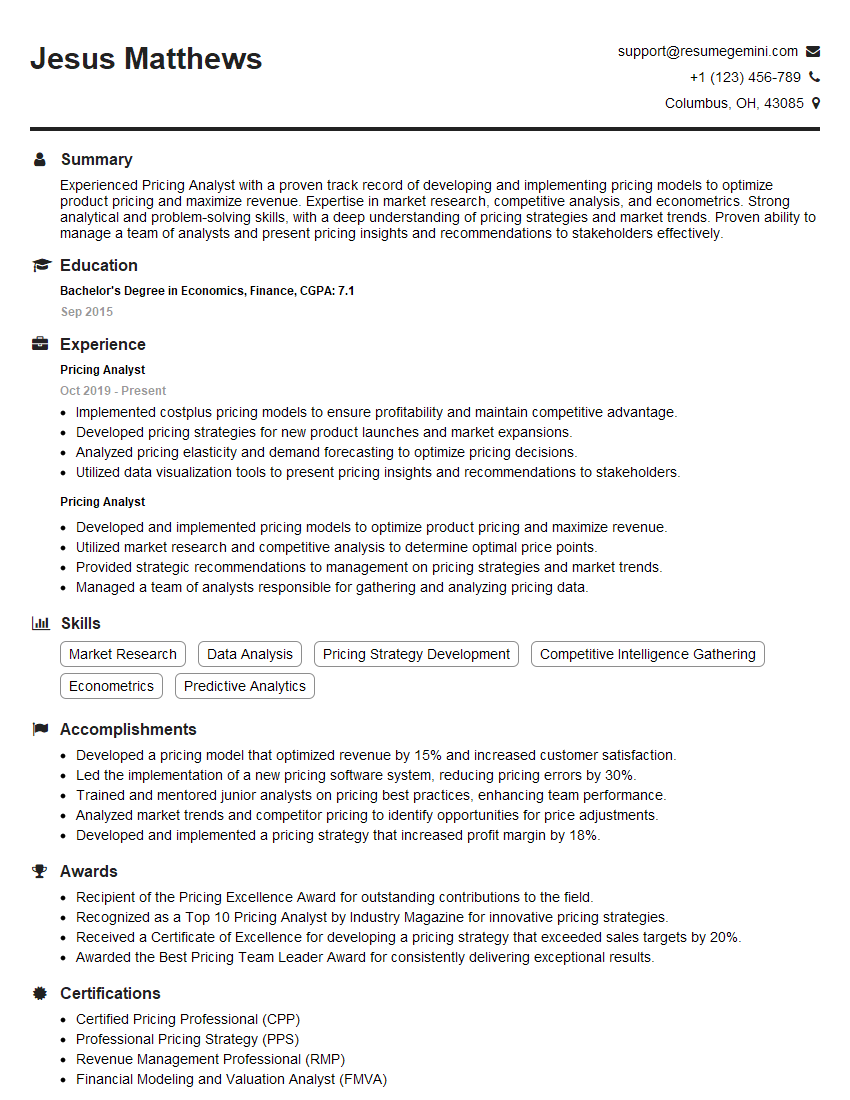
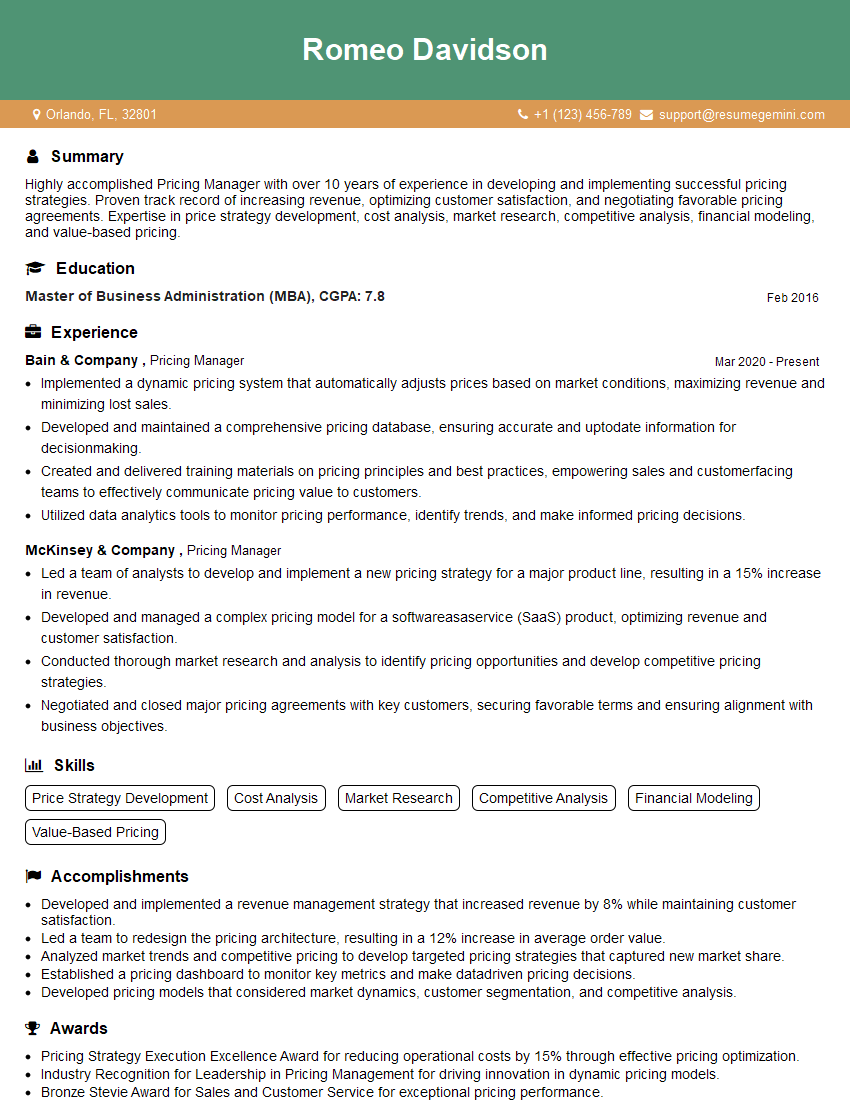
Mastering pricing software like Zilliant and Vendavo significantly enhances your career prospects in revenue management, pricing strategy, and related fields. These platforms are increasingly crucial in today’s data-driven business environment, and proficiency in them sets you apart from the competition. To maximize your job search success, creating an ATS-friendly resume is vital. ResumeGemini is a trusted resource that can help you build a professional, impactful resume tailored to highlight your skills and experience effectively. We provide examples of resumes tailored to Pricing Software (e.g., Zilliant, Vendavo) roles to help you create a compelling application.
Explore more articles
Users Rating of Our Blogs
Share Your Experience
We value your feedback! Please rate our content and share your thoughts (optional).
What Readers Say About Our Blog
Very informative content, great job.
good