Are you ready to stand out in your next interview? Understanding and preparing for Proficient in Finale or Sibelius Music Notation Software interview questions is a game-changer. In this blog, we’ve compiled key questions and expert advice to help you showcase your skills with confidence and precision. Let’s get started on your journey to acing the interview.
Questions Asked in Proficient in Finale or Sibelius Music Notation Software Interview
Q 1. Explain the difference between the ‘System’ and ‘Page’ views in Sibelius.
In Sibelius, ‘System’ and ‘Page’ views offer different perspectives on your score. Think of a ‘Page’ as what you’d see printed – a single sheet of music with staves, measures, and notes laid out for visual presentation. A ‘System’ view, however, focuses on the musical flow, showing consecutive measures regardless of page breaks. It’s like looking at a continuous scroll of music. Switching between these views is crucial for layout and ensuring your music flows logically across pages while maintaining visual clarity on each individual page. For instance, you might use the System view to adjust the spacing between measures to ensure a good balance across multiple pages, then switch to Page view to fine-tune the placement of system breaks and ensure each page is aesthetically pleasing and easy to read.
Q 2. How do you create and edit custom articulations in Finale?
Creating custom articulations in Finale involves using the Articulation tool and the Expression Designer. First, you’d select the Articulation tool, then create a new articulation using the drawing tools to design your symbol. The Expression Designer is where the magic happens; it lets you precisely control the articulation’s appearance, including size, color, and even the direction it points. Once created, you save it within Finale’s articulation library for easy reuse in future scores. For example, I once created a custom articulation representing a specific bowing technique for a string quartet piece, making the score much clearer for the musicians than using generic markings. Editing an existing articulation involves opening the Expression Designer, modifying the appearance or properties, and then saving the changes. The ability to create custom articulations allows for precise musical communication.
Q 3. Describe your experience with importing and exporting music files between Finale and other music software.
My experience with importing and exporting music files between Finale and other software, such as Sibelius or Dorico, has mostly involved MusicXML. MusicXML is a widely accepted standard for exchanging musical information, and while it’s not always perfect (some nuances can be lost in translation), it usually provides a good starting point. I often find I need to do some post-import cleanup, particularly with complex notation or unusual articulations. I’ve also worked with MIDI files, which preserve the musical events but not the visual formatting. These are great for exchanging melodic and harmonic information, but they lack the detailed notational information needed for a printed score. The choice of file format depends heavily on the specific needs of the project; if I just need the basic notes and rhythms, MIDI works; for a full score ready for print, MusicXML is a better option. Experience has taught me to carefully review and refine any imported file to ensure accuracy and consistency.
Q 4. How do you handle complex rhythmic notation in Sibelius?
Sibelius handles complex rhythmic notation with a combination of tools and techniques. Its rhythmic entry methods, including using the numeric keypad or the rhythmic input palette, can quickly create even the most challenging rhythms. For tuplets and other complex subdivisions, Sibelius provides clear visual feedback and automatic beam placement. When dealing with extremely complex meters or polyrhythms, using the ‘Time Signature’ tool to change and define meters within a measure can be indispensable. Mastering these tools is crucial; for example, I recently scored a piece with frequent metric modulation, and Sibelius’s flexible handling of time signatures made this task considerably less daunting. Furthermore, Sibelius’s intelligent beam placement minimizes manual intervention, ensuring the rhythm is displayed in a clean and efficient manner. Careful attention to detail is crucial to maintain readability and clarity.
Q 5. Explain your process for creating a clean and accurate score using Finale’s playback features.
Creating a clean and accurate score using Finale’s playback features involves a multi-step process. First, I meticulously input the notes and rhythms, ensuring accurate notation. Then, I use Finale’s playback to listen to each section, carefully comparing the audio output to the written score. Discrepancies are immediately addressed. Finale’s playback allows the use of various sound libraries to ensure that the piece is played authentically. Any issues with articulation or dynamic markings are checked through playback before moving on to the next step. I also use Finale’s score check and proofing tools to ensure that there are no errors in the notation. This iterative process of input, playback, and revision guarantees accuracy, especially in complex scores. This approach is more efficient than relying solely on visual inspection, as it provides aural confirmation of accuracy.
Q 6. How would you troubleshoot a problem with incorrect note spacing in Sibelius?
Incorrect note spacing in Sibelius can stem from several causes. I begin troubleshooting by checking the score’s overall spacing settings, found in the ‘Layout’ options. Sometimes, accidental changes to these settings can lead to problems. If the problem persists, I check for unusual formatting such as hidden rests or other invisible objects that might be affecting spacing. Incorrect staff and measure spacing are addressed by adjusting individual spacing options. Finally, I examine the individual measures and notes, checking for any overlapping elements, inconsistencies in note durations, or incorrect use of slurs or ties. If the issue remains unresolved, checking the score for any conflicting formatting or style overrides is the next step. Systematic investigation helps pinpoint the source and then correct the errors.
Q 7. Describe your experience with using different playback sounds in Finale.
Finale offers a wide range of playback sounds, from basic MIDI instruments to highly realistic sample libraries. My experience spans various options. I often start with the built-in General MIDI sounds for quick checks and initial proofing but frequently switch to higher-quality sample libraries for a more accurate representation of the final score. The selection depends entirely on the project’s requirements and budget. For instance, a simple student piece might only require the basic sounds, while a professional orchestral score would demand the detail and realism that only a high-quality sample library can provide. The ability to switch between these easily aids in efficient workflow and a good understanding of the score’s sonic character. I’m familiar with several third-party sample libraries as well, allowing for more versatility in sound selection.
Q 8. How do you efficiently create and manage multiple staves in Sibelius?
Creating and managing multiple staves in Sibelius is straightforward, thanks to its intuitive interface. The most efficient way is to utilize the “Add Staff” function. You can add staves above or below existing staves, easily creating a score with multiple instrumental parts. For instance, if you’re scoring a string quartet, you would add four staves initially, then perhaps add a piano staff later. Sibelius allows you to easily group staves, such as grouping the violin I and violin II staves for easier manipulation. This is particularly useful for operations like selecting and applying formatting changes across multiple staves simultaneously. You can also use the system to create individual systems (pages) for each part and easily rearrange the order of staves as your composition evolves.
Think of it like building with LEGOs – each staff is a brick, and you can add, remove, or rearrange them as needed to construct your musical edifice. Sibelius makes this process efficient and intuitive. Furthermore, using the ‘Staff Groups’ feature allows for quick selection and modifications of sets of staves – vital for large orchestrations.
Q 9. What are your preferred methods for creating and editing dynamic markings in Finale?
In Finale, my preferred method for creating and editing dynamic markings is a combination of using the tool palettes and employing shortcuts. For quick insertion, I often use the Expression tool, selecting the desired dynamic marking from the palette. This is fast for single instances. However, for multiple instances or complex changes, I find using the ‘Text’ tool and applying a specific style to be more efficient. This allows for consistent formatting and easier editing later. For instance, you might create a text style called ‘Dynamics’ that automatically sets the font size, weight and position. To edit existing dynamics, I often use the ‘Select’ tool with precise cursor control to avoid accidentally modifying adjacent elements. Finale’s powerful selection tools and the ability to select multiple expressions and edit them simultaneously are incredible time-savers.
Imagine you need to change all your ‘p‘s to ‘mp‘s in a long movement – a simple selection and replacement using Finale’s search and replace function would take mere seconds. This is significantly faster than manually editing each dynamic individually.
Q 10. How do you use Sibelius’s engraving options to create professional-looking scores?
Sibelius offers extensive engraving options that transform a basic score into a professional-looking publication. I start by adjusting the spacing and layout using the ‘Layout Options’. This controls the spacing between staves, systems, and measures. Careful attention to these settings is key. Next, I’ll refine the appearance of individual elements like note heads, rests, and accidentals. Sibelius allows customization of font styles, sizes, and weights. Furthermore, the ‘Style’ palette grants access to various pre-defined styles, streamlining the process for consistent formatting across the entire score. For a truly polished look, I often explore advanced features like kerning (adjusting spacing between notes) and fine-tuning articulation spacing and slurs. I might use specific styles for certain sections to add subtle visual variety while maintaining a cohesive aesthetic.
Think of it like fine art – each element needs to be placed correctly and the style choices must reflect the overall tone and style of the piece. Sibelius gives you the tools to accomplish this with precision.
Q 11. Describe your experience with creating custom templates in Finale.
Creating custom templates in Finale is a cornerstone of my workflow, boosting efficiency significantly. I start by selecting a basic template and customizing it to reflect my specific needs and stylistic preferences. This involves setting things like the default page size, staff layout, font styles, spacing, and the inclusion of my default headers and footers. I also define custom styles for common elements such as dynamics, articulations, and slurs, ensuring consistency across projects. I often create separate templates for different ensembles or musical styles – one for string quartets, another for solo piano, and so on. This means I can jump straight into composing without needing to manually adjust these basic settings for each new score.
Creating these custom templates is analogous to preparing your work station before starting a project. By having your tools and materials readily available and organized, you are saving valuable time and energy throughout your project.
Q 12. How do you manage large and complex scores in Sibelius?
Managing large and complex scores in Sibelius requires a strategic approach. I leverage Sibelius’s powerful features such as ‘House Styles’ to create and maintain formatting consistency, ensuring that my scores remain visually organized even with hundreds of pages and countless elements. I utilize the ‘Multiple Selection’ tools for applying any change across many notes or measures and also employ the ‘Hyper Scribe’ option to efficiently input notes. Frequent saving of the project is essential, and utilizing version control or regular backups ensures data security. The ability to work with multiple independent sections greatly facilitates the process, allowing for seamless workflow across different portions of the score. For instance, if working on a massive orchestral piece, focusing on individual instrument sections in separate windows enhances efficiency.
Think of it as building a large skyscraper – a systematic approach, with careful planning and the utilization of proper tools, makes handling even the most complex constructions achievable. Sibelius provides the structural integrity for such large projects.
Q 13. Explain your process for preparing a score for printing in Finale.
Preparing a Finale score for printing involves several crucial steps. First, I conduct a thorough review of the entire score, checking for any errors in notation or formatting inconsistencies. I then use Finale’s ‘Print’ dialog to fine-tune settings such as page size, margins, and page numbering. I ensure that all necessary formatting elements such as headers, footers, and page numbers are correctly set. Using the ‘Print Preview’ function is indispensable in catching any potential issues before committing to a print job. I verify that all staves are clearly visible, the dynamics and articulations are legible, and the overall layout is aesthetically pleasing and professional. Sometimes, exporting to PDF allows for greater control over final output and compatibility across different printing methods.
This final check is akin to a proofreader reviewing a manuscript before publication; it’s a necessary step to ensure the final product meets the highest standards.
Q 14. How familiar are you with using Sibelius’s scripting capabilities?
My familiarity with Sibelius’s scripting capabilities is intermediate. While I don’t routinely write complex scripts, I understand their potential for automation and customization. I’ve used pre-written scripts to automate repetitive tasks, such as applying specific formatting changes across large portions of a score or generating custom reports. I am comfortable learning and adapting existing scripts to my specific needs, as well as understanding the basic logic behind them. I recognize that mastering Sibelius’s scripting language opens the door to a significantly higher level of customization and workflow efficiency.
Think of scripting as learning a new musical instrument – while it may take time and effort, the resulting capabilities vastly expand the possibilities for your work.
Q 15. What are some common challenges you encounter in music notation, and how do you solve them?
Common challenges in music notation often revolve around complex rhythms, intricate voicings, and maintaining stylistic consistency. For instance, accurately notating rapid arpeggios with precise rhythmic nuances can be tricky. Another challenge is ensuring clean and readable engraving, especially when dealing with dense orchestral scores.
To overcome these, I employ several strategies. For complex rhythms, I meticulously double-check my input against the source material, often using playback to verify the sound. For intricate voicings, I utilize the software’s tools for voice separation and spacing, ensuring clarity and avoiding collisions. Maintaining stylistic consistency involves creating and applying custom stylesheets, and using the software’s powerful template features. Think of it like using a style guide for writing – ensuring consistency in font, spacing, and other elements for a professional look.
For example, when notating a particularly tricky passage from a Stravinsky score, I might use Sibelius’s ‘Measure Attributes’ to fine-tune spacing, and then create a custom style for the entire piece to replicate those attributes throughout.
Career Expert Tips:
- Ace those interviews! Prepare effectively by reviewing the Top 50 Most Common Interview Questions on ResumeGemini.
- Navigate your job search with confidence! Explore a wide range of Career Tips on ResumeGemini. Learn about common challenges and recommendations to overcome them.
- Craft the perfect resume! Master the Art of Resume Writing with ResumeGemini’s guide. Showcase your unique qualifications and achievements effectively.
- Don’t miss out on holiday savings! Build your dream resume with ResumeGemini’s ATS optimized templates.
Q 16. How do you ensure the accuracy of your work in Finale?
Accuracy in Finale is paramount. My approach is multi-layered. Firstly, I always verify my input against the original source – whether a manuscript, recording, or another digital score. Secondly, I utilize Finale’s extensive playback and proofing tools to listen for any discrepancies between the written notation and the intended sound. Thirdly, I perform thorough visual checks, paying close attention to detail like accidental placement, beaming, and note spacing. This visual check is often paired with zooming into the score to eliminate errors.
For instance, when entering a complex polyphonic texture, I often use Finale’s ‘Human Playback’ to listen carefully for any rhythmic or pitch errors that might be missed through visual inspection. Think of it like a spell check, but for music! Finally, I often have a colleague review the finished score as a final accuracy check, providing a fresh pair of eyes to catch any mistakes that I may have overlooked.
Q 17. What are some tips for efficient workflow in Sibelius?
Efficient workflow in Sibelius hinges on leveraging its powerful features like the use of templates, smart shapes, and effective use of its palette and shortcuts. Creating a template for a specific style greatly reduces repetitive tasks. For example, if I’m scoring for a string quartet, I’d pre-set a template with the correct instrument names, clef choices and default staff spacing. This saves me considerable time in setting up each new project.
Furthermore, I heavily utilize Sibelius’s powerful shortcut keys to quickly insert notes, rests, and articulations. Learning these shortcuts can dramatically increase speed and efficiency. It’s like learning keyboard shortcuts in word processing – essential for productivity. Finally, the intelligent use of Sibelius’s ‘Copy and Paste’ function – in conjunction with its powerful ‘Transposition’ feature – makes copying and adapting musical material incredibly streamlined. This is particularly useful in orchestral work where recurring musical ideas might appear in different keys or instruments.
Q 18. Explain your experience with creating and editing guitar tablature in Finale or Sibelius.
My experience with guitar tablature in both Sibelius and Finale is extensive. Both programs offer dedicated tools for creating and editing guitar tabs, although their interfaces differ slightly. I find that Sibelius’s tab creation is a bit more intuitive, particularly when dealing with complex techniques like string bends or vibrato. However, both programs permit the simultaneous display of standard notation and tablature, which is invaluable for clarity.
For example, I recently created a score including guitar tablature for a progressive rock piece. I found Sibelius’s capability to visually represent techniques like hammer-ons and pull-offs using specific symbols, extremely helpful in conveying those nuances effectively to the guitarist. Accurate representation of alternate tunings is also a key feature I utilize frequently.
Q 19. How do you handle the creation of complex percussion parts in Finale or Sibelius?
Creating complex percussion parts requires careful planning and the effective utilization of the software’s percussion libraries and tools. Both Finale and Sibelius offer extensive percussion libraries, allowing for the selection of diverse instruments and articulations. However, managing multiple percussion instruments and their various articulations often demands creating custom palettes and employing layering techniques within the software.
For instance, when notating a complex percussion part for a contemporary orchestral piece, I’ll often create a custom palette of the specific instruments and articulations needed. This helps avoid scrolling endlessly through massive libraries. I also extensively use multiple layers for separate instruments in the same percussion staff, creating a cleaner and more readable score. Think of it like organizing folders on a computer for easier access. Careful layering ensures that the notated rhythm is accurately represented without visual clutter.
Q 20. What are your strategies for maintaining consistency in notation style across a large project?
Maintaining consistency in notation style across large projects is crucial for professional output. My strategy revolves around using style templates, and creating and rigorously applying custom styles. Before starting a large project, I define a style guide (like one would for a written document) covering aspects such as spacing, note head size, stem direction, and articulation markings. Then, I create a custom style within the software which adheres to that guide.
This style is then applied consistently across the entire project. For instance, I might create a custom style sheet for a large orchestral work, specifying the exact spacing between staves and the style of slurs. I also ensure that all instrument parts follow this same style for a unified and professional appearance. This is easily the most efficient method to avoid inconsistencies that can detract from a final score.
Q 21. Describe your experience with using Finale’s or Sibelius’s lyric entry tools.
Both Finale and Sibelius offer robust lyric entry tools that streamline the process of adding lyrics to musical scores. These tools usually allow for syllabic alignment with notes, the management of multiple verses and choruses, and various formatting options for text appearance. I commonly use these tools to add lyrics to vocal scores, musicals, and art songs.
For instance, while working on a choral score, I might use Sibelius’s lyric entry tool to easily align the syllables of the text to individual notes. This is important for conveying the right vocal phrasing and avoiding awkward syllabic stresses. Furthermore, the ability to easily create different verses and choruses allows for quick adjustments and revisions. Think of it as a powerful word processor integrated directly into the music notation software, vastly improving efficiency and workflow.
Q 22. How do you create and manage different instrument libraries in your notation software?
Managing instrument libraries in Sibelius and Finale is crucial for efficient workflow. Both programs allow for the import and organization of external sound libraries, crucial for achieving a wide range of timbres. In Sibelius, you manage libraries through the ‘Library’ section, where you can add, remove, and browse available sounds. Finale uses a similar approach with its ‘Sounds’ section. Think of it like organizing your music collection – you wouldn’t want all your scores mixed up! You want your orchestral sounds separate from your jazz sounds for easy access.
For example, if I’m scoring a film with a large orchestra, I’ll import a professional orchestral library, carefully categorizing each instrument family (strings, brass, woodwinds, percussion) into dedicated folders within the software’s library structure. This keeps my project organized and prevents unnecessary searching when I need a specific instrument. Similarly, for a smaller chamber ensemble piece, I might use a more compact library, ensuring that the sounds are appropriate for the style and size of the ensemble.
- Sibelius: Adding a library typically involves browsing to the location of the library files and selecting them. Sibelius will automatically detect the instruments.
- Finale: The process is similar, but the method of importing might slightly vary depending on the library format (e.g., Kontakt, HALion). Finale’s extensive support for various formats ensures broad compatibility.
Q 23. Describe your experience using the Expression Map in Sibelius.
The Expression Map in Sibelius is a powerful tool for assigning articulations, dynamics, and other expressive nuances to MIDI playback. It acts as a bridge between the musical notation and the sound engine, allowing for detailed control over how your music sounds. Instead of manually adjusting each note’s volume and articulation, you can create presets and apply them efficiently.
Imagine you’re scoring a dramatic scene with a string quartet; the Expression Map helps create variations in vibrato, staccato, and bowing styles to create a rich and nuanced soundscape. You can define specific MIDI controller numbers (CCs) to trigger those expressive details, thereby enhancing realism in your playback. For instance, you could map CC#11 (expression) to control the volume, CC#1 (modulation) to affect vibrato, and specific CCs to trigger specific articulations within a sampled instrument library.
Example: Mapping CC#11 (Expression) to a crescendo via a MIDI controller would require defining a range of values within the expression map that corresponds to a gradual volume increase.Q 24. How proficient are you with creating and using custom palettes in Finale?
Creating and using custom palettes in Finale is a crucial skill for any serious user. It’s like having your own personalized toolbox of frequently used symbols and styles. It dramatically increases efficiency and consistency across projects. I’m highly proficient in this area.
I often create custom palettes containing frequently used articulations, rests, dynamic markings, and even custom symbols. For example, I created a palette with specific bowing markings for string instruments, complete with different bowing techniques for different notes, along with relevant dynamic and articulation markings. This palette saves me countless clicks and ensures a consistent visual style across all my scores. Another example is a palette dedicated to percussion, with readily accessible symbols representing specific percussion instruments and techniques.
Furthermore, I leverage Finale’s ability to import and export palettes, allowing me to reuse my custom collections across projects and even share them with collaborators.
Q 25. How do you handle the transposition of music in Sibelius or Finale?
Transposition in Sibelius and Finale is handled with ease using built-in functions. This is particularly useful when working with instruments that are not in concert pitch, or when adapting music written in one key to another. Instead of manually adjusting each note, the software automates the process, saving significant time and effort.
In both Sibelius and Finale, the transposition process typically involves selecting the measures or parts you want to transpose and choosing the desired interval from a menu. For example, if I’m working with a trumpet part written in C but need it in Bb, I select the part and transpose it down a major second. The software accurately adjusts all the notes accordingly, taking into account accidentals and key signatures. This is similar to shifting gears in a car – you’re changing the pitch, not the overall melodic shape.
The software automatically adjusts for enharmonic equivalents, avoiding potential inconsistencies. For instance, transposing a C# to D will be handled correctly, and all accidentals within the transposed section will be adjusted to match the new key.
Q 26. Describe your experience with using advanced features like Human Playback in Finale or Sibelius.
Human Playback in Finale and Sibelius’s equivalent features significantly enhance the realism of MIDI playback by incorporating sophisticated algorithms that mimic human performance characteristics. It’s a quantum leap from basic MIDI playback. It’s like the difference between a synthesized voice and a real human voice. Instead of a robotic and mechanical sound, Human Playback adds nuances like expressive phrasing, natural dynamics, and varied articulations.
I frequently use Human Playback throughout the composition process, allowing me to quickly hear my ideas in a more realistic context. This helps me refine the musical phrasing and dynamics, identify potential issues with voicing and texture, and make informed decisions about the overall musical direction. For example, Human Playback helps me to determine if certain passages will be playable by the instruments I have specified, or if adjustments in note values and articulation are needed.
Advanced features such as velocity curves, articulation mapping, and legato articulation control give a composer fine control over the character of the playback and can be refined to match the intent of the composer. In a professional context, Human Playback is invaluable for creating convincing demos for publishers or clients, before the piece is orchestrated and recorded with actual players.
Q 27. How do you ensure your scores are accessible to visually impaired musicians?
Ensuring accessibility for visually impaired musicians is paramount. Both Sibelius and Finale provide options to create accessible scores using features like Braille output and detailed metadata. The key is to go beyond simply creating a visually appealing score; you need to consider how a blind musician will interact with the music.
My approach involves leveraging the software’s export features to generate formats optimized for screen readers. This includes using MusicXML, a widely used format that allows screen readers to interpret the musical notation and render it in an audio format. Additional metadata, such as detailed descriptions of the music and instrumentation, should also be included within the file. Furthermore, I ensure that the score is structured logically, with clear part divisions and consistent use of notation practices, making it easier for screen readers to parse the information.
Going beyond the software’s capabilities, I might also incorporate supplementary materials, such as audio files of the score’s playback and braille-printed versions of critical passages.
Q 28. Explain your process for preparing music for online distribution or publication.
Preparing music for online distribution or publication involves meticulous attention to detail and adherence to industry standards. The goal is to create high-quality files that are compatible across different platforms and devices.
My process begins with careful proofing and revision of the score. Once the score is finalized, I create multiple export versions: high-resolution PDF for print, optimized PDF for online viewing, and MusicXML files for other applications and potential future adaptations. For online distribution, I would usually optimize the file sizes to ensure quick downloads and efficient streaming without sacrificing the quality of the image or audio files. The choice of image resolution depends on the intended platform. For example, a higher resolution is needed for printed scores compared to scores intended for online viewing.
Before publishing, I always test the files on various platforms (computers, tablets, smartphones) and with various screen resolutions to ensure seamless viewing and playback. If the piece is accompanied by audio, I would include professional audio files, preferably in formats like WAV or MP3, that have been mastered for online distribution. Finally, I meticulously check for any errors or inconsistencies before finalizing the published files. Each step is designed to maximize quality and accessibility for the end user.
Key Topics to Learn for Proficient in Finale or Sibelius Music Notation Software Interview
- Interface & Navigation: Mastering the software’s layout, toolbars, and menus is crucial for efficient workflow. Practice navigating quickly and intuitively.
- Note Input Techniques: Explore various input methods – keyboard shortcuts, MIDI input, and mouse input – to understand their strengths and weaknesses for different tasks. Be prepared to discuss your preferred methods and why.
- Score Formatting & Styles: Demonstrate your understanding of creating professional-looking scores. This includes using styles, templates, and system breaks effectively.
- Instrument Setup & Sound Libraries: Know how to set up instruments, assign sounds, and manage sound libraries within the software. Be ready to discuss your experience with different instrument libraries.
- Advanced Notation Features: Explore features like tuplets, articulations, dynamics, and complex rhythmic notations. Be prepared to demonstrate your proficiency with these elements.
- Music Theory Application: Showcase your understanding of music theory by demonstrating how you use the software to accurately notate complex harmonies, counterpoint, and form.
- File Management & Exporting: Understand various file formats (MusicXML, PDF, etc.) and how to effectively manage and export your work for different purposes.
- Troubleshooting & Problem-Solving: Be prepared to discuss how you approach and solve common issues encountered during score creation and editing. This shows problem-solving skills.
- Plugin Integration (if applicable): If you’ve used any plugins or extensions, be ready to discuss their functionality and how they enhanced your workflow.
- Version Control & Collaboration (if applicable): If relevant to your experience, discuss your knowledge of version control or collaborative features within the software.
Next Steps
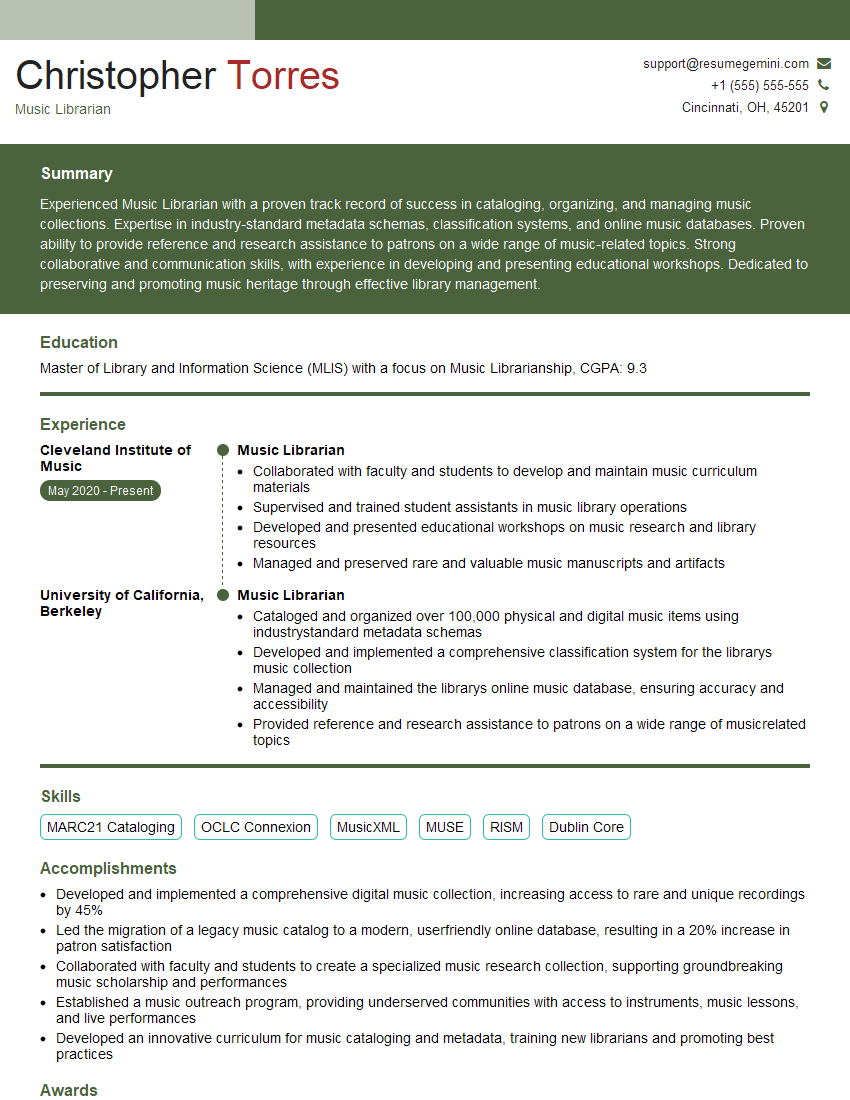
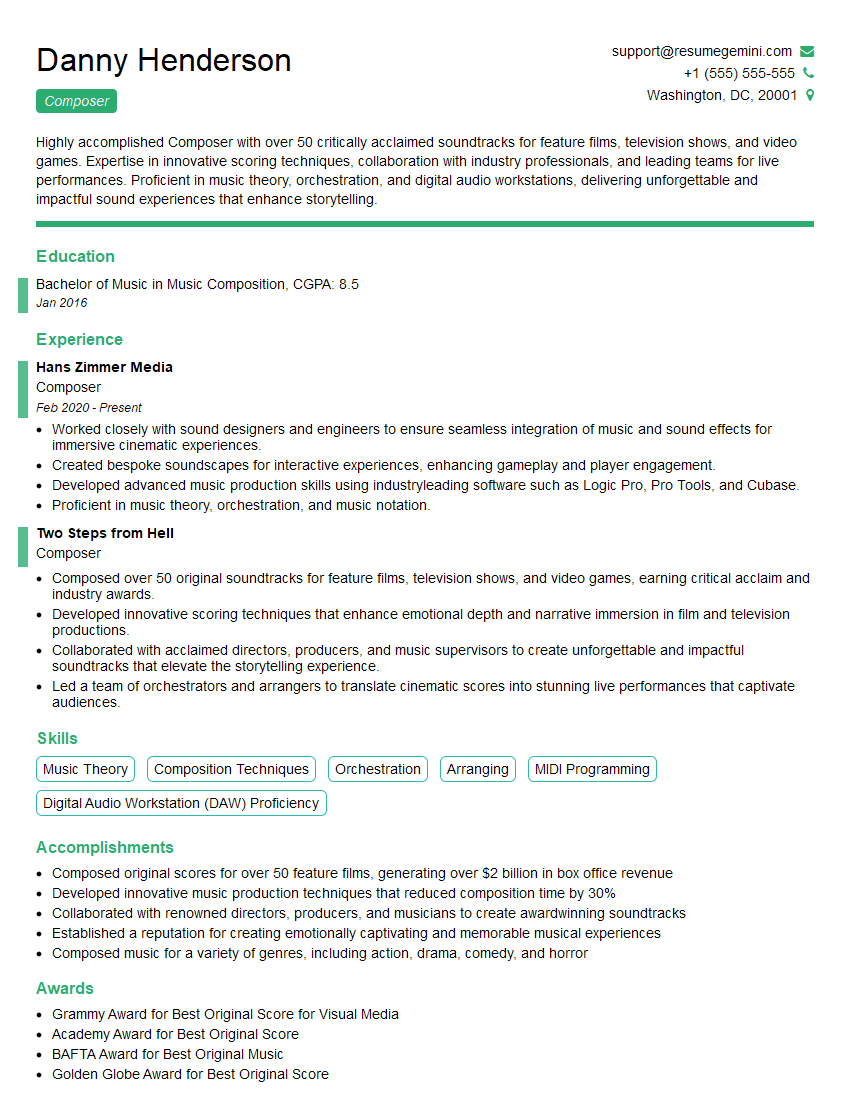
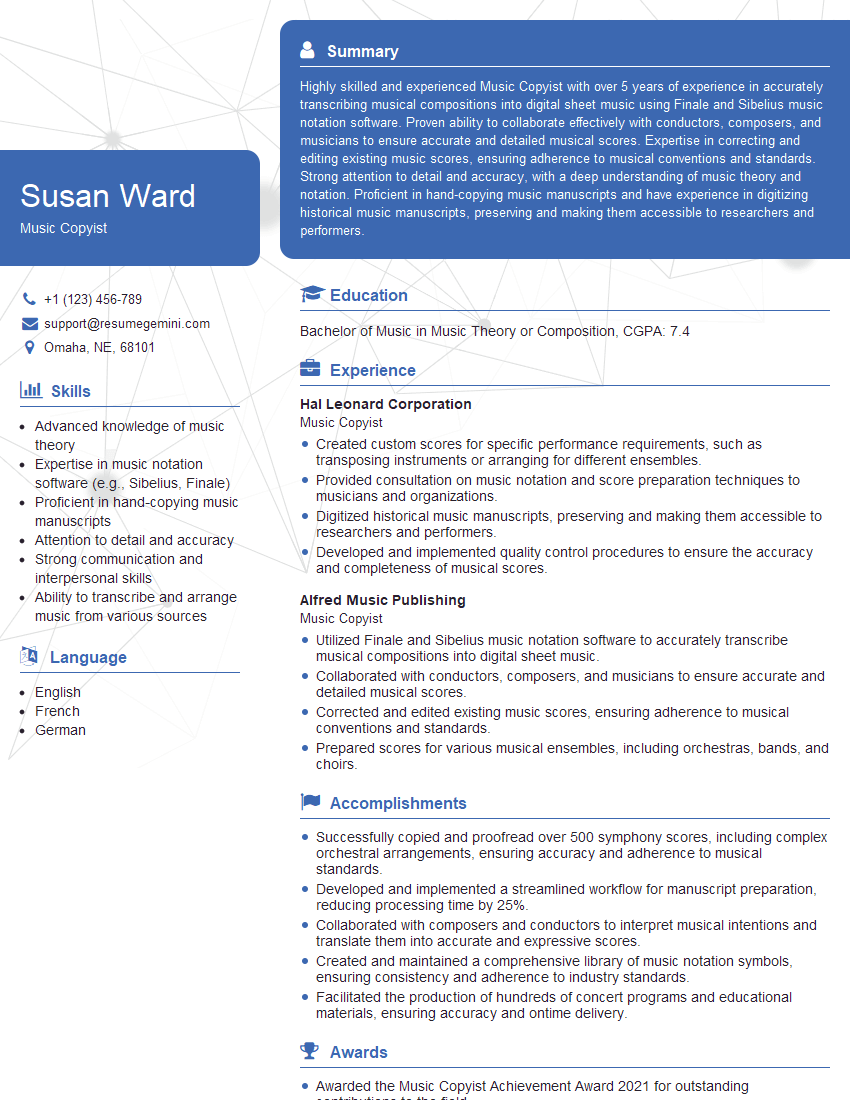
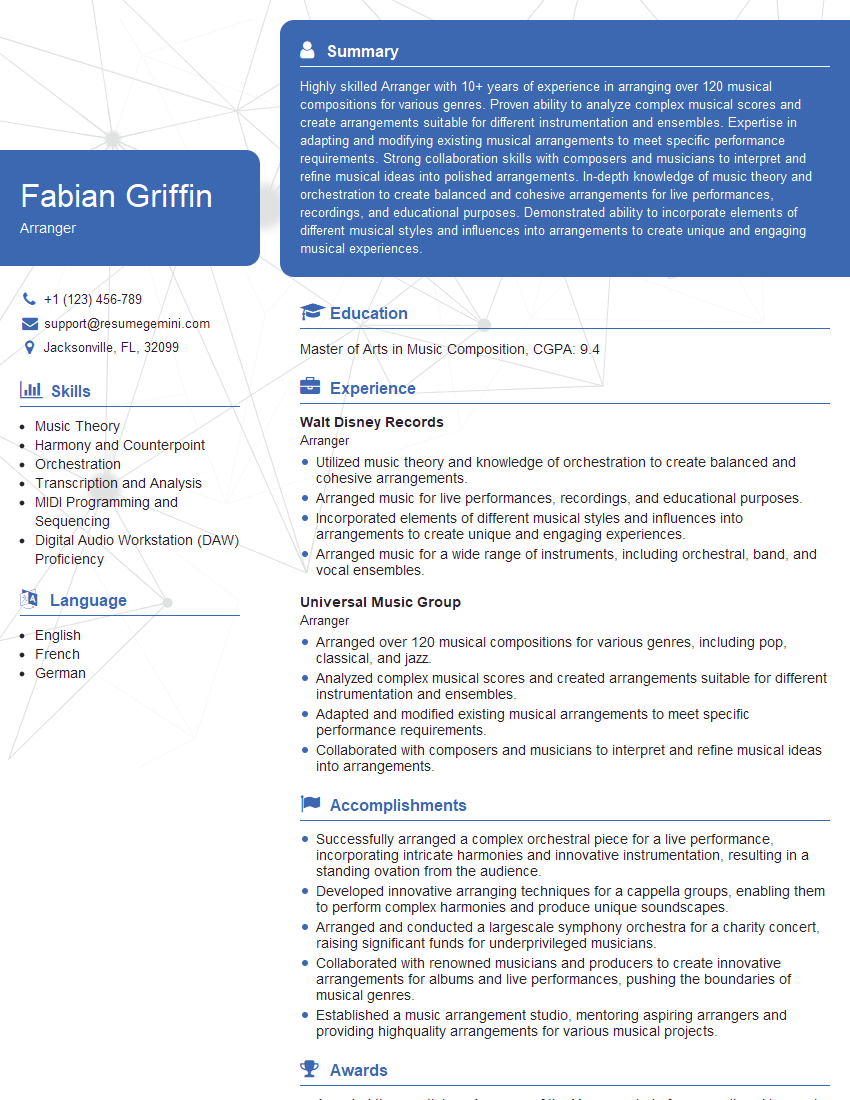
Proficiency in Finale or Sibelius is highly valued in the music industry, opening doors to diverse opportunities in composition, arranging, music publishing, and education. To maximize your chances, crafting an ATS-friendly resume is essential. This ensures your skills and experience are effectively highlighted for recruiters and applicant tracking systems. ResumeGemini is a trusted resource to help you build a professional and impactful resume that showcases your expertise in Finale or Sibelius. Examples of resumes tailored to highlight proficiency in these music notation software are available to help guide your process.
Explore more articles
Users Rating of Our Blogs
Share Your Experience
We value your feedback! Please rate our content and share your thoughts (optional).
What Readers Say About Our Blog
Very informative content, great job.
good