Interviews are opportunities to demonstrate your expertise, and this guide is here to help you shine. Explore the essential Project specifications interview questions that employers frequently ask, paired with strategies for crafting responses that set you apart from the competition.
Questions Asked in Project specifications Interview
Q 1. Explain the importance of clear and concise project specifications.
Clear and concise project specifications are the bedrock of successful projects. They act as a single source of truth, ensuring everyone involved – from developers and designers to clients and stakeholders – is on the same page. Ambiguity in specifications leads to misunderstandings, delays, rework, and ultimately, project failure. Think of it like a blueprint for a house; without a detailed and accurate plan, the house won’t be built correctly.
Importance Breakdown:
- Reduced rework: Clear specifications minimize the chances of building the wrong thing, saving time and resources.
- Improved communication: A shared understanding of the project goals and requirements ensures smooth collaboration.
- Enhanced risk management: Identifying potential issues early on through well-defined specifications allows for proactive mitigation.
- Better cost estimation: Accurate specifications lead to more reliable cost and time estimations.
- Increased client satisfaction: When the final product aligns perfectly with the client’s expectations, satisfaction is guaranteed.
Example: Imagine building a software application. Vague specifications like “make it user-friendly” are unhelpful. Clear specifications would include detailed descriptions of user flows, interface elements, and specific functionalities.
Q 2. Describe your experience in developing functional and non-functional specifications.
In my experience, developing both functional and non-functional specifications is crucial for a complete project definition. Functional specifications define *what* the system should do, while non-functional specifications define *how* well it should do it. I’ve worked on various projects, from e-commerce websites to complex enterprise software solutions, consistently employing a structured approach to cover both aspects.
Functional Specifications Examples:
- The system should allow users to create an account.
- The system should process payments securely.
- The system should generate reports on sales data.
Non-Functional Specifications Examples:
- The system should have a response time of under 2 seconds.
- The system should be scalable to handle 10,000 concurrent users.
- The system should be secure against common vulnerabilities.
- The system should be easy to use and intuitive.
I use techniques like use cases, user stories, and data flow diagrams to capture functional requirements. For non-functional requirements, I leverage techniques like performance testing plans, security audits, and usability testing protocols. The specific tools and techniques vary based on project complexity and methodology (Agile, Waterfall, etc.).
Q 3. How do you ensure consistency and accuracy in project specifications?
Maintaining consistency and accuracy in project specifications is paramount. I use several techniques to achieve this:
- Version Control: Employing a version control system (like Git) allows for tracking changes, managing different versions, and ensuring everyone works with the latest approved specification.
- Centralized Repository: Storing specifications in a central, easily accessible location prevents inconsistencies caused by multiple, disparate versions.
- Template and Style Guide: Using a standardized template and style guide ensures consistency in formatting, terminology, and structure across the entire specification document.
- Review and Approval Process: Implementing a formal review and approval process involving key stakeholders ensures accuracy and buy-in from all parties. This includes technical reviews, client reviews, and management approvals.
- Traceability Matrix: A traceability matrix links requirements to design components and test cases, enabling better validation and verification.
Example: Before finalizing any specification, I always conduct a thorough review with the development team and the client to identify and correct any inconsistencies or inaccuracies. This collaborative approach ensures everyone is aligned and reduces the risk of errors.
Q 4. What techniques do you use to manage changes to project specifications?
Managing changes to project specifications is an inevitable part of the project lifecycle. I employ a formal change management process to handle this effectively, ensuring transparency and control:
- Change Request Form: All change requests must be submitted through a formal process, typically using a change request form that documents the proposed change, its justification, impact assessment, and required approvals.
- Impact Analysis: Before approving any change, a thorough impact analysis must be performed to assess the effect on the project scope, schedule, and budget. This often involves discussions with developers and other stakeholders.
- Configuration Management: A configuration management system ensures that all changes are documented, tracked, and implemented in a controlled manner.
- Version Control: Changes to the specifications are tracked using version control, allowing for easy rollback if necessary.
- Communication: Regular communication about approved changes keeps the entire team informed and minimizes confusion.
Example: If a client requests a significant change mid-project, I’d initiate a formal change request, conduct an impact assessment, present the updated timelines and cost estimates, and obtain client approval before implementing the change. This ensures everyone remains informed and minimizes disruptions.
Q 5. Explain the difference between a requirement and a specification.
While often used interchangeably, requirements and specifications are distinct concepts. A requirement describes a need or capability that the system must possess to satisfy a stakeholder’s goal. A specification, on the other hand, provides the detailed description of how that requirement will be implemented.
Analogy: Think of a requirement as “I need a car to get to work.” The specification would detail the type of car (sedan, SUV), its features (automatic transmission, power steering), and other technical characteristics.
Example:
- Requirement: The system shall allow users to search for products.
- Specification: The search functionality will utilize a full-text search engine, allowing users to input keywords and receive relevant results within 0.5 seconds. The results will be displayed on a dedicated search results page.
In essence, requirements define the *what*, while specifications define the *how*.
Q 6. How do you handle conflicting requirements in project specifications?
Conflicting requirements are a common challenge. Resolving them requires careful analysis, prioritization, and effective communication:
- Identify and Document: The first step is to clearly identify and document all conflicting requirements. This often involves meetings with stakeholders.
- Analyze the Impact: Assess the impact of each requirement on the project goals, cost, and schedule.
- Prioritize Requirements: Prioritize conflicting requirements based on their relative importance to the project’s overall objectives. This often involves negotiation and trade-offs with stakeholders.
- Negotiate and Compromise: Find solutions that address the core needs of all stakeholders while minimizing negative impacts. This may involve modifying requirements, introducing new ones, or eliminating some altogether.
- Document Decisions: Clearly document all decisions made regarding conflicting requirements and communicate these decisions to all stakeholders.
Example: If one stakeholder wants a highly secure system requiring complex authentication while another wants a simple and fast user experience, I would analyze the impact of both requirements, determine which is more critical, and then explore design solutions that balance security and usability. This might involve implementing a two-factor authentication system for higher security risks but a simpler login for routine access.
Q 7. Describe your experience using specification writing tools or software.
I have extensive experience utilizing various specification writing tools and software. My choices depend on the project’s nature and team preferences. I’ve used:
- Microsoft Word/Google Docs: For smaller projects, these remain valuable for creating well-structured documents, especially when collaborating with clients who might not be familiar with more specialized tools.
- Confluence/Jira: For larger projects and Agile environments, these platforms enable collaborative editing, version control, and integration with other project management tools. This allows for traceability and easier management of requirements across the development lifecycle.
- Specialized Requirements Management Tools: I have experience with tools like Jama Software and Polarion, which offer advanced features like impact analysis, traceability matrices, and reporting capabilities. These are particularly helpful for managing complex projects with many stakeholders.
My selection criteria focus on collaborative capabilities, version control, integration with other project tools, and ease of use for all stakeholders. The goal is to choose the tool best suited for the project’s needs and the team’s expertise.
Q 8. How do you ensure that project specifications are traceable to project goals?
Ensuring traceability between project specifications and goals is crucial for project success. It ensures everyone understands the ‘why’ behind each requirement. This is achieved through a structured approach that explicitly links specifications to the overarching project objectives.
- Goal Decomposition: Start by breaking down the high-level project goals into smaller, more manageable objectives. For example, if the goal is to “increase customer satisfaction,” objectives might include “reduce customer support response time” and “improve website usability.”
- Requirement Mapping: Each specification should be explicitly linked to the relevant objective(s). This can be done using a requirements traceability matrix (RTM), a spreadsheet or database that maps each requirement to its corresponding objective. For instance, a specification like “Implement a live chat feature on the website” directly supports the objective of “improve website usability.”
- Regular Review: Periodically review the RTM to ensure that all specifications remain aligned with the project goals. Changes in project scope or priorities should trigger updates to the RTM to maintain traceability.
Think of it like a roadmap. The project goals are your destination, the objectives are major checkpoints, and the specifications are the individual steps you take to reach each checkpoint. Without this mapping, you risk straying off course.
Q 9. How do you involve stakeholders in the development of project specifications?
Stakeholder involvement is paramount in developing effective project specifications. Their diverse perspectives ensure the specifications are complete, accurate, and address the real needs of the project.
- Stakeholder Analysis: Identify all key stakeholders early on and analyze their interests, influence, and expectations.
- Workshops and Meetings: Conduct workshops and meetings to collaboratively define requirements. Using techniques like brainstorming and facilitated discussions can help elicit a wide range of needs and perspectives.
- Surveys and Questionnaires: Use surveys and questionnaires to gather input from a larger group of stakeholders, especially for large projects.
- Prototyping and Feedback: Develop prototypes and present them to stakeholders for feedback. This allows them to see and interact with the proposed solution, providing more concrete feedback on the specifications.
- Documentation and Communication: Maintain clear and consistent communication throughout the process. Document all decisions and feedback to ensure everyone is on the same page.
For example, in developing a new software application, involving end-users in the design process through user testing sessions ensures that the final product meets their needs and expectations. Ignoring their input can lead to a product that is technically sound but ultimately fails to meet its intended purpose.
Q 10. What methods do you use to validate project specifications?
Validating project specifications is essential to ensure they are feasible, accurate, and complete. Several methods can be employed:
- Reviews and Inspections: Formal reviews by subject matter experts and stakeholders help identify inconsistencies, ambiguities, and omissions. This includes walkthroughs and peer reviews.
- Prototyping: Creating prototypes allows for early testing and validation of design and functionality. This helps identify flaws early in the development cycle, which is less costly to fix.
- Modeling and Simulation: For complex systems, modeling and simulation can help validate the specifications against expected behavior and performance.
- Feasibility Studies: These studies assess the technical, economic, and operational feasibility of the project specifications.
- Proof of Concept: A proof of concept demonstrates the viability of a key technical element of the project, reducing the risk of failure later on.
For instance, before building a new bridge, engineers would conduct detailed simulations and stress tests to validate the structural integrity of the design based on the specifications.
Q 11. Explain your process for reviewing and approving project specifications.
The review and approval process for project specifications should be formal and well-defined to ensure quality and accountability.
- Version Control: Use a version control system (e.g., Git) to manage changes and track revisions.
- Defined Roles and Responsibilities: Clearly define roles and responsibilities for reviewing and approving specifications (e.g., technical leads, project managers, stakeholders).
- Formal Review Meetings: Conduct formal review meetings where reviewers provide feedback and sign-off on the specifications.
- Documentation of Approvals: Maintain a record of all approvals and any changes made to the specifications.
- Change Management Process: Establish a process for managing changes to approved specifications, ensuring that any changes are properly documented, reviewed, and approved.
A well-defined process minimizes misunderstandings and ensures everyone is working from the same, approved document. This reduces the risk of costly rework later in the project lifecycle.
Q 12. Describe a time you had to revise project specifications due to unexpected challenges.
In a project to develop a mobile application for a large retail chain, we initially specified a native iOS and Android development approach. However, midway through, unexpected challenges arose when we discovered limitations in integrating with the client’s existing legacy systems. The integration proved significantly more complex and time-consuming than anticipated, threatening the project’s timeline and budget.
We responded by revising the specifications to adopt a hybrid app development approach, leveraging a cross-platform framework. This reduced the integration complexities and allowed us to deliver a functional app on time. While this required a compromise in some aspects of native performance, it prioritized timely delivery and aligned with the client’s revised priorities.
This experience underscored the importance of flexibility and adaptability in project management, and having clear communication channels with clients to manage unexpected challenges effectively. The documentation of the revised specifications was rigorously maintained to ensure clarity and consistency.
Q 13. How do you balance detail and conciseness in project specifications?
Balancing detail and conciseness in project specifications is a crucial skill. Too much detail can overwhelm readers and hinder comprehension, while insufficient detail can lead to ambiguities and errors.
- Prioritization: Focus on documenting essential information, ensuring critical details are clearly defined while avoiding unnecessary complexity.
- Modular Approach: Break down specifications into smaller, manageable modules or sections to improve readability.
- Use of Diagrams and Visual Aids: Use flowcharts, diagrams, and other visual aids to illustrate complex concepts and processes concisely.
- Clear and Concise Language: Use clear, simple language, avoiding technical jargon unless necessary and defining any specialized terms used.
- Templates and Style Guides: Employ templates and style guides to maintain consistency and readability.
Think of it as writing a recipe. You need enough detail to ensure the dish is made correctly, but you don’t need to describe every minute action. The key is to provide just enough information for clear understanding and consistent implementation.
Q 14. What are the key elements of a well-written project specification?
A well-written project specification is a comprehensive document that provides a detailed description of the project’s requirements, constraints, and deliverables. Key elements include:
- Introduction and Overview: A clear description of the project’s goals, objectives, and scope.
- Functional Requirements: A detailed description of what the project should do.
- Non-Functional Requirements: Requirements related to performance, security, usability, and other non-functional aspects.
- Technical Requirements: Specifications related to the technology stack, platforms, and infrastructure.
- Constraints: Limitations and restrictions impacting the project, such as budget, timelines, and regulatory compliance.
- Acceptance Criteria: Clearly defined criteria for accepting the completed project.
- Glossary of Terms: A list of definitions for technical terms or acronyms used in the document.
A well-structured, clear, and comprehensive project specification serves as a crucial reference point throughout the project lifecycle, minimizing misunderstandings and ensuring everyone is aligned with the project vision.
Q 15. How do you manage different versions of project specifications?
Managing different versions of project specifications is crucial for maintaining clarity and traceability throughout a project’s lifecycle. Think of it like writing a novel – you have multiple drafts, each representing a stage of development. I typically employ a version control system, such as Git, coupled with a document management system. This allows me to:
- Track Changes: Each version is meticulously documented, highlighting modifications and the rationale behind them. This ensures accountability and transparency.
- Rollback to Previous Versions: If a change introduces errors or unwanted effects, we can easily revert to a previous stable version.
- Collaborate Effectively: Multiple team members can work on the specifications concurrently, merging their changes seamlessly. Conflict resolution tools within the system help manage discrepancies.
- Maintain a Clear Audit Trail: The version history provides a complete record of all changes, who made them, and when, crucial for auditing and future reference.
For instance, in a recent project developing a mobile application, we used Git to manage the specification document. Every update, from refining UI elements to adjusting functionality, was committed with a descriptive message, allowing us to trace changes back to specific decisions and discussions.
Career Expert Tips:
- Ace those interviews! Prepare effectively by reviewing the Top 50 Most Common Interview Questions on ResumeGemini.
- Navigate your job search with confidence! Explore a wide range of Career Tips on ResumeGemini. Learn about common challenges and recommendations to overcome them.
- Craft the perfect resume! Master the Art of Resume Writing with ResumeGemini’s guide. Showcase your unique qualifications and achievements effectively.
- Don’t miss out on holiday savings! Build your dream resume with ResumeGemini’s ATS optimized templates.
Q 16. How do you handle ambiguous or incomplete requirements?
Ambiguous or incomplete requirements are a significant risk to any project. My approach involves a proactive and iterative process:
- Clarification through Stakeholder Engagement: I actively engage with stakeholders, using techniques like workshops and interviews, to clarify unclear points. Asking open-ended questions (‘Can you elaborate on…?’, ‘What is the intended outcome here?’) helps unearth implicit needs.
- Prototyping and Mockups: To visualize ambiguous requirements, I leverage prototyping tools to create early mockups or functional prototypes. This facilitates better understanding and allows for quick feedback.
- Requirement Decomposition: Breaking down large, complex requirements into smaller, manageable chunks improves clarity and helps identify areas of ambiguity more readily.
- Assumption Logging: Explicitly documenting assumptions made when dealing with incomplete information helps manage the inherent uncertainty and allows for revisiting and refactoring based on later developments.
For example, if a requirement states ‘user-friendly interface’, I would work with the UX team and stakeholders to define concrete metrics for ‘user-friendly,’ such as task completion time, error rate, and user satisfaction ratings.
Q 17. Explain your experience with different specification formats (e.g., IEEE, UML).
My experience encompasses various specification formats, including IEEE standards (like IEEE 830) and UML (Unified Modeling Language). Each offers unique strengths depending on the project’s needs.
- IEEE 830: I’ve utilized this standard for creating comprehensive software requirements specifications, focusing on clear, concise descriptions of functionalities, external interfaces, performance requirements, and design constraints. The structured approach ensures consistency and completeness.
- UML: I’ve used UML diagrams, such as use case diagrams, class diagrams, and sequence diagrams, to visually model system behavior and structure. This helps to bridge the communication gap between technical and non-technical stakeholders. For instance, use case diagrams clearly illustrate user interactions with the system.
The choice of format depends on the project’s complexity and the stakeholders’ technical proficiency. For complex systems, a combination of both IEEE-style textual specifications and UML diagrams is often the most effective approach, creating a comprehensive and accessible representation of the requirements.
Q 18. How do you ensure that project specifications are understandable to all stakeholders?
Ensuring specifications are understandable to all stakeholders requires a multi-faceted approach:
- Plain Language: Avoiding technical jargon and using clear, concise language that is easily accessible to all is paramount. Replacing technical terms with everyday language where possible improves comprehension.
- Visual Aids: Diagrams, flowcharts, mockups, and prototypes enhance understanding by providing a visual representation of complex concepts.
- Targeted Communication: Tailoring the communication style and level of detail to the audience’s technical expertise is crucial. A technical document for developers will differ from a summary for business stakeholders.
- Review and Feedback Cycles: Regular review sessions with stakeholders provide opportunities for feedback and clarification, ensuring everyone is on the same page.
In a recent project, we used user stories to explain requirements in a simple, relatable format. For example, ‘As a customer, I want to be able to easily track my order so I can know when it will arrive.’ This approach made it easy for non-technical stakeholders to grasp the system’s purpose.
Q 19. What is your approach to prioritizing different specification requirements?
Prioritizing requirements is critical for efficient project management. I utilize a combination of methods to achieve this:
- MoSCoW Method: This prioritization technique categorizes requirements as Must have, Should have, Could have, and Won’t have. This clearly outlines essential vs. desirable features.
- Value vs. Effort Matrix: Plotting requirements based on their business value and implementation effort helps identify high-value, low-effort items to prioritize first.
- Risk-Based Prioritization: Requirements that pose higher risk to project success, such as critical functionalities or regulatory compliance aspects, are prioritized to mitigate potential negative impacts.
- Stakeholder Input: Collaborating with stakeholders to understand their priorities and weighing their input in the decision-making process is fundamental.
For example, in a project with a tight deadline, we’d prioritize the ‘Must have’ requirements identified through the MoSCoW method, ensuring core functionality is delivered on time.
Q 20. How do you utilize project specifications to manage risk?
Project specifications are a cornerstone of risk management. By clearly defining requirements, constraints, and assumptions, we can proactively identify and mitigate potential risks.
- Risk Identification: The specification process itself often reveals potential risks. For instance, ambiguous requirements could lead to rework, and unrealistic deadlines might cause delays.
- Risk Assessment: Once identified, risks are assessed based on their likelihood and potential impact on the project. This allows for prioritizing risk mitigation strategies.
- Contingency Planning: The specifications should incorporate contingency plans for identified risks. For example, if a particular technology might not be available, alternative solutions should be documented.
- Requirement Traceability: Linking requirements to test cases and risk mitigation plans ensures complete coverage and allows for tracking progress and identifying potential issues early.
A thorough specification acts as a roadmap for risk management. By defining clear expectations and outlining potential pitfalls, we can build resilience and adaptability into the project, leading to a smoother and more successful outcome.
Q 21. Describe your experience using specification management systems.
I have extensive experience using various specification management systems, including both standalone tools and integrated platforms within larger project management suites.
- Confluence/Jira: These platforms provide centralized repositories for specifications, allowing for collaboration, version control, and tracking of changes. The integration with other project management tools streamlines workflows.
- SharePoint: SharePoint offers document management capabilities, version control, and workflow automation for managing specifications. It’s suitable for larger organizations with established document control processes.
- Dedicated Specification Management Tools: These tools offer specialized features for requirements tracing, impact analysis, and change management. They’re particularly helpful for complex projects with numerous stakeholders.
My choice of system depends on the project’s size, complexity, and the organization’s existing infrastructure. Regardless of the system, I prioritize establishing clear processes for document access, version control, and change management to ensure data integrity and efficient collaboration.
Q 22. How do you ensure the completeness of project specifications?
Ensuring complete project specifications is crucial for project success. It’s like building a house – you wouldn’t start construction without a complete blueprint. Completeness means covering all aspects, leaving no room for ambiguity or assumptions. My approach involves a multi-step process:
- Requirements Elicitation: Thoroughly gathering requirements from stakeholders through interviews, workshops, and document analysis. This ensures we capture everything needed, from functional requirements (what the system should do) to non-functional requirements (performance, security, usability).
- Traceability Matrix: Creating a traceability matrix that links requirements to design, implementation, and testing activities. This ensures every requirement is addressed and verified.
- Reviews and Inspections: Conducting formal reviews and inspections involving multiple stakeholders to identify gaps and inconsistencies. This includes peer reviews, walkthroughs, and formal inspection meetings with checklists.
- Prototyping: Developing prototypes to validate requirements and uncover hidden issues early on. This is especially beneficial for complex systems where visual representation helps clarify ambiguities.
- Use Cases and Scenarios: Defining detailed use cases and scenarios to illustrate how the system should behave under different conditions. This helps in identifying edge cases and exceptional scenarios that might be missed otherwise.
For example, in a recent software project, we used a traceability matrix to ensure that all user stories (requirements) were linked to corresponding acceptance criteria (testing) and development tasks. This prevented any requirements from slipping through the cracks.
Q 23. How do you address inconsistencies between different sections of the project specifications?
Inconsistencies in project specifications are like cracks in a foundation – they can lead to major problems down the line. Addressing them requires careful attention to detail and a collaborative approach. My process involves:
- Version Control: Using a version control system (e.g., Git) to manage different versions of the specifications and track changes. This helps identify conflicts and inconsistencies introduced by multiple authors.
- Automated Checks: Utilizing tools to perform automated checks for inconsistencies, such as duplicate IDs or conflicting statements. This can catch simple errors that might be missed during manual review.
- Cross-Referencing: Ensuring proper cross-referencing between different sections of the specifications. This helps in understanding how different components relate to each other and in identifying inconsistencies.
- Reconciliation Meetings: Holding regular meetings with stakeholders to discuss and resolve inconsistencies. This collaborative approach ensures everyone is on the same page and avoids misunderstandings.
- Prioritization and Resolution: Establishing a clear process for prioritizing and resolving inconsistencies based on their impact. Critical inconsistencies are addressed first.
For instance, I once encountered a conflict between the database schema defined in one section and the data access layer described in another. Using a reconciliation meeting, we identified and corrected the discrepancy, preventing significant rework later in the development process.
Q 24. How do you incorporate regulatory requirements into project specifications?
Incorporating regulatory requirements into project specifications is non-negotiable, especially in industries like healthcare, finance, or aerospace. Failure to comply can lead to legal issues and project failure. My approach involves:
- Regulatory Research: Thoroughly researching and identifying all applicable regulatory requirements, including industry standards and legal frameworks.
- Requirement Mapping: Mapping regulatory requirements to specific project requirements and design elements. This ensures that compliance is addressed systematically.
- Traceability and Audits: Establishing traceability between regulatory requirements, design decisions, and testing procedures. This allows for easy auditing and demonstration of compliance.
- Templates and Checklists: Developing templates and checklists for different regulatory requirements to streamline the process and minimize errors.
- Regular Updates: Regularly reviewing and updating the specifications to reflect changes in regulations and industry best practices.
For example, in a medical device project, we meticulously documented how each design feature met the relevant sections of ISO 13485, ensuring complete compliance and a smooth regulatory approval process.
Q 25. Explain your experience with different types of specifications (e.g., system, hardware, software).
My experience encompasses various types of specifications, each requiring a different approach and level of detail:
- System Specifications: These high-level documents define the overall functionality, architecture, and interfaces of a system. They focus on ‘what’ the system does, rather than ‘how’ it does it. I’ve worked on system specifications for everything from enterprise resource planning (ERP) systems to embedded control systems. Key elements include use cases, system diagrams, and performance requirements.
- Hardware Specifications: These detail the physical components of a system, including their characteristics, interfaces, and interconnections. Experience includes specifying components for servers, network devices, and embedded systems. This often involves working with datasheets and component selection tools.
- Software Specifications: These documents detail the software components, their functionality, and interfaces. I’ve worked extensively on software specifications using techniques like UML diagrams, pseudocode, and detailed API descriptions. My experience includes specifying web applications, mobile apps, and backend systems. Emphasis is on algorithms, data structures, and security considerations.
Each type of specification requires different levels of detail and expertise. For example, system specifications are often more abstract, while software specifications need to be more precise and detailed. However, they all need to be clear, concise, and consistent to support successful project execution.
Q 26. How do you contribute to the overall quality assurance of project specifications?
Quality assurance of project specifications is paramount. It’s like ensuring the blueprint is accurate before starting construction. My contributions include:
- Review Processes: Developing and implementing rigorous review processes to identify inconsistencies, ambiguities, and errors. This involves formal reviews, walkthroughs, and inspections.
- Style Guides and Templates: Creating and enforcing style guides and templates to ensure consistency and readability across the specifications.
- Metrics and KPIs: Defining metrics and key performance indicators (KPIs) to track the quality of the specifications, such as the number of defects found during reviews or the time taken to resolve issues.
- Tooling and Automation: Using automated tools to check for common errors and inconsistencies in the specifications.
- Training and Education: Providing training and education to project team members on writing and reviewing effective specifications.
For instance, in one project, I implemented a peer review process that significantly reduced the number of defects found during later stages of development, saving time and resources.
Q 27. Describe your process for creating and maintaining a specification baseline.
Establishing and maintaining a specification baseline is like creating a master blueprint that everyone agrees upon. It’s essential for managing changes and ensuring consistency. My process includes:
- Formal Approval: Formally approving the specifications through a documented process involving key stakeholders. This typically includes reviews, sign-offs, and version control.
- Configuration Management: Implementing a configuration management system to track changes to the specifications and ensure that everyone is working with the latest approved version. This might involve a version control system like Git, or a more specialized configuration management tool.
- Change Control Process: Defining a formal change control process for managing and approving changes to the baseline specifications. This ensures that changes are documented, reviewed, and approved before they are implemented.
- Version History: Maintaining a detailed history of all changes made to the specifications, including who made the changes, when they were made, and why they were made.
- Regular Audits: Regularly auditing the specifications to ensure that they are up-to-date, accurate, and consistent.
For example, using Git branching and merging allowed us to manage different versions of the specifications during the development process, while the formal change control process ensured that every update was properly reviewed and approved before being incorporated into the main baseline.
Q 28. How do you use project specifications to track progress and measure performance?
Project specifications are the roadmap for success. They provide the basis for tracking progress and measuring performance. My approach involves:
- Work Breakdown Structure (WBS): Breaking down the project into smaller, manageable tasks based on the specifications. This provides a clear picture of the work to be done.
- Metrics and KPIs: Defining metrics and KPIs to track progress against the specifications. This could include features completed, tests passed, or milestones achieved.
- Progress Reporting: Regularly reporting on progress against the specifications, highlighting any deviations or issues that need attention.
- Performance Measurement: Using the specifications to measure performance against established goals and targets. This helps in identifying areas for improvement.
- Variance Analysis: Performing variance analysis to identify the causes of any deviations from the plan and take corrective actions.
For example, we used a project management tool to track the progress of each task defined in the WBS against the project schedule. This allowed us to identify potential delays early on and make appropriate adjustments to the plan.
Key Topics to Learn for Project Specifications Interviews
- Scope Definition and Management: Understanding how project specifications define the project’s boundaries, deliverables, and constraints. Practical application includes analyzing existing specifications to identify potential scope creep.
- Requirements Elicitation and Analysis: Techniques for gathering and analyzing stakeholder needs to create comprehensive and unambiguous specifications. Practical application includes prioritizing requirements based on business value and feasibility.
- Functional and Non-Functional Requirements: Distinguishing between what the system *does* (functional) and how well it does it (non-functional). Practical application involves translating user stories into detailed technical specifications.
- Use Case Modeling: Creating visual representations of user interactions with the system to clarify functionality. Practical application includes developing use cases to test different scenarios and edge cases.
- Specification Documentation and Communication: Understanding best practices for writing clear, concise, and unambiguous specifications, and effectively communicating these to stakeholders. Practical application involves reviewing and providing constructive feedback on existing project specifications.
- Risk Management in Specifications: Identifying and mitigating potential risks associated with unclear or incomplete specifications. Practical application involves proposing solutions to address identified risks and uncertainties.
- Traceability and Verification: Ensuring that requirements are traceable throughout the development lifecycle and can be verified against the final product. Practical application includes developing a traceability matrix to link requirements to test cases.
Next Steps
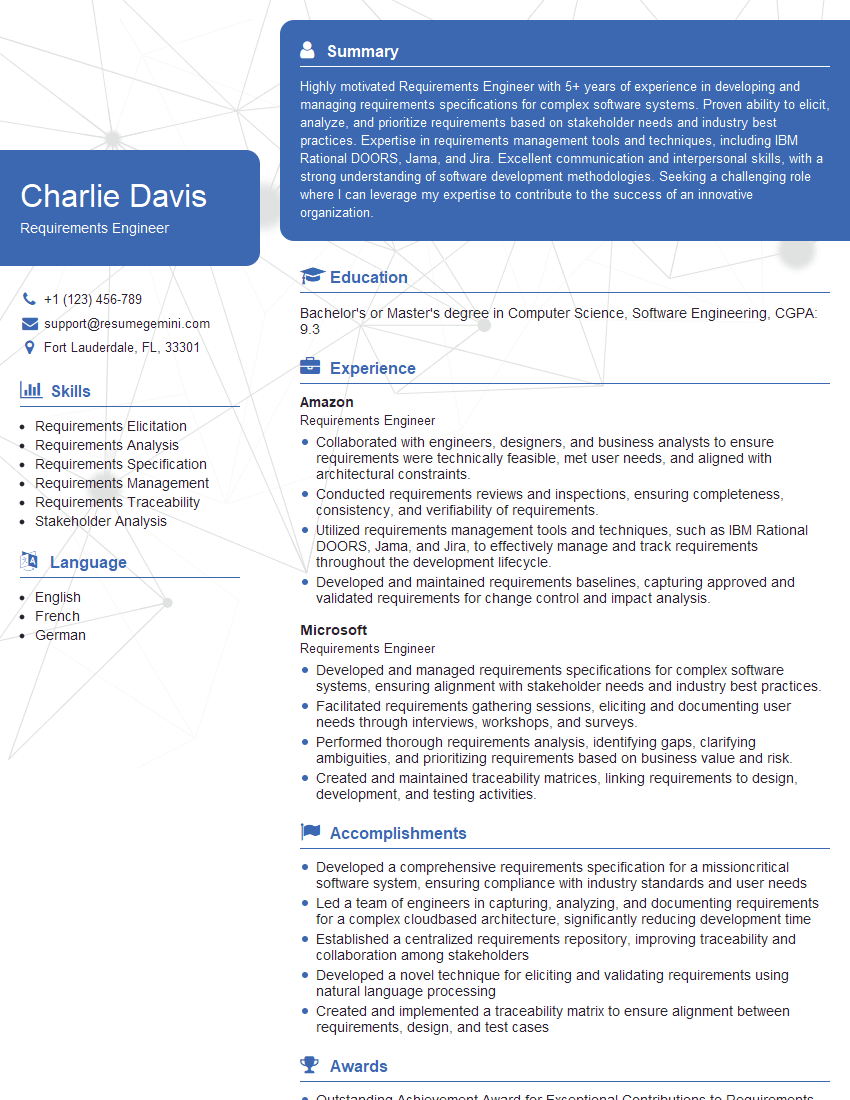
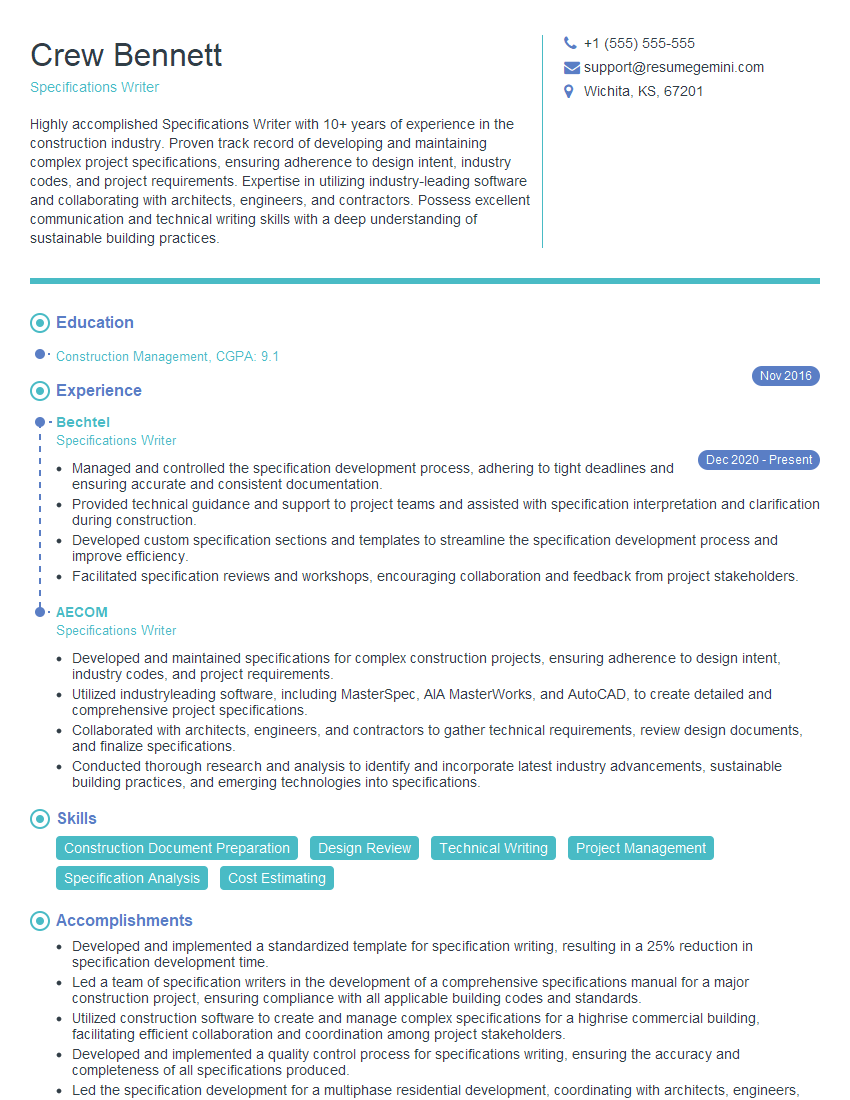
Mastering project specifications is crucial for career advancement in project management and related fields. A strong understanding of specification development and management demonstrates key skills sought after by employers, setting you apart from the competition. To significantly boost your job prospects, create an ATS-friendly resume that showcases your expertise. ResumeGemini is a trusted resource to help you build a professional and impactful resume that highlights your skills and experience effectively. Examples of resumes tailored to showcasing project specifications expertise are available within ResumeGemini, providing you with templates and guidance to create a winning application.
Explore more articles
Users Rating of Our Blogs
Share Your Experience
We value your feedback! Please rate our content and share your thoughts (optional).
What Readers Say About Our Blog
Very informative content, great job.
good