The right preparation can turn an interview into an opportunity to showcase your expertise. This guide to Radar System Performance Monitoring interview questions is your ultimate resource, providing key insights and tips to help you ace your responses and stand out as a top candidate.
Questions Asked in Radar System Performance Monitoring Interview
Q 1. Explain the key performance indicators (KPIs) used to monitor radar system performance.
Monitoring radar system performance relies on several key performance indicators (KPIs). These KPIs provide a quantitative measure of how well the radar system is functioning and achieving its intended purpose. Think of them as a radar system’s ‘vital signs’.
- Range Resolution: This measures the ability of the radar to distinguish between two closely spaced targets. A higher resolution means better target discrimination. For instance, a radar with poor range resolution might confuse two closely flying aircraft as one.
- Angle Accuracy: This KPI assesses the precision with which the radar determines the direction (azimuth and elevation) of a target. In air traffic control, inaccurate angle measurements can lead to incorrect positioning of aircraft.
- Sensitivity: This refers to the radar’s ability to detect weak signals, indicating its ability to detect small or distant targets. A less sensitive radar might miss small, low-observable aircraft.
- False Alarm Rate: This KPI measures the frequency of false alarms – detections of targets where none exist. High false alarm rates reduce operator efficiency and create confusion. For example, clutter from weather can lead to a high false alarm rate.
- Clutter Rejection: This indicates the radar’s effectiveness in filtering out unwanted signals, such as ground clutter or weather echoes. Poor clutter rejection masks actual targets, particularly near the ground.
- Signal-to-Noise Ratio (SNR): This is a crucial measure of how strong the target signal is compared to the background noise. A higher SNR indicates better target detectability.
- System Availability: This reflects the percentage of time the radar system is operational and functioning correctly. Downtime due to malfunctions directly affects the system’s effectiveness.
Regularly monitoring these KPIs allows for proactive maintenance and ensures the radar system maintains optimal performance.
Q 2. Describe different radar system architectures and their impact on performance monitoring.
Radar system architectures significantly impact performance monitoring. Different architectures have varying complexities, impacting the data collected and the methods used for analysis.
- Mono-static Radar: The transmitter and receiver are co-located. Monitoring is relatively straightforward, focusing on KPIs related to signal transmission, reception, and processing at a single point. Troubleshooting involves checking the health of the combined unit.
- Bi-static Radar: The transmitter and receiver are spatially separated. Performance monitoring becomes more challenging as it requires coordinated monitoring of both transmitter and receiver units. Data synchronization and signal propagation effects need careful consideration. Troubleshooting involves investigating the health of two separate, geographically distant units.
- Multi-static Radar: This employs multiple receivers with one or more transmitters. This presents the most complex monitoring scenario. Data fusion from multiple receivers is crucial, and precise time synchronization is essential to accurately locate targets. Troubleshooting often requires sophisticated signal processing and data analysis techniques.
The choice of architecture dictates the complexity of the performance monitoring system. Mono-static systems require simpler monitoring tools and processes, while multi-static systems require advanced data fusion and analysis techniques to integrate data from multiple sources accurately.
Q 3. How do you identify and troubleshoot radar system malfunctions using performance data?
Identifying and troubleshooting radar system malfunctions requires a systematic approach using performance data. It’s like diagnosing a patient’s illness through medical test results.
- Data Acquisition: Gather comprehensive performance data from all relevant sensors and subsystems, including the KPIs mentioned earlier.
- Data Analysis: Analyze the data, looking for deviations from established baselines or thresholds. Statistical process control charts can be particularly useful in identifying anomalies.
- Fault Isolation: Use the anomalous data to pinpoint the source of the malfunction. For example, a sudden drop in SNR might point to a receiver problem, while a rise in the false alarm rate might indicate clutter interference.
- Verification and Repair: Once the source is identified, verify the fault and initiate the appropriate repair or corrective action.
- Performance Validation: After repairs, re-evaluate the system’s performance to ensure the malfunction is resolved and KPIs are within acceptable ranges.
For example, if the range resolution suddenly degrades, you might suspect a problem with the signal processing unit or the antenna. Analyzing the specific nature of the degradation (e.g., consistent reduction across all ranges or only in a particular range band) can help further narrow down the problem.
Q 4. What are the common sources of radar system errors and how are they detected?
Radar systems are prone to various errors, which can significantly degrade performance. These errors can originate from multiple sources.
- Hardware Failures: These include faults in the transmitter, receiver, antenna, or signal processing units. Detection involves monitoring for unusual signal levels, power consumption, or temperature readings.
- Software Glitches: Bugs in the radar software can cause malfunctions, leading to inaccurate measurements or data corruption. Rigorous software testing and version control are essential. Detection often involves error logs and system diagnostics.
- Environmental Factors: Weather conditions (rain, snow, fog), atmospheric interference, and ground clutter can all impact performance. Monitoring weather data alongside radar performance metrics is essential. Adaptive signal processing techniques can help mitigate some of these effects.
- Operator Errors: Incorrect settings or calibrations can lead to errors. Regular operator training and standard operating procedures (SOPs) help prevent these issues. Careful system logs tracking operator actions are very useful in investigation.
Detection involves a combination of automated monitoring systems, alarm thresholds, and human oversight. Regular maintenance, preventative checks, and rigorous testing are vital for early detection and prevention of these errors.
Q 5. Explain the role of signal processing in radar performance monitoring.
Signal processing plays a critical role in radar performance monitoring. It’s the backbone of extracting meaningful information from raw radar signals.
- Signal Detection: Signal processing algorithms identify the presence of target signals amidst noise and clutter. Techniques such as matched filtering and constant false alarm rate (CFAR) detection are widely used.
- Parameter Estimation: Signal processing estimates crucial target parameters, including range, velocity, and angle. Accurate parameter estimation directly impacts the quality of the radar data and depends critically on robust signal processing.
- Clutter Rejection: Signal processing techniques filter out unwanted signals (clutter) to enhance target detection. Adaptive filters and space-time processing are used to achieve this.
- Data Compression: Signal processing techniques can compress large volumes of radar data, reducing storage and transmission requirements. Compression must be designed carefully so as to not compromise data integrity.
Effective signal processing is essential for ensuring the accuracy and reliability of the radar’s performance metrics. By analyzing signal processing parameters and metrics, we gain deep insights into the health and performance of the radar system. For example, if the clutter rejection is ineffective, the system will struggle to detect weak target signals even in the presence of strong clutter.
Q 6. Discuss the use of statistical analysis in evaluating radar performance.
Statistical analysis is crucial for evaluating radar performance, providing objective and quantitative assessments. It moves us beyond simple observation into rigorous understanding.
- Statistical Process Control (SPC): SPC charts (e.g., control charts) are used to monitor KPIs over time, identifying trends and detecting anomalies. This allows for early detection of performance degradation.
- Hypothesis Testing: Statistical tests (e.g., t-tests, ANOVA) can compare the performance of different radar systems or the system’s performance under varying conditions. This can help determine if observed differences are statistically significant.
- Regression Analysis: This technique helps to model the relationship between different performance indicators and environmental factors, enabling better understanding of influencing variables.
- Probability Distributions: Analyzing the probability distributions of KPIs (e.g., range error) provides insights into their variability and uncertainty, which is crucial in understanding the system’s limitations.
For example, using a control chart to track the false alarm rate can reveal if it’s consistently exceeding an acceptable threshold, indicating a need for maintenance or recalibration. Similarly, regression analysis might reveal a strong correlation between rain intensity and range accuracy, leading to better operating procedures during heavy weather.
Q 7. How do you interpret radar system performance reports and identify trends?
Interpreting radar system performance reports and identifying trends requires a combination of technical expertise and analytical skills. Think of it as deciphering a story told by numbers.
- Baseline Establishment: First, define a baseline of normal operation. This includes average values and acceptable ranges for each KPI. This baseline forms the basis for comparison.
- Data Visualization: Employ appropriate data visualization techniques (e.g., graphs, charts) to identify patterns and trends in the performance data. Look for anomalies, sudden changes, or gradual drifts.
- Trend Analysis: Analyze the time series data to identify trends. Is performance gradually degrading? Are there seasonal variations? Are there specific operating conditions leading to performance issues?
- Correlation Analysis: Examine the correlation between different KPIs. For example, is there a correlation between SNR and the false alarm rate? This might hint at underlying issues.
- Root Cause Analysis: Once trends or anomalies are identified, investigate their root cause using appropriate diagnostic tools and procedures.
For instance, a gradual decrease in sensitivity over time might indicate a problem with the receiver’s gain or a gradual degradation of the antenna’s performance. Identifying these trends and their root causes allows for timely interventions to prevent larger issues.
Q 8. Describe your experience with radar calibration and its impact on performance.
Radar calibration is crucial for ensuring accurate measurements and maintaining optimal system performance. It involves adjusting the radar’s internal parameters to align its readings with known standards. Think of it like calibrating a kitchen scale – you need to ensure it accurately reflects the weight of ingredients. In radar, this involves calibrating parameters like transmit power, receiver gain, and antenna alignment. Inaccurate calibration can lead to significant errors in target detection, range, and velocity measurements, impacting the overall effectiveness of the system. For example, a poorly calibrated weather radar might underestimate rainfall intensity, leading to inaccurate flood predictions. My experience includes working with various calibration techniques, including using precision test equipment to verify signal strength and phase alignment across different frequencies and channels, and employing sophisticated algorithms to compensate for environmental factors like temperature and humidity.
During one project involving an airport surveillance radar, we discovered a significant calibration drift in the receiver gain. This resulted in a systematic underestimation of aircraft ranges. After recalibration, we saw a marked improvement in detection accuracy and a reduction in false alarms, demonstrating the direct impact of calibration on system performance and safety.
Q 9. Explain the significance of maintaining accurate radar system documentation.
Accurate and up-to-date radar system documentation is paramount for several reasons. It provides a complete history of the system, including its configuration, maintenance records, and performance data. This documentation is vital for troubleshooting, ensuring regulatory compliance, and facilitating efficient upgrades or repairs. Imagine trying to fix a complex machine without any instructions – it’s nearly impossible. Similarly, a lack of proper radar documentation can lead to significant downtime and increased maintenance costs. Good documentation aids in identifying potential issues before they escalate into major problems.
Specifically, documentation should include details on the radar’s specifications, calibration records, software versions, and any modifications made to the system. It also needs to include performance metrics, such as detection range, accuracy, and false alarm rates, collected over time. This allows for trend analysis, helping predict potential failures and plan for preventative maintenance. I’ve personally overseen the development and implementation of a comprehensive documentation system for a large-scale weather radar network, ensuring that all data was meticulously recorded and readily accessible. This significantly reduced the time required for troubleshooting and maintenance.
Q 10. How do you ensure the accuracy and reliability of radar performance data?
Ensuring the accuracy and reliability of radar performance data involves a multi-faceted approach. It starts with meticulous data acquisition using properly calibrated equipment. Then, rigorous quality control processes are implemented to identify and remove any spurious or erroneous data points. Think of it as sifting through sand to find gold – you need to systematically eliminate the unwanted elements to reveal the valuable data. This may involve applying statistical filters and cross-referencing data from multiple sources.
Furthermore, regular system checks and validation against known targets or benchmarks are critical. This could involve comparing radar data with data from other sensors or known meteorological events. We also use redundancy: having multiple independent data streams and comparing their results provides a strong level of confidence in the data’s validity. For instance, in one project, we used a combination of simulated targets and real-world observations to validate the accuracy of our radar’s tracking algorithms. Any discrepancies were investigated and corrected, ensuring the data’s reliability.
Q 11. What are the challenges associated with real-time radar performance monitoring?
Real-time radar performance monitoring presents several challenges. The sheer volume of data generated by modern radars demands efficient processing and storage solutions. Processing this data quickly enough for real-time analysis is a challenge. The need for low latency is paramount for many applications, such as air traffic control. Additionally, dealing with noisy data and spurious signals requires sophisticated algorithms to filter out irrelevant information and retain only the valuable data.
Another challenge is the dynamic nature of the environment. Changes in weather conditions, clutter from terrain or other objects, and interference from other electronic sources can significantly impact radar performance. Adapting the monitoring system to these variable conditions requires robust algorithms and efficient signal processing techniques. In one project involving a maritime radar system, we had to deal with significant sea clutter, which affected target detection. We addressed this by implementing adaptive clutter cancellation algorithms, enhancing the system’s performance in real-time.
Q 12. How do you handle conflicting data from different radar performance monitoring systems?
Conflicting data from different radar performance monitoring systems requires careful investigation and analysis. The first step is to identify the source of the discrepancy. This may involve checking the calibration status of each system, investigating potential interference sources, or examining the data acquisition and processing techniques. Often, the conflict stems from differences in sensor placement, calibration, or data processing algorithms. A systematic comparison of the data, looking for patterns and inconsistencies, is essential.
For example, one system may be more sensitive to a specific type of interference than another. Once identified, we can prioritize data based on known reliabilities, or use data fusion techniques to combine data from multiple sources, weighting the contributions based on confidence levels. We might also re-evaluate the calibration procedures or filter settings to resolve the conflict. A thorough understanding of each system’s limitations and strengths is crucial for effective conflict resolution. Ultimately, the goal is to arrive at a consistent and reliable picture of the radar performance.
Q 13. Describe your experience with different radar performance monitoring tools and software.
My experience encompasses a wide range of radar performance monitoring tools and software. I’ve worked with both commercial off-the-shelf (COTS) systems and custom-built solutions. COTS systems often provide user-friendly interfaces and a broad range of functionalities. However, they may lack the flexibility to adapt to specific requirements. Custom solutions offer greater control and customization but require significant development effort.
Specific examples include using MATLAB for signal processing and data analysis, specialized radar performance analysis software from companies like [mention a relevant company, e.g., a radar software vendor], and various database management systems for storing and retrieving large datasets. I’ve also worked with embedded systems for real-time monitoring and data acquisition in deployed radar systems. The choice of tools depends heavily on the specific application, budget, and the level of customization needed.
Q 14. Explain the importance of regular radar system maintenance in ensuring optimal performance.
Regular radar system maintenance is essential for ensuring optimal performance and preventing costly downtime. This involves both preventative and corrective maintenance. Preventative maintenance involves scheduled checks, cleaning, and calibration to prevent potential problems before they arise. Think of it like regular servicing of a car – it ensures that everything is running smoothly and prevents major breakdowns. Corrective maintenance involves repairing or replacing faulty components after a problem occurs.
Neglecting maintenance can lead to decreased accuracy, increased false alarms, reduced detection range, and ultimately, system failure. This can have significant consequences depending on the radar’s application – from inaccurate weather forecasts to compromised air traffic safety. My experience shows a clear correlation between consistent maintenance and optimal radar performance. A well-maintained system requires fewer repairs, has a longer lifespan, and provides more reliable data, significantly improving efficiency and reducing operational costs.
Q 15. How do environmental factors affect radar system performance, and how are they accounted for?
Environmental factors significantly impact radar system performance. Think of it like trying to shout across a crowded room – the more noise (interference), the harder it is to hear (detect a target). Key factors include:
- Atmospheric Attenuation: Rain, snow, fog, and even humidity absorb and scatter radar signals, reducing range and accuracy. The heavier the precipitation, the greater the attenuation. We account for this using atmospheric models and propagation algorithms that estimate signal loss based on weather data.
- Multipath Propagation: Signals can bounce off the ground or other surfaces before reaching the radar, creating ghost targets or signal distortion. Sophisticated signal processing techniques, like adaptive filtering and space-time processing, mitigate these effects.
- Clutter: Ground clutter (reflections from the ground), sea clutter (from the sea surface), and weather clutter (from rain, snow, etc.) overwhelm weak target signals. Techniques like Moving Target Indication (MTI) and clutter cancellation filters are crucial to separating targets from clutter.
- Ionospheric and Tropospheric Refraction: Changes in atmospheric density bend radar waves, leading to range and bearing errors. Corrections are applied based on atmospheric profiles obtained from weather data or specialized sensors.
Accounting for these factors involves using sophisticated models that integrate weather data, terrain information, and radar system parameters. Real-time processing and adaptive algorithms are often employed to compensate for changing environmental conditions.
Career Expert Tips:
- Ace those interviews! Prepare effectively by reviewing the Top 50 Most Common Interview Questions on ResumeGemini.
- Navigate your job search with confidence! Explore a wide range of Career Tips on ResumeGemini. Learn about common challenges and recommendations to overcome them.
- Craft the perfect resume! Master the Art of Resume Writing with ResumeGemini’s guide. Showcase your unique qualifications and achievements effectively.
- Don’t miss out on holiday savings! Build your dream resume with ResumeGemini’s ATS optimized templates.
Q 16. Describe your experience with troubleshooting radar system hardware issues.
My experience with troubleshooting radar hardware includes working on various systems, from legacy X-band to modern phased-array radars. A common approach involves a systematic process:
- Initial Assessment: Carefully examining the system logs and error messages to pinpoint the source of the problem. For example, a low signal-to-noise ratio might indicate an issue with the receiver.
- Component Level Testing: Isolate the faulty component using techniques like signal tracing, spectrum analysis, and checking for continuity. We might replace suspected components like high-power amplifiers or faulty RF cables.
- Calibration and Alignment: Often, performance degradation is due to misalignment of antennas or incorrect calibration. Precision instruments and calibration procedures are essential to address these.
- Environmental Checks: Confirm that the system’s operating environment is within specified limits. Overheating, for instance, can significantly impact performance. We use temperature sensors and monitoring systems to ensure proper operating temperatures.
- Documentation and Reporting: Thorough documentation is critical. We log all steps, test results, and repairs to prevent recurrence and assist future troubleshooting.
One memorable case involved a sudden loss of signal in a weather radar. Through systematic testing, we identified a faulty high-voltage power supply, which was causing intermittent failures in the transmitter. Replacing this component restored full functionality.
Q 17. Explain your process for identifying and resolving software bugs in a radar system.
My approach to identifying and resolving software bugs in radar systems is based on a structured debugging process. Think of it as carefully searching for a lost key – a systematic search is more efficient than random guessing.
- Reproduce the Bug: First, we need to reliably reproduce the bug. This involves understanding the conditions under which it occurs. Detailed documentation of the steps to reproduce the issue is crucial.
- Isolate the Source: We use debugging tools, such as print statements, debuggers, and logging tools to narrow down the location of the error within the code. This often involves inspecting variables and memory states.
- Analyze the Code: Once the source is identified, we analyze the code to understand the root cause of the bug. We might identify logical errors, data type mismatches, or concurrency issues.
- Implement a Fix: We develop and implement the fix, ensuring that it addresses the root cause without introducing new problems. We carefully test the fix to ensure it behaves as expected.
- Testing and Verification: The fix needs thorough testing, including unit testing, integration testing, and system-level testing to validate its effectiveness and absence of side effects. Regression testing is done to ensure that the fix does not break any existing functionality.
For instance, a bug causing inaccurate range measurements was traced to an incorrect calculation within the signal processing algorithm. Fixing this formula, followed by rigorous testing, resolved the issue.
Q 18. Discuss your experience with radar performance modeling and simulation.
Radar performance modeling and simulation are integral parts of radar system design and analysis. It’s like building a virtual prototype before building the actual system, saving significant time and cost.
My experience involves using tools like MATLAB, Python (with libraries like NumPy and SciPy), and specialized radar simulation software. We use these tools to:
- Predict Radar Performance: Model the radar’s detection range, accuracy, and resolution under various scenarios, including different target types, clutter conditions, and environmental effects.
- Optimize System Design: Simulations help evaluate different antenna designs, signal processing algorithms, and waveform parameters to optimize radar performance for a specific application. This often involves running numerous simulations to determine optimal parameters.
- Test Algorithms and Software: Simulations provide a controlled environment to test and debug signal processing algorithms and software before deployment on real hardware. This significantly reduces the risk of unexpected behavior in the real-world system.
- Analyze System Behavior: Modeling and simulation help us understand how the radar system interacts with its environment and predict its limitations.
For example, I used simulation to optimize the waveform parameters of a maritime radar to maximize its detection range for small targets while minimizing the effects of sea clutter.
Q 19. How do you ensure compliance with relevant standards and regulations in radar system performance?
Ensuring compliance with relevant standards and regulations is paramount in radar system performance. This involves adhering to both safety standards (to prevent interference or harm) and performance standards (to meet specified operational capabilities).
My approach involves:
- Understanding Applicable Regulations: This includes familiarity with regulations like those from the Federal Communications Commission (FCC) in the US or similar international bodies regarding electromagnetic emissions and interference.
- Implementing Compliance Measures: Design and implementation processes incorporate measures to ensure compliance, such as using appropriate filters, limiting transmit power, and adhering to strict emission masks.
- Testing and Verification: Rigorous testing, both in simulation and in real-world environments, is conducted to verify compliance with all relevant standards. This often involves specialized measurement equipment to test emission levels and ensure they fall within permitted limits.
- Documentation and Auditing: Maintaining thorough documentation of the system’s design, testing procedures, and compliance results is crucial for audits and regulatory inspections.
For example, in one project, we carefully designed the radar’s transmit waveform and implemented filters to meet stringent requirements for minimizing interference with other communication systems in a congested spectrum.
Q 20. Describe a situation where you had to troubleshoot a complex radar system issue.
During a project involving an airborne radar system, we encountered an unexpected issue where the radar’s tracking accuracy was significantly degraded under certain flight conditions. Initially, the problem seemed unpredictable, occurring intermittently.
Our troubleshooting process involved:
- Data Analysis: We meticulously reviewed flight data, radar data, and system logs, searching for patterns. This revealed a correlation between the degraded performance and specific atmospheric conditions – high humidity and temperature changes.
- System Modeling: We utilized our radar performance models to simulate the radar’s behavior under the observed atmospheric conditions. This highlighted a potential weakness in the system’s automatic gain control (AGC) algorithm, which was susceptible to errors under rapid changes in atmospheric attenuation.
- Algorithm Refinement: The AGC algorithm was modified to incorporate a more robust compensation mechanism for varying atmospheric conditions. This involved adding a predictive component based on weather data available during flight.
- Testing and Validation: Following the algorithm update, thorough flight tests were conducted to validate the fix. These tests showed a significant improvement in tracking accuracy under the previously problematic conditions.
This experience underscored the importance of a systematic approach, thorough data analysis, and the value of accurate radar performance modeling in troubleshooting complex issues.
Q 21. What are the limitations of current radar performance monitoring techniques?
Current radar performance monitoring techniques have limitations, primarily stemming from the complexity of radar systems and their environments:
- Incomplete Observability: Many aspects of radar performance are difficult to directly observe and measure, particularly within the internal workings of the radar signal processing chain. We might be able to see the output (detected targets), but fully understanding the internal state remains challenging.
- Environmental Uncertainty: Precise knowledge of the environment is often limited. Weather data might have limited accuracy, and the effects of multipath propagation can be difficult to model completely.
- Computational Complexity: Real-time performance monitoring requires significant computational power, which can be a bottleneck for complex systems and high data rates. This limits the amount of data that can be processed and analyzed in real-time.
- Limited Predictive Capability: Current techniques primarily focus on monitoring current performance. Predicting future performance degradation remains a significant challenge, especially for long-term monitoring.
Addressing these limitations involves developing more advanced monitoring techniques incorporating machine learning and AI for improved fault prediction, more sophisticated environmental modeling, and the use of distributed sensor networks for enhanced observability.
Q 22. How would you improve the efficiency of our existing radar performance monitoring system?
Improving the efficiency of a radar performance monitoring system involves a multi-pronged approach focusing on data processing, system architecture, and algorithm optimization. First, we can leverage advanced signal processing techniques like compressed sensing or wavelet transforms to reduce the amount of data requiring processing and storage, thus boosting speed and reducing computational burden. This means analyzing only the most relevant parts of the radar signal, discarding redundant information. Secondly, a shift towards a cloud-based or distributed architecture can significantly enhance scalability and processing power, handling larger datasets and complex analyses more efficiently. Think of it like moving from a single, powerful desktop computer to a network of smaller, interconnected machines, each capable of handling specific tasks. Finally, optimizing algorithms – for instance, implementing more efficient search or filtering algorithms – can dramatically decrease processing time without sacrificing accuracy. For example, replacing a brute-force search with a faster, optimized algorithm can shave off significant processing time, allowing for near real-time monitoring.
An example of practical application would be migrating from a system that processes all raw radar data to one that performs initial signal filtering and preprocessing at the sensor level before transmitting to the central processing unit, thus reducing bandwidth requirements and improving overall efficiency.
Q 23. What new technologies or techniques are emerging in radar performance monitoring?
The field of radar performance monitoring is constantly evolving. Several exciting technologies are emerging. Artificial Intelligence (AI) and Machine Learning (ML) are revolutionizing how we analyze radar data. AI/ML algorithms can automatically detect anomalies, predict potential failures, and optimize system parameters in real-time, leading to more proactive maintenance and improved system uptime. Imagine an AI identifying a subtle change in signal characteristics indicating an impending hardware failure days before it actually occurs. Another significant advancement is the integration of advanced sensor fusion techniques. Combining data from multiple radar systems, along with other sensors like LiDAR or cameras, provides a more comprehensive and robust performance picture. This allows us to overcome limitations of individual sensors and gain a much clearer understanding of the environment. Finally, the use of high-performance computing (HPC) clusters enables faster processing and more sophisticated analysis of larger and more complex radar datasets than was previously possible.
Q 24. How do you balance the need for high performance with considerations for system cost and power consumption?
Balancing high performance with cost and power consumption requires careful consideration of several factors. One strategy is to optimize the trade-off between the resolution of the radar data and its processing requirements. Higher resolution provides better accuracy but comes at the cost of increased computational complexity and power usage. Selecting the optimal resolution requires a careful assessment of the specific application needs. A lower resolution might suffice for some applications, reducing processing demands and overall power consumption without compromising essential performance.
Another approach involves using energy-efficient hardware components like low-power processors and optimized digital signal processing (DSP) chips. For instance, we might opt for a less powerful but energy-efficient processor to run the monitoring system, accepting a slight decrease in processing speed to significantly reduce power consumption. Finally, intelligent power management techniques can dynamically adjust the system’s power consumption based on the current operational demands. This adaptive approach allows the system to operate at peak performance when needed but conserve energy during periods of low activity.
Q 25. Describe your experience with data visualization techniques in radar performance monitoring.
My experience with data visualization in radar performance monitoring emphasizes clarity and insightful representation. I’ve used various techniques to effectively communicate complex radar data to both technical and non-technical audiences. For instance, I’ve extensively used interactive dashboards to display key performance indicators (KPIs) like SNR, detection range, and false alarm rate in real-time. These dashboards often incorporate gauges, charts (line graphs for trends, scatter plots for correlations), and maps to visually represent spatial information. For detailed analysis, I frequently employ heatmaps to identify areas of interest or patterns in the radar data, as well as 3D visualizations to represent complex datasets effectively.
Furthermore, I’ve found that selecting the appropriate visualization technique depends heavily on the specific data and the intended audience. For example, a simple bar chart may be sufficient to show the overall system performance to management, while a more complex 3D visualization might be necessary to show detailed internal system behavior to engineers.
Q 26. Explain your understanding of radar signal-to-noise ratio (SNR) and its significance.
The signal-to-noise ratio (SNR) is a crucial metric in radar systems, representing the ratio of the power of the desired radar signal to the power of the background noise. A higher SNR indicates a stronger signal relative to the noise, leading to better detection performance. It’s essentially how well we can distinguish the echoes from our target amidst the background clutter and thermal noise. Think of it as listening for a faint whisper in a noisy room – a high SNR is like having a loud, clear voice, making the whisper easy to hear, whereas a low SNR is like trying to hear that whisper in a crowded, noisy stadium.
The significance of SNR lies in its direct impact on detection probability and accuracy. A higher SNR improves the reliability of target detection and reduces the likelihood of false alarms. In practical terms, a radar system with a low SNR might struggle to detect small or distant targets, potentially leading to missed detections or inaccurate estimations of target range and velocity.
Q 27. What are the key factors influencing radar detection range?
Several key factors determine a radar’s detection range. First and foremost is the transmitted power – a higher power signal travels further. Next, the antenna gain plays a crucial role; a highly directional antenna focuses the energy in a specific direction, increasing the signal strength at the target and improving detection range. The target’s radar cross-section (RCS), which describes how effectively the target reflects radar waves, is another significant factor; larger targets generally have a higher RCS and are easier to detect. The system’s noise level is also critical; higher noise reduces detection range since it makes it harder to distinguish the signal from the background noise. Finally, the radar’s receiver sensitivity and signal processing capabilities influence the detection range. Advanced signal processing techniques can extract weak signals from noise, thereby extending detection capabilities.
Q 28. How would you design a performance monitoring system for a new radar platform?
Designing a performance monitoring system for a new radar platform would involve a phased approach. First, I would carefully define the system’s requirements and key performance indicators (KPIs) based on the specific radar’s operational needs and anticipated challenges. This includes identifying what aspects of performance we need to monitor (e.g., signal strength, detection range, false alarm rate, system latency). Next, I would select appropriate sensors and data acquisition methods that can accurately and reliably collect the necessary performance data. This would likely involve incorporating dedicated monitoring channels within the radar itself, capable of capturing essential internal parameters.
The data processing and analysis stage is crucial. This involves developing algorithms for data filtering, anomaly detection, and performance assessment. Machine learning techniques could be leveraged to create predictive models for potential failures. Finally, I would design a user-friendly interface for displaying performance data in real-time through dashboards and reports, facilitating quick identification of issues. Throughout this process, rigorous testing and validation would be performed to ensure the system’s accuracy, reliability, and effectiveness in providing actionable insights for maintaining optimal radar performance.
Key Topics to Learn for Radar System Performance Monitoring Interview
- Signal Processing Fundamentals: Understanding concepts like signal-to-noise ratio (SNR), clutter rejection, and target detection algorithms is crucial for analyzing radar system performance.
- Radar Waveform Design and Analysis: Learn how different waveforms impact range resolution, Doppler resolution, and overall system performance. Be prepared to discuss the trade-offs involved in waveform selection.
- Performance Metrics: Master the interpretation and application of key metrics such as probability of detection (Pd), probability of false alarm (Pfa), and mean time between failures (MTBF) in assessing radar system effectiveness.
- System Calibration and Testing: Familiarize yourself with various calibration techniques and testing procedures used to ensure accurate and reliable radar performance. Understanding the practical aspects of maintaining a radar system is vital.
- Data Acquisition and Analysis: Gain proficiency in analyzing radar data using specialized software and tools. Be prepared to discuss techniques for identifying anomalies and troubleshooting performance issues.
- Fault Detection and Isolation: Understand methods for diagnosing and resolving system malfunctions. This includes knowledge of common radar system failures and troubleshooting strategies.
- Radar System Architecture: Possessing a broad understanding of the components and interactions within a radar system, from antenna to signal processing, will demonstrate a holistic perspective.
- Modern Radar Technologies: Explore advancements such as phased-array radar, MIMO radar, and cognitive radar to show your awareness of current trends in the field.
Next Steps
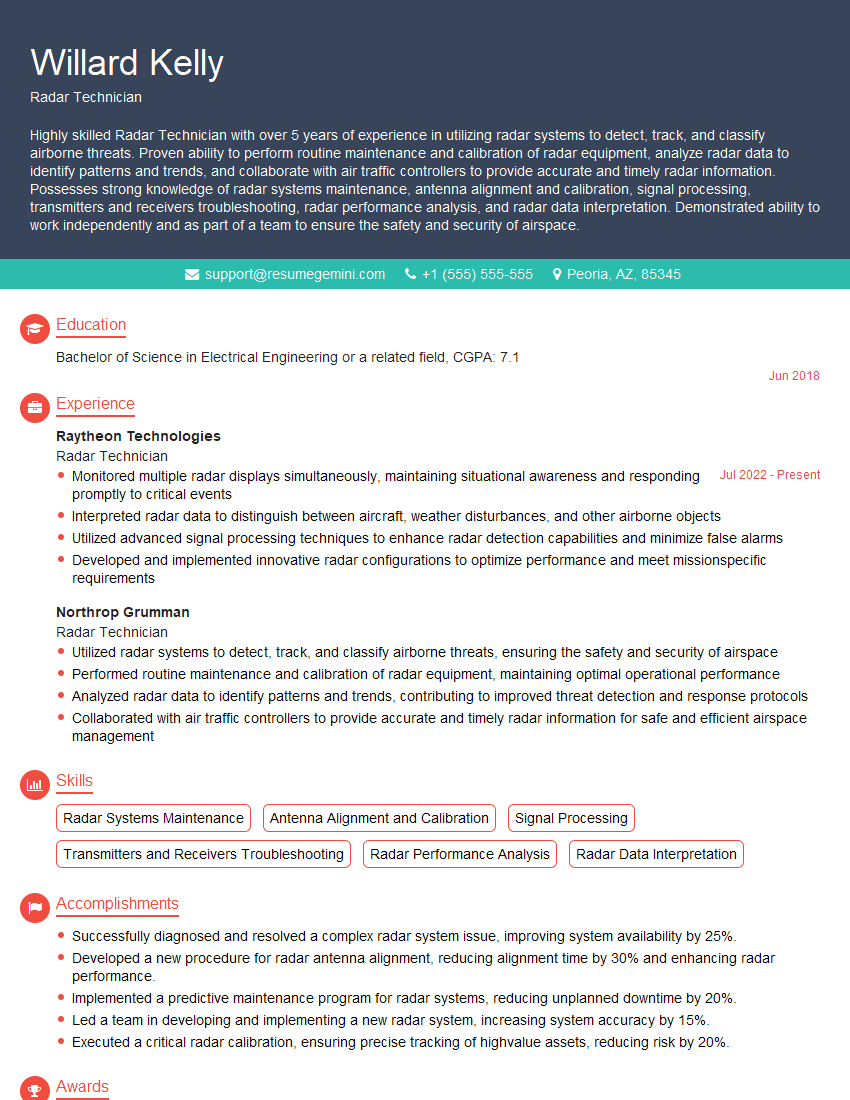
Mastering Radar System Performance Monitoring opens doors to exciting career opportunities in a rapidly evolving technological landscape. A strong understanding of these concepts will significantly enhance your interview performance and demonstrate your valuable expertise to potential employers. To maximize your job prospects, creating an ATS-friendly resume is crucial. ResumeGemini is a trusted resource that can help you build a professional and impactful resume, highlighting your skills and experience effectively. We provide examples of resumes tailored to Radar System Performance Monitoring to guide you through the process. Invest in your future – craft a compelling resume that showcases your potential.
Explore more articles
Users Rating of Our Blogs
Share Your Experience
We value your feedback! Please rate our content and share your thoughts (optional).
What Readers Say About Our Blog
Very informative content, great job.
good