The thought of an interview can be nerve-wracking, but the right preparation can make all the difference. Explore this comprehensive guide to Radio Frequency Communication interview questions and gain the confidence you need to showcase your abilities and secure the role.
Questions Asked in Radio Frequency Communication Interview
Q 1. Explain the concept of impedance matching and its importance in RF systems.
Impedance matching is a crucial concept in RF systems that involves ensuring the impedance of a source (e.g., a transmitter) is equal to the impedance of a load (e.g., an antenna). This matching is essential for maximizing power transfer and minimizing signal reflections. Imagine trying to pour water from a narrow-necked bottle into a wide-mouthed jug – if the sizes don’t match, you’ll get splashing and wasted water. Similarly, impedance mismatch in RF causes signal reflections, resulting in power loss and signal distortion. The optimal match is typically 50 ohms, a standard impedance used in many RF systems.
The importance stems from the fact that any impedance mismatch creates standing waves on the transmission line connecting the source and load. These standing waves represent power that is not being delivered to the load, leading to reduced efficiency and potential damage to components. Techniques like using matching networks (L-networks, pi-networks, etc.), or using transformers are employed to achieve impedance matching. For instance, a mobile phone’s internal circuitry needs to be impedance-matched to its antenna to ensure efficient transmission and reception of signals.
Q 2. Describe different types of antennas and their applications.
Antennas are crucial components in RF systems, converting electrical signals into electromagnetic waves (transmission) and vice-versa (reception). There’s a wide variety, each suited to different applications:
- Dipole Antennas: These are simple, commonly used antennas comprising two conductive elements of equal length. They are relatively inexpensive and easy to build, making them suitable for many applications, such as television broadcasting and amateur radio.
- Monopole Antennas: These have a single conductive element, often grounded at the base. They are frequently used in applications where one side is grounded, like car antennas or cell phone antennas.
- Patch Antennas: These are planar antennas etched onto a substrate. They are compact, lightweight, and easily integrated into printed circuit boards, commonly found in mobile phones and wireless devices.
- Yagi-Uda Antennas (Yagi Antennas): These directional antennas use multiple elements (a driven element and parasitic reflectors and directors) to achieve high gain and directivity, making them ideal for long-range point-to-point communication.
- Horn Antennas: These antennas, shaped like a horn, are commonly used in microwave applications offering high gain and directivity.
- Microstrip Antennas: These are printed antennas on a dielectric substrate and integrated into circuit boards, widely used in wireless communications and satellite communications. Their small size and low profile make them advantageous for compact devices.
The choice of antenna depends heavily on factors such as frequency, desired gain, size constraints, and application requirements.
Q 3. What are Smith charts and how are they used in RF design?
A Smith chart is a graphical tool used in RF engineering to visualize impedance and reflection coefficient. It’s a polar plot that allows engineers to easily analyze and design matching networks. Think of it as a specialized graph paper designed to simplify complex calculations related to impedance.
It’s used to:
- Impedance matching: Determine the component values (capacitors, inductors) needed to match the impedance of a source to a load.
- Analyzing transmission lines: Determine the impedance at different points along a transmission line.
- Designing matching networks: Visually design and optimize matching networks to minimize signal reflections.
- Analyzing antenna performance: Determine the input impedance of an antenna.
By plotting impedance points on the Smith chart, engineers can quickly identify the required components to achieve impedance matching. It’s an invaluable tool to save time and increase accuracy in RF design, eliminating the need for tedious calculations.
Q 4. Explain the difference between linear and logarithmic amplifiers.
Linear and logarithmic amplifiers differ fundamentally in their output power response relative to their input power.
- Linear Amplifiers: These amplifiers maintain a constant ratio between the input and output signal amplitude. This means a doubling of the input signal results in a doubling of the output signal. They are crucial in applications requiring faithful signal reproduction, such as communication systems where distortion needs to be minimized. However, they are generally less efficient than logarithmic amplifiers.
- Logarithmic Amplifiers: The output signal of these amplifiers increases logarithmically with an increase in input signal amplitude. This means that a large range of input powers can be compressed into a smaller output range. They are preferred in applications where a wide dynamic range needs to be handled, such as power meters or signal detectors.
Imagine a microphone: A linear amplifier would accurately represent all sound levels, while a logarithmic amplifier might compress loud sounds to prevent clipping, making a wide range of sounds audible without distortion.
Q 5. How do you measure RF power and signal strength?
Measuring RF power and signal strength involves specialized instruments and techniques:
- Power Measurement: RF power is measured using power meters, which come in various types such as thermal power meters (measuring heat generated by the RF signal), diode detectors (converting RF power to DC voltage), and directional couplers (measuring power without significantly affecting the signal flow). The unit is typically dBm (decibels relative to 1 milliwatt).
- Signal Strength Measurement: Signal strength, often expressed in dBm or dBµV (decibels relative to 1 microvolt), can be measured using spectrum analyzers, signal generators, and RF power meters. Spectrum analyzers provide a detailed visualization of the signal’s frequency and power characteristics. For example, in cell phone testing, signal strength is measured to ensure proper coverage and performance.
Calibration of the measurement equipment is critical to ensure accurate readings. The choice of measurement technique depends on the frequency range, power level, and specific application.
Q 6. Describe various modulation techniques used in RF communication.
Modulation is the process of varying one or more properties of a periodic waveform, called the carrier signal, with a modulating signal that contains information. This allows transmission of information over long distances. Common modulation techniques include:
- Amplitude Modulation (AM): The amplitude of the carrier wave is varied in proportion to the instantaneous amplitude of the modulating signal. It’s relatively simple to implement but susceptible to noise and interference. AM radio broadcasting is a prime example.
- Frequency Modulation (FM): The frequency of the carrier wave is varied in proportion to the instantaneous amplitude of the modulating signal. It’s more robust to noise than AM, providing better sound quality. FM radio is a common application.
- Phase Modulation (PM): The phase of the carrier wave is varied in proportion to the instantaneous amplitude of the modulating signal. Often used in digital modulation schemes.
- Digital Modulation Techniques: These include various schemes like Binary Phase Shift Keying (BPSK), Quadrature Phase Shift Keying (QPSK), and others. They offer higher data rates and improved efficiency compared to analog modulation techniques. Many modern communication systems use digital modulation (e.g., Wi-Fi, 4G/5G).
The selection of the modulation scheme depends on factors such as the required bandwidth, power efficiency, noise immunity, and data rate.
Q 7. What are the challenges of designing high-frequency circuits?
Designing high-frequency circuits presents unique challenges compared to low-frequency circuits:
- Parasitic Effects: At high frequencies, parasitic capacitance and inductance become significant, affecting circuit performance and stability. These unwanted effects can be from component leads, PCB traces, and even air gaps.
- Skin Effect: High-frequency currents tend to flow near the surface of conductors, increasing resistance and reducing efficiency. This requires careful consideration of conductor geometry and material.
- Radiation and Electromagnetic Interference (EMI): High-frequency signals can radiate easily, causing interference with other circuits or systems. Careful shielding and grounding are crucial to mitigate EMI problems.
- Component Selection and Availability: Suitable components with low parasitic effects and high-frequency performance are crucial, but their selection can be limited.
- Layout Considerations: PCB layout is extremely important, needing controlled impedance traces, careful grounding, and minimal loop areas to minimize parasitic effects and noise.
These challenges necessitate specialized design techniques such as microstrip and stripline transmission lines, careful component placement, and sophisticated simulation tools to ensure successful design and operation. For instance, designing a high-speed data transmission link for a server requires meticulous attention to all these factors to ensure data integrity and stability.
Q 8. Explain the concept of signal-to-noise ratio (SNR) and its significance.
Signal-to-Noise Ratio (SNR) is a measure of the strength of a desired signal relative to the background noise. It’s expressed in decibels (dB) and is crucial in determining the quality of a received signal. A higher SNR indicates a stronger signal compared to noise, resulting in better signal clarity and less distortion. Think of it like listening to a conversation in a crowded room: a high SNR is like being close to the speaker where their voice is easily heard above the chatter (strong signal, low noise), while a low SNR is like being far away, struggling to understand them over the din (weak signal, high noise).
SNR significantly impacts data transmission reliability. In digital communication, a low SNR can lead to bit errors, requiring techniques like forward error correction (FEC) to improve data integrity. In analog communication, a low SNR results in poor audio or video quality, characterized by noise, static, or distortion. For example, a satellite communication system requires a high SNR to ensure reliable data transmission over vast distances, despite atmospheric interference.
Q 9. Discuss different types of filters used in RF systems.
RF systems utilize various filters to select desired frequencies and attenuate unwanted ones. These filters are broadly categorized based on their response:
- Low-pass filters: Allow frequencies below a cutoff frequency to pass through while attenuating higher frequencies. Example: Filtering out high-frequency noise from an audio signal.
- High-pass filters: Allow frequencies above a cutoff frequency to pass, attenuating lower frequencies. Example: Blocking DC bias from an RF signal.
- Band-pass filters: Allow a specific range of frequencies to pass while attenuating frequencies outside that range. Example: Selecting a specific radio channel in a receiver.
- Band-stop filters (or notch filters): Attenuate a specific range of frequencies while allowing frequencies outside that range to pass. Example: Removing interference from a specific frequency source.
Different filter technologies exist, including:
- LC filters: Utilize inductors (L) and capacitors (C) to achieve the desired frequency response. They are cost-effective but can be bulky at lower frequencies.
- Crystal filters: Use piezoelectric crystals to create highly selective band-pass filters with excellent stability and Q factor (measure of sharpness of resonance). Often used in communication systems requiring high selectivity.
- Surface acoustic wave (SAW) filters: Use acoustic waves propagating on a piezoelectric substrate. They offer small size, high frequency operation, and good temperature stability, commonly used in cellular phones.
Q 10. How do you perform RF troubleshooting and fault analysis?
RF troubleshooting involves a systematic approach to identify and resolve issues. It typically starts with understanding the system architecture and specifications. A common approach involves:
- Visual inspection: Check for loose connectors, damaged components, or obvious physical issues.
- Signal tracing: Use instruments like spectrum analyzers and oscilloscopes to examine signal levels and characteristics at various points in the system. Identify deviations from expected values.
- Signal injection: Inject test signals at different points to determine if the signal path is functioning correctly. This helps isolate faulty components.
- Spectrum analysis: Use a spectrum analyzer to identify interference sources or unwanted signals that may be disrupting the system. This is critical for EMI troubleshooting.
- Network analysis: Use a network analyzer to measure the impedance matching and transmission characteristics of the RF system, identifying mismatches that could cause signal loss or reflections.
- Documentation review: Review system schematics, specifications, and maintenance logs for insights into potential issues.
For example, if a cellular base station shows low signal strength, I might check the antenna connections, analyze the spectrum for interference, and examine the power amplifier output using a spectrum analyzer. Careful signal tracing and analysis will pinpoint the root cause.
Q 11. Explain the concept of electromagnetic interference (EMI) and how to mitigate it.
Electromagnetic Interference (EMI) is unwanted electromagnetic energy that disrupts the operation of electronic equipment. It can come from various sources, including other electronic devices, power lines, and natural phenomena. EMI can manifest as noise, data corruption, or complete system failure. Imagine a radio station being overwhelmed by a nearby, powerful broadcasting tower – that’s EMI in action.
EMI mitigation involves several techniques:
- Shielding: Enclosing sensitive components or circuits within conductive enclosures to block electromagnetic fields. This is effective for both radiated and conducted EMI.
- Filtering: Using filters to attenuate unwanted frequencies from power lines or signal paths. This includes using common-mode chokes and ferrite beads.
- Grounding: Providing a low-impedance path for unwanted currents to flow to ground, minimizing their impact on sensitive circuitry.
- Cable management: Routing cables carefully, avoiding parallel runs with high-current cables and using twisted-pair cables to reduce electromagnetic coupling.
- Component selection: Choosing components with low EMI emission characteristics. This includes considering radiated emissions from specific components.
Choosing appropriate grounding techniques and using proper shielding are essential in minimizing EMI in high-density electronic environments like server rooms or aircraft.
Q 12. Describe different types of RF connectors and their applications.
RF connectors are crucial for establishing reliable electrical connections between RF components. The choice of connector depends on the frequency range, power handling capability, and environmental conditions. Some common types include:
- BNC: A common bayonet-type connector used for coaxial cables, offering good performance up to several GHz. Simple and reliable, often used in lab setups.
- SMA: A threaded connector providing excellent performance and RF shielding up to several tens of GHz. Used in higher-frequency applications such as microwave communication systems.
- N-type: A larger threaded connector suitable for high-power applications, generally used in VHF and UHF bands.
- TNC: A threaded connector with a bayonet coupling, offering a compromise between SMA’s smaller size and N-type’s robust construction. Often used in field applications.
- SMB and SMC: Smaller versions of BNC and SMA connectors, suitable for space-constrained applications, providing good RF performance at lower frequencies.
Selecting the appropriate connector is crucial for ensuring signal integrity and minimizing signal loss, reflections, and insertion loss. For example, using a BNC connector in a high-power application might lead to overheating and connector failure.
Q 13. What is the difference between narrowband and wideband systems?
The difference between narrowband and wideband systems lies in the bandwidth they utilize:
- Narrowband systems: Operate over a relatively small range of frequencies. They are highly selective, requiring precise frequency control and synchronization. Examples include AM radio, some satellite communication systems, and older cellular technologies.
- Wideband systems: Operate over a much broader range of frequencies. They offer higher data rates but require more complex signal processing techniques. Examples include modern wireless LAN (Wi-Fi), cellular (4G/5G), and satellite communication systems utilizing OFDM (Orthogonal Frequency-Division Multiplexing).
The choice between narrowband and wideband depends on the application requirements. Narrowband systems are often preferred when spectrum is scarce and interference is a significant concern, while wideband systems are chosen when high data rates are needed. For example, a GPS receiver utilizes a narrowband signal for precise positioning, while a 5G cellular network uses wideband to support high-speed data transmission.
Q 14. Explain the concept of channel equalization in wireless communication.
Channel equalization is a crucial technique in wireless communication to compensate for signal distortions introduced by the communication channel. These distortions, caused by multipath propagation (signals arriving at the receiver via multiple paths), can lead to signal fading and intersymbol interference (ISI), where symbols overlap and become difficult to distinguish. Imagine a conversation echoing in a large hall – the echoes are like multipath, making it hard to understand what was said. Channel equalization aims to “undo” these distortions.
Equalization techniques work by applying a filter to the received signal to reverse the channel’s effects. Several methods exist, including:
- Linear equalization: Uses a linear filter to minimize ISI. It’s relatively simple to implement but may not perform well in severe distortion conditions.
- Decision feedback equalization (DFE): Combines a feedforward filter that operates on the received signal with a feedback filter that uses past decisions to further reduce ISI. It performs better than linear equalization but requires reliable past decisions.
- Adaptive equalization: Adapts the equalization filter based on the channel characteristics, improving performance in time-varying channels. This is crucial for mobile communications where the channel conditions change rapidly.
Effective channel equalization is vital for achieving high data rates and reliable communication in wireless systems. Modern wireless standards like 4G and 5G extensively use sophisticated adaptive equalization techniques to overcome multipath fading and achieve high data throughput.
Q 15. Discuss the principles of antenna array design.
Antenna array design involves strategically arranging multiple antenna elements to achieve desired radiation patterns and performance improvements. Think of it like a choir: individual singers (antennas) create sound (radio waves), but arranging them in a specific formation (array) produces a more powerful and directed sound (signal).
Key principles include:
- Element Spacing: The distance between antennas affects the array’s radiation pattern. Incorrect spacing can lead to destructive interference, weakening the signal. The spacing is often a fraction of the wavelength.
- Element Excitation: Each antenna element receives a signal with a specific amplitude and phase. Controlling these parameters allows shaping of the beam pattern (directionality). For example, a uniform amplitude and linear phase shift creates a steered beam.
- Array Geometry: The arrangement of antennas (linear, circular, planar) determines the shape of the radiation pattern. A linear array produces a narrow beam in one plane, while a planar array provides more control in two dimensions.
- Beamforming: This technique involves electronically controlling the phase and amplitude of the signals fed to each antenna element to steer the main beam direction and shape the side lobes (unwanted radiation). It’s like focusing a spotlight.
Example: A phased array radar system uses beamforming to rapidly scan a wide area by electronically adjusting the phase of each antenna element. This is superior to mechanically rotating a single antenna.
Career Expert Tips:
- Ace those interviews! Prepare effectively by reviewing the Top 50 Most Common Interview Questions on ResumeGemini.
- Navigate your job search with confidence! Explore a wide range of Career Tips on ResumeGemini. Learn about common challenges and recommendations to overcome them.
- Craft the perfect resume! Master the Art of Resume Writing with ResumeGemini’s guide. Showcase your unique qualifications and achievements effectively.
- Don’t miss out on holiday savings! Build your dream resume with ResumeGemini’s ATS optimized templates.
Q 16. How do you perform RF signal analysis using spectrum analyzers?
Spectrum analyzers are indispensable tools for RF signal analysis, providing a visual representation of the signal’s power across a range of frequencies. Imagine it as a sophisticated listening device that deconstructs complex radio signals into their individual frequency components.
Here’s how you perform RF signal analysis using a spectrum analyzer:
- Connect the signal: Connect the RF signal source to the spectrum analyzer’s input port using appropriate cables and attenuators (to protect the analyzer from strong signals).
- Set the span and center frequency: Select the frequency range (span) you want to analyze and set the center frequency to the expected frequency of the signal.
- Adjust the resolution bandwidth (RBW): RBW determines the analyzer’s frequency resolution; a narrower RBW provides better resolution but requires a longer sweep time. It’s like zooming in on a specific part of the frequency spectrum.
- Adjust the video bandwidth (VBW): VBW controls the averaging of the signal, reducing noise and making weak signals easier to see. It’s analogous to smoothing the signal’s display.
- Analyze the display: Observe the displayed spectrum for signal characteristics such as center frequency, power level, bandwidth, and presence of harmonics or spurious signals.
- Make measurements: Use the analyzer’s measurement functions to quantify the signal’s parameters like power, frequency, and bandwidth. Many analyzers offer advanced features like channel power measurements or occupied bandwidth calculations.
Example: To identify interference in a wireless network, you would use a spectrum analyzer to examine the frequencies used by the network and surrounding devices. Any unexpected signals or out-of-band emissions could indicate the source of interference.
Q 17. Explain the concept of frequency hopping and its applications.
Frequency hopping spread spectrum (FHSS) is a modulation technique where a radio signal transmits on different frequencies at short intervals. Think of it like a conversation using a series of different secret codes to prevent eavesdropping.
How it works:
- Hopping Sequence: The transmitter and receiver agree on a pseudorandom sequence of frequencies to hop between. This sequence ensures that the signal is unpredictable to unwanted listeners.
- Dwell Time: The duration that the transmitter stays on each frequency before hopping to the next.
- Hop Rate: The speed at which the transmitter changes frequencies.
Applications:
- Bluetooth: Uses FHSS to avoid interference from other Bluetooth devices and other radio sources.
- Military Communications: FHSS enhances security and resistance to jamming by making it difficult for an adversary to track or intercept the communication.
- Wireless LANs (some older protocols): While less common now with the prevalence of more robust techniques, FHSS was used in some early wireless LAN systems.
Advantages: Improved resistance to interference and jamming, increased security.
Disadvantages: Increased complexity, potential for data loss during a hop, limited bandwidth.
Q 18. Describe different types of RF oscillators and their characteristics.
RF oscillators are the heart of many RF systems, generating the fundamental frequency that drives the entire system. Imagine it as the metronome that keeps time in a musical orchestra.
Different types include:
- Crystal Oscillators: These use a piezoelectric crystal that vibrates at a precise frequency when an electric field is applied. They are known for their high stability and accuracy, making them suitable for applications requiring precise frequency control, such as clocks and timing circuits.
- LC Oscillators: These use inductors (L) and capacitors (C) to generate oscillations. They are relatively simple and inexpensive, but their frequency stability is less than crystal oscillators. They are often found in applications where high accuracy isn’t critical.
- Voltage-Controlled Oscillators (VCOs): The frequency of oscillation can be tuned by changing the control voltage. They are used in frequency synthesizers and PLLs (Phase Locked Loops) to generate signals of precisely controlled frequency.
- Dielectric Resonator Oscillators (DROs): These oscillators use a high-quality dielectric resonator as the frequency-determining element. DROs offer high stability and are frequently used in microwave applications.
Characteristics to consider when choosing an oscillator include: frequency stability, output power, phase noise, spurious emissions, and power consumption.
Q 19. What are the key performance indicators (KPIs) for RF systems?
Key Performance Indicators (KPIs) for RF systems depend on the specific application but generally include:
- Sensitivity: The minimum signal strength the receiver can detect reliably. Think of it as the quietest whisper your receiver can hear.
- Selectivity: The ability to reject unwanted signals at frequencies close to the desired signal. It’s like filtering out background noise in a conversation.
- Dynamic Range: The difference between the smallest and largest signal the system can handle without distortion. It’s akin to the range of volumes your audio system can accommodate.
- Linearity: How well the system handles multiple signals without creating unwanted intermodulation products. It’s the system’s ability to accurately amplify various components of a signal without altering them.
- Spurious Emissions: Unwanted signals emitted outside the designated frequency band. These signals can interfere with other devices. They are like unintended noise from a machine.
- Power Consumption: Particularly important for battery-powered devices like mobile phones.
- Efficiency: The ratio of output power to input power, crucial for energy conservation.
- Bit Error Rate (BER): In digital communication, this is the rate at which data bits are incorrectly received, a measure of communication reliability.
The specific KPIs and their relative importance will vary depending on the application; for example, high sensitivity is crucial for long-range communication, while linearity is critical for high-fidelity applications.
Q 20. Discuss the challenges of designing RF systems for mobile applications.
Designing RF systems for mobile applications presents unique challenges due to the highly dynamic environment and constraints on size, power, and cost.
- Multipath Propagation: Signals reflect off buildings and other objects, creating multiple copies of the signal that arrive at the receiver at slightly different times. This causes fading and signal distortion. Mitigation strategies include diversity techniques and advanced equalization algorithms.
- Doppler Shift: The movement of the mobile device causes a change in the received signal’s frequency. This can degrade signal quality and needs compensation.
- Limited Power: Mobile devices have limited battery power; efficient RF circuits are crucial to extend battery life.
- Size and Weight: Mobile devices are small and lightweight, requiring compact and efficient RF components.
- Interference: Mobile devices operate in a dense RF environment with many other wireless devices and systems. Careful frequency planning and robust interference mitigation techniques are crucial.
- Regulatory Compliance: Mobile devices must comply with stringent regulations regarding radiated emissions and power levels.
Addressing these challenges requires innovative antenna design, sophisticated signal processing techniques, and the use of low-power components.
Q 21. Explain the concept of intermodulation distortion (IMD) and how to reduce it.
Intermodulation distortion (IMD) occurs when two or more signals mix within a non-linear system, creating new signals at frequencies that are sums and differences of the original signals’ frequencies. Imagine mixing musical notes; you get new tones which aren’t part of the original melody.
IMD can significantly degrade system performance, masking desired signals and creating interference. It’s particularly problematic in applications with multiple strong signals, such as cellular base stations.
Reducing IMD involves:
- Using linear components: Select amplifiers and mixers with high linearity to minimize the generation of IMD products. Look for specifications like 1dB compression point and third-order intercept point (IP3).
- Back-off power: Operate components below their maximum power output to reduce non-linear effects. It’s like using a microphone at a lower volume to reduce distortion.
- Pre-distortion: Introduce a controlled amount of distortion to compensate for the non-linearity of the system. It’s like adding a counter-melody to correct an off-key tune.
- Careful filtering: Use filters to remove IMD products from the signal path.
- Component selection: Choose high-quality components with good linearity characteristics.
The severity of IMD problems depends on the system’s architecture, component specifications, and the operating power levels. Careful design and characterization are vital to ensure satisfactory system performance.
Q 22. How do you perform RF testing and verification?
RF testing and verification is a crucial process to ensure that a radio frequency system meets its specified performance requirements and complies with relevant regulations. It involves a multifaceted approach encompassing several key steps.
- Initial Design Verification: This stage involves simulations and preliminary tests using network analyzers to assess the basic functionality of components like filters and amplifiers. We check parameters like return loss, insertion loss, and gain at various frequencies. For example, we might simulate a filter design in ADS to verify its performance before physical prototyping.
- Component Level Testing: Individual components like oscillators, mixers, and power amplifiers are rigorously tested to ascertain their performance characteristics using instruments like spectrum analyzers and signal generators. We verify specifications such as output power, noise figure, and harmonic distortion.
- System-Level Testing: Once the individual components are verified, we assemble the entire RF system and evaluate its overall performance in a controlled environment. This involves checking metrics like sensitivity, selectivity, and spurious emissions using a combination of instruments including spectrum analyzers, signal generators, and network analyzers. Real-world scenarios are simulated, for example, testing for immunity to interference under various conditions.
- Over-the-Air (OTA) Testing: This is a critical step in evaluating the actual performance of the RF system in a real-world environment. OTA testing assesses signal strength, data rates, and other performance metrics in different propagation conditions. We might use a calibrated antenna and a channel emulator to mimic real-world fading and interference.
- Conformance Testing: This involves testing the system’s compliance with relevant regulatory standards (like FCC or ETSI) for emission limits and other requirements. Specialized test equipment and accredited testing labs are typically used for this.
Throughout the process, thorough documentation and record-keeping are vital to trace the results and identify any issues.
Q 23. Describe your experience with RF simulation tools (e.g., ADS, AWR Microwave Office).
I have extensive experience using both Advanced Design System (ADS) and AWR Microwave Office for RF simulation and design. ADS, with its powerful harmonic balance and transient simulators, has been instrumental in my work on high-frequency circuits and system-level simulations, particularly for complex scenarios involving non-linear components. For example, I used ADS to model and optimize a high-power amplifier design for a 5G base station, accurately predicting its performance under varying load conditions. AWR Microwave Office, with its strong emphasis on EM simulation, proved invaluable in the design of antennas and RF front-end components. I used its capabilities for co-simulation with PCB layout software to ensure accurate prediction of component performance within the final product. In both tools, I am proficient in defining complex models, optimizing designs for performance metrics, and creating comprehensive reports.
Q 24. Explain the concept of RF propagation and path loss.
RF propagation describes how radio waves travel through space. Path loss is the reduction in signal strength as it propagates from the transmitter to the receiver. Several factors influence RF propagation, making it a complex phenomenon.
- Free Space Path Loss: This is the ideal loss scenario, assuming no obstacles. It’s calculated based on distance, frequency, and antenna characteristics. The Friis transmission equation is commonly used to model this.
- Multipath Propagation: Signals can reflect off surfaces like buildings and trees, creating multiple copies of the signal arriving at the receiver at slightly different times. This can lead to constructive or destructive interference affecting signal quality. This is why diversity techniques, like using multiple antennas, are employed to mitigate multipath fading.
- Atmospheric Attenuation: The atmosphere absorbs some of the signal strength, particularly at higher frequencies. Rain, fog, and other weather conditions can significantly increase this attenuation.
- Shadowing: Obstacles such as buildings or hills can block or significantly attenuate the signal, causing shadowing effects. The severity depends on the size and material properties of the obstacles and the signal frequency.
- Diffraction: Radio waves can bend around obstacles, but the signal strength is reduced. This is especially important in scenarios with significant terrain variations.
Understanding these factors is crucial for accurate link budget calculations in RF system design. For instance, in designing a cellular network, we need to account for path loss to ensure sufficient signal strength at the edge of the coverage area, compensating for shadowing and multipath effects through careful site planning and power control.
Q 25. Describe different types of RF power amplifiers and their applications.
RF power amplifiers (PAs) are essential components that boost the power level of RF signals. They are categorized based on their architecture and operating principles:
- Class A: These amplifiers operate in a linear region, producing minimal distortion. They are efficient only at low power levels and are used in applications where linearity is paramount, such as in low-power transmitters.
- Class B: These amplifiers operate in a non-linear region, achieving higher efficiency than Class A amplifiers but introducing more distortion. They are common in applications requiring higher power, but distortion is managed through techniques like pre-distortion.
- Class C: These amplifiers operate with even higher efficiency than Class B, but they introduce even more distortion. They are typically used for applications where linearity is less critical, like radio transmitters.
- Class AB: A compromise between Class A and Class B, offering a balance between linearity and efficiency. This class is frequently seen in high-fidelity audio and communication systems needing a compromise between power and distortion.
- Switched-Mode PAs: These amplifiers switch between on and off states, offering high efficiency, but require sophisticated control circuitry to minimize distortion. They are becoming increasingly prevalent in high-efficiency, high-power applications such as 5G base stations.
The choice of PA depends heavily on the specific application requirements. For example, a high-fidelity audio amplifier would necessitate a Class A or AB amplifier to minimize distortion, whereas a cellular base station might use a highly efficient Class E or switched-mode PA to maximize power efficiency.
Q 26. Discuss your experience with different RF standards (e.g., 802.11, Bluetooth, LTE).
My experience spans various RF standards, including 802.11 (Wi-Fi), Bluetooth, and LTE.
- 802.11: I’ve worked on designs involving multiple 802.11 standards (a/b/g/n/ac/ax) covering aspects like channel selection, modulation schemes (OFDM), and power control. I’ve designed and tested both client and access point devices, focusing on maximizing throughput and minimizing interference. For example, I optimized an 802.11ac design for improved performance in dense multi-user environments.
- Bluetooth: My experience with Bluetooth encompasses various versions (Classic, Low Energy), focusing on low-power operation and coexistence with other wireless systems. I’ve designed and tested Bluetooth modules for various applications including wearable devices and IoT sensors. The challenge here is often in balancing power consumption with data rate.
- LTE: I’ve worked on the design and testing of LTE components, including RF transceivers and antennas. My experience covers aspects like OFDMA modulation, MIMO techniques, and carrier aggregation. For example, I was involved in the design of a high-power amplifier for an LTE base station that meets strict linearity and efficiency requirements.
Understanding the nuances of each standard, including their specific modulation schemes, channel access mechanisms, and power requirements, is essential for successful RF system design. Experience with coexistence issues between different wireless technologies is also crucial.
Q 27. How do you ensure the compliance of RF systems with regulatory standards?
Ensuring compliance with regulatory standards, such as those set by the FCC (Federal Communications Commission) or ETSI (European Telecommunications Standards Institute), is paramount in RF system design. This involves a rigorous process:
- Understanding the Regulations: Thorough familiarity with the specific regulations for the target region and frequency bands is crucial. This includes understanding emission limits, power limits, and other requirements.
- Design for Compliance: RF system design should inherently consider compliance. Techniques such as proper filtering, shielding, and low-emission circuitry are implemented from the outset to minimize unintended emissions.
- Pre-Compliance Testing: Before formal testing, pre-compliance testing is conducted using specialized equipment to identify any potential issues. This allows for early correction and avoids costly re-designs.
- Formal Testing and Certification: Formal testing is done by an accredited testing lab that uses calibrated equipment to ensure accurate and unbiased measurements. Successful completion of the test leads to certification, which is often a requirement for selling the product.
- Documentation: Meticulous documentation of the testing process, including test procedures, results, and compliance reports, is crucial for maintaining a complete audit trail.
Failure to comply with regulations can lead to substantial fines and market restrictions. My experience ensures proactive compliance measures are integrated into every stage of the design process.
Q 28. Describe your experience with RF design software and tools.
My RF design experience encompasses a wide range of software and tools, including:
- Circuit Simulation Software: ADS, AWR Microwave Office, Keysight Genesys, and NI AWR Design Environment for circuit-level simulations and optimizations.
- Electromagnetic (EM) Simulation Software: CST Microwave Studio, HFSS, and FEKO for accurate modeling of antennas and other RF components.
- PCB Design Software: Altium Designer and Eagle for creating and analyzing PCB layouts, ensuring signal integrity and minimizing interference.
- Measurement Software: Keysight VSA, and NI LabVIEW for controlling test equipment, automating measurements, and analyzing test data.
- System-Level Simulation Tools: MATLAB and Simulink for system-level modeling and performance analysis.
Proficiency in these tools allows for a comprehensive approach to RF design, encompassing all aspects from circuit simulation to system-level analysis and testing. The ability to seamlessly integrate various tools for a holistic design process is critical for efficient and effective RF system development.
Key Topics to Learn for Your Radio Frequency Communication Interview
- Fundamentals of RF Propagation: Understanding free-space path loss, multipath propagation, fading, and the effects of the environment on signal strength. Consider practical applications like optimizing antenna placement for maximum signal coverage.
- Antenna Theory and Design: Explore different antenna types (e.g., dipole, patch, horn), impedance matching, gain, bandwidth, and radiation patterns. Think about real-world examples such as selecting the appropriate antenna for a specific wireless application.
- Modulation and Demodulation Techniques: Mastering concepts like Amplitude Modulation (AM), Frequency Modulation (FM), Phase Shift Keying (PSK), and Quadrature Amplitude Modulation (QAM). Consider their applications in various communication systems.
- RF Circuit Design: Familiarize yourself with essential components like amplifiers, mixers, filters, and oscillators. Understand their roles in signal processing and system performance.
- RF System Design and Analysis: Gain a solid understanding of system architecture, link budget analysis, and performance metrics such as signal-to-noise ratio (SNR) and bit error rate (BER). Consider the challenges of designing a robust and reliable RF communication system.
- Spectrum Management and Regulations: Understand the importance of allocated frequency bands and regulatory compliance for different applications. Explore the impact of interference and spectrum sharing.
- Troubleshooting and Problem-Solving: Develop your ability to diagnose and resolve issues related to signal quality, interference, and equipment malfunctions. Consider methods for effective debugging.
Next Steps
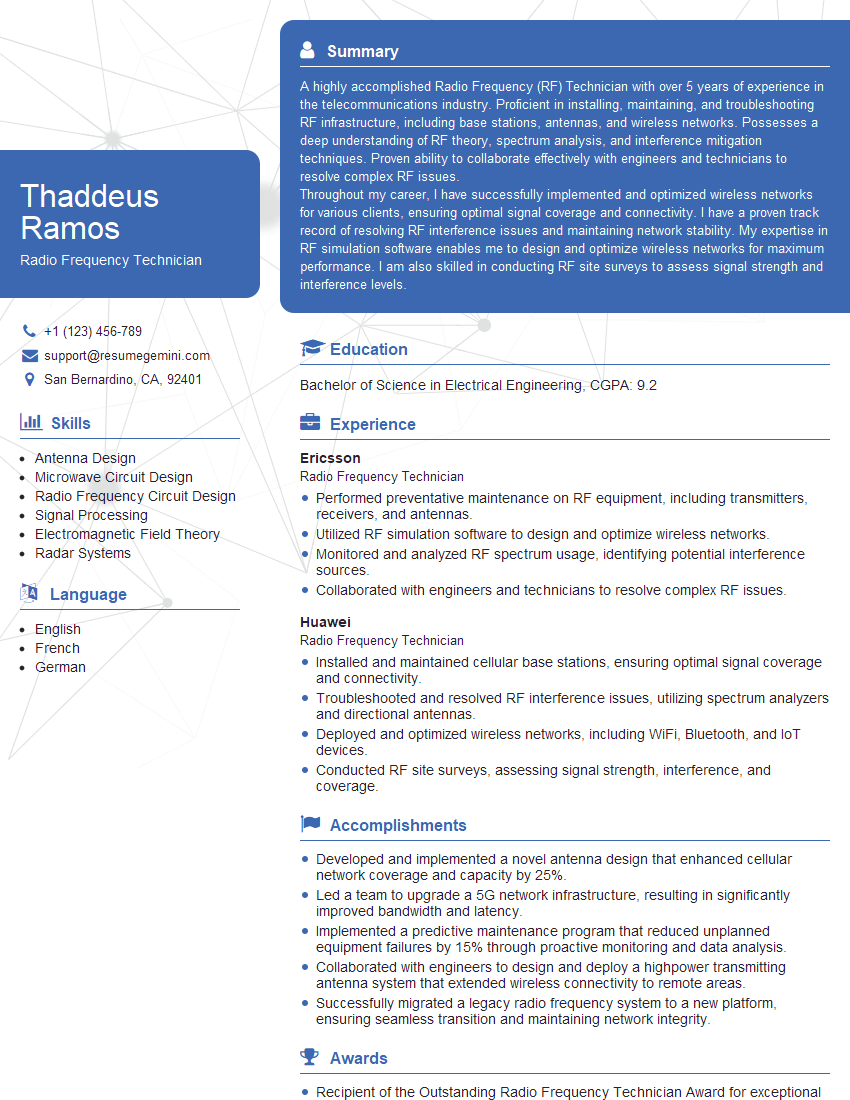
Mastering Radio Frequency Communication opens doors to exciting and rewarding careers in various sectors, from telecommunications and aerospace to defense and medical technology. A strong understanding of these principles is crucial for success in this competitive field. To maximize your job prospects, it’s essential to present your skills effectively. Creating an ATS-friendly resume is key to getting noticed by recruiters. We strongly encourage you to use ResumeGemini to build a professional and impactful resume that highlights your qualifications. ResumeGemini provides you with the tools and resources to craft a winning resume, and you’ll find examples specifically tailored to Radio Frequency Communication roles to guide you.

Explore more articles
Users Rating of Our Blogs
Share Your Experience
We value your feedback! Please rate our content and share your thoughts (optional).
What Readers Say About Our Blog
Very informative content, great job.
good