The right preparation can turn an interview into an opportunity to showcase your expertise. This guide to Rehearsal Direction interview questions is your ultimate resource, providing key insights and tips to help you ace your responses and stand out as a top candidate.
Questions Asked in Rehearsal Direction Interview
Q 1. Describe your experience managing rehearsal schedules and logistics.
Managing rehearsal schedules and logistics is crucial for a smooth production. It’s like orchestrating a complex symphony – each musician (actor, crew member) needs to be in the right place at the right time. My approach involves several key steps:
- Detailed Schedule Creation: I begin with a comprehensive schedule, outlining specific rehearsal days, times, and objectives. This isn’t just a list of dates; it includes specific scene breakdowns, planned activities (blocking, character work, tech rehearsals), and contingency time for unexpected issues.
- Communication is Key: I utilize shared online calendars and regular communication (email, group chats) to ensure everyone has access to the schedule and any updates. This proactive approach minimizes confusion and prevents scheduling conflicts.
- Resource Management: This extends beyond scheduling. I coordinate the booking of rehearsal spaces, ensuring adequate space, equipment, and props are available when needed. For example, if we’re rehearsing a fight scene, I’d make sure we have a designated safe space and appropriate safety equipment.
- Flexibility and Adaptability: Real-world events happen. I build in flexibility within the schedule to accommodate unforeseen circumstances, such as actor absences or technical issues. This might involve rescheduling scenes or adjusting the rehearsal plan.
For instance, during the rehearsal of ‘Macbeth,’ I created a detailed weekly schedule that incorporated specific scene work, blocking sessions, and even dedicated time for the actors to work with the fight choreographer. This allowed for efficient use of rehearsal time and ensured all aspects of the production were adequately prepared.
Q 2. How do you handle conflicts between actors or creative team members during rehearsals?
Conflict is inevitable in a collaborative creative environment. My approach to resolving conflicts between actors or creative team members is built on open communication, empathy, and a focus on the overall artistic goal. Think of it as conflict resolution through collaboration – finding common ground, not enforcing a singular vision.
- Facilitate Open Dialogue: I create a safe space for individuals to express their concerns and perspectives without feeling judged. I encourage active listening and ensure everyone feels heard.
- Identify the Root Cause: Conflicts often stem from miscommunication or differing artistic interpretations. I work to uncover the underlying issue, ensuring I understand the perspective of each party involved.
- Mediation and Compromise: I act as a neutral mediator, guiding the individuals towards a solution that considers everyone’s needs and the artistic vision. This often involves compromise and finding creative solutions that satisfy the needs of the production.
- Establish Clear Expectations: Proactive communication of expectations and roles can significantly reduce conflicts. For example, if an actor has a concern about a particular line, we’ll address it collaboratively and see if we can rewrite or change the scene.
In one production, a disagreement arose between the lead actor and the director regarding the character’s motivation. By facilitating a calm conversation, and exploring different interpretations of the script, we were able to find a solution that satisfied both parties and strengthened the performance.
Q 3. Explain your approach to blocking and staging a scene.
Blocking and staging a scene is about creating a visual narrative that enhances the story. I approach this as a collaborative process, working with actors to find movements and positions that are both expressive and natural.
- Understand the Text: I start by analyzing the script, paying attention to the subtext, relationships between characters, and emotional beats. This provides the foundation for the blocking.
- Actor-Driven Movement: I rarely dictate movements; instead, I work with the actors, exploring various options and encouraging them to suggest movement choices that reflect their character’s personality and emotions. This ensures ownership and authenticity.
- Visual Storytelling: Blocking should serve the story. I consider the stage space and how it can be utilized to enhance dramatic impact. For instance, a character moving upstage might suggest a sense of isolation.
- Rhythm and Pacing: The pace and rhythm of movement should reflect the scene’s emotional tone. Quick, sharp movements might work for a tense scene, while slower, more deliberate movements might be better for a melancholic one.
For a scene in ‘A Midsummer Night’s Dream,’ I worked with the actors to create a whimsical and chaotic blocking pattern, using the stage space to reflect the magical and unpredictable nature of the forest setting. The result was a visually engaging and memorable scene.
Q 4. What techniques do you use to maintain energy and focus during long rehearsal periods?
Maintaining energy and focus during long rehearsals is crucial for both the creative team and actors. It’s like running a marathon, not a sprint, requiring pacing, strategy, and regular breaks.
- Structured Breaks: I incorporate regular breaks into the rehearsal schedule – short breaks every hour and longer breaks for lunch. This allows actors and crew to rest and recharge.
- Variety of Activities: Monotony can kill energy. I vary rehearsal activities – focusing on blocking one day, working on character development the next, and incorporating technical rehearsals as needed. This keeps things dynamic.
- Positive Reinforcement: Positive feedback and encouragement go a long way in maintaining morale. I celebrate achievements, no matter how small, and acknowledge the hard work of everyone involved.
- Physical Activity: Incorporating simple physical exercises during breaks can help improve focus and energy. Even a few minutes of stretching can make a difference.
During a particularly demanding production, I scheduled 15-minute yoga and mindfulness breaks each day, which helped actors to refresh themselves and maintain focus throughout the long rehearsal days.
Q 5. How do you provide constructive feedback to actors without discouraging them?
Providing constructive feedback is an art. It’s about guiding actors towards improvement without diminishing their confidence. I approach this with a focus on specificity, positivity, and collaboration.
- Specific and Actionable Feedback: Instead of saying ‘That wasn’t very good,’ I would say, ‘When you delivered that line, the pacing felt rushed. Perhaps trying a slightly slower tempo might give it more impact.’ This is specific, offering a tangible improvement suggestion.
- Sandwich Technique: I often use the ‘sandwich’ method: start with positive feedback, then offer constructive criticism, and finish with more positive feedback. This softens the criticism and maintains a positive tone.
- Focus on Choices: I focus my feedback on the actor’s choices, rather than on the actor themselves. For instance, ‘That blocking choice felt a bit out of character. Perhaps exploring a different position could better suit the moment.’ This approach keeps the feedback focused on the performance.
- Open Dialogue: I encourage dialogue, asking actors what they intended and allowing them to explain their choices. This fosters a collaborative spirit and ensures mutual understanding.
For example, I once worked with an actor whose character was struggling to connect emotionally with a pivotal scene. Instead of simply telling them to ’emote more,’ I asked them to discuss their personal understanding of the character’s motivation, prompting a richer performance.
Q 6. How do you adapt your rehearsal techniques to different performance styles (e.g., realism, absurdism)?
Adapting rehearsal techniques to different performance styles is paramount. Realism requires a different approach than, say, absurdism. It’s about understanding the underlying principles of each style and translating those into the rehearsal process.
- Realism: Focus is on truthful and believable performances. Rehearsals emphasize detailed character work, naturalistic movement, and subtle emotional nuances. Improvisation can be used to find authentic reactions.
- Absurdism: This style embraces the illogical and unconventional. Rehearsals could incorporate physical comedy, heightened movement, and experimentation with unconventional staging. Finding the humor in the absurd is key.
- Musical Theatre: Requires a balance of acting, singing, and dance. Rehearsals involve separate and integrated sessions for each element, ensuring all aspects of the performance are cohesive and synchronized.
- Classical Theatre: Focuses on precise diction, formal movement, and grand gestures. Rehearsals pay close attention to the rhythms of the text, and the precise timing of movements and lines.
In a production of Samuel Beckett’s ‘Waiting for Godot,’ for example, I encouraged the actors to embrace the repetitive and nonsensical nature of the play, experimenting with physicality and timing to create a performance that was both humorous and thought-provoking.
Q 7. Describe your experience working with different technologies used in rehearsal (e.g., video recording, digital scripts).
Technology plays an increasingly significant role in rehearsals. I’m proficient in using various technologies to enhance the rehearsal process and improve efficiency.
- Video Recording: I regularly use video recording to capture rehearsals, enabling actors to review their performances and identify areas for improvement. It’s a valuable tool for objective self-assessment.
- Digital Scripts: Digital scripts with annotation features are extremely helpful. They allow for easy access to the script, the ability to add notes and blocking information, and sharing updates with the cast and crew in real time.
- Rehearsal Management Software: Software specifically designed for rehearsal management helps in scheduling, tracking progress, and streamlining communication. This can be particularly helpful in large-scale productions.
- Projection and Lighting Design Software: Familiarity with lighting and projection design software enables me to integrate these aspects early in the rehearsal process, facilitating effective communication between lighting/projection designers and actors.
For instance, in a recent production, using video recordings allowed us to identify subtle timing issues in a crucial scene, something that might have been missed during live rehearsals. This enabled us to make adjustments and refine the performance before opening night.
Q 8. How do you ensure actors achieve a consistent performance throughout the rehearsal process?
Consistency in performance is paramount. We achieve this through a multi-pronged approach. First, we establish a strong foundation in the initial rehearsals, focusing on scene work and character development. This involves detailed discussions about the character’s motivations, relationships, and objectives. We use techniques like character mapping and emotional recall to ensure a deep understanding of the role.
Secondly, we use video and audio recordings of rehearsals. This allows actors to see and hear their performances objectively, identify areas needing improvement, and track progress over time. Regular feedback sessions, both individual and group, are crucial. These sessions aren’t just about critique but also about celebrating successes and fostering a collaborative environment.
Finally, consistent note-taking helps track changes and maintain continuity. A detailed rehearsal log helps everyone – actors, director, and myself – stay on the same page and remember choices made along the way. This systematic approach ensures that the performance evolves organically while maintaining a core consistency and depth.
Q 9. How do you incorporate audience feedback into the rehearsal process?
Audience feedback is invaluable, though it needs careful management. Ideally, we conduct preview performances – essentially dress rehearsals with a small, select audience. This audience should represent the target demographic for the play. After the performance, we gather feedback through structured questionnaires and informal discussions. The focus is on understanding audience reactions to specific scenes, character choices, pacing, and overall clarity of the narrative.
We never take feedback as absolute truth, but rather as valuable data. For example, if an audience finds a particular scene confusing, we analyze that scene carefully. Did the actors convey the necessary information? Was the scene’s pacing too fast or slow? We use the feedback to inform adjustments, always ensuring the changes align with the director’s vision and the overall artistic intention.
Q 10. How do you identify and address pacing issues in a play?
Pacing is often a subtle but significant challenge. Identifying pacing issues requires careful observation throughout rehearsals. We look for moments where the energy lags, scenes feel rushed, or transitions feel jarring. We might use stopwatches to time specific scenes, looking for inconsistencies. A good rehearsal director knows to trust their gut instinct, too – often, a feeling that something isn’t quite right can point towards a pacing problem.
Addressing pacing issues often involves experimenting with different approaches. We might ask actors to adjust their tempo, modify the blocking (stage movement), or even rewrite parts of the script to create better flow. Sometimes, it’s about finding the right pauses, allowing moments for silence to enhance the impact of a line or scene. Regular performance checks, coupled with discussions amongst the team, help fine-tune the pacing until it feels natural and engaging.
Q 11. What is your approach to working with a director who has a very specific vision?
Working with a director who has a strong vision is both a challenge and a privilege. My approach focuses on collaboration and clear communication. It’s crucial to understand the director’s artistic intentions thoroughly at the outset – this often includes studying their previous works and having open, detailed discussions about their overall vision for this particular production.
My role then becomes one of facilitating their vision. I ensure the actors understand and embody the director’s concepts. I manage the rehearsal process to ensure everything aligns with their artistic goals. While I may offer suggestions or solutions to logistical problems, I always prioritize the director’s artistic choices, maintaining open communication to ensure mutual understanding and a positive working relationship.
Q 12. How do you manage the rehearsal process when working with a large cast?
Managing a large cast requires meticulous planning and organization. We start by creating a detailed rehearsal schedule that maximizes efficiency. This involves allocating specific rehearsal time slots to different groups of actors based on their scene involvement, thereby minimizing wasted time. We also utilize different rehearsal spaces if feasible, allowing multiple scenes to be rehearsed concurrently.
Clear communication is critical. I use a variety of communication tools – emails, group chats, and regular meetings – to keep everyone informed about schedules, changes, and upcoming tasks. I also encourage collaboration among the actors themselves, fostering a sense of team spirit and shared responsibility for the overall success of the production. This structured approach not only manages the logistical challenges of a large cast but also ensures that each actor feels valued and engaged in the process.
Q 13. How do you balance the creative aspects of rehearsals with the practical aspects (e.g., budget, time constraints)?
Balancing creative aspirations with practical limitations is an ongoing challenge. The key is proactive planning and smart resource management. We start with a clear understanding of the budget and time constraints. This information guides our initial planning, including the selection of the rehearsal space, props, and costume choices. We prioritize elements most essential to the production’s artistic success while making smart compromises where necessary.
Creative problem-solving is key. For instance, if a specific prop is too expensive, we brainstorm creative alternatives – perhaps a simpler design or substituting a similar prop. We might need to adjust the rehearsal schedule to accommodate unforeseen delays. The goal is to remain flexible and resourceful, finding creative solutions without sacrificing the artistic integrity of the production. Transparency with the team about budget and time constraints is crucial to foster shared responsibility and creative compromise.
Q 14. Describe a time you had to make a difficult decision during rehearsals. What was the outcome?
In one production, a lead actor fell seriously ill a week before opening night. The understudy, while talented, lacked experience with the lead’s nuanced performance. This presented a significant challenge. I had to make the difficult decision to radically adjust our rehearsal schedule, prioritizing intensive coaching sessions for the understudy, while simultaneously maintaining the morale and preparedness of the rest of the cast who had already spent many weeks in rehearsals.
The outcome, while stressful, was surprisingly positive. We focused on the core elements of the lead role and tailored the performance to fit the understudy’s strengths. We rallied around them, providing unwavering support and encouragement. The show opened on time, the understudy gave a truly compelling performance, and the audience was unaware of the last-minute change. This experience highlighted the importance of adaptability, teamwork, and prioritizing support for the cast in the face of unexpected challenges.
Q 15. How do you facilitate collaborative problem-solving within the rehearsal room?
Facilitating collaborative problem-solving in the rehearsal room is crucial for a successful production. It’s not just about fixing issues, but about fostering a creative environment where everyone feels empowered to contribute solutions. My approach involves establishing a safe space for open communication, active listening, and structured brainstorming.
Creating a Safe Space: I begin by setting clear expectations for respectful dialogue and constructive criticism. This includes emphasizing that there are no ‘bad ideas’ in the brainstorming phase.
Structured Brainstorming: Instead of free-for-all discussions, I often employ techniques like ‘brainwriting’ (writing down ideas individually before sharing), or ‘round-robin’ brainstorming (each person contributes one idea at a time). This ensures everyone gets a chance to be heard and prevents dominant personalities from overshadowing others.
Collaborative Problem Definition: Before jumping to solutions, I guide the team to clearly define the problem. This often involves asking clarifying questions and breaking down complex issues into smaller, more manageable parts. For example, if the problem is ‘the scene isn’t working’, we’d ask: ‘What specifically isn’t working? The pacing? The dialogue? The character motivations?’
Actionable Solutions: Once we have identified the problem and brainstormed potential solutions, we collaboratively choose the most practical and feasible ones. We then assign ownership of these solutions to specific individuals or groups, setting clear deadlines and follow-up processes. This creates accountability and ensures that ideas are not just discussed but implemented.
Career Expert Tips:
- Ace those interviews! Prepare effectively by reviewing the Top 50 Most Common Interview Questions on ResumeGemini.
- Navigate your job search with confidence! Explore a wide range of Career Tips on ResumeGemini. Learn about common challenges and recommendations to overcome them.
- Craft the perfect resume! Master the Art of Resume Writing with ResumeGemini’s guide. Showcase your unique qualifications and achievements effectively.
- Don’t miss out on holiday savings! Build your dream resume with ResumeGemini’s ATS optimized templates.
Q 16. How familiar are you with different rehearsal methodologies (e.g., Stanislavski, Meisner)?
I’m very familiar with various rehearsal methodologies, including Stanislavski and Meisner techniques, and I adapt my approach based on the specific needs of the production and the actors. Understanding these different approaches allows me to cater to diverse acting styles and help actors find their most authentic performances.
Stanislavski: This method emphasizes emotional truth and realistic portrayal. I use elements of Stanislavski, such as objective work, given circumstances, and emotional recall, to help actors build rich and believable characters. For example, I might guide an actor to explore their character’s backstory or their relationship with other characters to unlock their emotional depth.
Meisner: This technique focuses on truthful and reactive acting, emphasizing the ‘reality’ of the scene. I incorporate Meisner exercises, like the repetition exercise, to improve actors’ listening skills and spontaneous responses, fostering genuine interactions on stage. This often involves improvisational work to build strong connections between characters.
Other Methods: Beyond Stanislavski and Meisner, I also incorporate elements from other techniques as needed. This might include Viewpoints, which focuses on spatial awareness and physicality, or practical aesthetics, which prioritizes the physical actions of the character in relation to the environment.
Ultimately, my approach is eclectic. I believe in using a combination of methods that best serves the play, directorial vision, and the actors’ unique strengths and challenges.
Q 17. How do you ensure all aspects of the production (acting, design, technical) are integrated smoothly during rehearsals?
Integrating all aspects of a production – acting, design, and technical – requires proactive planning and consistent communication throughout the rehearsal process. My approach involves regular meetings, collaborative design sessions, and scheduled technical rehearsals.
Early Collaboration: I initiate discussions with the designers and technical crew early in the process to ensure that set designs, costumes, lighting, and sound are considered in relation to the actors’ movements, blocking, and emotional arcs. This prevents conflicts and allows for creative solutions.
Design Presentations: I facilitate presentations by the designers where they can showcase their work, and the actors and I can offer feedback. This ensures the design elements support the overall artistic vision and don’t hinder the actors’ performances.
Technical Rehearsals: These are dedicated sessions where the actors rehearse with the full technical setup. This helps to address any technical issues early on, and it helps the actors adapt to the presence of lights, sound cues, and special effects.
Open Communication: Maintaining open communication channels between all departments is critical. This means regular updates, sharing of schedules and progress reports, and addressing any issues promptly.
For example, if the lighting design obscures a critical moment in the play, we work collaboratively with the lighting designer and the director to find a solution, perhaps adjusting the blocking or the lighting cues.
Q 18. Describe your experience troubleshooting technical issues that arise during rehearsals.
Troubleshooting technical issues is an inevitable part of the rehearsal process. My approach is proactive and involves clear communication, a systematic approach to problem-solving, and a reliance on the expertise of the technical crew.
Proactive Planning: I ensure that adequate time is allocated for technical rehearsals and that the technical crew has access to necessary equipment and support. A well-planned schedule reduces the likelihood of unexpected technical problems.
Systematic Approach: When technical problems occur, I encourage a step-by-step approach. We identify the issue, analyze its cause, and explore potential solutions, often involving the technical crew to pinpoint the root cause. It is important to keep calm, avoid blaming, and focus on the collective solution.
Collaboration with Technicians: I leverage the expertise of the technical crew. I avoid attempting to fix complex technical issues myself, instead relying on their knowledge and skills to resolve them efficiently. Open communication is crucial here. If sound is cutting out intermittently, I would directly communicate with the sound technician to diagnose the problem – rather than trying to troubleshoot it alone.
Contingency Planning: We also develop contingency plans for foreseeable issues. For example, if a specific piece of equipment is prone to failure, we identify a backup or alternative method. This minimizes disruption and keeps the rehearsal process flowing smoothly.
Q 19. How do you handle an actor who consistently misses rehearsals?
Handling an actor who consistently misses rehearsals requires a sensitive yet firm approach that balances understanding with the needs of the production. My response involves open communication, clear expectations, and, if necessary, stronger action.
Open Communication: I would initiate a private conversation with the actor to understand the reasons for their absences. Perhaps there are personal circumstances, scheduling conflicts, or other underlying issues I can assist with.
Clear Expectations: I would reiterate the importance of regular attendance and the impact it has on the overall rehearsal process and the performance. I emphasize the team nature of theatre production, underscoring the dependence on everyone’s participation.
Collaboration on Solutions: If possible, we explore solutions that address the actor’s challenges while ensuring adequate rehearsal participation. This might involve rescheduling scenes or finding alternative arrangements.
Escalation (if necessary): If the absences continue despite communication and efforts to find solutions, I would escalate the issue to the director or producer. They may need to take stronger actions, such as replacing the actor, depending on the severity of the situation and the contract stipulations.
The key is to address the issue early on, maintaining both empathy and professional boundaries.
Q 20. How do you create a positive and supportive rehearsal environment?
Creating a positive and supportive rehearsal environment is paramount for fostering creativity, collaboration, and ultimately, a successful production. My approach emphasizes respect, open communication, and a focus on mutual support.
Respectful Communication: I establish clear guidelines for respectful communication, encouraging constructive feedback rather than criticism. I actively model this behavior myself.
Open Dialogue: I create opportunities for open dialogue and encourage actors to share their ideas, concerns, and challenges. This creates a sense of trust and inclusivity.
Positive Reinforcement: I actively celebrate successes, no matter how small. This might involve acknowledging individual accomplishments or commending the team’s progress in achieving a particular scene or objective. Positive reinforcement helps build confidence and encourages risk-taking.
Team Building: I sometimes incorporate team-building activities into the rehearsal process to foster stronger relationships between cast and crew members.
Breaks and Flexibility: I schedule regular breaks to allow actors to rest and recharge. I also strive to be flexible and understanding, accommodating unexpected circumstances as much as possible.
Ultimately, a positive rehearsal environment should feel like a collaborative journey, not a battleground.
Q 21. What are your strategies for addressing actor insecurities or anxieties during rehearsals?
Addressing actor insecurities or anxieties requires a sensitive and empathetic approach. It’s about building trust and fostering a safe space for vulnerability.
Individual Attention: I take time to speak with actors individually, creating a confidential space where they can express their concerns without judgment. Active listening is crucial here.
Affirmation and Validation: I actively affirm their strengths and talents, reminding them of their accomplishments and validating their feelings. It’s important to acknowledge that these feelings are normal.
Goal Setting: I collaborate with the actor to set achievable goals, breaking down challenging tasks into smaller, more manageable steps. This builds confidence and reduces feelings of being overwhelmed.
Positive Self-Talk: I gently encourage positive self-talk and mindful practices like breathing exercises. This can help manage anxiety and build self-awareness.
Seeking Professional Support: For persistent or severe anxieties, I recommend seeking support from a qualified professional, such as a therapist or coach. I can help connect them with resources if needed.
Remember, a supportive rehearsal environment allows actors to feel safe enough to take risks, explore their characters fully, and deliver their best performances.
Q 22. How do you prioritize tasks during the rehearsal process to stay on schedule?
Prioritizing tasks during rehearsals requires a strategic approach that blends artistic vision with logistical efficiency. I utilize a system that prioritizes based on several factors: deadline proximity (things needed for upcoming performances take precedence), interdependency (tasks that are prerequisites for others are tackled first), and impact (high-impact scenes or complex sequences get priority over smaller details).
For instance, if a crucial scene requires elaborate set changes and complex lighting cues, I’ll dedicate a block of rehearsal time to meticulously work through those elements before moving on to smaller details like individual character blocking. I also create a daily checklist, breaking down larger tasks into smaller, manageable steps. This allows for consistent progress and minimizes feeling overwhelmed.
Think of it like baking a cake – you wouldn’t attempt the frosting before the cake is baked. Similarly, I ensure fundamental elements are in place before moving to finer details. Regular check-ins with the director help refine priorities based on evolving needs and artistic adjustments.
Q 23. Describe your experience using rehearsal reports to track progress and identify challenges.
Rehearsal reports are invaluable for tracking progress and identifying challenges. I typically structure my reports to include sections on: achieved milestones (what was accomplished during the rehearsal), outstanding tasks (what still needs work), and identified challenges (obstacles faced and potential solutions). I also incorporate notes on individual performer progress and overall ensemble cohesion.
For example, a report might note the successful implementation of a complex fight choreography sequence but also highlight the need for further work on a specific actor’s line delivery. These reports serve as a living document, guiding adjustments to the rehearsal schedule and providing clear communication for the creative team. Detailed observations from these reports often lead to innovative solutions to staging and performance problems. This meticulous record-keeping prevents repetition of errors and ensures that rehearsals are highly productive.
Q 24. What software or tools do you use to manage rehearsal schedules and communication?
Effective rehearsal management relies on the right tools. I leverage a combination of software and methods to manage schedules and communication. For scheduling, I find Google Calendar incredibly useful for its sharing capabilities, allowing all team members to view and update schedules collaboratively. For communication, I utilize Slack or email, depending on the production size and the team’s preference. These platforms allow for quick updates, distribution of documents (like rehearsal reports), and efficient problem-solving through group chats. For larger productions, dedicated project management software like Asana or Trello can be invaluable for managing tasks, dependencies, and individual responsibilities.
Q 25. How do you ensure that the rehearsal process effectively serves the overall artistic goals of the production?
The rehearsal process is not an isolated entity but an integral part of realizing the production’s artistic vision. From the initial planning stages, I actively collaborate with the director to ensure that each rehearsal serves a specific purpose aligned with the overall artistic goals. This involves understanding the director’s concept, thematic intentions, and desired style before even creating the rehearsal schedule.
For example, if the director’s vision is to create a heightened sense of realism, rehearsals will focus on achieving naturalistic performances, detailed set design, and nuanced lighting. Conversely, if the production aims for a stylized aesthetic, then rehearsals will emphasize specific physicality, rhythmic movement, and an exploration of visual metaphor. By understanding and actively serving the artistic aims, rehearsals become far more than just technical sessions; they evolve into a collaborative exploration of the production’s heart and soul.
Q 26. How do you handle notes from the director or other creative team members?
Handling director’s notes and feedback from the creative team requires diplomacy, organization, and a willingness to adapt. I prioritize constructive feedback and approach notes with an open mind. I encourage a collaborative dialogue, ensuring everyone feels heard and valued. I document all notes meticulously, categorizing them by scene, character, or technical element to ensure clarity and track progress. A crucial aspect is to clarify any ambiguity in notes; it’s essential to ensure everyone shares the same understanding.
Imagine a sculptor receiving feedback on their work – they don’t simply dismiss it; they thoughtfully consider how it impacts their overall vision. Likewise, I use notes to refine and enhance the production. I communicate these notes to the relevant individuals clearly and concisely, always emphasizing the positive aspects and collaboratively finding solutions to address constructive criticism.
Q 27. Describe your experience with creating and implementing a rehearsal schedule.
Creating a rehearsal schedule demands meticulous planning and flexibility. I begin by outlining the production’s key elements, identifying scenes with complex staging, technical requirements, and ensemble work. I then map out a timeline that ensures sufficient time for each scene’s development, allowing for flexibility should unexpected challenges arise. The schedule includes clear objectives for each rehearsal session, ensuring focused progress and avoiding wasted time.
For example, early rehearsals might focus on script read-throughs, character discussions, and initial blocking, gradually progressing to more technical elements, like lighting and sound cues, closer to the performance date. Importantly, I build in buffer time to account for unforeseen delays or adjustments. It’s essential to remember that a rehearsal schedule isn’t a rigid structure, but rather a dynamic tool adaptable to the evolving needs of the production. Regular review and adjustments are crucial to its success.
Key Topics to Learn for Rehearsal Direction Interview
- Understanding the Director’s Vision: Learn to effectively interpret and translate a director’s artistic vision into practical rehearsal strategies. This includes analyzing scripts, identifying key themes, and understanding the director’s overall goals.
- Collaborative Rehearsal Techniques: Explore various rehearsal methodologies, such as blocking, table work, and improvisation exercises. Understand how to foster a collaborative and supportive environment for actors and creative teams.
- Problem-Solving and Conflict Resolution: Develop strategies for addressing challenges that may arise during rehearsals, such as actor conflicts, technical difficulties, or creative differences. Practice effective communication and conflict resolution techniques.
- Time Management and Organization: Learn to efficiently manage rehearsal time, create detailed schedules, and track progress effectively. This includes prioritizing tasks, delegating responsibilities, and adapting to unexpected changes.
- Communication and Feedback: Master clear and constructive communication skills for providing feedback to actors, designers, and other members of the creative team. Understand how to deliver both positive and constructive criticism effectively.
- Technical Aspects of Production: Develop a basic understanding of stage management, lighting, sound, and set design to effectively collaborate with technical crews and ensure a smooth production process.
- Adaptability and Flexibility: Discuss your ability to adapt to different directorial styles, production scales, and unforeseen challenges. Highlight examples of your flexibility and problem-solving skills in past experiences.
Next Steps
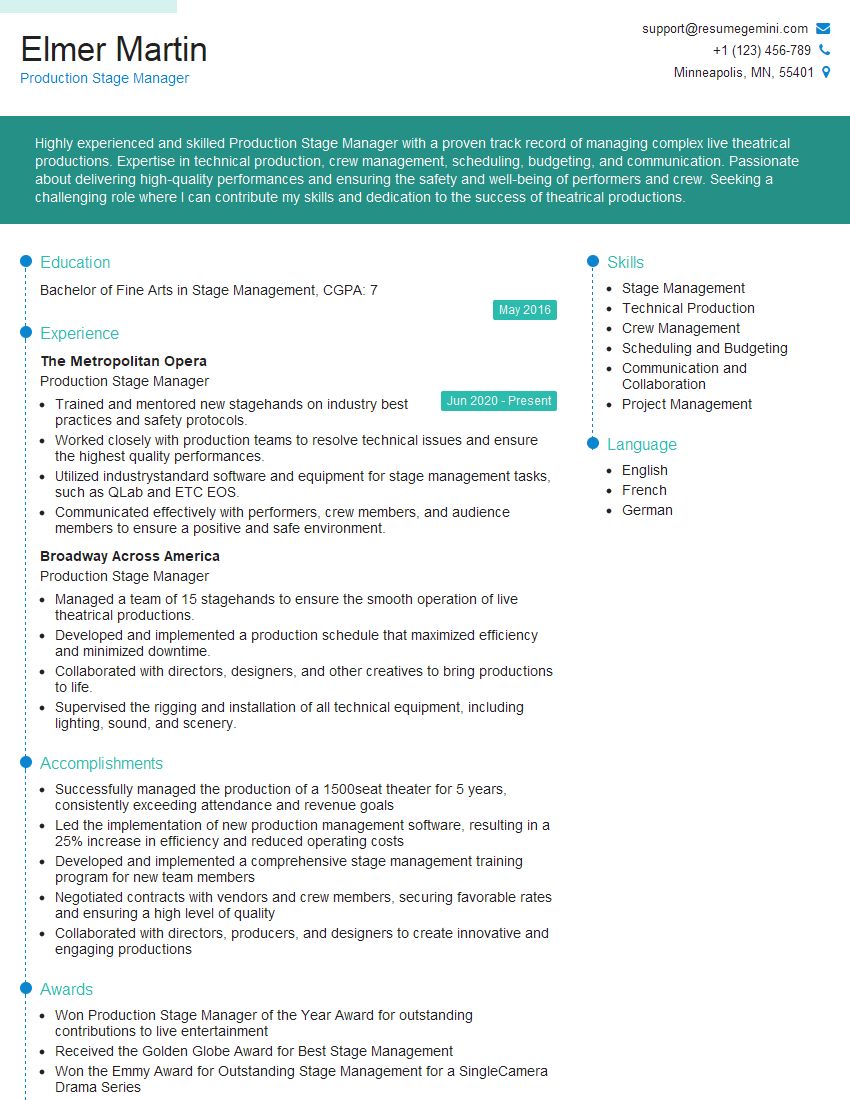
Mastering Rehearsal Direction opens doors to exciting career advancements within the theatre and performing arts industries, leading to increased responsibility, higher earning potential, and greater creative control. To significantly boost your job prospects, crafting a compelling and ATS-friendly resume is crucial. ResumeGemini is a trusted resource to help you build a professional resume that showcases your skills and experience effectively. Examples of resumes tailored to Rehearsal Direction are available within ResumeGemini to help guide your creation of a standout application.
Explore more articles
Users Rating of Our Blogs
Share Your Experience
We value your feedback! Please rate our content and share your thoughts (optional).
What Readers Say About Our Blog
Very informative content, great job.
good