Feeling uncertain about what to expect in your upcoming interview? We’ve got you covered! This blog highlights the most important Sewing Machine Knowledge interview questions and provides actionable advice to help you stand out as the ideal candidate. Let’s pave the way for your success.
Questions Asked in Sewing Machine Knowledge Interview
Q 1. What types of sewing machine needles are you familiar with and when would you use each?
Sewing machine needles come in a variety of types, each designed for specific fabrics and sewing tasks. Choosing the right needle is crucial for achieving clean stitches and preventing damage to your fabric or machine.
- Universal Needles: These are the workhorses of the sewing world, suitable for a wide range of fabrics like cotton, linen, and light-weight wools. Their slightly rounded point makes them versatile but not ideal for very delicate fabrics.
- Ballpoint Needles: Specifically designed for knit fabrics. Their rounded point glides between the knit loops, preventing skipped stitches or snags. I’ve used these extensively when working with jersey and other stretchy materials.
- Sharp Needles: These needles feature a sharp point, perfect for weaving, quilting, and sewing through heavier fabrics like denim or canvas. The sharp point easily pierces dense materials.
- Jeans Needles: Stronger and heavier than universal needles, designed for sewing multiple layers of heavy denim or canvas. I often use these when working on sturdy projects.
- Embroidery Needles: These have a larger eye to accommodate thicker embroidery threads. The point is usually sharp or slightly rounded depending on the technique.
- Stretch Needles: Similar to ballpoint but with a slightly sharper tip, offering a balance between ease of use on knit fabrics and slightly stronger penetration for denser knits.
For instance, if I were sewing a delicate silk blouse, I’d definitely select a sharp needle to avoid damaging the fabric. Conversely, for a pair of jeans, a jeans needle is a must to prevent needle breakage.
Q 2. Explain the different types of sewing machine stitches and their applications.
Sewing machine stitches are categorized into various types, each designed for a particular purpose. Understanding the nuances of each stitch type is essential for creating professional-quality garments.
- Straight Stitch: The most basic stitch, used for seams, topstitching, and general construction. Think of the seams on your favorite shirt.
- Zigzag Stitch: Used for finishing seams to prevent fraying, creating decorative effects, and attaching elastic. It’s a staple stitch in most sewing projects.
- Overlock Stitch (Serger Stitch): A stitch that sews, trims, and finishes the raw edges of fabric simultaneously. Often done with a serger but some sewing machines offer a close approximation. Crucial for professional-looking seams, especially in stretch fabrics.
- Blind Hem Stitch: Creates an almost invisible hem finish; perfect for dress pants or skirts. It requires some practice to master but results in a clean, professional look.
- Buttonhole Stitch: Automatically creates perfectly sized buttonholes, saving time and ensuring consistent results. This is a time saver for almost any project.
- Satin Stitch: Creates a dense, decorative stitch often used for applique or embellishment. Great for adding a touch of artistry.
Choosing the right stitch depends entirely on the project. For example, a straight stitch would be appropriate for constructing the main seams of a dress, whereas an overlock stitch (or a zigzag stitch for less professional finish) is crucial for preventing the seams from fraying.
Q 3. Describe your experience with troubleshooting common sewing machine malfunctions.
Troubleshooting sewing machine issues is a significant part of my work. Over the years, I’ve developed a systematic approach to identifying and resolving common problems.
- Skipped Stitches: Often caused by a dull needle, incorrect tension, or improper threading. My first step is always to replace the needle and check the threading.
- Broken Needles: This usually indicates hitting something hard like a pin or sewing too thick fabric without using the appropriate needle. Always inspect the fabric before sewing.
- Tension Problems: Uneven stitches often point to tension issues; the upper or lower tension needs adjustment. I systematically adjust each and test until the tension is balanced.
- Jammed Machine: This often requires a thorough cleaning and inspection. I remove lint and debris to clear any obstructions.
- Bobbin Case Problems: This might involve a misaligned bobbin or case. I carefully re-seat and ensure proper alignment.
One time, a customer’s machine was making a loud clicking noise. After a careful inspection, I found a small piece of thread lodged in the shuttle mechanism, which I easily removed. A simple fix but critical to smooth operation. My approach is always methodical: identify the symptom, then systematically check the most likely causes.
Q 4. How do you maintain and clean a sewing machine to ensure optimal performance?
Regular maintenance is vital for keeping a sewing machine in peak condition and extending its lifespan. I follow a consistent cleaning and maintenance routine.
- Regular Cleaning: After each use, I remove lint and dust from the machine using a brush and compressed air. I pay particular attention to the bobbin area and feed dogs.
- Lubrication: I regularly lubricate the moving parts with high-quality sewing machine oil, following the manufacturer’s instructions. This ensures smooth operation and prevents wear.
- Needle Replacement: I replace needles frequently, even if they don’t appear visibly damaged. Dull needles lead to skipped stitches and broken threads. A sharp needle is essential.
- Bobbin Case Cleaning: I periodically remove and clean the bobbin case, paying attention to any lint buildup. A clean bobbin case prevents tension problems.
Imagine a car needing an oil change; the same principle applies to a sewing machine. Regular maintenance ensures it runs smoothly and prevents costly repairs down the line. Preventive maintenance saves time and money.
Q 5. What safety precautions do you take when operating industrial sewing machines?
Safety is paramount when operating industrial sewing machines, which are significantly more powerful than domestic machines. My safety protocols include:
- Proper Training: Thorough training on the specific machine’s operation and safety features is crucial before operation. Never operate a machine without proper instruction.
- Guards and Shields: Always ensure all safety guards and shields are in place and functioning correctly. These are designed to protect against injury.
- Loose Clothing: I avoid wearing loose clothing, jewelry, or long hair that could get caught in the machine. This eliminates a major potential hazard.
- Foot Pedal Awareness: I maintain awareness of the foot pedal to prevent accidental engagement or sudden stops that might cause injury.
- Emergency Stop: I am familiar with the location and operation of the emergency stop button and know how to use it immediately if needed. This should be second nature.
- Maintenance Schedule: Following a strict maintenance schedule to prevent unexpected malfunctions that might lead to accidents is paramount.
In the industrial setting, even a small mistake can lead to significant injury. Therefore, vigilance and strict adherence to safety protocols are non-negotiable.
Q 6. How do you adjust the tension on a sewing machine?
Adjusting the tension on a sewing machine is a critical skill to achieve even, attractive stitches. The goal is to balance the tension between the upper and lower threads.
Most machines have a tension dial, typically numbered from 0 to 9 (or similar), for the upper thread tension. The lower tension (bobbin) usually needs adjusting via the bobbin case. First, check your owner’s manual.
Start with a test stitch. If the stitches are too loose (upper thread is more prominent), increase the upper tension by turning the dial to a higher number (e.g., from 4 to 5). If the stitches are too tight (lower thread is showing), reduce the upper tension. The reverse is needed if the lower thread dominates. If after adjusting the upper tension you still have issues, examine the bobbin case tension. Many machines have a screw to adjust bobbin case tension. Tighten slightly if the lower tension is too loose, loosen it if the lower thread is too tight.
Remember to check your tension after each adjustment. It’s a process of trial and error until you find the perfect balance for your fabric and thread.
Q 7. Explain the process of threading a sewing machine, including bobbin winding.
Threading a sewing machine and winding a bobbin are fundamental steps. Let’s break down the process:
Bobbin Winding:
- Place an empty bobbin on the bobbin winder.
- Thread the bobbin winder using the path indicated by your machine’s instructions.
- Engage the bobbin winder, usually by placing the bobbin in the correct position.
- Feed the thread from the spool to the bobbin.
- Start the machine. It will automatically wind the thread onto the bobbin.
- Once the bobbin is full, disengage the winder.
Threading the Machine:
- Raise the presser foot.
- Following the threading path indicated in your machine’s manual (it usually involves guiding the thread through various guides, across the tension disks, and to the needle), thread the machine.
- Make sure the thread goes through the correct guides, or it could affect your tension.
- After threading, carefully pull the thread to check the path and make sure there are no snags.
- Once correctly threaded, place the full bobbin into the bobbin case.
- Insert the bobbin case into the shuttle.
- Lower the presser foot.
Remember to consult your machine’s manual, as threading paths differ across models. Practice makes perfect; with time, you’ll become proficient at this.
Q 8. What experience do you have with different types of sewing machine feet?
Sewing machine feet are specialized attachments that significantly impact the outcome of your sewing project. Think of them as specialized tools for different jobs. My experience encompasses a wide range, including:
- General-purpose foot: This is your workhorse – perfect for straight stitching, zigzagging, and most basic sewing tasks. I’ve used it extensively for everything from mending clothes to creating garment prototypes.
- Zipper foot: Essential for cleanly sewing zippers. I’ve used various types, including those with a single or double groove, mastering the technique for both invisible and standard zippers. I frequently use this when making bags or jackets.
- Buttonhole foot: Creates consistent and professional-looking buttonholes. I have experience with various buttonhole foot types, each producing slightly different buttonhole styles. Precision and consistency are key here, and I’ve honed this skill through countless projects.
- Walking foot: Keeps multiple layers of fabric moving evenly, preventing slippage. This is indispensable when working with difficult fabrics like leather or multiple layers of denim. I’ve used this for quilting projects and upholstery work, where even feed is crucial for a professional result.
- Overlock/serger foot (if applicable to the machine): If the machine has this functionality, it helps to create professional, clean-finished edges. I’ve employed this to prevent fraying on woven fabrics and create a more polished look.
Beyond these common feet, I’m also familiar with more specialized feet like cording feet, piping feet, and even free-motion embroidery feet. My experience is practical and project-driven, meaning I’ve selected and used the appropriate foot to achieve the desired result on countless occasions.
Q 9. Describe your experience with various sewing machine brands and models.
My experience spans several decades and includes a diverse range of sewing machine brands and models, from vintage Singers to modern computerized machines from Brother, Janome, and Bernina. I’ve worked with mechanical machines that require precise manual adjustments and electronic machines offering pre-programmed stitches and advanced features. For example, I’ve mastered the intricacies of the Singer 221’s feed dog adjustments for perfect results on even the most challenging fabrics, and I’m equally comfortable programming stitch patterns and managing the computerized functions of a modern Bernina. This broad experience allows me to adapt quickly to different machines and troubleshoot effectively. My understanding goes beyond superficial use; I’ve studied the mechanisms and functionalities of each to understand how they function optimally.
Q 10. How do you identify and resolve skipped stitches?
Skipped stitches are a common sewing problem, usually stemming from one of several issues. My troubleshooting process is systematic:
- Check the bobbin: Make sure it’s properly wound, correctly inserted, and that the bobbin tension is correctly adjusted. A poorly wound or incorrectly placed bobbin is the most frequent culprit. I often demonstrate this to new sewers.
- Inspect the needle: Bent, damaged, or incorrectly sized needles are major contributors. I always visually check the needle for any damage before starting a project and replace it if necessary. The correct needle for the fabric type is also crucial.
- Examine the thread: Ensure the thread is smooth, clean, and the correct type for your machine and fabric. Knots, tangles, or frayed thread can easily cause skipped stitches. I’ll usually rethread the machine completely if I suspect a thread problem.
- Verify tension settings: Incorrect top and bobbin tension can lead to skipped stitches. I adjust the tension dial carefully, testing the stitch quality until it’s even and consistent. This requires practice and familiarity with the machine.
- Check the feed dogs: Sometimes, feed dog issues can affect stitch formation. I make sure that the feed dogs are clean and properly engaging with the fabric.
By methodically checking these aspects, I’ve successfully resolved skipped stitches in a variety of situations.
Q 11. How familiar are you with different sewing machine speeds and their impact on fabric?
Sewing machine speed significantly impacts the outcome of a project, especially in relation to the fabric type. Slower speeds offer greater control and precision, particularly with delicate fabrics or intricate stitching. I might use a slower speed when sewing curves on silk or when creating decorative stitches. Faster speeds increase productivity, ideal for straight stitching on sturdy fabrics. However, excessive speed can lead to skipped stitches, broken needles, or uneven seams, especially with lightweight materials. I always adjust the speed to the fabric’s requirements and the complexity of the stitch.
For instance, when sewing denim, I’m comfortable using higher speeds because the fabric is robust. Conversely, when working with fine lace or chiffon, a slower speed provides much better control and prevents damage to the fabric.
Q 12. How do you handle broken needles or damaged threads?
Handling broken needles and damaged threads is a routine part of sewing. My approach prioritizes safety and efficiency:
- Broken needles: I always lower the needle fully before handling it to avoid injury. I carefully remove the broken needle, usually with needle nose pliers, and replace it with a new, correctly sized needle.
- Damaged threads: I carefully remove the damaged thread, ensuring no loose ends are left in the machine to prevent future problems. Before rethreading, I carefully inspect the thread path for any obstructions. I always rethread the machine completely after any major thread issues.
Prevention is also key. Regular maintenance, using appropriate needles for the fabric type, and avoiding excessive tension minimizes the likelihood of these issues.
Q 13. What is your experience with using a sewing machine’s reverse stitch function?
The reverse stitch function is crucial for securing the beginning and end of seams, preventing unraveling. I use it consistently to lock stitches at the start and finish of each seam. This reinforces the stitching and adds durability to the garment or project. My experience shows that ignoring the reverse stitch can lead to easily undone seams. I often emphasize the importance of this function to less experienced sewers.
Q 14. How do you adjust the stitch length and width on a sewing machine?
Adjusting stitch length and width is fundamental to sewing. Most machines have dials or digital controls for these adjustments. Stitch length is measured in stitches per inch (spi). Shorter stitch lengths (e.g., 10-12 spi) are stronger and ideal for areas needing durability, while longer lengths (e.g., 2-4 spi) are suitable for basting or decorative purposes. Stitch width is adjusted based on the desired stitch pattern; a wider stitch width is used for decorative stitches or zigzag stitches. The machine’s manual clearly indicates how to adjust these settings, and I’m proficient in using both dial-based and digital controls.
For example, I’ll use a short stitch length when sewing seams on a pair of jeans to ensure they are durable. A longer stitch length is appropriate for gathering fabric when making a dress.
Q 15. What is your experience with industrial sewing machine programming (if applicable)?
While my experience doesn’t directly involve programming industrial sewing machines in the sense of writing code, I possess extensive experience in operating and configuring them for various tasks. This includes setting up stitch patterns, adjusting stitch length and width, and fine-tuning the machine’s tension and feed mechanisms to achieve optimal results with different fabrics and projects. For instance, I’ve worked with machines that allow for the selection of pre-programmed stitches for specific applications like buttonholes or decorative stitches. Adjusting these parameters effectively is crucial for consistent, high-quality production. Think of it as ‘programming’ the machine’s behavior through its control panel and mechanical adjustments, rather than coding in a traditional sense.
Career Expert Tips:
- Ace those interviews! Prepare effectively by reviewing the Top 50 Most Common Interview Questions on ResumeGemini.
- Navigate your job search with confidence! Explore a wide range of Career Tips on ResumeGemini. Learn about common challenges and recommendations to overcome them.
- Craft the perfect resume! Master the Art of Resume Writing with ResumeGemini’s guide. Showcase your unique qualifications and achievements effectively.
- Don’t miss out on holiday savings! Build your dream resume with ResumeGemini’s ATS optimized templates.
Q 16. Describe your experience with different types of fabrics and their sewing requirements.
My experience spans a wide range of fabrics, each demanding a unique sewing approach. Lightweight fabrics like silk or chiffon require delicate handling, fine needles, and slow speeds to prevent tearing. Medium-weight fabrics such as cotton or linen are more forgiving and allow for a broader range of sewing techniques and speeds. Heavyweight fabrics like denim or canvas necessitate robust needles, strong threads, and potentially a walking foot to prevent slippage. Specialty fabrics like leather or vinyl need specific needles and often require lower sewing speeds with reduced pressure to prevent damage. Each type needs specific consideration to needle size, thread weight, stitch type, and machine settings. For example, sewing delicate lace requires a very fine needle and a smaller stitch length to prevent it from puckering or tearing.
Q 17. Explain the importance of proper fabric preparation before sewing.
Proper fabric preparation is paramount for successful sewing. It ensures a clean, crisp finish and prevents problems during the sewing process. Pre-washing fabrics is vital, especially for natural fibers like cotton and linen, as it pre-shrinks the material, preventing shrinkage after the garment is finished. Pressing the fabric to remove wrinkles and creases is equally essential; it smooths the material, making it easier to handle and facilitating precise seam alignment. For fabrics prone to fraying, pre-finishing the edges with serging, pinking, or zigzag stitching prevents unraveling during sewing. Think of it like prepping a canvas before painting – a clean, smooth surface ensures the best final product.
Q 18. How do you handle different types of seams and seam finishes?
Seam selection and finishing are crucial for both the aesthetics and durability of a garment. I’m proficient with various seam types, including plain seams, French seams, flat-felled seams, and welt seams, each suitable for specific fabrics and garment construction. The choice of seam finish depends on the fabric type and the intended use of the garment. For example, a French seam is ideal for sheer fabrics as it encloses all raw edges, while a serged seam is practical for stronger, less delicate fabrics. A clean finish prevents unraveling and adds a professional touch. I choose the right seam finish based on the fabric, the intended garment, and the durability required.
Q 19. How do you perform routine maintenance on a sewing machine?
Routine maintenance is crucial for the longevity and efficient operation of a sewing machine. My routine includes regularly cleaning the bobbin area, removing lint and debris from the feed dogs and shuttle mechanism, lubricating moving parts with a specialized sewing machine oil, and checking the tension of the upper and lower threads. I also regularly inspect the needle for damage or bending and replace it as needed. Additionally, I perform a thorough cleaning of the machine at least once a month or after extensive use. This prevents breakdowns and ensures the machine’s smooth operation. Think of it as regular car maintenance—small efforts go a long way in preventing bigger problems.
Q 20. What is your experience with computerized sewing machines?
I have extensive experience with computerized sewing machines, appreciating their versatility and precision. These machines offer pre-programmed stitch patterns, automatic needle threading, and adjustable stitch settings for various fabrics and applications. I’m comfortable utilizing their features for tasks such as creating buttonholes, monograms, and intricate decorative stitches. The ability to program different stitch sequences, adjust stitch densities, and control the speed are invaluable advantages. For instance, when working with intricate designs, a computerized machine’s precision and programmable features are crucial for consistent, high-quality results. I can efficiently use features like automatic needle threading to save time and increase productivity.
Q 21. Describe your process for diagnosing and repairing a malfunctioning sewing machine.
Diagnosing and repairing a malfunctioning sewing machine involves a systematic approach. I begin by carefully observing the machine’s behavior: Is it skipping stitches? Is the thread breaking frequently? Are there any unusual noises? Then, I systematically check the basics – thread tension, needle condition, bobbin winding, and the proper placement of the bobbin. If the problem persists, I’ll proceed to inspect the feed dogs, shuttle mechanism, and other internal components, utilizing appropriate tools and techniques. Experience is invaluable here; I can often identify the source of a problem through systematic testing and observation. I also consult manuals and online resources when necessary. The process is similar to troubleshooting a computer; a methodical approach helps isolate the problem and find a solution.
Q 22. How do you ensure quality control in a sewing production environment?
Quality control in a sewing production environment is paramount for maintaining consistent product quality and minimizing defects. It’s a multi-faceted process that begins before the sewing even starts and continues throughout the entire production cycle.
- Pre-Production Checks: This involves rigorously inspecting fabrics for flaws, checking thread quality and consistency, and ensuring all patterns are accurate and correctly sized.
- Machine Calibration and Maintenance: Regularly scheduled maintenance and calibration of sewing machines are crucial. This ensures stitch consistency, prevents breakdowns, and reduces defects caused by malfunctioning equipment. We check needle alignment, tension settings, and feed dog function.
- In-Process Inspection: Throughout the sewing process, operators should conduct regular self-inspections. This includes checking seams for evenness, proper stitch length, and the absence of skipped stitches or broken threads.
- Final Inspection: A dedicated quality control team conducts a thorough inspection of finished garments. This includes evaluating overall aesthetics, checking for imperfections like loose threads, missed seams, or fabric defects, and confirming compliance with size specifications.
- Data Tracking and Analysis: We meticulously track and analyze defect data to identify trends and root causes. This enables us to implement preventative measures and continuously improve our quality control processes. For instance, if we see a spike in a particular type of seam defect, we might investigate whether it’s related to a specific machine, operator, or material.
Think of it like baking a cake: you wouldn’t just throw ingredients together and hope for the best. Each step, from measuring ingredients to checking the oven temperature, is crucial for a perfect result. Similarly, each step in our sewing production process needs careful monitoring to produce high-quality garments.
Q 23. What experience do you have with different sewing machine drive systems (e.g., belt, direct drive)?
I have extensive experience with both belt-driven and direct-drive sewing machines. Belt-driven machines use a belt to transfer power from the motor to the sewing mechanism, while direct-drive machines have the motor directly coupled to the needle mechanism.
- Belt-driven systems: These are typically less expensive and often found in older or entry-level machines. They are generally quieter but can be less precise, with potential for slippage and variations in speed. Regular belt adjustments are necessary.
- Direct-drive systems: These offer superior speed control, smoother operation, and greater precision, resulting in consistent stitch quality. They are generally more energy-efficient due to less power loss from the belt. However, they tend to be more expensive to purchase and repair.
In my experience, direct-drive systems are advantageous for high-volume production environments where precision and consistent speed are critical. The superior control reduces defects and allows for more efficient production. I’ve successfully maintained and repaired both systems, adeptly troubleshooting issues related to belt tension, motor performance, and electronic controls.
Q 24. How do you work effectively as part of a sewing team?
Effective teamwork in a sewing environment is all about communication, collaboration, and mutual support.
- Clear Communication: Open and clear communication is key. This includes regular updates on production progress, identifying and addressing potential bottlenecks, and promptly sharing information about any machine malfunctions or material shortages.
- Collaborative Problem-Solving: We work together to resolve challenges. When faced with a complex sewing problem, we discuss potential solutions as a team, drawing on each other’s expertise and experiences.
- Mutual Support and Training: A strong team provides support for each other. More experienced sewers help train new employees, ensuring everyone is competent and comfortable with their tasks. We share knowledge and best practices.
- Respectful and Efficient Work Environment: A positive and respectful work environment is paramount. We avoid conflicts and ensure a smooth workflow.
I’ve found that when team members support each other and work together efficiently, production increases and product quality improves dramatically. It’s a synergistic effect; the whole is greater than the sum of its parts.
Q 25. Describe your experience with different types of sewing machine motors.
I’ve worked with several types of sewing machine motors, including servo motors, stepper motors, and traditional induction motors.
- Servo motors: These offer precise speed control and high torque, making them ideal for high-speed and high-precision sewing tasks. They are also very energy-efficient.
- Stepper motors: These provide precise step-by-step movement, excellent for applications requiring specific stitch patterns or automated functions. They are common in computerized embroidery machines.
- Induction motors: These are simple and robust motors; however, they are less precise and less energy-efficient than servo motors.
My experience includes troubleshooting motor-related issues, such as identifying faulty motor windings, diagnosing control board problems, and conducting necessary repairs or replacements. Understanding the strengths and weaknesses of different motor types allows for appropriate selection and maintenance strategies in a variety of sewing applications.
Q 26. What is your experience with sewing machine lubrication and its importance?
Sewing machine lubrication is absolutely critical for maintaining optimal machine performance, extending its lifespan, and preventing costly repairs. Lubrication reduces friction between moving parts, preventing wear and tear.
- Types of Lubricants: Different types of lubricants are used depending on the machine’s components. Some machines require specialized oils, while others use greases for specific parts. The wrong lubricant can cause damage.
- Lubrication Schedule: A regular lubrication schedule is essential. This typically involves daily or weekly lubrication depending on usage frequency and the machine type.
- Importance: Proper lubrication reduces noise, minimizes heat build-up, ensures smooth operation, prevents the needle from breaking, and prolongs the lifespan of the machine.
- Over-lubrication: It’s important to avoid over-lubrication, which can attract dust and debris, leading to gumming and further damage.
I’ve seen firsthand the devastating effects of neglecting lubrication – from minor stitch inconsistencies to major breakdowns. A well-lubricated machine is a productive machine. It’s a simple preventative measure with significant long-term benefits.
Q 27. Explain how you would handle a large-scale sewing machine breakdown during production.
A large-scale sewing machine breakdown during production requires a swift and organized response to minimize downtime and maintain production flow.
- Immediate Assessment: First, we assess the situation. Identify the specific problem with the machine, whether it’s electrical, mechanical, or related to a specific part. Determine the scope of the problem and if it can be immediately repaired.
- Safety First: Ensure the safety of all personnel by immediately turning off the power to the machine and clearing the surrounding area.
- Attempt Repair: Depending on my expertise and the nature of the malfunction, I’ll attempt a repair. This may involve replacing a broken needle, fixing a jammed stitch, or addressing a more complex mechanical or electrical issue. If necessary, I can utilize diagnostic tools to identify the root cause.
- Escalation: If the problem is beyond my immediate capabilities, I immediately escalate the issue to more senior technicians or external maintenance services. This is crucial to speed up the resolution of the issue.
- Alternative Solutions: While waiting for the repair, we explore alternative solutions. This might involve redistributing workloads to other sewing machines or temporarily shifting production to different product lines.
- Documentation: Detailed documentation of the breakdown, repair, and downtime is vital. This information is valuable for future preventative maintenance and troubleshooting.
My experience has taught me the importance of remaining calm, thinking strategically, and prioritizing safety when managing a major machine failure. Effective communication and a well-defined escalation process minimize production disruptions.
Q 28. What are your preferred methods for documenting sewing machine maintenance and repairs?
I utilize a combination of methods for documenting sewing machine maintenance and repairs, ensuring accurate and readily accessible information.
- Digital Maintenance Logs: I maintain detailed digital logs using spreadsheet software or dedicated CMMS (Computerized Maintenance Management System) software. These logs record dates, descriptions of repairs, parts used, and any observations.
- Machine-Specific Files: For each machine, I create a separate file containing all maintenance and repair records, including photos of any damaged parts or unique issues encountered. This method offers a comprehensive history for each individual machine.
- Visual Aids: When necessary, I include photos or videos documenting the repair process or specific machine components. This proves particularly helpful when dealing with complex repairs or unique problems.
- Regular Audits: I conduct regular audits of the maintenance logs to ensure accuracy and identify any patterns or trends in machine issues, enabling proactive maintenance and problem prevention.
This multifaceted approach ensures we have a comprehensive record-keeping system, which is essential for optimizing machine maintenance and minimizing downtime in the long run. It also aids in providing crucial data for purchasing spare parts effectively.
Key Topics to Learn for Your Sewing Machine Knowledge Interview
- Machine Mechanics: Understanding the internal workings of various sewing machine types (e.g., industrial, domestic, serger), including the feed dogs, bobbin mechanism, needle bar, and tension system. Consider practical troubleshooting scenarios involving these components.
- Stitch Types and Applications: Mastering different stitch types (straight stitch, zigzag, overlock, blind hem, etc.) and their appropriate uses in various fabrics and projects. Be prepared to discuss the advantages and disadvantages of each stitch for different applications.
- Fabric Selection and Needle Choice: Knowing how to select the correct needle and thread for different fabric types (e.g., lightweight, medium-weight, heavyweight) to achieve optimal stitch quality and prevent needle breakage. Discuss practical considerations like fabric tension and needle size.
- Maintenance and Troubleshooting: Demonstrate knowledge of routine maintenance tasks (e.g., cleaning, oiling, changing needles) and common troubleshooting techniques for resolving simple sewing machine malfunctions. Be prepared to discuss preventative maintenance strategies.
- Safety Procedures: Understanding and adhering to safe operating procedures for sewing machines, including proper needle handling, avoiding entanglement, and maintaining a clean workspace. Be prepared to discuss workplace safety regulations.
- Industrial Sewing Machine Operation (if applicable): If applying for roles involving industrial sewing machines, demonstrate familiarity with their unique features, higher speeds, and specialized attachments. Discuss experience with specific industrial machine brands or models.
Next Steps
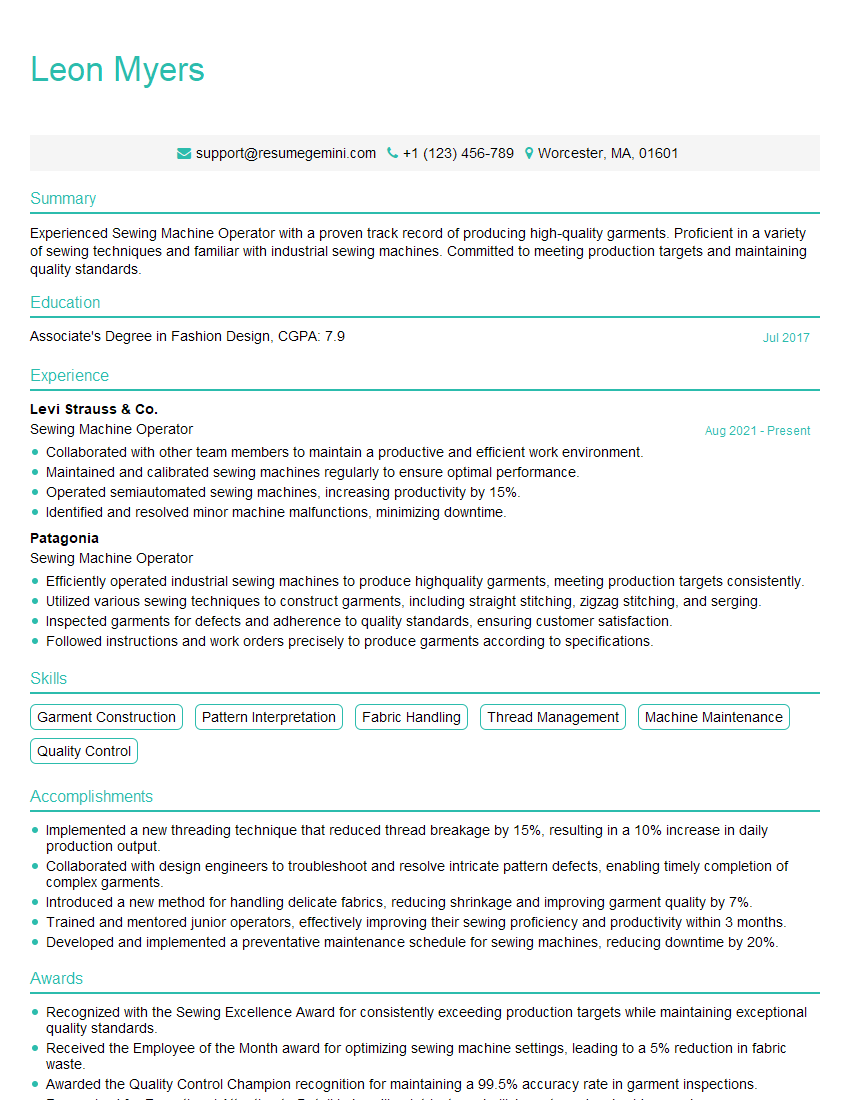
Mastering sewing machine knowledge is crucial for career advancement in the textile and garment industry. A strong understanding of these principles will significantly improve your performance and open doors to exciting opportunities. To maximize your job prospects, create an ATS-friendly resume that highlights your skills and experience effectively. ResumeGemini is a trusted resource to help you build a professional and impactful resume. We offer examples of resumes tailored to Sewing Machine Knowledge expertise to guide you in creating a winning application. Take the next step toward your dream job today!
Explore more articles
Users Rating of Our Blogs
Share Your Experience
We value your feedback! Please rate our content and share your thoughts (optional).
What Readers Say About Our Blog
Very informative content, great job.
good