Interviews are opportunities to demonstrate your expertise, and this guide is here to help you shine. Explore the essential Solo Piano Repertoire interview questions that employers frequently ask, paired with strategies for crafting responses that set you apart from the competition.
Questions Asked in Solo Piano Repertoire Interview
Q 1. Describe your approach to interpreting a Bach prelude and fugue.
Interpreting a Bach prelude and fugue requires a deep understanding of Baroque counterpoint and structure. My approach begins with a meticulous analysis of the score, identifying the subject, countersubject, and episodes within the fugue. For the prelude, I focus on the harmonic structure and the expressive potential within its often concise form.
I strive for clarity and precision in voicing, ensuring each voice is distinct and contributes to the overall texture. Articulation is crucial; I might use a detached style for clarity in contrapuntal sections, while employing legato phrasing in more lyrical passages. Tempo is carefully considered, avoiding a mechanical approach; I aim for a natural ebb and flow that reflects the emotional arc of the piece. Ultimately, my goal is to reveal the intellectual brilliance and emotional depth inherent in Bach’s writing, not just a technically proficient performance.
For example, in the Well-Tempered Clavier, Prelude and Fugue No. 1 in C major, I might emphasize the grandeur of the prelude’s opening chords by allowing a slight resonance before moving to the subsequent sections. In the fugue itself, I focus on the interplay of voices, highlighting the subject’s emergence and development, while ensuring the countersubject maintains its independence and character.
Q 2. Compare and contrast the compositional styles of Debussy and Rachmaninoff.
Debussy and Rachmaninoff, while both giants of the piano repertoire, represent vastly different compositional styles. Debussy, a key figure in Impressionism, prioritized atmosphere and color over traditional forms. His music is characterized by its shimmering textures, use of whole-tone scales and pentatonic scales, and avoidance of strong cadences. Think of the ethereal beauty of ‘Clair de Lune’ – its hazy atmosphere is achieved through subtle harmonic shifts and a delicate touch.
Rachmaninoff, on the other hand, is associated with Romanticism. His style is characterized by its lush harmonies, passionate melodies, and virtuosic demands. His works often feature sweeping romantic gestures, dramatic contrasts, and a powerful emotional intensity. Consider the thunderous opening of his Piano Concerto No. 2 – its immediate grandeur contrasts sharply with Debussy’s subtle approach.
The key difference lies in their aesthetic priorities. Debussy sought to evoke moods and sensations through sound painting, while Rachmaninoff aimed for emotional expression through dramatic narrative. Both composers masterfully used the piano, but their approaches—impressionistic versus romantic—shaped their distinct sounds.
Q 3. Explain your method for memorizing complex piano pieces.
Memorizing complex piano pieces is a multifaceted process that goes beyond rote learning. My method involves a systematic approach incorporating several stages. Firstly, I thoroughly analyze the score, understanding the musical structure, harmonic progressions, and melodic lines. I don’t just learn the notes; I understand their musical context.
Secondly, I work in sections, mastering small chunks before connecting them. This allows me to focus on technical challenges and musical phrasing within manageable units. I use a combination of techniques: playing slowly to build accuracy and gradually increasing tempo, and practicing hands separately before putting them together. Visual memory is important; I often visualize the keyboard layout while learning.
Thirdly, I incorporate kinesthetic learning. I pay attention to the physical sensations of playing—the weight of my fingers on the keys, the muscle memory involved. Finally, I practice in different environments and under varied conditions to build resilience and adaptability, simulating the performance setting.
Regular performance, even to a small audience, strengthens memory and builds confidence. The process isn’t about simply memorizing notes; it’s about internalizing the music to the point where it becomes an extension of myself.
Q 4. How do you handle performance anxiety?
Performance anxiety is a common experience for musicians. My approach to managing it is proactive and multifaceted. Firstly, thorough preparation is paramount. The more confident I am in my technical abilities and musical understanding, the less anxiety I experience. This includes meticulous practice, focusing not only on accuracy but also on musical expression and interpretation.
Secondly, I utilize relaxation techniques, such as deep breathing exercises and mindfulness meditation, to calm my nerves before a performance. Visualization, mentally rehearsing the performance successfully, can also significantly reduce anxiety.
Thirdly, I focus on reframing negative thoughts. Instead of dwelling on potential mistakes, I concentrate on the positive aspects of the performance—sharing the music with the audience. Finally, building experience through regular performances is invaluable; each performance reduces anxiety levels with increased familiarity of the performance setting.
It’s important to remember that a degree of nervousness is normal and can even enhance performance. The key is to manage it effectively, transforming anxiety into focused energy.
Q 5. Discuss your experience with different piano pedagogies (e.g., Suzuki, Kodály).
My experience with different piano pedagogies has shaped my teaching philosophy. While I haven’t strictly adhered to any single method, I’ve integrated elements from various approaches. The Suzuki method, with its emphasis on early childhood musical development and parental involvement, highlights the importance of creating a nurturing learning environment and instilling a love of music from a young age.
The Kodály method, with its focus on ear training, solfège, and folk music, underscores the significance of developing a strong musical foundation based on accurate pitch recognition and rhythmic understanding. I incorporate aspects of both methods, adapting them to the individual needs and learning styles of my students.
Ultimately, my approach is student-centered, prioritizing the development of both technical skills and musical understanding, nurturing a lifelong love of music while adapting the teaching style according to the unique characteristics and goals of every student.
Q 6. What are your favorite solo piano works and why?
Choosing favorites is difficult, as the solo piano repertoire is vast and breathtaking! However, some works consistently resonate deeply with me. Bach’s Goldberg Variations offer an unparalleled intellectual and emotional journey, showcasing his mastery of counterpoint and invention. The depth and complexity of the work are endlessly rewarding to explore.
Beethoven’s late piano sonatas, especially Op. 110 and Op. 111, are profound explorations of human emotion and spirituality. The profound beauty and philosophical depth of these works make them perpetually inspiring. Finally, Chopin’s nocturnes and études epitomize the romantic ideal. Their lyrical beauty, technical brilliance and expressive range remain timeless masterpieces.
Each of these works represents a pinnacle of musical achievement, offering different perspectives on the expressive capabilities of the piano. Their lasting impact on the musical world makes them enduring favorites of mine.
Q 7. How would you teach a beginner the concept of articulation?
Teaching articulation to a beginner requires a multi-sensory approach. I begin by explaining the concept – articulation refers to how notes are played, emphasizing their individual character and shaping musical phrases. We explore the basic articulations: legato (smooth connection) and staccato (detached notes).
I use simple exercises, starting with single notes, showing how different finger techniques affect the sound. For legato, I demonstrate a smooth, connected touch, ensuring the fingers don’t lift completely from the keys. For staccato, I explain the importance of a quick, decisive movement, allowing space between notes.
Then, we apply these techniques to simple melodies, focusing on the musical context. For instance, legato creates lyrical lines while staccato gives a sense of playfulness or rhythmic emphasis. Through repetition and mindful practice, the student develops a feel for different articulations, improving their expressive ability and musicality. It’s crucial to adapt to the student’s learning pace and provide clear, concise feedback throughout the process.
Q 8. Explain your understanding of musical form (e.g., sonata form, rondo).
Musical form provides the blueprint for a composition, organizing its structure and creating a sense of coherence. Think of it as the skeleton upon which the musical flesh and blood are built. Two fundamental forms are the sonata form and the rondo.
Sonata Form: Typically used in larger pieces, sonata form features three main sections: Exposition (presenting the main themes), Development (exploring and transforming those themes), and Recapitulation (returning to the main themes, often in the tonic key). Think of it like telling a story with a beginning (Exposition), a middle filled with conflict and exploration (Development), and a satisfying resolution (Recapitulation). Beethoven’s piano sonatas are masterful examples of this form.
Rondo Form: This form is characterized by a recurring main theme (the ‘A’ section) interspersed with contrasting episodes (B, C, etc.). It’s like a catchy musical refrain that keeps returning, providing a sense of familiarity and stability amidst the variety. Mozart’s piano sonatas often utilize rondo form, creating lively and engaging pieces.
Other important forms include theme and variations, where a single theme is presented in multiple variations, and binary form (two main sections, ABA being a common variation).
Q 9. Describe your process for selecting repertoire for a recital.
Selecting repertoire for a recital is a crucial process demanding careful consideration. My selection criteria prioritize a balanced program showcasing my strengths while offering a compelling narrative for the audience. I consider several key factors:
- Variety of Styles and Eras: I aim for a program that isn’t homogenous. Perhaps a Baroque prelude, a Classical sonata, a Romantic nocturne, and a 20th-century piece. This showcases breadth of knowledge and technical ability.
- Technical and Musical Challenges: The program should contain pieces that stretch my abilities but still allow for confident execution. I want to be challenged, but not overwhelmed.
- Thematic Coherence: While stylistic variety is important, I try to create a sense of flow and narrative arc throughout the recital. This could be achieved through a common emotional thread, or by showing the evolution of a compositional technique across different eras.
- Audience Engagement: I consider what pieces are likely to resonate with the audience, balancing demanding pieces with more approachable or well-known works.
- Personal Connection: Ultimately, I choose pieces I am passionate about and that speak to me personally. This enthusiasm translates to a more engaging performance.
For example, for a recent recital, I paired Bach’s Toccata in C minor with Chopin’s Ballade No. 1 to show the contrast and evolution of dramatic expression in piano music.
Q 10. How do you maintain your technical proficiency on the piano?
Maintaining technical proficiency requires consistent and focused practice. It’s not just about playing scales and arpeggios (though those are essential!), but about developing a holistic approach:
- Daily Practice Routine: I dedicate time each day to practicing, even if it’s just for 30 minutes. Consistency is key.
- Targeted Exercises: I focus on specific areas needing improvement, addressing technical challenges in individual pieces. This might include working on difficult passages, developing finger independence, or improving my trills.
- Scales and Arpeggios: These remain fundamental for developing finger dexterity, hand coordination, and even musicality. I don’t just play them mechanically, but explore different articulations and dynamics.
- Etudes: Etudes, such as those by Czerny, Chopin, or Debussy, are invaluable for developing specific skills. They’re designed to be challenging and rewarding.
- Teacher Feedback: Regular feedback from a qualified piano teacher helps to identify areas for improvement and ensures my technique remains sound.
I find that incorporating mindfulness in my practice helps me avoid physical strain and improves my focus.
Q 11. How do you adapt your teaching style to different learning styles?
Teaching styles must adapt to individual learning styles to maximize effectiveness. I employ a multifaceted approach:
- Visual Learners: For visual learners, I use diagrams, charts, and written exercises. Showing them fingerings clearly on sheet music can also be hugely beneficial.
- Auditory Learners: Auditory learners benefit from listening to recordings of pieces, analyzing musical phrasing and dynamics, and discussing musical structure. I also encourage singing melodies and rhythms.
- Kinesthetic Learners: Hands-on activities are important for kinesthetic learners. They may benefit from playing musical games or improvising. I encourage them to experiment with various techniques.
- Personalized Approach: I try to understand each student’s strengths and weaknesses, tailoring lessons to their specific needs and goals. Some students thrive under a structured approach, while others are better suited to more exploratory activities.
Flexibility is key. I observe my students’ responses during lessons and make appropriate adjustments to my methods.
Q 12. Discuss your experience with sight-reading.
Sight-reading is a fundamental skill for any pianist, enabling immediate interpretation of new music. My experience encompasses a wide range of styles and difficulties. It’s a skill honed over years of practice. I approach sight-reading systematically:
- Initial Scan: I first skim the piece to get an overview of the key, time signature, and overall structure. This provides a roadmap for the journey.
- Gradual Approach: I don’t try to play the piece perfectly from the outset. Instead, I focus on accuracy and understanding in sections, gradually building fluency.
- Phrase-by-Phrase: I work in manageable phrases, ensuring I understand the melodic, harmonic, and rhythmic elements before moving on.
- Regular Practice: I dedicate time to sight-reading exercises, using various pieces of varying difficulty to maintain proficiency and build stamina.
- Mental Preparation: Staying relaxed and focused is crucial. Stress can hinder sight-reading performance. Taking a deep breath before beginning a piece can also be helpful.
The more I practice sight-reading, the better I get at it. It’s a skill that improves with consistent effort. Regular participation in ensemble playing often enhances sight-reading abilities considerably.
Q 13. How do you approach analyzing a new piece of piano music?
Analyzing a new piece involves a multifaceted approach, moving from the broad strokes to the finer details. My process typically involves:
- Overall Impression: I begin by listening to recordings and forming an initial understanding of the mood, style, and character of the piece. This provides a starting point for deeper investigation.
- Formal Analysis: I identify the musical form (sonata, rondo, etc.), analyzing the different sections and their relationships.
- Harmonic Analysis: I examine the harmonic progressions and their function within the piece. Understanding the harmony illuminates the underlying structure and emotional arc.
- Melodic Analysis: I investigate the melodic lines, noting their range, shape, and contour. This helps understand the overall musical narrative.
- Rhythmic Analysis: A careful analysis of rhythm patterns reveals the pulse, accents, and rhythmic drive of the piece.
- Textural Analysis: I examine the texture of the piece, considering the interplay between different melodic and harmonic elements.
- Structural Outline: I create a structural outline, identifying key thematic areas and how they relate to one another.
This process, which might involve pencil-in-hand annotations on the score, helps create a holistic understanding of the piece allowing informed interpretation and performance.
Q 14. Explain your understanding of musical dynamics and phrasing.
Musical dynamics and phrasing are inextricably linked, shaping the expressive power and emotional impact of a performance. Dynamics refer to the volume (loudness and softness), while phrasing dictates the shaping and articulation of musical ideas. Think of dynamics as the color palette, and phrasing as the brushstrokes.
Dynamics: Effective use of dynamics creates contrast and builds tension and release. Piano (soft), mezzo piano (moderately soft), mezzo forte (moderately loud), and forte (loud) are basic dynamic markings, but subtle gradations and nuanced changes are essential for expressive playing. Sudden dynamic shifts (sforzando) can emphasize crucial moments. A gradual increase or decrease in volume (crescendo and diminuendo) enhances the emotional flow.
Phrasing: Phrasing involves shaping musical lines, creating arcs of sound that reflect the musical meaning. Proper phrasing often involves breathing points, subtle pauses, and rubato (flexible tempo). Phrasing clarifies the structure of a musical idea and emphasizes its meaning. For example, a legato (smooth and connected) approach might be suitable for a lyrical melody, while a staccato (short and detached) style could highlight a playful or energetic passage.
The interplay between dynamics and phrasing is crucial. A crescendo on a lyrical phrase will heighten the emotional intensity, while a diminuendo might create a sense of reflection or fading.
Q 15. What is your experience with accompanying singers or instrumentalists?
While my primary focus is solo piano repertoire, I have considerable experience accompanying singers and instrumentalists. This often involves a deep understanding of musical phrasing, dynamics, and the ability to listen attentively and respond sensitively to the other musician’s interpretation. For example, when accompanying a vocalist, I need to be acutely aware of their breath control and phrasing, adjusting my tempo and dynamics subtly to support their performance. With instrumentalists, it’s about finding a balance – a collaborative dialogue where our individual parts complement each other, creating a cohesive whole. This requires excellent sight-reading skills, a flexible approach to tempo and rhythm, and a strong sense of ensemble.
Specifically, I’ve had the opportunity to collaborate with vocalists in various genres, from art song to contemporary musical theatre, and instrumentalists such as violinists, cellists, and flutists, performing works ranging from classical sonatas to more modern arrangements. This collaborative experience has enhanced my understanding of musical communication and broadened my performance skills significantly.
Career Expert Tips:
- Ace those interviews! Prepare effectively by reviewing the Top 50 Most Common Interview Questions on ResumeGemini.
- Navigate your job search with confidence! Explore a wide range of Career Tips on ResumeGemini. Learn about common challenges and recommendations to overcome them.
- Craft the perfect resume! Master the Art of Resume Writing with ResumeGemini’s guide. Showcase your unique qualifications and achievements effectively.
- Don’t miss out on holiday savings! Build your dream resume with ResumeGemini’s ATS optimized templates.
Q 16. Discuss your familiarity with different historical periods of piano music.
My familiarity with different historical periods of piano music is extensive, spanning from the Baroque period to the contemporary era. The Baroque period (e.g., works by Domenico Scarlatti) is characterized by its ornamentation, terraced dynamics, and often contrapuntal textures. The Classical period (e.g., Haydn, Mozart, Beethoven’s early works) showcases elegant melodies, balanced forms, and homophonic textures. The Romantic period (e.g., Chopin, Schumann, Liszt) is marked by expressive melodies, dramatic contrasts in dynamics, and virtuosic technique. The 20th and 21st centuries encompass a vast array of styles, from Impressionism (Debussy, Ravel) to Minimalism (Philip Glass) and beyond.
Understanding these historical periods involves more than just recognizing stylistic differences; it includes grasping the historical context, the evolution of piano construction and technique, and the composers’ individual approaches to expression. This contextual understanding greatly informs my interpretation and teaching of solo piano literature. For instance, understanding the historical context of a Chopin nocturne allows for a more nuanced and informed performance.
Q 17. How would you teach a student to improve their hand coordination?
Improving hand coordination is a cornerstone of piano technique. My approach focuses on building independence and strength in each hand, gradually increasing the complexity of exercises. I start with simple exercises that isolate the movement of each hand, such as playing scales and arpeggios separately. Then I introduce exercises that require coordination, such as playing different rhythms or melodic patterns simultaneously in each hand. For example, we might start with a simple C-major scale in the right hand and a different rhythm in the left hand, gradually increasing the complexity.
Another important element is the use of Hanon exercises, which, while sometimes considered tedious, are incredibly effective in building finger dexterity and independence. I also incorporate exercises that focus on crossing the hands, playing broken chords, and octave passages. It’s crucial to focus on relaxation and proper posture throughout these exercises to avoid tension, a common obstacle to hand coordination.
Throughout the process, I emphasize the importance of consistent practice, focusing on accuracy and control rather than speed. The goal is to develop a natural flow and ease of movement between the hands.
Q 18. Explain your approach to practicing scales and arpeggios.
My approach to practicing scales and arpeggios emphasizes efficiency and musicality. It’s not just about rote repetition; it’s about developing fluency, accuracy, and an understanding of the underlying harmonic structures. I encourage students to play scales in different articulations (legato, staccato, etc.), dynamics, and rhythms to build versatility and musical expression. We also explore different fingerings to find the most efficient and comfortable options for each individual.
Beyond the technical aspects, I encourage students to internalize the harmonic relationships within the scales and arpeggios. We might analyze the chords implied by the scales, exploring their inversions and voicings. This deeper understanding transforms a technical exercise into a musical exploration. Furthermore, I advocate for incorporating scales and arpeggios into actual musical pieces; applying them in context helps students learn how to use these skills musically rather than just mechanically.
Q 19. How do you address student performance issues such as tension or technical challenges?
Addressing performance issues like tension and technical challenges requires a multifaceted approach. For tension, I emphasize relaxation techniques, including deep breathing exercises, progressive muscle relaxation, and mindful awareness of physical posture. Often, tension arises from a fear of making mistakes or a lack of confidence. We work together to build a supportive and encouraging learning environment, focusing on progress over perfection.
To tackle technical challenges, I conduct a thorough analysis of the student’s playing, identifying the specific areas needing improvement. We break down difficult passages into smaller, manageable sections, focusing on accuracy and control before increasing speed. I might suggest using specific exercises to address particular weaknesses, such as slow practice with meticulous attention to detail, or using rhythmic variations to develop control. Visual aids, such as finger numbers, can be helpful for clarity. Ultimately, patience, consistent effort, and a positive attitude are key to overcoming any technical hurdle.
Q 20. What are your strategies for engaging students in learning piano?
Engaging students in learning piano goes beyond just technical exercises. I aim to create a learning environment that fosters curiosity, creativity, and a genuine love for music. I introduce a variety of repertoire, from classical pieces to contemporary compositions, allowing students to explore different styles and genres. I encourage them to actively participate in choosing their pieces, fostering a sense of ownership and motivation.
In addition to solo playing, I incorporate group activities like sight-reading sessions, ensemble playing, and even composing simple melodies. This allows for collaborative learning and provides opportunities for students to share their musical ideas. We also might delve into the history and context of the music, making the learning experience more holistic and enriching. The goal is to make learning fun and relevant to the student’s interests, thus creating a lasting connection to music.
Q 21. How would you differentiate your teaching approach for adult vs. child learners?
My teaching approach differs significantly between adult and child learners. With children, I focus on creating a fun and playful learning environment, using games, visuals, and storytelling to engage their imaginations. Progress is measured more holistically, taking into account the child’s overall development and motivation. Patience and positive reinforcement are crucial in fostering a love for music at a young age. The curriculum is often more structured, progressing systematically through fundamental skills.
Adult learners often have different goals and learning styles. They may have prior musical experience or specific musical goals in mind. My approach with adults is more collaborative and tailored to their individual needs and preferences. We discuss their musical goals and tailor the curriculum accordingly, prioritizing their personal interests. The pace of learning can be more flexible and the lessons often incorporate more theoretical understanding of music.
Q 22. Discuss your experience using technology in piano teaching.
Technology has revolutionized piano teaching, offering exciting new avenues for learning and engagement. I utilize technology in several key ways. Firstly, I use notation software like Sibelius and Finale to create customized exercises and arrangements tailored to individual student needs and learning styles. This allows me to address specific technical challenges or explore repertoire in a more personalized way. For example, a student struggling with rhythmic precision in a Chopin nocturne might benefit from a simplified version created with the help of notation software, focusing specifically on the problematic passages. Secondly, I leverage online resources for supplementary learning. Platforms like YouTube provide access to masterclasses and performance videos, broadening students’ exposure to different interpretations and performance styles. Thirdly, video conferencing tools like Zoom facilitate remote lessons, enabling me to teach students globally, offering flexibility unavailable through traditional in-person methods. This also allows me to share screens and demonstrate techniques interactively.
Finally, I use recording software to document student progress. This allows both the student and me to track improvements over time and identify areas needing further attention. A before-and-after comparison can be incredibly motivating for the student and helpful for the teacher in refining their teaching approach.
Q 23. Explain your understanding of music theory and its application to piano playing.
Music theory is the backbone of effective piano playing. A solid understanding of harmony, counterpoint, form, and rhythm is crucial for both interpreting existing works and composing new ones. For instance, understanding chord progressions allows a pianist to grasp the emotional arc of a piece. Recognizing dominant seventh chords leading to tonic resolutions provides insights into the harmonic tension and release. Similarly, knowledge of counterpoint helps decipher the interplay of melodic lines in a polyphonic work like a Bach invention or fugue, enabling a richer and more nuanced performance. Analysis of musical form – sonata form, rondo form, etc. – helps the pianist understand the overall structure and architecture of a piece, facilitating a coherent and compelling interpretation. The application is multifaceted: It aids in sight-reading, improvisation, composing, and, most importantly, interpreting the composer’s intentions effectively. Without a thorough grasp of theory, a pianist might play the notes correctly but miss the emotional depth and structural subtleties inherent in the music.
Q 24. How would you assess a student’s progress?
Assessing a student’s progress involves a multi-faceted approach, going beyond simply evaluating technical proficiency. I assess progress through several avenues. Firstly, I monitor technical skill development. This involves regular assessment of their scales, arpeggios, and other technical exercises. Secondly, I evaluate their musicality. This includes aspects like phrasing, dynamics, articulation, and overall interpretation. I listen for musical expression, accuracy in rhythm and intonation, and an understanding of the composer’s intent. Thirdly, I track their progress in learning repertoire. This involves evaluating their mastery of the chosen pieces, noting improvements in technical fluency, musical expression, and overall performance quality. Finally, I also gauge their learning process by observing their ability to understand musical concepts, apply feedback, and solve technical challenges independently. It’s important to consider both quantitative measures (speed, accuracy) and qualitative ones (musicality, expression).
Regular performance opportunities, even informal ones, help to consolidate learning and build confidence. For instance, a student might perform a short piece at the end of each lesson or participate in a small recital to gauge their comfort level and overall progress.
Q 25. What are your professional development goals related to piano performance and/or teaching?
My professional development goals focus on continuous improvement in both performance and teaching. In performance, I aim to expand my repertoire to include challenging and diverse works, including contemporary compositions and lesser-known gems from the standard repertoire. I plan to participate in masterclasses and workshops with renowned pianists to refine my technique and interpretive skills. In teaching, I want to deepen my understanding of pedagogical approaches, exploring innovative methods for engaging students of diverse ages and skill levels. I’m particularly interested in incorporating technology more effectively into my teaching, such as using interactive software for music theory instruction and developing virtual learning resources. Ultimately, my goal is to become an even more effective and inspiring teacher, fostering a genuine love of music in my students.
Q 26. Describe your experience with different types of piano concertos.
My experience encompasses a broad range of piano concertos, from the classical period to the contemporary era. I have performed and studied concertos by composers such as Mozart (whose concertos exemplify clarity and elegance), Beethoven (whose works showcase dramatic intensity and profound emotional depth), Rachmaninoff (known for their romantic lyricism and technical virtuosity), and Prokofiev (whose concertos are characterized by their rhythmic drive and unique harmonic language). Each concerto presents unique challenges and rewards. For example, mastering Mozart’s precision and clarity requires a different approach than tackling the virtuosic demands of a Rachmaninoff concerto. My experience involves not only performing but also analyzing the scores, understanding their historical context, and exploring various interpretations. This deep engagement allows for a nuanced and informed performance, reflecting the unique personality of each concerto.
Q 27. What are your thoughts on the use of recordings in piano pedagogy?
Recordings play a crucial role in piano pedagogy, offering invaluable learning resources for both teachers and students. Listening to recordings of great pianists interpreting a specific piece can provide insights into phrasing, dynamics, and articulation. Students can learn different approaches and interpretations, expanding their understanding of the piece beyond the printed score. However, it’s important to emphasize that recordings should be used judiciously and not as a substitute for personal guidance from a qualified teacher. The teacher can help the student critically analyze the recording, identifying strengths and weaknesses in the interpretation and guiding them towards developing their own unique understanding and expressive style. Moreover, exposure to a diverse range of recordings – from historical performances to contemporary interpretations – encourages a holistic and nuanced understanding of the piece and its evolution over time. Over-reliance on recordings can hinder the development of individual musicality and independent interpretation.
Q 28. Discuss your familiarity with contemporary solo piano works.
My familiarity with contemporary solo piano works extends across a wide spectrum of styles and approaches. I’ve explored the works of composers such as Philip Glass, known for his minimalist style and repetitive structures; John Adams, whose music incorporates both minimalist and post-minimalist elements; and Kaija Saariaho, renowned for her unique and evocative soundscapes. The challenge with contemporary works often lies not only in the technical demands but also in understanding the composer’s often unconventional harmonic language and structural approaches. Unlike the established structures of classical repertoire, contemporary works often call for a deeper engagement with the score and careful consideration of the composer’s intentions, which often deviate from traditional harmonic and formal expectations. It’s essential to approach these works with an open mind and a willingness to explore new sonic territories, understanding that the absence of traditional structures doesn’t negate the composer’s intent or emotional impact.
Key Topics to Learn for Solo Piano Repertoire Interview
- Historical Context & Styles: Understanding the evolution of solo piano repertoire from Baroque to contemporary periods. This includes recognizing stylistic characteristics and compositional techniques across different eras.
- Technical Mastery & Interpretation: Demonstrating proficiency in various technical aspects like scales, arpeggios, chords, and articulation. This also involves conveying a nuanced and expressive interpretation of the chosen repertoire.
- Analytical Skills: Analyzing musical scores effectively, identifying formal structures, harmonic progressions, and melodic development. This includes being able to discuss the composer’s intent and musical choices.
- Program Building & Contextualization: Curating a coherent and engaging recital program, demonstrating an understanding of pacing, contrast, and narrative flow. Being able to justify your program choices and their artistic significance.
- Performance Practice & Pedagogical Approaches: Understanding different performance practices relevant to the selected repertoire and articulating pedagogical approaches for teaching these pieces effectively.
- Improvisation & Composition (If Applicable): Depending on the specific role, demonstrating skills in improvisation within a stylistic context or discussing compositional techniques relevant to solo piano music.
Next Steps
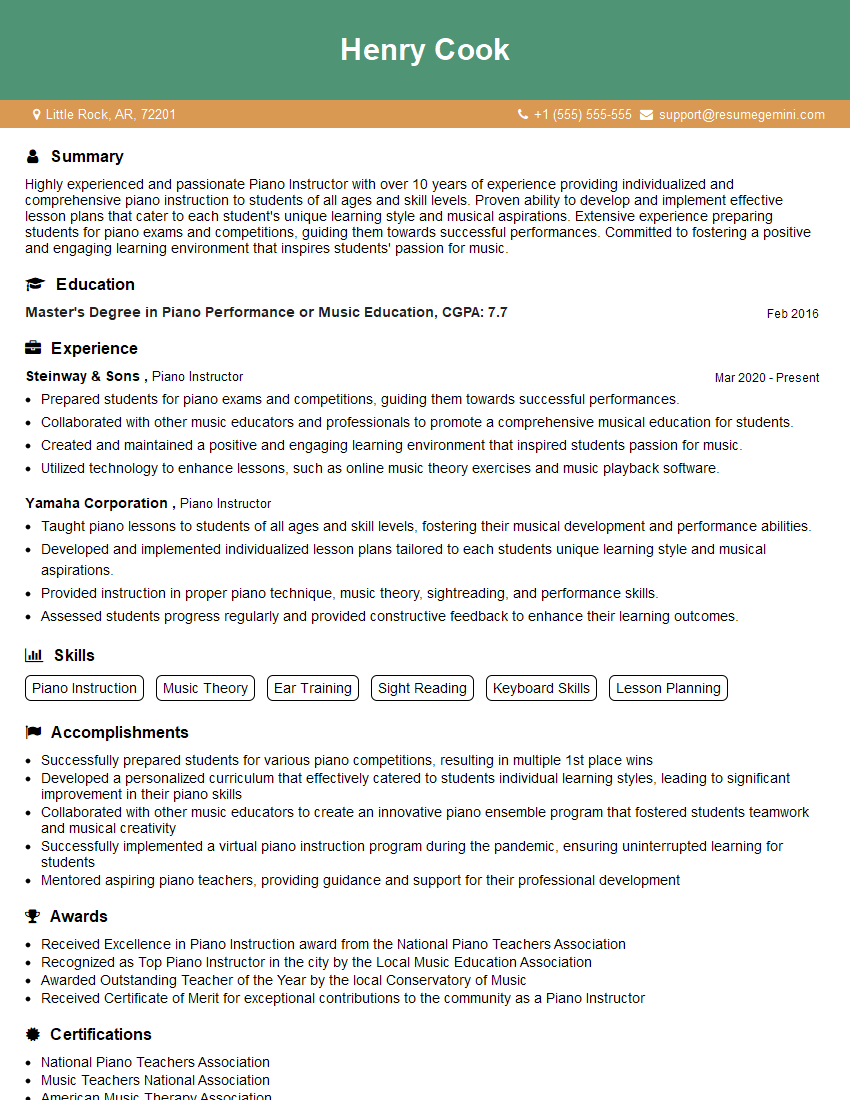
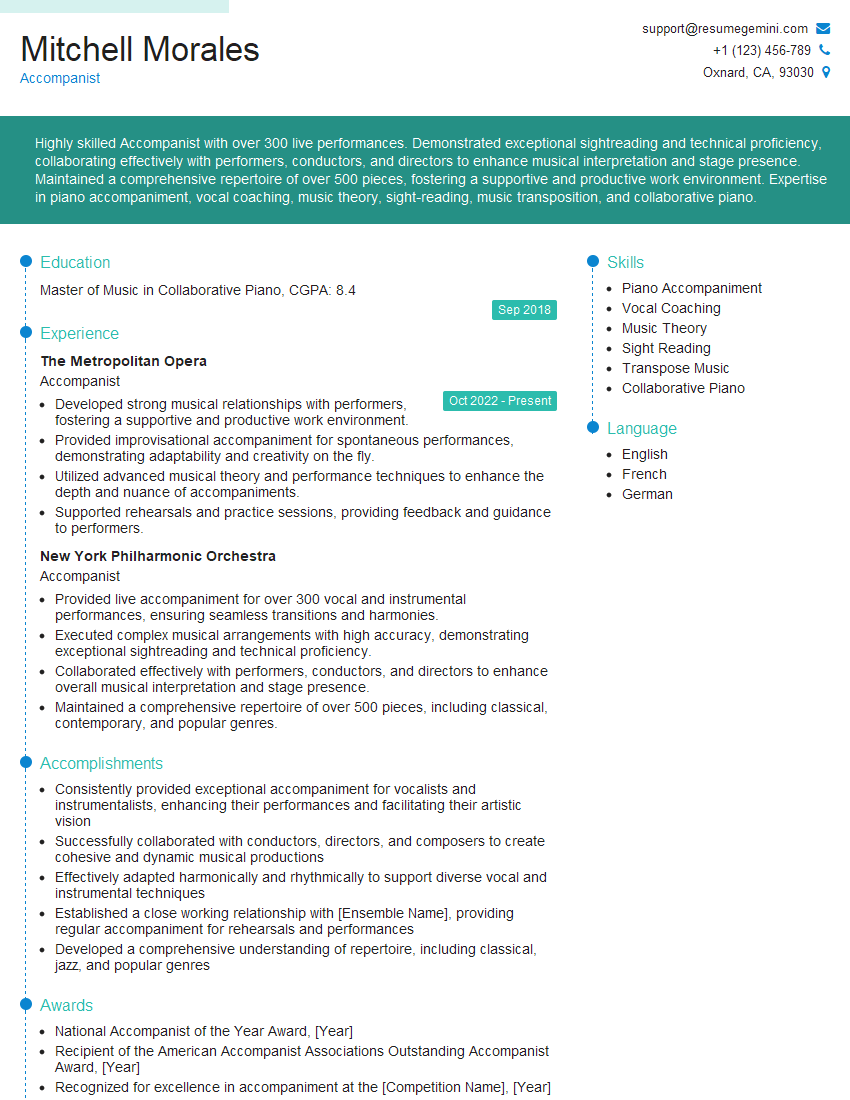
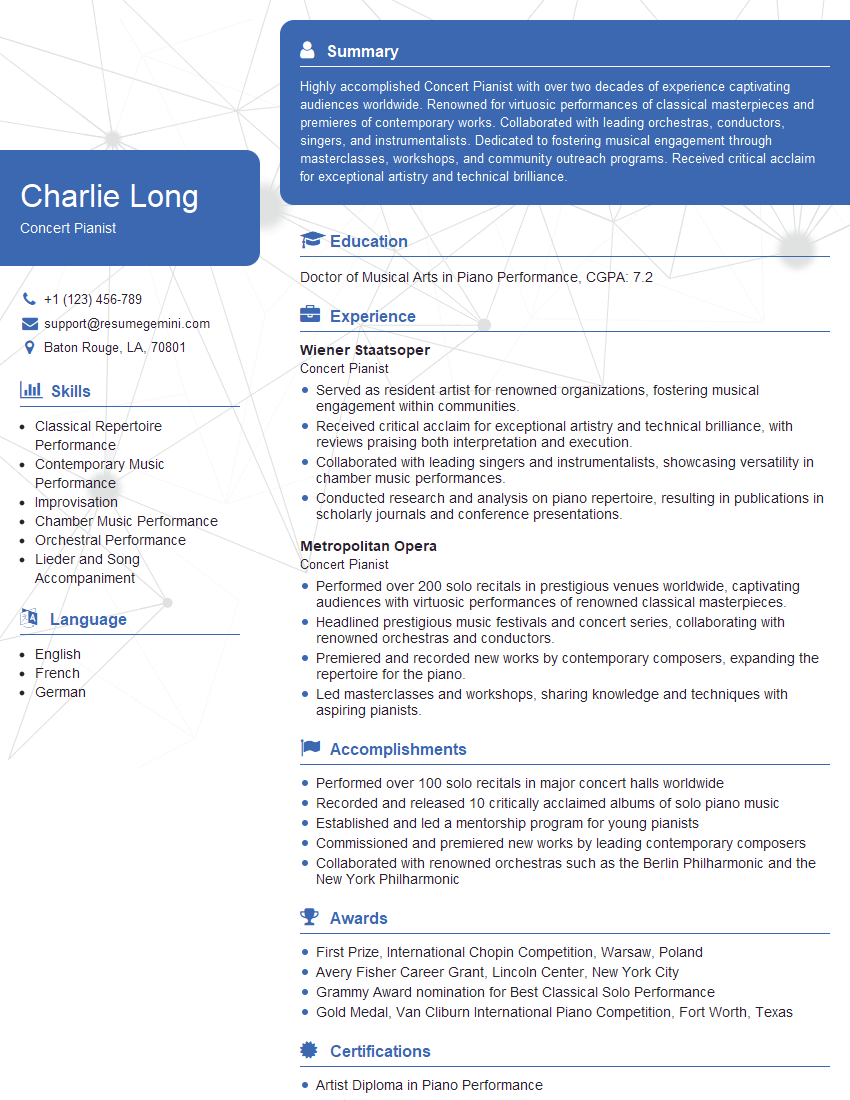
Mastering solo piano repertoire is crucial for career advancement, opening doors to diverse opportunities such as teaching, performing, accompanying, and scholarly research. A strong resume is your key to unlocking these opportunities. Make sure yours is ATS-friendly to maximize its impact on potential employers. ResumeGemini is a valuable resource to help you build a professional and impactful resume that showcases your skills and experience effectively. We offer examples of resumes tailored to highlight expertise in Solo Piano Repertoire to help guide your creation process.
Explore more articles
Users Rating of Our Blogs
Share Your Experience
We value your feedback! Please rate our content and share your thoughts (optional).
What Readers Say About Our Blog
Very informative content, great job.
good