Interviews are more than just a Q&A session—they’re a chance to prove your worth. This blog dives into essential Spectrum Management and Frequency Analysis interview questions and expert tips to help you align your answers with what hiring managers are looking for. Start preparing to shine!
Questions Asked in Spectrum Management and Frequency Analysis Interview
Q 1. Explain the concept of electromagnetic spectrum allocation.
Electromagnetic spectrum allocation is the process of assigning specific portions of the radio frequency (RF) spectrum to different users or services. Think of it like dividing a valuable resource – the spectrum – into different plots of land, each designated for a specific purpose. This ensures that various wireless technologies, from radio and television broadcasts to cellular networks and satellite communications, can operate without significant interference. Without careful allocation, the spectrum would become a chaotic jumble of signals, rendering many services unusable. This allocation is governed by national and international regulations, aiming to maximize efficient use while minimizing harmful interference.
Q 2. Describe different spectrum allocation methods (e.g., auction, licensing).
Several methods exist for spectrum allocation, each with its advantages and drawbacks. Licensing is a traditional approach where government bodies grant exclusive rights to use specific frequency bands to individuals or organizations. This provides certainty and encourages investment, but can lead to underutilization if the licensee doesn’t fully use the allocated spectrum. Auctions, increasingly common, allow for competitive bidding on spectrum licenses, leading to efficient allocation based on market demand. This approach generates revenue for governments and encourages efficient spectrum use, but can favor large companies with substantial financial resources. Command and control, typical for government or military use, involves direct allocation of frequencies by regulatory bodies. Open access or unlicensed spectrum allows free access to specific bands, encouraging innovation and fostering competition, but necessitates careful management to prevent interference issues. The choice of allocation method often depends on the specific frequency band and its intended use.
Q 3. What are the key challenges in spectrum management?
Spectrum management faces numerous challenges. Spectrum scarcity is a fundamental issue; the available spectrum is a finite resource, and demand is continuously increasing with the proliferation of wireless devices and services. Interference between different systems using overlapping frequencies or adjacent bands remains a major concern, requiring sophisticated mitigation techniques. Dynamic spectrum access (DSA), while promising more efficient use, presents challenges in managing shared access and preventing conflicts. International coordination is crucial, as radio waves don’t respect national boundaries. Harmonizing regulations and standards across countries is vital for seamless global communication. Furthermore, managing unlicensed bands requires balancing innovation with the need to prevent harmful interference and ensure fair access for all users. Finally, the ever-evolving landscape of technology, with new wireless services and devices constantly emerging, necessitates continuous adaptation and refinement of management strategies.
Q 4. How does interference affect wireless communication systems?
Interference degrades the quality of wireless communication by corrupting the intended signal. Imagine trying to hear a conversation in a noisy room; the noise acts like interference, making it difficult to understand the message. In wireless systems, interference can manifest as reduced signal strength, increased bit error rates, and ultimately, service disruptions. This can lead to dropped calls, slow data speeds, and distorted audio or video. The severity of the impact depends on the strength of the interfering signal, its proximity to the desired signal, and the characteristics of the wireless system itself. For instance, a strong interfering signal can completely overwhelm a weak desired signal, rendering the communication impossible.
Q 5. Explain different types of interference (co-channel, adjacent channel, etc.).
Several types of interference exist: Co-channel interference occurs when two or more transmitters use the same frequency channel. This is analogous to two radio stations broadcasting on the same frequency, causing their signals to overlap and blend together. Adjacent channel interference arises when signals from adjacent channels bleed over into each other, due to imperfect filtering or close frequency spacing. Intermodulation interference results from the mixing of signals from different transmitters, generating new signals at frequencies different from the original ones. These new signals can interfere with other systems operating in those frequencies. Impulse noise refers to short bursts of high-intensity noise, often caused by electronic devices such as ignition systems. Finally, cross-polarization interference occurs when signals transmitted using different polarizations interfere with each other due to imperfect isolation between polarization states.
Q 6. What are the techniques used to mitigate interference?
Various techniques exist for mitigating interference. Frequency planning involves carefully selecting frequencies for different systems to minimize overlap and potential conflict. Directional antennas focus signals in specific directions, reducing the amount of energy radiated in areas where interference is likely. Filtering helps remove unwanted signals from the received signal. Adaptive equalization adjusts the receiver to compensate for the effects of interference. Spread spectrum techniques use wider bandwidths, making the signal more robust to interference. Power control adjusts the transmit power of devices to reduce interference while maintaining adequate signal strength. Furthermore, robust coding schemes and error correction techniques can help to correct errors introduced by interference. The specific technique or combination of techniques used will depend on the nature of the interference and the characteristics of the wireless system.
Q 7. Describe your experience with spectrum monitoring tools and techniques.
Throughout my career, I’ve extensively used various spectrum monitoring tools and techniques. I have experience with software-defined radios (SDRs) for real-time signal acquisition and analysis, capable of capturing a wide range of frequencies simultaneously. These systems allow for detailed signal characterization, including the identification of interference sources and their strength. I’m proficient in using specialized spectrum analyzers for precise frequency measurements and signal identification. My expertise extends to using geolocation techniques to pinpoint the location of interfering sources, enabling targeted mitigation efforts. Furthermore, I have experience analyzing spectrum data using signal processing techniques to identify patterns and trends that may indicate interference problems. I’m familiar with various spectrum monitoring databases and reporting tools which enable me to track the spectrum usage within a given region. This experience has provided me with a strong understanding of spectral characteristics and interference patterns, enabling effective troubleshooting and preventive measures.
Q 8. How do you analyze frequency response data?
Analyzing frequency response data involves understanding how a system or component responds to different frequencies. This is crucial in spectrum management to ensure efficient use of frequencies and to identify potential interference. The process typically involves:
- Data Acquisition: This involves using instruments like spectrum analyzers to capture the frequency response data. The data might be in the form of a graph showing amplitude (power) versus frequency or a set of numerical data points.
- Data Processing: This stage often involves using software tools to clean up the data (removing noise), smoothing the curve, and potentially performing transforms like Fourier transforms for further analysis.
- Interpretation: This is the most critical part. We look for key characteristics such as resonant frequencies (peaks in the response), bandwidth (the range of frequencies where the response is significant), and roll-off (the rate at which the response decreases outside the bandwidth). We also look for anomalies or unexpected behavior that may indicate problems.
- Visualization: Graphs are essential! Plotting the frequency response allows us to visually identify key features and compare the response of different systems or components. For example, a Bode plot is commonly used to show both the magnitude and phase response as a function of frequency.
Example: Imagine analyzing the frequency response of an antenna. A peak at a specific frequency indicates that the antenna is most efficient at that frequency. A broad, flat response suggests a wideband antenna, while a narrow peak shows a narrowband antenna. Identifying irregularities could reveal antenna damage or design flaws.
Q 9. Explain the difference between narrowband and wideband signals.
The difference between narrowband and wideband signals lies in their bandwidth – the range of frequencies they occupy.
- Narrowband signals occupy a very small range of frequencies. Think of a single radio station broadcasting on a specific frequency. They are typically easier to filter and less susceptible to interference from adjacent channels, but they can only carry a limited amount of information.
- Wideband signals occupy a much broader range of frequencies. High-definition television broadcasts and modern wireless communication systems are examples. They have the capacity to carry a significantly larger amount of information, but require more complex filtering and are more prone to interference from nearby signals.
Analogy: Imagine a road. A narrowband signal is like a single lane road; only one car (piece of information) can pass at a time. A wideband signal is a multi-lane highway, allowing many cars (lots of information) to pass simultaneously. However, managing traffic (interference) on the multi-lane highway is far more challenging.
Q 10. What are the advantages and disadvantages of different modulation techniques?
Various modulation techniques offer different trade-offs in terms of bandwidth efficiency, power efficiency, and robustness against noise and interference. Here’s a comparison:
- Amplitude Modulation (AM): Simple to implement, but inefficient in terms of bandwidth usage and susceptible to noise. Common in older radio broadcasting.
- Frequency Modulation (FM): More robust against noise than AM, but requires a wider bandwidth. Used in FM radio broadcasting.
- Phase Modulation (PM): Similar to FM in noise immunity, but with different bandwidth characteristics. Often used in combination with other techniques.
- Digital Modulation Techniques (e.g., QAM, OFDM): More bandwidth-efficient and robust than analog techniques like AM and FM. Used in modern communication systems like Wi-Fi and cellular networks. They offer various levels of complexity and resilience to noise.
Advantages and Disadvantages Summary:
- Analog Modulation (AM, FM, PM): Simple to implement, but less efficient and prone to noise.
- Digital Modulation: Highly efficient, robust, but more complex to implement.
The choice of modulation technique depends on the specific application requirements, balancing factors like bandwidth availability, power constraints, and desired signal quality.
Q 11. Describe your experience with spectrum analyzer usage.
I have extensive experience using spectrum analyzers, both in the lab and in the field, for various tasks including signal identification, interference hunting, and antenna characterization. My experience includes using both benchtop and portable spectrum analyzers from various manufacturers (e.g., Keysight, Rohde & Schwarz). I’m proficient in using various analyzer functions, including:
- Sweep measurements: To visualize the power spectral density of signals across a wide frequency range.
- Marker measurements: To accurately determine the frequency and power level of individual signals.
- Channel power measurements: To quantify the power of signals within specific frequency bands.
- Occupancy measurements: To analyze the frequency usage and identify potential interference.
- Advanced functions: Such as spectrum emission mask testing and modulation analysis.
Example: In one project, I used a spectrum analyzer to identify the source of interference affecting a sensitive scientific instrument. By carefully analyzing the frequency response and comparing it to known sources, I pinpointed a nearby industrial equipment as the culprit, leading to a successful mitigation strategy.
Q 12. How do you identify and troubleshoot RF interference issues?
Identifying and troubleshooting RF interference involves a systematic approach. The steps usually include:
- Initial Observation and Data Collection: Document the symptoms of the interference (e.g., intermittent signal loss, data corruption, noise). Use a spectrum analyzer to identify the frequency and power level of the interfering signal.
- Signal Identification: Use the spectrum analyzer to identify the characteristics of the interfering signal (e.g., frequency, modulation type, bandwidth). Compare this information to known signal sources in the area.
- Source Localization: This may involve using directional antennas or signal tracing equipment to pinpoint the source of the interference. The process can be iterative, narrowing down the location through systematic testing.
- Mitigation Strategies: Once the source is identified, implement appropriate mitigation techniques. This might include filtering, shielding, changing frequencies, or adjusting system parameters.
- Verification: After implementing mitigation strategies, verify the effectiveness using the spectrum analyzer to ensure the interference has been reduced to an acceptable level.
Example: I once worked on a project where a Wi-Fi network was experiencing intermittent connectivity issues. Using a spectrum analyzer, I identified a strong interfering signal from a nearby microwave oven operating on a frequency close to the Wi-Fi channel. The solution involved changing the Wi-Fi channel to one further away from the microwave’s operating frequency, resolving the connectivity issues.
Q 13. Explain the concept of signal-to-noise ratio (SNR).
The signal-to-noise ratio (SNR) is a measure of the strength of a desired signal relative to the background noise. It’s expressed in decibels (dB) and is a crucial indicator of signal quality. A higher SNR means the signal is stronger relative to the noise, leading to better signal fidelity and reduced errors.
Formula: SNR = 10 log10 (Signal Power / Noise Power)
Practical Application: In communication systems, a high SNR is essential for reliable data transmission. Low SNR can lead to errors and data loss. For example, in a cellular network, a low SNR might result in dropped calls or slow data speeds. The SNR is a key performance indicator that influences system design and determines acceptable performance levels.
Q 14. What is the significance of the Shannon-Hartley theorem?
The Shannon-Hartley theorem is fundamental to communication theory. It establishes the maximum rate at which information can be reliably transmitted over a communication channel with a specific bandwidth and signal-to-noise ratio (SNR).
Formula: C = B log2(1 + SNR)
Where:
- C is the channel capacity (bits per second).
- B is the bandwidth of the channel (Hertz).
- SNR is the signal-to-noise ratio.
Significance: The theorem provides a theoretical upper limit on the data transmission rate. It highlights the critical role of bandwidth and SNR in determining the channel capacity. This has significant implications for designing communication systems, as it guides engineers in making decisions about bandwidth allocation, modulation techniques, and power levels to achieve the desired data rate.
Example: When designing a new wireless communication system, engineers use the Shannon-Hartley theorem to determine the maximum achievable data rate given the available bandwidth and the expected SNR. This helps in optimizing the system design to achieve the best possible performance while staying within regulatory constraints and technical limitations.
Q 15. Describe your experience with spectrum planning and licensing.
Spectrum planning and licensing involves strategically allocating radio frequencies to various users and services, ensuring efficient and non-interfering use. My experience encompasses the entire lifecycle, from initial need assessment and frequency selection to license application and compliance monitoring. I’ve worked on numerous projects, including designing frequency plans for cellular networks, planning spectrum for public safety systems, and coordinating spectrum usage in shared environments like airports. This involves understanding technical parameters like bandwidth requirements, interference potential, and propagation characteristics. For example, in a cellular network expansion project, I was responsible for identifying available spectrum bands, considering existing services, predicting interference levels using propagation models, and submitting a detailed license application to the relevant regulatory body, adhering to stringent technical and regulatory specifications.
I’ve also been involved in spectrum trading and sharing, negotiating agreements between different stakeholders to optimize spectrum utilization. This often requires complex technical analysis and careful negotiation to balance the needs of competing users. In a recent project, I successfully brokered a spectrum sharing agreement between a private company and a government agency, resulting in efficient spectrum usage and cost savings for both parties.
Career Expert Tips:
- Ace those interviews! Prepare effectively by reviewing the Top 50 Most Common Interview Questions on ResumeGemini.
- Navigate your job search with confidence! Explore a wide range of Career Tips on ResumeGemini. Learn about common challenges and recommendations to overcome them.
- Craft the perfect resume! Master the Art of Resume Writing with ResumeGemini’s guide. Showcase your unique qualifications and achievements effectively.
- Don’t miss out on holiday savings! Build your dream resume with ResumeGemini’s ATS optimized templates.
Q 16. Explain the role of regulatory bodies in spectrum management.
Regulatory bodies play a crucial role in ensuring the orderly and efficient use of the radio frequency spectrum, a finite and valuable resource. Organizations like the Federal Communications Commission (FCC) in the United States, Ofcom in the UK, and similar bodies worldwide, establish regulations to prevent harmful interference, allocate spectrum fairly, and promote innovation. Their functions include:
- Spectrum Allocation: Defining which frequency bands are allocated to which services (e.g., cellular, broadcasting, aviation).
- Licensing: Issuing licenses to users, specifying their permitted frequency bands, power levels, and operating conditions.
- Enforcement: Monitoring spectrum usage to detect and address violations, potentially including fines or license revocation.
- International Coordination: Collaborating with other countries to manage spectrum usage across borders and prevent international interference.
- Technological Advancement: Encouraging innovation by developing policies and procedures for new spectrum technologies.
These regulatory functions are critical to prevent chaos in the radio frequency landscape. Imagine a world without spectrum regulation – a cacophony of interfering signals rendering communication and many technological services impossible. The regulatory framework ensures a predictable and safe radio environment.
Q 17. How do you ensure compliance with spectrum regulations?
Ensuring compliance with spectrum regulations requires a multi-faceted approach. It begins with a thorough understanding of the applicable regulations for the specific location and service. This understanding informs every stage of the project, from initial planning and design to ongoing operation and maintenance.
- Pre-Deployment Planning: This includes conducting spectrum surveys to identify existing signals and potential interference, using sophisticated propagation models to predict signal coverage and interference levels. The selected frequencies and power levels must comply with the regulatory limits and any license conditions.
- Technical Compliance: Equipment must meet all technical specifications, including emission masks and power limits, as defined in the regulations. Regular testing and calibration of equipment are crucial to maintain compliance.
- Documentation: Maintaining detailed records of all spectrum usage, including frequency assignments, power levels, antenna parameters, and any modifications. This documentation is vital for audits and regulatory compliance checks.
- Monitoring: Continuous monitoring of spectrum usage for potential interference with other services. Automated monitoring systems can be employed to detect and alert operators of any deviations from the licensed parameters.
- Incident Reporting: Promptly reporting any incidents of interference or non-compliance to the regulatory body.
My experience includes developing and implementing comprehensive compliance programs for various clients. For example, in one project, we developed a detailed spectrum management plan, which integrated with the client’s network management system, providing real-time monitoring and alerting, thus ensuring continuous compliance with all relevant regulations.
Q 18. Describe your experience with RF propagation modeling.
RF propagation modeling is essential for predicting how radio signals will behave in a given environment. It involves using software tools and mathematical models to simulate the transmission path of a radio wave, taking into account various factors such as terrain, obstacles, atmospheric conditions, and antenna characteristics. My experience includes utilizing a variety of propagation models, including ray tracing, path loss models (such as the Okumura-Hata model and the COST-231 model), and diffraction models. I’m proficient in using software packages like MATLAB, HFSS, and specialized propagation prediction tools.
For example, in a recent project designing a wireless sensor network in a mountainous region, we used ray tracing models to simulate the signal propagation, considering the complex topography. This allowed us to optimize the placement of sensors and antennas to achieve the desired coverage and minimize signal loss. In another project involving a cellular network planning exercise in a densely populated urban area, we employed path loss models to accurately predict the signal strength in various locations. This enabled us to optimize the placement of cell towers and ensure sufficient network coverage.
Q 19. Explain the impact of path loss on signal strength.
Path loss refers to the reduction in signal strength as a radio wave travels from the transmitter to the receiver. It’s primarily caused by the spreading of the signal energy over an increasingly larger area as the distance increases. This phenomenon is often described using a logarithmic scale, expressed in decibels (dB). Several factors contribute to path loss, including:
- Distance: The further the signal travels, the weaker it becomes. This is often the dominant factor.
- Frequency: Higher frequencies experience greater path loss than lower frequencies.
- Obstacles: Buildings, trees, and terrain features can significantly attenuate the signal.
- Atmospheric Conditions: Rain, fog, and other weather phenomena can also affect signal strength.
The impact on signal strength is significant, as even a small increase in path loss can drastically reduce the received signal power. For instance, a 10 dB increase in path loss reduces the signal strength by a factor of 10. Understanding path loss is crucial for link budget calculations and ensuring sufficient signal strength for reliable communication.
Q 20. What are the effects of multipath propagation?
Multipath propagation occurs when a radio signal travels from the transmitter to the receiver via multiple paths. This happens when the signal reflects off objects like buildings or bounces off the ground. These multiple signals arrive at the receiver with different delays and amplitudes, leading to several effects:
- Signal Fading: The combined effect of the multiple signals can result in constructive or destructive interference, leading to variations in the received signal strength. This fading can be rapid and unpredictable, leading to unreliable communication.
- Inter-Symbol Interference (ISI): Delayed signals can overlap with subsequent signals, causing distortion and errors in the received data.
- Delay Spread: The difference in arrival times of the multiple signals is called delay spread. A large delay spread can severely impact the performance of high-speed data transmission systems.
Techniques such as equalization and diversity reception are used to mitigate the effects of multipath propagation. Equalization aims to correct for the distortion caused by ISI, while diversity reception utilizes multiple antennas to receive the signal via different paths, reducing the impact of fading. For instance, in 5G cellular networks, MIMO (Multiple-Input and Multiple-Output) antenna systems and advanced signal processing techniques are employed to overcome multipath challenges and achieve high data rates. Understanding and mitigating multipath effects are critical for reliable wireless communication.
Q 21. Describe different antenna types and their characteristics.
Antenna types are numerous and their selection depends heavily on the application and frequency. The key characteristics are gain, directivity, polarization, and impedance. Here are some common examples:
- Dipole Antenna: A simple, resonant antenna with moderate gain and omnidirectional radiation pattern in one plane. Often used in television and radio broadcasting.
- Yagi-Uda Antenna (Yagi): A directional antenna with high gain, consisting of a driven element and parasitic elements (directors and reflectors). Commonly used in television reception and point-to-point links.
- Patch Antenna: A planar antenna with a small footprint, suitable for applications where space is limited. Widely used in mobile devices and satellite communication.
- Horn Antenna: A high-gain, directional antenna used in microwave applications, often found in satellite earth stations and radar systems.
- Parabolic Antenna (Dish Antenna): A high-gain, directional antenna that uses a parabolic reflector to focus the radio waves. Frequently used in satellite communication and radio astronomy.
The choice of antenna significantly impacts the performance of a radio system. For example, using a high-gain directional antenna increases the signal strength in a particular direction but results in limited coverage. Conversely, an omnidirectional antenna provides broader coverage but with lower signal strength. Careful antenna selection is crucial for optimizing system performance and ensuring efficient spectrum utilization.
Q 22. How do you select appropriate antennas for different applications?
Antenna selection is crucial for optimal signal transmission and reception. The choice depends heavily on the application’s specific needs, including frequency, power, range, and environmental factors. Think of it like choosing the right tool for a job – a hammer won’t work for screwing in a screw.
- Frequency: Different frequencies require antennas with different physical dimensions. Higher frequencies generally use smaller antennas, while lower frequencies need larger ones. For instance, a cellular phone antenna operates in the GHz range and is considerably smaller than a longwave radio antenna.
- Gain: This describes how well an antenna focuses the signal. High-gain antennas concentrate power in a specific direction, ideal for long-range communication like satellite dishes. Low-gain antennas radiate power more broadly, suitable for omnidirectional coverage like Wi-Fi routers.
- Polarization: Antennas transmit and receive signals with a specific polarization (vertical, horizontal, circular). Matching polarization between transmitting and receiving antennas maximizes signal strength. Mismatched polarization significantly reduces signal quality.
- Environment: Obstacles like buildings and trees attenuate signals. In urban environments, antennas with good multipath mitigation capabilities are preferred. In open spaces, high-gain directional antennas might be more efficient.
- Application: A broadcast radio station will use a very different antenna compared to a GPS receiver or a microwave link. Each application has specific requirements for coverage area, signal strength, and directionality.
For example, selecting an antenna for a Wi-Fi router in a home involves considering the size of the house and the placement of the router to ensure good coverage throughout. A low-gain omnidirectional antenna would be suitable here. However, for a point-to-point microwave link across a long distance, a high-gain directional antenna focused on the receiving station is essential.
Q 23. Explain the concept of antenna gain and directivity.
Antenna gain and directivity are closely related but distinct concepts that describe an antenna’s ability to focus radiated power. Imagine a flashlight: a focused beam has high gain and directivity, while a diffuse light has low gain and directivity.
Antenna Gain: This represents the ratio of power radiated in a specific direction to the power radiated by a reference antenna (usually an isotropic radiator—a theoretical antenna radiating equally in all directions) with the same input power. It’s expressed in decibels (dBi).
Antenna Directivity: This is a measure of how concentrated the radiated power is in a particular direction compared to an isotropic radiator. It indicates the antenna’s ability to focus its signal, regardless of losses. It’s also expressed in decibels (dBi) or as a dimensionless ratio.
The key difference: Gain considers the antenna’s efficiency (losses due to ohmic resistance, impedance mismatch, etc.), while directivity only considers the antenna’s pattern. An antenna with high directivity can have lower gain if it has significant losses. For example, a parabolic dish antenna has very high directivity and gain, directing most of its power in a narrow beam. A short dipole antenna has lower directivity and gain, radiating power more evenly in most directions.
Q 24. How does polarization affect antenna performance?
Antenna polarization refers to the orientation of the electric field vector of the radiated electromagnetic wave. The most common polarizations are linear (vertical or horizontal) and circular (right-hand or left-hand). Polarization matching between transmitting and receiving antennas is crucial for efficient signal transfer. Think of it like trying to fit a square peg into a round hole; if the polarizations don’t match, the signal strength is significantly reduced.
Effects of Mismatched Polarization: If the transmitting and receiving antennas have different polarizations, signal strength will decrease. For example, a vertically polarized antenna will receive minimal power from a horizontally polarized signal. The degree of reduction depends on the angle between the polarization vectors. This loss can be very significant, often resulting in signal fading or complete signal loss.
Practical Applications: Proper polarization is vital in various applications. In satellite communication, both transmitting and receiving antennas often use circular polarization to compensate for variations in the satellite’s orientation. In terrestrial microwave links, linear polarization is commonly used, ensuring accurate alignment between the antennas. Understanding polarization is essential for optimizing signal strength and minimizing interference.
Q 25. What are the challenges in managing unlicensed spectrum?
Managing unlicensed spectrum presents unique challenges due to its open-access nature. Unlike licensed bands, which are assigned to specific users, the unlicensed spectrum is a shared resource, leading to potential conflicts and interference.
- Interference: Multiple devices operating on the same frequency can create significant interference, reducing performance and reliability. This is particularly challenging in dense environments with many Wi-Fi networks and Bluetooth devices.
- Hidden Node Problem: Devices might not be aware of each other’s presence, leading to collisions and data loss. This is common in Wi-Fi networks where devices are not within direct line of sight of each other.
- Spectrum Congestion: The increasing demand for wireless services puts immense pressure on the limited available unlicensed spectrum, leading to congestion and reduced performance. This problem is exacerbated in densely populated urban areas.
- Lack of Central Control: Unlike licensed bands, there is no central authority managing the use of unlicensed spectrum. This necessitates the use of sophisticated protocols and mechanisms to prevent and mitigate interference, such as CSMA/CA (Carrier Sense Multiple Access/Collision Avoidance) in Wi-Fi.
- Unfair Access: Without proper management, certain devices or users might dominate the spectrum, leading to unfair access for others.
Effective management strategies for unlicensed spectrum often involve sophisticated access protocols, power control mechanisms, and dynamic frequency selection to minimize interference and maximize efficiency.
Q 26. Describe your experience with cognitive radio technology.
Cognitive radio technology is a revolutionary approach to spectrum management that allows secondary users (devices) to opportunistically access unused portions of the licensed spectrum without interfering with primary users (license holders). Imagine it as a sophisticated system that ‘listens’ to the spectrum and only uses frequencies that are not currently in use.
My experience with cognitive radio involves research and development in spectrum sensing techniques. We developed algorithms to accurately detect the presence of primary users in different frequency bands, minimizing the risk of interference. This included work on energy detection, cyclostationary feature detection, and collaborative spectrum sensing, where multiple cognitive radios work together to improve detection reliability. We also explored different spectrum access strategies to efficiently share the available spectrum among secondary users.
In one project, we developed a software-defined radio (SDR) platform incorporating cognitive radio capabilities for dynamic spectrum access in a 5 GHz Wi-Fi environment. The system successfully identified unused channels and allowed secondary users to access the spectrum without causing interference with the primary Wi-Fi network. This research significantly enhanced my understanding of the challenges and opportunities of cognitive radio technology.
Q 27. What are some emerging trends in spectrum management?
Several emerging trends are shaping the future of spectrum management:
- Artificial Intelligence (AI) and Machine Learning (ML): AI and ML are increasingly used for intelligent spectrum management, automating tasks like spectrum monitoring, interference detection, and resource allocation. This leads to more efficient spectrum utilization and improved performance.
- Internet of Things (IoT): The proliferation of IoT devices significantly increases the demand for spectrum resources. Efficient and intelligent spectrum management solutions are crucial to accommodate this growing demand and manage the complexity of IoT networks.
- Software Defined Radio (SDR): SDRs provide flexibility and adaptability in utilizing different frequency bands, facilitating dynamic spectrum access and improving the efficiency of spectrum use.
- 5G and Beyond: The evolution of cellular networks towards 5G and beyond requires advanced spectrum management techniques to handle the high bandwidth demands and enable new services like ultra-reliable low-latency communication (URLLC).
- Spectrum Sharing and Leasing: Innovative spectrum sharing models, where different users share spectrum resources, are gaining traction, leading to a more efficient use of this valuable resource.
These trends necessitate a shift towards more dynamic, intelligent, and collaborative spectrum management approaches that consider the increasing demand for wireless connectivity and the complexity of modern wireless systems.
Q 28. Explain your understanding of dynamic spectrum access.
Dynamic spectrum access (DSA) is a paradigm shift in spectrum management that allows unlicensed devices to opportunistically access currently unused licensed spectrum. Unlike traditional fixed spectrum allocation, DSA allows for flexible and efficient use of spectrum resources. Imagine a city’s parking system: DSA is like having sensors that detect empty parking spaces and letting drivers use them on a temporary basis.
Key aspects of DSA include:
- Spectrum Sensing: DSA systems employ sophisticated spectrum sensing techniques to detect unused licensed spectrum. Various sensing methods are used, including energy detection, cyclostationary feature detection, and collaborative sensing.
- Spectrum Decision: Based on sensing data, a decision is made whether to access the available spectrum, taking into account various factors such as interference levels and the risk of harming primary users.
- Spectrum Access: If access is granted, the secondary user transmits using the detected available frequency band, but with power control mechanisms to minimize interference with primary users.
- Spectrum Mobility: In a dynamic environment, secondary users might need to vacate a frequency band quickly if a primary user requires it. Efficient mobility management is crucial for smooth operation.
DSA promises to significantly improve spectrum utilization and alleviate spectrum scarcity. However, it requires robust spectrum sensing techniques, efficient access protocols, and reliable mechanisms to protect primary users from interference. This is an active area of research and development, with significant advancements expected in the near future.
Key Topics to Learn for Spectrum Management and Frequency Analysis Interview
- Fundamentals of Radio Wave Propagation: Understanding free space path loss, diffraction, reflection, and refraction is crucial for predicting signal strength and interference.
- Spectrum Allocation and Licensing: Familiarize yourself with the processes and regulations governing the allocation of radio frequencies, including national and international standards.
- Interference Analysis and Mitigation Techniques: Learn how to identify and quantify interference sources, and explore methods for minimizing their impact on communication systems.
- Signal Processing Techniques for Frequency Analysis: Master concepts like Fourier Transforms, filtering, and spectral estimation for accurate signal characterization.
- Cognitive Radio and Dynamic Spectrum Access: Understand the principles and applications of intelligent spectrum utilization, including sensing and adaptation to changing spectrum conditions.
- Measurement Techniques and Instrumentation: Become familiar with common spectrum analyzers, signal generators, and other equipment used in frequency analysis and management.
- Modeling and Simulation of Wireless Communication Systems: Develop skills in using simulation tools to predict system performance and optimize spectrum usage.
- Legal and Regulatory Frameworks: Understand the legal and regulatory landscape surrounding spectrum management and its implications for system design and operation.
- Practical Application: Consider case studies involving real-world scenarios of spectrum allocation conflicts, interference resolution, or system optimization in different communication systems (e.g., cellular, satellite, radar).
- Problem-Solving Approach: Practice breaking down complex problems into smaller, manageable components, and applying your theoretical knowledge to solve practical challenges.
Next Steps
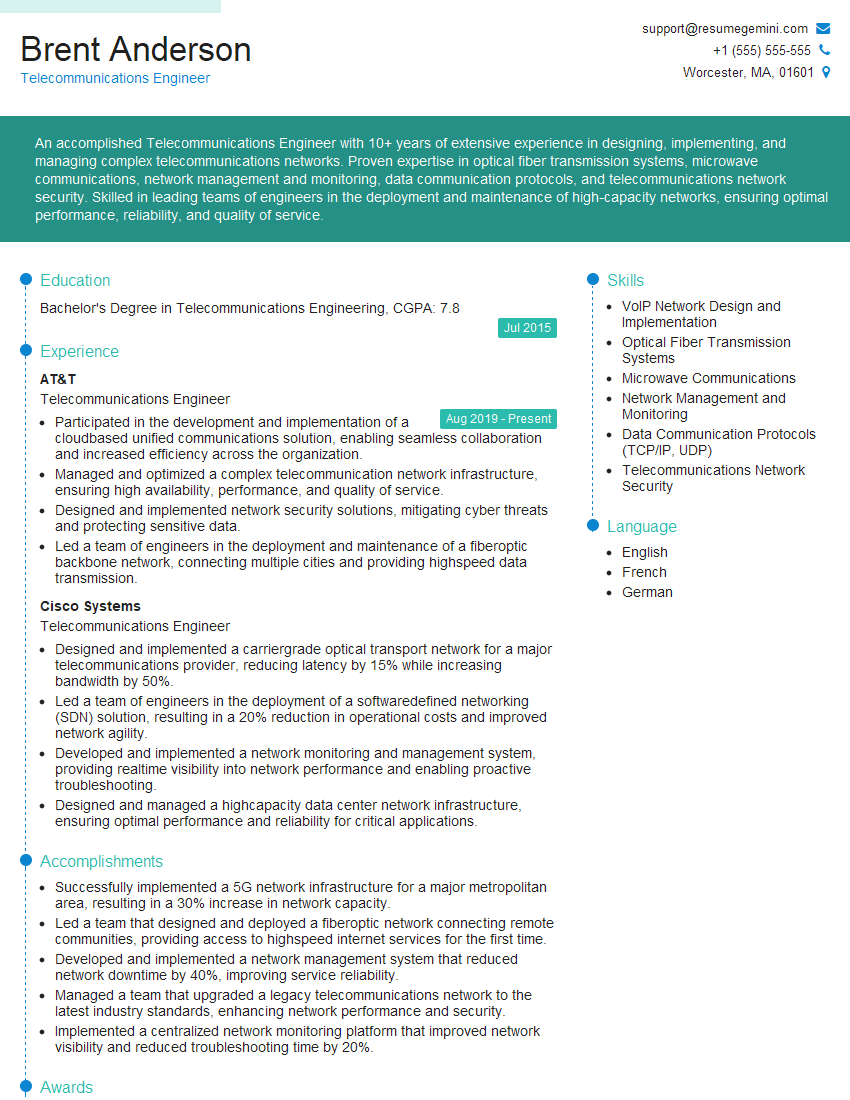
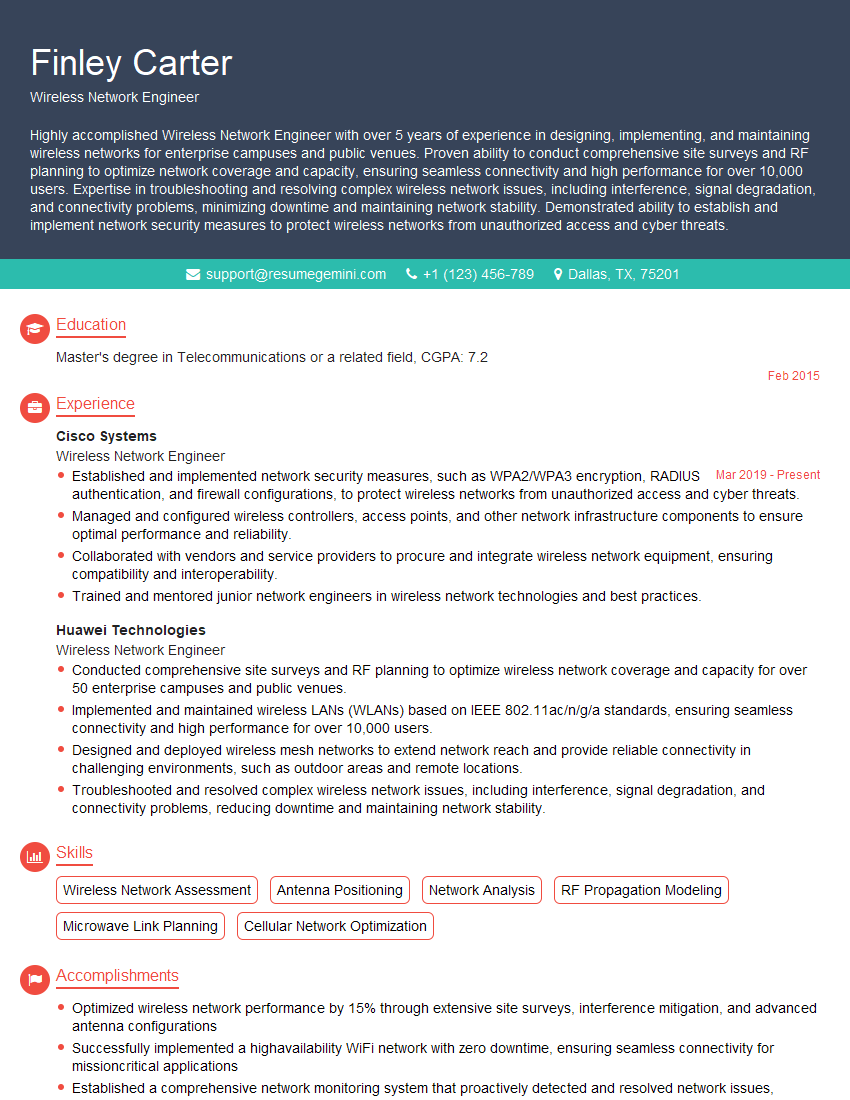
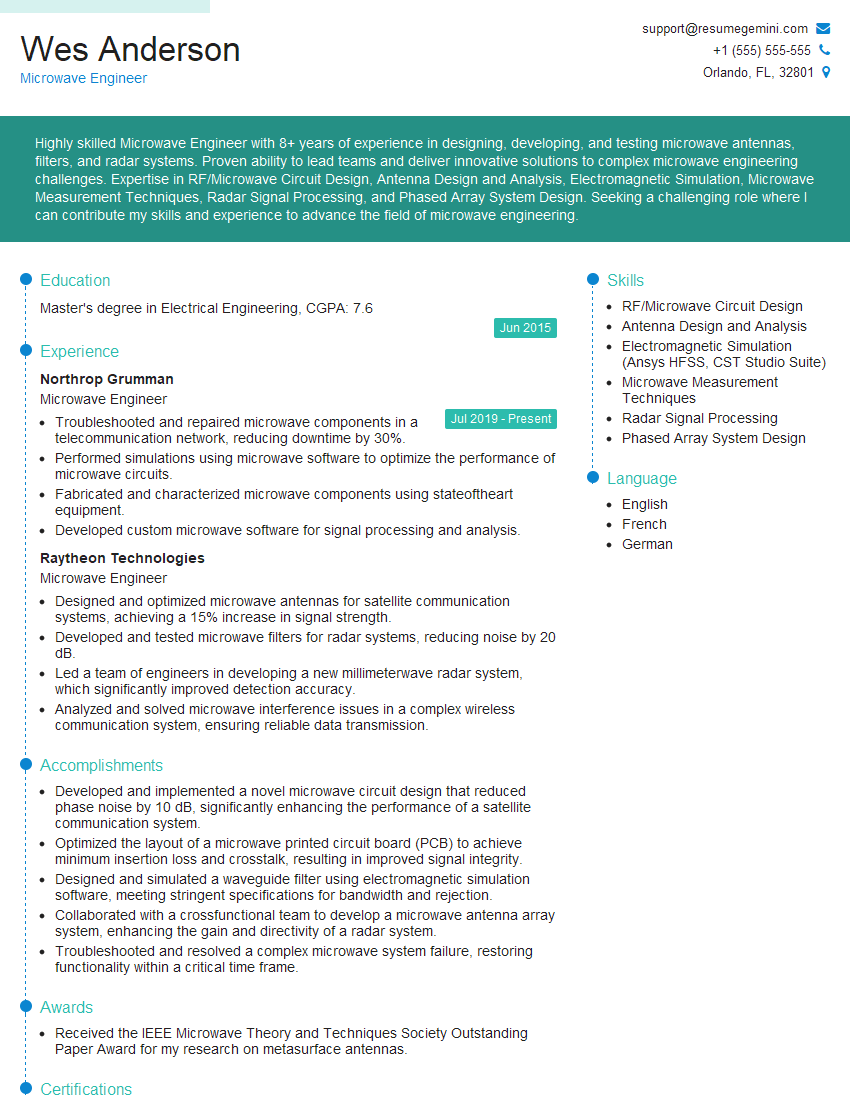
Mastering Spectrum Management and Frequency Analysis opens doors to exciting and impactful careers in telecommunications, aerospace, defense, and research. A strong understanding of these concepts is highly valued by employers. To maximize your job prospects, it’s essential to create an ATS-friendly resume that effectively showcases your skills and experience. ResumeGemini is a trusted resource that can help you build a professional and impactful resume. They provide examples of resumes tailored to Spectrum Management and Frequency Analysis to guide you through the process. Take advantage of these resources to present yourself in the best possible light and land your dream job!
Explore more articles
Users Rating of Our Blogs
Share Your Experience
We value your feedback! Please rate our content and share your thoughts (optional).
What Readers Say About Our Blog
Very informative content, great job.
good