Interviews are opportunities to demonstrate your expertise, and this guide is here to help you shine. Explore the essential Spray Coating interview questions that employers frequently ask, paired with strategies for crafting responses that set you apart from the competition.
Questions Asked in Spray Coating Interview
Q 1. Explain the difference between HVLP and airless spray systems.
High Volume Low Pressure (HVLP) and airless spray systems are two distinct methods for applying coatings. The key difference lies in how they atomize the paint. HVLP systems use a large volume of air at low pressure to gently atomize the paint, resulting in less overspray and higher transfer efficiency (meaning more paint lands on the surface and less is wasted). Think of it like a gentle breeze softly dispersing the paint. Airless systems, on the other hand, use very high pressure to force the paint through a small nozzle, atomizing it without the need for much air. This is like squeezing toothpaste out of a tube with considerable force.
In practice, HVLP is preferred when a fine finish and minimal overspray are paramount, such as in automotive refinishing or high-end furniture. Airless systems are favored for larger projects, where speed and efficiency are crucial, such as painting houses or large industrial structures. The trade-off is that airless systems usually result in more overspray and a slightly coarser finish.
Q 2. Describe your experience with various spray coating materials (e.g., epoxy, polyurethane, acrylic).
My experience encompasses a wide range of spray coating materials. I’ve extensively worked with epoxy coatings, known for their exceptional durability and chemical resistance. I’ve used them in applications ranging from protecting industrial equipment to creating decorative flooring. Polyurethane coatings are another staple in my work; their versatility makes them suitable for everything from automotive finishes to protective coatings on wood. I appreciate their ability to provide both a tough, protective layer and a beautiful, high-gloss finish. Finally, acrylic coatings are frequently used, especially in applications requiring a quick-drying, water-based solution, often chosen for their ease of use and low VOC (Volatile Organic Compound) content.
In one particular project, I used a specialized high-build epoxy primer followed by a polyurethane topcoat on a large steel structure for corrosion protection. The epoxy primer provided excellent adhesion and rust prevention, while the polyurethane ensured a durable, weather-resistant finish. Each material selection was critical to achieving the project’s specific requirements for longevity and appearance.
Q 3. How do you determine the correct spray gun pressure and fluid tip size for a given application?
Determining the correct spray gun pressure and fluid tip size is crucial for achieving a quality finish. It’s a balancing act. Too much pressure can lead to overspray, runs, and sags; too little, and the coating might be too thin or uneven. The ideal settings depend on several factors: the viscosity of the coating material, the desired film thickness, the type of spray gun, and the surface being coated.
Typically, I start by consulting the manufacturer’s recommendations for the specific material. Then, I conduct test sprays on a scrap material similar to the project surface to refine the settings. I gradually adjust the pressure and fluid tip size, observing the resulting spray pattern and film thickness. A good spray pattern is even and consistent, without excessive misting or dry spray. The goal is to achieve a smooth, even coat with minimal waste. For example, a thicker coating might require a larger fluid tip size, while a higher viscosity material might need increased pressure (but within the recommended ranges).
Q 4. What safety precautions are essential when working with spray coating equipment?
Safety is paramount in spray coating. The primary hazards include inhalation of paint fumes, skin contact with the coating material, and fire hazards. Therefore, I always start by ensuring adequate ventilation. This often involves using a respirator with appropriate cartridges, along with exhaust fans or working outdoors. Protective clothing, including coveralls, gloves, and eye protection, is mandatory. It’s critical to follow the material safety data sheets (MSDS) for each material to understand specific hazards and necessary precautions.
Furthermore, I take precautions to prevent fire hazards by keeping the work area free from flammable materials and using appropriate fire extinguishers. Regular maintenance of the spray equipment is also crucial to preventing malfunctions and accidents. Finally, I always make sure the workplace is clearly marked, with proper signage indicating the hazards and safety protocols.
Q 5. Explain the importance of surface preparation before spray coating.
Surface preparation is the foundation of a successful spray coating job. A poorly prepared surface will result in poor adhesion, leading to premature failure of the coating. The process typically involves several steps: cleaning, sanding, and possibly priming. Cleaning removes dirt, grease, oil, and any other contaminants that could interfere with adhesion. Sanding creates a profile, creating a surface with mechanical ‘teeth’ that helps the coating grip effectively. This is especially important on smooth surfaces. Priming is often necessary to improve adhesion and provide a uniform base for the topcoat, particularly on porous surfaces or those with significant imperfections.
Think of it like gluing two pieces of wood together. You wouldn’t expect a good bond if the surfaces were dirty or smooth. Similarly, proper surface preparation ensures a strong bond between the coating and the substrate, ensuring a long-lasting, high-quality finish.
Q 6. How do you troubleshoot common spray coating problems such as orange peel, runs, or sags?
Troubleshooting spray coating problems requires systematic investigation. Orange peel, runs, and sags are common issues with identifiable causes. Orange peel, a textured surface resembling an orange peel, typically results from excessive spray gun distance, too high a pressure, or a coating that is too thin. The solution is to adjust the spray gun distance, reduce pressure, or increase the number of coats to build a thicker film.
Runs and sags, characterized by excess coating pooling in certain areas, typically indicate either too much material being applied, insufficient viscosity, or uneven surface preparation. The solution is to reduce the material flow rate, increase the viscosity of the coating, ensure even surface preparation, or use a slower pass when spraying.
To troubleshoot effectively, I always begin by closely examining the finished surface and considering what factors might have contributed to the defect. Then, I adjust the spray parameters (pressure, distance, material flow rate), clean the spray gun, or refine the surface preparation as needed, performing test sprays on a sample before addressing the main area.
Q 7. Describe your experience with different spray gun types (e.g., air atomizing, airless, electrostatic).
My experience includes all three major types of spray guns: air atomizing, airless, and electrostatic. Air atomizing guns use compressed air to atomize the paint, offering excellent control and a fine finish but with lower transfer efficiency. These are ideal for smaller, detailed applications where a high-quality finish is critical.
Airless spray guns, as discussed earlier, use high pressure to atomize the paint, providing high speed and efficiency, especially for large-scale projects. However, they tend to produce more overspray and a less refined finish than air atomizing guns.
Electrostatic spray guns use an electrical charge to attract the paint particles to the surface, significantly reducing overspray and improving transfer efficiency. This is particularly advantageous when coating irregularly shaped objects or reaching hard-to-access areas. The choice of gun depends heavily on the project scope, desired finish quality, and material being sprayed.
Q 8. How do you ensure proper ventilation and air filtration in a spray booth?
Proper ventilation and air filtration in a spray booth are crucial for worker safety and a high-quality finish. The system needs to effectively remove overspray, solvents, and other airborne contaminants. This is achieved through a combination of air movement and filtration.
- Air Movement: A well-designed booth uses powerful exhaust fans to create a consistent airflow, pulling contaminated air away from the operator and workpiece. The direction and velocity of this airflow are carefully engineered to prevent overspray from settling on the surrounding areas. Think of it like a powerful vacuum cleaner, but for paint fumes and particles.
- Filtration: Multiple stages of filtration are typically used. First, larger particles are trapped by a preliminary filter (e.g., a mesh filter). Then, finer filters, often made of activated carbon, remove the volatile organic compounds (VOCs) and smaller paint particles, ensuring cleaner air is released back into the environment. Regular filter changes are vital to maintain effectiveness.
- Airflow Monitoring: Regular monitoring of airflow velocity and pressure is essential. This can be done with calibrated instruments to ensure the system is operating within its designed parameters. A drop in airflow could indicate a clogged filter or a malfunctioning fan, posing safety risks.
For example, in one project, we experienced a sudden drop in airflow. Quick inspection revealed a clogged primary filter. Replacing it immediately restored the proper ventilation, highlighting the importance of routine maintenance and monitoring.
Q 9. What are the different types of spray coating finishes (e.g., gloss, matte, satin)?
Spray coating finishes are categorized by their sheen level, impacting the final look of the product. This is controlled by the pigment and resin composition of the coating and sometimes via additives.
- Gloss: High-gloss finishes have a very smooth, shiny surface, reflecting a significant amount of light. These are often used for applications where a sleek, modern look is desired, such as automotive parts or furniture.
- Matte/Flat: Matte finishes have a minimal sheen, appearing almost non-reflective. They provide a more subdued and sophisticated appearance, often chosen for high-end projects or where a lower-maintenance finish is needed.
- Satin: Satin finishes fall between gloss and matte, offering a soft, subtle sheen. This balanced finish is popular for its versatility, offering both visual appeal and durability.
- Eggshell: Similar to satin, but with a slightly less sheen. Often favored for its ability to mask minor imperfections.
The choice of finish depends entirely on the application and the desired aesthetic. For instance, a matte finish might be preferred for a piece of fine furniture, while a gloss finish might be suitable for a car part that requires easy cleaning.
Q 10. Explain the process of color matching in spray coating.
Color matching in spray coating is a critical aspect, requiring precision and experience. It involves replicating a specific color using a combination of basecoats, clear coats, and pigments. Modern methods often leverage sophisticated color matching systems.
- Spectrophotometer: This instrument measures the precise color values of a sample, providing numerical data (e.g., L*a*b* values) that can be used to formulate the matching spray coating. Think of it as a highly accurate color scanner for paint.
- Color Matching Software: Specialized software uses the spectrophotometer data to calculate the necessary proportions of pigments and other ingredients needed to achieve the desired color. This streamlines the process and minimizes errors.
- Manual Adjustments: Even with advanced technology, some manual adjustments may be necessary. Experienced technicians fine-tune the mix based on visual inspection, ensuring a perfect match under various lighting conditions. It’s not just about the numbers; the human eye is critical.
For example, in a recent project, we had to match a unique shade of green for a vintage car restoration. Using the spectrophotometer and color matching software, we created a base formula. Minor adjustments were then made manually to achieve a perfect match to the original paint, both in shade and depth.
Q 11. How do you clean and maintain spray equipment?
Cleaning and maintaining spray equipment is paramount for ensuring longevity, preventing clogs, and maintaining a consistent finish. The process varies slightly depending on the type of equipment (airless, HVLP, etc.) but generally follows these steps:
- Immediate Cleaning: As soon as you finish spraying, immediately flush the equipment with the appropriate solvent (e.g., thinner for solvent-based paints, water for water-based paints). This prevents the paint from drying and hardening within the system, which can lead to costly repairs or replacements.
- Thorough Cleaning: After the initial flush, disassemble the equipment as needed and clean each component thoroughly with the recommended solvent. Pay special attention to the nozzle and filter, as these are the most prone to clogging.
- Lubrication: Lubricate moving parts according to the manufacturer’s instructions. This helps maintain the smooth operation of the equipment and extends its lifespan. Think of it like oiling the hinges on a door—it keeps everything working smoothly.
- Storage: Store the equipment in a clean, dry place, protecting it from dust and moisture.
Ignoring regular cleaning can lead to costly repairs and inconsistent finishes. A clogged nozzle can result in uneven application and a poor finish quality. For instance, failure to clean equipment properly once led to a significant downtime during a crucial project.
Q 12. What are the common methods for applying powder coatings?
Powder coating is an environmentally friendly and durable finish applied electrostatically. The common methods include:
- Electrostatic Spraying: Powder is charged and sprayed onto the grounded workpiece. The electrostatic attraction causes the powder to adhere to the surface.
- Electrostatic Fluidized Bed: The workpiece is immersed in a fluidized bed of powder, which is then electrostatically charged. This method is particularly suitable for parts with complex geometries.
- Tribostatic Spraying: The powder is charged through friction as it passes through the spray gun, rather than through a separate charging unit. This method is often preferred for its simplicity and lower cost.
The choice of method depends on factors such as the shape and size of the workpiece, the desired coating thickness, and the production volume. For example, electrostatic spraying is well-suited for large, flat surfaces, while the fluidized bed method is better for more complex shapes.
Q 13. Describe your experience with quality control procedures in spray coating.
Quality control is an integral part of the spray coating process, ensuring a consistent and high-quality finish. My experience involves a multi-stage approach:
- Pre-Spray Inspection: This involves carefully inspecting the workpiece for any defects or imperfections that may affect the final finish. This could include cleaning, surface preparation, and masking.
- Process Monitoring: Closely monitoring the spraying process, including air pressure, nozzle distance, and coating thickness, to ensure consistency throughout the process. Regular calibration of equipment is crucial.
- Post-Spray Inspection: After the coating has cured, a thorough inspection is performed to identify any imperfections, such as runs, sags, or orange peel. This often involves visual inspection under various lighting conditions.
- Testing: Depending on the application, various tests may be conducted to evaluate the coating’s properties, such as adhesion, durability, and corrosion resistance. This often involves industry-standard tests.
In one instance, we implemented a new quality control checklist that significantly reduced the number of rejects and improved our overall efficiency. Thorough QC procedures save time and resources in the long run.
Q 14. How do you manage waste materials and adhere to environmental regulations?
Managing waste materials and adhering to environmental regulations is a critical responsibility. We follow a comprehensive approach:
- Waste Reduction: Implementing strategies to minimize waste, such as precise mixing of coatings and careful spraying techniques, reduces the amount of material that needs disposal. We’re always looking for ways to minimize.
- Waste Segregation: Separating different types of waste (e.g., solvents, overspray, packaging) for proper disposal, following local and national regulations. Each material needs a specific disposal method.
- Recycling and Recovery: Whenever possible, we recycle or recover materials to minimize environmental impact. Solvent recovery systems, for instance, can capture and reuse solvents, drastically reducing waste.
- Proper Disposal: Partnering with licensed waste disposal companies to ensure the safe and environmentally responsible disposal of hazardous waste according to all relevant regulations. This is critical for compliance and safety.
- Documentation: Meticulous documentation of all waste management activities is vital for compliance audits and demonstrating our commitment to environmental responsibility.
Our commitment to sustainable practices isn’t just about environmental responsibility; it’s also about cost savings. By reducing waste and recycling materials, we can lower our operational expenses.
Q 15. What are the different types of spray booth systems?
Spray booth systems are crucial for creating a controlled environment for spray coating, minimizing overspray and ensuring worker safety. They come in various types, categorized primarily by their size, ventilation system, and level of automation.
- Downdraft booths: These booths draw air downwards through the work area, capturing overspray and directing it to a filtration system. They’re excellent for larger parts or when minimizing airborne contaminants is paramount.
- Side draft booths: These use air curtains along the sides to push overspray out, often coupled with exhaust at the rear. They are a more budget-friendly option than downdraft booths but may be less effective at containing overspray.
- Cross draft booths: Air flows horizontally across the work area, creating a balanced airflow. They offer a balance between downdraft and side draft options, but require careful placement to ensure effective capture.
- Water wash booths: These use water curtains or sprays to capture overspray, making them environmentally friendly and particularly suitable for applications with significant overspray or hazardous materials.
- Robotic spray booths: These integrate robotic arms for automated spray application, improving consistency and efficiency significantly. We’ll discuss robotic systems in more detail in the next answer.
The choice of spray booth system depends heavily on factors such as budget, the size and type of parts being coated, the type of coating material used, and the desired level of environmental control.
Career Expert Tips:
- Ace those interviews! Prepare effectively by reviewing the Top 50 Most Common Interview Questions on ResumeGemini.
- Navigate your job search with confidence! Explore a wide range of Career Tips on ResumeGemini. Learn about common challenges and recommendations to overcome them.
- Craft the perfect resume! Master the Art of Resume Writing with ResumeGemini’s guide. Showcase your unique qualifications and achievements effectively.
- Don’t miss out on holiday savings! Build your dream resume with ResumeGemini’s ATS optimized templates.
Q 16. Explain your experience with robotic spray painting systems.
I have extensive experience with robotic spray painting systems, having overseen their implementation and maintenance in several large-scale manufacturing projects. My experience encompasses programming, troubleshooting, and optimizing these systems for various applications, including automotive parts and industrial equipment. I’m familiar with different robot models and control systems, and I understand the importance of precise path planning, spray parameters, and robot maintenance to guarantee high-quality results.
One project I particularly remember involved integrating a six-axis robotic arm into an automotive parts production line. The challenge was to program the robot to apply a consistent coating to complex, three-dimensional parts with varying surface geometries. We addressed this by employing advanced path planning software that considered the part’s geometry and the spray characteristics to ensure even coating coverage. Regular calibration and preventative maintenance were critical to minimizing downtime and maximizing productivity.
Beyond programming and maintenance, I’ve also worked on optimizing robotic spray systems for improved transfer efficiency to minimize paint waste and reduce environmental impact. Implementing techniques like overspray reduction strategies and precision paint application significantly reduced our overall material costs and improved sustainability.
Q 17. How do you handle different substrate materials (e.g., metal, plastic, wood)?
Handling different substrate materials requires a thorough understanding of their properties and the interaction with the chosen coating. Different materials need tailored surface preparation and potentially different coating systems.
- Metals: Typically require cleaning, degreasing, and possibly abrasive blasting to ensure good adhesion. The choice of primer and topcoat will depend on the metal type and the environment the final product will operate in (e.g., corrosion resistance).
- Plastics: Often require adhesion promoters to create a surface that bonds well with the coating. The cleaning process needs to be gentle to avoid damaging the plastic surface. Specific coatings are chosen to consider plastic flexibility and avoid cracking or peeling.
- Wood: Often requires sanding, priming, and potentially sealing to prepare the surface and minimize porosity. The choice of coating will depend on the intended application, whether it’s interior or exterior, and the desired finish.
For instance, when coating aluminum car parts, I’d employ a multi-stage process involving degreasing, chemical etching, and possibly powder coating before applying the top coat. With plastics, such as automotive dashboards, a pretreatment with a specific adhesion promoter is necessary before applying the desired color coating.
Q 18. What is your experience with masking and protection techniques?
Masking and protection techniques are essential for achieving precise and high-quality spray coatings. This involves protecting areas not intended for coating, avoiding overspray, and ensuring a clean, professional finish. My experience includes using various masking methods, selecting appropriate materials based on the application and the sensitivity of the substrate.
- Tape masking: Different tape types are employed based on adhesion, conformability and temperature resistance. This is crucial for achieving sharp lines and edges.
- Film masking: Using plastic films, often with adhesive, to cover larger areas quickly and efficiently. This is particularly suitable for complex shapes.
- Plugs and covers: Used to protect openings and recesses in components to prevent paint from entering.
- Specialized masking compounds and gels: Used for masking intricate details, uneven surfaces or areas needing specialized protection.
A real-world example involves masking a complex automotive assembly: We used a combination of tape, film and specialized masking compounds to precisely cover areas not to be painted, ensuring the final product met quality standards. Failure to properly mask can lead to costly rework and reduce overall quality.
Q 19. Explain the importance of viscosity control in spray coating.
Viscosity control is paramount in spray coating because it directly impacts the quality of the final finish. The viscosity, or thickness, of the coating material affects the atomization process, the flow rate, and the overall appearance of the coating. Incorrect viscosity can lead to several defects such as orange peel, runs, sags, and uneven coverage.
Think of it like painting a wall with a roller. If the paint is too thick, it won’t spread evenly; if it’s too thin, it will be patchy. Similarly, in spray coating, optimal viscosity ensures proper atomization, leading to a smooth, uniform finish. We typically use viscometers to measure viscosity and adjust it by adding thinners or thickeners as needed. The required viscosity will vary depending on the coating material, application method, and the desired film thickness.
Maintaining consistent viscosity throughout the coating process is crucial for maintaining consistent quality. Factors such as temperature and humidity can influence viscosity, so careful monitoring and adjustment are required.
Q 20. How do you identify and rectify defects in a sprayed coating?
Identifying and rectifying defects in a sprayed coating involves a systematic approach. First, we need to identify the type of defect, then determine its root cause, and finally, implement corrective actions.
- Orange peel: Caused by incorrect atomization, spray distance, or viscosity. This can often be mitigated by adjusting spray parameters or using different nozzle types.
- Runs and sags: Caused by excessive viscosity or too much material applied at once. This is usually corrected by reducing viscosity or applying thinner coats.
- Dry spray: Caused by insufficient material or high air pressure. Increasing material flow rate or reducing air pressure usually remedies this.
- Fish eyes: Caused by contamination on the surface. Proper surface preparation is essential to prevent this.
The process is iterative, involving careful observation, analysis, and adjustment of various parameters like air pressure, spray distance, material viscosity, and spray pattern. Sometimes, the process necessitates complete recoating of the defective area after proper surface preparation.
Q 21. What is your experience with different types of spray nozzles?
Spray nozzles are critical components in spray coating, influencing the spray pattern, atomization, and the overall quality of the coating. Various types are available, each with its own characteristics and applications.
- Airless nozzles: Generate a high-velocity spray, ideal for high-volume, high-speed coating applications. They require high pressure pumps.
- Air-assisted airless nozzles: Combine the high-transfer efficiency of airless with better control over the spray pattern via air assistance.
- HVLP (High Volume Low Pressure) nozzles: Optimize transfer efficiency while minimizing overspray, making them environmentally friendly and cost-effective. They produce finer atomization.
- Conventional air spray nozzles: Use compressed air to atomize the coating material. While versatile, they are less efficient than newer technologies.
Choosing the right nozzle depends on the coating material, the substrate, the desired finish, and the application method. For instance, HVLP nozzles are preferred for fine finishes, while airless nozzles are ideal for large surfaces requiring fast coating.
Q 22. How do you ensure consistent coating thickness?
Ensuring consistent coating thickness in spray coating is paramount for achieving the desired aesthetic and functional properties. It’s a multi-faceted process that starts long before the spray gun is even turned on. Inconsistencies lead to defects like runs, sags, holidays (pinholes), and ultimately, compromised performance.
Precise Spray Gun Settings: This includes careful adjustment of air pressure, fluid flow rate, and spray pattern. Too much pressure can lead to overspray and uneven coverage; too little results in a thin, patchy coat. I always calibrate my equipment before each job, and regularly check these settings throughout the process.
Consistent Substrate Preparation: The surface being coated needs to be meticulously cleaned and prepared. Any imperfections, such as dirt, grease, or rust, will affect adhesion and result in inconsistent film build. Proper surface treatment, like sanding or chemical etching, is essential.
Controlled Spray Technique: This is where experience plays a crucial role. Maintaining a consistent distance from the surface, overlapping spray passes evenly, and avoiding spraying at extreme angles all contribute to uniform thickness. Imagine painting a wall; you wouldn’t just slap on paint in one go. It’s the same principle here, just with a more controlled and precise application.
Wet Film Thickness Measurement: Regularly checking the wet film thickness using a calibrated gauge ensures the coating is being applied consistently. This allows for immediate adjustments if needed. I always cross-reference this with the manufacturer’s specifications to ensure we are within the recommended range.
Environmental Control: Temperature, humidity, and air currents can significantly affect the spray process. Maintaining a stable environment helps in minimizing inconsistencies. For example, high humidity can affect the drying process and lead to uneven film build.
Q 23. Describe your experience with different curing methods (e.g., oven curing, air drying).
Curing is the process by which the applied coating hardens and develops its final properties. My experience spans various methods, each with its own advantages and disadvantages.
Oven Curing: This method offers consistent and rapid curing, resulting in a high-quality finish. Oven curing allows for precise temperature and time control, leading to predictable results. I have extensive experience working with convection ovens, capable of reaching temperatures up to 200°C, for curing thermoset coatings used in high-performance applications such as automotive parts.
Air Drying: Air drying is a simpler and less costly method, suitable for coatings that cure at ambient temperature. However, it is highly susceptible to environmental factors, making consistency challenging. The drying time can vary greatly depending on temperature, humidity, and air circulation. For example, I’ve used air drying for certain water-based acrylic coatings on smaller projects where oven curing isn’t feasible. Careful monitoring and potentially the use of fans to ensure proper air circulation are important.
UV Curing: I also have experience with UV curing, a fast-curing process that uses ultraviolet light to initiate the polymerization reaction in specific coatings. This is particularly useful for high-volume production lines and provides excellent surface hardness.
The choice of curing method depends heavily on the specific coating material, the application requirements, and the available resources.
Q 24. What are the challenges of applying spray coatings in different environmental conditions?
Applying spray coatings in varying environmental conditions presents significant challenges. Temperature, humidity, and wind are major factors influencing the outcome.
Temperature: Extreme temperatures affect the viscosity of the coating material. In hot conditions, the coating may dry too quickly, leading to uneven application and a poor finish. Cold temperatures can cause the coating to become too thick and difficult to spray. I often adjust the material’s viscosity according to the ambient temperature, using appropriate thinners or additives.
Humidity: High humidity can slow down the drying process and lead to surface defects. It can even affect the adhesion of the coating to the substrate. I use specialized coatings designed for high-humidity environments and monitor the drying process closely to avoid issues.
Wind: Wind can interfere with the spray pattern, causing uneven application and overspray. Ideally, we work in sheltered areas, using windbreaks to minimize wind’s effect. This includes proper consideration of the spray booth’s ventilation.
Dust and Debris: Contaminants in the air can settle on the wet coating, resulting in imperfections. A clean, controlled environment is essential.
To mitigate these challenges, thorough environmental monitoring, proper equipment selection, and skilled application techniques are essential. In extreme conditions, it may even be necessary to postpone the spray coating operation until more favorable conditions are present.
Q 25. How do you select the appropriate spray coating for a given application?
Selecting the appropriate spray coating requires a careful assessment of various factors, prioritizing performance, aesthetics, and cost-effectiveness.
Substrate Material: The type of material being coated (e.g., metal, plastic, wood) dictates the compatibility of the coating. Certain coatings only adhere well to specific materials.
Application Environment: The coating must withstand the environmental conditions the finished product will encounter (e.g., UV exposure, temperature fluctuations, chemical exposure). Outdoor applications require UV-resistant coatings, while food-contact surfaces need FDA-approved materials.
Desired Properties: The required properties of the final coating, such as hardness, flexibility, corrosion resistance, and color, guide the material selection. For example, a coating for a high-traffic area might need to be highly abrasion-resistant.
Cost Considerations: Balancing performance requirements with cost is crucial. Some high-performance coatings are more expensive than standard coatings.
I often use technical data sheets, material compatibility charts, and consult industry standards to ensure the chosen coating meets all the specifications for the application. I also consider the overall process; for example, the compatibility of primers and topcoats is very important.
Q 26. Explain your experience with different types of primers and their applications.
Primers are crucial for ensuring proper adhesion and surface protection before the application of the topcoat. Different types of primers cater to specific needs.
Epoxy Primers: Excellent adhesion to various substrates, including metals and plastics. They offer superior corrosion resistance and are often used in industrial applications. I’ve used these extensively in projects involving steel structures exposed to harsh environments.
Acrylic Primers: Good adhesion and offer flexibility, making them suitable for plastics and other flexible materials. They also tend to be easier to clean up than epoxy primers.
Zinc-Rich Primers: Provide excellent corrosion protection for ferrous metals. The zinc particles act as a sacrificial anode, protecting the underlying metal from rust. These are common for applications where corrosion resistance is a major concern, like marine environments.
The selection of the primer depends on the substrate material, the topcoat used, and the environmental conditions. For example, for a metal component exposed to seawater, a zinc-rich primer followed by a polyurethane topcoat would be a suitable choice.
Q 27. Describe your proficiency in using a paint mixing system.
Proficiency in using a paint mixing system is essential for ensuring consistent color and quality. My experience encompasses both automated and manual mixing systems. I’m well-versed in understanding color formulas, accurately measuring components, and thoroughly mixing the materials to obtain a homogenous blend.
Automated Systems: These systems offer precise control and minimize errors. I’m proficient in programming and operating automated mixing systems to produce large quantities of consistent color batches, minimizing waste and ensuring color accuracy across multiple projects.
Manual Systems: I am adept at using manual systems, employing precise measuring techniques and thorough mixing to achieve the desired consistency. Careful attention to detail is vital to ensure that the ratios of components are accurate.
Quality Control: Regardless of the mixing system, I always perform quality control checks to verify color accuracy and viscosity before spraying. This includes using colorimeters and viscometers to ensure that the mixed paint meets the project’s specifications.
Accurate mixing is crucial for obtaining the desired color, gloss, and other properties of the final coating. Inconsistent mixing can lead to variations in the final finish, making proper mixing an essential aspect of successful spray coating.
Q 28. How do you interpret and follow technical data sheets for spray coatings?
Technical data sheets (TDS) are the bible for spray coating. They contain crucial information on a coating’s properties, application methods, safety precautions, and environmental considerations. My ability to accurately interpret and follow TDS is fundamental to my work.
Understanding Key Parameters: I thoroughly review parameters such as viscosity, curing time, application temperature, surface preparation requirements, and safety data (SDS). For instance, I’ll look for the recommended dry film thickness and the VOC (volatile organic compound) content to ensure compliance with regulations.
Mixing Ratios: The TDS specifies the exact mixing ratios for different components of the coating system. Deviating from these ratios can lead to compromised performance or even failure.
Safety Precautions: I always adhere to the safety guidelines outlined in the TDS. This includes using appropriate personal protective equipment (PPE), such as respirators, gloves, and eye protection, and working in well-ventilated areas to minimize exposure to harmful chemicals.
Environmental Considerations: The TDS often provides information on environmental impacts and disposal procedures. I’m committed to following environmentally responsible practices throughout the spray coating process, including proper disposal of waste materials.
I never start a spray coating job without carefully studying the relevant TDS. It’s a crucial step that helps ensure the project’s success and safety.
Key Topics to Learn for Your Spray Coating Interview
- Spray Coating Techniques: Understand the differences between airless, air-assisted airless, HVLP, and electrostatic spray methods. Consider the advantages and disadvantages of each in various applications.
- Material Selection and Properties: Become familiar with different coating materials (e.g., epoxy, polyurethane, acrylic) and their properties (viscosity, adhesion, curing time). Be prepared to discuss how material choice impacts the final finish and project requirements.
- Surface Preparation: Master the importance of proper surface preparation, including cleaning, sanding, and priming. Discuss the impact of inadequate preparation on coating adhesion and longevity.
- Spray Equipment and Maintenance: Demonstrate knowledge of spray guns, pumps, and related equipment. Be ready to discuss routine maintenance procedures and troubleshooting common issues.
- Health and Safety Regulations: Understand and be able to discuss relevant safety protocols, including personal protective equipment (PPE), ventilation, and waste disposal procedures for spray coating materials.
- Troubleshooting and Problem Solving: Practice identifying and resolving common issues such as orange peel, runs, sags, and pinholes. Explain your approach to diagnosing and rectifying these problems.
- Quality Control and Inspection: Be familiar with quality control methods and inspection techniques to ensure the final finish meets specifications. This includes understanding industry standards and tolerances.
- Application Processes and Techniques: Discuss the application process for different substrates and surface geometries. Be able to describe techniques to achieve even coating thickness and consistent finish quality.
Next Steps: Land Your Dream Spray Coating Job
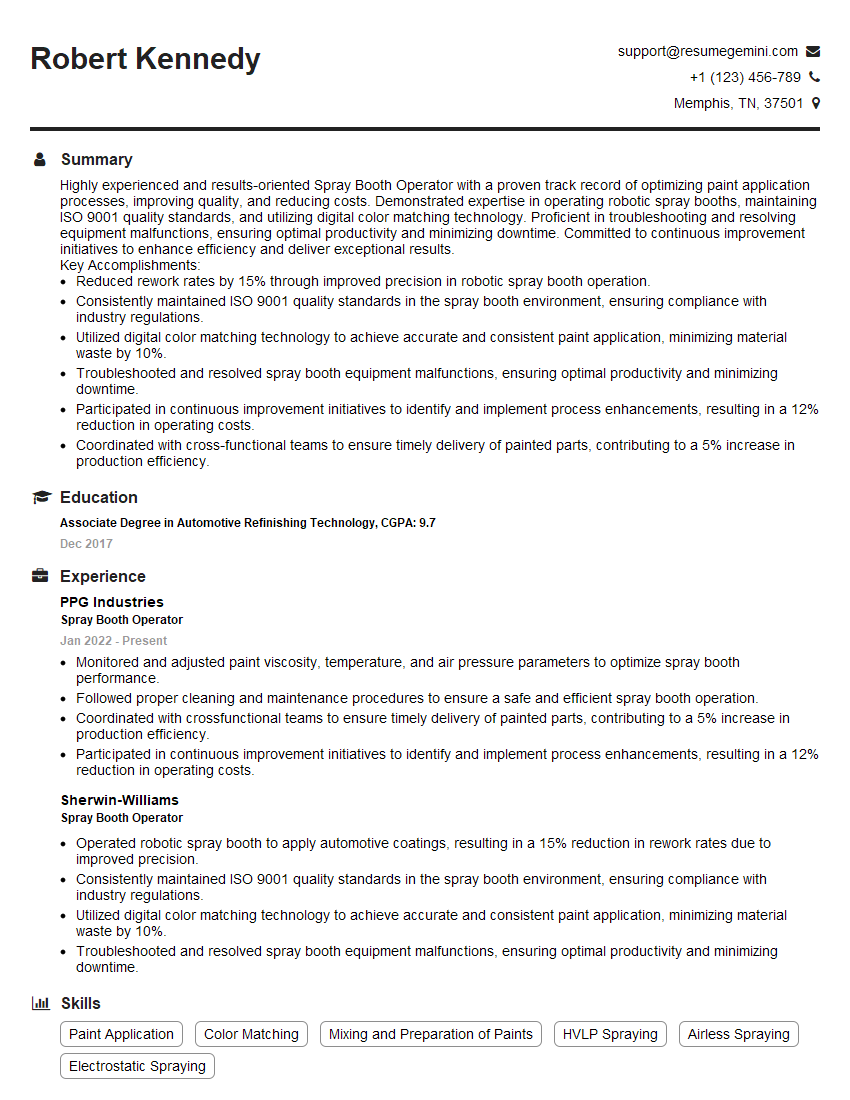
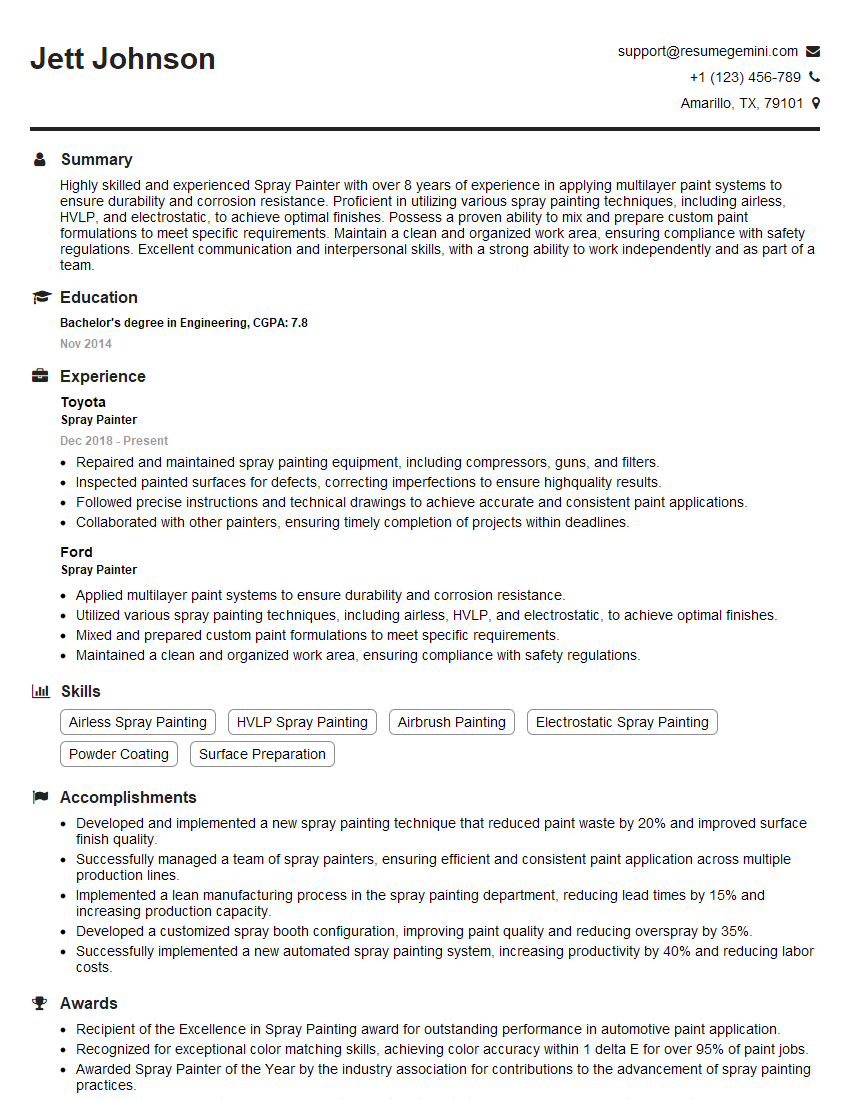
Mastering spray coating techniques opens doors to exciting career opportunities with excellent growth potential. To maximize your chances of success, create a compelling and ATS-friendly resume that showcases your skills and experience effectively. ResumeGemini is a trusted resource to help you build a professional resume that highlights your qualifications in the best possible light. We offer examples of resumes tailored specifically for Spray Coating professionals to give you a head start. Invest time in crafting a strong resume – it’s your first impression with potential employers.

Explore more articles
Users Rating of Our Blogs
Share Your Experience
We value your feedback! Please rate our content and share your thoughts (optional).
What Readers Say About Our Blog
Very informative content, great job.
good