Preparation is the key to success in any interview. In this post, we’ll explore crucial Sprinkler Layout and Design interview questions and equip you with strategies to craft impactful answers. Whether you’re a beginner or a pro, these tips will elevate your preparation.
Questions Asked in Sprinkler Layout and Design Interview
Q 1. Explain the different types of sprinkler heads and their applications.
Sprinkler heads are the nozzles that discharge water when a fire occurs. Different types cater to specific needs and environments.
- Standard Spray Heads: These are the most common type, providing a wide spray pattern suitable for general-purpose fire protection in offices, retail spaces, and residential buildings. Think of them as the ‘all-arounders’ of sprinkler heads.
- Pendant Spray Heads: Hanging from the ceiling, these offer a similar spray pattern to standard spray heads but are ideal for high-ceiling areas where a standard spray head might not provide adequate coverage.
- Upright Spray Heads: Mounted on the ceiling, these project water downwards, making them suitable for areas with obstructions or where a downward spray is preferred.
- Sidewall Heads: These are designed for installation on walls and offer a targeted spray pattern, perfect for protecting specific areas or equipment.
- Concealed Heads: These are aesthetically pleasing and blend seamlessly into the ceiling, offering a discreet fire protection solution for areas where appearance is paramount.
- Early Suppression Fast Response (ESFR) Heads: These are designed for high-challenge occupancies like warehouses storing large quantities of combustible materials. They discharge water more rapidly and effectively than standard heads to control large fires quickly.
The selection of an appropriate sprinkler head depends heavily on the occupancy type, ceiling height, potential fire loads, and aesthetic considerations. For example, an ESFR head would be inappropriate for a small office but crucial in a large warehouse storing pallets of flammable goods.
Q 2. Describe the process of designing a sprinkler system for a high-rise building.
Designing a high-rise sprinkler system is complex and demands meticulous planning. It involves several crucial steps:
- Building Codes and Regulations: Start by fully understanding all applicable fire codes and standards specific to high-rise buildings in your region. These will dictate minimum requirements and design limitations.
- Water Supply Analysis: Assess the building’s existing water supply capacity. This will likely require a dedicated fire pump and substantial water storage tanks to provide sufficient water pressure and flow for the system.
- Hydraulic Calculations: Conduct detailed hydraulic calculations to determine the appropriate pipe sizes, pump pressures, and sprinkler head flow rates. This ensures sufficient water reaches every sprinkler head during a fire.
- System Layout and Zoning: Divide the building into different fire zones, ensuring each zone has its own dedicated sprinkler riser and pump. This limits the impact of a potential failure in one zone.
- Sprinkler Head Selection: Select appropriate sprinkler heads based on ceiling heights, fire loads within each zone, and the risk classification of the specific areas (e.g., residential floors versus storage areas).
- Pipe Material and Installation: Choose durable and corrosion-resistant pipe materials and ensure professional installation practices are followed to prevent leaks and ensure system reliability.
- Testing and Commissioning: A thorough testing and commissioning process is critical. This includes testing the water pressure, flow rate, and ensuring the proper functioning of every sprinkler head. Regular testing and maintenance are equally important.
Designing a high-rise sprinkler system involves collaboration between architects, engineers, and fire protection specialists. It is a multidisciplinary endeavor demanding precision and adherence to stringent safety regulations.
Q 3. How do you calculate water flow and pressure in a sprinkler system?
Calculating water flow and pressure in a sprinkler system is fundamental. This involves using hydraulic calculation software or manual methods based on established formulas and standards.
Factors to Consider:
- Demand: The total water flow required to adequately protect the building (influenced by area, occupancy type, and fire risk).
- Pressure: The pressure required at each sprinkler head to ensure sufficient discharge (affected by elevation, pipe length, and fittings).
- Pipe Friction Loss: The pressure drop in the pipes due to friction (depends on pipe diameter, length, and flow rate).
- Elevation: Higher floors require additional pressure to compensate for gravity.
Methods:
Hydraulic calculation software simplifies these complex calculations, employing algorithms to model water flow and pressure across the entire system. Manual calculations involve applying Hazen-Williams or Darcy-Weisbach equations to determine friction loss. Detailed calculations account for each component, resulting in a detailed pressure and flow map for the entire system.
Example (Simplified): Imagine a simple system. If you need a flow rate of 100 gallons per minute (GPM) at a specific head and the pressure drop in the piping is 10 psi, then the pump needs to supply sufficient pressure (often much more than 10 psi) to overcome this loss and achieve that 100 GPM at the required pressure.
Q 4. What are the key design considerations for sprinkler systems in hazardous locations?
Sprinkler systems in hazardous locations require special design considerations to account for the increased risks associated with flammable or explosive materials. Key considerations include:
- Special Sprinkler Head Types: Using sprinkler heads specifically designed for hazardous locations. These often employ materials resistant to corrosion and have features that prevent igniting flammable vapors.
- Increased Water Flow Rates and Pressures: The system must be capable of delivering higher flow rates and pressures than typical systems to suppress fires more rapidly in the presence of hazardous materials.
- Material Selection: Selecting pipes, fittings, and other components made from materials compatible with the hazardous materials present. Stainless steel and other corrosion-resistant materials are often required.
- System Integrity: Implementing rigorous testing and inspection procedures to ensure the integrity of the system and prevent leaks or malfunctions. These must exceed standard codes in sensitivity and frequency.
- Special Zoning: Dividing hazardous areas into smaller zones to limit the impact of a fire. This can help contain the spread of fire and prevent catastrophic system failure.
- Environmental Considerations: Taking into account potential environmental hazards, such as the generation of toxic fumes during a fire.
NFPA standards provide detailed guidelines for designing sprinkler systems in hazardous locations. Designing such systems requires extensive experience and expertise in hazardous material handling and fire protection.
Q 5. Explain the importance of hydraulic calculations in sprinkler system design.
Hydraulic calculations are crucial in sprinkler system design because they ensure the system’s performance meets the required standards. These calculations are essential for:
- Determining Adequate Water Supply: Ensuring the water supply provides enough pressure and flow to reach every sprinkler head, even under peak demand during a fire.
- Sizing Pipes and Fittings: Accurately sizing pipes and fittings to minimize pressure loss while transporting sufficient water to all sprinkler heads.
- Selecting the Correct Pump: Determining the required pump capacity, pressure, and flow rate to satisfy the system’s demands.
- Ensuring System Reliability: Preventing potential problems such as insufficient water pressure, low flow rates, or pipe breaks, which could compromise the system’s effectiveness.
- Meeting Regulatory Requirements: Demonstrating compliance with fire codes and standards through documented calculations and analyses.
Think of it as planning a complex highway system. You need to ensure that traffic (water flow) can reach its destination (sprinkler heads) efficiently, without major bottlenecks (pressure drop). Neglecting hydraulic calculations can lead to a system that fails when needed most.
Q 6. What are the common fire codes and standards relevant to sprinkler system design?
Several fire codes and standards are relevant to sprinkler system design, varying by location and occupancy type. Key examples include:
- NFPA 13: Standard for the Installation of Sprinkler Systems. This is a comprehensive standard covering virtually every aspect of sprinkler system design, installation, and testing.
- NFPA 13D: Standard for the Installation of Sprinkler Systems in One- and Two-Family Dwellings and Manufactured Homes. This covers residential applications.
- NFPA 13R: Standard for the Installation of Sprinkler Systems in Residential Occupancies up to and Including Four Stories in Height. Covers multi-family residential buildings.
- International Building Code (IBC): This code contains requirements for fire protection systems, including sprinklers, that must be adhered to during the design and construction of buildings.
- Local Codes and Ordinances: Many jurisdictions have their own fire codes that supplement or modify national standards. It is imperative to check local requirements.
Adherence to these codes is not merely a formality. It is essential for ensuring the safety of building occupants and the integrity of the fire protection system. Non-compliance can lead to costly penalties and legal issues.
Q 7. How do you determine the appropriate sprinkler spacing and density?
Sprinkler spacing and density directly impact the system’s effectiveness. Spacing refers to the distance between sprinkler heads, while density refers to the number of heads per square foot. These are determined through:
- Occupancy Type: Different occupancy types (e.g., offices, warehouses, residential) have different fire risks and thus require varying spacing and density.
- Ceiling Height: Higher ceilings typically require closer spacing to ensure complete coverage.
- Fire Load: The amount of combustible materials present in a space influences the required density. High fire loads demand higher sprinkler density.
- Sprinkler Head Type: Different sprinkler heads have different coverage areas, influencing spacing requirements.
- NFPA Standards: NFPA 13 provides detailed tables and guidelines for determining appropriate sprinkler spacing and density based on the above factors.
For example, a warehouse storing large quantities of highly combustible materials would require a higher sprinkler density and closer spacing compared to a standard office building. Using incorrect spacing and density can result in inadequate fire protection and lead to larger fire damage.
Q 8. Describe your experience with different sprinkler system design software.
My experience with sprinkler system design software spans several leading platforms. I’m proficient in using programs like HydraCAD, AutoSPRINK, and SprinkCAD, each offering unique strengths. HydraCAD, for instance, excels in its hydraulic calculation capabilities, crucial for accurate pipe sizing. AutoSPRINK is known for its user-friendly interface and comprehensive library of sprinkler heads. SprinkCAD provides robust 3D modeling features, particularly beneficial for visualizing complex layouts in challenging building designs. My expertise isn’t limited to the software itself; I understand the underlying hydraulic principles and NFPA standards that these programs utilize, allowing me to effectively interpret and validate the results generated.
I’ve also worked extensively with software that integrates with BIM (Building Information Modeling) workflows. This allows for seamless coordination between the sprinkler system design and other building systems, minimizing conflicts and ensuring efficient design collaboration.
Q 9. Explain the process of developing a sprinkler system design drawing.
Developing a sprinkler system design drawing is a systematic process requiring meticulous attention to detail and adherence to relevant codes. It typically begins with a thorough understanding of the building plans, including occupancy type, construction materials, and any unique architectural features. The process can be broken down into the following steps:
- Data Gathering: Obtaining accurate architectural drawings, identifying hazard classifications, and determining water supply characteristics.
- System Layout: Designing the optimal layout of pipes, fittings, and sprinkler heads based on the building’s layout, considering factors such as obstructions and accessibility for maintenance.
- Hydraulic Calculations: Performing detailed hydraulic calculations to ensure adequate water flow and pressure to each sprinkler head, using specialized software and adhering to NFPA standards. This often involves iterative adjustments to optimize pipe sizing and system design.
- Component Selection: Choosing the appropriate sprinkler heads, pipes, fittings, and other components based on the calculated hydraulic requirements and fire protection needs.
- Drawing Creation: Generating detailed design drawings using CAD software, including plan views, elevations, sections, and details, clearly indicating the location and specifications of all components. These drawings often include annotations such as pipe sizes, pressure readings, and flow rates.
- Review and Approval: Submitting the completed drawings for review and approval by the relevant authorities to ensure compliance with all applicable codes and standards.
For example, in a high-rise building, the design would need to incorporate features like riser diagrams and pressure reducing devices to manage the pressure variations at different floor levels. This ensures effective sprinkler performance throughout the structure.
Q 10. How do you ensure the proper sizing of pipes and fittings in a sprinkler system?
Proper pipe and fitting sizing is critical for ensuring the system delivers the required flow and pressure to all sprinkler heads. Undersized pipes lead to insufficient water pressure and flow, compromising the fire suppression capabilities. Conversely, oversizing is wasteful and unnecessarily increases project costs. This is achieved through hydraulic calculations, typically using specialized sprinkler design software.
The process involves using established formulas and methods to calculate the friction losses in the pipes, the pressure drop across fittings, and the required flow rate for each sprinkler head. The software considers factors such as pipe diameter, pipe material, length of pipe runs, number and type of fittings, and the sprinkler head discharge coefficient. These calculations help determine the appropriate pipe diameter at each section of the system. NFPA standards provide guidelines and tables to ensure the calculations and the final pipe sizing conform to accepted best practices.
For example, a longer pipe run will require a larger diameter pipe to compensate for increased friction losses, ensuring sufficient pressure at the most distant sprinkler head. If the calculations indicate inadequate pressure at a given point, adjustments such as increasing the pipe diameter or adding a pressure booster pump might be needed.
Q 11. What are the considerations for designing a sprinkler system in a retrofit application?
Retrofitting a sprinkler system presents unique challenges compared to new construction. The existing building structure and its occupancy needs to be carefully considered. Key considerations include:
- Existing Structure: Assessing the structural capacity of ceilings, floors, and walls to support the new piping and sprinkler heads. This often requires careful planning and coordination to minimize damage to the existing building.
- Accessibility: Determining the ease of access for installation, which may be limited in existing buildings. The routing of pipes and the placement of sprinkler heads need to take into consideration existing fixtures, equipment, and building services.
- Integration with Existing Systems: Ensuring compatibility with existing HVAC systems, electrical systems, and other building services to avoid conflicts and ensure smooth operation.
- Minimal Disruption: Minimizing disruption to building occupants during installation through efficient scheduling and careful coordination of work activities.
- Code Compliance: Meeting all current fire codes and regulations for retrofit applications, which may differ from those for new construction.
For instance, in a retrofit of an older building, we might need to utilize smaller diameter piping or different types of sprinkler heads to accommodate limited space within the existing structure without compromising fire protection efficacy. The entire process requires a detailed assessment and strategic planning to minimize disruption while ensuring code compliance and effective fire protection.
Q 12. How do you incorporate fire pumps into sprinkler system design?
Fire pumps are vital for high-rise buildings and other applications where the municipal water supply may not provide sufficient pressure or flow for the sprinkler system. Incorporating fire pumps into the design involves several key steps:
- Capacity Determination: Calculating the required fire pump capacity to meet the system’s water demand under fire conditions, considering factors like the total sprinkler head flow and the required residual pressure.
- Pump Selection: Selecting a fire pump with appropriate capacity, type (e.g., centrifugal, jockey), and features (e.g., automatic start-up, pressure switches).
- Pump Location: Choosing a suitable location for the fire pump, considering accessibility for maintenance and ease of connection to the water supply and the sprinkler system.
- Piping and Controls: Designing the piping network that connects the fire pump to the sprinkler system, incorporating necessary valves, gauges, and flow meters, as well as the control system that manages the pump’s operation based on pressure and demand.
- Testing and Commissioning: Thoroughly testing and commissioning the fire pump and its associated components to ensure they function correctly and meet the required performance standards.
For instance, in a large-scale commercial building, a multiple-pump configuration might be needed to ensure redundancy and to deliver sufficient water volume. A complex control system would manage these pumps, activating them based on pressure drops and ensuring a reliable water supply under emergency conditions. The system would need detailed approval processes and regular inspections.
Q 13. Explain the concept of water supply and its impact on sprinkler system design.
The water supply is the lifeblood of a sprinkler system. Its characteristics, including pressure and flow rate, directly impact the design. Insufficient water pressure or flow can render the system ineffective, putting lives and property at risk. The design must carefully consider the available water supply, either from a municipal system or an on-site source such as a fire pump, reservoir or water tank.
Several factors need careful consideration:
- Available Pressure: Determining the static pressure (pressure when the system is not flowing) and residual pressure (pressure remaining when the system is in operation) at the point of connection. If the static pressure is too low, a fire pump or pressure booster might be required.
- Available Flow: Determining the available flow rate to ensure the system can deliver the required flow to all sprinkler heads simultaneously. Low flow rate necessitates design changes or an augmented water supply source.
- Water Quality: Considering the water quality to prevent corrosion or scaling in the pipes and sprinkler heads. Water treatment may be necessary in areas with hard water.
- Water Supply Reliability: Assessing the reliability of the water supply, considering factors like potential interruptions or limitations in capacity.
Imagine a scenario with a low water pressure in a small town with an aging municipal system. In this case, the sprinkler system design must account for this limitation, possibly incorporating a larger diameter pipe network or a dedicated fire pump to achieve adequate water pressure and flow at each sprinkler head.
Q 14. How do you address the challenges of designing sprinkler systems in complex geometries?
Designing sprinkler systems in complex geometries, such as irregularly shaped buildings or those with multiple levels and unusual architectural features, presents significant challenges. However, careful planning and the use of advanced design tools can overcome these difficulties.
Strategies for handling such complexity include:
- 3D Modeling: Utilizing 3D modeling software to visualize the system within the building’s complex geometry, allowing for accurate placement of pipes, fittings, and sprinkler heads and avoiding potential conflicts with other building elements.
- Zone Division: Dividing the system into smaller zones, each with its own dedicated piping and control valves. This makes it easier to manage pressure and flow in different parts of the system and to isolate sections during testing or maintenance.
- Detailed Hydraulic Analysis: Conducting detailed hydraulic calculations for each zone, considering the unique flow paths and pressure drops in the complex geometry. This might involve simulations to test the system’s performance under various scenarios.
- Iterative Design: Employing an iterative design process to refine the system layout based on the analysis results, adjusting pipe sizes, locations of fittings, and even choosing the appropriate types of sprinklers to optimize performance within the constraints of the building’s geometry.
- Specialized Fittings and Components: Utilizing specialized fittings and components, such as bends with low pressure loss, to navigate complex spaces and minimize friction losses.
For instance, in a building with a curved atrium, a 3D model would be crucial for visualizing the pipe routing and ensuring adequate coverage of the space. The iterative process would involve fine-tuning the layout to optimize pressure and flow to all sprinkler heads in this challenging environment.
Q 15. What are the different types of fire sprinkler system layouts?
Fire sprinkler system layouts are categorized to optimize water distribution and coverage across a building. The most common types include:
- Grid System: This is the most prevalent layout, featuring a regular grid pattern of pipes with sprinklers spaced evenly. It’s simple to design and install, ensuring even coverage. Think of it like a checkerboard—simple and efficient.
- Branch Line System: This system uses a main pipe with smaller branch lines extending to different areas. It’s suitable for buildings with irregular shapes or varying occupancy densities. Imagine a tree—a main trunk with many branches reaching out to different areas.
- Loop System: In this setup, pipes form a continuous loop, providing redundancy. If one section fails, the remaining loop still provides protection. It’s like having a backup system ensuring no dead zones.
- Combination System: This is a blend of different layouts tailored to a building’s specific needs and layout. Often employed for large or complex buildings with various sections requiring different approaches.
The choice of layout depends significantly on the building’s geometry, occupancy type, and fire hazards present. A proper hydraulic calculation is crucial for any chosen system to ensure adequate water supply to all sprinklers.
Career Expert Tips:
- Ace those interviews! Prepare effectively by reviewing the Top 50 Most Common Interview Questions on ResumeGemini.
- Navigate your job search with confidence! Explore a wide range of Career Tips on ResumeGemini. Learn about common challenges and recommendations to overcome them.
- Craft the perfect resume! Master the Art of Resume Writing with ResumeGemini’s guide. Showcase your unique qualifications and achievements effectively.
- Don’t miss out on holiday savings! Build your dream resume with ResumeGemini’s ATS optimized templates.
Q 16. Explain your experience with hydraulic analysis software.
I have extensive experience using several hydraulic analysis software packages, including HydraCAD, SprinkCAD, and PIPE-FLO. These programs are essential for designing efficient and safe sprinkler systems. They allow me to model the system, simulate water flow, and ensure adequate pressure and flow rates at each sprinkler head.
For example, in a recent project involving a high-rise office building, I used HydraCAD to model the system, inputting parameters like pipe diameter, sprinkler spacing, and water supply pressure. The software then performed a hydraulic calculation, providing crucial data on pressure drop across the system and ensuring adequate flow at each sprinkler. If the results didn’t meet NFPA 13 standards, I would adjust system parameters until the design was optimized.
My proficiency extends to interpreting the software’s output and using it to make informed design decisions, such as selecting appropriate pipe sizes and pump configurations. I’m also experienced in troubleshooting any discrepancies and optimizing designs for efficiency and cost-effectiveness.
Q 17. What are some common design errors to avoid in sprinkler system design?
Several common design errors can compromise a sprinkler system’s effectiveness. Some critical ones to avoid include:
- Inadequate water supply: Insufficient water pressure or flow rate can drastically reduce the system’s effectiveness, leading to inadequate fire suppression. This needs meticulous hydraulic calculations to ensure sufficient water supply.
- Incorrect sprinkler spacing: Improper spacing can leave areas uncovered or with inadequate protection. NFPA 13 provides detailed guidance on sprinkler spacing based on occupancy and hazard classification.
- Obstructed sprinklers: Storage, furniture, or other obstacles blocking sprinklers render them useless. Proper clearance is vital to ensure unobstructed spray patterns.
- Ignoring pipe friction losses: Neglecting friction losses in pipe calculations can lead to insufficient pressure at the furthest sprinkler heads. Accurate calculation of these losses is critical.
- Incorrect pressure reducing valve sizing or placement: Improper sizing or placement leads to uneven pressure distribution and reduced effectiveness.
Avoiding these errors requires careful planning, precise calculations, and adherence to NFPA 13 standards. A thorough review of the design is critical before implementation.
Q 18. How do you incorporate accessibility requirements into your designs?
Incorporating accessibility requirements is paramount for inclusive design. For sprinkler systems, this focuses primarily on ensuring accessibility for individuals with disabilities during emergencies. Key considerations include:
- Sprinkler head location: Avoid placing sprinkler heads where they could pose a hazard to people using mobility devices. Careful consideration of head placement relative to pathways and furniture is essential.
- Alarm system accessibility: Ensure the fire alarm system is audible and visible to individuals with hearing or visual impairments. This includes sufficient strobe lights and visual alarms alongside audible alarms.
- Evacuation routes: Design the sprinkler system to avoid interfering with designated evacuation routes for individuals with mobility issues. Clear and unobstructed paths are crucial.
- Compliance with ADA standards: Design must comply with the Americans with Disabilities Act (ADA) guidelines and local building codes regarding accessibility for people with disabilities.
For example, in a recent hospital project, we ensured all sprinkler heads were placed at appropriate heights avoiding obstruction of pathways crucial for wheelchair access. We also incorporated visual and audible fire alarms adhering strictly to ADA standards.
Q 19. Explain your experience with different types of piping materials used in sprinkler systems.
I have extensive experience with various piping materials used in fire sprinkler systems. The choice of material depends on factors like cost, corrosion resistance, and the system’s pressure and temperature requirements. Common materials include:
- Black iron pipe (BIP): A durable and cost-effective option for lower-pressure systems. However, it is susceptible to corrosion, limiting its lifespan and requiring more frequent maintenance.
- Galvanized steel pipe (GSP): Offers better corrosion resistance than BIP, making it suitable for a wider range of applications. However, it is still prone to corrosion over time, especially in areas with high humidity.
- Copper pipe: Excellent corrosion resistance and durability, making it ideal for long-term use. It is more expensive than steel but its longevity often compensates for the higher initial cost.
- CPVC (Chlorinated Polyvinyl Chloride): A lightweight, corrosion-resistant plastic pipe, widely used for its ease of installation and non-corrosive nature. Its suitability depends on the system’s operating temperature and pressure limits.
Material selection involves careful consideration of local codes, budget constraints, and the system’s long-term maintenance requirements. For example, in corrosive environments, copper or CPVC might be preferred over steel.
Q 20. What is your experience with pressure-reducing valves and their application?
Pressure-reducing valves (PRVs) are crucial in sprinkler systems for regulating water pressure. They are necessary when the water supply pressure exceeds the design pressure of the system. PRVs prevent excessive pressure, protecting pipes and sprinkler heads from damage. They also maintain a consistent pressure across the system, even with fluctuating water supply.
My experience includes selecting the appropriate PRV based on the system’s flow rate, pressure requirements, and water hammer mitigation. I understand the different types of PRVs, including swing-check valves and altitude valves. Proper sizing and placement are crucial to avoid pressure surges and ensure consistent pressure throughout the system. Incorrectly sized or positioned PRVs can lead to uneven pressure, reduced sprinkler effectiveness, and even pipe failures.
In one project, a high-rise building with a significant pressure differential between the water supply and the required sprinkler system pressure, required multiple strategically located PRVs to maintain the design pressure across all branches and floors. The correct selection and placement ensured optimal system performance and safety.
Q 21. Describe your familiarity with NFPA 13.
NFPA 13, Standard for the Installation of Sprinkler Systems, is the cornerstone of sprinkler system design and installation in the United States. I am extremely familiar with its requirements and regularly utilize it in my projects. My knowledge encompasses all aspects of the standard, from hazard classifications and water supply calculations to piping design and testing procedures.
I understand the different sprinkler types, their application in various occupancies, and the specific requirements for different hazard classifications. I routinely use NFPA 13 to determine appropriate sprinkler spacing, pipe sizing, and pressure requirements. Moreover, I am proficient in interpreting its requirements for system testing and inspection, ensuring compliance throughout the project lifecycle.
My understanding goes beyond just following the code; I can also explain the rationale behind the requirements and address any ambiguities or exceptions. This allows me to make informed decisions and implement design solutions that are both compliant and effective.
Q 22. How do you conduct a site survey for sprinkler system design?
A thorough site survey is the cornerstone of any successful sprinkler system design. It’s not just about walking the property; it’s a systematic process of data collection to ensure the system meets all needs and regulations.
Property Assessment: This involves measuring the area to be covered, identifying building locations, obstacles (trees, structures, etc.), and noting the slope of the land. Accurate measurements are crucial for calculating water flow and pressure requirements.
Water Source Evaluation: We assess the existing water supply – its pressure, capacity, and location. This helps determine the pump size and the placement of the system’s main components (e.g., backflow preventer). For example, a low water pressure might necessitate a booster pump.
Hydraulic Analysis (Preliminary): A preliminary assessment of water flow and pressure is performed based on initial data. This allows us to make initial decisions about pipe sizing and sprinkler head selection. We would use specialized software for detailed calculations later.
Fire Protection Requirements (if applicable): If the system includes fire protection, we would check local fire codes and regulations to ensure compliance. Fire protection systems often have stricter requirements than landscaping systems.
Client Consultation: We discuss the client’s needs and preferences regarding water usage, aesthetic considerations, and desired coverage. This helps tailor the system to the specific site and its intended use.
Think of it like creating a blueprint before building a house—you need the precise measurements and understanding of the land to design a system that functions effectively and efficiently.
Q 23. Explain your process for coordinating with other trades during construction.
Coordinating with other trades is crucial for a smooth construction process. Effective communication and proactive planning are key. My process usually involves:
Pre-Construction Meetings: I participate in regular meetings with the general contractor and other trade representatives (electricians, plumbers, landscapers) to discuss the project timeline, potential conflicts, and coordination strategies. This allows us to identify and resolve potential issues early on, avoiding costly delays.
Detailed Drawings and Specifications: Clear, detailed drawings are provided that clearly show the location of all sprinkler components, piping, and wiring. This reduces the risk of conflicts and ensures everyone understands the project’s scope.
Mark-up and Coordination: I visit the site regularly to review progress and address any unexpected issues. This on-site coordination allows for prompt adjustments to the plans if necessary.
Open Communication: Maintaining open communication channels with other trades through regular meetings, emails, and on-site discussions is critical for a successful project. For example, if the electricians are working near a pipe trench, we coordinate to ensure no damage occurs.
An example of a successful coordination strategy is using a shared online platform for updating designs, specifications and scheduling. This ensures everyone is on the same page and has access to the latest information.
Q 24. How do you incorporate sustainability considerations into sprinkler system design?
Sustainability is increasingly important in sprinkler system design. We aim to minimize water consumption and environmental impact using several strategies:
Water-Efficient Sprinkler Heads: We specify low-flow, high-efficiency sprinkler heads that deliver the required coverage with less water. Rotational heads with adjustable arcs and nozzles are a great example.
Smart Irrigation Controllers: Weather-based controllers adjust watering schedules based on local weather data, preventing overwatering during rain. These controllers can significantly reduce water usage.
Soil Moisture Sensors: These sensors measure soil moisture levels and only activate irrigation when needed, avoiding unnecessary watering.
Rain Sensors: These prevent irrigation during rainfall, saving water and energy.
Drip Irrigation in Sensitive Areas: Drip irrigation is used in areas where water conservation is particularly important, such as around trees and shrubs.
Proper Zone Design: Dividing the landscape into separate zones allows for targeted watering based on the specific needs of each area. This optimizes water use and ensures no areas are over or under-watered.
By implementing these strategies, we can design systems that are both effective and environmentally responsible, reducing the overall water footprint of the project.
Q 25. What is your experience with backflow prevention devices?
Backflow prevention devices are essential to protect the potable water supply from contamination. My experience includes selecting, installing, and inspecting various types, including:
Double Check Valve Assemblies: These are commonly used for low-pressure applications and consist of two independently functioning check valves.
Reduced Pressure Zone (RPZ) Backflow Preventers: These are used for higher-pressure applications and offer a higher level of protection. They have a pressure-reducing mechanism and two check valves.
Pressure Vacuum Breaker (PVB): These are simpler devices suitable for low-pressure systems and prevent back siphonage.
I am familiar with all relevant codes and regulations regarding backflow prevention and ensure all devices are properly tested and maintained according to local authority requirements. Regular testing is crucial to ensure their continued effectiveness.
For example, I’ve overseen the installation of an RPZ backflow preventer for a large commercial project to ensure the highest level of protection for the building’s water system.
Q 26. Explain your experience with different types of sprinkler system activation methods.
Sprinkler systems can be activated in various ways, and my experience encompasses several methods:
Manual Activation: This involves manually turning on the system through a control valve. Simple and cost-effective, but lacks flexibility.
Automatic Activation (Timer-Based): A timer-based system automatically turns on and off according to a pre-programmed schedule. While convenient, it doesn’t consider weather conditions.
Weather-Based Controllers: These automatically adjust the watering schedule based on local weather data, such as rainfall and temperature. This is more water-efficient.
Smart Irrigation Controllers: These offer advanced features such as soil moisture sensing, remote control, and integration with weather apps for highly optimized watering schedules. This allows for customized watering schemes based on specific zones and their needs.
Fire Sprinkler Systems (Hydraulically-activated): These systems are activated by heat sensors or other fire detection devices. These require specialized design and testing to meet strict fire codes.
I have experience designing and implementing all of these methods, and I carefully select the most appropriate activation method based on project requirements, budget, and client preferences.
Q 27. How do you manage design changes and revisions during a project?
Design changes are inevitable in construction projects. My process for managing them involves:
Documentation: Any change request is documented formally, including the reason for the change, its impact on the project timeline and budget, and the proposed solution.
Client Approval: All changes are discussed with the client and require their formal approval before implementation. This ensures transparency and avoids misunderstandings.
Updated Drawings and Specifications: The drawings and specifications are updated to reflect the approved changes, and these updates are communicated to all stakeholders.
Cost and Schedule Impacts: A thorough assessment of the cost and schedule impacts of each change is performed and documented. This ensures the project remains within budget and on schedule, as far as possible.
Version Control: We use version control to track all changes, ensuring we always have access to the most up-to-date plans.
For example, if a tree needs to be relocated, a revised plan will be drawn up, reviewed, and approved, with all costs associated with the change detailed clearly. This approach guarantees a smooth and transparent process.
Q 28. What are the steps involved in obtaining necessary approvals and permits?
Obtaining necessary approvals and permits varies depending on location, but generally involves these steps:
Prepare Submittal Documents: This includes detailed plans, specifications, calculations, and other relevant documents. The level of detail is dictated by the authority having jurisdiction (AHJ).
Submittal to Authorities: The documents are submitted to the appropriate authorities, usually the local building department or fire department (for fire protection systems).
Review and Approval: The authorities review the submittal for compliance with codes and regulations. This may involve inspections or additional clarifications.
Permit Issuance: Once the review is complete and all requirements are met, the necessary permits are issued.
Inspections: During construction, inspections are conducted at various stages to ensure the system is installed correctly and meets code requirements. This includes inspections for the backflow preventer and other crucial components.
Final Inspection and Approval: A final inspection is performed upon completion of the project, and once passed, final approval is given.
I have extensive experience navigating the permitting process in various jurisdictions and ensure all regulations are met to ensure a smooth and efficient project completion.
Key Topics to Learn for Sprinkler Layout and Design Interview
- Hydraulic Calculations: Understanding friction loss, pressure drop, and flow rate calculations is fundamental. Practice solving various scenarios involving different pipe sizes and sprinkler types.
- Sprinkler Selection: Learn the characteristics of various sprinkler types (e.g., upright, pendant, sidewall) and their applications in different environments (e.g., residential, commercial, industrial). Be prepared to justify your sprinkler choices based on coverage and hydraulic performance.
- System Design Principles: Master the principles of designing efficient and compliant sprinkler systems, including understanding design criteria, NFPA standards, and local codes. Consider the impact of different pipe materials and fittings.
- CAD Software Proficiency: Demonstrate your skills in using relevant CAD software (e.g., AutoCAD) for creating accurate sprinkler system layouts and generating detailed drawings. Be ready to discuss your experience with different design tools and techniques.
- Water Supply Analysis: Understand how to assess the adequacy of the water supply for the sprinkler system, including evaluating pump capacity, tank storage, and available water pressure.
- NFPA Codes and Standards: Demonstrate a thorough understanding of relevant NFPA codes and standards related to fire sprinkler system design, installation, and testing. Be prepared to discuss specific code requirements and their practical implications.
- Problem-Solving and Troubleshooting: Be ready to discuss your approach to identifying and resolving design challenges, such as addressing difficult site conditions or integrating the sprinkler system with other building systems.
Next Steps
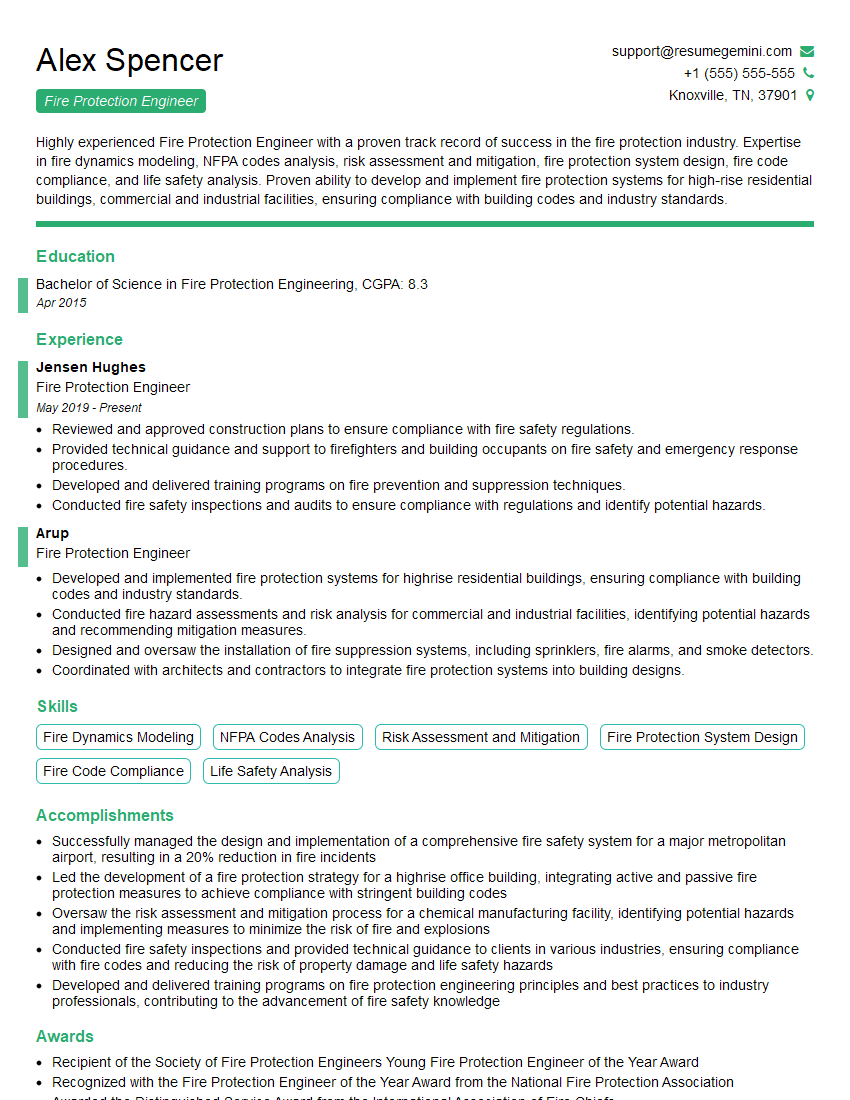
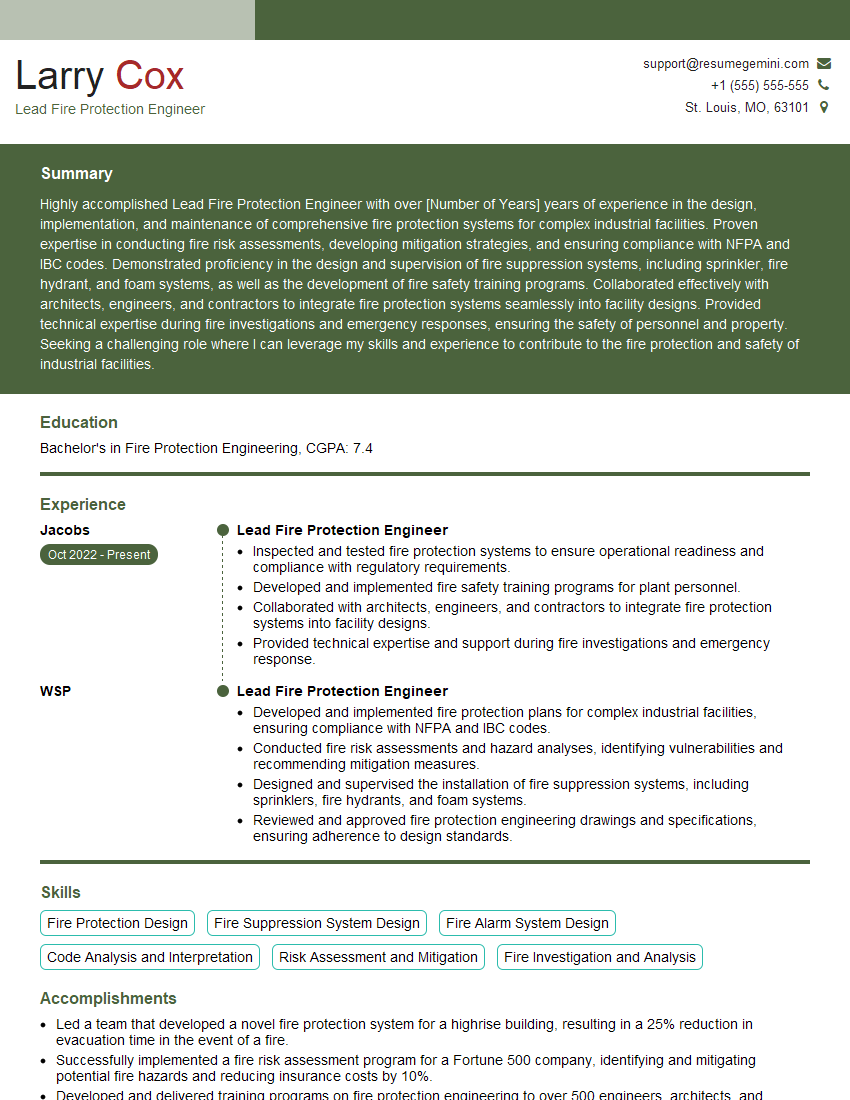
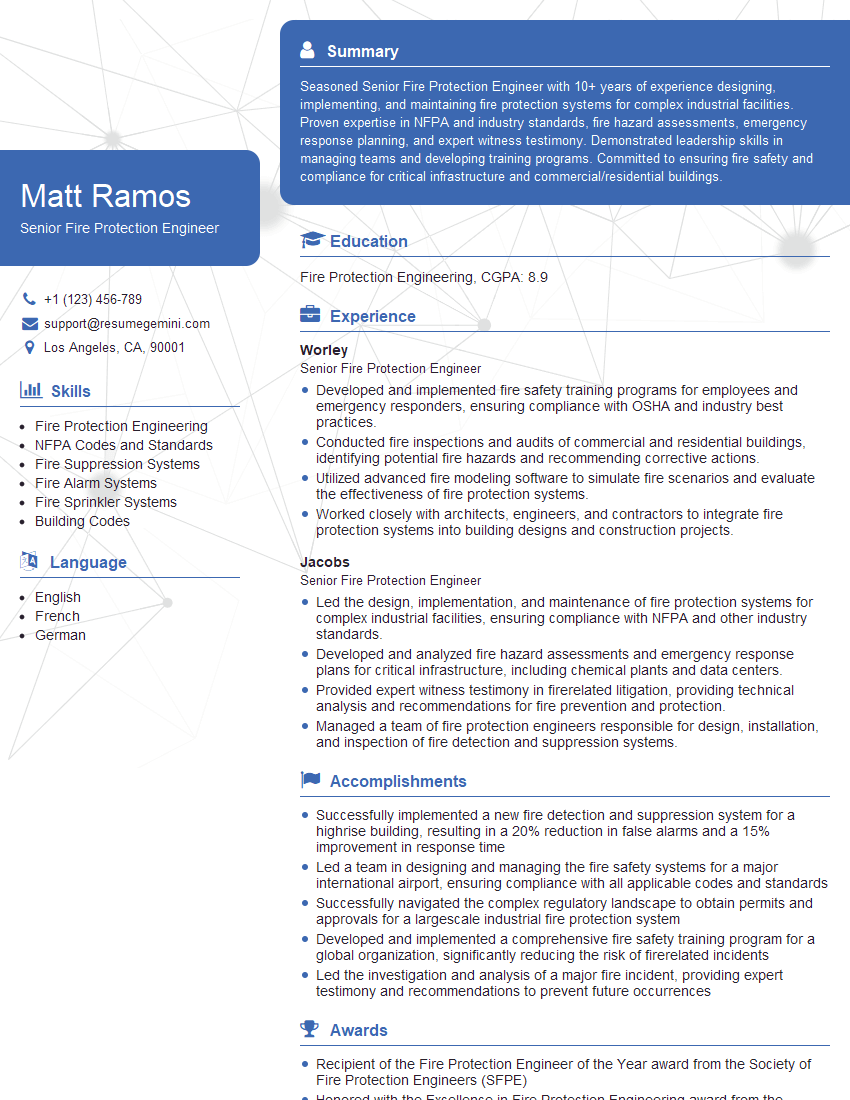
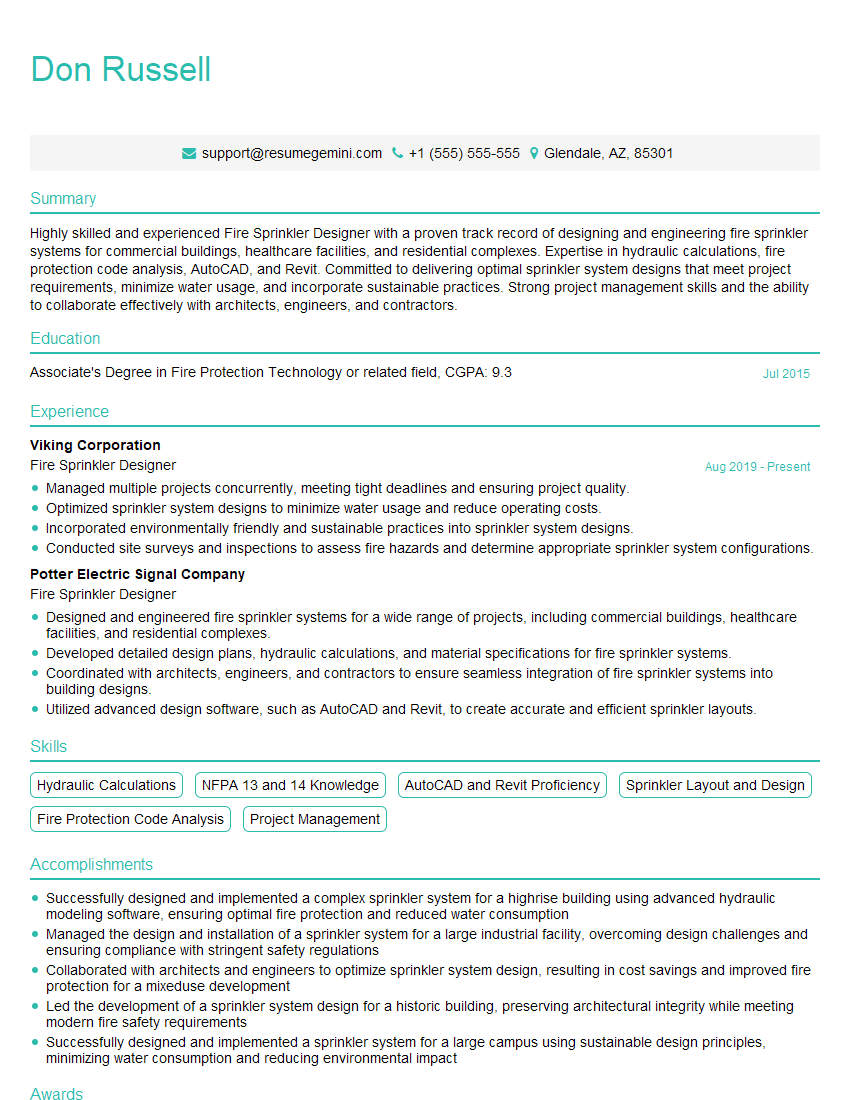
Mastering Sprinkler Layout and Design opens doors to exciting career opportunities and positions you for leadership roles within the fire protection industry. A strong understanding of these concepts is crucial for success in this competitive field. To maximize your chances of landing your dream job, focus on creating an ATS-friendly resume that highlights your skills and experience effectively. We recommend using ResumeGemini, a trusted resource for building professional resumes that stand out. ResumeGemini provides examples of resumes tailored to Sprinkler Layout and Design to help you create a compelling application. Take the next step towards your career goals – build your best resume yet!
Explore more articles
Users Rating of Our Blogs
Share Your Experience
We value your feedback! Please rate our content and share your thoughts (optional).
What Readers Say About Our Blog
Very informative content, great job.
good