Feeling uncertain about what to expect in your upcoming interview? We’ve got you covered! This blog highlights the most important Stability and Trim Analysis interview questions and provides actionable advice to help you stand out as the ideal candidate. Let’s pave the way for your success.
Questions Asked in Stability and Trim Analysis Interview
Q 1. Explain the principles of hydrostatic equilibrium.
Hydrostatic equilibrium describes the state where a floating body is at rest, experiencing no net force acting upon it. Imagine a perfectly balanced scale – the upward buoyant force exactly counteracts the downward weight of the vessel. This balance is crucial for a ship’s stability. The buoyant force, equal to the weight of the water displaced by the hull, acts vertically upwards through the center of buoyancy (B). The ship’s weight acts vertically downwards through the center of gravity (G). In hydrostatic equilibrium, these two forces are equal in magnitude and opposite in direction, resulting in a stable, floating position.
For example, a simple wooden block floating in water achieves hydrostatic equilibrium when the weight of the block is matched by the buoyant force from the water it displaces. The block will settle to a depth where these forces are balanced.
Q 2. Define metacentric height (GM) and explain its significance.
Metacentric height (GM) is the distance between the center of gravity (G) and the metacenter (M). The metacenter is the point of intersection between the vertical line passing through the center of buoyancy (B) and the new vertical line passing through the shifted center of buoyancy (B’) when the vessel is subjected to a small angle of heel (tilt). GM is a critical indicator of a ship’s initial static stability. A larger GM indicates greater initial stability – the vessel will right itself more quickly and strongly after a small disturbance.
Think of it like a pendulum: a longer pendulum (larger GM) will swing back to its upright position more readily than a shorter one (smaller GM). A negative GM indicates an unstable condition where the vessel will not self-right after a small disturbance.
Q 3. Describe the different methods for determining GM.
Several methods exist for determining GM, often combining theoretical calculations with practical measurements:
- Inclining Experiment: This involves intentionally heeling the ship by shifting a known weight across the deck. By measuring the resulting angle of heel and knowing the weight shift, GM can be calculated. This is a common method for newly built vessels.
- Calculations from Ship’s Drawings: Using detailed ship plans, the positions of G and B can be calculated, and thus GM can be determined. This method relies on the accuracy of the plans and assumes accurate weight distribution estimations.
- Using Deadweight Scale: Measuring the displacement of the vessel using load cells in the dry dock can give the position of B. This is done in combination with the estimation of G.
- Dynamic Methods: These methods rely on observing the vessel’s response to small disturbances, like waves, and inferring GM from the motion characteristics.
The choice of method depends on the resources available, the stage of the ship’s life cycle, and the desired level of accuracy.
Q 4. How does freeboard affect the stability of a vessel?
Freeboard is the vertical distance between the waterline and the deck. A higher freeboard provides increased safety and improves stability by increasing the reserve buoyancy. Greater reserve buoyancy implies that the ship can withstand more water entering the deck before losing stability. However, a very high freeboard may be undesirable as it can create extra wind resistance and increase the vessel’s overall height, possibly increasing the likelihood of rolling.
Imagine a bathtub toy: a toy with a high ‘freeboard’ (the part above the water) is more stable than a low-freeboard toy because more water needs to be added to submerge it completely.
Q 5. Explain the impact of loading conditions on ship stability.
Loading conditions significantly impact ship stability. The position and quantity of cargo influence the center of gravity (G). Heavily loaded vessels may have a lower G if the cargo is low in the vessel, resulting in increased stability (larger GM). Conversely, uneven or high loading may elevate G, reducing GM and thus the stability of the vessel. The type of cargo also matters – dense cargo lowers G, while lighter cargo raises it.
For example, a container ship loaded with heavy containers low in the hull will be more stable than the same ship carrying the same weight of less-dense cargo placed higher up.
Q 6. What are the effects of shifting weights on trim and stability?
Shifting weights affects both trim and stability. A weight shift longitudinally (fore-to-aft) will alter the trim – the difference in draft between the fore and aft ends. A weight shift transversely (side-to-side) will change the heel (list). Both types of shifts alter the position of the center of gravity (G), potentially impacting the metacentric height (GM) and therefore the stability of the vessel. If G moves upwards, GM reduces and vice versa.
Think of stacking books: shifting one book from the center to one end alters both the overall balance (trim) and the risk of toppling (stability). A large weight shift can have a significant effect on GM and should always be taken into consideration, especially if the vessel is already close to its stability limit.
Q 7. How do you calculate the righting lever (GZ)?
The righting lever (GZ) is the horizontal distance between the center of gravity (G) and the vertical line passing through the center of buoyancy (B), when the vessel is heeled. It represents the restoring moment acting to right the vessel. GZ is calculated using the following basic relationship, and it is a function of the heel angle:
GZ = MG * sin(θ) - BG * sin(θ) where θ is the angle of heel. MG is the distance between the metacenter (M) and the center of gravity (G), and BG is the distance between the center of buoyancy (B) and the center of gravity (G).
Determining the precise value of GZ often requires more complex calculations and usually uses the cross-curves of stability or numerical methods. The righting lever (GZ) represents the restoring moment of the vessel.
Q 8. What is the angle of loll, and how is it corrected?
The angle of loll is a phenomenon where a ship rests at a significant angle to the vertical even in calm seas and without any external forces acting upon it. Imagine a partially filled glass of water tilted – that’s similar to a ship experiencing an angle of loll. It’s essentially an unstable equilibrium condition. This occurs due to an asymmetrical distribution of weight within the vessel, possibly caused by liquid cargo shifting or damage.
Correcting the angle of loll involves redistributing the weight onboard to restore symmetry. This could include shifting cargo, adding ballast water to the opposite side, or pumping out water from a flooded compartment. In some severe cases, external assistance might be needed. The goal is to bring the ship’s center of gravity (CG) back to a position where it’s vertically aligned with the center of buoyancy (CB) in the upright condition, thus eliminating the heeling moment causing the loll. A thorough stability assessment, involving calculations and possibly physical measurements, is crucial to determine the most effective method for correction.
Q 9. Describe the process of performing a stability assessment.
A stability assessment is a systematic process to evaluate a ship’s ability to return to its upright position after being heeled (tilted). It involves several steps:
- Data Collection: This includes gathering information about the vessel’s dimensions, weight distribution (including cargo, fuel, and ballast), and the location of the center of gravity (CG).
- Calculations: Using established formulas and software, various stability parameters are calculated. These include the metacentric height (GM), the righting lever arm (GZ), and the righting moment.
- Curve Generation: A stability curve, which plots the righting moment against the angle of heel, is generated. This curve is essential for assessing the ship’s stability characteristics.
- Criteria Evaluation: The calculated parameters are compared against the relevant international stability criteria (e.g., IMO standards) to determine if the ship meets the minimum stability requirements.
- Interpretation and Reporting: Finally, the results are interpreted, and a report is generated summarizing the ship’s stability condition, highlighting any deficiencies, and recommending corrective actions if necessary.
For instance, a low metacentric height might indicate reduced initial stability, while a lack of sufficient righting moment at larger angles could suggest an increased risk of capsizing.
Q 10. Explain the importance of intact stability criteria.
Intact stability criteria are essential regulations and guidelines ensuring a vessel’s stability in its undamaged condition. These criteria define minimum acceptable stability standards that must be met to guarantee a safe voyage. They aim to prevent capsizing by ensuring the ship possesses sufficient righting moments across a range of loading conditions and sea states. These criteria are often expressed in terms of minimum values for the metacentric height (GM), areas under the righting lever curve, and other related parameters.
For example, inadequate intact stability could lead to a situation where even a relatively small external force (like a strong gust of wind) can cause a large heel, potentially leading to capsizing. By enforcing stringent intact stability criteria, we significantly reduce the risk of such incidents, protecting lives, cargo, and the marine environment.
Q 11. What are the regulations and standards related to ship stability?
Ship stability regulations and standards are primarily set by the International Maritime Organization (IMO) and implemented by national maritime administrations. Key instruments include the International Convention for the Safety of Life at Sea (SOLAS) and its associated codes, including the International Code for Intact Stability (IS Code). These regulations dictate detailed requirements for stability calculations, documentation, and onboard procedures.
Specific standards vary depending on the ship type, size, and operational profile. They commonly cover aspects like: minimum GM values, required stability information to be carried onboard, procedures for loading and ballasting, and requirements for stability assessments and surveys. Failure to comply with these regulations can result in serious consequences, including detention of the vessel, fines, and potential legal action.
Q 12. How do you interpret a stability curve?
A stability curve is a graphical representation of a ship’s righting moment (the restoring force that tries to return the ship to its upright position) versus the angle of heel (the angle of tilt). The curve provides a comprehensive overview of the ship’s stability characteristics across a range of angles.
Interpreting a stability curve involves analyzing several key features:
- Initial Stability: The slope of the curve near zero degrees indicates the initial stability; a steeper slope means greater initial stability.
- Range of Positive Stability: The angle up to which the curve remains above the horizontal axis indicates the range of positive stability. Beyond this angle, the ship will capsize.
- Maximum Righting Moment: The peak of the curve represents the maximum righting moment, representing the ship’s strongest resistance to capsizing.
- Area Under the Curve: The area under the curve provides a measure of overall stability. A larger area indicates greater stability.
By examining these aspects, experts can determine a ship’s stability characteristics and identify potential weaknesses. For instance, a curve with a small range of positive stability suggests a high risk of capsizing.
Q 13. Discuss the various types of stability calculations.
Several methods exist for performing stability calculations, each with its own level of complexity and application:
- Simplified Methods: These utilize simplified formulas and are suitable for preliminary assessments or quick checks. They often involve approximations and may not be as accurate as more advanced methods.
- Graphical Methods: These use graphical tools and curves, like the stability curve, to visualize and analyze stability characteristics. They are helpful for understanding the overall stability behavior but may not be suitable for complex situations.
- Computer-Based Methods: These employ specialized software packages employing sophisticated algorithms to perform more complex calculations. They offer high accuracy and are essential for handling intricate loading scenarios and irregular ship shapes. These programs often incorporate hydrostatic and hydrodynamic principles.
- Direct Stability Calculations: These methods involve calculating the positions of the center of gravity (CG) and center of buoyancy (CB) at different heel angles and determining the associated righting lever arms. This approach is generally employed in conjunction with software to manage the computational complexity.
The choice of method depends on factors such as the complexity of the ship’s geometry, loading conditions, and the desired level of accuracy.
Q 14. Explain the concept of cross-flooding and its impact on stability.
Cross-flooding refers to a situation where water enters multiple compartments of a ship simultaneously, typically due to collision or grounding. This is a significant threat to stability because it can lead to a rapid and drastic shift in the ship’s weight distribution. Imagine a ship with several watertight compartments. If one compartment floods, the ship’s CG moves, but the overall effect on stability might be manageable. However, if multiple compartments flood, the change in CG can be catastrophic and significantly reduce the ship’s righting moments, drastically increasing the risk of capsizing.
The impact on stability depends on several factors, including the size and location of the flooded compartments, the quantity of water entering each compartment, and the overall ship design. The consequences of cross-flooding can be severe, often resulting in rapid loss of stability and capsizing, particularly if the flooding occurs in compartments on opposite sides of the ship.
Q 15. How does damage stability affect ship design?
Damage stability is a crucial aspect of ship design, focusing on ensuring the vessel remains afloat and stable even after suffering damage, such as flooding or hull breaches. It’s not just about preventing sinking; it’s also about maintaining sufficient stability to allow for rescue operations and damage control. Regulations like SOLAS (Safety of Life at Sea) dictate stringent requirements for damage stability calculations. These calculations consider various scenarios, including flooding of specific compartments and the resulting shift in the ship’s center of gravity. Designers use advanced software to model different damage scenarios and ensure the vessel meets the required stability criteria even in compromised conditions. For example, the location of watertight bulkheads and the design of double-bottom structures are critical to damage stability. A poorly designed vessel might capsize or list dangerously after relatively minor damage, while a well-designed vessel will remain afloat and manageable even with significant flooding.
Imagine a cargo ship hit by a rogue wave, resulting in a breach in the hull of one of its cargo holds. A properly designed vessel, with appropriate damage stability measures, will retain sufficient buoyancy and stability to allow the crew to control the flooding and reach safety. Conversely, a vessel lacking in damage stability design might quickly capsize, leading to significant loss of life and cargo.
Career Expert Tips:
- Ace those interviews! Prepare effectively by reviewing the Top 50 Most Common Interview Questions on ResumeGemini.
- Navigate your job search with confidence! Explore a wide range of Career Tips on ResumeGemini. Learn about common challenges and recommendations to overcome them.
- Craft the perfect resume! Master the Art of Resume Writing with ResumeGemini’s guide. Showcase your unique qualifications and achievements effectively.
- Don’t miss out on holiday savings! Build your dream resume with ResumeGemini’s ATS optimized templates.
Q 16. What is the difference between initial and residual stability?
Initial stability refers to the ship’s stability in its initial upright condition, before any heeling (tilting) has occurred. It’s essentially a measure of how much resistance the vessel offers to an initial disturbing force, like a gust of wind or a shifting cargo. This is primarily determined by the ship’s metacentric height (GM), a critical parameter representing the vertical distance between the center of gravity (G) and the metacenter (M). A larger GM indicates greater initial stability. Residual stability, on the other hand, describes the ship’s stability after it has already heeled to a certain angle. It’s a measure of the vessel’s ability to right itself after being inclined. This is expressed through the righting lever (GZ) or the righting moment curve.
Think of a pendulum. Initial stability is like how quickly it swings back to its center position after a small push. Residual stability is how the pendulum continues to swing back towards the center even after a larger push, indicating its ability to return to its upright state despite the larger initial displacement.
Q 17. Describe the use of stability software and tools.
Stability software and tools are essential for modern ship design and operation. These sophisticated programs perform complex calculations, allowing naval architects and marine engineers to assess a vessel’s stability characteristics under various conditions. Such tools can simulate different loading scenarios, damage cases, and environmental factors. They generate graphical representations of the righting arm curve, providing insights into the vessel’s initial and residual stability. Some advanced programs even incorporate hydrodynamic effects and allow for detailed analysis of wave-induced motions.
These tools significantly reduce reliance on manual calculations, which can be time-consuming and prone to errors. They facilitate rapid iteration during the design process, allowing for optimization of the vessel’s stability characteristics within given constraints. Examples include commercially available software such as Maxsurf, SESAM, and ShipX.
Q 18. How do environmental factors (waves, wind) affect stability?
Environmental factors such as waves and wind significantly impact ship stability. Waves can exert dynamic forces on the hull, inducing both heeling (tilting) and rolling (oscillating) motions. The size, frequency, and direction of waves are critical factors. Large waves can generate significant heeling moments, potentially exceeding the vessel’s righting capability. Wind exerts forces on the vessel’s superstructure and exposed surfaces, causing additional heeling. The wind’s speed and direction, along with the ship’s exposed area, determine the magnitude of the wind-induced heeling moment. These combined effects can reduce the effective metacentric height, potentially leading to a loss of stability, particularly in smaller or less stable vessels. Proper stability assessments must account for the combined effects of waves and wind, often using probabilistic methods to consider various sea states.
Consider a small fishing vessel in a storm. The combined effects of strong winds and large waves can easily exceed the vessel’s inherent stability, leading to capsizing. Conversely, a large tanker, with its greater inherent stability, can handle such conditions better. However, even large vessels need to account for environmental loading when determining safe operational limits.
Q 19. Explain the concept of trim and its calculation.
Trim refers to the difference in draft (the depth of the hull below the waterline) between the fore (front) and aft (rear) ends of a ship. A vessel is said to be ‘trimmed by the head’ if the draft at the bow is greater than at the stern, and ‘trimmed by the stern’ if the opposite is true. A ship with zero trim is said to be ‘on an even keel’. Trim is caused by uneven distribution of weight or cargo along the ship’s length. Calculations involve determining the longitudinal center of gravity (LCG) and the longitudinal center of buoyancy (LCB). The trim moment is the moment caused by the difference between the LCG and LCB, and it can be calculated using simple statics. The trim can then be calculated using the ship’s longitudinal metacentric height (GML) and the moment to change trim (MCT).
Trim = (LCG - LCB) * Weight / MCT
The MCT represents the moment required to change the trim by one unit (e.g., one meter).
Q 20. How do you address trim problems during ship operation?
Addressing trim problems during ship operation often involves adjusting the cargo distribution or ballast water levels. If a vessel is trimmed excessively by the head or stern, it can affect stability, maneuverability, and propeller efficiency. To correct excessive trim by the head, cargo or ballast water can be moved towards the stern. Conversely, if the vessel is trimmed by the stern, the opposite adjustment is needed. The goal is to shift the center of gravity (CG) to bring the vessel closer to an even keel. This requires careful consideration of weight shifts to avoid inducing excessive stress on the hull structure. Sophisticated loading and ballast control systems are employed in modern vessels to facilitate accurate and efficient trim adjustments. Accurate calculation of the moment required to correct the trim is essential.
Imagine a container ship arriving at port with excessive trim by the head. To allow safe unloading, ballast water may be shifted from forward tanks to aft tanks, reducing the draft at the bow and increasing it at the stern. The process involves careful calculations to determine the amount of ballast required to achieve the desired trim.
Q 21. Discuss the role of ballast water in ship stability.
Ballast water plays a vital role in ship stability. It’s water carried in tanks to adjust the vessel’s weight distribution and maintain stability, particularly when a vessel is not fully loaded with cargo. Ballast water is crucial in maintaining the required draft and trim. Without ballast, an empty cargo ship would sit too high in the water, reducing its stability and increasing its susceptibility to rolling and heeling due to high metacentric height. Furthermore, ballast water can be strategically shifted to compensate for changes in cargo loading or environmental conditions. The correct amount and distribution of ballast are critical in maintaining a safe and stable vessel under various loading conditions.
Consider a large bulk carrier transporting grain. When the vessel is empty, significant amounts of ballast water are used to provide adequate draft and stability. As the grain is loaded, the ballast is slowly discharged to maintain proper trim and prevent instability. The entire process is carefully managed to prevent excessive stress on the vessel’s hull structure.
Q 22. How does the shape of the hull influence stability?
A vessel’s hull shape is paramount to its stability. Think of it like a rocking chair: a wider base provides greater stability. Similarly, a wider, deeper hull provides a larger righting moment – the force that restores the vessel to its upright position after being tilted. The shape influences the underwater volume and the position of its center of buoyancy (B). A hull with a large beam (width) and a deep draft (vertical depth) will have a larger metacentric height (GM), a key indicator of initial stability. A beamy hull, for example, is inherently more stable than a narrow hull. Conversely, a narrow, deep hull might have a lower GM, making it less stable to initial disturbances. Consider a catamaran versus a monohull; the catamaran’s wide, separated hulls offer significantly greater initial stability.
The form of the hull’s underwater section also plays a crucial role. A fuller form (rounder hull section) will generally have a higher initial stability than a finer form (narrower hull section) due to the change in volume and the position of the center of buoyancy. Advanced hull forms, such as those designed to minimize wave resistance, often involve compromises in this regard, requiring careful consideration of stability throughout the design process.
Q 23. Explain the concept of free surface effect.
The free surface effect refers to the reduction in stability caused by the movement of a liquid within a partially filled tank or compartment on a ship. Imagine a tank half-full of water on a rolling ship. When the ship heels, the water in the tank will shift to the lower side, effectively increasing the vessel’s angle of heel. This shifting weight increases the height of the center of gravity (G), and decreases the metacentric height (GM), thereby reducing the ship’s stability. The effect is more pronounced as the tank becomes larger and more nearly full.
The reduction in stability is calculated using the formula for the effective free surface: A simplified representation often involves the effective moment of inertia of the free surface area. This effect is particularly crucial for large tanks carrying liquids like oil or ballast water. Correct calculations and mitigation techniques, such as the use of baffles inside the tanks to restrict liquid movement, are essential for maintaining adequate stability.
Q 24. What is the importance of dynamic stability?
Dynamic stability considers the ship’s behavior over time following a disturbance, not just its initial response. It’s concerned with the ship’s ability to recover its upright position after a large angle of heel. Initial stability (GM) provides a measure of the restoring force at small angles, but dynamic stability gauges the ship’s overall energy required to return to upright after a large heeling moment.
A ship with high dynamic stability will not only resist small disturbances but also successfully recover from larger ones, such as those caused by a large wave or a sudden shift in cargo. It’s evaluated by examining the area under the curve of the righting lever arm (GZ) against the angle of heel. A larger area indicates higher dynamic stability and a greater capacity to withstand disturbances. Poor dynamic stability can result in prolonged rolling motions and potentially capsizing.
Q 25. What are the potential consequences of insufficient stability?
Insufficient stability can have devastating consequences, ultimately leading to capsizing. This risk is amplified in challenging sea conditions. A ship with insufficient stability might experience excessive rolling or listing (a steady lean to one side), making it difficult to control and potentially causing damage to cargo, machinery, or the vessel structure itself.
- Capsizing: The most extreme outcome, where the vessel turns completely upside down.
- Loss of Cargo: Excessive rolling or listing can damage cargo and lead to significant financial losses.
- Structural Damage: Repeated stresses from large heeling angles can weaken the ship’s hull and other structural components.
- Injury or Loss of Life: Unstable conditions can pose considerable risks to crew and passengers.
- Environmental Pollution: Capsizing or damage can lead to oil spills or other forms of environmental contamination.
Regulatory bodies have strict stability criteria to prevent these risks, mandating regular checks and assessments of vessels to ensure they maintain adequate stability margins.
Q 26. Describe the methods used to improve ship stability.
Improving ship stability involves various strategies focused on either lowering the center of gravity (G) or increasing the righting moment. These methods include:
- Lowering the Center of Gravity (G): This can be achieved by careful weight distribution of cargo and equipment, ensuring heavier items are placed low in the hull. Ballast tanks can be used to adjust the center of gravity as needed.
- Increasing Beam: A wider hull increases stability, though this might compromise speed and maneuverability.
- Adding Bilge Keels: These extend from the bottom of the hull and increase underwater surface area, providing resistance to rolling motions.
- Using Stabilizers (Fin Stabilizers): These retractable fins extend underwater, counteracting rolling motions by generating hydrodynamic forces.
- Tank Modifications: Installing baffles within tanks to reduce free surface effects can significantly enhance stability.
- Cargo Handling: Proper cargo stowage to keep the center of gravity low and the weight distribution uniform.
The choice of method depends on the specific vessel and operational requirements. Often, a combination of strategies is implemented for optimal stability.
Q 27. How would you assess the stability of a damaged vessel?
Assessing the stability of a damaged vessel is a complex process requiring careful consideration of the extent and location of the damage. It often involves:
- Damage Assessment: Determining the size, location, and type of damage to the hull. This might involve underwater inspections using remotely operated vehicles (ROVs).
- Intact Stability Calculations: Determining the vessel’s original stability characteristics.
- Damaged Stability Calculations: Using specialized software to estimate the stability based on the assessed damage. This considers the loss of buoyancy and the possible shift of the center of gravity.
- Flooding Calculations: Estimating the effects of flooding on stability if compartments have been breached.
- Residual Strength Assessment: Determining the vessel’s remaining structural integrity to assess its ability to withstand further stresses.
The outcome of this assessment determines whether the vessel can remain afloat safely, needs immediate repair, or must be abandoned. The process necessitates experience, sophisticated software and a deep understanding of hydrostatics and structural mechanics.
Q 28. Explain the process of verifying stability calculations.
Verifying stability calculations is crucial to ensure the safety of the vessel. This process involves several steps:
- Cross-checking Calculations: Performing calculations using multiple methods or software packages to identify any discrepancies.
- Comparison with Existing Data: Comparing calculated values with previous stability data or similar vessels.
- Model Testing: Using physical models in a towing tank to validate the calculations and observe the vessel’s behavior under various conditions.
- Software Validation: Using validated and recognized software packages for the calculations, ensuring regular software updates are installed.
- Peer Review: Having other experts in the field review the calculations and the methodology to ensure accuracy and identify potential errors.
- Regulatory Compliance: Ensuring that the calculations and the final stability characteristics meet all relevant classification society rules and regulations.
This rigorous verification process is essential to minimize errors and ensure the accuracy and reliability of the stability assessments, which directly impact the safety of the vessel and its crew.
Key Topics to Learn for Stability and Trim Analysis Interview
- Static Stability: Understanding the principles of buoyancy, center of gravity (CG), and center of buoyancy (CB). Explore methods for calculating metacentric height (GM) and its significance in vessel stability.
- Dynamic Stability: Learn about the factors influencing a vessel’s response to disturbances, including restoring moments and the effect of free surface effects.
- Trim and List: Master the concepts of trim (longitudinal inclination) and list (lateral inclination). Practice calculating trim and list adjustments, and understand their impact on vessel stability and operational efficiency.
- Intact Stability Criteria: Familiarize yourself with relevant stability criteria and regulations (e.g., IMO standards) and their application in assessing vessel stability.
- Damaged Stability: Understand the principles of damaged stability assessment, including the effects of flooding compartments on vessel stability and the methods used to analyze the remaining stability.
- Stability Calculations and Software: Gain proficiency in performing stability calculations using both manual methods and specialized software. Understanding the underlying principles is crucial even when using software.
- Practical Applications: Consider real-world scenarios like cargo loading and unloading, ballasting operations, and the impact of environmental conditions (e.g., waves, currents) on vessel stability.
- Problem-Solving Approaches: Practice solving stability problems using systematic approaches. Develop your ability to identify key parameters, apply relevant formulas, and interpret the results in a practical context.
Next Steps
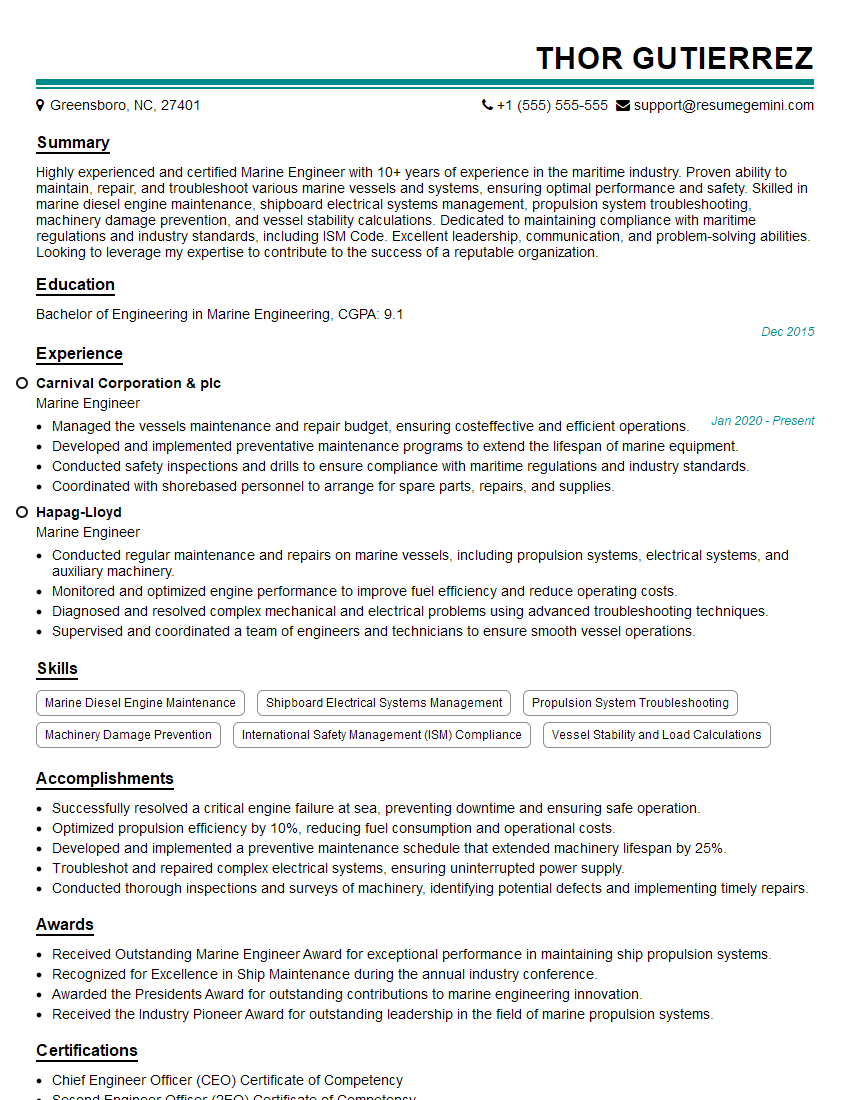
Mastering Stability and Trim Analysis is crucial for career advancement in maritime engineering and related fields. A strong understanding of these principles demonstrates your technical expertise and problem-solving capabilities, opening doors to more challenging and rewarding roles. To maximize your job prospects, it’s vital to present your skills effectively. Creating an ATS-friendly resume is key to getting noticed by recruiters and landing interviews. ResumeGemini is a trusted resource that can help you build a professional, impactful resume tailored to highlight your skills and experience. Examples of resumes tailored to Stability and Trim Analysis are available within ResumeGemini to help guide your creation process. Take the next step toward your dream career today!
Explore more articles
Users Rating of Our Blogs
Share Your Experience
We value your feedback! Please rate our content and share your thoughts (optional).
What Readers Say About Our Blog
Very informative content, great job.
good