Feeling uncertain about what to expect in your upcoming interview? We’ve got you covered! This blog highlights the most important Television Scoring interview questions and provides actionable advice to help you stand out as the ideal candidate. Let’s pave the way for your success.
Questions Asked in Television Scoring Interview
Q 1. Describe your experience with various orchestral instruments and their suitability for different TV genres.
My experience with orchestral instruments spans decades, encompassing both practical performance and composition. Understanding their unique timbral qualities is crucial for effective scoring. For example, the soaring strings of a violin section perfectly evoke romance or heightened drama in a TV series like Bridgerton, while the punchy brass of trumpets and trombones lend themselves to action sequences in a show like The Mandalorian. Conversely, the delicate textures of woodwinds like flutes and oboes create a sense of mystery or introspection, perhaps fitting a slow-burn thriller. I also deeply understand the versatility of percussion – from the subtle shakers creating atmosphere to the powerful impact of timpani driving a dramatic climax. The key is choosing the instrument or instrumental combination that best reflects the specific emotional intent and genre of each scene.
- Strings: Ideal for conveying emotion, romance, sadness, or grandeur.
- Brass: Excellent for powerful statements, heroic themes, action, and suspense.
- Woodwinds: Suited for creating atmosphere, mystery, and quieter, more intimate moments.
- Percussion: Highly versatile, adding rhythmic drive, texture, and dramatic impact.
Q 2. Explain your process for creating a musical cue based on a scene’s emotional arc.
Creating a musical cue based on a scene’s emotional arc is a multi-stage process. First, I meticulously analyze the scene’s script and visuals, identifying key emotional beats and transitions. Think of it as mapping the emotional landscape. I then develop a thematic idea—a musical motif—that encapsulates the overall emotional tone. This motif will be manipulated and developed throughout the cue to reflect the changing emotions. I’ll often sketch out the general form of the cue, visualizing how the music should evolve, perhaps using a simple piano or MIDI mockup. Next, I begin the detailed composition and arrangement, selecting the instruments, harmonies, and rhythms to accurately reflect the emotions at play. I always consider the pacing and dynamics – a slow, low-register string passage for a moment of reflection, a rapid crescendo with brass and percussion for a sudden escalation of tension. Finally, I iterate, refining the music based on my own critical listening and feedback from the director and producers.
Q 3. How do you handle revisions and feedback on your television scores?
Handling revisions and feedback is a crucial part of the scoring process. I always approach feedback constructively, viewing it as an opportunity to enhance the score. I believe open communication is key. My workflow involves clearly documenting the revisions, ensuring I understand the specific changes requested. I make the revisions promptly, demonstrating the changes clearly through annotated scores or separate versions of the music. I welcome further feedback iterations to ensure the final product aligns perfectly with the director’s vision. This collaborative process ensures the score truly enhances the narrative.
For example, a director might request a more prominent brass theme during a chase scene, or a softer, more melancholic string passage during a reflective moment. I would meticulously adjust the mix, arrangement, or even the composition itself to achieve their vision.
Q 4. What DAWs are you proficient in, and how do you utilize their features for scoring?
I’m proficient in several DAWs (Digital Audio Workstations), including Logic Pro X, Ableton Live, and Pro Tools. Each offers unique strengths. Logic Pro X’s powerful orchestral instrument libraries and scoring tools are indispensable for creating detailed orchestral scores. Ableton Live’s flexibility excels in creating more experimental or electronic textures, sometimes used to complement or contrast traditional orchestral elements. Pro Tools is excellent for audio editing, mixing and mastering, ensuring the final product is polished and ready for broadcast. My workflow typically involves using Logic Pro X for composing and arranging orchestral elements, perhaps incorporating elements from Ableton Live for unique sonic textures, and then using Pro Tools for final mixing and mastering.
Q 5. Describe your workflow for integrating music with sound effects and dialogue.
Integrating music with sound effects and dialogue is a delicate balance, requiring careful consideration of dynamics, frequency ranges, and overall sonic cohesion. My workflow involves receiving a rough mix of picture, sound effects and dialogue which I then use as a guide for composing the music. The goal isn’t to compete with the other elements, but to complement them. I often create space for the dialogue and SFX to breathe, carefully adjusting levels and frequency bands to ensure clarity. This might involve using EQ (Equalization) to carve out space for the music in the frequency spectrum, or using compression to ensure a consistent dynamic range. I will also consider the rhythmic qualities of the SFX to see how to synchronize the music to keep the production feeling unified.
For example, a tense scene might feature subtle, low-frequency music underlying dialogue and sound effects to add a sense of underlying threat without overpowering the other elements.
Q 6. How do you adapt your scoring style to different television genres (e.g., drama, comedy, thriller)?
Adapting my scoring style to different genres is essential. A romantic comedy needs light, playful melodies and perhaps a jazzy or pop-influenced score, while a thriller requires suspenseful harmonies, dissonant chords, and driving rhythms. A period drama might call for a more classical or baroque style, relying on rich string textures and contrapuntal lines. My approach involves deep research into the genre’s conventions and expectations, whilst also retaining my unique compositional voice. It’s about finding the right balance between adhering to established genre norms and bringing a fresh perspective.
Q 7. What strategies do you employ to ensure your score complements the visual narrative effectively?
Ensuring my score complements the visual narrative is paramount. This involves a deep understanding of the visual storytelling – the pacing, editing, and emotional arc of the scenes. I often visualize the music as a counterpoint to the visuals—sometimes mirroring the emotion directly, sometimes offering a contrasting counterpoint. For example, a peaceful scene might be underscored by tranquil music, while a tense scene could feature discordant harmonies, creating contrast and highlighting the underlying tension. I strive for a symbiotic relationship between the music and visuals, where each element enhances the impact of the other. This requires close collaboration with the director and editor, ensuring the music serves the narrative effectively.
Q 8. Explain your experience with temp music and how you use it in your scoring process.
Temp music, or temporary music, is crucial in the television scoring process. It’s essentially placeholder music used during the editing stage to help visualize the pacing and emotional arc of a scene. I use it extensively throughout my workflow.
Firstly, I receive the picture edit from the director and editor, often with temp tracks already in place. This gives me a strong initial understanding of their vision. I analyze these temp tracks carefully, noting not only the musical style and genre but also the specific cues they’ve chosen and *why* – what emotional beats are they emphasizing? What kind of energy are they trying to create? This careful listening is key.
Secondly, I use the temp tracks as a springboard for my own composition. I don’t simply try to recreate the temp; rather, I consider it a roadmap. It helps me understand the emotional landscape and timing. Sometimes, I’ll take inspiration from a particular melodic motif or rhythmic pattern, reworking it completely to fit my own style and the overall sonic palette of the show. Other times, the temp might suggest a completely different approach altogether.
Finally, I often present my scores alongside the temp tracks to allow the director and editor to directly compare. This collaborative process allows for refinement and ensures that my score effectively captures their original intent while adding my creative expertise.
Q 9. How do you handle tight deadlines and high-pressure situations in television scoring projects?
Tight deadlines are the norm in television scoring. My approach focuses on meticulous planning and efficient workflows. It’s like a well-orchestrated symphony – every element needs to be in place and timed perfectly.
First, I prioritize clear communication with the director and editor to fully understand the scope and expectations of the project from the outset. This includes establishing realistic deadlines, factoring in potential delays, and agreeing on clear milestones.
Secondly, I employ efficient composition techniques and leverage technology to streamline my processes. This could involve using templates, sample libraries, or even sophisticated music composition software that helps automate certain aspects of the workflow.
Finally, I maintain a flexible and adaptable mindset. Unexpected problems arise – that’s simply a fact of life in television production. I am adept at prioritizing tasks and making informed decisions when faced with unexpected setbacks, ensuring that the project remains on track despite unforeseen challenges. It’s about keeping a cool head and staying focused on the ultimate goal: creating compelling and effective music that enhances the viewing experience.
Q 10. Describe your experience with spotting sessions and collaborating with directors/editors.
Spotting sessions are pivotal for collaborative success. They are meetings where the composer, director, and editor collectively decide where music should be placed within the show. It’s a true team effort where everyone’s input matters.
My experience involves actively participating in these sessions, listening attentively to the director’s vision for each scene, understanding the subtleties of the narrative and considering the emotional impact the music should create. I often bring preliminary sketches or ideas to these sessions, facilitating informed discussion and helping guide decisions about music placement and style.
Collaboration with directors and editors isn’t just about technical aspects; it’s also about creating a genuine understanding and rapport. It’s about listening, learning from each other’s expertise, and building trust. Open communication and a willingness to compromise and refine ideas are essential. I find that building strong relationships with the creative team leads to more effective and rewarding collaborations.
For example, in one project, the director initially envisioned a grand, orchestral score for a particular scene. After discussion, we explored several alternatives. By experimenting with different approaches, we settled on a more intimate and nuanced score that ultimately enhanced the scene’s emotional depth and impact.
Q 11. How familiar are you with music copyright and licensing in the context of television?
Music copyright and licensing are incredibly important in television. A thorough understanding of these legal aspects is crucial to avoid potential issues and protect the interests of all parties involved.
My familiarity extends to various aspects of copyright, including understanding the different types of licenses (mechanical, synchronization, performance, etc.), the implications of using pre-existing music, and the process of clearing rights for any musical elements used in the score. I am proficient in working with music licensing agencies and ensuring all necessary paperwork and approvals are secured well in advance of broadcast.
Ignoring these legal intricacies can lead to costly litigation and significant production delays. For example, the use of unlicensed music can result in hefty fines and even the removal of the affected episodes from broadcast. I always ensure that my work adheres to all relevant copyright laws and that all necessary licenses are obtained, both to protect the production company and to ensure the creative integrity of the project.
Q 12. What is your approach to incorporating thematic elements throughout a television series?
Incorporating thematic elements across a television series is like weaving a musical tapestry. It’s about creating a consistent sonic identity that binds the entire series together, while still allowing for variation and evolution.
I typically start by developing a core set of musical themes – main title theme, character themes, and thematic motifs that represent key plot points or emotions. These themes are then subtly developed and re-contextualized throughout the series. This involves using variations of the theme, changing instrumentation, or adapting its tempo and mood to suit the specific scene.
For instance, a character’s theme might start as a hopeful melody in the first episode, but as the character undergoes a transformation, the melody might become darker or more complex to reflect the character’s emotional development. This approach creates a layered and engaging musical experience for the viewer, adding depth and meaning to the narrative.
Careful consideration of leitmotifs (recurring musical ideas associated with particular characters, objects, or situations) plays a crucial role. These can be as simple as a short melodic phrase or as complex as a fully developed musical theme, but consistency is key to establish recognition and emotional resonance with the audience.
Q 13. Describe your process for creating a musical logo or theme for a television show.
Creating a musical logo or theme for a television show is akin to crafting a memorable signature. It’s the first impression, a sonic calling card that sets the tone and atmosphere for the entire series.
My process typically begins with a close examination of the show’s concept, target audience, and overall style. I work closely with the showrunner and network to understand their vision and expectations.
I then start to experiment with different musical styles and instruments, exploring various melodic and rhythmic ideas. The goal is to create a theme that’s both memorable and instantly recognizable, reflecting the spirit and essence of the show. The melody should be concise and impactful, ideally remaining in the listener’s mind long after the opening credits have ended.
Once I have a few promising ideas, I present them to the production team and gather feedback. The process often involves several iterations of refinement before a final version is selected. This back-and-forth collaboration helps ensure the theme accurately represents the show’s identity and resonates with the intended audience.
Q 14. How do you balance creative freedom with the director’s vision in television scoring?
Balancing creative freedom with the director’s vision is an art in itself. It’s a collaborative dance where both perspectives are essential for creating a successful score.
My approach emphasizes open communication and mutual respect. I begin by carefully understanding the director’s vision and the overall narrative arc of the series. This often involves detailed discussions about the intended emotional tone, desired atmosphere, and specific stylistic preferences.
While I maintain creative freedom to explore various musical ideas and techniques, I always ensure that my musical contributions enhance and support the director’s vision. I might offer alternative interpretations or suggest innovative musical approaches, but these suggestions are always rooted in a deep understanding of the narrative and the director’s intent.
Sometimes, this might involve compromising on specific aspects of the score. For example, I might initially conceive a certain instrumental arrangement that ultimately doesn’t align with the overall aesthetic. In such cases, I collaborate closely with the director to find a mutually agreeable solution, ensuring that the final product meets both artistic and narrative goals. It’s about finding the sweet spot where my creative vision complements and elevates the director’s artistic objectives.
Q 15. Explain your experience with various microphone techniques and recording environments for scoring.
Microphone technique and recording environment are paramount in achieving the desired sonic quality for a television score. My experience encompasses a wide range, from intimate close-miking of individual instruments for nuanced detail, to using spaced omni-directional microphones for a more natural, ambient feel, especially useful for orchestral recordings. I’ve worked in various environments, from dedicated scoring stages with excellent acoustics to smaller, more intimate studios where careful placement and room treatment are crucial.
- Close Miking: This technique involves placing microphones very close to the sound source (e.g., a violin or a trumpet). This provides high fidelity, minimizing unwanted room noise and capturing the instrument’s unique timbre. It’s ideal for solo instruments or specific instrumental textures needing to stand out.
- Spaced Pair: Employing two microphones spaced several feet apart, often omni-directional, captures a more natural stereo image. This gives a sense of space and ambiance, perfect for recording string sections or ensembles where the natural blend is important. This method is often preferred for large ensembles in concert halls.
- Decca Tree: This classic technique utilizes three microphones in a triangular configuration, capturing a realistic stereo image with great depth. I’ve found it especially effective for capturing the full body and resonance of orchestral recordings.
- Recording Environments: My experience ranges from large, acoustically treated scoring stages in major studios to smaller, purpose-built recording rooms and even location recordings, requiring adjustments in microphone techniques and signal processing to compensate for variable acoustic characteristics. I have a keen understanding of the importance of selecting the optimal environment for the sound palette required by the project.
For example, when scoring a suspenseful scene, a close-miked cello might be preferable to create an immediate, visceral response, whereas for a more expansive, epic scene, a spaced-pair recording of a full orchestra in a large hall would enhance the grandeur.
Career Expert Tips:
- Ace those interviews! Prepare effectively by reviewing the Top 50 Most Common Interview Questions on ResumeGemini.
- Navigate your job search with confidence! Explore a wide range of Career Tips on ResumeGemini. Learn about common challenges and recommendations to overcome them.
- Craft the perfect resume! Master the Art of Resume Writing with ResumeGemini’s guide. Showcase your unique qualifications and achievements effectively.
- Don’t miss out on holiday savings! Build your dream resume with ResumeGemini’s ATS optimized templates.
Q 16. How proficient are you in music notation software (e.g., Sibelius, Finale)?
I’m highly proficient in both Sibelius and Finale, having used them extensively throughout my career. My skills extend beyond simple notation input to encompass advanced techniques like sophisticated score layouts, custom template creation, and the use of advanced notation features. I regularly use these programs for composing, arranging, and preparing scores for orchestration and for creating detailed parts for musicians.
For instance, I frequently use Sibelius’s advanced playback features to experiment with different orchestral arrangements and timbres during the composition process. The ability to quickly modify the notation and hear the changes in real-time is invaluable. Finale’s engraving capabilities allow for producing exceptionally clean and professional scores, critical for communicating clearly with musicians and ensuring smooth rehearsals.
Q 17. Describe your experience with creating music for specific emotional states (e.g., tension, suspense, joy).
Evoking specific emotional states through music is a core aspect of my work. I achieve this by carefully considering various musical elements such as harmony, rhythm, melody, dynamics, and instrumentation.
- Tension/Suspense: I often use dissonant harmonies, irregular rhythms, sparse instrumentation, and slowly ascending or descending melodic lines to create a sense of unease and anticipation. The use of low registers and subtle rhythmic irregularities is crucial.
- Joy: Major keys, bright timbres (e.g., woodwinds, strings in higher registers), quick tempos, and consonant harmonies are key ingredients for joyful scenes. Lively rhythms and a sense of lightness can further enhance this feeling.
For example, in one project, a scene requiring growing tension was scored using a solo cello with a slowly increasing tempo and increasingly dissonant harmonies, building to a crescendo before a sudden resolution. Conversely, a lighthearted scene was scored using a flute and harpsichord with a bright major key and a fast, bouncy tempo.
Q 18. How do you work with a team of musicians (or virtual musicians) in a professional setting?
Collaborating with musicians is an integral part of my workflow. My experience involves working both with live musicians in recording studios and with virtual musicians through online platforms. Clear communication and detailed preparation are essential in both cases.
- Live Musicians: I provide detailed scores and parts, ensuring clarity and precision. Pre-production meetings are crucial to discuss nuances and interpretations. Active feedback during recording sessions is essential to ensure the performance aligns with the director’s vision.
- Virtual Musicians: Effective communication through online platforms is crucial. I provide meticulously prepared scores and clear instructions, ensuring all stylistic preferences are explicitly stated. Regular communication and feedback loops through online platforms keep the collaboration smooth.
I believe in creating a collaborative environment where musicians feel valued and empowered to contribute their artistic input. My approach is to foster open dialogue and mutual respect to achieve a final product that surpasses individual contributions.
Q 19. What are your preferred methods for spotting and preparing music for picture?
Spotting music to picture is a crucial step where the composer and editor determine precisely where music should begin and end. My preferred method involves a collaborative session with the editor, watching the picture and marking key moments where music can enhance the narrative.
I use a combination of digital audio workstations (DAWs) and notation software to create detailed spotting notes, often including timestamps, descriptions of the desired mood and tempo, and specific musical cues. This meticulous approach ensures that the final score seamlessly integrates with the picture. Following the spotting session, I’ll create a temporary musical sketch, sometimes using placeholder sounds, to fully visualize the placement and overall flow of the score before commencing the final composition.
Q 20. Explain your experience with the post-production workflow in television, especially concerning audio.
My experience in television post-production workflow regarding audio is extensive. I’m familiar with all stages, from initial music recording and mixing to delivering final stems for broadcast. I’m proficient with various audio editing software such as Pro Tools, Logic Pro X, and Cubase, and I understand the nuances of audio mixing for television, such as dialogue clarity, sound effects integration, and maintaining a consistent sonic landscape throughout the program.
I’m particularly adept at working within the limitations and requirements of television broadcasting standards and the need for precise timing and synchronization. This includes understanding various audio file formats and delivery specifications required by broadcast networks.
Q 21. How do you approach creating music for specific scenes with particular pacing requirements?
Creating music that complements specific scene pacing requires careful consideration of tempo, rhythmic complexity, and harmonic movement. A fast-paced action scene will require a score with a quick tempo, driving rhythms, and perhaps a dense orchestral texture, while a slow, contemplative scene might call for a slower tempo, simpler rhythms, and a sparse, introspective texture.
For instance, I might use a fast tempo and syncopated rhythms in a chase scene to mirror the adrenaline rush, contrasting it with a slower, more lyrical melody during moments of reflection. By carefully manipulating these elements, I can create a score that organically reinforces the on-screen action, enhancing the emotional impact on the viewer. I also pay close attention to the ebb and flow of the narrative, ensuring the music subtly swells and retreats according to the unfolding drama, avoiding any jarring discrepancies between the visual and auditory experience.
Q 22. Describe a time you had to solve a technical challenge during a television scoring project.
One significant technical challenge I faced involved scoring a high-octane car chase scene for a crime drama. The director wanted a score that dynamically responded to the on-screen action, seamlessly weaving between moments of intense percussion and quieter, more suspenseful passages. The initial attempt resulted in a score that felt disjointed – the music felt too ‘on the nose’ and lacked subtlety. To solve this, I employed a technique called ‘algorithmic composition,’ using Max/MSP to generate musical variations based on real-time analysis of the picture’s movement and pace. This allowed me to create a score that responded dynamically to the action, subtly shifting the intensity and timbre of the music without feeling predictable. This required close collaboration with the sound editor to ensure the music’s timing was precisely synchronized with the visual elements – including the sound of screeching tires and engine revving – which was challenging to sync seamlessly but ultimately resulted in a highly impactful scene.
Q 23. Explain your understanding of audio mixing and mastering techniques in a television context.
Audio mixing and mastering for television are crucial for creating a cohesive and impactful soundscape. Mixing involves balancing the levels of various audio elements – dialogue, music, sound effects – to ensure clarity and intelligibility. For television, this is particularly important because of the wide range of viewing environments and devices. A well-mixed track will sound good on a high-end home theatre system and a small laptop speaker equally well. Mastering, which comes after mixing, focuses on optimizing the overall loudness and dynamic range to meet broadcast specifications and ensure the audio is competitive with other programs. This often involves careful EQ (equalization), compression, and limiting to achieve a consistent volume and prevent clipping or distortion. I usually follow a thorough process which involves iterative mixing passes, checking levels on various playback systems and, finally, delivering a master which adheres strictly to the network’s standards for loudness.
Q 24. How do you ensure consistency in the sound and style of your music throughout a series?
Maintaining stylistic consistency across a series requires meticulous planning and execution. Before I begin composing, I collaborate closely with the showrunner and director to establish a clear musical identity. We discuss the show’s overall tone, themes, and the emotional arc of the characters. This discussion helps me develop a thematic vocabulary and palette of sounds that define the show’s sonic landscape. For example, a recurring motif might represent a specific character or a significant plot element. This motif is then subtly varied throughout the series, evolving with the narrative. Furthermore, I maintain detailed documentation of musical elements – including instrumentation, tempo ranges, harmonic progressions, and key signatures – to ensure the musical cues remain consistent even across multiple episodes and seasons. This method acts as a reference point, making the process of maintaining quality easy and transparent.
Q 25. What software or plugins do you commonly use for sound design in your television scoring?
My sound design workflow relies heavily on a suite of software and plugins. I primarily use Logic Pro X as my DAW (Digital Audio Workstation), leveraging its powerful MIDI editing capabilities and extensive library of virtual instruments. For sound design itself, I often use Native Instruments Kontakt for sample-based instruments and effects. I rely on several plugins, including Waves plugins (like CLA-76 compressor and API 2500 EQ) for signal processing, as well as Valhalla Room for reverb and Soundtoys for creative effects. For more experimental sound design, I explore granular synthesis using software such as Ableton Live or specialized granular synthesis plugins. Ultimately, the choice of software and plugins depends on the specific needs of the project and the desired aesthetic.
Q 26. How do you manage your time efficiently when working on multiple scoring projects simultaneously?
Juggling multiple projects requires a structured and disciplined approach. I utilize project management software to track deadlines, tasks, and communication with clients. This allows for better time allocation and reduces the likelihood of missed deadlines. I also prioritize tasks based on urgency and deadline, focusing on completing the most time-sensitive tasks first. Additionally, I allocate specific blocks of time to each project, minimizing context switching and maximizing focus during those periods. This method helps me maintain a consistent workflow and avoids feeling overwhelmed. Finally, effective communication with clients and producers is critical in keeping projects on schedule and addressing any unforeseen delays.
Q 27. Describe your experience with different scoring styles (e.g., orchestral, electronic, hybrid).
My experience spans a broad range of scoring styles. I’m comfortable working with full orchestral scores, utilizing large ensembles to create epic and emotional soundscapes – this is particularly effective for period dramas or fantasy series. I also have significant experience with electronic music, employing synthesizers and samplers to craft modern and atmospheric sounds – perfect for sci-fi or thrillers. However, many of my recent projects involve hybrid approaches, blending orchestral instrumentation with electronic elements. This approach allows me to create a unique sonic signature, marrying the warmth and emotional depth of orchestral instruments with the dynamism and flexibility of electronic sounds. The hybrid approach is effective when dealing with projects that demand a dynamic mixture of tones – sometimes needing the grandness of an orchestra, at others the edginess of electronic sound.
Q 28. How do you stay current with the latest trends and technologies in television scoring?
Keeping up with the latest trends and technologies in television scoring involves active engagement in the industry. I regularly attend industry events and conferences, networking with other composers, sound designers, and music supervisors. I follow leading industry publications and online resources, staying informed about new software, plugins, and scoring techniques. Furthermore, I dedicate time to experimenting with new technologies and techniques in my personal projects. This continuous learning process is crucial for remaining at the forefront of the evolving field of television scoring and ensure that I can deliver fresh and engaging soundscapes.
Key Topics to Learn for Television Scoring Interview
- Musical Styles & Genres: Understanding the nuances of various musical genres and their application in different television contexts (e.g., drama, comedy, action).
- Orchestration & Instrumentation: Demonstrating knowledge of different instruments and how to effectively orchestrate them for television scoring, considering budget and production limitations.
- Tempo, Rhythm & Meter: A firm grasp of rhythmic and melodic elements and how they drive emotional impact within a scene. Ability to discuss how these elements contribute to storytelling.
- Harmony & Melody: Deep understanding of harmonic principles and their use in creating compelling melodies and emotional responses to picture.
- Music Software Proficiency: Showcase your expertise with industry-standard Digital Audio Workstations (DAWs) such as Logic Pro X, Pro Tools, or Ableton Live. Highlight your workflow and efficiency.
- Spotting & Cue Sheets: Explain your process for analyzing video footage, identifying key emotional moments, and creating accurate cue sheets for scoring.
- Collaboration & Communication: Discuss your experience working with producers, directors, and other team members. Highlight your ability to understand and translate their vision into music.
- Copyright & Licensing: Demonstrate awareness of copyright laws and licensing procedures related to using pre-existing music or samples in television productions.
- Problem-Solving & Adaptability: Prepare examples of how you’ve overcome creative or technical challenges in past projects. Discuss your ability to work under pressure and meet deadlines.
- Portfolio & Showreel: Discuss your approach to curating a compelling portfolio and showreel that effectively showcases your skills and style to potential employers.
Next Steps
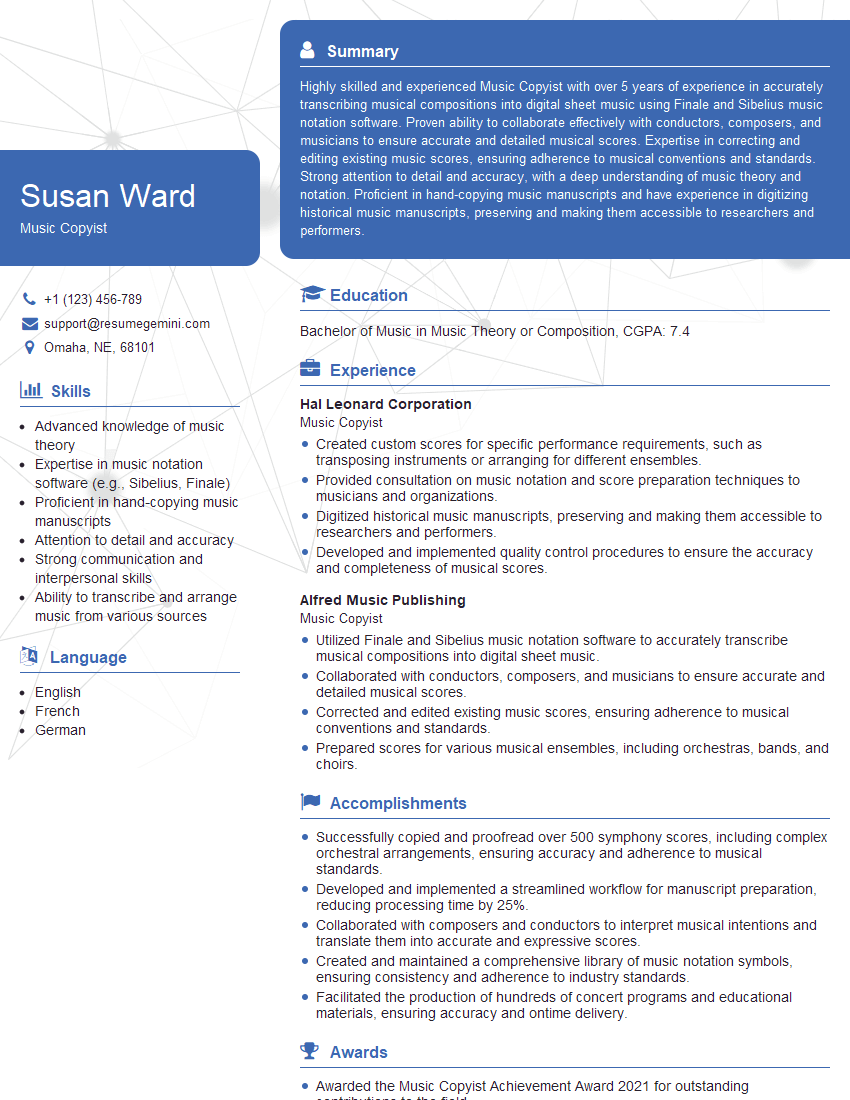
Mastering television scoring opens doors to exciting career opportunities, from working on high-profile shows to collaborating with renowned directors and producers. To maximize your job prospects, creating a strong, ATS-friendly resume is crucial. ResumeGemini is a trusted resource that can help you build a professional resume tailored to highlight your unique skills and experience in television scoring. Examples of resumes tailored to this field are available to guide you.
Explore more articles
Users Rating of Our Blogs
Share Your Experience
We value your feedback! Please rate our content and share your thoughts (optional).
What Readers Say About Our Blog
Very informative content, great job.
good