Interviews are opportunities to demonstrate your expertise, and this guide is here to help you shine. Explore the essential Traffic Signal Control Design interview questions that employers frequently ask, paired with strategies for crafting responses that set you apart from the competition.
Questions Asked in Traffic Signal Control Design Interview
Q 1. Explain the difference between actuated and fixed-time traffic signal control.
The core difference between actuated and fixed-time traffic signal control lies in how the signal timing is determined. Fixed-time control uses a pre-programmed schedule, cycling through green, yellow, and red phases at set intervals regardless of traffic demand. Think of it like a regularly scheduled bus – it runs on a timetable, whether it’s full or empty. This is simple and cost-effective but can be inefficient during periods of fluctuating traffic.
Actuated control, on the other hand, responds to real-time traffic conditions. Detectors embedded in the roadway sense the presence and volume of vehicles, adjusting the signal timing dynamically to optimize traffic flow. It’s like a taxi service – it adjusts to demand, sending more taxis where they are needed most. This is more complex and expensive but offers significant improvements in efficiency and reduces congestion, particularly during peak hours or when traffic patterns are unpredictable.
For example, a fixed-time signal might give a side street 30 seconds of green regardless of whether any cars are waiting. An actuated signal would only extend the green phase on that street if vehicles are detected waiting to turn.
Q 2. Describe the process of conducting a traffic signal warrant analysis.
A traffic signal warrant analysis is a systematic process used to determine if installing or modifying a traffic signal is justified. It involves evaluating various factors to ensure the signal will improve safety and efficiency, rather than creating further problems. The process typically includes these steps:
- Data Collection: This involves gathering traffic volume data, pedestrian counts, accident history, and speed studies at the intersection.
- Warrant Application: Various warrants exist, published by organizations like the Institute of Transportation Engineers (ITE), outlining specific criteria that must be met to justify a signal. These warrants consider factors like traffic volume, pedestrian volume, accident rates, and delays.
- Evaluation of Warrants: Each collected data point is assessed against the relevant warrants. For instance, a warrant might require a minimum hourly traffic volume on multiple approaches.
- Cost-Benefit Analysis: Even if warrants are met, a cost-benefit analysis compares the estimated cost of installing and maintaining the signal against the anticipated benefits in terms of reduced congestion, improved safety, and time savings.
- Recommendations: Based on the analysis, a recommendation is made regarding whether a traffic signal is warranted, and if so, what type of control (fixed-time or actuated) is most appropriate.
Failure to conduct a thorough warrant analysis can lead to unnecessary signal installations that are ineffective or even detrimental to traffic flow.
Q 3. What are the key performance indicators (KPIs) used to evaluate traffic signal effectiveness?
Key Performance Indicators (KPIs) for evaluating traffic signal effectiveness fall into several categories:
- Safety: Accident rates (total, severity), pedestrian collisions.
- Efficiency: Delay (average vehicle delay, total delay), queue lengths, saturation flow rates (vehicles passing through per hour during green).
- Level of Service (LOS): A qualitative measure reflecting the operational conditions at the intersection, typically ranging from A (free flow) to F (forced flow).
- Travel Time: Average travel time through the intersection or along a corridor.
- Throughput: Number of vehicles passing through the intersection per unit time.
- Fuel Consumption: Estimated fuel consumption by vehicles due to idling or stopping.
- Emissions: Levels of pollutants emitted by vehicles due to idling and acceleration/deceleration.
Analyzing these KPIs helps to identify areas for improvement in signal timing, detector placement, or overall system design.
Q 4. How do you determine the optimal cycle length for a traffic signal?
Determining the optimal cycle length for a traffic signal is crucial for efficiency. A cycle length that’s too short might lead to frequent changes, causing unnecessary stops and starts. Too long a cycle can lead to excessive delays for certain movements. The optimal cycle length balances the needs of all approaches and is often determined using methods like Webster’s method or other optimization techniques embedded in traffic signal software.
Webster’s method uses the critical lane volume and lost time to estimate the optimal cycle length, although it assumes a certain level of saturation flow rate which might not always be met in reality. More advanced methods may consider the saturation flow rates for each movement and adjust cycle lengths accordingly, considering factors such as pedestrian phases, turning movements, and phasing strategies.
Software like Synchro and CORSIM can model different cycle lengths and analyze their impacts on various KPIs, enabling fine-tuning for optimal performance. The process often involves iterative adjustments based on simulation results and field observations.
Q 5. Explain the concept of green split optimization in traffic signal control.
Green split optimization is the process of allocating the available green time within a traffic signal cycle to individual traffic movements (lanes or phases) in the most efficient way. The goal is to minimize delays and maximize throughput while ensuring safety. It’s not simply about giving each approach an equal share of green time; instead, it’s about assigning green time based on traffic demand.
Several techniques are used, often integrated into advanced traffic control systems:
- Proportional Split: Green time is allocated proportionally to the traffic volume on each approach. Higher volume approaches get longer green times.
- Actuated Control with Optimization Algorithms: Sophisticated algorithms dynamically adjust the green splits based on real-time traffic detection data, constantly optimizing for flow.
- Offset Optimization: Coordinating the timing of multiple signals along a corridor to minimize delays for vehicles traveling through multiple intersections.
Effective green split optimization requires accurate traffic detection and robust algorithms capable of adapting to changing traffic conditions throughout the day and week.
Q 6. What are the different types of traffic detectors used in modern traffic signal systems?
Modern traffic signal systems utilize a variety of traffic detectors to sense vehicle presence and volume. The choice depends on factors like cost, accuracy, and the specific application. Common types include:
- Inductive Loop Detectors: These are embedded in the pavement and detect vehicles by their metallic mass inducing a change in the magnetic field. They are reliable but require pavement cutting for installation.
- Video Image Processing (VIP): Cameras capture video images, and software analyzes the images to detect vehicles and their movements. VIP systems are flexible but can be affected by poor weather conditions or image quality.
- Radar Detectors: These use radar waves to detect vehicles’ presence and speed. They are non-intrusive and can provide speed data, but can be affected by environmental factors like heavy rain or snow.
- Ultrasonic Detectors: These emit ultrasonic waves that bounce off vehicles to detect their presence. They are relatively low-cost and less susceptible to pavement damage than inductive loops but have a shorter detection range.
- LiDAR (Light Detection and Ranging): Similar to radar, but uses laser light instead of radio waves. Offers high accuracy and detailed information about vehicle location and movement.
Many modern systems combine different detector types to ensure redundancy and robustness.
Q 7. Describe your experience with traffic signal simulation software (e.g., Synchro, CORSIM).
I have extensive experience using Synchro and CORSIM for traffic signal simulation and optimization. In past projects, I’ve used Synchro for designing new signalized intersections, analyzing the impact of proposed geometric improvements, and optimizing signal timings based on various scenarios (e.g., peak vs. off-peak hours). I’ve also utilized CORSIM for more complex corridor-level simulations, particularly when evaluating the coordinated operation of multiple signals along a major arterial.
For instance, in one project involving a congested urban corridor, I used CORSIM to model different signal coordination strategies, comparing their effects on travel times, queue lengths, and overall system performance. This analysis informed the development of an optimized signal timing plan that significantly reduced congestion and improved travel times. My workflow typically involves building accurate models, calibrating them with field data, running simulations, and analyzing the results to identify opportunities for improvement.
My skills in these software packages allow me to confidently predict the impacts of various traffic signal design and operational changes and support data-driven decision-making.
Q 8. How do you handle conflicts in traffic signal timing optimization?
Traffic signal timing optimization often involves resolving conflicts between different traffic movements. Think of it like a busy intersection – you need to give enough green time to each direction to clear the queues, but you also have to prioritize safety and efficiency. Conflicts arise when maximizing one aspect negatively impacts another. For example, giving a long green time to one direction might significantly delay others, leading to increased congestion and potentially longer overall delays for the system.
We handle these conflicts through a multi-step process using software tools like Synchro or Transyt. First, we analyze traffic data, using historical counts and predictive models to forecast future volumes. Next, we define performance measures – key metrics like delay, stops, and queue length. Then, we use optimization algorithms which iteratively adjust signal timings to minimize these performance measures. This process involves careful consideration of various factors, including:
- Cycle length: The total time it takes for a complete sequence of green, yellow, and red phases.
- Green splits: The proportion of the cycle length allocated to each phase.
- Offset: The coordination of signal timing between multiple intersections along a corridor.
During this iterative process, we systematically address conflicts by adjusting these parameters to achieve a balance between the needs of different movements. For example, if optimizing for one direction leads to unacceptable delays in another, we might adjust the cycle length, or explore different offset strategies to better synchronize the flow of traffic across intersections.
Q 9. Explain the role of adaptive traffic control systems.
Adaptive traffic control systems (ATCS) are the smart brains behind modern traffic management. Unlike fixed-time signals that operate on a pre-programmed schedule, ATCS dynamically adjust signal timings in real-time based on the actual traffic conditions. Imagine a system constantly monitoring traffic flow using sensors embedded in the road, cameras, and detectors. This information is fed into a central controller that uses sophisticated algorithms to optimize signal timing, reacting to changing traffic patterns like rush hour surges or unexpected incidents.
The key role of ATCS is to improve traffic efficiency and reduce congestion by reacting to real-world conditions. For example, if a traffic jam develops on one approach, the ATCS might lengthen the green time for that approach to clear the queue more quickly. This dynamic response ensures better traffic flow, reduces delays, and enhances overall system performance. Some ATCS also incorporate predictive capabilities, using historical data and weather forecasts to anticipate traffic patterns and preemptively adjust signal timings.
Beyond real-time control, ATCS often include features like:
- Incident detection: Identifying and responding to traffic incidents such as accidents or stalled vehicles.
- Priority control: Giving priority to emergency vehicles.
- Data collection and analysis: Providing valuable information for network-level traffic management.
Q 10. What are the common challenges faced in designing traffic signal systems for complex intersections?
Designing traffic signal systems for complex intersections, such as those with multiple lanes, turning movements, pedestrian crossings, and bicycle lanes, presents unique challenges. The sheer number of conflicting movements makes coordination and optimization more complex.
- Conflicting movements: Managing the intricate interactions between vehicles turning left, right, and going straight, along with pedestrians and cyclists, is crucial. Poorly designed phasing can lead to conflicts and increased risk of accidents.
- Capacity constraints: Complex intersections may have limited capacity, especially during peak hours. Efficient signal timing is vital to prevent saturation and excessive queuing.
- Geometric constraints: Physical limitations of the intersection, such as narrow lanes or limited sight distance, can influence signal design and affect the effectiveness of different strategies.
- Pedestrian and cyclist considerations: Ensuring adequate pedestrian crossing times and safe bicycle movement requires careful planning, potentially including protected phases or advanced detection systems.
- Data availability and quality: Accurate and reliable traffic data is essential for effective signal design, but this can be challenging to obtain in complex situations.
Solving these challenges requires a systematic approach, integrating advanced modeling techniques, detailed traffic simulations, and extensive field data collection to refine designs before implementation. It often involves iterative design, testing, and adjustments to achieve optimal performance.
Q 11. How do you ensure pedestrian safety in traffic signal design?
Pedestrian safety is paramount in traffic signal design. We employ several strategies to prioritize pedestrians’ safe passage through intersections:
- Dedicated pedestrian phases: Providing pedestrians with exclusive crossing time, ensuring they are not in conflict with vehicles.
- Push-button activation: Allowing pedestrians to activate the signal when they need to cross, particularly useful at less-busy crossings.
- Leading pedestrian intervals (LPIs): Giving pedestrians a head start before vehicles are allowed to proceed, improving their visibility and safety.
- High-visibility pedestrian signals: Using clear and easily understood pedestrian signals, including audible signals for visually impaired individuals.
- Improved crossing geometry: Designing safe and well-lit crossings with adequate width and sufficient refuge islands, where necessary, to break up long crossing distances.
- Pedestrian countdown timers: Displaying the remaining time for pedestrians to cross, helping them manage their crossing time efficiently.
Furthermore, good design involves considering the needs of all pedestrian users, including those with disabilities, children, and elderly individuals. This requires adhering to accessibility standards and employing inclusive design principles.
Q 12. Describe your experience with traffic signal maintenance and troubleshooting.
My experience with traffic signal maintenance and troubleshooting spans several years, encompassing both routine checks and complex repairs. Routine maintenance involves regularly inspecting signal equipment for wear and tear, ensuring proper operation of detectors, controllers, and signal heads. This includes checking for loose connections, damaged wiring, and malfunctioning components.
Troubleshooting involves diagnosing and resolving various problems that can disrupt signal operation. These issues can range from minor glitches like a burnt-out bulb to major failures requiring controller replacement or extensive system repairs. I’m proficient in using diagnostic tools and software to pinpoint the source of the problem. For example, I use specialized software to communicate with controllers and analyze real-time data to identify erratic signal behavior or malfunctioning detectors. My experience encompasses working with various controller technologies, understanding their communication protocols, and interpreting error codes.
A memorable troubleshooting instance involved a seemingly random failure of a signal phase. After eliminating issues with the controller and signal head, we discovered a faulty detector loop buried underground that was intermittently losing contact, causing this unpredictable behavior. This incident highlighted the importance of thorough investigation and the need to consider all potential sources of failure.
Q 13. What are the key considerations for designing traffic signals for bicycle traffic?
Designing traffic signals for bicycle traffic requires careful consideration of their unique needs and vulnerabilities. Cyclists are more vulnerable than motorists, and incorporating specific elements improves their safety and encourages cycling.
- Dedicated bicycle signals: Providing cyclists with dedicated signals or phases, allowing them to cross safely without conflict with other traffic.
- Advanced bicycle detection: Using detectors specifically designed to detect bicycles, ensuring timely activation of signals.
- Bicycle-friendly crossing geometries: Designing crossings with ample space and clear sightlines for cyclists to navigate safely.
- Protected left-turn phases for bicycles: Allowing cyclists to make left turns safely by separating them from conflicting traffic.
- Bicycle signals separated from pedestrian signals: Sometimes, it’s beneficial to create separate signals, avoiding confusion and providing more efficient crossings.
Integrating these elements into signal design promotes a safer and more convenient cycling environment, ultimately encouraging cycling as a sustainable mode of transportation.
Q 14. Explain the impact of connected and autonomous vehicles (CAVs) on traffic signal control.
Connected and autonomous vehicles (CAVs) are poised to revolutionize traffic signal control. Their ability to communicate with infrastructure and each other opens up exciting possibilities for improved efficiency and safety.
CAVs, equipped with vehicle-to-infrastructure (V2I) communication, can receive real-time information about signal timings and traffic conditions. This allows them to adjust their speed and behavior proactively, reducing stops and optimizing traffic flow. This seamless integration minimizes delays caused by stop-and-go driving patterns. In addition, V2I communication can allow for more optimized signal control, as the system can anticipate traffic demand more accurately, utilizing information about CAV destinations and intentions.
However, the widespread adoption of CAVs necessitates changes to traffic signal control systems. New protocols and communication standards will be essential. Furthermore, the design of traffic signals needs to account for the heterogeneous mix of CAVs and human-driven vehicles. We’ll likely see the development of new algorithms and control strategies to handle this transition and ensure a smooth and efficient traffic system even during the mix of both CAVs and traditional vehicles.
Q 15. How do you incorporate accessibility considerations into traffic signal design?
Incorporating accessibility into traffic signal design is crucial for ensuring safe and efficient movement for all users, including pedestrians, cyclists, and individuals with disabilities. This involves much more than just installing signals; it’s about designing a system that’s intuitive and usable for everyone.
- Accessible Pedestrian Signals (APS): These signals provide audible and tactile cues to guide visually impaired pedestrians. They’re typically combined with countdown timers that provide a clear indication of the remaining time in the pedestrian phase.
- Push-button activation: For pedestrian crossings, ensuring that buttons are conveniently placed and easy to operate is crucial. This includes consideration of button height and tactile features for easy identification and use.
- Clear and consistent signage: Signage should use simple, clear language and should be placed in highly visible locations, making them readily understandable for all users, regardless of literacy level.
- Adequate crossing times: Pedestrian crossing times must accommodate the needs of older adults, individuals with disabilities, and those pushing strollers or wheelchairs. This often requires longer crossing times than would be necessary for an average pedestrian.
- Detection technologies: Using advanced technologies like radar or video detection can help ensure that all pedestrians are detected, even those who might not activate a push button.
For example, during a recent project, we incorporated a new type of audible signal that provided clearer, more distinct tones, leading to a significant improvement in pedestrian safety, particularly for visually impaired individuals. We also worked closely with accessibility specialists to ensure proper button placement and signage.
Career Expert Tips:
- Ace those interviews! Prepare effectively by reviewing the Top 50 Most Common Interview Questions on ResumeGemini.
- Navigate your job search with confidence! Explore a wide range of Career Tips on ResumeGemini. Learn about common challenges and recommendations to overcome them.
- Craft the perfect resume! Master the Art of Resume Writing with ResumeGemini’s guide. Showcase your unique qualifications and achievements effectively.
- Don’t miss out on holiday savings! Build your dream resume with ResumeGemini’s ATS optimized templates.
Q 16. What are the different types of traffic signal controllers?
Traffic signal controllers are the brains of the operation, dictating signal timing and coordinating movements at intersections. They vary significantly in complexity and capabilities.
- Fixed-time controllers: These controllers operate on a pre-programmed schedule, cycling through different phases at set intervals. They are simple and cost-effective but don’t adapt to changing traffic conditions.
- Actuated controllers: These controllers respond to real-time traffic demands. Sensors detect vehicles and pedestrians, adjusting the signal timings to optimize traffic flow. This type is more efficient than fixed-time but can be complex to program and maintain.
- Adaptive controllers: These represent the most sophisticated type, using algorithms to learn and adapt to traffic patterns. They can adjust signal timings in response to historical data, real-time conditions, and even predicted traffic volumes. This leads to optimized traffic flow and reduced congestion.
- Centralized controllers: These manage multiple intersections through a central system, enabling coordinated signal timing across a network of intersections to improve overall traffic flow. This approach is especially valuable for managing large networks.
The choice of controller depends on the specific needs of the intersection, the budget, and the complexity of the traffic patterns. For instance, a simple intersection with low traffic volumes might only need a fixed-time controller, while a complex intersection within a large city center would likely benefit from an adaptive or centralized controller.
Q 17. Describe your experience with traffic data collection and analysis.
Traffic data collection and analysis is fundamental to effective traffic signal design. This involves gathering data to understand traffic patterns and then using that data to inform design decisions. My experience covers a range of techniques:
- Loop detectors: These inductive loops embedded in the pavement detect the presence of vehicles and provide data on traffic volume, speed, and occupancy.
- Video detection: Camera-based systems analyze video streams to detect vehicles and pedestrians, providing more detailed information than loop detectors and the ability to classify vehicle types.
- Radar detection: Radar systems can detect vehicles regardless of pavement conditions, offering reliable data even in challenging environments.
- Data analysis software: I’m proficient in using specialized software packages to analyze collected traffic data, identifying peak hours, average speeds, and other key performance indicators. This allows for identification of bottlenecks and areas for improvement.
For example, in one project, we used a combination of loop detectors and video detection to assess traffic flow at a busy intersection. The video data revealed that left-turning vehicles were creating significant congestion during peak hours, leading to a redesign of the signal phasing that significantly reduced delays.
Q 18. Explain your understanding of traffic signal timing plans.
Traffic signal timing plans specify how a signal operates over time. They dictate how long each phase is active, and the sequence of phases. A well-designed plan is crucial for safe and efficient traffic flow. Key elements include:
- Cycle length: The total time it takes for the signal to complete one full cycle of phases.
- Phase lengths: The duration of each phase, allocated based on traffic volume and pedestrian demand.
- Green splits: The distribution of green time across different movements (e.g., through movements, left turns).
- Offset: The coordination of signal timings across multiple intersections to create a green wave, improving traffic flow along corridors.
- Pedestrian timing: Allocation of pedestrian crossing times to ensure adequate time for safe crossing.
Creating effective timing plans requires a deep understanding of traffic dynamics. For instance, we often use optimization software to find the best combination of cycle length, phase lengths, and offsets to minimize delays and improve overall efficiency. Simulation software is also used to test different timing plans and predict their impact on traffic flow.
Q 19. How do you use traffic modeling software to evaluate traffic signal performance?
Traffic modeling software is indispensable for evaluating traffic signal performance. It allows us to simulate traffic flow under various scenarios and assess the effectiveness of different signal timing plans before implementation. This avoids costly mistakes and allows for informed decision-making.
I have extensive experience with software packages such as Synchro and TRANSYT. These tools allow us to:
- Simulate traffic flow: Model traffic movements under different signal timing scenarios to predict delays, queue lengths, and other performance indicators.
- Analyze the impact of design changes: Test different signal timings, lane configurations, or intersection geometries to optimize traffic flow and safety.
- Evaluate various scenarios: Explore the impact of future development or changes in traffic patterns.
- Identify bottlenecks: Pinpoint areas of congestion and design solutions to alleviate them.
For example, using Synchro, we recently modeled the effects of adding a dedicated left-turn lane at a congested intersection. The simulation showed a significant reduction in delays and improved safety, justifying the implementation of the lane addition.
Q 20. What are the regulations and standards you follow in traffic signal design?
My work adheres strictly to relevant regulations and standards, ensuring designs are safe, efficient, and compliant. These standards vary by location, but generally, I follow guidelines set by organizations such as the Institute of Transportation Engineers (ITE), the Manual on Uniform Traffic Control Devices (MUTCD), and local transportation departments. Key aspects of compliance include:
- Signal visibility and placement: Ensuring signals are visible to all users from appropriate distances and angles.
- Signal timing and coordination: Meeting standards for cycle lengths, phase lengths, and offsets.
- Pedestrian safety: Designing pedestrian crossings that meet safety standards, considering aspects such as crossing times and signal visibility.
- Accessibility standards: Adhering to ADA requirements for accessible pedestrian signals and other features.
- Emergency vehicle preemption: Implementing systems that allow emergency vehicles to efficiently navigate intersections.
Maintaining compliance is crucial for ensuring the safety and efficiency of our traffic signal systems. We regularly review and update our designs to meet the latest standards and best practices.
Q 21. Explain your experience with different signal phasing strategies.
Signal phasing strategies dictate how traffic movements are grouped and sequenced within a signal cycle. Different strategies are employed to optimize traffic flow based on the specific conditions at an intersection. My experience encompasses several approaches:
- Simultaneous phasing: Allows multiple movements to occur simultaneously, increasing capacity but potentially leading to conflicts. It might be used for low-volume, simple intersections.
- Protected/permitted phasing: Provides protected phases for vulnerable movements like left turns, followed by a permitted phase where left turns are allowed only when safe. This approach significantly enhances safety.
- Leading left-turn phasing: Provides a dedicated phase for left turns before through movements, often improving efficiency during peak periods.
- Lagging left-turn phasing: Positions the left-turn phase after through movements, often simplifying the control logic but potentially causing greater delays for left turns.
- Two-stage left turns: A more complex approach for high-volume left turns where they are split into two phases for safety.
The optimal phasing strategy is highly context-dependent. For instance, a high-volume intersection might benefit from a leading left-turn phase to reduce delays, while an intersection with pedestrian crossings might need to prioritize pedestrian movements, necessitating specific timings and protected phases. Selection requires careful analysis of traffic patterns and safety considerations.
Q 22. How do you address the issue of signal coordination in a network of intersections?
Signal coordination in a network of intersections, often called traffic signal timing optimization, is crucial for efficient traffic flow. It aims to synchronize signal timings across multiple intersections to create green waves, allowing vehicles to progress through a series of intersections without stopping. This reduces delays, improves travel times, and decreases fuel consumption.
We use sophisticated software and techniques to achieve this. One common approach involves using optimization algorithms that consider factors like traffic volume, turning movements, and cycle length at each intersection. These algorithms attempt to find the optimal timings that minimize overall delay across the network. For instance, we might employ a TRANSYT (TRAffic Network Study Tool) based model or other similar software. The process begins with data collection – traffic counts at various times of day are necessary. This data is then inputted into the software, and we calibrate and fine-tune the model until the simulations reflect real-world conditions as closely as possible.
Consider a scenario with three intersections along a major arterial road. Without coordination, drivers might encounter a red light at each intersection, leading to significant delays. However, with proper coordination, a ‘green wave’ could be established, allowing vehicles to travel through all three intersections with minimal stops, significantly improving traffic efficiency.
- Data Collection: Conducting traffic counts and surveys.
- Modeling: Using software to simulate traffic flow and optimize signal timings.
- Optimization: Adjusting signal timings to minimize delays and maximize throughput.
- Implementation: Uploading the optimized timings to the traffic controllers.
- Monitoring and Evaluation: Continuously monitoring performance and adjusting timings as needed.
Q 23. What is your experience with SCATS or other centralized traffic management systems?
I have extensive experience with SCATS (Sydney Coordinated Adaptive Traffic System), having been involved in several large-scale deployments. SCATS is a powerful centralized traffic management system that allows for real-time adaptive control of traffic signals. It uses advanced algorithms to monitor traffic conditions and dynamically adjust signal timings based on real-time data. This contrasts with pre-timed systems which rely on fixed signal timings regardless of traffic conditions. I’ve worked on projects where SCATS significantly improved traffic flow during peak hours by dynamically adjusting signal timings to respond to changing traffic demands. I’ve also worked with other centralized systems like SCOOT (Split, Cycle and Offset Optimization Technique) and have a solid understanding of their strengths and weaknesses. The selection of a system always depends on budget constraints and the scale and complexity of the project.
In one project, we used SCATS to alleviate congestion at a busy city center intersection. By implementing SCATS, we reduced average delay by 15% and improved the overall throughput by 10% during peak hours, leading to significant reductions in both commute times and emissions.
Q 24. Describe your process for developing a traffic signal design plan.
Developing a traffic signal design plan is a multi-step process that requires careful planning and consideration of various factors. The process typically includes:
- Needs Assessment and Data Collection: We begin by conducting a thorough assessment of the existing traffic conditions. This involves collecting data through traffic counts, speed studies, turning movement counts, and accident history. We also analyze future traffic projections based on population growth and land-use changes.
- Geometric Design Review: The physical characteristics of the intersection, such as lane configurations, sight distances, and approach geometries, are carefully analyzed to identify potential conflicts and bottlenecks.
- Signal Timing Design: Using traffic simulation software, we design the optimal signal timings, balancing the needs of all traffic movements. This involves determining the cycle length, green split, and offset for each phase of the signal operation.
- Hardware Selection: We choose appropriate signal controllers, detectors (such as loop detectors or video detectors), and other necessary hardware based on the size and complexity of the intersection.
- Safety Analysis: A comprehensive safety analysis is conducted to ensure that the proposed design meets all safety standards and minimizes the risk of accidents.
- Public Consultation and Stakeholder Engagement: We involve the public and relevant stakeholders in the design process, ensuring that their concerns and feedback are considered.
- Implementation and Monitoring: Once the design is approved, we oversee the implementation of the new signal system, followed by a monitoring period where we evaluate its performance and make necessary adjustments.
Q 25. Explain the concept of vehicle actuation and its impact on traffic flow.
Vehicle actuation is a key feature of modern traffic signal systems. It allows the signal to respond to the presence of vehicles, adapting its operation in real-time to improve efficiency and reduce unnecessary delays. Unlike pre-timed signals that operate on a fixed schedule, actuated signals only activate a phase when vehicles are detected at that approach. This dynamic adjustment is especially effective at intersections with low traffic volumes where a pre-timed system would be highly inefficient.
For instance, consider a small side street intersecting a busy arterial road. A pre-timed signal might give the side street a significant green phase even when no vehicles are present, causing delays on the arterial. An actuated system, however, would only activate the side street’s green phase when a vehicle is detected, minimizing delays for the higher-volume traffic on the arterial. The detection can be done using various methods, including inductive loop detectors, video image processing, or radar sensors.
The impact on traffic flow is substantial; actuated signals reduce delays and improve throughput, especially during off-peak hours. It increases the overall efficiency of the signalized intersection, leading to better traffic flow and less fuel consumption.
Q 26. How do you evaluate the effectiveness of a newly implemented traffic signal system?
Evaluating the effectiveness of a newly implemented traffic signal system involves a combination of quantitative and qualitative methods. We use a variety of performance metrics to assess the system’s impact on traffic flow and safety. These metrics include:
- Delay: Average delay experienced by vehicles at the intersection.
- Queue Length: Maximum and average queue lengths at the approach.
- Saturation Flow Rate: Number of vehicles that can pass through the intersection during a green phase.
- Stop Rate: Percentage of vehicles that stop at the intersection.
- Travel Time: Overall travel time along a corridor including the intersection.
- Accident Data: Number and severity of accidents before and after the implementation.
We compare these metrics before and after the implementation to determine the improvement or degradation resulting from the changes. We use traffic simulation models to simulate different scenarios and predict the impact of design changes before implementation. Post-implementation, we collect real-world data to validate our simulations and fine-tune the system as needed. The data is collected using a variety of methods, from loop detectors in the roadway to sophisticated video analytics. We also collect feedback from drivers and pedestrians through surveys and observations to gather qualitative insights.
Q 27. Describe your experience with public consultation and stakeholder engagement in traffic signal projects.
Public consultation and stakeholder engagement are integral parts of any successful traffic signal project. Ignoring the needs and concerns of the community can lead to dissatisfaction and even opposition to the project. I’ve extensive experience conducting public meetings, workshops, and online surveys to gather input from residents, businesses, and other stakeholders. This often involves presenting the proposed design, explaining the rationale behind the decisions, and addressing concerns raised by the public.
For instance, in a recent project, we held a public meeting where residents expressed concerns about potential impacts on pedestrian safety. By actively listening to their feedback and incorporating their suggestions into the design, we were able to address their concerns and build community support for the project. This resulted in a more effective and well-received traffic signal system. We also employed online surveys and feedback platforms to allow those who couldn’t attend meetings to participate in the consultation process.
Effective stakeholder engagement involves not just collecting feedback but also actively incorporating it into the design. This can involve creating various scenarios with different design elements and then evaluating the impacts using our traffic simulation tools. The process is iterative, involving feedback loops and adjustments to ensure that the final design meets the needs of the community.
Key Topics to Learn for Traffic Signal Control Design Interview
- Signal Timing Optimization: Understanding concepts like cycle length, green split, offset optimization, and their impact on traffic flow and safety. Practical application includes using software like Synchro or TRANSYT to model and optimize signal timings for different traffic scenarios.
- Traffic Signal Hardware and Software: Familiarity with various types of controllers (e.g., adaptive, actuated), detectors (e.g., loop detectors, video detectors), and communication protocols. Practical application involves understanding how these components interact to control traffic signal operations and troubleshooting common issues.
- Intersection Design and Geometric Considerations: Knowledge of intersection design principles, including lane configurations, sight distance requirements, and their influence on signal design. Practical application includes analyzing intersection geometry to determine appropriate signal phasing and timing plans.
- Traffic Data Analysis and Modeling: Ability to interpret traffic data (e.g., volume counts, speed studies) to inform signal design decisions and evaluate the effectiveness of existing signal systems. Practical application involves using traffic simulation software to predict the impact of proposed signal changes.
- Safety and Pedestrian Considerations: Understanding the importance of pedestrian safety and incorporating pedestrian-friendly designs into signal systems. Practical application includes designing signals that prioritize pedestrian crossing times and minimize conflicts between vehicles and pedestrians.
- Adaptive Traffic Control Systems (ATCS): Understanding the principles and benefits of ATCS, including their ability to adjust signal timings in real-time based on traffic conditions. Practical application includes familiarity with different ATCS technologies and their implementation challenges.
- Intelligent Transportation Systems (ITS) Integration: Understanding how traffic signal control systems integrate with other ITS components, such as Advanced Traveler Information Systems (ATIS) and Connected Vehicle technologies. Practical application includes understanding the potential benefits and challenges of integrating various ITS components.
Next Steps
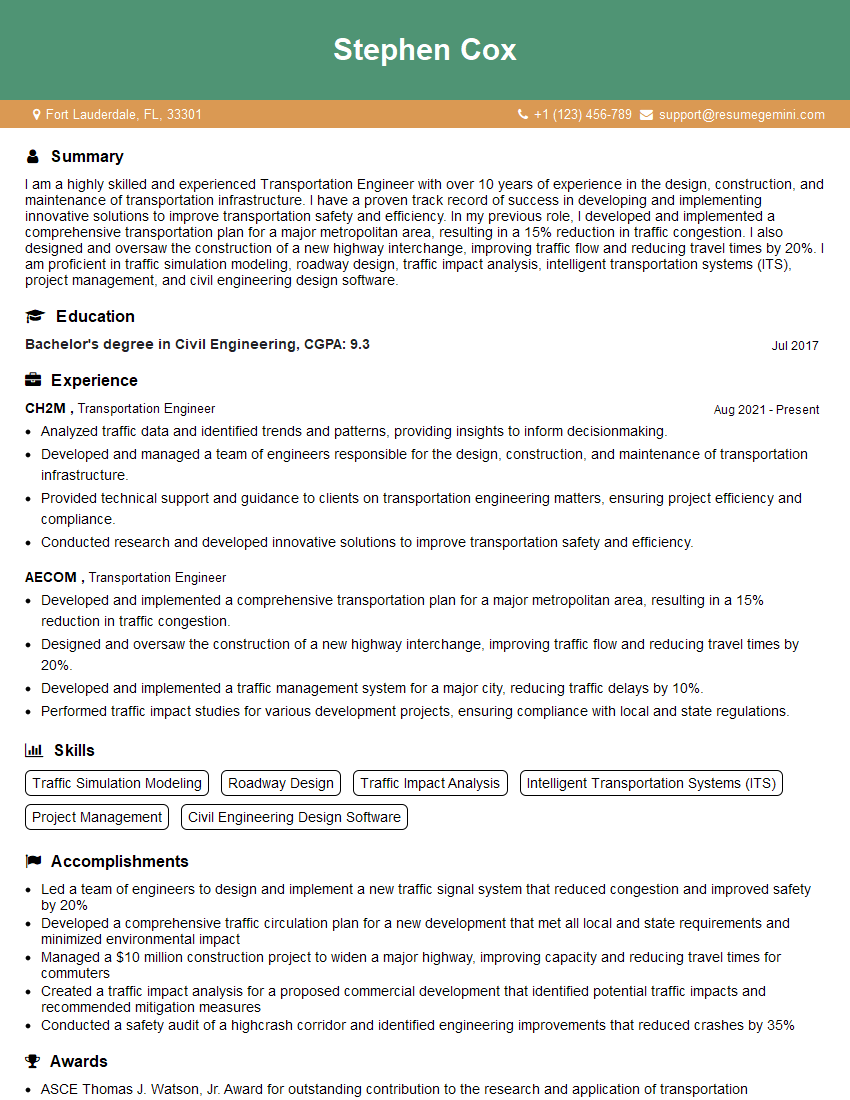
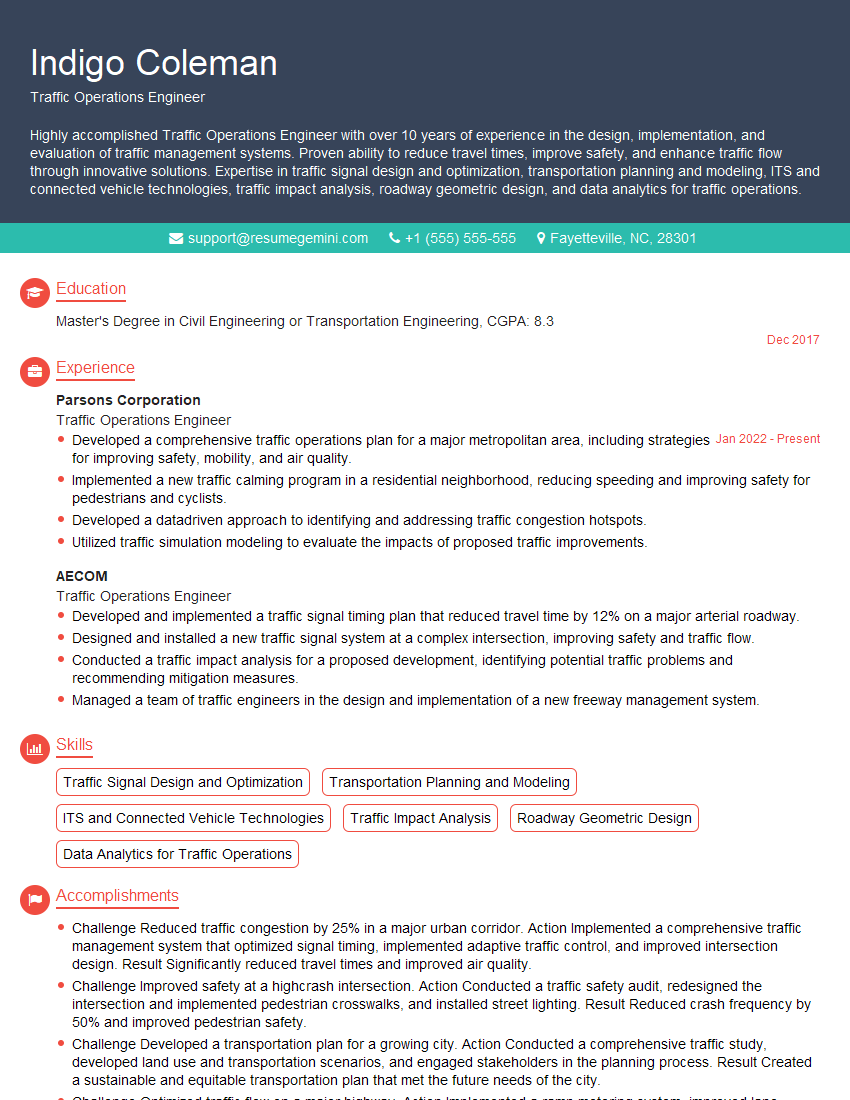
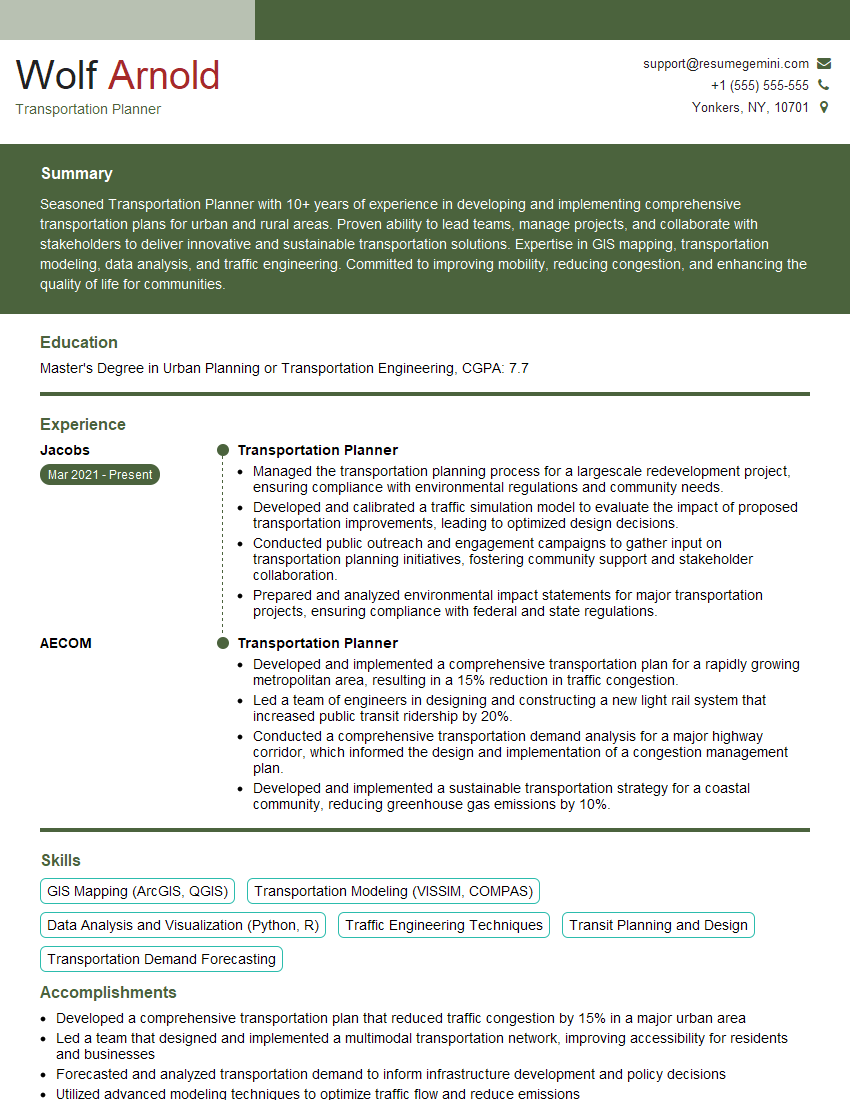
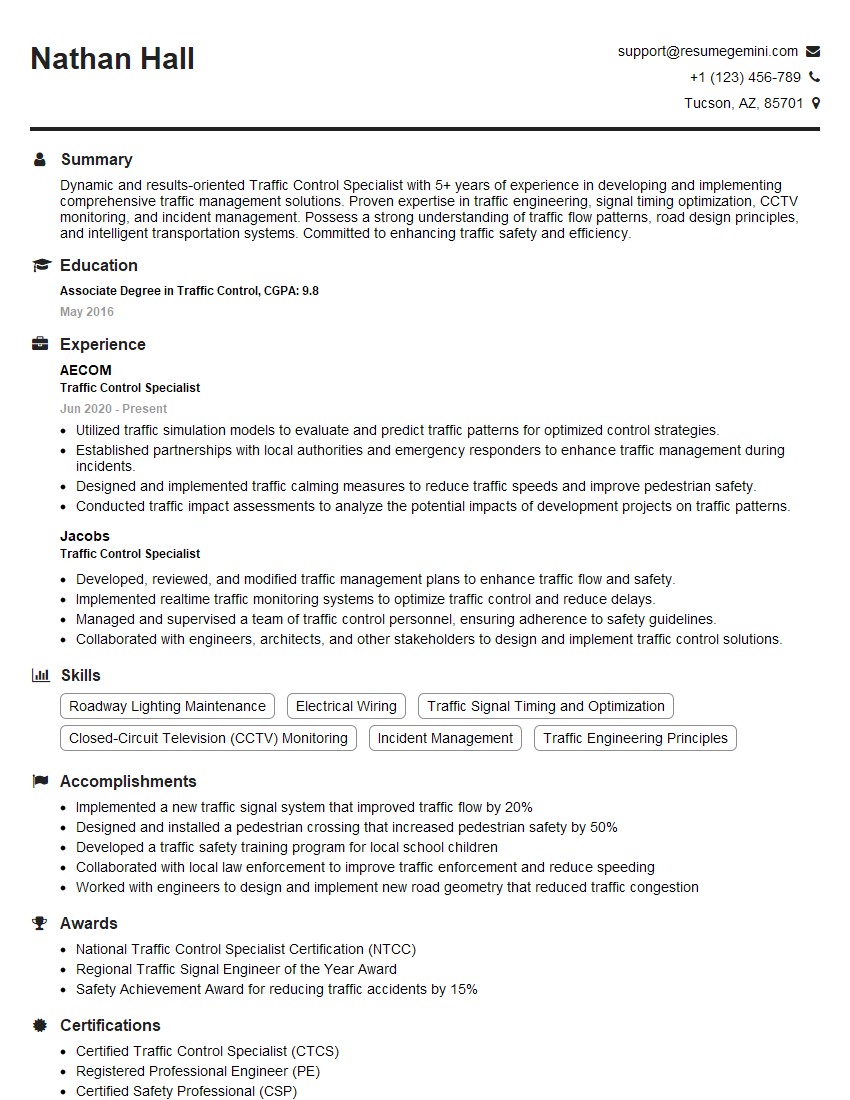
Mastering Traffic Signal Control Design is crucial for a successful and rewarding career in transportation engineering. It opens doors to challenging projects, leadership opportunities, and continuous professional development. To maximize your job prospects, creating a strong, ATS-friendly resume is paramount. ResumeGemini is a trusted resource to help you build a professional and impactful resume that highlights your skills and experience effectively. Examples of resumes tailored to Traffic Signal Control Design are available to further assist you in showcasing your qualifications to potential employers. Take the next step and invest in your career success today!

Explore more articles
Users Rating of Our Blogs
Share Your Experience
We value your feedback! Please rate our content and share your thoughts (optional).
What Readers Say About Our Blog
Very informative content, great job.
good