The right preparation can turn an interview into an opportunity to showcase your expertise. This guide to Understanding of Engraving Principles interview questions is your ultimate resource, providing key insights and tips to help you ace your responses and stand out as a top candidate.
Questions Asked in Understanding of Engraving Principles Interview
Q 1. Explain the difference between relief and intaglio engraving.
Relief and intaglio engraving are two fundamentally different methods of creating engraved images. Think of it like this: relief is like a raised stamp, while intaglio is like a recessed stamp.
Relief engraving creates the image by cutting away the material surrounding the design, leaving the design raised above the surface. Examples include woodcuts, linocuts, and raised-letter stamps. The image is printed directly from the raised surface.
Intaglio engraving, conversely, creates the image by cutting into the surface. The incised lines hold the ink, and when printed, the image is transferred from these recessed areas. Examples include traditional copperplate engraving, etching, and drypoint. The depth of the incision influences the ink holding capacity and the resulting print’s darkness.
Q 2. Describe various engraving tools and their applications.
The world of engraving tools is rich and varied, depending on the material and desired effect. Some common tools include:
- Gravers (Burins): These are pointed steel tools used for hand engraving on metal, creating fine lines and precise details. Different shapes (e.g., lozenge, square, flat) are used for varying line weights and styles.
- Engraving bits (for rotary tools): These are small, carbide-tipped bits used with rotary tools for engraving on a wider range of materials, from wood and plastic to metal. Various shapes and sizes are available for different applications.
- Diamond-tipped engraving tools: These are incredibly hard and durable, perfect for engraving on hard materials like glass, gemstones, or extremely hard metals.
- Scratch awls: Simpler tools, often used for marking or creating preliminary outlines before more detailed engraving.
- CNC engraving bits: These bits are designed for use in CNC machines and come in a wide array of sizes and shapes to suit the specific material and desired engraving depth. They usually consist of carbide or diamond tips for longevity.
The application depends on the material’s hardness, the desired detail level, and the scale of the project. Hand engraving with gravers allows for incredible precision and artistic control, while CNC engraving offers high speed and repeatability for mass production.
Q 3. What are the key considerations for choosing the right engraving tool for a specific material?
Choosing the right engraving tool depends critically on the material’s hardness and the desired result.
- Hard materials (e.g., steel, glass): Require exceptionally hard tools like diamond-tipped bits or specialized carbide gravers. A softer tool would quickly dull or break.
- Soft materials (e.g., wood, plastic): Can be engraved with a variety of tools, including carbide rotary bits or even sharp hand tools like carving knives.
- Detail level: Fine details necessitate sharp, small bits or fine-tipped gravers. Larger, coarser tools are appropriate for broader, less detailed work.
- Scale of the project: Hand engraving is better for smaller, highly detailed projects, while CNC engraving excels for larger, repetitive tasks.
For example, you wouldn’t use a wood carving tool on glass, as it would break. Similarly, a large, blunt engraving bit wouldn’t create fine lines in metal.
Q 4. How do you determine the appropriate depth and pressure for different engraving techniques?
Depth and pressure are crucial for achieving the desired result and avoiding damage. It’s a balance between control and aggression.
Depth: Is determined by the material, the type of engraving, and the desired visual effect. A shallow engraving might create a subtle effect, while a deep engraving provides a more dramatic result. Experimentation and experience are key to finding the right depth. Test on a scrap piece of the material first.
Pressure: Too much pressure can cause breakage of the tool or tear the material. Too little pressure will result in inconsistent engraving. For hand engraving, a light, consistent touch is essential to create clean, controlled lines. CNC machines will have settings that control the pressure based on the tool and material.
Example: When hand engraving on copper, a shallow depth and light pressure are used for fine lines, while a deeper depth and slightly more pressure may be needed for bolder lines. CNC settings would be calibrated for the desired depth and feed rate, ensuring consistent pressure and quality.
Q 5. Explain the process of setting up and using a CNC engraving machine.
Setting up and using a CNC engraving machine involves several steps:
- Design creation: The design is created using CAD software (Computer-Aided Design), specifying the engraving path and depth.
- Material preparation: The material is secured firmly to the machine’s work surface.
- Tool selection: The appropriate engraving bit is chosen based on the material and design.
- Software setup: The design file is imported into the CNC machine’s control software. Settings like feed rate, depth of cut, and spindle speed are adjusted based on the tool and material.
- Machine operation: The program is initiated, and the CNC machine precisely follows the programmed path, engraving the design into the material.
- Post-processing: Depending on the material and engraving, post-processing steps like cleaning or polishing might be necessary.
Safety is paramount. Always ensure proper safety precautions are in place before operating a CNC machine. This includes using appropriate safety glasses and ensuring the machine is properly secured.
Q 6. Describe the different types of engraving finishes.
Engraving finishes depend on the material and desired aesthetic. Some common finishes include:
- Matte finish: A non-reflective, slightly rough surface, often achieved through sanding or brushing after engraving.
- Glossy finish: A smooth, highly reflective surface, often achieved through polishing after engraving.
- Satin finish: A smooth, semi-reflective surface, achieved through finer polishing techniques.
- Antiqued finish: A worn, aged look, often achieved through chemical treatments or specialized abrasive techniques.
- Textured finish: A surface with a specific pattern or texture, often created through specialized tools or techniques during the engraving process itself.
The choice of finish significantly impacts the final appearance. A matte finish might be preferred for a rustic look, while a glossy finish enhances the detail and clarity of the engraving.
Q 7. How do you ensure precision and accuracy in your engraving work?
Ensuring precision and accuracy in engraving requires meticulous attention to detail and careful planning.
- Precise measurements and design: Accurate measurements are crucial, particularly in designs involving text or intricate patterns. Use high-resolution images and design software.
- Sharp tools: Dull tools lead to inconsistent lines and poor quality engraving. Regularly sharpen or replace tools as needed.
- Proper setup and calibration: For CNC machines, ensure proper calibration of the machine and tooling. For hand engraving, ensure a comfortable and stable working position.
- Consistent pressure and speed: Maintain even pressure and speed during engraving to avoid inconsistencies.
- Test runs: Always perform test runs on scrap material before working on the final piece to fine-tune settings and identify any potential issues.
- Magnification: Use magnification tools (e.g., jeweler’s loupe) to inspect work for minor flaws, particularly in fine detail.
The pursuit of precision is an ongoing process; constant refinement of technique and attention to detail are essential to produce high-quality engraving.
Q 8. What are the common challenges encountered in engraving and how do you overcome them?
Engraving, while a rewarding craft, presents several challenges. One common issue is material inconsistencies. Variations in hardness or density within a piece of metal, wood, or stone can lead to uneven engraving depth or tool breakage. I overcome this by carefully inspecting the material before starting, using a magnifying glass if necessary, and adjusting my pressure and technique accordingly. Sometimes pre-treating the material, such as annealing metal, can improve uniformity.
Another significant challenge is achieving consistent line weight and depth, especially in intricate designs. This requires steady hand control, appropriate tool selection, and practice. I mitigate this by using proper posture and employing magnification tools for fine detail work. Regular calibration of my engraving machines also plays a crucial role.
Finally, tool wear and tear is inevitable. Blunt or damaged tools lead to poor engraving quality and potential damage to the material. I address this through meticulous tool maintenance, including sharpening and replacement as needed. I also avoid excessive pressure during engraving to prolong tool life.
Q 9. Explain the importance of proper material selection for engraving.
Proper material selection is paramount in engraving because it directly impacts the final product’s quality, durability, and aesthetic appeal. The material’s hardness, grain structure, and susceptibility to damage all need consideration. For example, engraving on soft wood like balsa requires different techniques and tools compared to hard wood such as ebony. Similarly, engraving stainless steel demands significantly more force and specialized tools than engraving softer metals like copper.
Choosing the right material also influences the longevity of the engraving. A harder material is naturally more resistant to wear and tear, ensuring the engraving will last longer. Conversely, a softer material might be easier to engrave but the engraving may be more susceptible to damage over time. Therefore, matching material selection to the intended use and desired aesthetic is critical for successful engraving. For instance, a delicate piece of jewelry might necessitate a softer metal for intricate detail, while a durable monument inscription requires a harder, weather-resistant stone.
Q 10. How do you maintain and care for engraving tools?
Maintaining and caring for engraving tools is essential for achieving high-quality work and ensuring their longevity. This involves a multi-pronged approach:
- Regular Cleaning: After each use, I thoroughly clean my tools to remove debris and residue. This prevents corrosion and ensures smooth operation. I use appropriate solvents or cleaning agents depending on the material being engraved.
- Sharpening: Sharpening is crucial for maintaining the tool’s edge. I regularly sharpen my tools using appropriate sharpening stones or a professional sharpening service, depending on the tool type.
- Storage: Proper storage prevents damage and corrosion. I store my tools in a dry, dust-free environment, ideally in a case or protective covering.
- Inspection: I routinely inspect my tools for damage, such as cracks or chips. Damaged tools should be repaired or replaced immediately to avoid accidents and poor quality engravings.
This meticulous approach guarantees the precision and consistency necessary for creating exceptional engravings.
Q 11. Describe your experience with different engraving materials (e.g., metals, wood, stone).
My experience spans a variety of engraving materials. Working with metals, particularly steel, requires precision and considerable force due to their hardness. I utilize specialized tools like gravers and rotary engravers, employing techniques adapted to the metal’s specific properties. For instance, engraving on stainless steel requires more pressure and a sharper tool than engraving on softer metals like silver or gold. I’ve found that annealing steel prior to engraving can significantly improve the process.
Engraving wood is a different experience, offering a satisfying tactile engagement. The grain of the wood influences the engraving process greatly; I adjust my technique to follow the grain to avoid splintering or tearing. Different types of wood require varying degrees of pressure and tool sharpness.
Stone engraving offers unique challenges. The hardness and potential for breakage require careful planning and precise execution. Different types of stones (marble, granite, etc.) necessitate the use of specialized tools and techniques to achieve desired results. For instance, diamond tooling is often necessary for harder stones.
Q 12. Explain the process of designing an engraving pattern or design.
Designing an engraving pattern involves a creative and technical process. It often begins with conceptualization—visualizing the overall design and its purpose. This could range from a simple monogram to a complex, multi-layered illustration.
Next, I translate the concept into a tangible design using various methods like hand sketching, computer-aided design (CAD) software, or a combination of both. CAD software allows for precise scaling, intricate detail work, and the creation of symmetrical designs that would be challenging to achieve by hand. If hand-drawing, precision is critical to ensure the final engraving is accurate.
Once the design is finalized, it is often transferred to the material using techniques like tracing, projecting, or through the use of stencils. The choice of transfer method depends on the complexity of the design and the material being engraved.
Q 13. How do you ensure the longevity and durability of your engravings?
The longevity and durability of an engraving depend on several factors, starting with material selection, as discussed earlier. A harder, more resistant material will naturally produce a longer-lasting engraving.
Engraving technique also plays a crucial role. A well-executed engraving, with appropriate depth and clean lines, is less susceptible to wear and tear. Avoiding over-engraving and ensuring consistent depth are key.
Finally, protection against environmental elements is essential, especially for outdoor engravings. Applying a protective sealant or coating can significantly extend the lifespan of the engraving by protecting it from weathering, corrosion, and other forms of damage. This is crucial for outdoor installations and ensures the engraving will maintain its integrity over time.
Q 14. Describe your experience with hand engraving techniques.
Hand engraving is a deeply rewarding technique, demanding precision and skill. It involves using hand-held tools like gravers and punches to directly manipulate the material. This allows for a level of artistic control and nuance unattainable with machine engraving. I’ve found that hand engraving allows for a greater connection to the material and the creative process.
The experience varies drastically depending on the material. Engraving soft metals, like silver, allows for more freedom and fluidity, whereas harder materials like steel require greater force and precision. Different gravers are used for creating lines, shading, or adding detail, each requiring unique hand movements and pressure control. Mastering hand engraving takes years of practice and a deep understanding of tool manipulation and material behavior. The result, however, is an exquisite level of detail and artistry which is truly unique.
Q 15. What safety precautions do you take when engraving?
Safety is paramount in engraving. My approach is multifaceted and begins before I even touch the equipment. It starts with a thorough risk assessment of the project, considering the materials being engraved (some materials release toxic fumes when lasered, for example), the tools being used (rotary engravers require sharp bits and can cause injury if not handled correctly), and the environment (adequate ventilation is crucial for many processes).
- Personal Protective Equipment (PPE): I always wear appropriate safety glasses, often a full face shield for added protection, especially during laser engraving or when using rotary tools. Depending on the materials, I might also wear gloves, a respirator, and a lab coat.
- Machine Safety: Before operating any equipment, I carefully check for any damage or loose parts. I ensure that all safety guards are in place and functioning correctly. Laser engravers, in particular, require a careful review of the safety interlocks and emergency stop mechanisms.
- Material Handling: I handle materials with care, avoiding sharp edges and using appropriate tools to secure them during the engraving process. For example, using clamps or vacuum holders prevents movement during the process, reducing the risk of accidents.
- Clean Work Area: Maintaining a clean and organized workspace minimizes trip hazards and keeps potentially hazardous materials contained.
Regular equipment maintenance and adherence to manufacturer’s instructions are crucial elements of my safety protocol. It’s not just about preventing immediate accidents, but building a consistent safety culture in my work.
Career Expert Tips:
- Ace those interviews! Prepare effectively by reviewing the Top 50 Most Common Interview Questions on ResumeGemini.
- Navigate your job search with confidence! Explore a wide range of Career Tips on ResumeGemini. Learn about common challenges and recommendations to overcome them.
- Craft the perfect resume! Master the Art of Resume Writing with ResumeGemini’s guide. Showcase your unique qualifications and achievements effectively.
- Don’t miss out on holiday savings! Build your dream resume with ResumeGemini’s ATS optimized templates.
Q 16. How do you handle errors or mistakes during the engraving process?
Mistakes happen, even to the most experienced engravers. My approach focuses on prevention, but also on effective correction. Prevention starts with careful planning and design, using CAD/CAM software to preview the engraving before committing to the material.
- Minor Errors: For minor imperfections, like a slightly misaligned line, I often utilize touch-up techniques. This could involve hand-engraving, using a smaller tool to correct the issue, or using specialized inks or paints to subtly mask flaws.
- Major Errors: More significant errors might require more substantial remediation. Depending on the material and the nature of the error, I might attempt to carefully remove the flawed area using techniques like sanding or polishing, and re-engraving the section. In some cases, especially with expensive materials, starting over is the best option.
- Learning from Mistakes: I meticulously document any errors, including the cause and the corrective measures taken. This serves as a valuable learning experience, preventing similar issues in future projects. It’s all part of the continuous improvement process.
The ability to adapt and find creative solutions is key. Sometimes, an ‘error’ can even unexpectedly lead to a unique and desirable aesthetic, turning a setback into an opportunity.
Q 17. Explain your experience with different types of engraving inks or paints.
My experience encompasses a wide range of engraving inks and paints, each with its unique properties and applications. The choice of ink or paint depends heavily on the material being engraved, the desired effect, and the engraving method.
- Acrylic Paints: These are versatile and widely used, especially for hand-engraved pieces. They come in various finishes (matte, gloss, metallic), colors, and are generally easy to apply and clean up.
- Oil-Based Paints: These offer superior durability and richness of color, often preferred for projects requiring long-lasting results and vibrant hues. However, they require specific solvents for cleanup and have longer drying times.
- Enamels: Enamels provide a very hard, durable finish, making them ideal for items that will see significant wear and tear. They are often used for metal engraving.
- Specialty Inks: For specific applications, I have experience with inks designed for certain substrates like glass, wood, or leather. Some inks even glow under UV light or are formulated for extreme durability.
In my work, I’ve found that experimenting and developing a keen eye for color combinations and surface interactions are as important as understanding the technical properties of different inks.
Q 18. Describe your proficiency with CAD/CAM software for engraving.
Proficiency in CAD/CAM software is essential for efficient and accurate engraving. I’m highly skilled in using industry-standard software such as ArtCAM, Vectric Aspire, and AutoCAD. My expertise includes not only creating vector-based designs but also optimizing those designs for the specific engraving machine and material being used.
My experience includes:
- Design Creation: I can create intricate designs from scratch, or import and modify existing artwork, ensuring the design is optimized for the engraving process. This includes scaling, vectorizing, and adjusting line weights to achieve the desired depth and precision.
- Toolpath Generation: I use the software’s toolpath generation capabilities to create precise instructions for the engraving machine, specifying parameters such as depth of cut, feed rate, and spindle speed. This optimization significantly impacts the quality and speed of the engraving.
- Simulation & Optimization: Before initiating the engraving process, I use the software to simulate the toolpaths, allowing me to identify and correct potential errors or inefficiencies before they affect the final product. This reduces material waste and increases overall efficiency.
Understanding the limitations and capabilities of different engraving machines is paramount, and the software plays a critical role in bridging that gap between design intent and physical reality.
Q 19. How do you manage deadlines and prioritize tasks in a production engraving environment?
Managing deadlines and prioritizing tasks in a production environment demands a structured approach. My workflow combines meticulous planning with agile adaptation. I use project management tools to track deadlines, allocate resources, and monitor progress.
- Prioritization Matrix: I use a prioritization matrix (e.g., Eisenhower Matrix) to categorize tasks based on urgency and importance, ensuring that critical projects are completed first. This helps in effectively managing multiple projects with varying deadlines.
- Time Blocking: I allocate specific time blocks for particular tasks, allowing for focused effort and minimizing distractions. This approach enhances productivity and prevents scope creep.
- Communication & Collaboration: Effective communication with clients and team members is critical. I proactively update stakeholders on project progress, identifying potential roadblocks early on and finding collaborative solutions.
- Contingency Planning: Unexpected issues can arise. Having a contingency plan in place allows me to respond quickly and effectively to problems, minimizing their impact on overall project timelines.
Flexibility and problem-solving skills are crucial in production. The ability to adjust priorities and strategies based on real-time developments is key to consistently meeting deadlines without compromising quality.
Q 20. Describe your experience with laser engraving technology.
Laser engraving technology has revolutionized the engraving industry, offering speed, precision, and versatility. My experience encompasses various types of laser systems, including CO2 and fiber lasers.
- CO2 Lasers: These are well-suited for engraving non-metallic materials such as wood, acrylic, and leather. I have extensive experience optimizing settings (power, speed, frequency) for different materials to achieve desired depth and detail.
- Fiber Lasers: These excel at engraving metals and other hard materials. I’m proficient in using fiber lasers for marking and deep engraving, understanding the nuances of focusing and adjusting parameters for different metal types and thicknesses.
- Safety Protocols: Laser engraving necessitates strict adherence to safety guidelines. I’m thoroughly trained in safe laser operation, including the use of appropriate safety glasses, proper ventilation, and material handling procedures.
- Design Optimization: Laser engraving requires careful design considerations. I optimize designs for laser processing, considering factors such as line thickness, kerf (the width of the cut), and material properties. This ensures efficient and precise engraving.
Laser engraving is a powerful tool, and understanding its intricacies, from material interactions to safety procedures, is essential for producing high-quality results.
Q 21. How do you assess the quality of your engraving work?
Assessing the quality of engraving work involves a multi-faceted approach that extends beyond simple visual inspection. It combines objective measurements with subjective evaluation.
- Visual Inspection: I carefully examine the engraved piece for any imperfections, such as inconsistencies in depth, line clarity, or damage to the surface. Lighting and magnification are often used to enhance detail.
- Dimensional Accuracy: For projects requiring precise dimensions, I use measuring tools (calipers, micrometers) to verify that the engraving meets the specified requirements.
- Depth Consistency: Consistent engraving depth is crucial for quality. I use appropriate tools to check for variations in depth across the engraved area. This is particularly important for deep engravings.
- Material Integrity: I examine the material for any damage or burns caused by the engraving process. This assessment is critical to ensure the longevity and structural integrity of the finished piece.
- Overall Aesthetics: Subjective evaluation considers the overall aesthetic appeal of the engraving. This includes the clarity of the design, the balance of elements, and the overall visual impact.
Quality control is a continuous process, involving both preventive measures (proper machine maintenance, precise toolpath generation) and corrective actions (identifying and addressing defects). The goal is not only to meet but exceed client expectations.
Q 22. How do you adapt your engraving techniques for different design styles?
Adapting engraving techniques to different design styles requires a nuanced understanding of both the artistic vision and the material limitations. For instance, a delicate, intricate design like a floral motif requires a finer engraving tool and a lighter touch than a bold, geometric pattern which might benefit from a more aggressive approach and possibly a coarser tool. The depth of the engraving, the spacing between lines, and the overall pressure applied all need adjustments. For example, a minimalist style might favor shallow, clean lines, while a baroque style might demand deeply incised details and textures. I approach each project by carefully analyzing the design, selecting the appropriate tools, and adjusting my technique accordingly to ensure the final product accurately reflects the artist’s intent.
Consider the difference between engraving a delicate butterfly on a silver locket versus a powerful heraldic crest on a metal plate. The butterfly would necessitate precision and finesse, using perhaps a very fine burr or even a hand-held graver, while the crest could tolerate a more forceful approach, perhaps using a rotary engraver with a larger bit.
Q 23. What are the advantages and disadvantages of different engraving methods?
Various engraving methods offer distinct advantages and disadvantages. Hand engraving, for instance, provides unparalleled control and precision, allowing for intricate details and personalized artistic expression. However, it is time-consuming and labor-intensive. Rotary engraving, using a motorized tool, is significantly faster and can handle larger areas, but lacks the same level of fine control. Laser engraving is exceptionally fast and precise for repetitive designs, particularly on harder materials, but it can be expensive to set up and may not offer the same tactile texture as other methods.
- Hand Engraving: Advantages: High precision, artistic control; Disadvantages: Time-consuming, physically demanding.
- Rotary Engraving: Advantages: Speed, efficiency; Disadvantages: Less precision for fine details.
- Laser Engraving: Advantages: Speed, precision for repetitive tasks; Disadvantages: High initial cost, limited tactile texture.
The choice of method depends heavily on the project’s requirements: deadlines, budget, desired level of detail, and the material being engraved.
Q 24. Describe your experience troubleshooting engraving machine malfunctions.
Troubleshooting engraving machine malfunctions requires a systematic approach. I begin by identifying the specific problem: is the machine not powering on? Is the engraving depth inconsistent? Are there unusual noises? My experience has taught me to check the most basic things first, such as power connections, air pressure (for air-driven tools), and ensuring the correct bit or laser setting is selected. A consistent problem might indicate a worn-out bit, a malfunctioning motor, or even a software glitch. I keep a detailed log of my machine’s performance and maintenance to quickly identify recurring issues.
For instance, I once experienced inconsistent engraving depth. After ruling out issues with the bit and settings, I discovered a problem with the machine’s Z-axis, which controls the vertical movement. A thorough inspection revealed a loose screw, which I tightened, resolving the issue. This highlights the importance of meticulous preventative maintenance and a methodical troubleshooting strategy.
Q 25. Explain your understanding of different engraving styles and their historical context.
Engraving styles have evolved significantly throughout history, reflecting societal trends and technological advancements. Early forms, like those found in ancient Egypt and Mesopotamia, were often rudimentary, focusing on symbolic representations. The Renaissance saw a surge in detailed, intricate designs, showcasing craftsmanship and artistic skill. The Victorian era embraced elaborate ornamentation, while Art Nouveau introduced flowing, organic forms. Modern engraving encompasses a vast array of styles, from minimalist geometric patterns to photorealistic imagery. Each style carries its own historical context and aesthetic principles.
- Ancient Styles: Hieroglyphic engravings in Egypt, cuneiform in Mesopotamia, characterized by simplicity and symbolic representation.
- Renaissance: Highly detailed engravings, often illustrating religious scenes or classical mythology.
- Victorian Era: Ornate, decorative engravings, often found on jewelry and personal items.
- Art Nouveau: Flowing lines, organic forms, and stylized natural motifs.
- Modern Styles: A wide range of styles, from minimalist to photorealistic, showcasing diverse artistic approaches and technical capabilities.
Q 26. How do you handle client requests and feedback?
Handling client requests and feedback involves active listening, clear communication, and a collaborative approach. I begin by carefully reviewing the client’s design brief, clarifying any ambiguities, and discussing the feasibility of their vision given the material and chosen engraving method. Throughout the process, I provide regular updates and actively solicit feedback. Constructive criticism is invaluable; it allows me to refine the work and ensure it meets the client’s expectations. Even negative feedback provides an opportunity for learning and improvement. I strive to maintain open and transparent communication, fostering a positive working relationship.
For instance, a client once requested a design change midway through a project. Instead of resisting, I embraced the feedback, worked out the technical challenges, and delivered a product they were incredibly happy with. This highlighted the importance of flexibility and collaboration in creating satisfying outcomes.
Q 27. Describe your understanding of copyright and intellectual property related to engraving.
Understanding copyright and intellectual property is crucial in the engraving field. I am very mindful of not reproducing copyrighted designs without explicit permission from the copyright holder. This applies to both the design itself and any existing images or illustrations used as references. If a client provides a design, I clarify ownership rights to avoid any legal complications. When creating original designs, I ensure they are uniquely mine, minimizing the risk of infringement. I treat the intellectual property rights of others with the utmost respect and strive to conduct my business with integrity.
For example, I will always obtain written permission before reproducing a copyrighted design, even for a small-scale project. This ensures that I maintain a legally sound and ethical practice.
Q 28. How do you stay up-to-date with the latest advancements in engraving technology?
Staying updated on advancements in engraving technology requires continuous learning and engagement with the industry. I regularly attend industry conferences, workshops, and trade shows to learn about new tools, materials, and techniques. I subscribe to relevant publications and online forums, actively participating in discussions to learn from others’ experiences. I also experiment with new technologies myself, exploring their capabilities and limitations to expand my expertise. The field is constantly evolving, and continuous learning is essential to maintain a competitive edge and deliver cutting-edge results.
For example, recently I explored a new laser engraving system with variable pulse widths which allows for greater control and more nuanced effects. By actively seeking new knowledge, I continually refine my skills and offer clients the best possible service.
Key Topics to Learn for Understanding of Engraving Principles Interview
- Types of Engraving: Explore different engraving techniques (e.g., intaglio, relief, line engraving, stippling) and their respective applications. Understand the advantages and limitations of each method.
- Materials and Tools: Familiarize yourself with various engraving materials (metals, wood, stone, etc.) and the tools used in each process. Understand tool maintenance and sharpening techniques.
- Design and Composition: Grasp the principles of design as applied to engraving, including line weight, contrast, balance, and composition. Practice sketching and translating designs onto engraving plates.
- Pressure and Depth Control: Master the techniques for controlling pressure and depth of incision to achieve desired effects and detail. Understand how pressure affects the final engraved image.
- Etching Techniques (if applicable): If relevant to the role, understand the principles and processes involved in etching, including acid application and resist techniques.
- Safety Procedures: Demonstrate knowledge of safe handling of tools and materials, including appropriate protective equipment.
- Troubleshooting and Problem Solving: Be prepared to discuss common problems encountered during engraving (e.g., uneven lines, breakage, inaccurate depth) and your approaches to resolving them.
- Industry Standards and Best Practices: Understand industry standards related to engraving quality, precision, and safety.
Next Steps
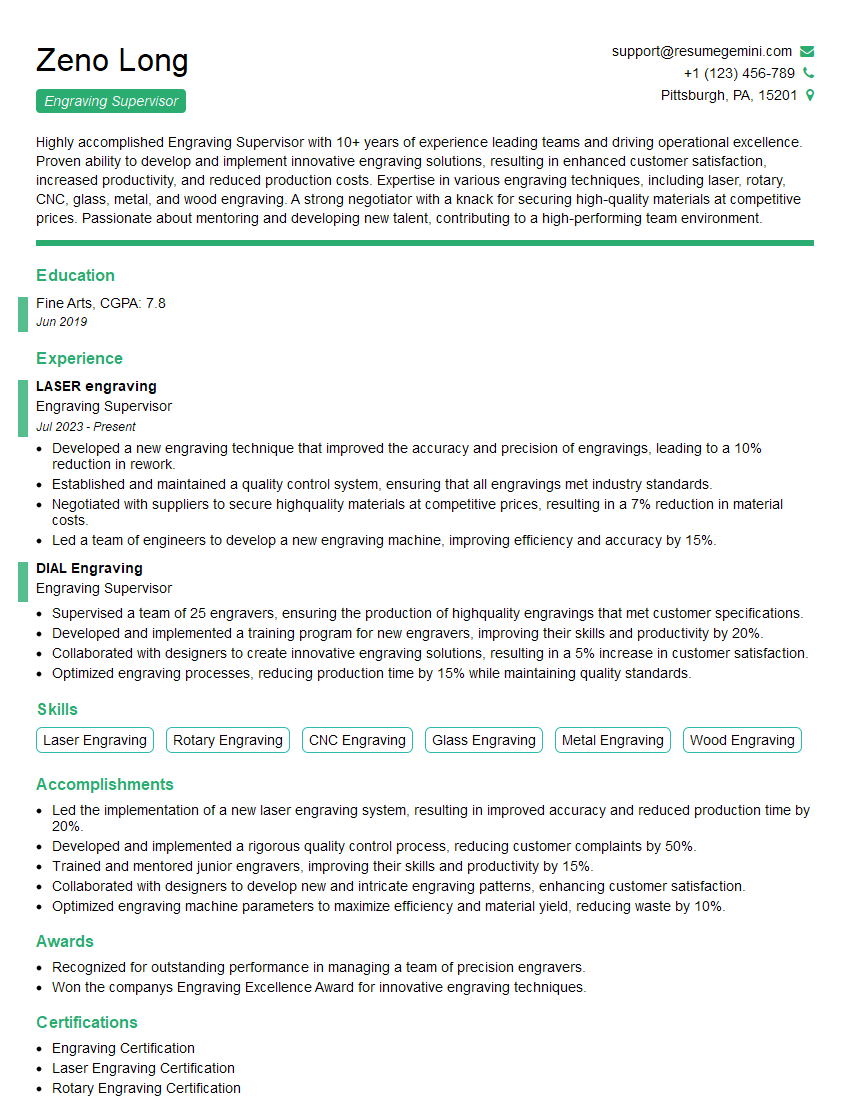
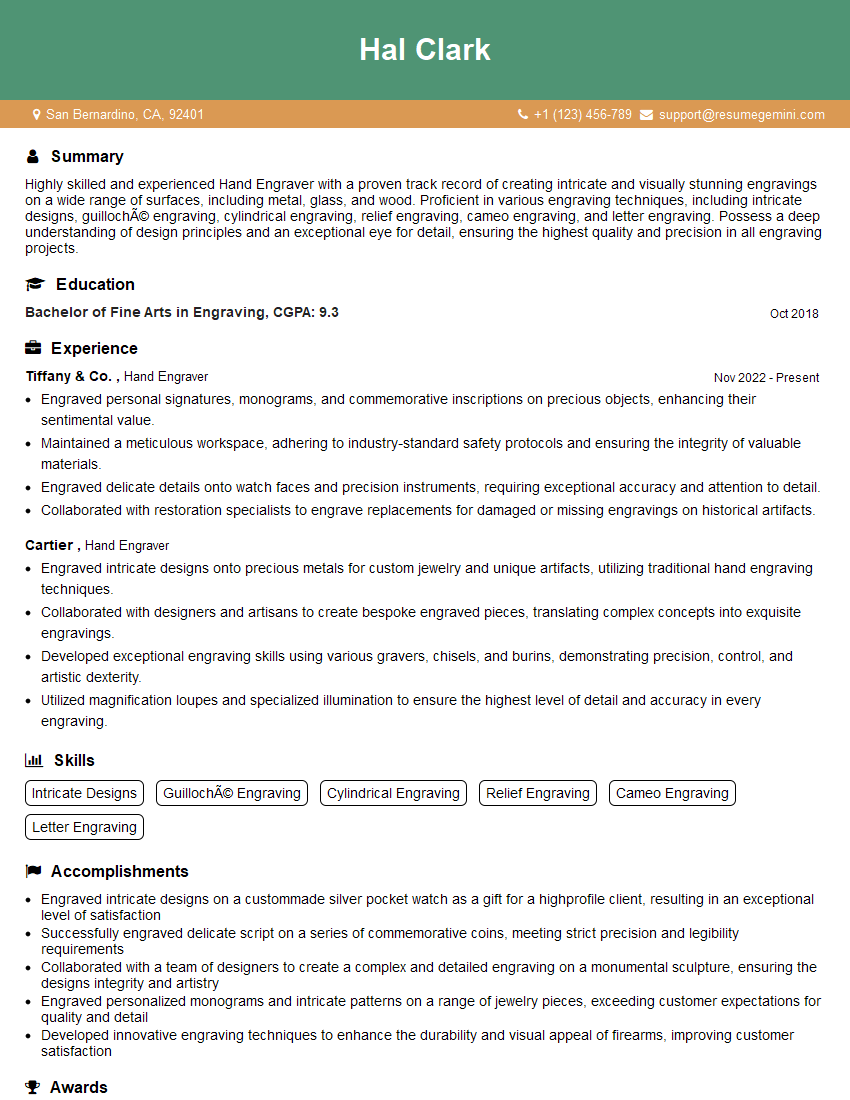
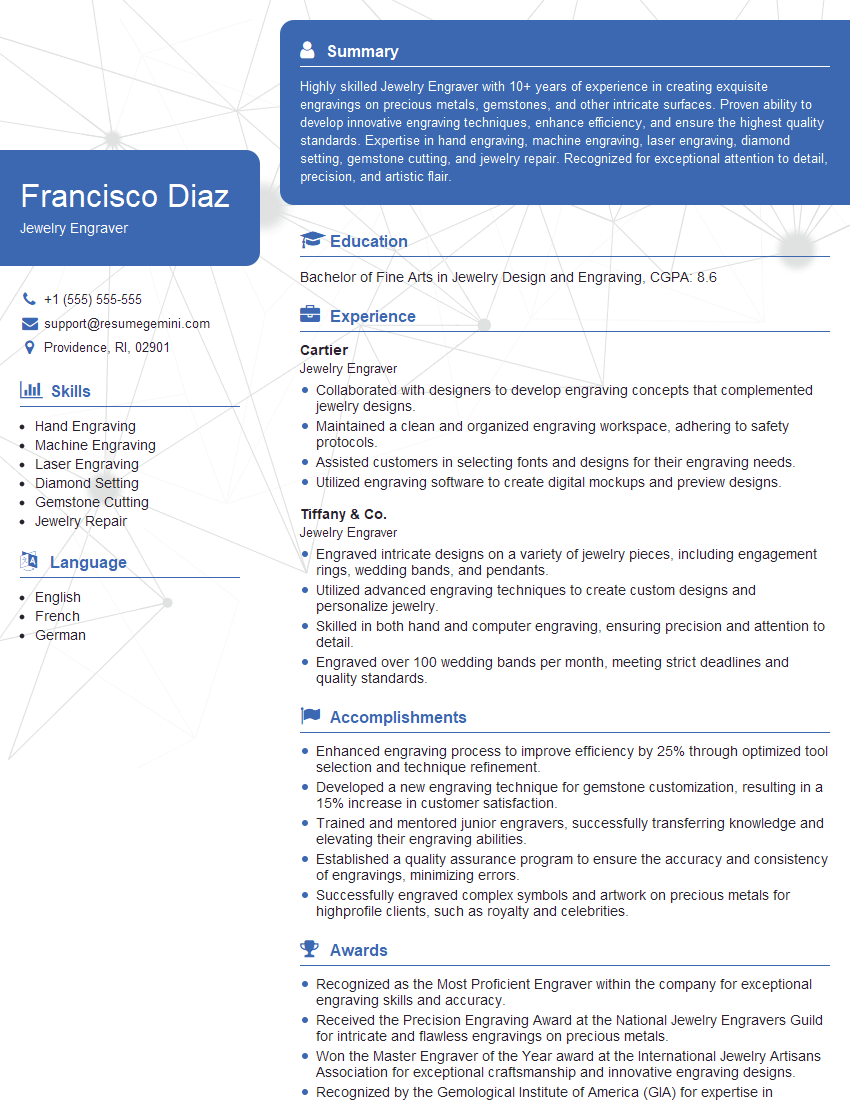
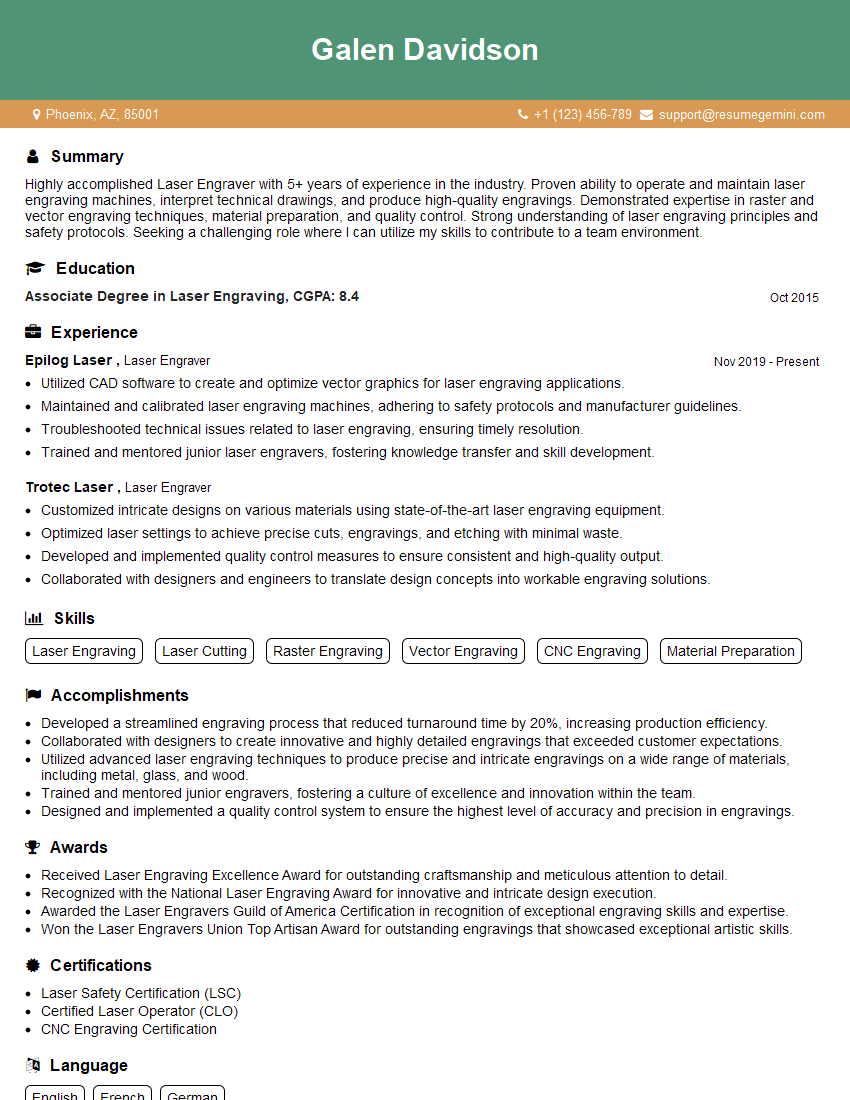
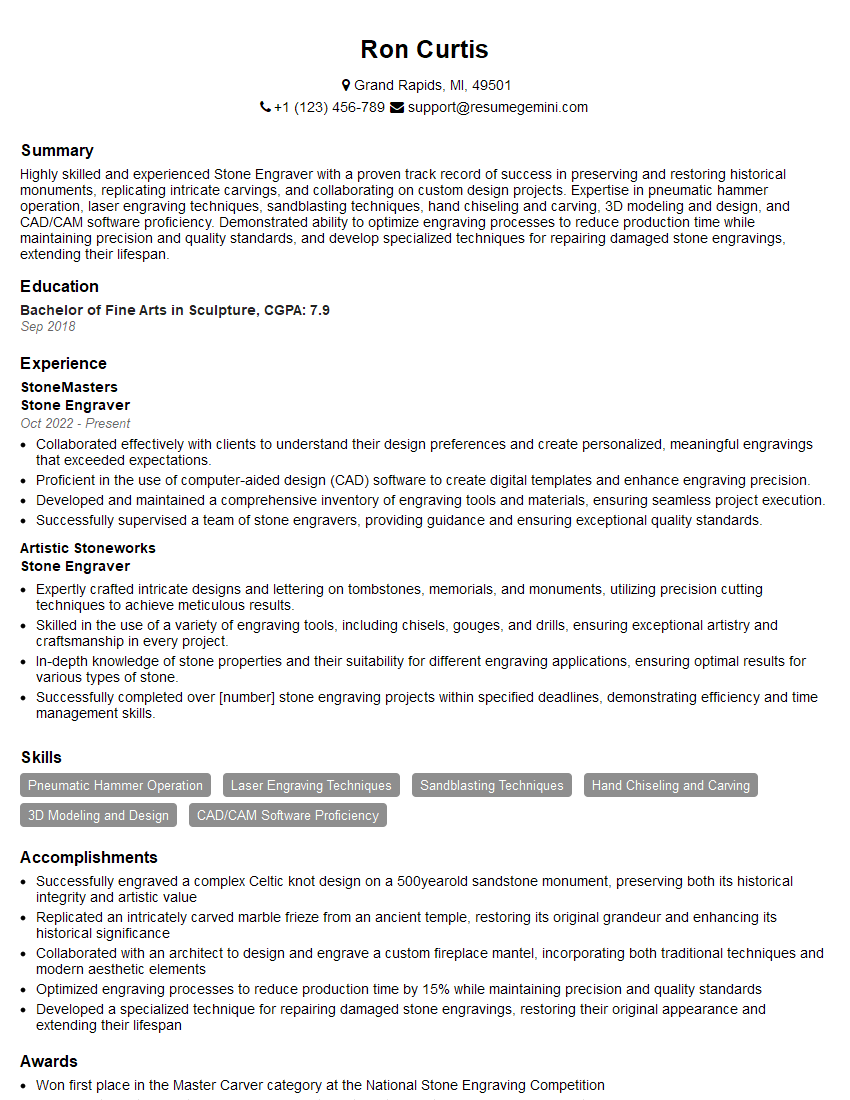
Mastering the principles of engraving opens doors to exciting career opportunities in various creative fields. A strong understanding of these techniques is highly valued by employers seeking skilled and detail-oriented professionals. To maximize your job prospects, crafting an ATS-friendly resume is crucial. ResumeGemini is a trusted resource to help you build a compelling and effective resume that highlights your skills and experience in engraving. Examples of resumes tailored to Understanding of Engraving Principles are available to guide you through the process. Invest the time to create a professional resume that showcases your expertise – it’s a critical step in securing your dream job.


Explore more articles
Users Rating of Our Blogs
Share Your Experience
We value your feedback! Please rate our content and share your thoughts (optional).
What Readers Say About Our Blog
Very informative content, great job.
good